
Rubber Seals & Mounts: Specifying for Export OEM Programs
Rubber Seals & Mounts: Specifying for Export OEM Programs
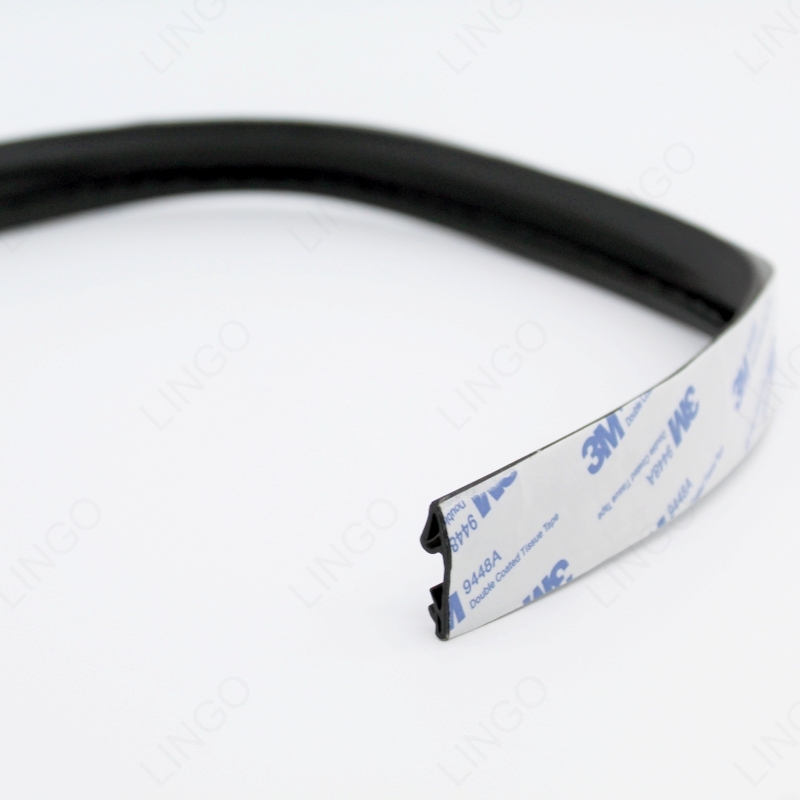
LG-RX rubber extrusion seals: solid, sponge, adhesive-backed and co-extruded profiles supplied in EPDM, NBR, silicone and FKM.
An export OEM programme rarely fails because a rubber part is difficult to make. It fails because the part was described in words instead of parameters. A drawing line that reads "rubber seal, black" or "anti-vibration mount, standard" leaves compound, hardness, profile and tolerance undefined — and every one of those variables changes both field performance and the result of goods-in inspection.
This guide is written for design engineers, sourcing engineers and procurement teams who have to turn an application into a released specification, and then into a repeatable purchase order. It works through two part families in detail — the LG-RX rubber extrusion seal and the LGMM cylindrical anti-vibration mount — and covers the silicone rubber cords and rubber sealing rings that are normally ordered alongside them.
Lingo Rubber Plastic is the trading name of Hangzhou Lingo Rubber and Plastic Product Co., Ltd, a rubber and plastics parts manufacturer established in 2022 in Hangzhou, China. The company operates a 3,000 m² manufacturing facility with approximately 40 staff, including a 10-person R&D team, and reports an annual production capacity of 1.58 million units. Around 80% of total sales are exported, with the EU and USA as the main markets, and the stated business focus is solving sealing problems and providing anti-vibration solutions — which is precisely the specification work described below.
Why an Under-Specified Rubber Part Becomes Expensive
Four variables stay open whenever a rubber part is specified by name only: the compound, the hardness, the profile, and the tolerance. Each of them has a cost attached.
- A sample that looks correct can still fail mechanically if hardness was never called out.
- A profile that seals against a flat plate can leak in a grooved housing if the compression geometry is different.
- A batch that measures outside an unwritten tolerance creates a receiving-inspection dispute with no agreed reference point.
- A tolerance that is not written down cannot be enforced on the second order, let alone the tenth.
In an export programme there is a fifth variable: documentation. Under the Harmonized Tariff Schedule, HS 4016.93 covers gaskets, washers and other seals of vulcanized rubber other than hard rubber — the heading commonly used for rubber seals and O-rings in import paperwork. A part that is clearly described technically is easier to classify, declare and clear.
The commercial logic is straightforward. Specification work costs engineering hours on the front end. Re-tooling, re-sampling, split shipments and field returns cost money and schedule on the back end. For a programme that will run for years, the first is always cheaper.
What the Market Data Supports — and What It Does Not
Rubber remains the dominant sealing material in industrial applications, and published research supports a simple reading of the market:
- Grand View Research values the global gasket and seal materials market at USD 61.4 billion in 2024.
- The same source estimates rubber seals at approximately 56% of that market, reflecting their role in dynamic sealing.
- Vantage Market Research values the global O-ring market at USD 10.41 billion in 2025.
- Cognitive Market Research attributes approximately 23% of the global anti-vibration rubber mounts market to China.
Broad industrial rubber estimates should be read with more caution. Persistence Market Research projects the global industrial rubber market at US$181.5 billion in 2026, reaching US$299.2 billion by 2033. Mordor Intelligence places the same market at US$16.88 billion in 2026, growing to US$20.36 billion by 2031. The two figures differ by roughly an order of magnitude because their product scope and assumptions differ. They are separate, non-comparable estimates and should not be averaged or quoted as a single number.
What the data does support is a supply-side conclusion. Sealing parts and vibration-isolation parts are widely available, so availability is not a differentiator for an export programme. The differentiator is whether a supplier can hold the same compound, the same hardness and the same tolerance across repeat batches — and whether that capability is written into the order.
The Two Core Part Families, Parameter by Parameter
LG-RX rubber extrusion seal
The LG-RX is a rubber extrusion seal supplied in silicone rubber extrusion seal, adhesive-backed, co-extruded, FKM, solid and sponge types. Its published parameters are deliberately open in three places and fixed in one:
| Parameter | LG-RX specification |
|---|---|
| Material | EPDM, NBR, silicone, FKM, etc. |
| Hardness | Shore A as required by the customer |
| Tolerance | Industry standard tolerances |
| Length | As required |
| Colour | Custom, to Pantone or RAL |
Hardness is not a catalogue value in this family; it is set by the customer in Shore A. Length is cut to requirement rather than picked from a stock list. Colour can be matched to Pantone or RAL, which matters whenever the seal is visible on a finished product. Length and colour flexibility are useful, but they are not substitutes for a defined hardness — the drawing, not the data sheet, controls the delivered part.
Solid and sponge versions behave differently in the same groove. A sponge extrusion closes gaps at lower compression, which suits doors, panels and housing interfaces. A solid extrusion carries more load and is chosen where the seal must resist compression set and mechanical wear. Co-extruded profiles combine more than one material in a single extrusion, which is typically used where a firmer carrier and a softer sealing element are needed in one part. Adhesive-backed profiles remove the need for separate bonding during assembly.
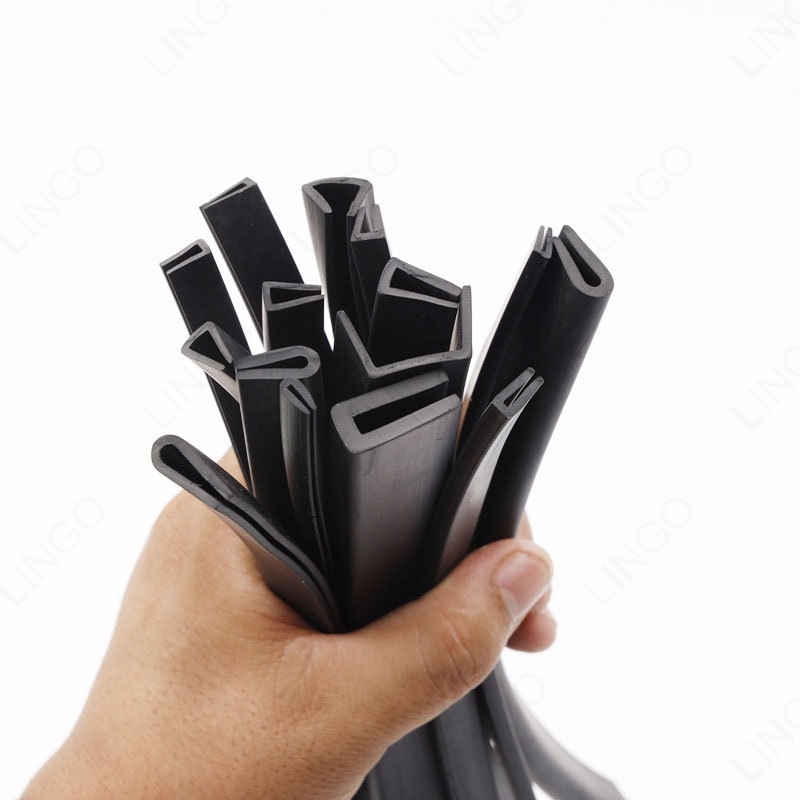
Extruded seal profiles can be delivered as solid, sponge, grooved or self-adhesive strips, depending on the housing geometry.
Industries listed for the LG-RX range include food & beverage, medical & healthcare, aerospace & aviation, automotive & transportation, HVAC & refrigeration, laboratory & analytical, electronics & electrical, industrial manufacturing, marine & offshore, and household appliances.
Material orientation: EPDM, NBR, silicone and FKM
Compound selection is where most specification errors originate, because buyers choose a material by habit rather than by exposure. The table below gives the usual orientation, not a guarantee.
| Compound | Commonly selected when |
|---|---|
| EPDM | Weather-exposed and water-contact sealing, where ozone and UV ageing are the main concern. |
| NBR | Oil, grease or fuel contact is expected — the classic choice for oil seals. |
| Silicone | A wide service temperature range is needed, or clean, medical-adjacent conditions apply. The LG-SRC silicone rubber cord is FDA qualified and heat resistant. |
| FKM | Aggressive chemicals or higher service temperatures. Available in LG-RX extrusion seals and in LG-RS rings, which also offer FFKM. |
These are orientations, not commitments. Final compound selection has to be confirmed against the real media list, the real temperature and the real load — which is exactly why the sample step described later in this guide carries more weight than any catalogue.
LGMM cylindrical anti-vibration mount
The LGMM is a cylindrical rubber mount — also described as a rubber stud mount — made from natural rubber with carbon steel. Its stated dimensions are 8–150 mm in diameter and 8–90 mm in height, with tolerance to the RMA A2 standard.
In transportation applications, the mount works under continuous cyclic compression and shear. Its function is to absorb engine vibration, reduce structure-borne noise and improve ride comfort. The operating envelope quoted for that use is a temperature range of −40°C to +120°C, with exposure to oil, grease, road shock and continuous vibration. The design expectation is low compression set with fatigue resistance across 10⁶ to 10⁷ cycles, and the matched equipment is engine brackets, chassis frames, rail bogies and ship engine beds.
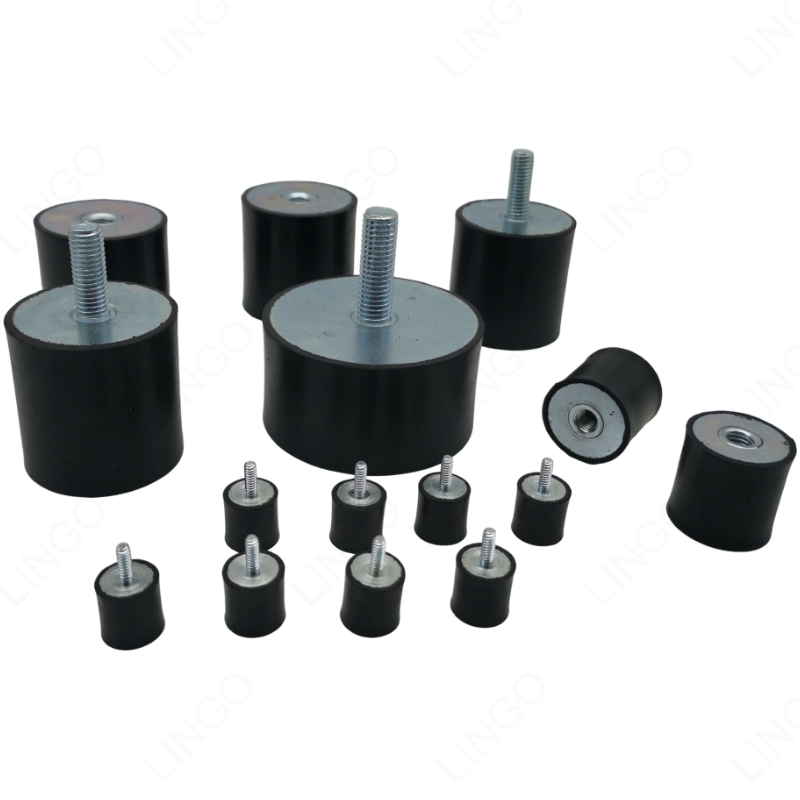
LGMM cylindrical mounts: natural rubber bonded to carbon steel, 8–150 mm diameter and 8–90 mm height, RMA A2 tolerance.
Diameter and height are the two parameters that decide whether a mount can be used at all. If the envelope sits inside the 8–150 mm diameter and 8–90 mm height range, the remaining engineering questions are rubber hardness, load direction, and whether the geometry needs a custom bonded assembly rather than a standard stud mount. Industries listed for the LGMM range include transportation, industrial machinery, electronics & precision instruments, construction & civil engineering, and marine & military.
Silicone cords and sealing rings in the same programme
The LG-SRC is a silicone rubber cord in solid and sponge forms, made of silicone rubber. It is heat resistant and FDA qualified, with custom length and colour per Pantone or RAL. Cords are normally used where a continuous sealing line is needed in a groove or channel rather than a closed moulded ring.
The LG-RS family covers rubber O-rings, X-rings and oil seals. Available compounds include NBR, EPDM, silicone, FKM and FFKM. Stated hardness is normally Shore A 50–95, with a heat range of −40°C to 250°C and resistance to ozone, water and oil. Certificates listed for the range include FDA, UL, RoHS and REACH.
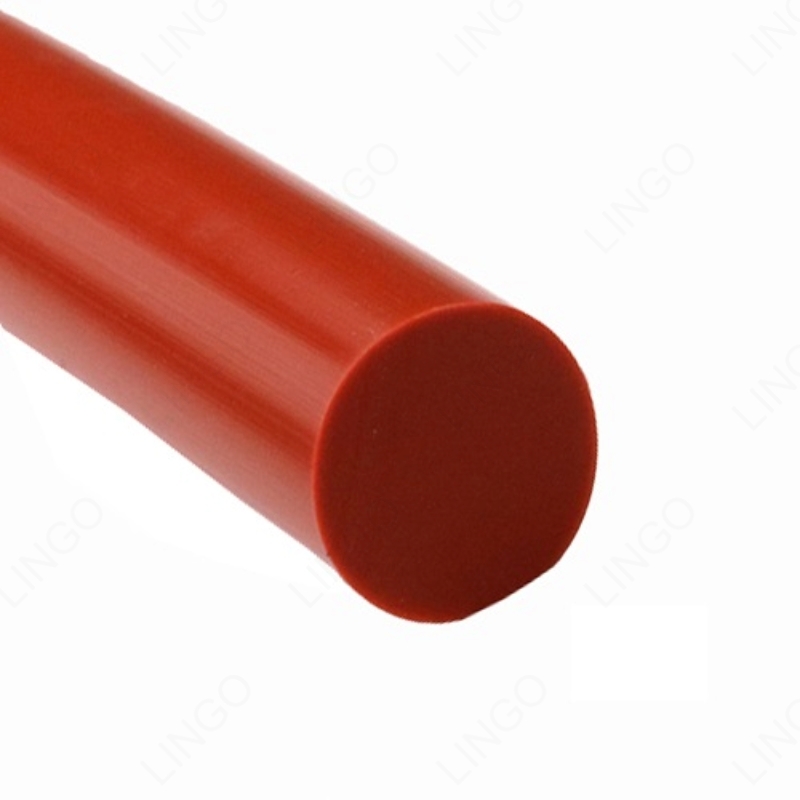
Silicone rubber cord (LG-SRC) in solid and sponge form, FDA qualified and heat resistant, supplied to custom length.
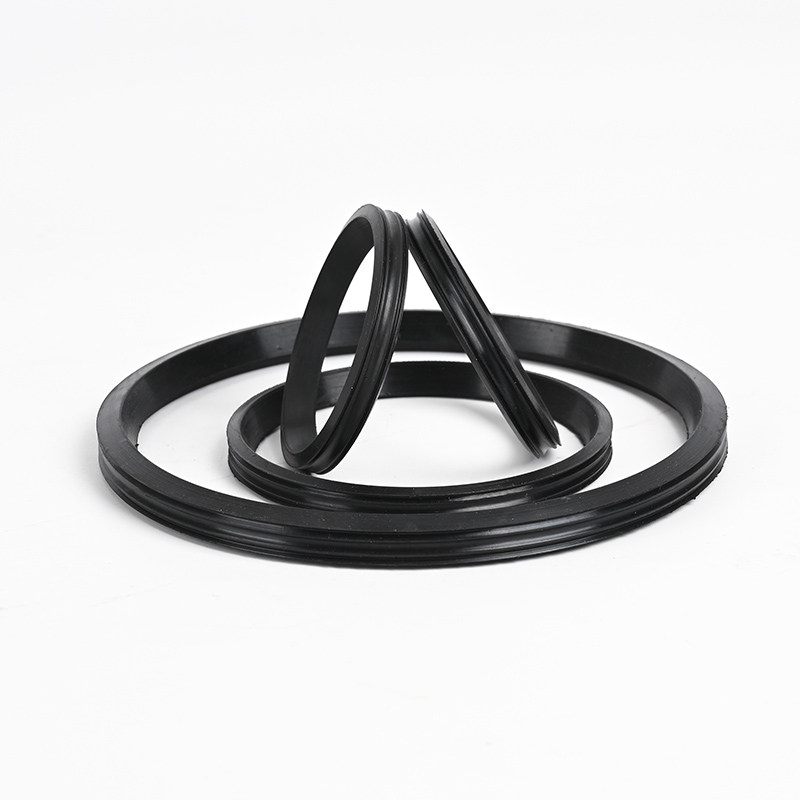
LG-RS rubber sealing rings: O-rings, X-rings and oil seals in NBR, EPDM, silicone, FKM and FFKM.
Eight Steps From Application Data to a Released Purchase Order
- Freeze the operating envelope. Write down temperature, media, static or dynamic load, cycle count and UV or ozone exposure before choosing a part. For a transportation mount that means −40°C to +120°C, oil and grease contact, road shock, and a fatigue target in the 10⁶ to 10⁷ cycle range.
- Select the part family. An extrusion suits a constant cross-section running along a length. A sealing ring suits a circular groove. A cord suits a continuous channel. A cylindrical mount suits dynamic load transfer between two structures.
- Select the compound. Use the orientation table above, then verify against the actual media list. EPDM, NBR, silicone and FKM are all available within the LG-RX extrusion seal range; the LG-RS ring range adds FFKM for more aggressive service.
- Set Shore A hardness. Extrusion seals are produced to the hardness the customer specifies; sealing rings are normally supplied in the 50–95A band. Higher hardness generally resists compression and extrusion better, while lower hardness generally conforms better to uneven surfaces. The number must come from the application, not from a default.
- Lock profile, length and colour. Profile governs sealing geometry, length is produced as required, and colour can be matched to Pantone or RAL where the part is visible on the finished product.
- Write the tolerance and the inspection criteria on the drawing. RMA A2 applies to the LGMM mount range; LG-RX extrusion seals are produced to industry standard tolerances. A tolerance that is not on the drawing cannot be enforced at goods-in.
- Validate with samples. Sample inspection is the cheapest point at which to catch a hardness, profile or fit error. Small trial quantities are accepted precisely so that this step can happen before a volume commitment is made.
- Lock the commercial terms. Confirm MOQ, delivery term, payment term, lead time and the spare-parts arrangement in the same document as the technical specification, so that the technical and commercial sides of the order cannot drift apart.
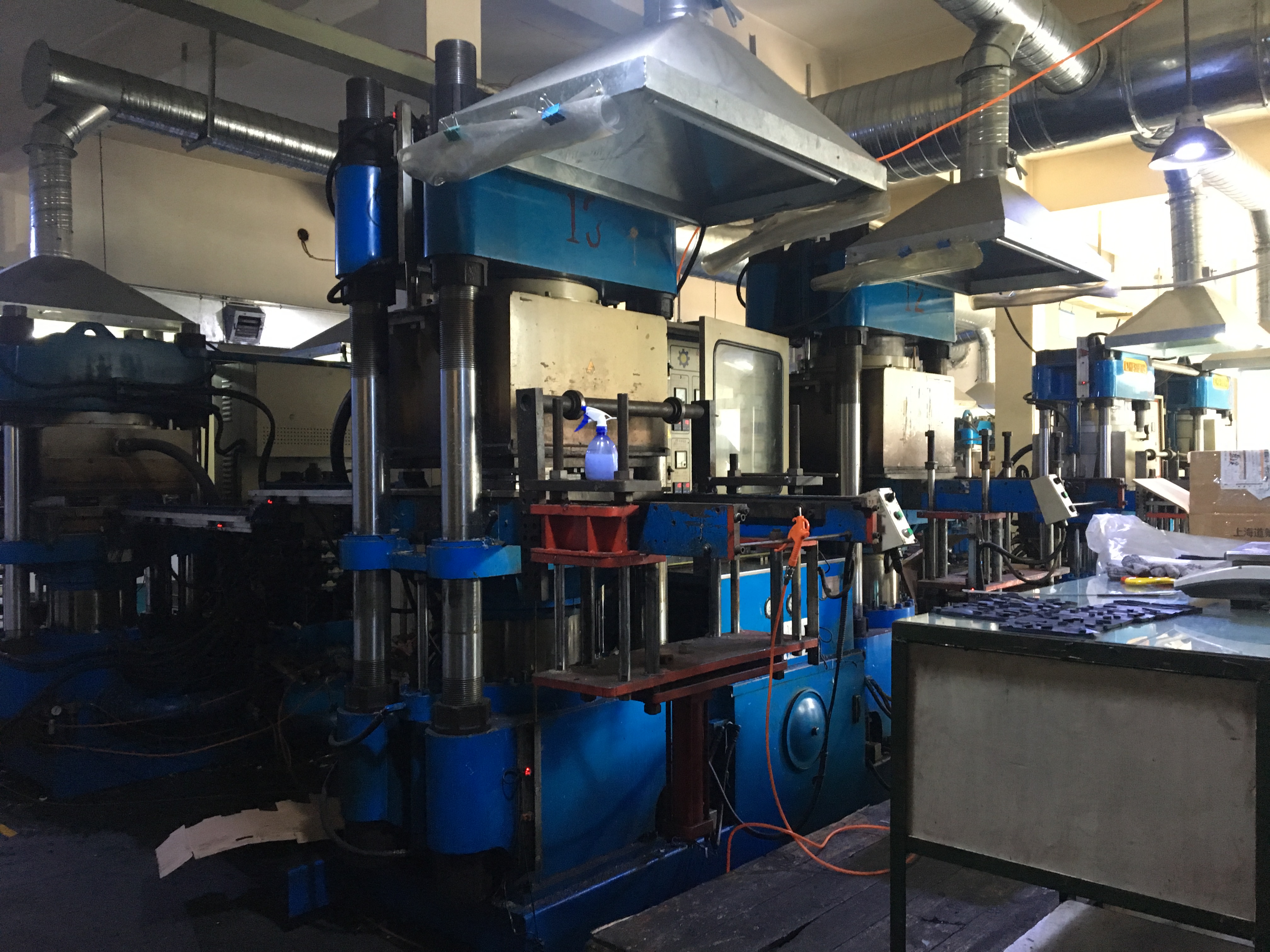
Production and inspection run against the approved sample and drawing, from sample inspection through to pre-shipment testing.
Where These Specifications Are Used in Practice
Transportation: engine mounting, suspension and seat isolation
This is the application profile behind the LGMM range. Mounts are used in engine mounting systems, suspension systems and seat vibration isolation projects, where the part must absorb engine vibration, reduce structure-borne noise and improve ride comfort while running continuously under cyclic compression and shear.
A US automotive OEM programme supplied by Lingo Rubber Plastic runs on recurring orders of 10,000 to 40,000 pieces. For a new programme, the value of that reference is not the volume. It is the evidence that the same part can be produced repeatedly to the same specification, and that in-house spare parts inventory exists to cover urgent orders when a production line is short. Both points matter more to a buyer than a headline capacity figure.
HVAC, refrigeration and household appliances
Housing, door and panel sealing in these product categories usually calls for an extruded profile rather than a moulded ring. EPDM and silicone extrusion seals in solid or sponge form are the common starting point, with colour matched to Pantone or RAL where the seal is visible.
Food, beverage and medical-adjacent equipment
Clean-application sealing relies on material qualification rather than shape alone. The LG-SRC silicone rubber cord is FDA qualified and heat resistant, and the LG-RS sealing ring range lists FDA, UL, RoHS and REACH certificates — documentation that procurement teams should request at quotation stage, not after the order is placed.
Oil, gas, chemical processing and automotive driveline
Oil seals in the LG-RS range address fluid-contact applications, with NBR, FKM and FFKM available and a stated heat range of −40°C to 250°C. Selection should follow the media list, not the temperature alone.
Electronics, precision instruments and civil engineering
Small-diameter mounts from the 8–150 mm LGMM range are used to protect sensitive equipment and structures from transmitted vibration, in electronics and precision instruments as well as construction and civil engineering.
Specification and Commercial Comparison
The four families compare most usefully on parameters rather than on price, because they solve different problems inside the same bill of materials.
| Family | Type options | Materials | Key parameters |
|---|---|---|---|
| LG-RX Rubber extrusion seal | Silicone, adhesive-backed, co-extruded, FKM, solid, sponge | EPDM, NBR, silicone, FKM, etc. | Shore A as required; length as required; colour to Pantone or RAL; industry standard tolerances |
| LG-SRC Silicone rubber cord | Solid, sponge | Silicone rubber | Heat resistant; FDA qualified; custom length and colour |
| LG-RS Rubber sealing ring | O-rings, X-rings, oil seals | NBR, EPDM, silicone, FKM, FFKM | Shore A normally 50–95; −40°C to 250°C; ozone, water and oil resistant; FDA, UL, RoHS, REACH listed |
| LGMM Anti-vibration mount | Cylindrical rubber mounts, rubber stud mounts | Natural rubber with carbon steel | Diameter 8–150 mm; height 8–90 mm; RMA A2 tolerance |
Commercially, the same order logic applies across all four families:
| Order element | Options available |
|---|---|
| MOQ | Flexible, with small quantities accepted for trial orders |
| Delivery terms | EXW, FOB, CIF, DDP |
| Payment terms | T/T with deposit, L/C at sight, D/P |
| Quality control | Full sample inspection, random bulk inspection, pre-shipment testing |
| Lead time | 4–6 weeks tooling and samples; 3–4 weeks production parts |
| Urgent orders | Supported by in-house spare parts inventory |
Frequently Asked Questions
Which standards and tolerances should be written on the drawing for rubber seals and mounts?
The LGMM cylindrical anti-vibration mount is specified to the RMA A2 tolerance standard, with diameter from 8 mm to 150 mm and height from 8 mm to 90 mm. LG-RX rubber extrusion seals are produced to industry standard tolerances at the Shore A hardness the customer specifies. Where compliance documentation matters, the LG-RS rubber sealing ring range lists certificates including FDA, UL, RoHS and REACH, and the LG-SRC silicone rubber cord is FDA qualified. Name the standard on the drawing and confirm it at sample stage, because an unwritten tolerance cannot be enforced at receiving inspection.
Can a supplier produce custom profiles, hardness and colours instead of catalogue parts?
Yes, within these product families. The LG-RX rubber extrusion seal is available in silicone, adhesive-backed, co-extruded, FKM, solid and sponge types, using EPDM, NBR, silicone or FKM compounds, with hardness per Shore A as required, length as required, and colour matched to Pantone or RAL. Lingo Rubber Plastic supports this with a 10-person R&D team, a 3,000 m² facility and a reported annual production capacity of 1.58 million units across rubber compression moulding, rubber extrusion, plastic injection and plastic extrusion.
What is the minimum order quantity for a trial order?
MOQ is handled flexibly and small quantities are accepted, which makes it practical to validate a profile, a hardness value or a compound on a small trial run before committing to production volume. That matters most for first-time extrusion profiles and for anti-vibration mounts where hardness has to be tuned to an actual load. Volume pricing, tooling and repeat-order scheduling are then confirmed against the drawing and the expected annual demand.
How are samples and bulk shipments inspected before they ship?
Inspection is staged rather than sampled once. Full sample inspection is carried out at the sample stage, so dimensions, hardness and profile are confirmed before tooling is committed to volume. On bulk orders, random bulk inspection verifies that production parts match the approved sample, and pre-shipment testing is completed before the goods are released. Because the reference is the approved sample plus the drawing, both buyer and supplier work from the same acceptance criteria.
What lead times, delivery terms and payment terms apply to export orders?
Typical lead time is 4–6 weeks for tooling and samples and 3–4 weeks for production parts. Delivery can be arranged on EXW, FOB, CIF or DDP terms, and payment terms include T/T with deposit, L/C at sight and D/P. For programmes that cannot wait — such as the US automotive OEM programme that places recurring orders of 10,000 to 40,000 pieces — in-house spare parts inventory supports urgent orders. To begin, send your drawing or sample request to sales@lingorp.com or contact the team through www.lingorp.com.
Conclusion: the Specification Is the Deliverable
For an export OEM programme, the rubber part is not the deliverable on the engineering side. The specification is. Once compound, hardness, profile and tolerance are written down — and confirmed by an inspected sample — the rest of the order becomes routine: flexible MOQ with small quantities accepted for trials, EXW, FOB, CIF or DDP delivery, T/T with deposit, L/C at sight or D/P payment terms, staged inspection at sample, bulk and pre-shipment stages, and an in-house spare parts inventory to absorb urgent demand.
Lingo Rubber Plastic manufactures the LG-RX rubber extrusion seal, the LG-SRC silicone rubber cord, the LG-RS rubber sealing ring and the LGMM cylindrical anti-vibration mount, and exports approximately 80% of its output to markets including the EU and USA.
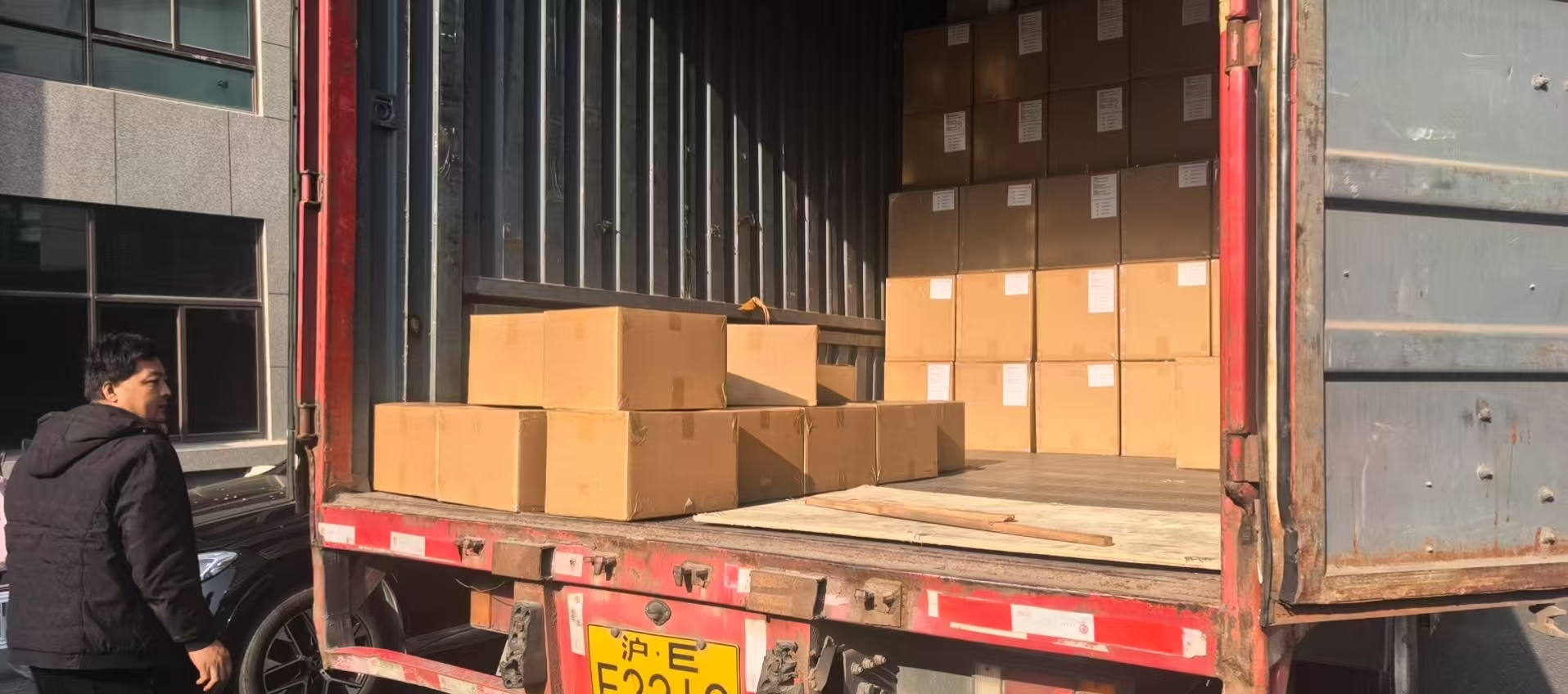
Export-ready packing and shipment, with full sample inspection, random bulk inspection and pre-shipment testing.
Next step: send the drawing, get a sample
Share your application data, profile drawing or groove dimensions and we will confirm the recommended compound, Shore A hardness, tolerance basis and MOQ for a trial order.
Email: sales@lingorp.com | Phone / WhatsApp: +86 18358136245 | Website: www.lingorp.com
Company profile PDF: download the Lingo Rubber Plastic company profile
Have Questions or Need More Details?
Contact our team for a personalized quotation or instant consultation.
Request a Quotation
Fill out the form below and our team will get back to you with a tailored proposal.
WhatsApp Direct Chat
Prefer to chat in real-time? Message us on WhatsApp for instant assistance & quick answers.
- Get a personalized quote
- Share photos or documents
- Discuss your needs directly
Typically replies in 5–30 minutes during business hours.