
Supplier Evaluation: Assessing Manufacturing Capabilities for Custom Rubber Seals
A supplier evaluation for custom rubber seals should be decided on documented process evidence — material range, hardness control, extrusion capability, MOQ flexibility, certification readiness, and after-sales support — rather than on catalogue size or a single unit price. The six criteria below give buyers a repeatable way to test those claims before tooling is committed. The LG-RX rubber extrusion seal from Lingo Rubber Plastic is used throughout this guide as a working example of what verifiable evidence looks like.
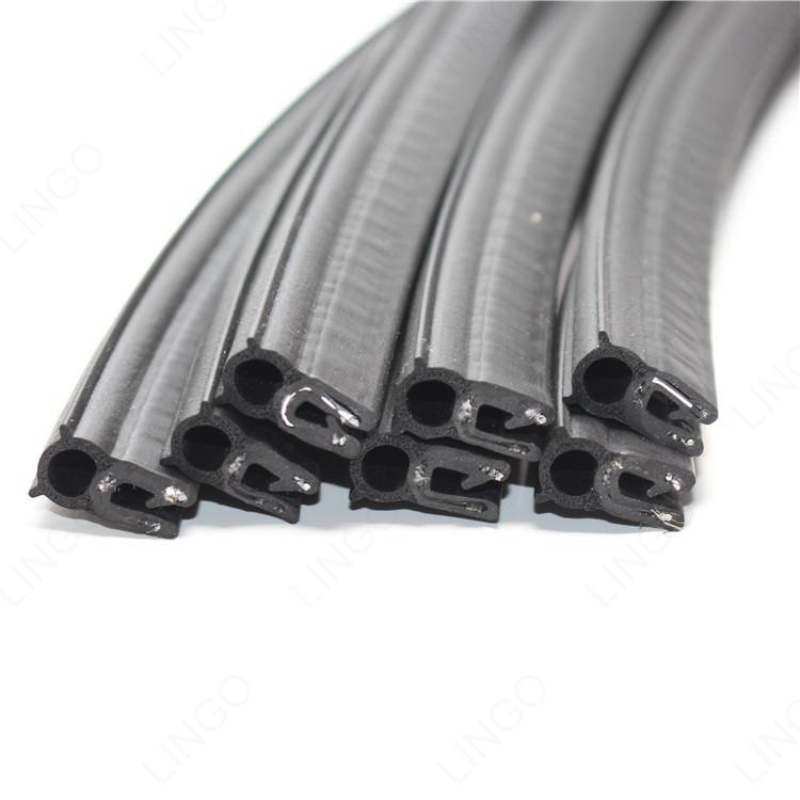
Cover: custom extruded rubber seal profiles from the LG-RX rubber extrusion seal family, Lingo Rubber Plastic.
Problem Definition: Why Rubber Seal Evaluations Usually Miss the Real Risk
A custom rubber seal is not a machined part with a fixed material behind it. It is a compounded elastomer formed through a tool, and both the compound and the tool determine whether the part seals at the end of a production run — not only in the first sample.
Evaluation processes that work well for metal components tend to fail here. A buyer compares drawings, collects quotations, checks that a supplier “does rubber”, and orders. The risks that then appear are rarely about the shape of the part:
- Compound mismatch. A profile that seals in a dry indoor enclosure may harden, crack, or swell in UV, ozone, oil, or glycol service if the elastomer family is wrong.
- Hardness drift between batches. A seal specified at a given Shore A hardness only performs repeatably if the supplier controls mixing and cure batch to batch, not just on the sample submitted for approval.
- Profile drift on long runs. Extrusion dies wear; without dimensional inspection discipline, cross-sections creep outside tolerance over long production runs.
- Tooling cost and ownership. If the mold or die is not clearly owned or maintained, lead times and tooling costs repeat every time the part is reordered.
- Quantity gates. Suppliers with high minimum order quantities push buyers into buying stock before the design is validated.
The evaluation target is therefore not “can this supplier make a rubber seal?” but “can this supplier hold a defined material, hardness, and profile across prototype, first article, and repeat production — and can it prove that in writing and in samples?”
Industry Background: What the Rubber Parts Market Tells Buyers
The commercial context explains why so many rubber seal suppliers exist and why differentiation has to come from capability evidence rather than availability.
- The global gasket and seal materials market reached a valuation of USD 61.4 billion in 2024, according to Grand View Research.
- Rubber-based seals account for approximately 56% of the global gasket and seals market, reflecting heavy use in dynamic sealing applications (Grand View Research).
- Within that, the global O-ring market alone was valued at USD 10.41 billion in 2025 (Vantage Market Research).
- China holds approximately 23% of the global anti-vibration rubber mounts market, which places a significant share of rubber parts capacity in Chinese manufacturing clusters (Cognitive Market Research).
- For trade and duty purposes, gaskets, washers, and other seals of vulcanized rubber other than hard rubber are classified under HS code 4016.93 (US International Trade Commission Harmonized Tariff Schedule).
Detailed Solution: A Six-Criteria Capability Framework
Each criterion below states what the capability is, why it matters to a seal program, and what a credible evidence set looks like. The examples are drawn from the documented capabilities of Hangzhou Lingo Rubber and Plastic Product Co., Ltd, which trades as Lingo Rubber Plastic and operates from China, serving export markets that are around 80% of its business, primarily the EU and USA.
1. Material Versatility (EPDM, NBR, Silicone, FKM)
The first question in any rubber seal evaluation is which elastomers the supplier actually compounds. A supplier that offers only one or two families will steer your application toward what it already stocks.
The LG-RX rubber extrusion seal is available in EPDM, NBR, Silicone, and FKM, among other materials. Across its sealing portfolio, Lingo Rubber Plastic also lists NBR, EPDM, SILICONE, NR, CR, SBR, FKM, FFKM, and AFLAS for rubber sealing rings, with a documented heat range of -40°C to 250°C and ozone, water, and oil resistance performance for that family. For flame-sensitive applications, a CTI test report (certificate number A2260538692101, issued 3 July 2026) verifies UL 94 V-0 flammability performance for CR Neoprene rubber, a compound relevant to the EU, US, and Middle East markets.
Evidence to request: a written material list with the elastomers the supplier compounds, plus any third-party test reports that relate to the compound rather than the catalogue.
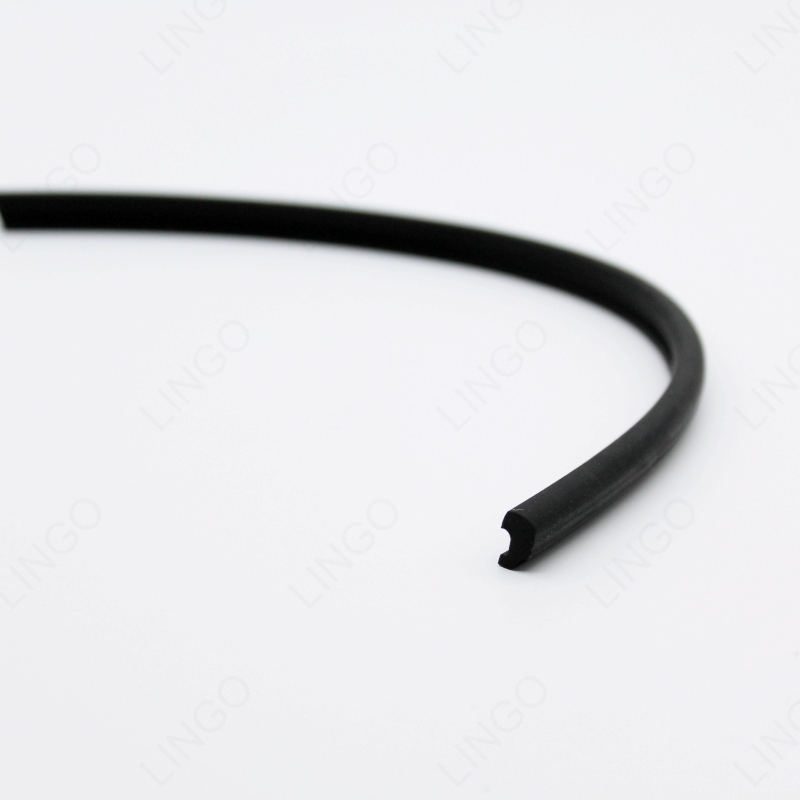
Extruded rubber seal cross-sections: solid, sponge, and co-extruded profile formats.
2. Hardness and Dimensional Customization
Hardness determines how a seal behaves under compression set; dimensional freedom determines whether the profile can actually be built to the drawing. Both should be confirmed in writing, not verbally.
For the LG-RX rubber extrusion seal, hardness is specified per Shore A as required, length is quoted as required, colour is custom per Pantone or RAL, and tolerances follow industry standards. The related LG-RS sealing ring family is normally produced between 50 and 95 Shore A. This is the practical meaning of “custom”: the buyer defines the target, and the supplier confirms it in a controlled document before tooling starts.
Evidence to request: written confirmation of the Shore A range the supplier can hold, the tolerance basis it works to, and how colour is controlled (Pantone or RAL reference).
3. Extrusion Process and Profile Capability
Extrusion is the process most often underestimated in seal sourcing, because a single part number can hide very different build methods. A solid profile, a sponge profile, and a co-extruded profile with a rigid carrier are three different manufacturing problems.
LG-RX is documented as covering silicone rubber extrusion seals, rubber extrusion seals with adhesive backing, co-extrusion seals, FKM rubber extrusion seals, solid rubber extrusion seals, and sponge rubber extrusion seals. Related capacity includes silicone rubber cords in both solid and sponge variants (LG-SRC), which are FDA qualified and heat resistant — a useful indicator of how a supplier handles sponge density and surface quality.
Evidence to request: physical cross-section samples in the material and density closest to your application, ideally from a previous production batch rather than a hand-made sample.
4. MOQ Flexibility and Small-Batch Prototyping
Minimum order quantities are where many technically suitable suppliers become commercially unsuitable. A seal that costs little per metre can still be uneconomic if the first order has to be five figures of units.
Lingo Rubber Plastic sets MOQ according to the specific part and accepts small quantity orders, which supports small-batch prototyping and design iteration. The same capability documentation lists a monthly capacity of 1,000,000 kg for its OEM/ODM lines, a stated lead time of 2 to 6 weeks, and export markets covering the EU, Middle East, and USA. That combination — small upfront quantities plus large stated capacity — is what allows a buyer to validate a profile before committing to volume.
Evidence to request: a written MOQ per part number and per material, not a general statement that “small orders are possible”.
5. Certification and Compliance Readiness
Certificates matter only when the scope, number, and market are specific. For custom rubber seals, three documentation types are typically relevant: automotive process approval, material safety documentation, and flammability performance.
- PPAP: Lingo Rubber Plastic holds PPAP certification for automotive production, covering silicone rubber cords, plastic injection parts, rubber sealing rings, and anti-vibration mounts.
- MSDS: Material Safety Data Sheet documentation covers the rubber sealing rings product and applies to the EU and USA markets.
- Flammability: the CTI UL 94 V-0 test report for CR Neoprene rubber relates to the EU, US, and Middle East markets and lists LG-RS sealing rings, LG-RX extrusion seals, and LGMM anti-vibration mounts among its related products.
- Customs classification: gaskets, washers and other seals of vulcanized rubber fall under HS code 4016.93, which is relevant when planning import duties.
Evidence to request: certificate number, issuing body, scope statement, issue date, and the market each certificate is valid for.
6. Technical Support, Mold Ownership, and After-Sales
Seal projects rarely end at first shipment. A supplier evaluation should therefore cover what happens after the purchase order: who answers a dimensional question, who maintains the die or mold, and whether a batch can be traced back if a field issue appears.
The documented after-sales structure at Lingo Rubber Plastic includes remote technical support, molds maintenance and ownership protection, a batch traceability system, and free exchange and acceptance of concessions. For a buyer, “molds maintenance and ownership protection” is the clause that prevents the repeated tooling charges and ownership ambiguity described in the problem section above.
Evidence to request: written after-sales terms covering technical response, mold maintenance responsibility, mold ownership, and traceability records.
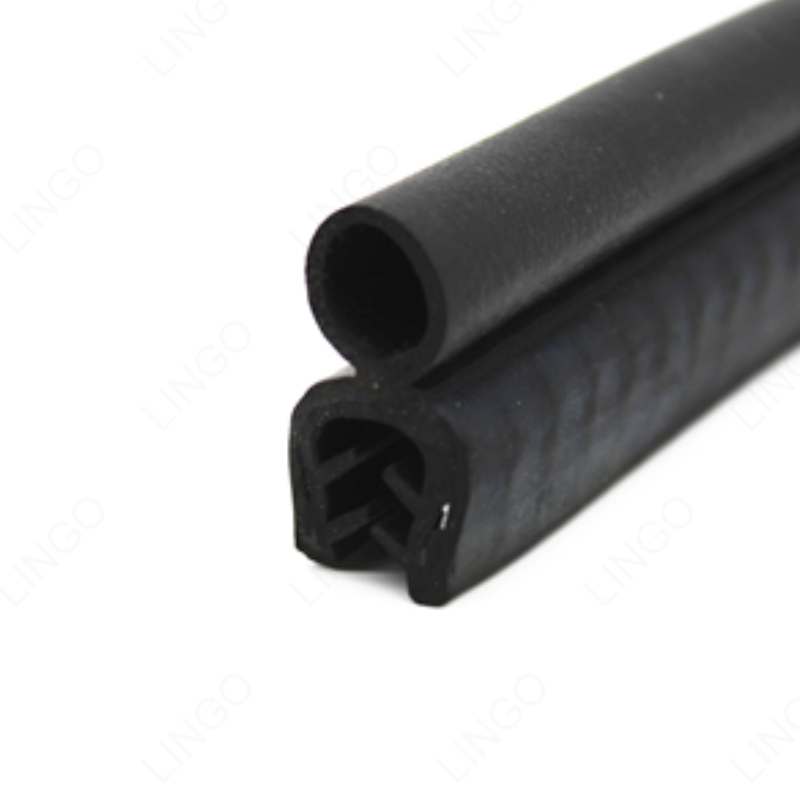
Custom rubber extrusion profiles produced to customer drawings and hardness requirements.
Step-by-Step Breakdown: Running the Evaluation
- Define your constraint set in writing. Material family, Shore A hardness, temperature and media exposure, tolerance basis, colour, length, and packaging. A seal evaluation without a written constraint set becomes a price comparison.
- Request the material and hardness declaration. Ask which elastomers the supplier compounds and which Shore A range it can hold. For Lingo Rubber Plastic, this means confirming EPDM, NBR, Silicone, or FKM for LG-RX, with hardness per Shore A as required.
- Ask for three cross-section samples. Request the closest existing profile, plus the material and density variant nearest your application — solid, sponge, adhesive-backed, or co-extruded.
- Confirm MOQ, tooling, and tooling ownership per part. Confirm the MOQ per part number in the quotation, together with the molds maintenance and ownership protection terms.
- Verify certification scope. Check the certificate number and scope for PPAP, MSDS, and any flammability or material test reports relevant to your market.
- Match lead time and capacity to your ramp. Compare the stated 2 to 6 week lead time and the listed monthly capacity against your launch schedule and reorder pattern.
- Run a small first batch and inspect it deliberately. The documented quality control model is full inspection of samples and random inspection of bulk goods — agree before shipment what the sample report must contain.
- Agree the after-sales terms before volume. Remote technical support, batch traceability, and exchange terms should be in the contract, not assumed.
Use Cases: What Evaluation Evidence Looks Like in Practice
Capability claims become credible when they can be linked to a specific program with specific conditions. The following examples come from documented project records at Lingo Rubber Plastic.
- Thermal sealing in automotive applications. A United Arab Emirates automotive OEM ordered 4,000 metres of silicone sponge cord against a three-year service expectation. The material withstood -60°C to 250°C without hardening or cracking, was UV-proof and ozone-resistant for outdoor use, and used closed-cell construction to keep out water, dust, and noise. Highlights recorded for the project were FDA silicone sponge material, high precision tolerance, high temperature resistance, and a smooth surface.
- Vibration and noise control in a large automotive program. A US automotive OEM ordered 10,000 to 40,000 pieces of vibration-absorbing parts where the recorded strengths were small size, tight tolerances, and consistent batch-to-batch quality. The supplier kept an in-house spare parts inventory to cover urgent orders, and instead of building a new mold, only a single middle plate was machined to the required dimensions for use with existing mold sets — a direct reduction of initial tooling investment.
- Flame-retardant mount program with existing tooling. A 500-piece order for automotive vibration and noise reduction used existing tooling for immediate production. Recorded test data showed a 45% reduction in peak vibration amplitude, and the part was engineered with flame-retardant rubber compounds to meet fire safety requirements, supported by UL 94 V-0 certification.
- Precision water sealing. For buyers in the US, UK, Canada, Australia, France, and Germany, a water treatment equipment manufacturer ordered 1,000 sealing units where the project requirement was precision exceeding ASTM A1. The material was FDA certified, the white rubber compound had no contamination, and the recorded outcome was stable operation with dimensions within tolerance, the spring remaining precisely centred without shifting, and zero claims.
Company-level context supports the same reading: Hangzhou Lingo Rubber and Plastic Product Co., Ltd was founded in 2022, operates a 3,000 m² facility with around 40 employees and an R&D team of 10, exports around 80% of its output to EU and USA markets, and states application industries including electronics, aerospace, healthcare, construction, transportation, and defense.
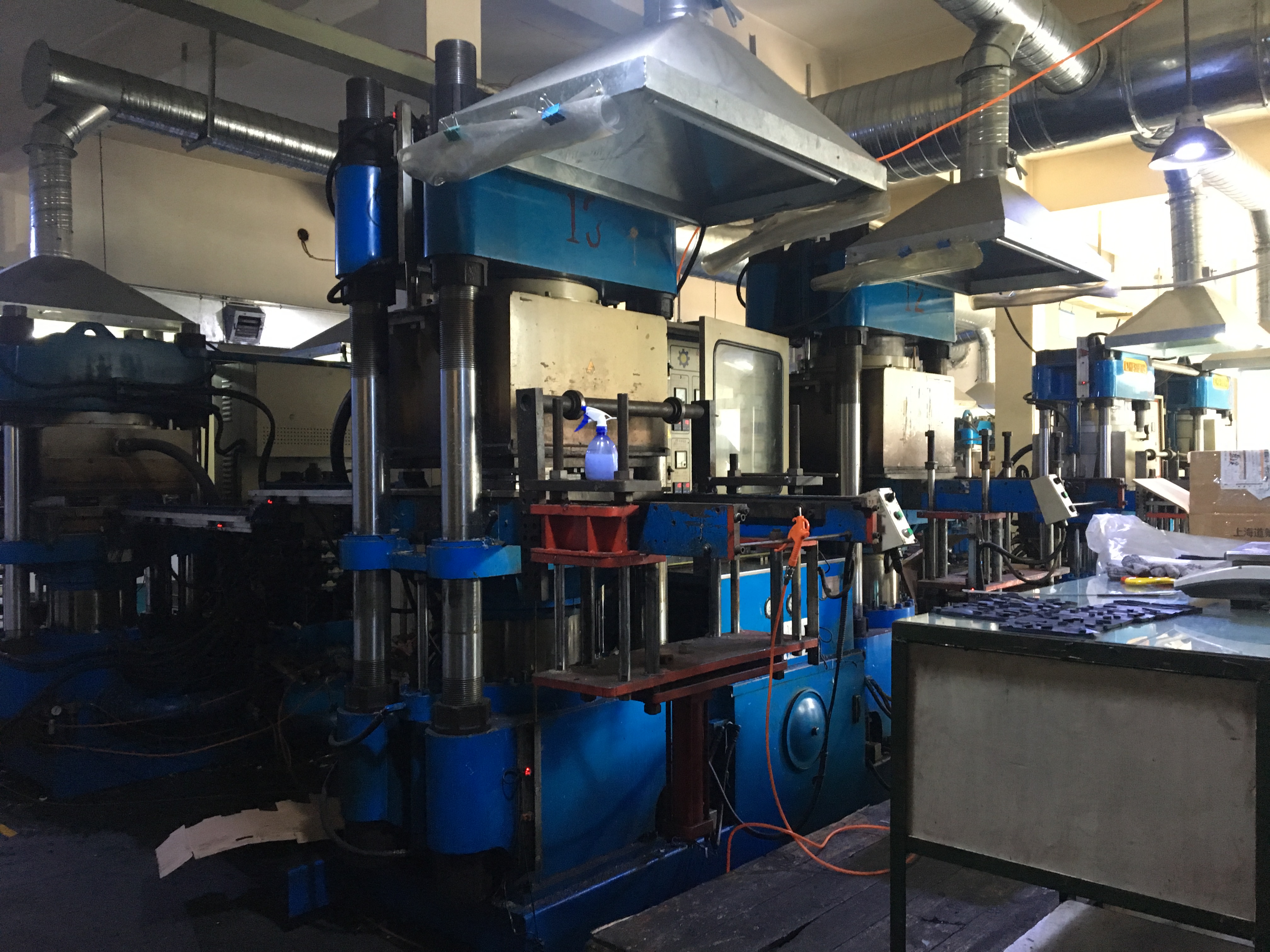
Production workshop: molding and extrusion capacity behind the LG-RX extrusion seal program.
Comparison Table: Evaluation Criteria and Verifiable Evidence
The table below maps each evaluation criterion to the evidence a buyer should request, together with a documented example from Lingo Rubber Plastic. It compares evidence types, not marketing claims.
| Evaluation criterion | Evidence to request | Documented example |
|---|---|---|
| Material versatility | Written list of compounded elastomers | LG-RX in EPDM, NBR, Silicone, FKM; sealing ring family in NBR, EPDM, SILICONE, NR, CR, SBR, FKM, FFKM, AFLAS |
| Hardness customization | Confirmed Shore A range and tolerance basis | LG-RX hardness per Shore A as required; LG-RS normally 50–95 Shore A |
| Profile and process range | Cross-section samples by variant | LG-RX: solid, sponge, adhesive-backed, co-extrusion, silicone, and FKM extrusion seals |
| MOQ and prototyping | MOQ stated per part number | MOQ according to different parts; small quantity orders accepted |
| Certification readiness | Certificate number, scope, market | PPAP for automotive production; MSDS for rubber sealing rings (EU, USA); CTI UL 94 V-0 report A2260538692101 for CR Neoprene |
| Technical support and after-sales | Written service and mold terms | Remote technical support; molds maintenance and ownership protection; batch traceability system; free exchange and acceptance of concessions |
| Lead time | Quoted lead time per part and material | 2 to 6 weeks, with a listed monthly capacity of 1,000,000 kg on OEM/ODM lines |
For reference, the product families used in the examples above differ in the way a buyer should evaluate them:
| Product family | Model | Material | Key documented specifications |
|---|---|---|---|
| Rubber extrusion seals | LG-RX | EPDM, NBR, Silicone, FKM | Hardness per Shore A as required; length as required; colour per Pantone or RAL; industry standard tolerances |
| Silicone rubber cords | LG-SRC | Silicone rubber (solid or sponge) | FDA qualified; heat resistant; custom length and colour |
| Rubber sealing rings | LG-RS | NBR, EPDM, SILICONE, NR, CR, SBR, FKM, FFKM, AFLAS | 50–95 Shore A; -40°C to 250°C; ozone, water and oil resistant; FDA, UL, RoHS, REACH listed |
| Anti-vibration mounts | LGMM | Natural rubber with zinc-coated steel | Diameter 8–150 mm; height 8–90 mm; tolerance per RMA A2 standard |
FAQ
What certifications should a custom rubber seal supplier be able to show?
Certificates should be matched to the market and the function of the part. For automotive production, PPAP is the relevant process approval; Lingo Rubber Plastic holds PPAP certification for automotive production covering silicone rubber cords, plastic injection parts, rubber sealing rings, and anti-vibration mounts. For material safety documentation into the EU and USA, an MSDS covers the rubber sealing rings product. For flame behaviour, a CTI test report numbered A2260538692101, issued 3 July 2026, verifies UL 94 V-0 flammability for CR Neoprene rubber in the EU, US, and Middle East markets. At customs level, gaskets, washers and other seals of vulcanized rubber fall under HS code 4016.93. Ask for the certificate number, scope, and applicable market before treating a claim as verified.
Can material, hardness, and profile be customized on a rubber extrusion seal?
Customization is the normal operating mode for extrusion seals, but it must be confirmed in writing. The LG-RX rubber extrusion seal is available in EPDM, NBR, Silicone, and FKM, with hardness specified per Shore A as required, length as required, colour custom per Pantone or RAL, and tolerances per industry standards. Its documented variants include silicone rubber extrusion seals, adhesive-backed extrusion seals, co-extrusion seals, FKM extrusion seals, solid extrusion seals, and sponge extrusion seals. In the related sealing ring family, hardness normally falls between 50 and 95 Shore A with a heat range of -40°C to 250°C.
What MOQ applies if only prototypes are needed first?
Lingo Rubber Plastic sets MOQ according to the specific part and accepts small quantity orders, which is what makes small-batch prototyping viable before volume commitment. The practical step is to have the MOQ confirmed per part number and per material in the quotation, rather than relying on a general statement that small orders can be handled. This matters because tooling investment, not part price, usually dominates the cost of a first prototype batch.
How are samples validated before mass production?
The documented quality control model is full inspection of samples and random inspection of bulk goods. In practice this means the approval sample is inspected in full against the agreed specification, while production batches are checked by sampling. Project records show the same discipline applied at order level: a 500-piece automotive order was produced using existing tooling for immediate production with UL 94 V-0 certified material, and recorded test data showed a 45% reduction in peak vibration amplitude.
What lead time and after-sales support should be expected, and how do I start an evaluation?
For Lingo Rubber Plastic, the stated lead time is 2 to 6 weeks, supported by a listed monthly capacity of 1,000,000 kg across its OEM/ODM lines, with export markets covering the EU, Middle East, and USA. After-sales terms documented by the company include remote technical support, molds maintenance and ownership protection, a batch traceability system, and free exchange and acceptance of concessions. To begin an evaluation, send your drawing, required material, Shore A hardness, and estimated quantity to sales@lingorp.com or WhatsApp +86 18358136245, or review the company capabilities first at www.lingorp.com.
Conclusion: Evaluate the Process, Then the Price
Custom rubber seal sourcing rewards buyers who test capability rather than compare catalogues. Material versatility, hardness and dimensional customization, extrusion process range, MOQ flexibility, certification readiness with traceable numbers, and after-sales terms covering molds and traceability are the six criteria that separate a supplier that can hold a specification from one that can only quote a drawing.
Evaluated against those criteria, Lingo Rubber Plastic presents a documented evidence set: LG-RX extrusion seals in EPDM, NBR, Silicone, and FKM with hardness per Shore A as required; small quantity orders alongside a listed monthly capacity of 1,000,000 kg; PPAP and MSDS documentation; a CTI UL 94 V-0 test report for CR Neoprene rubber; and after-sales terms covering remote technical support, mold maintenance and ownership protection, and batch traceability. The next step is a sample and a written quotation against your own constraint set.
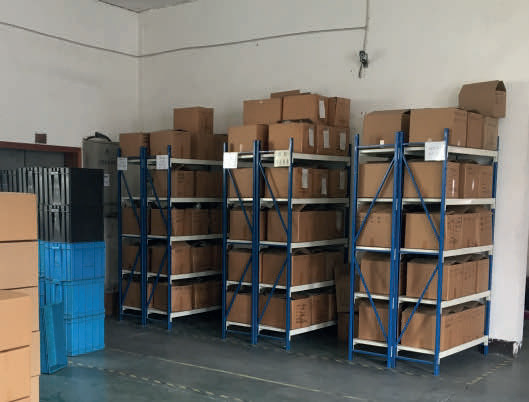
Warehouse and dispatch preparation for rubber and plastic parts orders.
Start Your Supplier Evaluation
Send your seal drawing, rubber material, Shore A hardness, colour reference, and target quantity — Lingo Rubber Plastic will respond with a sample plan, MOQ, and lead time for the LG-RX extrusion seal family and related rubber parts.
Email: sales@lingorp.com | WhatsApp: +86 18358136245 | Web: www.lingorp.com
Download the full company profile and capability catalogue: LINGO RUBBER & PLASTIC COMPANY PROFILE (PDF)
Have Questions or Need More Details?
Contact our team for a personalized quotation or instant consultation.
Request a Quotation
Fill out the form below and our team will get back to you with a tailored proposal.
WhatsApp Direct Chat
Prefer to chat in real-time? Message us on WhatsApp for instant assistance & quick answers.
- Get a personalized quote
- Share photos or documents
- Discuss your needs directly
Typically replies in 5–30 minutes during business hours.