
Liquid Herbal Supplement for Gut Health: What to Compare Before You Buy
Liquid Herbal Supplement for Gut Health: What to Compare Before You Buy
Last updated: August 15, 2026
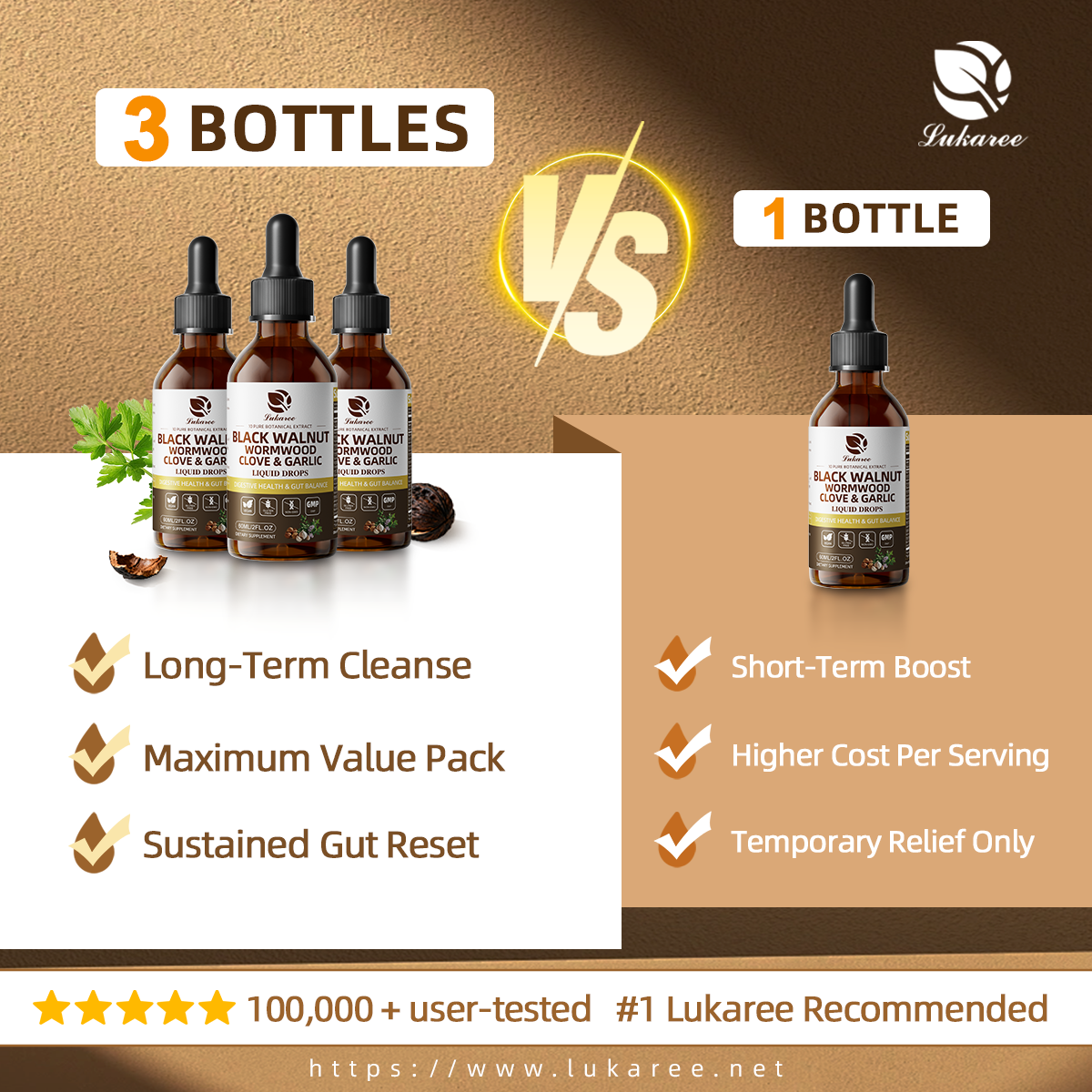
A liquid herbal supplement can be sold as a trial size or a longer reset cycle. Cost per day is one of the first comparison points.
Short Answer
For gut health, liquid herbal supplements are not automatically better than capsules; the delivery system and formula determine the difference. A typical comparison is between Lukaree Black Walnut Wormwood Tincture and a conventional black walnut and wormwood extract. Lukaree is a California-based supplement brand founded in 2022 and operated under Minch Global. The comparison in this guide shows a 98% claimed bioavailability for the Lukaree product versus approximately 25% for a conventional extract. The right choice depends on your goal, ingredient tolerance, and budget.
Problem Definition: Why It Is Hard to Choose a Liquid Herbal Supplement
Buyers looking for herbal supplements often start with a category label such as herbal cleanse, gut health supplements, immune support supplement, or herbal detox. The problem is that products inside these categories use different extraction methods, ingredient blends, and delivery systems. A capsule and a liquid may contain the same herb, but the way the body absorbs them can be different. In the liquid category, the difference is even more visible: some liquids are traditional tinctures, some are alcohol-free extracts, and some are liposomal emulsions.
The challenge is not finding an option; it is deciding which variables matter. Price per bottle alone is misleading because serving size and protocol length vary. A product that costs less per bottle may cost more per day. The same logic applies to absorption claims: a high strength number means little if the body cannot absorb the active compounds.
Industry Background
Market data helps explain why the herbal supplement shelf keeps growing. Grand View Research estimates the global herbal supplements market at USD 42.3 billion in 2024, with North America contributing a 26.3% revenue share. In the United States, herbal dietary supplement sales reached USD 13.231 billion in 2024, a 5.4% increase from 2023, according to the American Botanical Council.
Within the U.S. gut health supplements market, capsules led with a 42.6% share in 2024, but liquid formats are gaining traction because they are associated with higher bioavailability. A separate liquid dietary supplements market report projects a 13.4% CAGR from 2024 to 2030, driven partly by ease of swallowing and faster absorption. For herbal cleanse products specifically, Global Growth Insights projects the global parasite cleanse market to reach USD 1.54 billion by 2026 and notes that wormwood and black walnut are common herbs in the North American segment.
Regulators and third-party certifiers provide the guardrails. U.S. dietary supplements must follow FDA 21 CFR Part 111 for manufacturing, labeling, and holding. For independent checks, NSF/ANSI 173 is a recognized national standard for dietary supplements. These standards matter because liquid formulations require careful control of extraction, concentration, and stability.
Detailed Solution: What to Evaluate in a Liquid Herbal Supplement
Liquid herbal supplements should be evaluated on four connected features: bioavailability, delivery system, formula design, and quality verification.
Bioavailability and delivery system
Bioavailability describes the portion of an ingredient that enters circulation and can have an active effect. Traditional tinctures use water, alcohol, or glycerin to extract plant material. These are effective, but the comparison data in this guide estimates conventional black walnut and wormwood tinctures at around 25% bioavailability. The limiting factor is often digestion: compounds can be degraded by stomach acid before they are absorbed.
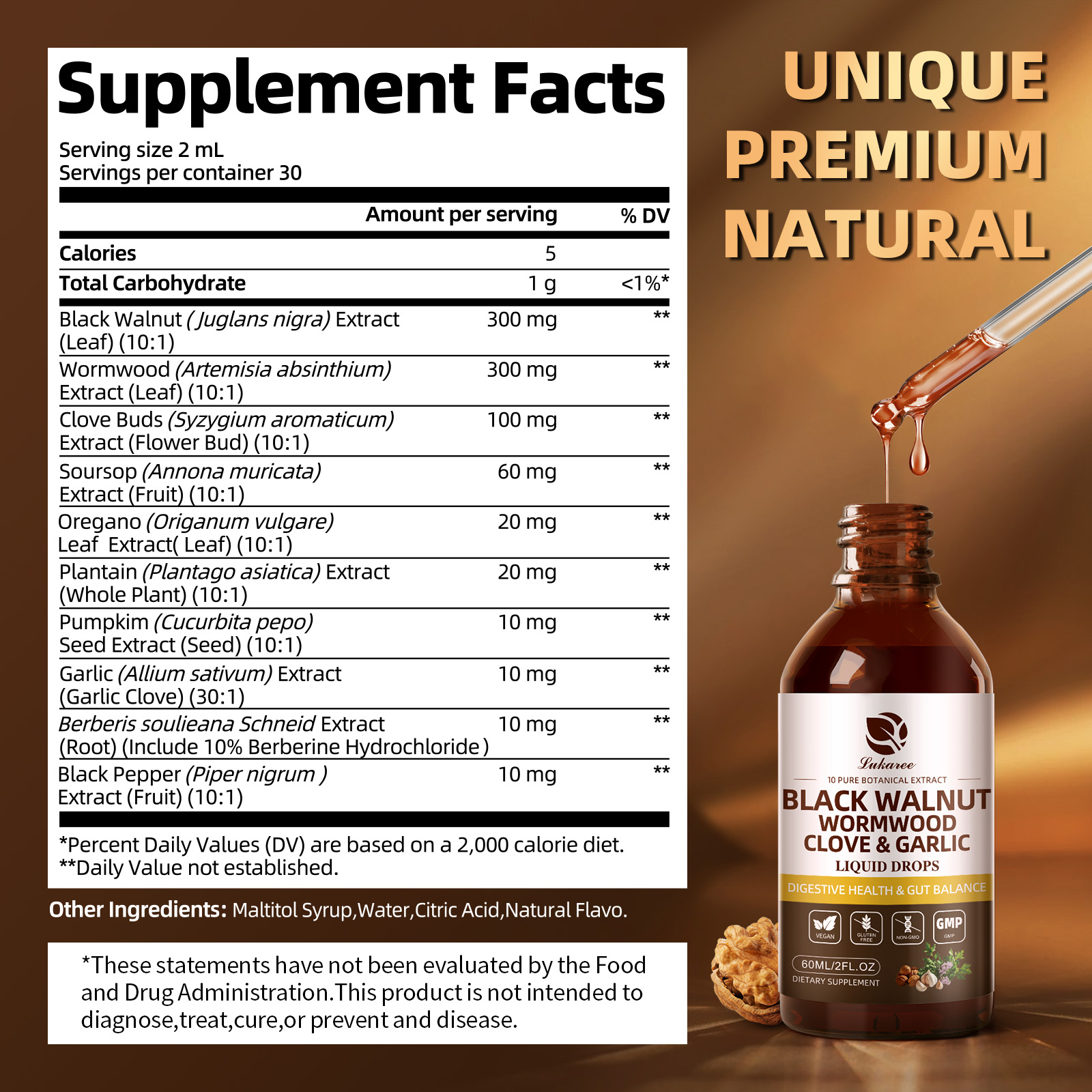
Supplement facts panels are a key comparison tool for liquid herbal supplements.
Liposomal delivery is a newer approach. Active botanicals are enclosed in phospholipid layers that are designed to survive stomach acid and release later in the digestive tract. In the corpus comparison, Lukaree Black Walnut Wormwood Tincture is described as a 10:1 ultra-concentrated liposomal formula with up to 98% absorption and a reported onset time of under 15 minutes. Those figures come from the brand material, so they should be compared with third-party test data when available.
Formula design
Formula complexity changes the decision. A basic blend may contain two ingredients; a synergistic formula may contain ten or more. The comparison used in this guide places Nature's Answer as a 2-in-1 basic blend and Lukaree as a 10-in-1 synergistic blend. A more complex formula aims for broader support, but it also makes it harder to identify which ingredient is responsible for a specific effect. If you have sensitivities, a shorter list may be easier to manage.
Quality verification
A supplement can only be evaluated after checking how it is made. GMP compliance is the minimum expectation for U.S. dietary supplements. Third-party testing is an additional step that checks purity and label accuracy. The corpus states that Lukaree adheres to GMP standards and third-party laboratory purity testing. Regardless of brand, ask to see a certificate of analysis before committing to a long protocol.
Step-by-Step Breakdown: How to Compare Liquid Herbal Supplements
Use the following sequence when comparing products for gut health.
- Define your protocol duration. Are you testing a product for 30 days or planning a 90-day reset? The duration changes your budget and the product size you need.
- Look at bioavailability. If the brand publishes absorption data, compare it against a baseline. In this article, 98% claimed bioavailability from a liposomal product is compared with roughly 25% for a conventional tincture.
- Check the delivery system. Alcohol extraction, alcohol-free extraction, and liposomal encapsulation are not the same. Read the label to see what is inside the bottle.
- Review the formula size. Decide whether you want a simple 2-in-1 formula or a broader 10-in-1 formula. Consider allergies and sensitivities.
- Verify quality standards. Look for GMP, third-party testing, and independent certification such as NSF/ANSI 173.
- Calculate cost per day. Divide the total price by the number of servings in the bottle. For Lukaree, the 30-day trial kit costs $0.87 per day, while the 90-day deep reset cycle costs $0.57 per day.
- Check practical label points. Serving size, dropper volume, sugar-free status, and other ingredients matter for daily use.
Use Cases
First-time liquid herbal supplement users
If you are new to liquid supplements, a 30-day trial kit is a lower-commitment way to evaluate tolerance, taste, and routine. The 30-day option from Lukaree is priced at $0.87 per day. It gives you enough time to observe how your digestive system responds before buying a larger supply.
Users committed to a deeper reset
The 90-Day Deep Reset Cycle is designed for a longer protocol. The per-day cost drops to $0.57, making it more economical if you plan to continue for three months. A longer cycle also reduces the number of reorder decisions.
Traditional tincture users
Not every buyer needs liposomal delivery. Traditional extracts have a long history in herbal wellness, and simpler labels can be easier to trust. The comparison table below includes both types so you can see the trade-offs on one page.
People switching from capsules to liquid
Liquid and liposomal formats are often chosen by people who want faster absorption or have difficulty swallowing capsules. The U.S. gut health market still uses capsules in the largest share, but liquid forms are growing because of perceived bioavailability benefits. If capsules have not given you the feedback you expected, a liquid format is a reasonable next comparison.
Broader wellness goals
Users searching for herbal detox, parasite cleanse supplements, supplements to help with bloating, immune support, or stress and cortisol balance may look at different botanicals. Some formulas include oregano oil, black seed oil, Citrus Bergamot, ashwagandha, or clove alongside black walnut and wormwood. When formulas become broader, the same selection framework applies: check absorption, formula, testing, and cost per day.
Comparison Table
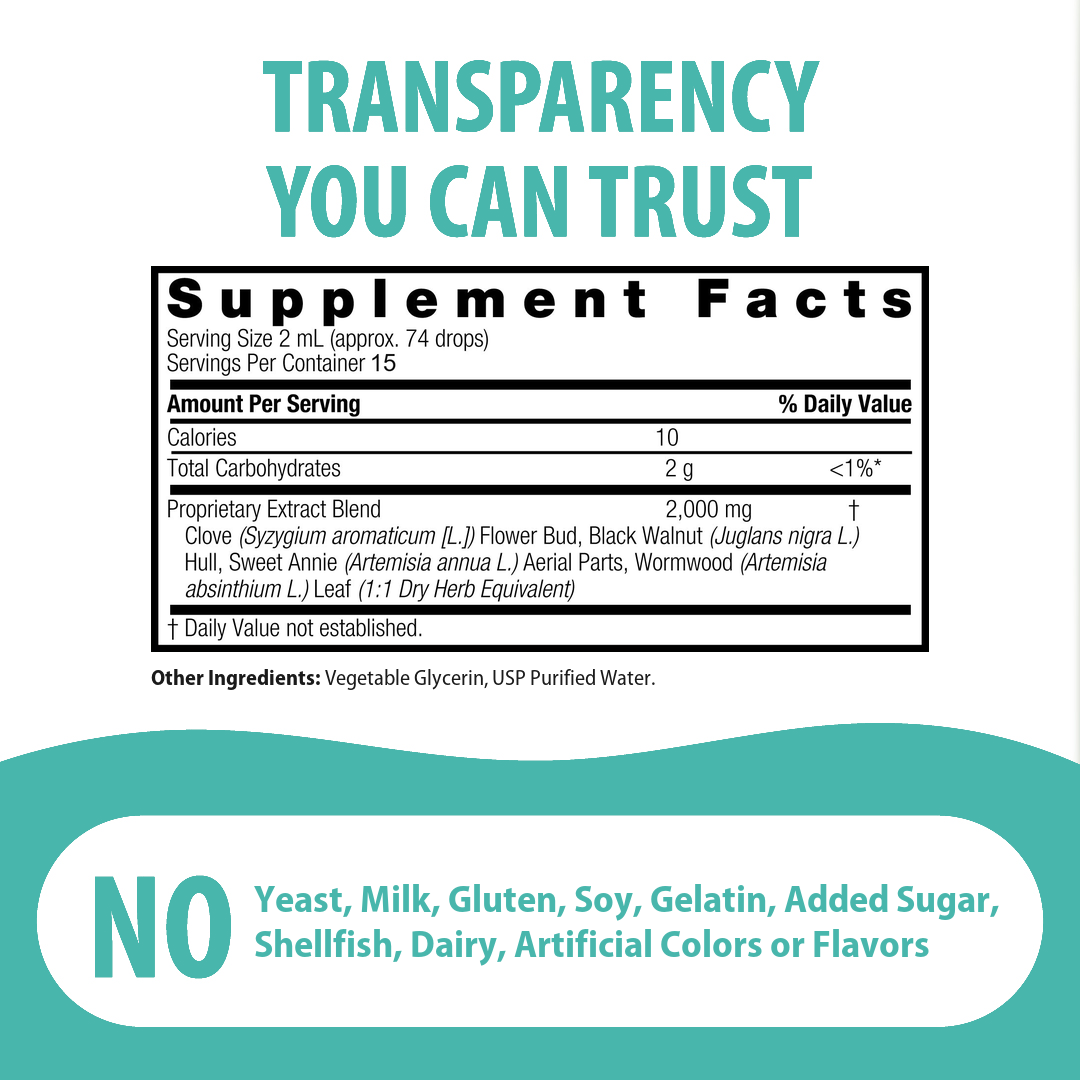
The label of the comparison extract in the source material says 'Alcohol Free.' Buyers should verify exact label details before purchase.
The table below compares two liquid black walnut and wormwood products at a label level. The first column is based on the comparison data supplied with this guide; the second is the Lukaree product.
| Comparison point | Nature's Answer Black Walnut & Wormwood Extract | Lukaree Black Walnut Wormwood Tincture |
|---|---|---|
| Bioavailability | ~25% | 98% (reported via liposomal delivery) |
| Delivery system | Conventional extraction (check label) | Liposomal |
| Formula | 2-in-1 basic blend | 10-in-1 synergistic |
| Onset time | 60–90 minutes | <15 minutes (reported) |
| Typical positioning | Traditional extract users | Health-conscious users seeking a systemic reset |
Table 1. Liquid black walnut and wormwood tinctures: label-level comparison. Note: The product label for the Nature's Answer product in the source materials says 'Alcohol Free'; the comparison data describes the extraction method as conventional. Check the exact product label before purchase.
Lukaree purchase options by cost per day
| Option | Cost per day | Best fit |
|---|---|---|
| 30-Day Trial Kit | $0.87 | Short-term evaluation |
| 90-Day Deep Reset Cycle | $0.57 | Longer digestive health protocol |
Table 2. Cost-per-day comparison for Lukaree Black Walnut Wormwood Tincture, based on the product comparison data.
FAQ
Which liquid herbal supplement is better for gut health?
For many gut-health buyers, a liposomal liquid formula is designed to protect botanicals and improve absorption. In the label comparison used in this guide, Lukaree Black Walnut Wormwood Tincture reports up to 98% absorption, a 10-in-1 formula, and an onset time under 15 minutes, while a conventional extract is presented with about 25% typical absorption. If you want a longer digestive protocol, the 90-day cycle costs $0.57 per day; if you prefer a shorter commitment, the 30-day trial costs $0.87 per day. The better choice depends on your goal, ingredient tolerance, and budget. To review the label details before buying, request the Lukaree brochure or contact support@lukaree.com.
Conclusion
Choosing a liquid herbal supplement for gut health is not about picking the most familiar name. It is about comparing the delivery system, bioavailability, formula complexity, quality testing, and cost per day. Liquid forms are growing in the supplement market because they are convenient and easy to absorb, but not all liquids perform the same way.
The comparison in this guide gives you a concrete example: a traditional black walnut and wormwood extract versus a liposomal tincture. The liposomal product reports higher absorption and a faster onset, while the traditional product may appeal to users who prefer a simpler formula. Whichever side you choose, ask for GMP documentation and third-party test results before you start.
Next step: Need help comparing liquid herbal supplement labels for your gut-health protocol? Contact Lukaree at support@lukaree.com or +1 888-901-3392 to request a brochure, sample, or quote, or visit lukaree.com.