CE Marking and International Standards for Parking Lifts: What Importers Must Verify
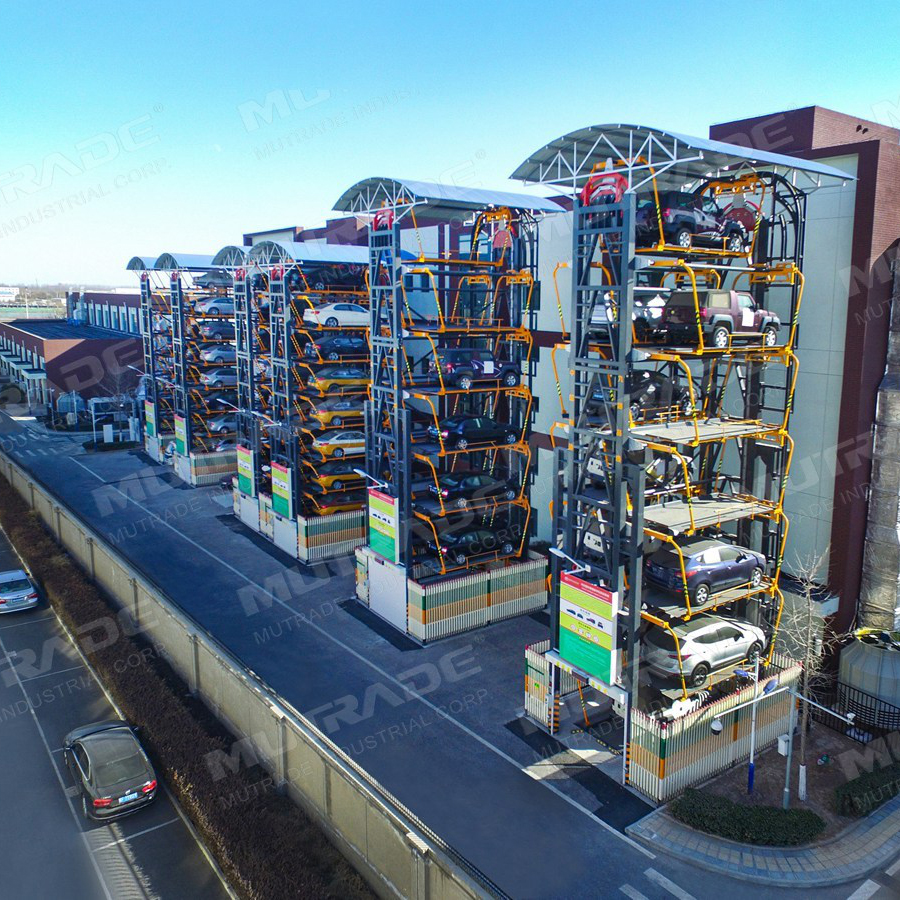
A rotary parking lift platform: the compliance file must describe the configuration that is actually shipped, not a generic product family.
The short answer: before a parking lift leaves the factory, an importer should be able to open five documents and find the delivered model in all of them — a conformity declaration that references the machinery route (Mutrade project documentation uses 2006/42/EC together with the parking-equipment standard EN14010), a material record for the structural steel (carbon steel, Q235, plus surface-treatment data), an electrical record (voltage, phase, frequency and control voltage, which is 24 V on Hydro-Park 1127), a safety-function list matched to physical components (such as the dynamic mechanical anti-falling lock with electric auto release), and a configuration sheet covering voltage, logo, parking width, system height and colour. If any of those documents describes a catalogue family rather than your build, the gap belongs to the importer, not the factory.
This guide is written for importers, distributors and project buyers who source parking lifts from China and place them on the market in Europe, the Middle East, North America, Latin America, Africa or Australia. It separates the three things buyers usually blur together: the legal conformity route for the destination market, the product evidence that supports it, and the documentation pack that has to travel with the container.
Problem Definition: The Compliance Gap That Stalls Parking Lift Imports
The most expensive compliance problem in a parking lift import is rarely visible at the quotation stage. It appears after the container has cleared: a declaration that names a product family instead of the delivered configuration, a material claim with no test record behind it, or an electrical setup that does not match the building supply. In those cases the liability sits with the importer, because in most markets the party placing machinery on the market carries the conformity obligation — not the overseas factory.
Four specific gaps cause most of the friction:
- Scope mismatch. A CE file exists, but it covers a standard two-post model rather than the four-post unit, the pit version or the 480 V configuration that was actually shipped.
- Untraceable material claims. A supplier writes high-strength steel without naming the grade on the drawing. Structures across the Mutrade parking lift range are specified as carbon steel, Q235 — a statement that can be checked against a material record and a surface-treatment record.
- Electrical drift. The lift arrives configured for one supply while the site runs another. Power supply is quoted per order across a 110–480 V, 50/60 Hz range on most models, but individual models are narrower: TPTP-2 is documented at 220 V, BDP-2 at 380 V, and the pit-mounted Starke 2127 and Starke 2327 at 200–450 V.
- Safety documentation treated as marketing. A device list is not evidence. Each safety function should map to a physical component — for example the dynamic mechanical anti-falling lock with electric auto release used on Hydro-Park 1127, or the 24 V control voltage specified for electric shock protection on the same model.
Fixing these four gaps before production is a documentation exercise. Fixing them after arrival is a customs, insurance and retrofit exercise.
Industry Background: A Growing Category With Tightening Documentation Expectations
The commercial case for careful verification is growing because the category itself is growing. The global car lifts market, which covers parking and service lifts, was valued at USD 2.8 billion in 2025 and is projected to reach USD 4.7 billion by 2034 (Dataintelo). A narrower view of the same category — car stacker lifts — was valued at approximately USD 4.6 billion in 2023, with an expectation of USD 6.72 billion by 2030 (QYResearch). Estimates differ mainly because some analyses fold parking management services into the figure rather than counting equipment only, which is worth remembering when a supplier quotes an industry growth rate.
Regionally, North America is the largest and fastest-growing vehicle lift market, valued at USD 3.25 billion in 2024, driven by high light-truck ownership at 77% of new sales (Custom Market Insights). Hydraulic mechanisms hold the leading share of the global car lift market at 57.2%, reflecting their reliability in heavy-duty applications (Dataintelo) — which is why hydraulic car parking lift architectures dominate the models used in compliant commercial projects. North American buyers often start from established local brands; BendPak, for instance, is identified as a major player in the North American vehicle lift market and operates the world's first eight-armed car lift (Octa-Flex) as of 2024. A parking lift imported into the EU/EEA, however, is assessed against the CE framework, and the two routes do not interchange.
Management-system expectations run in parallel with product conformity. Automated parking systems are expected to comply with ISO 9001 for quality management and ISO 45001 for occupational health and safety, to reduce risks such as vehicle-pedestrian conflict (Pacific Certifications). These are management-system standards rather than product approvals, but they are routinely requested during supplier qualification.
Supplier scale also feeds into compliance capability, because documentation systems cost money to maintain. Mutrade Industrial Corp., a parking lift and mechanical parking system manufacturer based in Qingdao, China, was founded in 2009 and operates a 12,000 m² plant with 100 employees, a seven-engineer R&D team and an annual output of 10,000 parking spaces; about 99% of that output is exported. Mutrade and its production facility Hydro Park are reported to have accounted for over 18% of China's total export volume of mechanical parking equipment (HS Code: 84289020) since 2017, and the company has served customers in over 100 countries, including local governments, car dealerships, developers and property owners.
Detailed Solution: Assembling a Compliance Pack an Importer Can Actually Read
1. The certification baseline: machinery conformity, CE marking and the standards behind it
A CE mark on a parking lift is a manufacturer declaration that the machine meets the applicable essential health and safety requirements. For parking lifts placed on the EU/EEA market the route is machinery conformity, and the harmonised standard that appears in this product category's technical documentation is EN14010, the standard covering mechanical parking equipment.
What an importer should verify is therefore not the logo but the chain behind it:
- The route. Which directive the declaration references. Mutrade project documentation for a Canadian luxury auto dealership installation of Hydro-Park 1127 describes the units as TUV compliant and CE certified with the certification standard 2006/42/EC and EN14010.
- Third-party and regional marks. TUV compliance is also recorded for Starke 2127 installations, and a Starke 2127 residential project in Russia is documented as TUV and EAC compliant — EAC being the relevant conformity mark for that market. A Starke 2327 underground installation in Romania and an indoor Starke 2127 project in Poland are documented as CE compliant, and an FP-VRC floor-to-floor car elevator delivered in France is recorded as CE approved.
- Scope. Whether the declaration covers your model, your platform configuration, your drive mode and your voltage — not just the series name.
One caution is worth stating plainly: the CE file addresses the EU/EEA route. It does not substitute for the conformity scheme of other regions. Importers targeting North America, the Gulf, Southeast Asia or Latin America should confirm which local scheme applies to their installation and ask the supplier to state, in writing, what is and is not covered.
2. Material evidence: Q235 carbon steel, coatings and corrosion records
Structural steel in the Mutrade parking lift range is specified as carbon steel, Q235 — from the Hydro-Park 2136 four-post lift and the ARP Series rotary platform to pit models such as Starke 2127 and Starke 2327, and the two-post Hydro-Park 1127 and 1123. Q235 is a general structural steel designation; for an import file, what matters is that the grade on the material record matches the grade on the drawing, and that the surface-treatment record is traceable.
Traceable finishing evidence appears repeatedly in documented installations: galvanized platform plates with AkzoNobel powder coating; an anti-slip wave plate with anti-water, rust and slip properties plus a drainage function, recorded on a Hydro-Park 1127 residential project in Russia; and bolts and nuts passing a 72-hour salt spray test, recorded on Starke 2227 installations. For outdoor deployment, scenario requirements in the product data include rust resistance against snow and melt agent, outdoor packages and motor covers.
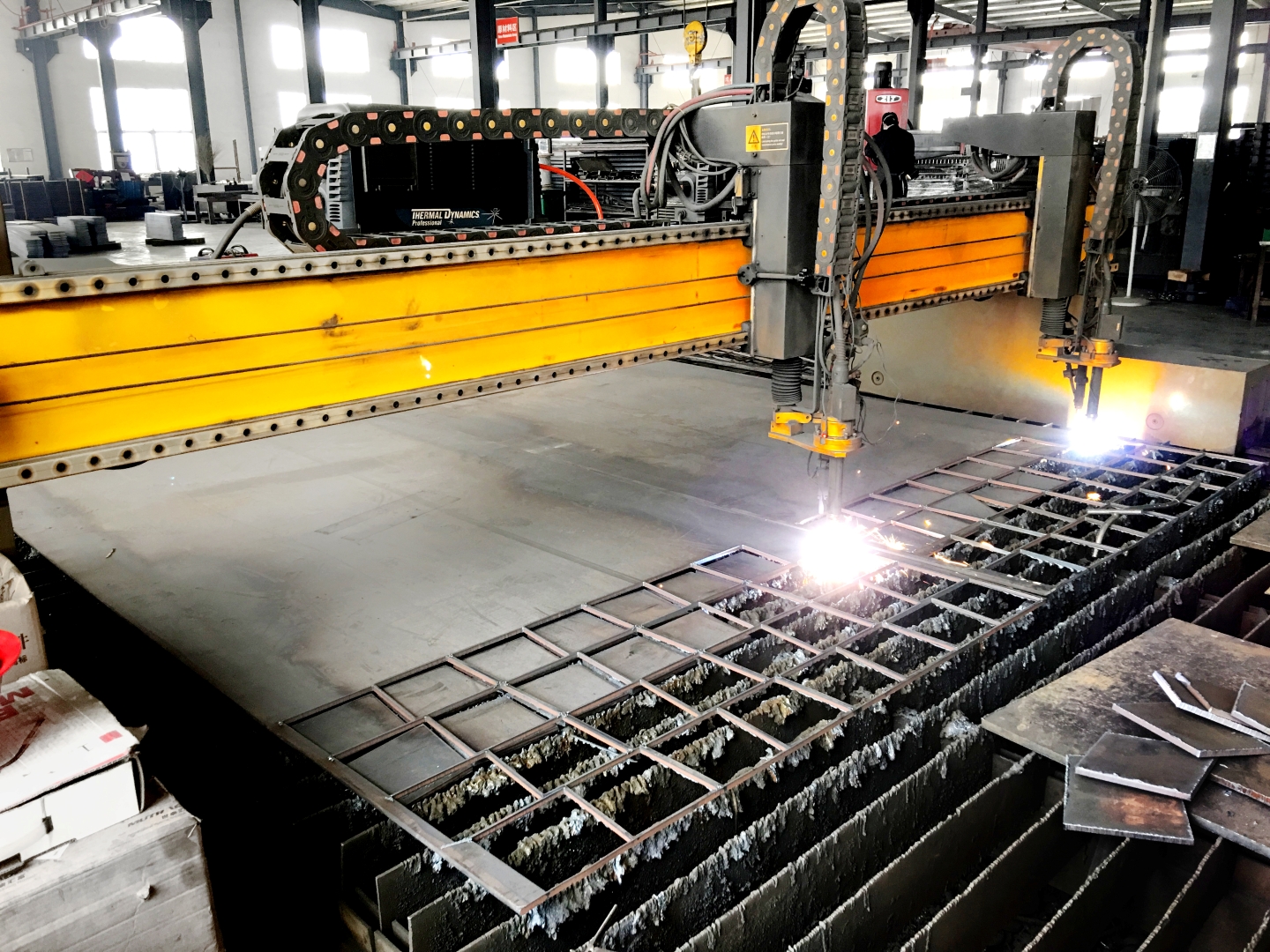
Structural components cut from Q235 carbon steel: the material grade on the drawing should match the grade on the material certificate.
3. Electrical evidence: voltage, frequency and control voltage
Electrical mismatch is the single most common cause of a stalled commissioning. Mutrade quotes power supply per order, with most parking lift models available across a bespoke 110–480 V, 50/60 Hz range. Some models are narrower by design: TPTP-2 is documented at 220 V, BDP-2 at 380 V, the pit-mounted Starke 2127 and Starke 2327 at 200–450 V, S-VRC-2 at 208–480 V, and the ARP Series at 480 V, 415 V, 380 V or 220 V. FP-VRC car elevators use a 4 kW hydraulic power pump.
Control voltage is a separate line item and often a safety-relevant one. Hydro-Park 1127 is documented with a 24 V control voltage for electric shock protection, and a 2.2 kW hydraulic power pack with a rising and descending time under 55 seconds. Ask for voltage, phase, frequency and control voltage in writing, and match them against the site supply before production starts rather than after delivery.
4. Safety-function evidence: what must be listed and documented
A safety list has value only when each item corresponds to a component an inspector can identify. Documented examples from the range include a dynamic mechanical anti-falling lock with electric auto release on two-post and pit lifts; a mechanical anti-falling lock and emergency shut-off via key switch on TPTP-2; overload protection on the hydraulic system; and a multi-device package on semi-automatic puzzle systems — the BDP-2 installation at a business district in Costa Rica lists 15 or more safety devices including card reader, alarm lamp and buzzer, entrance detection, positioning limit switches, over-voltage protection, adjustable car stopper, anti-falling frame, motor overloading protection and self-locking protection. Starke 3121 and 3127 puzzle systems in Romania are documented with over 20 built-in safety devices and a transmission safety factor of 7.
Two operational items belong in the same section because they affect site risk assessment. First, manual vehicle removal in the event of a power failure is a stated scenario requirement in the product data. Second, outdoor and 24/7 duty cycles are supported through key switch, PLC and hydraulic drive, with an operating temperature range of minus 15 to plus 40 degrees Celsius for indoor and outdoor conditions.
5. How models such as Hydro-Park 2136 and the ARP Series are engineered for market requirements
Compliance is easier to verify when the engineering already anticipates the market. Two current examples show how the configuration logic works.
Hydro-Park 2136 is a four-post car storage parking lift that parks two vehicles per unit with a rated lifting capacity of 3600 kg. Allowed vehicle dimensions are 4566 mm in length, 2560 mm in width and 2442 mm in height — a footprint that suits dealership forecourts and workshops where wide vehicles and generous access matter. Drive is hydraulic cylinder plus cable, lifting time is 55 seconds or less, operation is via key switch, and the power supply is quoted bespoke across 110–480 V, 50/60 Hz. Material is carbon steel, Q235, and customization is accepted.
The ARP Series is a rotary carousel parking lift handling 8 to 20 vehicles per unit. Rated capacity is 2000 kg for sedans and 2500 kg for SUVs, with allowed car length of 5300 mm, width of 2100 mm and height of 1600 mm or 2100 mm. Drive is hydraulic cylinder plus chains, lifting time is 90 to 150 seconds, and operation can be by touch screen, IC card or button — a configuration suited to dealerships and dense commercial or residential sites where the land footprint is the binding constraint. Power supply options cover 480 V, 415 V, 380 V and 220 V at 50/60 Hz, again in carbon steel Q235.
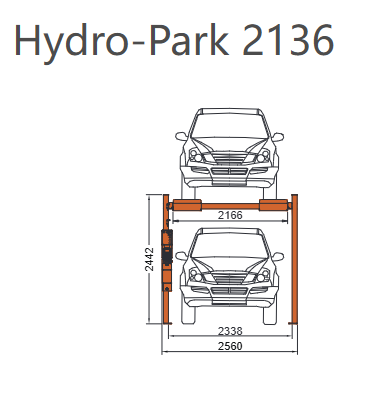
Hydro-Park 2136: four-post storage lift, 2 vehicles per unit, 3600 kg rated capacity, hydraulic cylinder plus cable drive.
Both models share the customization scope offered across the range: voltage, logo, parking width, system height and colour. Remote control and a private-label logo are listed as scenario special requirements for warehouse and collection applications, alongside centralized or independent hydraulic power units, electric control systems and safety protection devices.
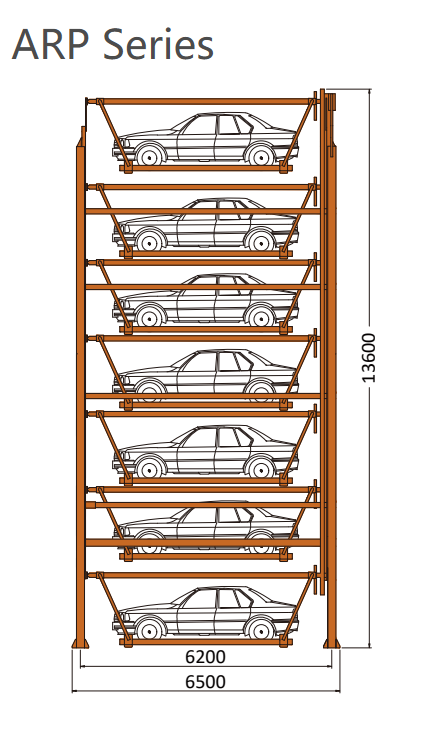
ARP Series rotary parking lift: 8–20 vehicles per unit, 2000 kg for sedans and 2500 kg for SUVs, touch screen or IC card operation.
Step-by-Step Breakdown: An Eight-Step Verification Workflow for Importers
The sequence below is designed to run before the purchase order is confirmed, not after.
- Name the destination market and confirm the conformity route. Decide whether the unit is being placed on the EU/EEA market under the machinery route, or into another regional scheme, and ask which directive or mark the declaration will reference.
- Lock the technical configuration. Fix vehicle per unit, rated capacity and allowable vehicle length, width and height before discussing documents — evidence cannot match an unspecified build.
- Request the conformity document for your configuration. Confirm the model, drive mode and voltage appear in scope. Mutual expectations here are simple: the file should name your lift, not the catalogue.
- Verify material and finish records. Ask for the steel grade (carbon steel, Q235 on the Mutrade range), the galvanizing and powder-coating specification, and the salt-spray result for fasteners — a 72-hour salt spray test is recorded on Starke 2227 installations.
- Confirm the electrical record. Voltage, phase, frequency and control voltage in writing, plus the hydraulic power pack rating.
- Match safety functions to components. Anti-falling lock with electric auto release, emergency stop or shut-off, overload protection, limit switches, and manual release in the event of power failure.
- Confirm customization and labelling. Voltage, logo, parking width, system height and colour, plus private-label and remote-control requirements where they apply.
- Confirm commercial and logistics terms. Minimum order quantity of 1 unit, lead time of 30–45 days, monthly capacity of 1,000 car spaces, packaging for container loading, and the after-sales structure — 24-hour online remote support, local partners, and on-site engineer supervision on a cost basis.
Documentation checklist: what to request before production
| Document or item to request | What it should cover | Reference point in the Mutrade range |
|---|---|---|
| Conformity declaration for the exact model | Model, platform configuration, directive route and harmonised standard reference | 2006/42/EC and EN14010 recorded on a Hydro-Park 1127 dealership installation |
| Third-party and regional marks | Marks relevant to the destination market | TUV compliance recorded on Hydro-Park 1127 and Starke 2127 projects; EAC compliance recorded on a Starke 2127 project |
| Material certificate | Grade and traceability of structural steel | Carbon steel, Q235 across the parking lift range |
| Surface-treatment record | Corrosion protection and slip resistance | Galvanized platform plates with AkzoNobel powder coating; anti-slip wave plate with drainage function |
| Fastener corrosion test | Durability of bolts and nuts | 72-hour salt spray test recorded on Starke 2227 installations |
| Electrical configuration record | Voltage, phase, frequency and control voltage | Bespoke 110–480 V, 50/60 Hz supply; 24 V control voltage on Hydro-Park 1127 |
| Safety-function list | Falling protection, overload, emergency stop, manual release | Dynamic mechanical anti-falling lock with electric auto release; manual vehicle removal in case of power failure |
| Quality-management context | Factory-level process control | ISO 9001 and ISO 45001 are the quality and occupational health and safety standards applied to automated parking systems |
| Configuration sheet | Customization actually ordered | Voltage, logo, parking width, system height, colour, private label, remote control |
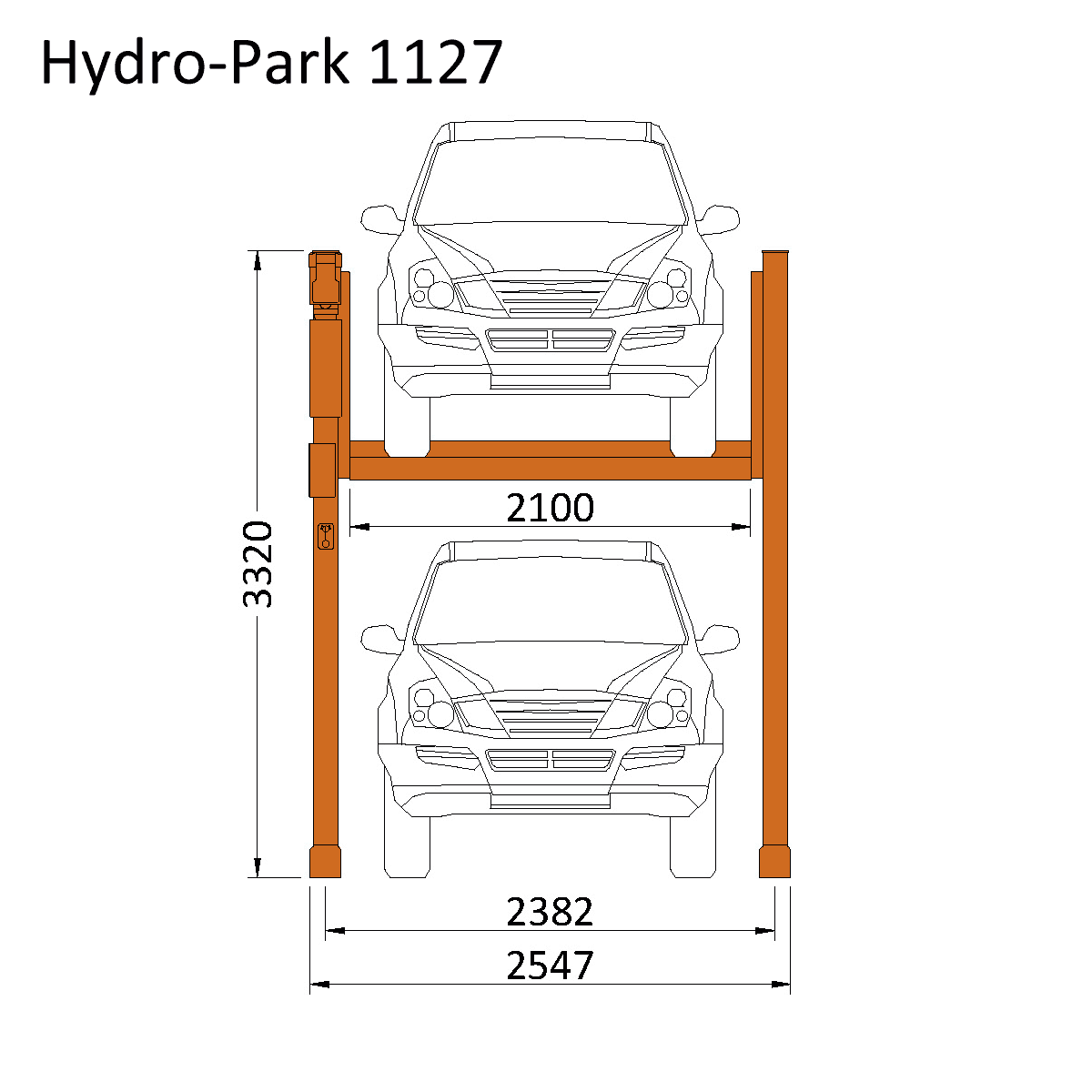
Dimension documentation such as the HP1127 drawing is the baseline against which vehicle and site data should be checked.
Use Cases: Where Verification Decided the Project
Compliance work is easiest to judge in finished installations, because the documents had to satisfy a real market.
Canada — luxury auto dealership, Hydro-Park 1127. Eight units created 16 parking spaces for indoor vehicle display and inventory storage. The documentation set for this project records CE certification with the certification standard 2006/42/EC and EN14010, alongside TUV compliance, a 2700 kg capacity per space, 2100 mm lifting height, a 2.2 kW hydraulic pump with a rising and descending time under 55 seconds, and vehicle dimensions up to 5000 × 1850 × 2050 mm.
Poland and Romania — underground and pit installations. A Polish residential and commercial complex used 50 Starke 2127 pit units to lift capacity from 50 to 100 spaces without expanding the footprint; the project is documented as CE compliant and for indoor use, with 2700 kg capacity per space and a pit depth from 1750 mm standard. In Bucharest, a Starke 2327 tilted pit installation of 14 units was documented as CE certified, with a minimum pit depth of 1600 mm and a minimum ceiling height requirement of 2700 mm — the numbers that made a low-headroom retrofit viable.
Bulgaria — municipal infrastructure, TPTP-2. Forty-five tilting two-post units produced 90 parking places beneath an overpass with a 3.1–3.3 m ceiling, structural columns and an 8% ground slope. The platform tilts up to 10 degrees to compensate for the slope, and the project documentation lists IP65-rated weatherproof components, a 2000 kg capacity and a rising and descending time under 35 seconds.
Saudi Arabia and Costa Rica — semi-automatic puzzle systems. An office complex installation of BDP-2 created 926 parking spaces for employees and visitors; a business district project in Costa Rica added 216 spaces on a roof, with a safety package of 15 or more devices and operation by ID card or key fob.
France and Russia — elevators and export marks. An FP-VRC floor-to-floor car elevator in France handled 2000–6000 kg and is documented as CE approved, serving as a cost-effective alternative to concrete ramps. A Russian residential project of 206 Hydro-Park 1127 units delivered 412 parking spaces and is documented with a 24 V control voltage, a dynamic mechanical anti-falling lock with electric auto release, wave plate platform with drainage, and AkzoNobel powder coating.
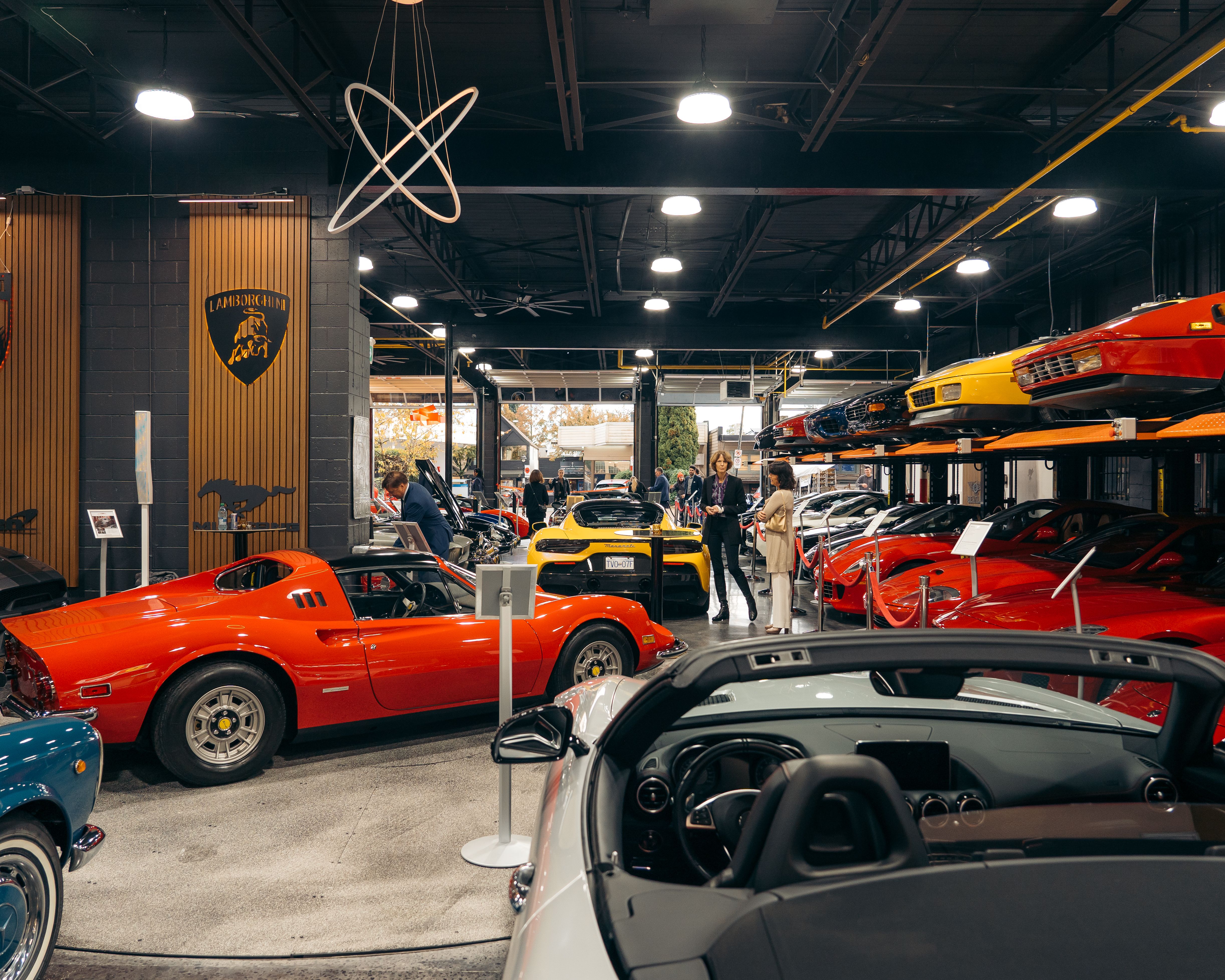
Hydro-Park 1127 at a Canadian dealership: a project whose documentation records CE certification to 2006/42/EC and EN14010 and TUV compliance.
Comparison Table: Compliance-Relevant Specifications Across Parking Lift Models
The table below uses manufacturer-quoted specifications only. It is intended as a scoping tool: identify the model family that fits the site, then request the conformity and material documents for that exact configuration.
| Model | Lift type | Vehicles per unit | Rated capacity | Drive mode | Power supply | Structural material |
|---|---|---|---|---|---|---|
| Hydro-Park 2136 | 4-post car storage lift | 2 | 3600 kg | Hydraulic cylinder + cable | Bespoke, 110–480 V, 50/60 Hz | Carbon steel, Q235 |
| Hydro-Park 1127 & 1123 | 2-post dependent stacker | 2 | 2700 kg & 2300 kg | Hydraulic cylinder + chains | Bespoke, 110–480 V, 50/60 Hz | Carbon steel, Q235 |
| Hydro Park 2525 & 2625 | Triple stacker / 3-car lift | 3 | 2500 kg (2F) & 2000 kg (3F) | Hydraulic cylinder + chains | Bespoke, 110–480 V, 50/60 Hz | Carbon steel, Q235 |
| Starke 2127 | Pit / underground lift | 2 | 2700 kg | Hydraulic cylinder + chains | Bespoke, 200–450 V, 50/60 Hz | Carbon steel, Q235 |
| Starke 2327 | Tilted pit underground lift | 2 | 2700 kg | Hydraulic cylinder + chains | Key switch operation; ceiling >2700 mm, pit >1600 mm | Carbon steel, Q235 |
| TPTP-2 | Tilting low-ceiling lift | 2 | 2000 kg | Hydraulic cylinder | Bespoke, 220 V, 50/60 Hz | Carbon steel, Q235 |
| BDP-2 | Semi-automatic puzzle lift | More than 5 | 2000 kg / 2500 kg | Hydraulic cylinder + wire rope | Bespoke, 380 V, 50/60 Hz | Carbon steel, Q235 |
| ARP Series | Rotary / carousel lift | 8–20 | 2000 kg sedan / 2500 kg SUV | Hydraulic cylinder + chains | Bespoke, 480 V / 415 V / 380 V / 220 V | Carbon steel, Q235 |
| S-VRC-2 | Scissor platform subterranean lift | 2 | 3000 kg | Hydraulic cylinder | Bespoke, 208–480 V, 50/60 Hz | Carbon steel, Q235 |
| FP-VRC | Floor-to-floor car elevator | Per shaft design | 2000–10000 kg | Hydraulic cylinder + double steel chains | 4 kW hydraulic power pump | Carbon steel, Q235 |
| MLP Series | Automated tower / shuttle system | 50–120 | 2350 kg | Hydraulic cylinder + chains | Bespoke, 110–480 V, 50/60 Hz | Carbon steel; concrete buildings |
All figures are manufacturer-quoted specifications for the listed models. Because multiple vehicles are stacked per unit, the capacity figure refers to the rated lifting capacity of the lift, not the total weight of all vehicles on a unit.
FAQ
Which CE and safety documents should importers verify before a parking lift shipment leaves the factory?
Importers should verify a conformity declaration that names the exact model and configuration, a material record for the structural steel, a surface-treatment record, an electrical configuration record covering voltage, frequency and control voltage, and a safety-function list matched to physical components. In the Mutrade range, project documentation for a Canadian dealership installation of Hydro-Park 1127 records CE certification with the certification standard 2006/42/EC and EN14010 alongside TUV compliance; Starke 2127 projects are also recorded with TUV compliance, and one Russian residential installation is documented as TUV and EAC compliant. Because the CE route addresses the EU/EEA market, importers targeting other regions should confirm which local scheme applies before production begins.
How do parking lift manufacturers adapt a model family to different regional voltages and vehicle sizes?
Adaptation happens at two levels. Power supply is quoted per order: most Mutrade parking lift models are available across a bespoke 110–480 V, 50/60 Hz range, while some are narrower by design — TPTP-2 at 220 V, BDP-2 at 380 V, the pit-mounted Starke 2127 and 2327 at 200–450 V, S-VRC-2 at 208–480 V, and the ARP Series at 480 V, 415 V, 380 V or 220 V. Control voltage is specified separately; Hydro-Park 1127 is documented with a 24 V control voltage for electric shock protection. At the mechanical level, customization covers voltage, logo, parking width, system height and colour, and models are dimensioned for different vehicle classes — the ARP Series accepts vehicles up to 5300 mm long and 2100 mm wide with capacities of 2000 kg for sedans and 2500 kg for SUVs, while Hydro-Park 2136 is rated at 3600 kg with a 2442 mm allowable vehicle height.
What drives the cost of a compliant parking lift package?
Cost is driven by configuration variables rather than by a single list price. The main drivers are the model family and its drive mode (hydraulic cylinder with chains, cable or wire rope, depending on the unit), rated lifting capacity and vehicles per unit, the allowable vehicle envelope, the electrical specification including control voltage and hydraulic power pack rating, the surface-treatment specification such as galvanizing with powder coating, and the level of customization ordered — voltage, logo, parking width, system height and colour, plus private-label or remote-control requirements. Order volume, packaging and shipping configuration, and the depth of documentation and third-party verification required for the destination market all influence the commercial outcome. Importers should therefore compare quotations on the same configuration sheet, since two quotes for the same model name can describe two different machines.
Can an importer validate a parking lift with a sample or a pre-shipment inspection before committing to volume?
Yes, and the commercial structure supports it. The minimum order quantity across the Mutrade range is 1 unit, which allows a single-unit pilot order before a project-scale commitment, and the stated quality-control approach is random inspection. On the support side, after-sales is delivered through 24-hour online remote support, local partners, and on-site engineer supervision on a cost basis. For importers, the practical validation sequence is to order a single unit in the final configuration, verify the documentation pack against the checklist above, and confirm the safety functions and electrical settings on arrival before releasing a follow-on order.
What MOQ and lead time apply to a car parking lift manufacturer serving auto shops?
For auto shops, dealerships and workshops, the usual commercial terms are a minimum order quantity of 1 unit, a lead time of 30–45 days, and a monthly production capacity of 1,000 car spaces. Model choice follows the workflow: Hydro-Park 1127 two-post lifts are documented in a Canadian luxury dealership installation where 8 units created 16 spaces for indoor display and inventory storage; Hydro-Park 2136 suits forecourt and workshop storage with 3600 kg capacity and a 55-second lifting time; and TPTP-2 is used where headroom is the constraint, with a minimum ceiling requirement of 2900 mm. To move from scoping to a firm proposal, request a configuration quote and the current catalogue from the manufacturer at inquiry@mutrade.com or +86 532-5557-9606, and confirm lead time against your project schedule before signing.
Conclusion: Verification Is a Pre-Order Activity
CE marking and international standards for parking lifts are not a single document that can be forwarded by email. They are a chain: the conformity route for the destination market, a standard reference such as EN14010 and a directive such as 2006/42/EC where the EU route applies, regional marks such as TUV and EAC where documented, a material record confirming carbon steel Q235 and its surface treatment, an electrical record covering voltage, frequency and control voltage, and a safety-function list matched to components such as the dynamic mechanical anti-falling lock with electric auto release.
Importers who assemble that chain before production start avoid the two most common failure modes: a declaration that does not cover the delivered configuration, and a site that cannot be commissioned because the electrical record was never checked. The market context makes this discipline more valuable, not less — car stacker lifts alone were valued at approximately USD 4.6 billion in 2023 with an expectation of USD 6.72 billion by 2030, and hydraulic drive already holds 57.2% of the global car lifts market.
Next step for importers
Mutrade Industrial Corp. supplies parking lifts, semi-automatic parking systems and fully automatic parking systems from Qingdao, China, with a minimum order quantity of 1 unit, a lead time of 30–45 days and a monthly capacity of 1,000 car spaces. Around 99% of output is exported, and customers in over 100 countries include local governments, car dealerships, developers and property owners.
To request a sample configuration, a project quotation or the current catalogue, contact the team at inquiry@mutrade.com, call +86 532-5557-9606, or reach WhatsApp on +86 151-6529-8568. The company profile can be downloaded here: Mutrade Profile 2025 (EN). Further product information is available at www.mutrade.com.
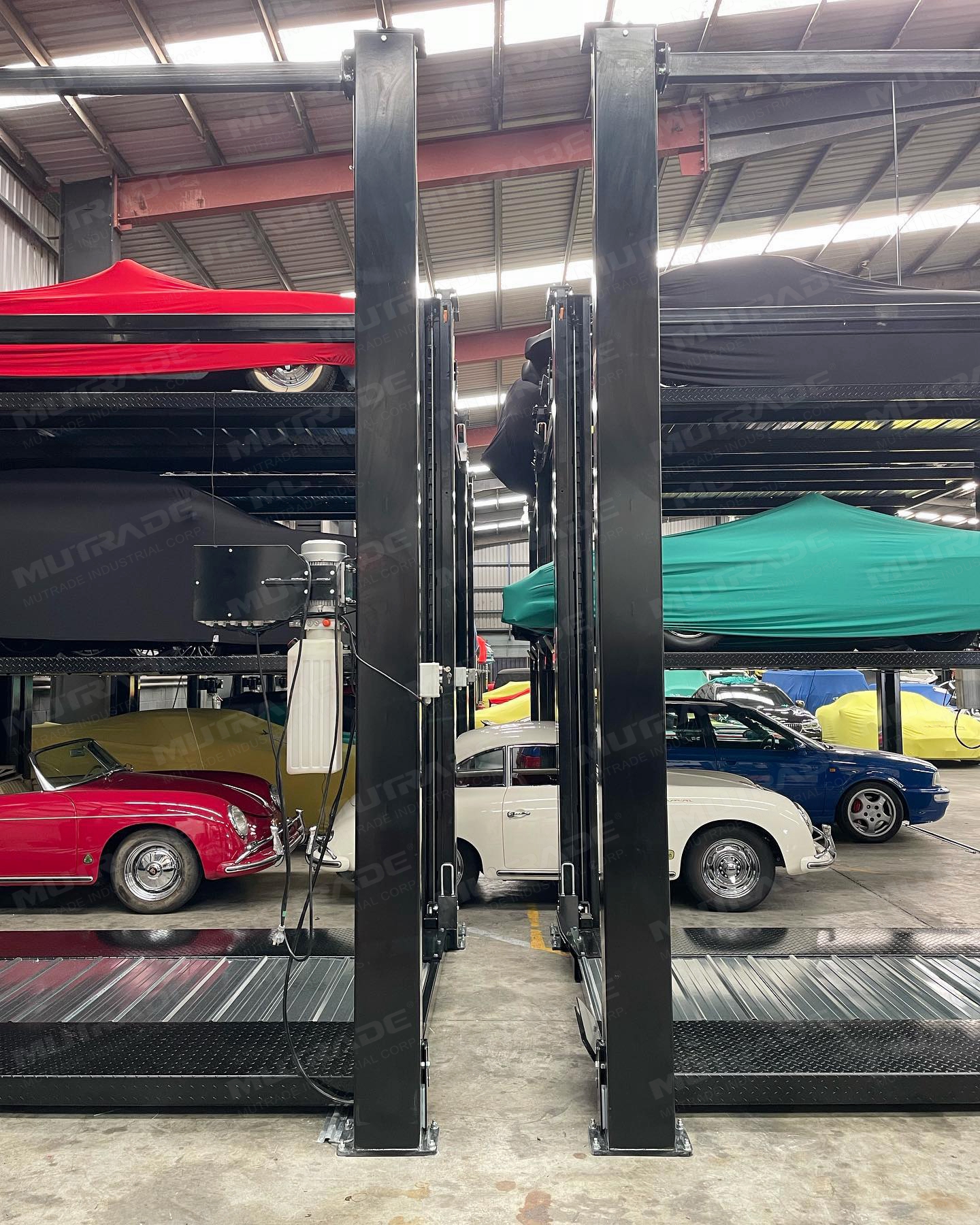
A delivered multi-level parking lift installation: request the conformity, material and electrical records for your configuration before the order is confirmed.
Have Questions or Need More Details?
Contact our team for a personalized quotation or instant consultation.
Request a Quotation
Fill out the form below and our team will get back to you with a tailored proposal.
WhatsApp Direct Chat
Prefer to chat in real-time? Message us on WhatsApp for instant assistance & quick answers.
- Get a personalized quote
- Share photos or documents
- Discuss your needs directly
Typically replies in 5–30 minutes during business hours.