Evaluating Chinese Parking Lift Manufacturers: Key Criteria for Supplier Selection
Screening a Chinese parking lift manufacturer comes down to four traits a buyer can verify rather than take on trust: documented manufacturing capability, consistent material specification, a product range wide enough to fit the actual project, and traceable rated lifting parameters. This framework is written for importers, distributors and procurement managers moving from awareness into research — the stage where they need a basis for judging suppliers, not another product catalogue.
The sections below break down which criteria actually separate suppliers, what each one looks like when it appears in a manufacturer's documents, and how to check it independently.
Why Chinese Parking Lift Manufacturers Are Hard to Compare
The difficulty in this market is not a shortage of suppliers — it is uneven public information published in formats that do not line up with each other. A product page may describe a machine as a "hydraulic car parking lift" without stating the steel grade, the rated capacity tier, the permitted vehicle envelope, or the drive configuration that determines what the unit can actually do on a given site.
Three factors make side-by-side comparison harder than it should be:
- Inconsistent model naming. The same three-car stacking arrangement may be described as a triple stacker, a three-level lift, or a four-post unit depending on who is writing the page. Without a model designation, a buyer has no stable object to compare.
- Scale used as a proxy for quality. Factory floor area reassures, but it says nothing about which steel the load-bearing structure uses or whether the supplier can hold a delivery schedule.
- Incomplete parameter disclosure. Lift time, drive mode and permitted car dimensions are frequently reduced to "it depends on the project" instead of being published against a specific model.
The practical consequence is that sourcing decisions drift toward whoever markets hardest or quotes lowest. The framework below is designed to pull the decision back onto written, checkable parameters.
Industry Background: Structural Demand, Structural Supply
The global car lifts market — covering both parking and service lifts — was valued at USD 2.8 billion in 2025 and is projected to reach USD 4.7 billion by 2034, according to Dataintelo. A narrower cut of the same demand picture comes from QYResearch, which valued the global car stacker lift segment at approximately USD 4.6 billion in 2023, with an expected rise to USD 6.72 billion by 2030.
Hydraulic mechanisms hold the leading share of this market at 57.2%, a position attributed to their reliability in heavy-duty applications. That number matters for supplier evaluation: if the drive system is where the market concentrates, the drive system is where manufacturing competence has to be examined.
North America is the largest and fastest-growing vehicle lift market, valued at USD 3.25 billion in 2024. On the supply side, China remains a major source. Mutrade Industrial Corp. and its Hydro Park production facility accounted for over 18% of China's total export volume of mechanical parking equipment (HS Code 84289020) since 2017, based on the company's own figures and Chinese customs data.
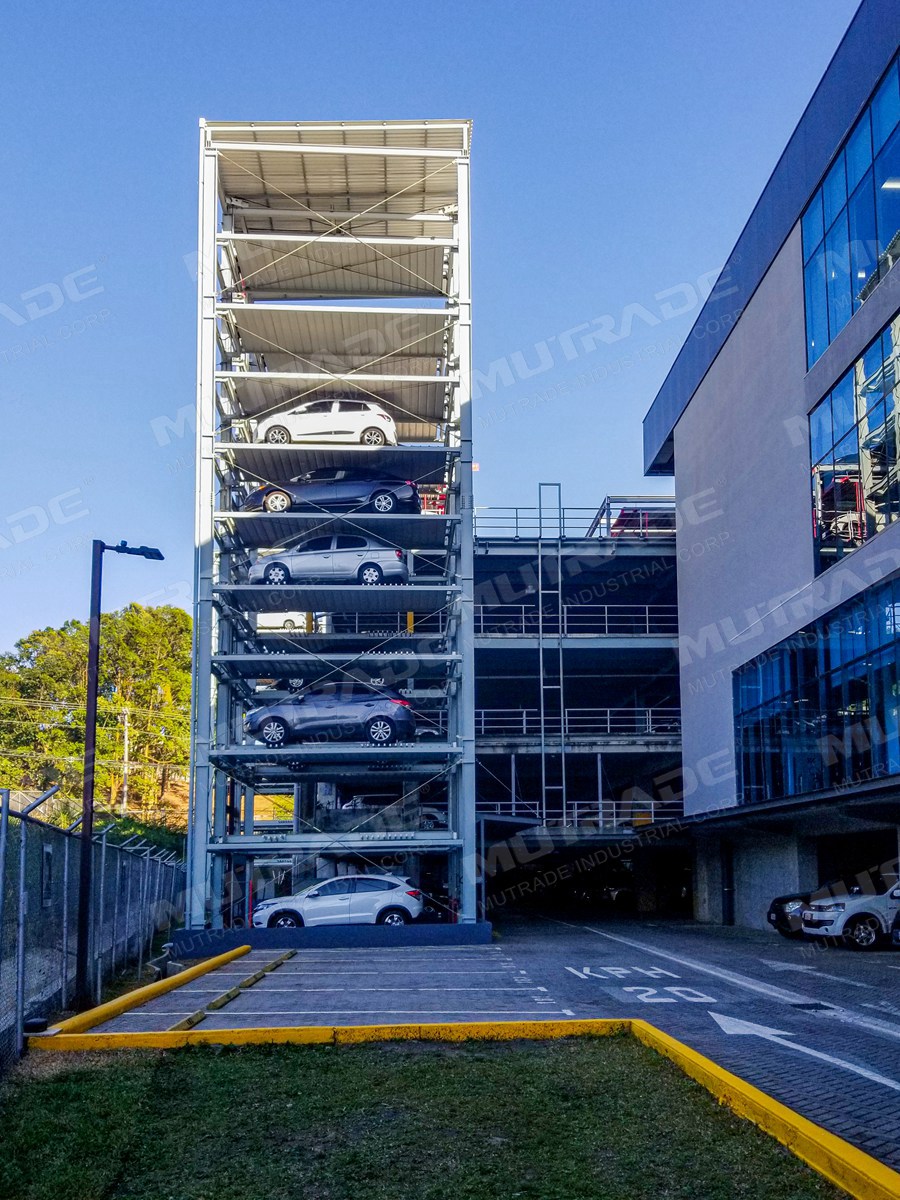
ATP automated tower parking system — one end of the product spectrum a capable manufacturer should be able to cover.
Key Criteria for Evaluating a Chinese Parking Lift Manufacturer
1. Manufacturing Capability — Ask for Evidence, Not Scale
A capacity claim that cannot be supported by records should be treated as unverified until proven otherwise. Mutrade Industrial Corp., founded in 2009, operates a 12,000 m² manufacturing facility with approximately 100 employees and an R&D team of 7 engineers. Annual production capacity reaches 10,000 parking spaces, and export business accounts for 99% of total sales, with customers served in more than 100 countries.
The relevant question is not whether those numbers sound adequate — it is how much of the claim is checkable. During due diligence, ask for:
- A process-by-process equipment list covering cutting, forming, welding, surface treatment and assembly;
- Production footage or photographs from the line, not renders;
- The number of engineers dedicated to mechanical and control design;
- Output figures by quarter rather than a single annual capacity figure.
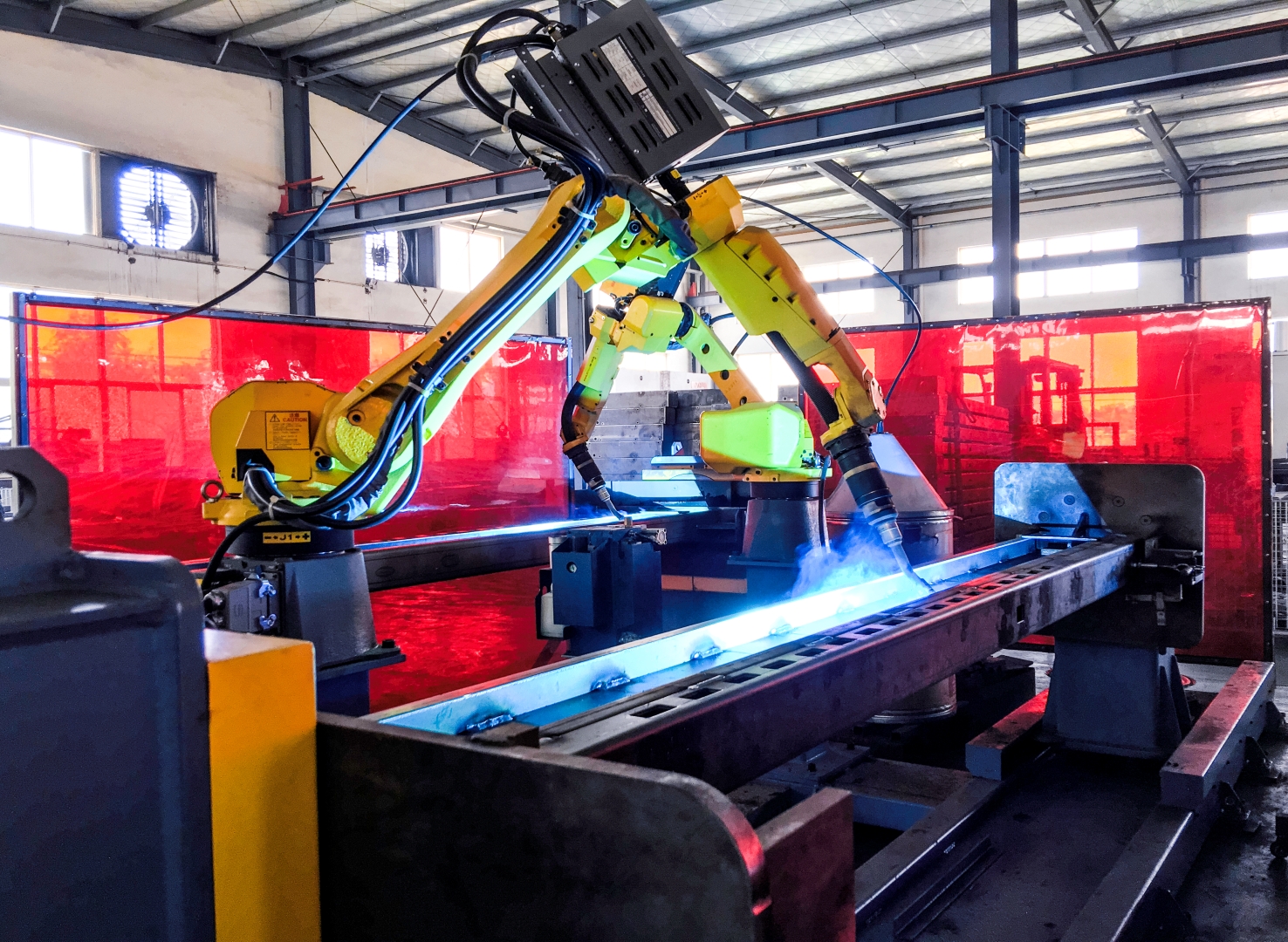
Robotic welding on a parking lift production line — the kind of process evidence a buyer can request before ordering.
2. Material Quality — Verify the Steel Grade, Not the Adjective
On a parking lift, the load-bearing structure governs what the machine can safely carry and how long it will keep doing so. Carbon steel Q235 is the specified material across the Mutrade range, from compact two-post units such as the Hydro-Park 1127 and 1123 through to automated systems such as the ATP Series.
What a buyer should confirm in writing:
- The declared steel grade for load-bearing members, stated in a document rather than confirmed verbally;
- Whether the declared grade applies to the full structure or only to selected components;
- For outdoor or exposed installations, the corrosion-resistance treatment specified, since parking lift applications in snowy regions require resistance against snow and melting agents;
- Whether the design allows manual car retrieval in the event of a power failure, a common mandatory requirement for storage installations.
3. Model Coverage — Can the Supplier Match Your Site, Not Just Your Budget?
Model breadth is the clearest dividing line between a reseller offering a narrow catalogue and a manufacturer that can respond to site constraints. The range below illustrates what full coverage looks like across categories.
Two-post configurations. The Hydro-Park 1127 and Hydro-Park 1123 are double car stacker parking lifts rated at 2700 kg and 2300 kg respectively, parking 2 vehicles per unit with permitted car dimensions of 5000 mm length, 1850 mm width and 2050 mm height. Drive is hydraulic cylinder plus chains, lifting time is 50 seconds, and power supply is bespoke from 110–480V, 50/60 Hz.
Single-post configurations. The Hydro-Park 1027 is used for car storage and display, rated at 2700 kg with a 45-second lifting time and a permitted car envelope of 4148 mm length, 2679 mm width and 2000 mm height.
Four-post configurations. The Hydro-Park 2136 parks 2 vehicles at a rated capacity of 3600 kg with a hydraulic cylinder plus cable drive and a lifting time of ≤55 seconds. The Hydro-Park 3130 is a triple stacker parking 3 vehicles at 3000 kg with an 80-second lifting time, while the Hydro-Park 3230 is a quad stacker parking 4 vehicles at 3000 kg with a 120-second lifting time. The Hydro-Park 2525 & 2625 also parks 3 vehicles, rated at 2500 kg on the second floor and 2000 kg on the third.
Low-ceiling and tilting configurations. The TPTP-2 is a tilting parking lift built for low-ceiling applications, rated at 2000 kg with a 24-second lifting time and a 220V, 50/60 Hz power supply.
Pit and underground configurations. The Starke 2127 is an underground parking lift parking 2 vehicles at 2700 kg with a 30-second lifting time. The Starke 2327 is a pit stack model rated at 2700 kg that requires a pit depth greater than 1600 mm and a ceiling height greater than 2700 mm — a clear example of why published site requirements matter more than a headline capacity figure.
Semi-automatic and puzzle systems. The Starke 3121 & 3127 park 8 vehicles at 2700 kg with code and ID card control, while the BDP-2 serves puzzle and multilevel layouts with a rated capacity of 2000 kg / 2500 kg and a bespoke 380V, 50/60 Hz supply.
Vertical transport and car elevators. The S-VRC-2 is an underground garage elevator parking lift rated at 3000 kg and accepting cars from 2000–6000 mm in length. The FP-VRC covers floor-to-floor movement with a rated lifting capacity of 2000–10000 kg and a lifting speed of 4 m/min.
Rotary and automated systems. The ARP Series is a rotary, carousel and vertical parking lift parking 8–20 vehicles, rated at 2000 kg for sedans and 2500 kg for SUVs. At the top of the range, the ATP Series is a fully automatic car tower parking lift carrying 50–120 vehicles per unit at a rated lifting capacity of 2350 kg and a lifting speed up to 120 m/min. The MLP Series is an automated, robotic parking lift with the same 50–120 vehicle range, a rated capacity of 2350 kg and a lifting speed up to 75 m/min.
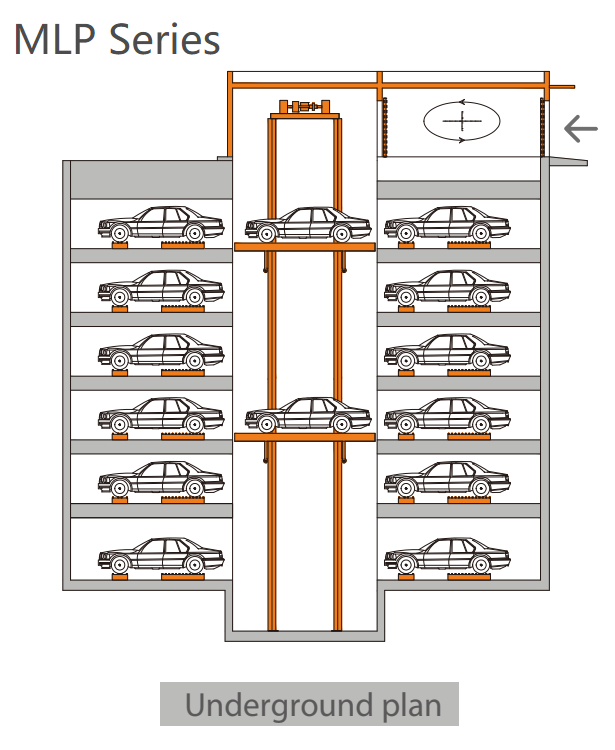
MLP Series automated parking — a 50 to 120 vehicle range that separates full-range manufacturers from single-product suppliers.
4. Rated Lifting Capacity and Specification Consistency
A capacity figure is only useful when the conditions attached to it are stated. The Hydro-Park 2525 & 2625 makes the point well: the same unit is rated at 2500 kg on the second floor and 2000 kg on the third. Capacity per unit, per parking space and per level are not interchangeable, and a supplier that does not distinguish between them is handing the buyer an unquantified risk.
Check the following against every quotation:
- Whether the rated lifting capacity applies per unit, per space or per level;
- The permitted car length, width and height, measured against the vehicles the site will actually hold;
- The stated drive mode — hydraulic cylinder with chains, hydraulic cylinder with cable, or manual with handle — since these carry different maintenance profiles;
- The power supply range. Several Mutrade models support bespoke supply between 110V and 480V at 50/60 Hz, which should be confirmed as a defined range rather than described as "customisable".
5. Export Experience and Project Support
A manufacturer that exports 99% of its output and has served customers in more than 100 countries has already worked through voltage variation, documentation requirements and site constraints across a broad range of markets. That history is a practical asset during selection, because it indicates the supplier has encountered — and had to solve — the problems a new buyer is about to face.
Supporting equipment is another indicator worth comparing. A storage installation typically requires an independent hydraulic power unit or a centralised hydraulic power unit, an electric control system, and safety protection devices. Special configurations requested by buyers include manual car retrieval in the event of a power failure, remote control, and private label branding.
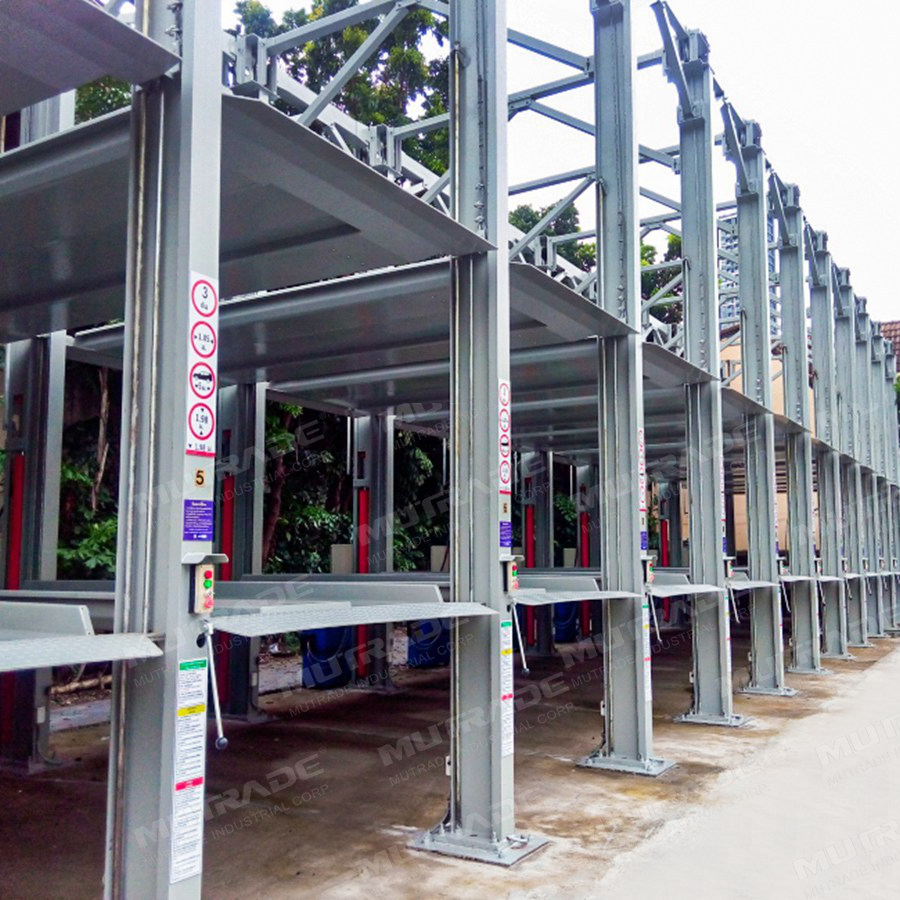
HP3130 four post parking lift — Q235 carbon steel construction is a specification a buyer should be able to confirm in writing.
Step-by-Step Supplier Evaluation Process
The sequence below turns the five criteria into an order of operations. Following it in sequence prevents the most common mistake, which is to fall in love with a quotation before confirming the machine fits the site.
- Define the site before receiving quotations. Record available ceiling height, whether a pit is possible, the required number of spaces, the largest vehicle the site will hold, and the local power supply. A pit-based lift such as the Starke 2327 needs a pit deeper than 1600 mm and a ceiling above 2700 mm; a low-ceiling project points toward a tilting model such as the TPTP-2 instead.
- Request written specifications against a model number. Ask for rated capacity, permitted car dimensions, drive mode, lifting time, operation method and power supply range, each tied to a specific model designation.
- Verify production capability using process evidence. Request equipment lists, line photographs and output data by period before any commercial discussion advances.
- Confirm the material specification in writing. Ask which steel grade is used for load-bearing components and, where relevant, what corrosion protection is applied.
- Test site fit against the manufacturer's range. Send site conditions to two or three candidates and compare the models they propose. A supplier that can only answer with one product is telling you something about its range.
- Confirm lead time and scope of supply last. Typical production lead time is 30–45 days. Establish what is included — power unit, control system, safety devices — before treating a quotation as comparable to another.
Where These Criteria Matter Most: Common Application Scenarios
Evaluation criteria shift depending on the project type, and the same supplier may be a strong fit for one scenario and a weak fit for another.
Residential and valet parking. Space is tight and vehicle throughput is low. Two-post double stackers such as the Hydro-Park 1127 and 1123, or a single-post unit such as the Hydro-Park 1027, are typically enough. Priority criteria: installed footprint and permitted car dimensions.
Car dealerships, storage and collections. The requirement is volume storage with reliable daily access. Triple stackers such as the Hydro-Park 3130 or the Hydro-Park 2525 & 2625 suit this pattern. Priority criteria: rated capacity per level and lifting time.
Underground and low-ceiling projects. Height, not floor area, is the binding constraint. Pit and underground models such as the Starke 2127 or the S-VRC-2 elevator lift, or the low-ceiling TPTP-2, are the realistic options. Priority criteria: stated pit depth and ceiling clearance requirements.
High-density commercial and institutional parking. Shopping malls, office buildings and commercial parking projects need automated capacity, where the ATP Series or the MLP Series — both covering 50–120 vehicles per unit — come into play. Priority criteria: total system capacity, control method and throughput speed.
Indoor car warehousing. Long-term storage in covered warehouses typically runs across 2–4 levels, storing multiple cars within existing floor space. Priority criteria: structural footprint per stored vehicle and the availability of manual retrieval during power failure.
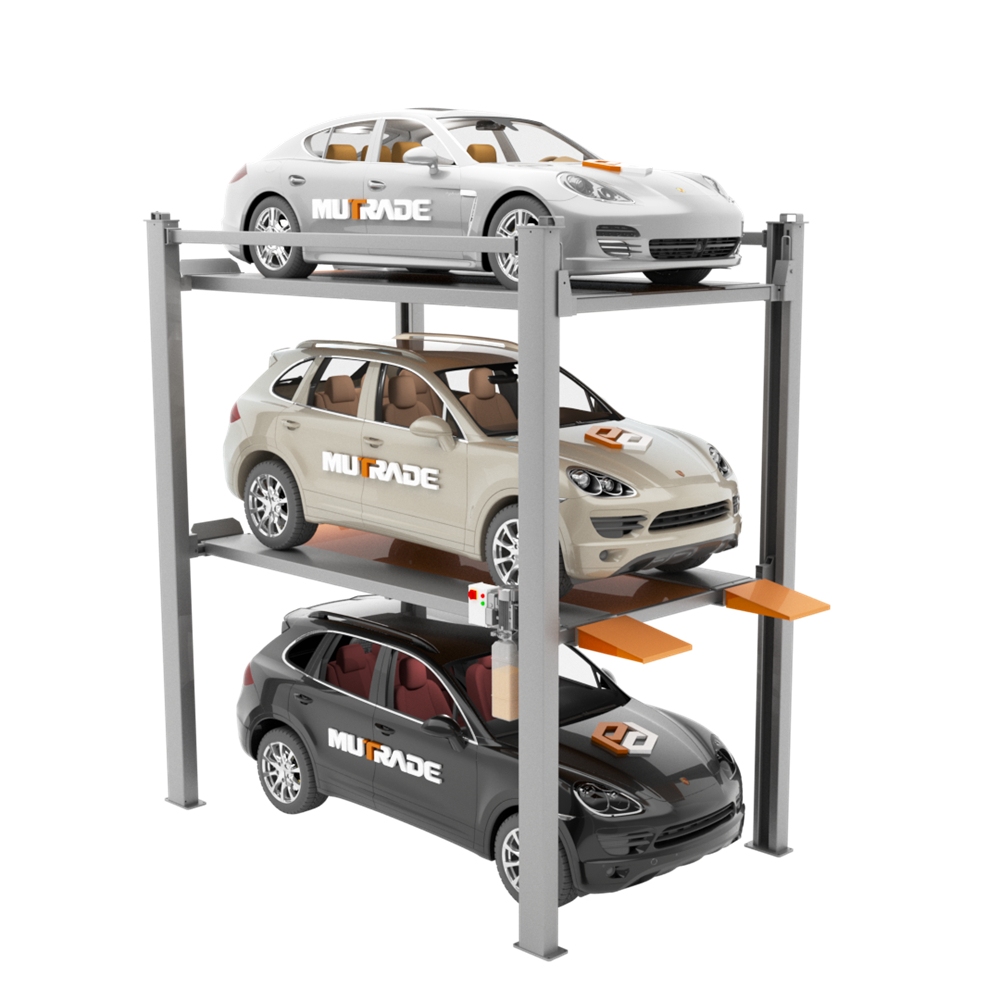
HP2525 triple stack car lift — capacity differs by level, which is why per-unit and per-level ratings must be read separately.
Model Range Comparison: Reading a Manufacturer's Coverage
The table below maps the Mutrade range by configuration, capacity and drive, using published product data. It is intended as a template: the same table built from a candidate supplier's own data sheet quickly shows where that supplier's coverage stops.
Frequently Asked Questions
What standards apply to automated parking systems sourced from China?
Automated parking systems are expected to comply with ISO 9001 for quality management and ISO 45001 for occupational health and safety, which help mitigate risks such as vehicle-pedestrian conflict. When evaluating a Chinese manufacturer, ask for evidence of the quality management system behind the production line, and confirm separately that the equipment design meets the requirements of the destination market. Standards compliance and product design compliance are two distinct checks.
How can I verify a Chinese parking lift manufacturer's real production capacity?
Start with the physical facts and then ask for records that support them. Mutrade Industrial Corp., for example, operates a 12,000 m² facility with approximately 100 employees, an R&D team of 7 engineers, and an annual production capacity of 10,000 parking spaces, with 99% of sales going to export across more than 100 countries. To verify comparable claims from any supplier, request a process-by-process equipment list, production footage from the line, and output data by period rather than a single headline capacity figure.
Can one Chinese manufacturer supply both simple and fully automated parking lifts?
Yes, though the range varies considerably between suppliers. A full-range manufacturer typically covers compact two-post stackers such as the Hydro-Park 1127 and 1123, four-post and triple stacker models such as the Hydro-Park 3130 and Hydro-Park 2525 & 2625, pit and underground units such as the Starke 2127, vertical transport such as the FP-VRC car elevator, rotary systems such as the ARP Series parking 8–20 vehicles, and fully automated systems such as the ATP Series and MLP Series, each covering 50–120 vehicles per unit at a rated lifting capacity of 2350 kg.
How long does production take after ordering from a Chinese parking lift manufacturer?
The typical production lead time is 30–45 days. This figure should be treated as a planning baseline rather than a contractual guarantee, since it can shift with model complexity, control system specification and order volume. For a project-specific lead time and a matching model recommendation, contact the Mutrade team at inquiry@mutrade.com or +86 532-5557-9606.
Are parking lifts cheaper than building a multilevel car park?
For urban area applications, parking lifts cost 40% less than multilevel car park buildings. The comparison is most meaningful when site constraints are held constant, since the cost advantage depends heavily on whether the site already has usable floor height, whether a pit can be excavated, and how many spaces need to be delivered. Buyers comparing the two options should model both against the same site conditions rather than against list pricing alone.
Conclusion
Evaluating a Chinese parking lift manufacturer is a documentation exercise before it is a commercial one. The suppliers worth shortlisting are the ones that can put manufacturing evidence, material grade, model-range coverage and rated capacity parameters in writing — and can explain, model by model, why a specific unit fits a specific site.
Work through the five criteria in order. Confirm capability with process evidence rather than capacity claims. Confirm material specification rather than accepting a general assurance. Test the supplier's range against your actual ceiling height, pit availability and vehicle mix. Then compare lead time and scope of supply last, once the technical fit is settled.
Mutrade Industrial Corp. has designed and manufactured mechanical parking solutions since 2009, covering parking lifts, semi-automatic parking systems and fully automatic parking systems, with export customers in more than 100 countries.
Planning a parking lift project?
Send your site conditions — ceiling height, pit availability, required spaces and power supply — and the Mutrade team will respond with a matching model recommendation and a project-specific lead time.
Email: inquiry@mutrade.com | Tel: +86 532-5557-9606
Download the company profile: Mutrade Profile 2025 (EN)
Have Questions or Need More Details?
Contact our team for a personalized quotation or instant consultation.
Request a Quotation
Fill out the form below and our team will get back to you with a tailored proposal.
WhatsApp Direct Chat
Prefer to chat in real-time? Message us on WhatsApp for instant assistance & quick answers.
- Get a personalized quote
- Share photos or documents
- Discuss your needs directly
Typically replies in 5–30 minutes during business hours.