Hydraulic Cylinder & Wire Rope Parking Lifts: Technical Selection Guide
Hydraulic Cylinder & Wire Rope Parking Lifts: Technical Selection Guide
A parking lift is selected on four technical parameters before brand or price: drive mode, power supply, lifting time and structural configuration. Each of these is fixed by the building and by the vehicles that will use it, and each one is written into the model specification sheet — which means each one can be checked, compared and confirmed before a purchase order is issued.
This guide explains how hydraulic cylinder drives are combined with chains, cables and wire ropes; how 220 V, 380 V and 200–450 V 50/60 Hz supplies map onto real models; how lifting times from 24 seconds to 120 seconds change what a lift can do in daily operation; and how pit depth, ceiling height and stack height are matched to a specific site. The model evidence used here comes from Mutrade Industrial Corp. product specifications and from documented installations.
Mutrade Industrial Corp. is a mechanical parking solution provider founded in 2009 and based in Qingdao, China, manufacturing parking lifts, semi-automatic parking systems and fully automatic parking systems for customers in more than 100 countries.
Why parking lifts fail selection before they reach the site
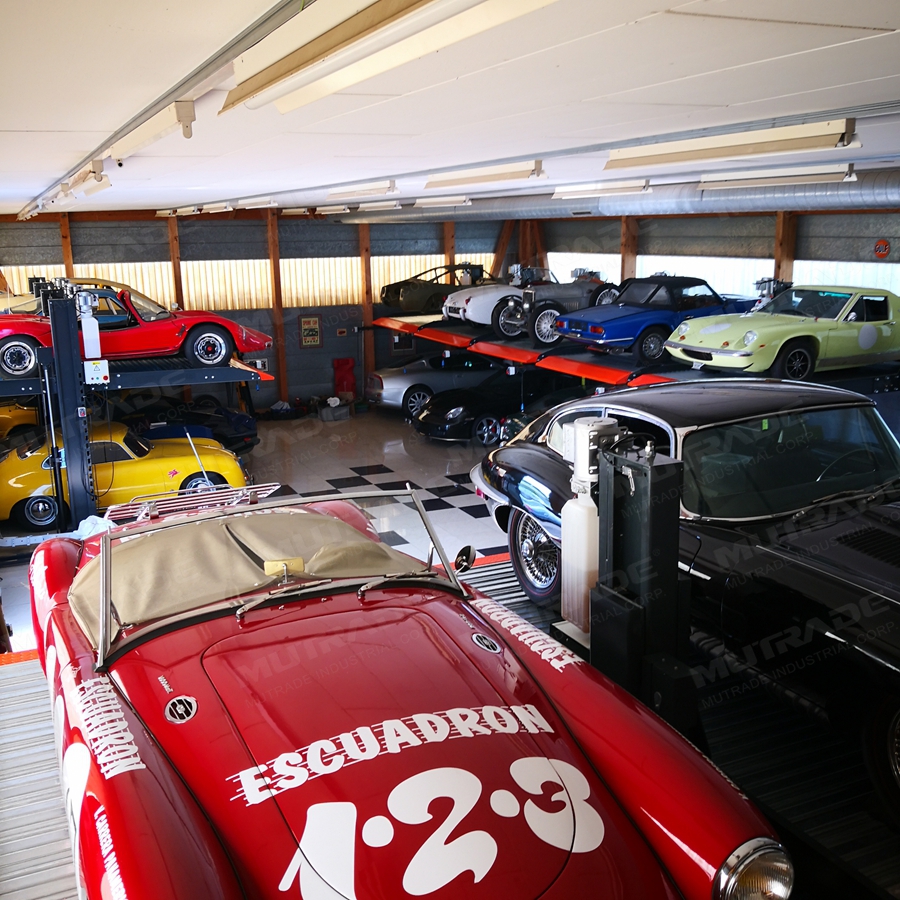
Most parking lift mismatches are structural and electrical, not mechanical. A lift that is correctly engineered can still be the wrong lift for a building if its ceiling requirement, pit requirement or supply voltage does not match the site. The four parameters below decide fit before capacity, finish or price are discussed.
- Ceiling height. The Starke 2327 requires a ceiling height above 2700 mm, and the TPTP-2 was developed around a minimum ceiling of 2900 mm for low-ceiling underground environments. A garage below those limits needs a different structural format, not a smaller version of the same lift.
- Pit availability. The Starke 2127 uses a standard pit depth of 1750 mm, while the Starke 2327 needs a pit above 1600 mm together with its ceiling condition. Sites without excavation potential move to above-ground configurations such as the Hydro-Park 2136 or the Hydro-Park 1127 & 1123.
- Power supply. The TPTP-2 is specified at 220 V 50/60 Hz, the Starke 2127 and Starke 2227 at 200–450 V 50/60 Hz, and several other models across a 110–480 V window. Voltage is a configuration line in the order, not an accessory added later.
- Vehicle envelope. Allowed car height ranges from 1550 mm on the Starke 2327 and TPTP-2 to 2442 mm on the Hydro-Park 2136. A lift that fits the room but not the cars is still a failed selection.
Throughput is the fourth practical filter. A TPTP-2 cycle is listed at 24 seconds; a Hydro-Park 3230 four-level unit is listed at 120 seconds. At a dealership or auto shop where vehicles move during the working day, that difference shapes the workflow. At a long-term storage facility, it rarely does.
How the lift-type parking market is structured
Mechanical parking exists because the number of cars keeps rising while the footprint of buildings does not. Developers, property owners and operators therefore add vertical capacity inside an existing envelope instead of acquiring land. In practice this produces two purchase routes: new-build projects where the lift is specified alongside the structure, and retrofit projects where the lift must adapt to a ceiling, a pit or a column grid that already exists.
Within the product families documented in this guide, every lift-type model lists a hydraulic cylinder as the primary drive, with chains, cables or wire ropes added as the secondary transmission element. The exception is the Hydro-Park 3230, a four-level unit driven manually with a handle. That pattern matters for buyers: when a specification sheet describes a lift as a "hydraulic car parking lift", the buyer still needs to know which secondary element carries the platforms, because that is the component the maintenance schedule will follow.
Manufacturing scale also shapes what a project can ask for. Mutrade Industrial Corp. operates a 12,000 m² factory with 100 employees and a 7-engineer R&D team, produces 10,000 parking spaces per year at a monthly capacity of 1,000 car spaces, and exports 99% of its output. Those figures determine whether a custom voltage, a bespoke platform width or a single-unit trial order is realistic within a normal project schedule.
Detailed solution: reading the drive mode line correctly
Hydraulic cylinder as the primary drive
The TPTP-2 is a two-vehicle tilting parking lift driven by a hydraulic cylinder, rated at 2000 kg, accepting cars up to 5000 mm long, 1850 mm wide and 1550 mm high, with a listed lifting time of 24 seconds, key switch operation and a 220 V 50/60 Hz supply. In the Romanian residential project where 20 units were installed, the unit was documented with a 10° tilting platform, a 1600 mm lifting height, 2100 mm usable platform width, a 2.2 kW pump and a minimum ceiling requirement of 2900 mm.
The S-VRC-2 is a scissor-platform underground lift, also hydraulic cylinder driven, rated at 3000 kg with an allowed car length of 2000–6000 mm and a 208–480 V 50/60 Hz supply. Operation is by push buttons as standard, with a remote controller available as an option. It suits private and residential sites where the lift should disappear into the ground when lowered.

Hydraulic cylinder with chain transmission
Chain transmission appears across the widest set of models, and it is where most comparison work happens.
- Starke 2127 and Starke 2227 — hydraulic cylinder plus chains, 2700 kg per car, 30 seconds lifting time, key switch, 200–450 V 50/60 Hz, cars up to 5000 × 2050 × 1700 mm. The Starke 2127 parks two vehicles per unit; the Starke 2227 parks four.
- Hydro-Park 1127 & 1123 — hydraulic cylinder plus chains, 2700 kg and 2300 kg rated capacity respectively, 50 seconds lifting time, key switch, 110–480 V 50/60 Hz, cars up to 5000 × 1850 × 2050 mm.
- Hydro Park 2525 & 2625 — hydraulic cylinder plus chains, three vehicles per unit, 2500 kg on the second level and 2000 kg on the third level, 68 seconds lifting time, key switch, 110–480 V 50/60 Hz.
- ATP Series — hydraulic cylinder plus chains, 2350 kg rated lifting capacity, 50–120 vehicles per unit, cars up to 5300 × 1900 × 2050 mm, operated by IC card, touch screen or manually, 110–480 V 50/60 Hz.
Hydraulic cylinder with cable or wire rope
Cable and wire rope appear as the secondary transmission element on specific models and in specific projects, and the distinction is worth confirming in writing. The Hydro-Park 2136 is listed with a hydraulic cylinder plus cable drive, a 3600 kg rated capacity, a listed lifting time of 55 seconds or less, key switch operation and a 110–480 V 50/60 Hz supply, accepting cars up to 4566 × 2560 × 2442 mm. In the Australian commercial car storage facility where 18 units of Hydro-Park 2525 were installed, the drive was documented as a hydraulic cylinder with wire ropes for smooth vertical movement.
Because manufacturers use "cable" and "wire rope" for the same functional element, the correct approach at specification stage is to ask which element is listed for the exact model ordered and what inspection the maintenance schedule requires for it. The comparison that matters is not the vocabulary but whether the secondary element, the anti-fall arrangement and the rated capacity per platform are all named in the datasheet.

Manual with handle
The Hydro-Park 3230 is a four-level, four-vehicle parking lift driven manually with a handle, rated at 3000 kg, with a listed lifting time of 120 seconds, key switch operation, 208–480 V 50/60 Hz supply, and an allowed car envelope of 8912 × 2100 × 2000 mm. It is the configuration to examine when the requirement is maximum vertical stacking with a mechanical rather than powered drive.
Power supply: 220 V, 380 V and 200–450 V in practice
Power supply is a configuration line in every model in this list, and the ranges differ by product family. A site survey that does not record voltage, phase and frequency will produce a quotation that has to be revised.
- 220 V, 50/60 Hz — TPTP-2, described as a bespoke supply in the specification.
- 200–450 V, 50/60 Hz — Starke 2127 and Starke 2227.
- 208–480 V, 50/60 Hz — Hydro-Park 3230 and S-VRC-2.
- 110–480 V, 50/60 Hz — Hydro-Park 2136, Hydro-Park 1127 & 1123, Hydro Park 2525 & 2625 and the ATP Series.
A 380 V three-phase site falls inside the 200–450 V and the 110–480 V windows, so the question is not whether the model can run on it but whether the unit is configured for it at order stage. One documented private-garage installation in France specified a Starke 2227 at 200–480 V, 3 phase, 50/60 Hz — an example of how the supply line is written into the order rather than assumed. Voltage is also listed as a customization item alongside logo, parking width, system height and colour, so the supply requirement should be part of the initial inquiry, not a late change.
Lifting time: what 24 seconds to 120 seconds changes
Lifting time is a cycle figure, and its importance depends on how often the lift is used. The spread across the models here is wide enough to make it a real selection criterion rather than a datasheet detail.
| Model | Listed lifting time | Vehicles per unit |
|---|---|---|
| TPTP-2 | 24 s | 2 |
| Starke 2127 | 30 s | 2 |
| Starke 2227 | 30 s | 4 |
| Hydro-Park 1127 & 1123 | 50 s | 2 |
| Hydro-Park 2136 | ≤55 s | 2 |
| Hydro Park 2525 & 2625 | 68 s | 3 |
| Hydro-Park 3230 | 120 s | 4 |
At a dealership in Canada using eight Hydro-Park 1127 units for display and inventory storage, the rising and descending time was documented as under 55 seconds with a 2.2 kW hydraulic power pack — fast enough to move vehicles during showroom hours and to streamline the retrieval process. In the Polish residential retrofit where 50 units of Starke 2127 were installed, the hydraulic pump was specified at 5.5 kW with a rising and descending time under 55 seconds, and independent access to both vehicles meant the lower car never had to be moved to reach the upper one.

Structural configuration: pit, above-ground, tilting and underground
Structural format is decided by the building, not by preference. The same capacity can be delivered by a pit unit, an above-ground stacker, a tilting lift or a fully underground scissor platform, and each carries a different site requirement.
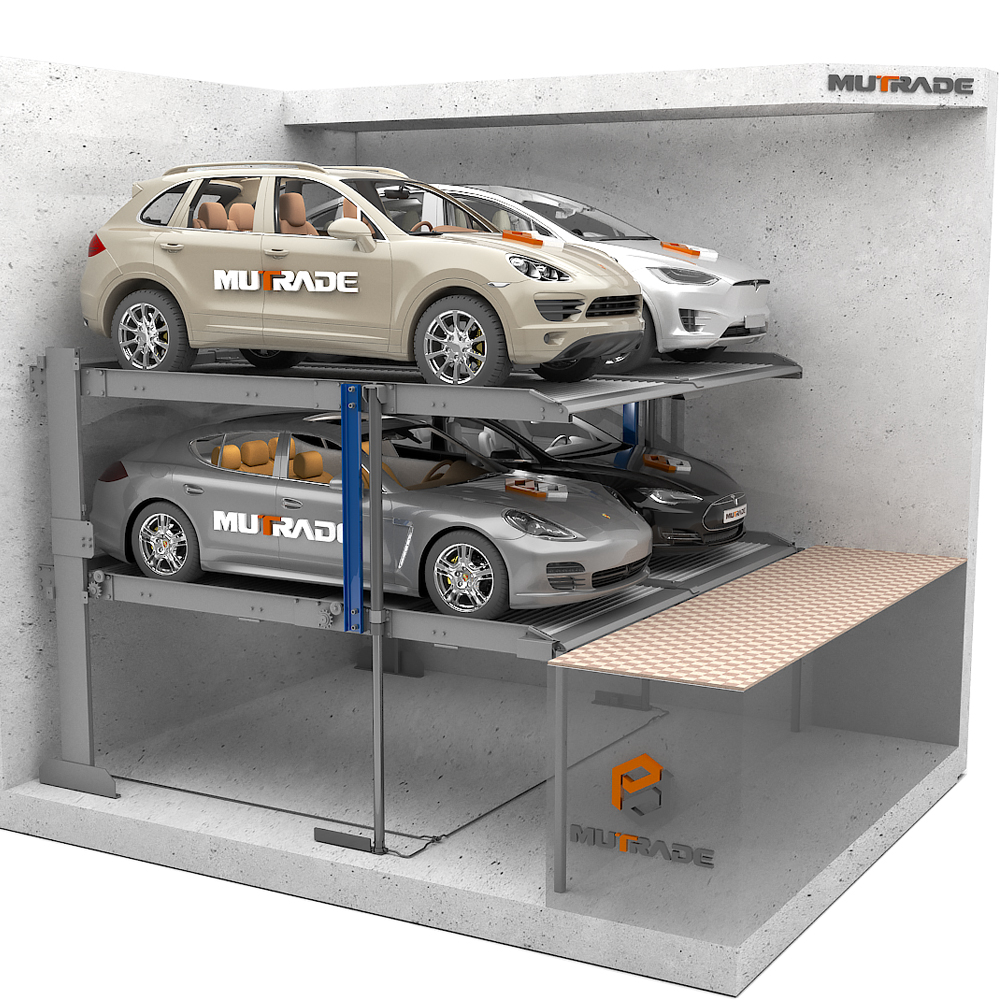
- Pit units. Starke 2127 uses a standard pit depth of 1750 mm and gives independent access to both cars; Starke 2227 stacks four cars per unit in the same 1700 mm car-height envelope; Starke 2327 reduces the pit requirement to above 1600 mm with a ceiling above 2700 mm, which is the configuration used in the Bucharest retrofit of 14 units in a basement with limited headroom.
- Above-ground units. Hydro-Park 2136 is a four-post unit rated at 3600 kg with a 2442 mm allowed car height; Hydro-Park 1127 & 1123 stack two cars with no excavation; Hydro Park 2525 & 2625 stack three cars and were documented in Australia with a 2100 mm clear height on each level, accommodating SUVs and standard vehicles.
- Tilting units. TPTP-2 uses a 10° tilting platform to work within a 2900 mm minimum ceiling, converting low-headroom space that would otherwise be unusable.
- Underground units. S-VRC-2 lowers flush with the ground and accepts car lengths from 2000 mm to 6000 mm, with a 3000 kg rating.
Step-by-step: matching a lift to a site and a vehicle
- Measure the envelope. Record ceiling height, available pit depth, column spacing and driveway width. Compare against the model limits: Starke 2327 needs a ceiling above 2700 mm and a pit above 1600 mm; TPTP-2 works from a 2900 mm ceiling; Starke 2127 expects a 1750 mm pit.
- List the vehicles. Take the largest car in the fleet and check it against the allowed dimensions: 5000 × 2050 × 1700 mm on the Starke 2127 and Starke 2227, 5000 × 1850 × 2050 mm on the Hydro-Park 1127 & 1123, 4566 × 2560 × 2442 mm on the Hydro-Park 2136, 5060 × 2802 × 2050 mm on the Hydro Park 2525 & 2625, 5300 × 1900 × 2050 mm on the ATP Series.
- Set the stacking depth. Decide between two, three or four vehicles per unit. Note that capacity is rated per platform, not per unit, on multi-level models: Hydro Park 2525 & 2625 carries 2500 kg on level two and 2000 kg on level three.
- Choose the drive mode. Confirm whether the unit is hydraulic cylinder only, hydraulic cylinder plus chain, or hydraulic cylinder plus cable or wire rope, and confirm the anti-fall arrangement for that model.
- Match the power supply. Record site voltage, phase and frequency and map it to the model range — 220 V on the TPTP-2, 200–450 V on the Starke 2127 and Starke 2227, 208–480 V on the Hydro-Park 3230 and S-VRC-2, 110–480 V on the Hydro-Park 2136, Hydro-Park 1127 & 1123, Hydro Park 2525 & 2625 and ATP Series.
- Define the operation interface. Key switch is standard on most models in this list; push buttons with optional remote control on the S-VRC-2; IC card, touch screen or manual on the ATP Series.
- Confirm documentation. Request the certificate that names the exact model and destination market, plus the installation and maintenance schedule for the transmission element in that model.
Use cases: how the parameters combine
Auto shops and dealerships
Vehicle display and storage put a premium on cycle time, footprint and safe access. Eight Hydro-Park 1127 units at a luxury dealership in Canada created 16 spaces in the existing indoor footprint, doubled capacity, improved the visual display of vehicles for buyers, and used key switch operation with 24 V control voltage. The installation is documented as TUV compliant and CE certified to 2006/42/EC and EN14010, with cars up to 5000 × 1850 × 2050 mm supported. Where the vehicle mix includes heavier units, the figure to check is rated capacity — the Hydro-Park 2136 lists 3600 kg.
Residential underground parking
Low ceilings and shallow pits define this category. Twenty TPTP-2 units in a Romanian residential complex doubled capacity in a low-ceiling underground garage by using a tilting platform. Fifty Starke 2127 units in a Polish residential and commercial complex doubled capacity from 50 to 100 spaces without expanding the footprint and without new construction. Thirty-five Starke 2127 units in a Russian development provided 70 spaces with independent access to each vehicle. Fourteen Starke 2327 units in Bucharest addressed basements with headroom under 3 metres.
Commercial car storage and high-density sites
Where utilization is the business model, three and four-level stacking plus automated retrieval justify the investment. Eighteen Hydro-Park 2525 units in Australia created 54 spaces, tripling capacity within the existing footprint, with TUV Rheinland and EAC certification. The ATP Series moves to a different scale: 50–120 vehicles per unit at 2350 kg per space, operated by IC card or touch screen.
Model comparison on selection parameters
| Model | Drive mode | Vehicles per unit | Rated capacity | Lifting time | Power supply | Operation |
|---|---|---|---|---|---|---|
| TPTP-2 | Hydraulic cylinder | 2 | 2000 kg | 24 s | 220 V, 50/60 Hz | Key switch |
| Starke 2127 | Hydraulic cylinder + chains | 2 | 2700 kg | 30 s | 200–450 V, 50/60 Hz | Key switch |
| Starke 2227 | Hydraulic cylinder + chains | 4 | 2700 kg per car | 30 s | 200–450 V, 50/60 Hz | Key switch |
| Starke 2327 | Hydraulic cylinder + chains | 2 | 2700 kg | Not listed | Not listed | Key switch |
| Hydro-Park 1127 & 1123 | Hydraulic cylinder + chains | 2 | 2700 kg / 2300 kg | 50 s | 110–480 V, 50/60 Hz | Key switch |
| Hydro-Park 2136 | Hydraulic cylinder + cable | 2 | 3600 kg | ≤55 s | 110–480 V, 50/60 Hz | Key switch |
| Hydro Park 2525 & 2625 | Hydraulic cylinder + chains | 3 | 2500 kg 2F / 2000 kg 3F | 68 s | 110–480 V, 50/60 Hz | Key switch |
| Hydro-Park 3230 | Manual with handle | 4 | 3000 kg | 120 s | 208–480 V, 50/60 Hz | Key switch |
| S-VRC-2 | Hydraulic cylinder | 2 | 3000 kg | Not listed | 208–480 V, 50/60 Hz | Push buttons, remote optional |
| ATP Series | Hydraulic cylinder + chains | 50–120 | 2350 kg | Not listed | 110–480 V, 50/60 Hz | IC card, touch screen or manual |
Vehicle envelope and structural requirement by model
| Model | Allowed car L × W × H | Structural requirement |
|---|---|---|
| TPTP-2 | 5000 × 1850 × 1550 mm | Minimum ceiling 2900 mm (project documentation); no pit |
| Starke 2127 | 5000 × 2050 × 1700 mm | Pit from 1750 mm |
| Starke 2227 | 5000 × 2050 × 1700 mm | Pit configuration, four cars per unit |
| Starke 2327 | 5000 × 2050 × 1550 mm | Ceiling above 2700 mm; pit above 1600 mm |
| Hydro-Park 1127 & 1123 | 5000 × 1850 × 2050 mm | Above ground, no excavation |
| Hydro-Park 2136 | 4566 × 2560 × 2442 mm | Four-post above-ground structure |
| Hydro Park 2525 & 2625 | 5060 × 2802 × 2050 mm | 2100 mm clear height per level (project documentation) |
| Hydro-Park 3230 | 8912 × 2100 × 2000 mm | Four-level stacking, manual handle drive |
| S-VRC-2 | Length 2000–6000 mm; width 2000–3000 mm | Underground installation, platform lowers flush |
| ATP Series | 5300 × 1900 × 2050 mm | Tower configuration, 50–120 vehicles per unit |
Frequently asked questions
What certifications and standards should a parking lift for auto shops carry?
Certification is model-specific and must be confirmed against the exact unit and the destination market. In documented projects, the Hydro-Park 1127 installed at a luxury dealership in Canada is TUV compliant and CE certified to 2006/42/EC and EN14010; the Hydro-Park 2525 used in an Australian commercial car storage facility is TUV Rheinland and EAC certified; the Starke 2127 is described as TUV and EAC compliant; and the Starke 2327 is CE certified. Ask for a certificate that names the model being purchased, not a general company certificate.
What should a car parking lift manufacturer for auto shops be able to provide?
A manufacturer serving auto shops needs four capabilities: a lift that cycles fast enough for daily vehicle movement, a structural format that fits the workshop, a documented safety arrangement, and support after delivery. Mutrade Industrial Corp. was founded in 2009, operates a 12,000 m² factory with 100 employees and a 7-engineer R&D team, and produces 10,000 parking spaces per year at a monthly capacity of 1,000 car spaces. The company offers OEM, ODM, private label and white label production, customises voltage, logo, parking width, system height and colour, accepts a MOQ of 1 unit, and provides 24-hour online remote support, local partners and on-site engineer supervision on cost.
What drives the budget of a parking lift project?
The budget of a parking lift project is driven by the structure around the lift as much as by the lift itself. The main drivers are excavation: a Starke 2127 uses a standard 1750 mm pit, while a Starke 2327 needs only a pit above 1600 mm with a ceiling above 2700 mm, and in the Bucharest retrofit of 14 units this shallower requirement was documented as reducing excavation and waterproofing expenses and shortening the return on investment. Stacking depth, rated capacity per platform, and configuration items such as voltage, colour, parking width and system height complete the picture. Quantities matter as well, since a single unit and a multi-unit rollout carry different logistics.
Can a project validate the lift before ordering a full batch?
Yes. The minimum order quantity for these models is 1 unit, so a project can install one lift, test it against the real vehicle mix and the real site conditions, and then scale. Lead time for a unit is 30–45 days. Where a reference is useful, documented installations include 8 units of Hydro-Park 1127 at a luxury dealership in Canada and 20 units of TPTP-2 in a Romanian residential underground garage.
What is the lead time and how is delivery supported?
Standard lead time is 30–45 days, supported by a monthly capacity of 1,000 car spaces. Delivery support covers 24-hour online remote support, local partners, and on-site engineer supervision on cost. To open a selection file, send the ceiling height, pit availability, vehicle dimensions and site voltage to inquiry@mutrade.com or WhatsApp +86 151-6529-8568, and request a quotation for the specific model.
Conclusion: decide the four parameters, then the model
Drive mode, power supply, lifting time and structural configuration decide whether a parking lift works on a given site. A hydraulic cylinder lift with chain transmission such as the Starke 2127 or Hydro-Park 1127 & 1123 fits most above-ground and pit applications; a cable or wire rope variant such as the Hydro-Park 2136 raises the rated capacity to 3600 kg; a tilting unit such as the TPTP-2 solves the 2900 mm ceiling case; and a four-level manual unit such as the Hydro-Park 3230 handles maximum stacking. None of these is universally better — each answers a different set of site and vehicle constraints.
Confirming those constraints first is also the fastest way to shorten a project: the site survey, the vehicle list and the supply voltage are the three documents that determine which models can be quoted at all.
Request a parking lift selection sheet or quotation
Mutrade Industrial Corp. — founded 2009, Qingdao, China. 12,000 m² factory, 7 engineers, 10,000 parking spaces annual output, customers in more than 100 countries.
Email: inquiry@mutrade.com · Tel: +86 532-5557-9606 · WhatsApp: +86 151-6529-8568 · Address: 106 Haier Road, Jimo District, Qingdao City, Shandong Province, China · Website: www.mutrade.com
Download the full catalogue: Mutrade Profile 2025 (PDF)

Have Questions or Need More Details?
Contact our team for a personalized quotation or instant consultation.
Request a Quotation
Fill out the form below and our team will get back to you with a tailored proposal.
WhatsApp Direct Chat
Prefer to chat in real-time? Message us on WhatsApp for instant assistance & quick answers.
- Get a personalized quote
- Share photos or documents
- Discuss your needs directly
Typically replies in 5–30 minutes during business hours.