Hydraulic vs. Cable Drive in Parking Lifts: A Technical Breakdown for Engineers
Hydraulic vs. Cable Drive in Parking Lifts: A Technical Breakdown for Engineers
For a specification engineer, the words “hydraulic parking lift” answer almost nothing. They describe the prime mover, not the machine. The decisions that actually determine lifting speed, structural sizing, power supply, safety redundancy and the ten-year maintenance routine sit in the components between the cylinder and the platform — and those components differ from model to model. This breakdown works through documented drive architectures in Mutrade’s parking lift range, including the Starke 2227 pit lift and the S-VRC-2 scissor platform, and shows how each parameter changes what you can specify.
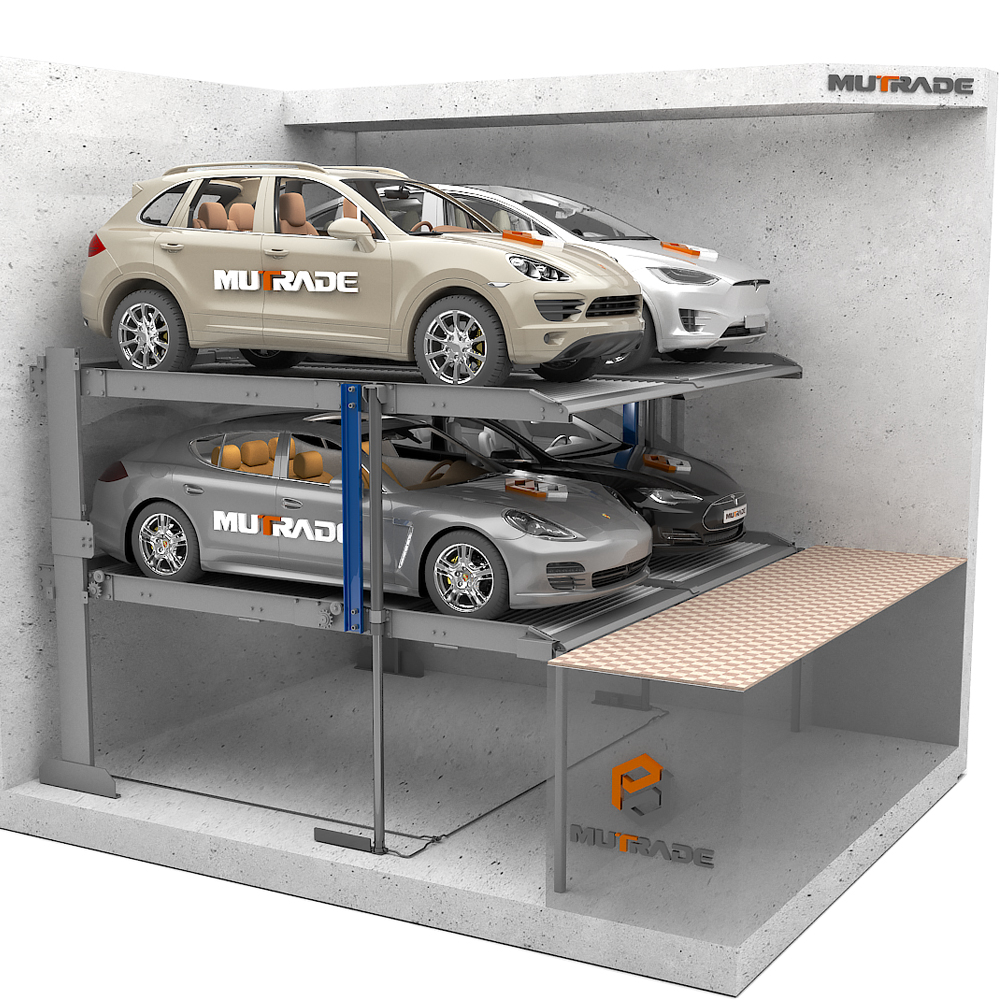
Starke 2227 pit parking lift: hydraulic cylinder drive with chain transmission, rated 2700 kg per car, four vehicles per unit, 30-second lifting time.
The Specification Problem: “Hydraulic” Covers Three Different Machines
A parking lift datasheet normally compresses its drive system into a single line. That line is the one engineers should read most carefully, because it hides a chain of decisions: how the load is raised, how two or more lifting points stay synchronized, how the platform is held when the power fails, and how much maintenance access the structure will demand over its service life.
In practice, three configurations appear repeatedly across documented models:
- Hydraulic cylinder + chains — used on Starke 2227, Starke 2127, Starke 3121 & 3127, Hydro-Park 1027, Hydro-Park 1127 & 1123, Hydro-Park 2525 & 2625, the ARP Series, the MLP Series and the ATP Series.
- Hydraulic cylinder + wire rope — the specified drive mode of the BDP-2 puzzle parking lift.
- Hydraulic cylinder + cable — the specified drive mode of the Hydro-Park 2136 four-post storage lift.
Two further models show why “hydraulic” alone is insufficient. The S-VRC-2 is specified simply as hydraulic cylinder drive, because the scissor platform carries the load directly with no long transmission run. The FP-VRC floor-to-floor car elevator is specified as a hydraulic cylinder with double steel chains. Same prime mover family, four different mechanical answers — and four different maintenance profiles.
Buyers comparing “hydraulic versus cable” should always confirm the transmission type per model rather than per brand. For example, the Starke 2227 is documented as hydraulic cylinder + chains, the BDP-2 as hydraulic cylinder + wire rope, and the Hydro-Park 2136 as hydraulic cylinder + cable. The lifting principle is hydraulic in all three cases; only the transmission element changes.
Industry Background: Why Hydraulic Drive Owns This Category
Hydraulic drive is not a legacy choice in mechanical parking — it is the dominant one. According to Dataintelo’s car lifts market analysis, hydraulic mechanisms hold a 57.2% share of the global car lift market, with reliability in heavy-duty applications cited as the primary driver. The same source values the global car lifts market (parking and service lifts combined) at USD 2.8 billion in 2025, projected to reach USD 4.7 billion by 2034.
The narrower car stacker segment shows the same direction. QYResearch valued the global car stacker lift market at approximately USD 4.6 billion in 2023, with growth to USD 6.72 billion expected by 2030. Regionally, Custom Market Insights places North America as the largest and fastest-growing vehicle lift market at USD 3.25 billion in 2024, supported by high light-truck ownership.
That growth changes what engineers are asked to deliver. A single-unit private garage and a 926-space office complex (as delivered for a Mutrade client in Saudi Arabia using the BDP-2 semi-automatic puzzle system) sit in the same category but obey completely different drive requirements. Compliance frameworks reflect this: automated parking systems are expected to align with quality and occupational safety management systems such as ISO 9001 and ISO 45001 to mitigate vehicle–pedestrian conflict risk, per Pacific Certifications.
Competitive context matters too. BendPak is identified as a major player in the North American vehicle lift market and operates the eight-armed Octa-Flex car lift as of 2024. That kind of development pushes the whole category toward higher specification transparency, which is good for buyers: engineers now have more public parameters to compare, and fewer excuses for specifying on brochure adjectives.
Inside the Drive: How a Hydraulic Parking Lift Actually Moves a Car
1. The prime mover: hydraulic cylinder and power pack
Every hydraulic parking lift in this range converts electrical energy into hydraulic pressure, then into linear force. What differs is how the pressure is distributed. Some projects use an independent hydraulic power unit per lift; others use a centralized hydraulic power unit serving a bank of lifts. Both options are listed as supporting equipment alongside the electric control system and safety protection devices.
Pump sizing follows the load and the required cycle time. Documented examples illustrate the range: a 2.2 kW hydraulic power pack on the Hydro-Park 1127 residential project in Russia, a 3.0 kW pump on the Hydro-Park 2525 installation for an auto shop in Uruguay, a 5.5 kW pump on the Starke 2127 underground project in Poland, and 5.5 kW / 7.5 kW options on the Starke 2227 private garage installation in France. The FP-VRC car elevator uses a 4 kW hydraulic power pump for floor-to-floor duty.
2. The transmission: chain, wire rope or cable
This is where the engineering consequence becomes visible. The transmission element transfers cylinder force to the platform and keeps multiple lifting points moving together.
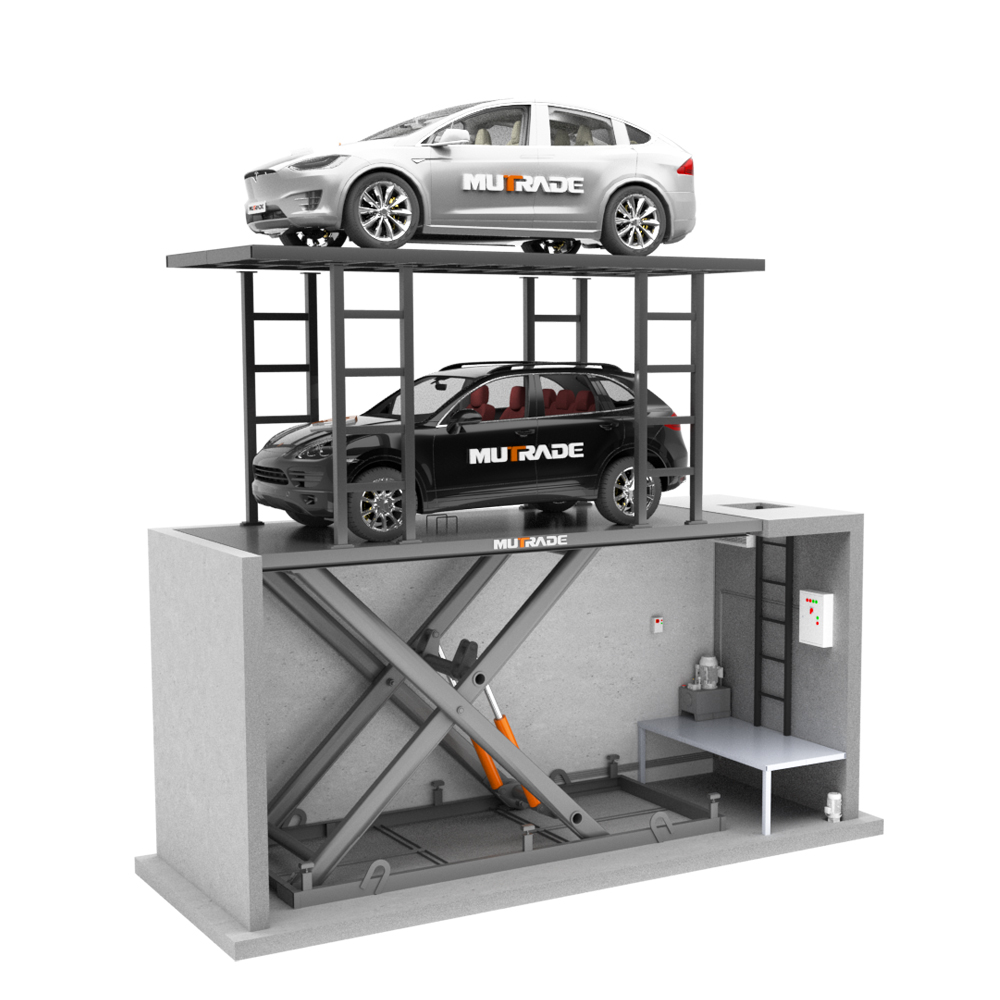
S-VRC-2 scissor lift platform: direct hydraulic cylinder drive, 3000 kg rated capacity, 208–480 V power supply, push-button operation with optional remote control.
Chain transmission is the most widely documented configuration in the range. It is specified on pit lifts (Starke 2227, Starke 2127), puzzle systems (Starke 3121 & 3127), two-post stackers (Hydro-Park 1127 & 1123), triple stackers (Hydro-Park 2525 & 2625), single-post display lifts (Hydro-Park 1027), and the automated families (ARP, MLP and ATP Series). Chain drives suit long vertical runs where synchronization across two or four corners must be maintained mechanically.
Wire rope appears on the BDP-2 semi-automatic puzzle parking lift, a system that parks more than five vehicles per unit with a 380 V supply and a travel speed of 8–12 m/min. Cable is specified on the Hydro-Park 2136 four-post storage lift, which parks two vehicles with a 3600 kg rated capacity and a lifting time of 55 seconds or less.
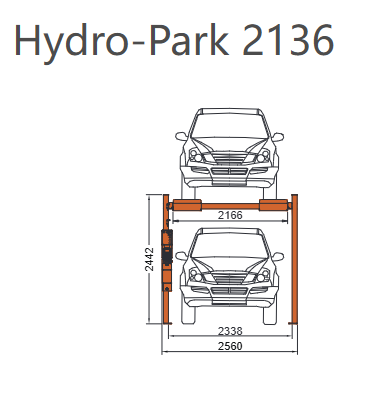
Hydro-Park 2136 four-post storage lift: hydraulic cylinder with cable transmission, 3600 kg rated capacity, lifting time 55 seconds or less, 110–480 V.
The S-VRC-2 removes the transmission question entirely. With a scissor structure, the hydraulic cylinder acts directly on the platform, which is why the datasheet lists drive mode as hydraulic cylinder only. The trade-off is travel geometry: a scissor platform is well suited to underground garage elevators and pit applications such as private residential installs, where a documented project in Germany used two units with a maximum lifting height of 13 m and a platform up to 5000 mm wide and 6000 mm long.
3. The safety layer: locks, control voltage and redundant detection
Drive architecture and safety architecture are separate systems, and engineers should review them separately. Documented safety features across installed projects include dynamic mechanical anti-falling locks with electric auto release, embedded mechanical anti-fall systems, lock release failure detection, semi-automatic lock release, emergency stop buttons, limit switches, overload protection and photocell sensors.
Control voltage is a frequently overlooked specification. A documented Hydro-Park 1127 deployment in Russia uses 24 V control voltage for electric shock protection, as does a Starke 2227 installation in France. Where a pit or sloping floor is involved, self-standing structures allow relocation without permanent installation — relevant for retrofit projects where the building may be reconfigured later.
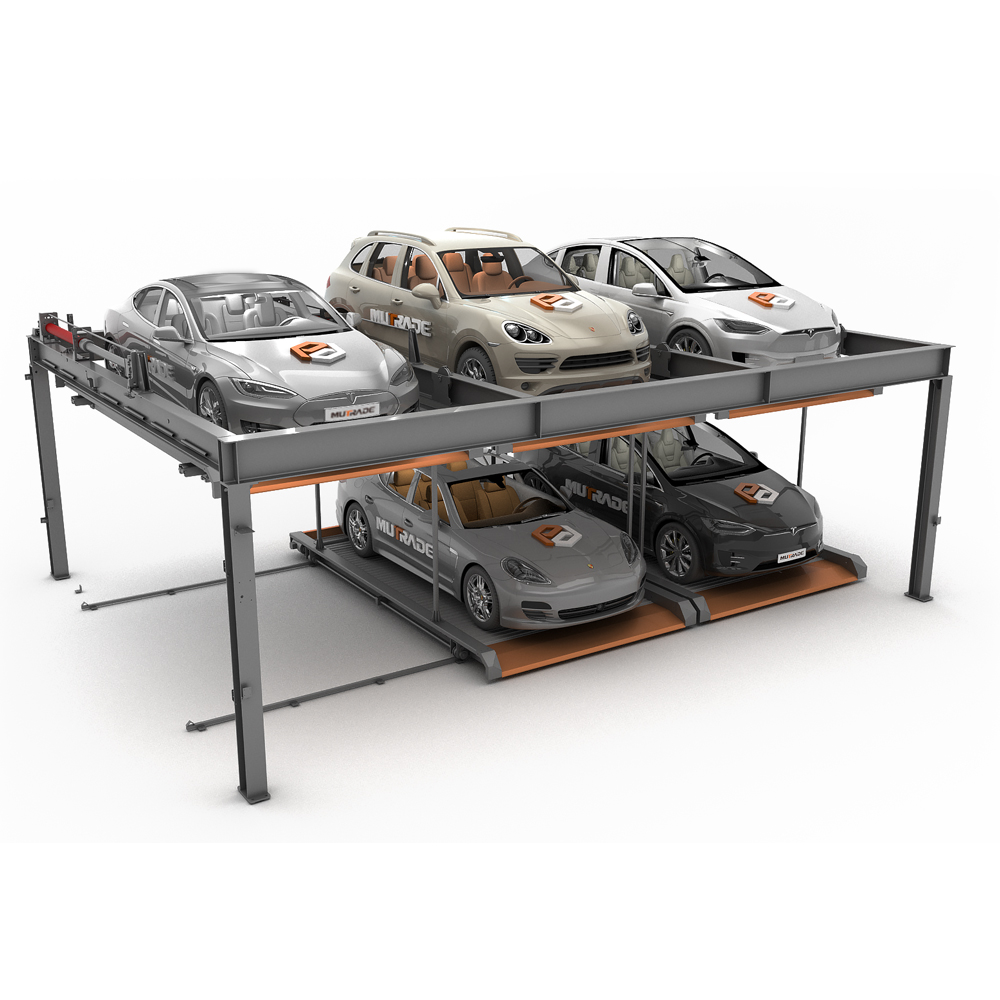
BDP-2 semi-automatic puzzle parking lift: hydraulic cylinder with wire rope drive, 380 V supply, 8–12 m/min travel speed, more than five vehicles per unit.
Operational Parameters That Change the Specification
Lifting speed and cycle time
Lifting figures in this range are published in two different units, and mixing them up is a common specification error. Some models are quoted as a linear speed; others as a total cycle time.
- Linear speed figures: 8–12 m/min on the Starke 3121 & 3127 puzzle system and on the BDP-2; 4 m/min on the FP-VRC car elevator; up to 75 m/min on the MLP Series and up to 120 m/min on the ATP Series, as listed on those datasheets.
- Cycle time figures: 24 s on the TPTP-2 tilting lift; 30 s on the Starke 2227 and Starke 2127; 45 s on the Hydro-Park 1027; 50 s on the Hydro-Park 1127 & 1123; 55 s or less on the Hydro-Park 2136; 68 s on the Hydro-Park 2525 & 2625; 80 s on the Hydro-Park 3130; 120 s on the Hydro-Park 3230; 90–150 s on the ARP Series.
The S-VRC-2 is quoted differently again — as a lifting rate of 4 lifts per minute — which reflects its role as a repeated short-travel garage elevator rather than a storage stacker. A no-load reference of 4000 mm/min with a 3.0 kW pump is documented for a Hydro-Park 2525 installation in Uruguay.
For an engineer, the practical rule is that speed is rarely the binding constraint. In low-ceiling or dense-stacking layouts, the limiting factor is usually vertical clearance and platform travel, not pump output. Cycle time becomes commercially relevant only where the lift sits in a throughput path, such as a dealership retrieval area or a valet queue.
Power supply requirements
Voltage is bespoke across the range, which matters for import projects where the local grid does not match a supplier’s domestic standard. Documented supply specifications include:
- 200–450 V, 50/60 Hz — Starke 2227, Starke 2127, Starke 3121 & 3127
- 208–480 V, 50/60 Hz — Hydro-Park 3130, Hydro-Park 3230, S-VRC-2
- 110–480 V, 50/60 Hz — Hydro-Park 1027, Hydro-Park 1127 & 1123, Hydro-Park 2136, Hydro-Park 2525 & 2625, MLP Series, ATP Series
- 380 V, 50/60 Hz — BDP-2
- 220 V, 50/60 Hz — TPTP-2
- 480 V / 415 V / 380 V / 220 V, 50/60 Hz — ARP Series
A documented Starke 2227 installation in France operates on 200–480 V, three phase, 50/60 Hz. Voltage is listed as a customization option alongside logo, parking width, system height and color, so the electrical interface can be matched to the destination market rather than adapted on site.
Structural material and corrosion protection
Every model reviewed here is specified with carbon steel Q235 as the primary structural material. Material grade alone, however, does not determine service life in a parking structure — surface treatment does. Documented finishing and durability measures include galvanized platforms, anti-slip wave plates with drainage function, and AkzoNobel powder coating for rust protection on Hydro-Park 1127 installations in Russia and Canada. On a Starke 2227 private garage project in France, all bolts and nuts passed a 72-hour salt spray test.
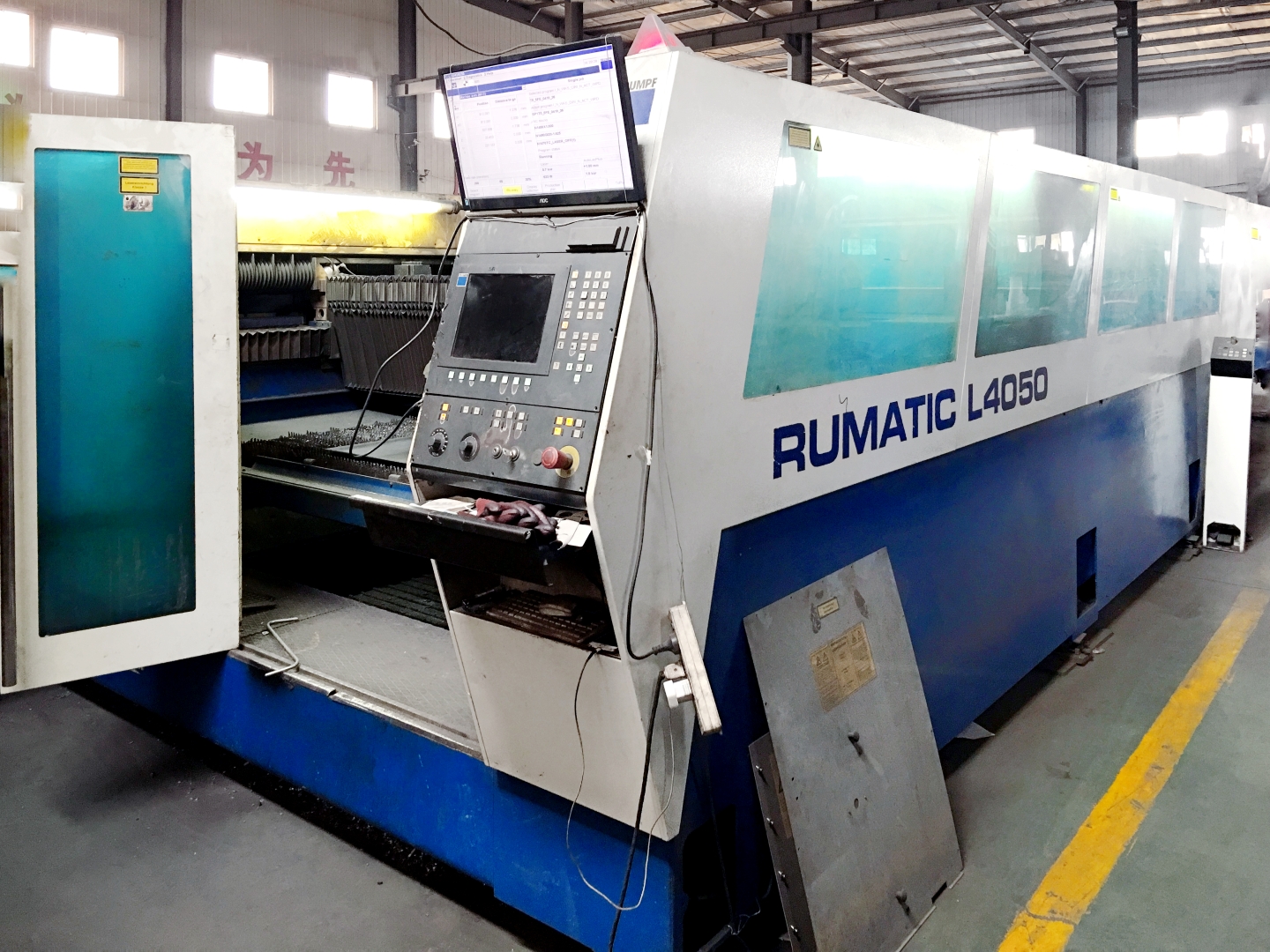
Carbon steel Q235 components are laser cut before forming and welding — the structural starting point for every model discussed in this breakdown.
For outdoor or partially exposed installations, an outdoor package and rust-resistance performance against snow and melting agents are listed among the custom requirements for parking projects. Where a lift sits under a bridge, in a wash-down area or in a coastal environment, that specification line carries more weight than any lifting-speed figure on the datasheet.
Step-by-Step: Specifying a Drive System for a Project
The following sequence follows the order in which the parameters actually constrain each other. Skipping a step usually forces a redesign later.
Step 1 — Fix the vehicle envelope and load per platform. Confirm length, width and height limits before choosing a model. Documented envelopes range from 4148 × 2679 × 2000 mm on the Hydro-Park 1027 to 8912 × 2100 × 2000 mm on the Hydro-Park 3230. Rated capacity per platform runs from 2000 kg on the TPTP-2 and ARP Series sedan configuration to 3600 kg on the Hydro-Park 2136.
Step 2 — Measure the envelope the building actually offers. Ceiling and pit dimensions eliminate more models than any other constraint. The Starke 2327 requires a ceiling height above 2700 mm and a pit depth greater than 1600 mm. The TPTP-2 was designed around a minimum ceiling of 2900 mm, and was deployed in an under-bridge municipal project in Bulgaria with a 3.1–3.3 m ceiling and an 8% ground slope.
Step 3 — Set the throughput target. Decide whether the lift is a storage device or part of an operational flow. A 90–150 s ARP carousel and a 30 s Starke 2227 pit lift are both “hydraulic”, but they serve entirely different duty cycles.
Step 4 — Match the electrical supply. Confirm phase, voltage and frequency at the point of connection, then specify voltage as a customization item. Confirm the pump rating against the platform load rather than against the building’s spare capacity.
Step 5 — Select the transmission element. Chain, wire rope or cable should be chosen against travel length, number of synchronized lifting points, environment and maintenance access — not against a generic preference.
Step 6 — Confirm certification for the destination market. CE certification under the Machinery Directive governs the EU; welding certification to CSA W47.1 governs structural fabrication for North America. Certificate scope must match the exact model, not just the brand.
Step 7 — Lock the maintenance plan before the order. Independent versus centralized hydraulic power units, lock release access, and the wear-part list should be agreed while drawings are still editable.
Maintenance Differences Between Chain, Wire Rope and Cable Drives
Hydraulic prime movers are maintained largely the same way regardless of transmission: hydraulic oil condition, seal integrity, pump and motor behaviour, and pressure stability. The divergence appears in the mechanical transmission and the safety lock interface.
Chain drives introduce multiple articulating joints. In normal industrial practice, chains require periodic inspection for elongation and adequate lubrication, and the chain path must remain free of debris. Their advantage in a parking lift is that synchronization across lifting points is mechanically enforced by the chain run itself, which is why chain transmission dominates the multi-post models in this range.
Wire rope and cable drives concentrate wear inside the rope or cable and at the sheave or drum interface rather than at visible joints. Inspection therefore focuses on the rope or cable itself and on the termination points. Their advantage is a quieter, more compact routing, which matters in puzzle systems such as the BDP-2 where platforms travel behind one another.
Direct cylinder drives such as the S-VRC-2 remove the long transmission run altogether, which simplifies the wear-part list but places the full synchronization duty on the hydraulic and control system.
The safety layer needs its own routine. Documented installations use dynamic anti-falling locks with electric auto release, embedded mechanical anti-fall systems, and lock release failure detection. A documented Hydro-Park 2525 deployment adds semi-automatic lock release and an emergency stop button to that list. For power-failure scenarios, manual car removal is listed as a supported special requirement on covered indoor storage configurations.
One practical maintenance specification worth writing into the contract: access. A centralized hydraulic power pack reduces the number of service points but concentrates the risk of a single outage; independent power units isolate faults but multiply the inspection route. Both are valid — the error is leaving the choice open until commissioning.
Use Cases: Where Each Drive Configuration Fits
Pit parking for residential and commercial basements. The Starke 2127 doubled capacity from 50 to 100 spaces without expanding the footprint on a Polish residential and commercial project, using a centralized hydraulic power pack for cost-effectiveness, a 5.5 kW pump and a pit depth from 1750 mm. The Starke 2227 serves the same logic in a private French garage, with 2700 kg per space and a cable anti-falling system paired with Korean-manufactured chains.
Low-ceiling and sloping structures. The TPTP-2 addresses the most punishing sites. Twenty units were installed in a Romanian residential complex with a minimum ceiling of 2900 mm and a 10° tilting platform. A Bulgarian municipal project placed 45 units under an overpass — 90 parking spaces in a space with a 3.1–3.3 m ceiling, an 8% slope and structural columns — using IP65-rated weatherproof components.
Commercial vertical storage. Eighteen Hydro-Park 2525 units created 54 spaces for an Australian car storage business, with 2500 kg capacity on the second floor and 2000 kg on the third, clear height of 2100 mm per floor, and TUV Rheinland and EAC certification. Four additional units were deployed at an auto shop in Uruguay for repair and storage workflow.
Multiple-unit residential expansion. A Russian residential developer installed 206 Hydro-Park 1127 units — 412 parking spaces, half on the ground floor and half on the roof — doubling capacity within the existing footprint over a three-year programme.
Underground and floor-to-floor movement. The S-VRC-2 handles invisible pit installations for private and luxury residential properties, with drive-through alignment when lowered and customizable width, length and travel. The FP-VRC covers heavier duty: a Russian dealership uses a 4000 kg unit at 4 m/min for vehicle and goods movement between floors, and a French business facility uses a 2000–6000 kg configuration with zero electricity consumption during descent.
Automated and semi-automated scale. The BDP-2 semi-automatic puzzle system delivered 926 parking spaces for an office complex in Saudi Arabia and 216 spaces on a business district roof in Costa Rica, where 15 or more safety devices are documented, including card readers, entrance detection, positioning limit switches and anti-falling frames.
Comparison Table: Drive Configurations and Documented Parameters
| Model | Drive configuration (as specified) | Capacity and vehicle envelope | Lifting figure | Power supply | Primary application |
|---|---|---|---|---|---|
| Starke 2227 | Hydraulic cylinder + chains | 4 vehicles; 2700 kg per car; 5000 × 2050 × 1700 mm | 30 s | 200–450 V, 50/60 Hz | Pit parking, residential and commercial |
| Starke 2127 | Hydraulic cylinder + chains | 2 vehicles; 2700 kg; 5000 × 2050 × 1700 mm | 30 s | 200–450 V, 50/60 Hz | Underground pit parking |
| S-VRC-2 | Hydraulic cylinder (scissor platform, direct) | 2 vehicles; 3000 kg; 2000–6000 mm L / W / H | 4 lifts per minute | 208–480 V, 50/60 Hz | Underground garage elevator, luxury homes |
| BDP-2 | Hydraulic cylinder + wire rope | More than 5 vehicles; 2000/2500 kg; 5000 × 1850 × 1550/2050 mm | 8–12 m/min | 380 V, 50/60 Hz | Semi-automatic puzzle, multilevel |
| Hydro-Park 2136 | Hydraulic cylinder + cable | 2 vehicles; 3600 kg; 4566 × 2560 × 2442 mm | 55 s or less | 110–480 V, 50/60 Hz | 4-post vehicle storage |
| Hydro-Park 1127 & 1123 | Hydraulic cylinder + chains | 2 vehicles; 2700 kg & 2300 kg; 5000 × 1850 × 2050 mm | 50 s | 110–480 V, 50/60 Hz | Two-post stacker, valet and residential |
| Hydro-Park 2525 & 2625 | Hydraulic cylinder + chains | 3 vehicles; 2500 kg (2F) & 2000 kg (3F); 5060 × 2802 × 2050 mm | 68 s | 110–480 V, 50/60 Hz | Triple stacker storage, dealerships |
| TPTP-2 | Hydraulic cylinder (tilting platform) | 2 vehicles; 2000 kg; 5000 × 1850 × 1550 mm | 24 s | 220 V, 50/60 Hz | Low-ceiling and sloping basements |
| FP-VRC | Hydraulic cylinder + double steel chains | 2000–10000 kg; 2000–6000 mm L; 2000–5000 mm W | 4 m/min | 4 kW hydraulic power pump | Floor-to-floor car elevator, dealerships |
| Starke 3121 & 3127 | Hydraulic cylinder + chains | 8 vehicles; 2700 kg; 5000 × 1950 × 1700 mm | 8–12 m/min | 200–450 V, 50/60 Hz | Semi-automatic puzzle with pit |
All models listed are specified with carbon steel Q235 as the primary structural material. Lifting figures are reproduced as published per model and are not directly convertible between linear speed and cycle time.
Frequently Asked Questions
Which manufacturers supply CE-certified parking lifts for the EU market?
CE marking under the Machinery Directive is mandatory for parking lifts placed on the EU market, and the certificate scope must name the exact model. Mutrade’s documented certifications include Starke 2227, CE Machinery Certified by TUV Rheinland under certificate AM 50425570 0001 to 2006/42/EC, EN 14010:2003+A1 and EN 60204-1:2006+A1+AC; Starke 3121 and 3127 under AM 50429276 0001; Starke 2127 under AM 50423989 0001; Hydro-Park 1127 and 1123 under AM 50326224 0001 and AM 50414529 0001; Hydro-Park 3130 under AM 50426783 0001; TPTP-2 under AM 50537070 0001; and BDP-2 under AM 50454918 0001. Hydro-Park 2136 and S-VRC-2 are certified under 3J251223.QMWD01 and 3J211118.QHPCD14 issued by Ente Certificazione Macchine Srl, and the ARP, ATP and MLP series under 3J260613.QMTU32. For North America, welding of steel structures for car lifting products is CWB certified under certificate QINHY1 to CSA Standard W47.1. Because certificate validity periods vary, buyers should confirm the current certificate for the specific model and order date before signing.
Should I specify hydraulic cylinder with chain, wire rope or cable?
The transmission element should follow the travel geometry, the number of synchronized lifting points and the maintenance access available. Chain transmission is specified on the Starke 2227, Starke 2127, Starke 3121 & 3127, Hydro-Park 1027, Hydro-Park 1127 & 1123, Hydro-Park 2525 & 2625, and the ARP, MLP and ATP series. Wire rope is specified on the BDP-2 semi-automatic puzzle lift, and cable on the Hydro-Park 2136 four-post storage lift. The FP-VRC uses a hydraulic cylinder with double steel chains. The S-VRC-2 uses a direct hydraulic cylinder with no long transmission run, because the scissor platform carries the load directly. If two or more lifting points must stay synchronized across a long vertical run, chain or rope transmission is the normal engineering answer; if vertical travel is short and repeated, a direct cylinder platform is simpler to maintain.
What power supply and pump rating do these parking lifts require?
Voltage is bespoke and matched to the destination market. Documented supply specifications are 200–450 V, 50/60 Hz for Starke 2227, Starke 2127 and Starke 3121 & 3127; 208–480 V, 50/60 Hz for Hydro-Park 3130, Hydro-Park 3230 and S-VRC-2; 110–480 V, 50/60 Hz for Hydro-Park 1027, Hydro-Park 1127 & 1123, Hydro-Park 2136, Hydro-Park 2525 & 2625, and the MLP and ATP series; 380 V, 50/60 Hz for BDP-2; 220 V, 50/60 Hz for TPTP-2; and 480 V / 415 V / 380 V / 220 V, 50/60 Hz for the ARP Series. The FP-VRC uses a 4 kW hydraulic power pump. Pump ratings in installed projects range from a 2.2 kW hydraulic power pack on Hydro-Park 1127 to 5.5 kW on a Starke 2127 project, with 5.5 kW / 7.5 kW options documented on a Starke 2227 installation. Voltage is listed as a customization option, so the electrical interface can be specified rather than adapted.
Where do the operating and maintenance cost differences actually sit?
They sit in three places. First, descent energy behaviour: the FP-VRC floor-to-floor elevator is documented with zero electricity consumption during descent. Second, power-pack architecture: some projects use an independent hydraulic power unit per lift, while others use a centralized hydraulic power unit, as on the Starke 2127 project in Poland where centralization was chosen for cost-effectiveness. Third, wear parts and access: chain, wire rope and cable each place their wear points in different locations and therefore require different inspection routines and different access provisions. Safety hardware also belongs in the cost model — documented installations include dynamic anti-falling locks with electric auto release, embedded mechanical anti-fall systems, lock release failure detection, semi-automatic lock release and emergency stop buttons. After-sales coverage for these systems typically combines 24-hour online remote support, local partners and on-site engineer supervision on cost.
Can I validate a drive configuration with one unit before committing to a project order?
Yes. The minimum order quantity for Mutrade parking lifts is 1 unit, and monthly production capacity is 1000 car spaces with a documented lead time of 30–45 days. Customization is accepted on voltage, logo, parking width, system height and color, and production can run under OEM, ODM, private label or white label modes. Quality control includes random inspection, and reference projects are available across residential, dealership, municipal and commercial applications in more than 100 countries. Export experience covers the EU, Middle East, North America, Latin America, Southeast Asia, Africa, and Australia and New Zealand. To move from specification to validation, you can request a model-specific datasheet, drawing package or quotation from the Mutrade engineering team at inquiry@mutrade.com or via the website below; a single-unit trial is the fastest way to confirm that a chosen transmission type behaves as expected in your actual building envelope.
Conclusion: Specify the Transmission, Not the Label
Hydraulic drive holds the majority of the car lift market because it solves the hardest problem in mechanical parking — lifting heavy loads reliably in constrained structures. But the parameter that determines how that reliability feels in daily operation is the transmission between cylinder and platform, and it is documented model by model rather than brand by brand.
For engineers, three actions follow from this breakdown. Confirm the drive mode of the exact model you are specifying, not the category. Convert published figures into a single unit before comparing, because 8–12 m/min, 30 s and 4 lifts per minute describe three different machines. And write the transmission, the power supply and the maintenance access route into the specification while the drawings can still change — by the time the pit is poured, the drive architecture is fixed.
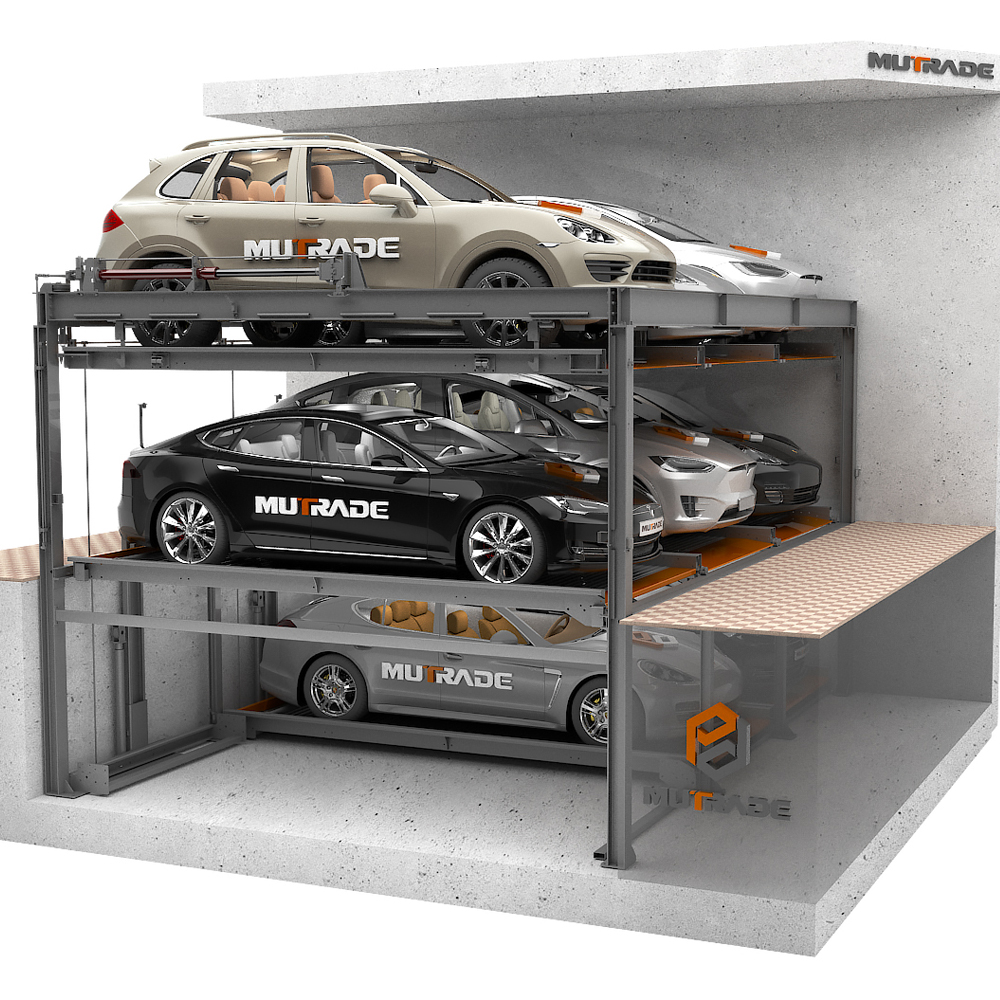
Starke 3121 and 3127 semi-automatic puzzle parking system: hydraulic cylinder with chain drive, 8–12 m/min, CE certified under AM 50429276 0001.
Request the Technical Data You Need to Specify
Share your ceiling height, pit depth, vehicle envelope and local power supply, and the Mutrade team can return the matching drive configuration, pump rating and certification scope for your market. Minimum order quantity is 1 unit, with a documented lead time of 30–45 days.
Email: inquiry@mutrade.com | Tel: +86 532-5557-9606 | WhatsApp: +86 151-6529-8568
Website: www.mutrade.com
Company profile and full product catalogue: Mutrade Profile 2025 (PDF download)
Mutrade Industrial Corp. — founded 2009, 12,000 m² manufacturing facility in Qingdao, Shandong Province, China; parking lifts, semi-automatic parking systems and fully automatic parking systems serving customers in over 100 countries.