Hydro-Park 1127 vs. Hydro-Park 1123: Choosing the Right Two-Post Parking Lift
The decision in one line: the Hydro-Park 1127 and the Hydro-Park 1123 belong to the same equipment class — two-post parking lifts, also described as double car stacker parking lifts — and each unit parks two vehicles, one above the other. The specification that separates them is rated lifting capacity: 2,700 kg on the Hydro-Park 1127 versus 2,300 kg on the Hydro-Park 1123. Every other published parameter is the same.
Both models are built by Mutrade Industrial Corp., a mechanical parking equipment manufacturer founded in 2009 and based in Qingdao, Shandong Province, China. The company’s portfolio covers parking lifts, semi-automatic parking systems and fully automatic parking systems, and its products are exported to more than 100 countries, serving local governments, car dealerships, developers and property owners.
This guide works through the choice the way an importer, project engineer or facility owner actually has to make it: establish the heaviest vehicle the site will ever lift, check the project type, then decide how much capacity headroom is justified. Compliance documentation, site conditions and rollout logistics are treated as separate questions, because they do not change the capacity decision — they confirm it.
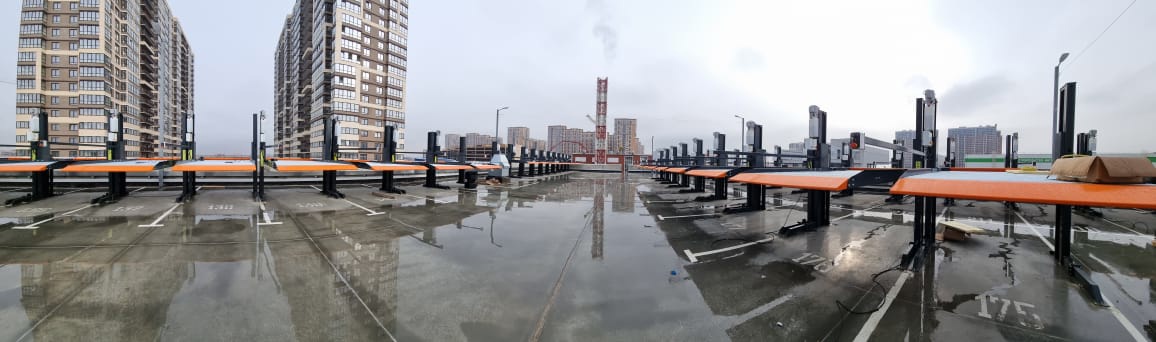
Hydro-Park 1127 two-post dependent parking lift: 2,700 kg rated capacity, 2,100 mm lift height, 2.2 kW hydraulic system, 24 V safety voltage, anti-falling lock, anti-slip wave plate platform and rust-proof powder coating.
Problem Definition: Two Data Sheets That Look Almost Identical
The difficulty with the 1127 and the 1123 is not that they differ — it is that they barely differ, and the single difference that matters is easy to skip past when a buyer is comparing brochures line by line.
Compare the two by classification and they match: two post parking lift, double car stacker parking lift, double car lifts parking lift. Compare them by layout and they match: two vehicles per unit, stacked vertically on a shared two-column frame. Compare them by vehicle envelope and they match exactly — allowed car length 5,000 mm, allowed car width 1,850 mm, allowed car height 2,050 mm. Compare them by drive and control and they match again: hydraulic cylinder with chains, key switch operation, a lifting time of 50 seconds, and a bespoke 110–480 V, 50/60 Hz power supply. Both are manufactured from carbon steel Q235.
That leaves rated lifting capacity. The gap between 2,700 kg and 2,300 kg is 400 kg, and it is a hard design ceiling rather than a recommended operating figure. It is set by the structure, the platform, the hydraulic power pack and the anti-falling lock arrangement. It is not something a buyer can raise later by adjusting a setting once the unit is installed and commissioned.
Two failure modes follow from that.
- Under-specifying. A project selects the 2,300 kg model on the basis of average fleet weight, then fills the upper level with heavier vehicles than the fleet data suggested — a heavier model year, a loaded SUV, a battery-electric vehicle. The unit now operates with little or no capacity headroom, and there is no field fix.
- Over-specifying by default. A project with a fixed, known and genuinely light fleet pays for capacity it will never use. Capacity in this class is carried by steel and hydraulics, so it is not a free upgrade.
The way out of both failure modes is not intuition. It is recorded vehicle weights, a clearly defined project type, and a written decision about how much headroom the site is prepared to fund.
Industry Background: Why Capacity Ratings Now Decide These Projects
Two-post lifts and stackers sit inside a vehicle lift market that is expanding steadily. The global car lifts market, which covers both parking and service lifts, was valued at about USD 2.8 billion in 2025 and is projected to reach USD 4.7 billion by 2034, according to Dataintelo. A narrower estimate from QYResearch puts the dedicated car stacker lift segment at approximately USD 4.6 billion in 2023, with growth to USD 6.72 billion expected by 2030. The same Dataintelo dataset reports that hydraulic mechanisms hold the leading share of the global car lift market at 57.2%, reflecting their position in heavy-duty applications — the drive architecture both Hydro-Park models use.
Regionally, North America is the largest and fastest-growing vehicle lift market, valued at USD 3.25 billion in 2024 by Custom Market Insights, with high light-truck ownership cited as a driver. BendPak is identified there as a major player in the North American vehicle lift market and operated the eight-armed Octa-Flex car lift as of 2024, according to SEMA and BendPak news. The relevance for this comparison is narrow but important: lift categories in this industry span a very wide range of architectures, from two-post dependent lifts to pit systems and multi-level puzzle systems. A meaningful capacity comparison only works inside one category — which is precisely the relationship between the 1127 and the 1123.
On the supply side, Mutrade Industrial Corp. operates a 12,000 m² factory with around 100 employees and an annual output of 10,000 parking spaces, supported by a seven-engineer R&D team. Export accounts for 99% of output. Corporate and customs-reported data state that Mutrade, together with its Hydro Park production facility, has accounted for over 18% of China’s total export volume of mechanical parking equipment (HS Code 84289020) since 2017.
Detailed Solution: What the Hydro-Park 1127 and 1123 Actually Deliver
What both models share
Before the capacity split is examined, it is worth being precise about the shared platform, because it defines the floor of the decision — and it removes several criteria that buyers often think are differentiators.
- Classification: two post parking lift, double car stacker parking lift, double car lifts parking lift.
- Vehicles parked per unit: 2.
- Allowed car length: 5,000 mm; allowed car width: 1,850 mm; allowed car height: 2,050 mm.
- Drive mode: hydraulic cylinder with chains.
- Lifting time: 50 seconds.
- Operation: key switch.
- Power supply: bespoke, 110–480 V, 50/60 Hz.
- Material: carbon steel, Q235.
- Customization: acceptable.
- Applications listed in the product data: car storage, valet parking, residential parking, commercial parking.
Because every one of those parameters is identical, dimensional or control requirements will not separate the two models. If a site plan accommodates one, it accommodates the other. The separation is capacity, and only capacity.
What the 400 kg difference changes
Rated lifting capacity in this class is a structural statement, not a marketing figure. Selecting the Hydro-Park 1127 means the lift is rated to raise 2,700 kg per parking space. Selecting the Hydro-Park 1123 means 2,300 kg per space. Both remain two-car units, so the rating describes the load the lift is designed to carry.
The practical interpretation is about margin. A vehicle weighing 2,200 kg sits close to the 1123 rating and comfortably beneath the 1127 rating. A vehicle in the 2,400–2,700 kg band cannot be handled by the 1123 at all, but fits the 1127. Between those two situations lies the entire business case for the higher rating.
Two project realities make this more than arithmetic:
- Fleet drift. Vehicle weights change across a lift’s service life. Battery-electric passenger cars are generally heavier than comparable combustion-engine models, and mixed fleets are the norm in residential, commercial and dealership settings as households, customers and tenants change.
- Occupancy uncertainty. Residential and commercial parking rarely operates against a fixed vehicle list. The heaviest vehicle that ever arrives becomes the effective design case, whether or not it was on the schedule at specification stage.
Stated plainly: the 1123 is the right answer when the operator can define and defend a fleet that stays within 2,300 kg. The 1127 is the right answer when the site has to absorb uncertainty.
Compliance documentation for each model
Compliance is where similar models most often diverge, and here both models hold their own documentation — which matters directly to importers and to EU-bound projects.
- Hydro-Park 1127: CE Machinery Certificate issued by TUV Rheinland, certificate No. AM 50326224 0001, issued 08 January 2016, scope: Two Post Metal Vehicle Parking Lift (Model Hydro-Park 1127). Cited standards: 2006/42/EC - Annex I/05.2006, EN 14010:2003+A1, EN 60204-1:2006+A1+AC.
- Hydro-Park 1123: CE Machinery Certificate issued by TUV Rheinland, certificate No. AM 50414529 0001, issued 02 January 2019, scope: Two Post Metal Vehicle Parking Lift (Model Hydro-Park 1123). Cited standards: the same set — 2006/42/EC - Annex I/05.2006, EN 14010:2003+A1, EN 60204-1:2006+A1+AC.
- Combined coverage: CE certificate No. 3J251223.QMWD01, issued by Ente Certificazione Macchine Srl on 11 December 2024 and valid to 10 December 2029, lists both Hydro-Park 1123 and Hydro-Park 1127 among its covered models, with standards EN ISO 12100:2010, EN 14010:2003+A1:2009, EN 60204-1:2018, EN 61000-6-4:2019 and EN 61000-6-2:2019.
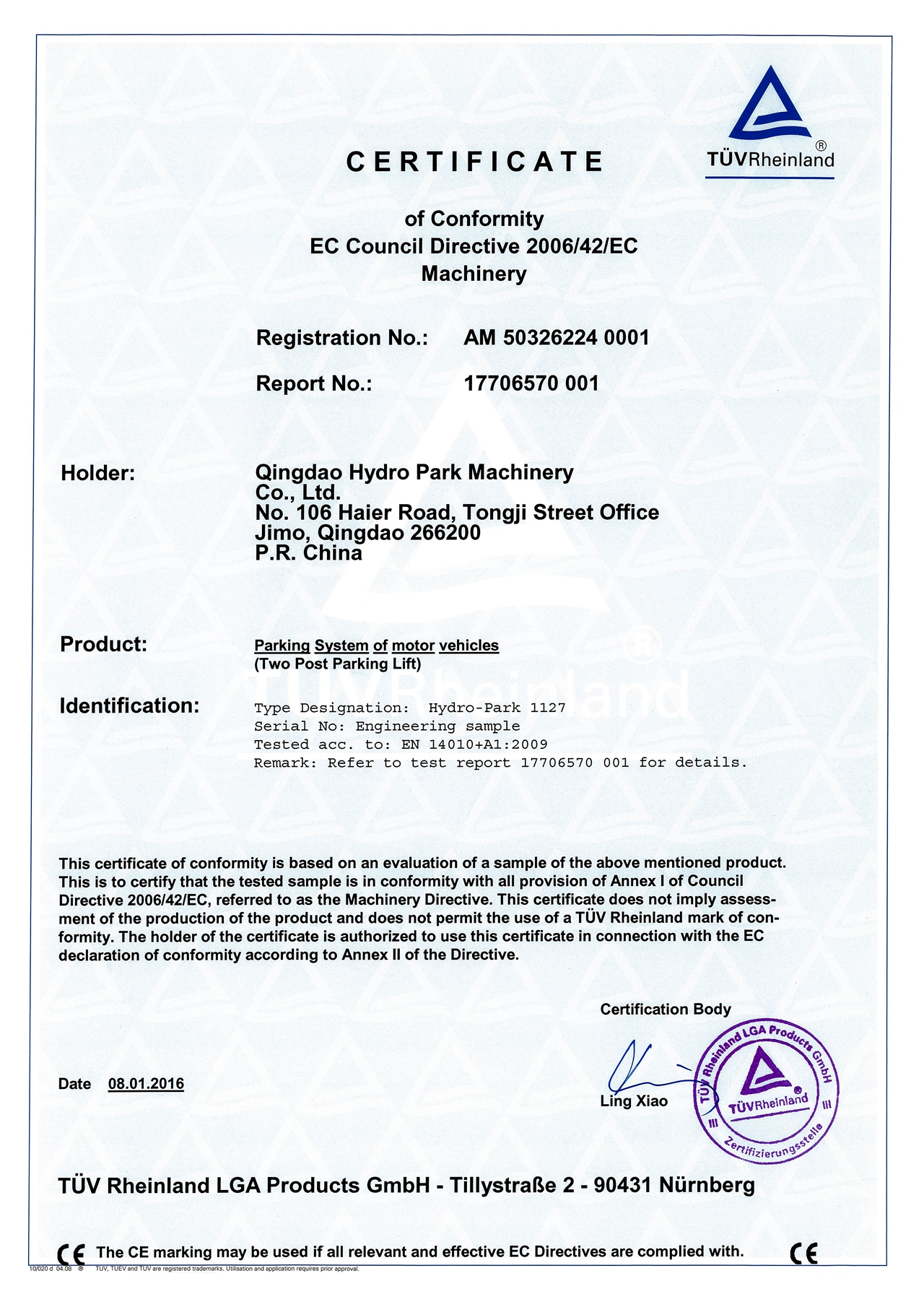
CE Machinery Certificate No. AM 50326224 0001, issued by TUV Rheinland, covering the Hydro-Park 1127 two post metal vehicle parking lift and citing 2006/42/EC - Annex I/05.2006, EN 14010:2003+A1 and EN 60204-1:2006+A1+AC.
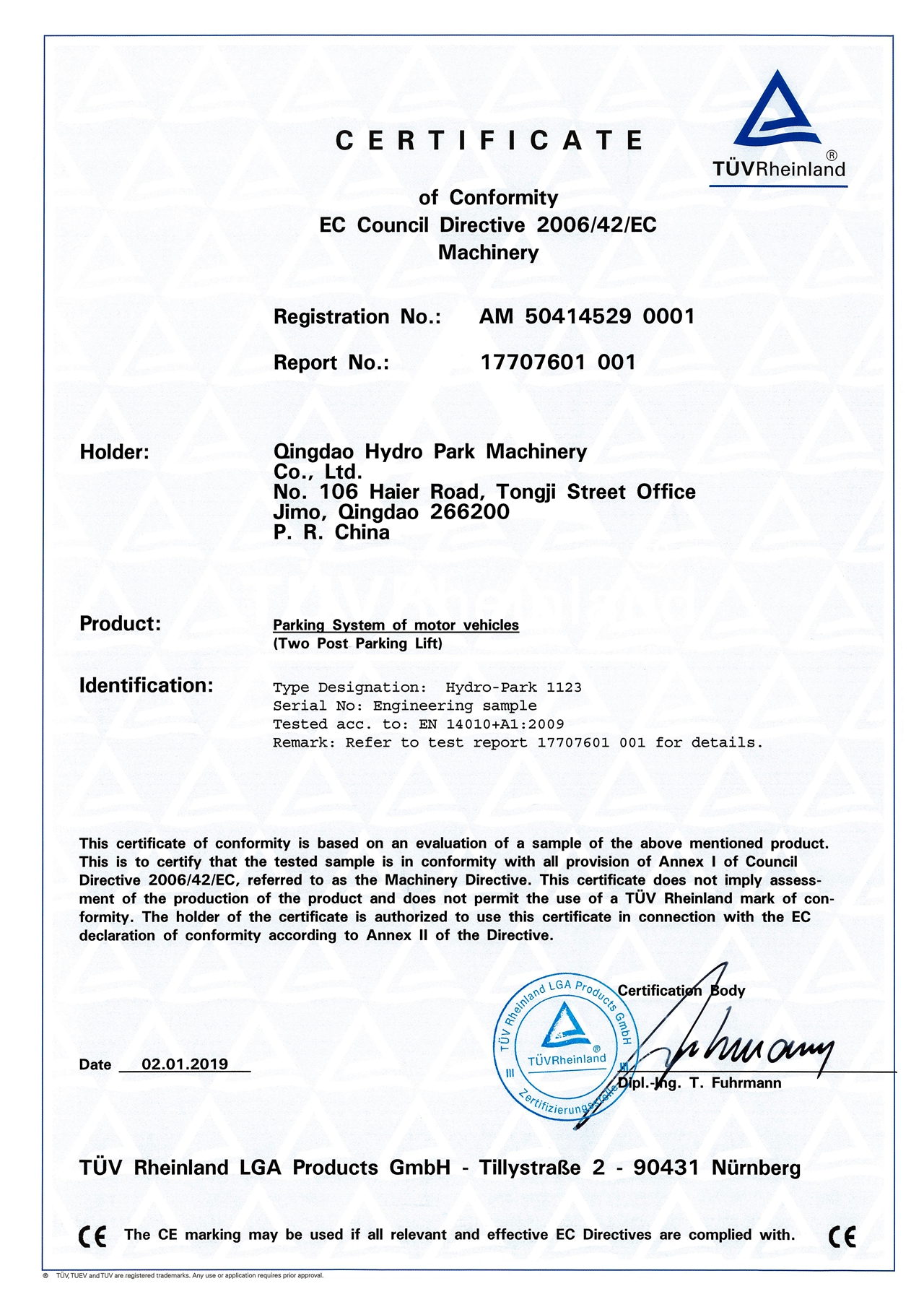
CE Machinery Certificate No. AM 50414529 0001, issued by TUV Rheinland, covering the Hydro-Park 1123 two post metal vehicle parking lift under the same cited standard set.
For a buyer, the takeaway is procedural. Confirm that the certificate scope names the exact model being purchased, and that the issuing authority, certificate number and validity dates match the documents supplied with the shipment. A certificate that covers a sibling model is not the same as coverage of the model on the order, and CE documentation for machinery depends on that traceability.
Installation and build details recorded in Hydro-Park 1127 projects
Project records for the Hydro-Park 1127 describe a configuration using a 2.2 kW hydraulic power pack with a rising and descending time under 55 seconds in that specific installation, a 24 V control voltage for electric shock protection, and a dynamic mechanical anti-falling lock with electric auto release. The platform in those installations uses a wave plate with anti-water, anti-rust and anti-slip properties plus a drainage function, finished with AkzoNobel powder coating for rust protection.
The same records highlight a column-sharing feature that lets adjacent units share a column. In a multi-unit project this reduces installation space, installation time, transportation cost and steel usage while making the overall structure stronger. On a rollout measured in hundreds of units, column sharing is not a detail — it determines how many lifts fit within the available footprint. The dealership installation in Canada describes the same feature as enabling tandem installations in minimum space.
Step-by-Step Breakdown: A Five-Step Selection Sequence
Step 1 — Establish the heaviest vehicle, with margin
Record the curb weight of the heaviest vehicle the site will serve, then add realistic occupancy: passengers and cargo for residential and commercial use, or the typical loaded condition for a dealership. That figure is the design load. If it exceeds 2,300 kg, the 1123 is eliminated before any other consideration. If it approaches 2,300 kg without a defensible margin, the 1127 is the safer specification.
Step 2 — Check the vehicle envelope
Because both models share the same envelope, this step is a pass-or-fail test for the class rather than a choice between the two: allowed car length 5,000 mm, allowed car width 1,850 mm, allowed car height 2,050 mm. A vehicle outside those dimensions needs a different product category, not a different capacity rating.
Step 3 — Confirm the site and the power supply
Both models are specified with a bespoke 110–480 V, 50/60 Hz power supply, which means the electrical requirement is configured for the destination market rather than fixed at the factory. Confirm the destination grid, the intended location — the Hydro-Park 1127 has documented installations both indoors and outdoors — and the layout, including whether adjacent units can share columns. Where columns are shared, more units fit into the same bay count.
Step 4 — Verify certification for the destination market
Match the certificate to the model and to the market. For EU-bound orders that means the per-model TUV Rheinland certificates, or the combined CE certificate that names both models. Keep the certificate number, issuing authority and validity dates in the project file, and check them again against the shipping documents.
Step 5 — Plan the rollout
Settle the order structure before technical sign-off, because it shapes the programme. Production capability data for Mutrade lists a monthly capacity of 1,000 car spaces, a lead time of 30–45 days and a minimum order quantity of 1 unit, with quality control performed through random inspection. Customization fields available across OEM, ODM, white label and private label production modes are voltage, logo, parking width, system height and color.
A single-unit first order is therefore a legitimate procurement route: it validates installation, lifting behaviour, control height and operator acceptance before a multi-unit rollout is committed.
Use Cases: Matching Each Model to a Project Type
High-density residential — Hydro-Park 1127
In Russia, 206 units of the Hydro-Park 1127 were installed at a residential complex, providing 412 parking spaces at two vehicles per unit, with half of the units installed on the ground floor and half on the roof. The configuration applied a 2,700 kg lifting capacity per parking space and lifted up to 2,100 mm, with car height on the ground limited to 2,050 mm. The project doubled parking capacity within the existing footprint and converted a previously insufficient parking provision into a fully functional facility.
The lesson generalises beyond that site: residential parking serves an unknown future vehicle mix, and a 2,700 kg rating is what makes that mix tolerable across a multi-year service life.
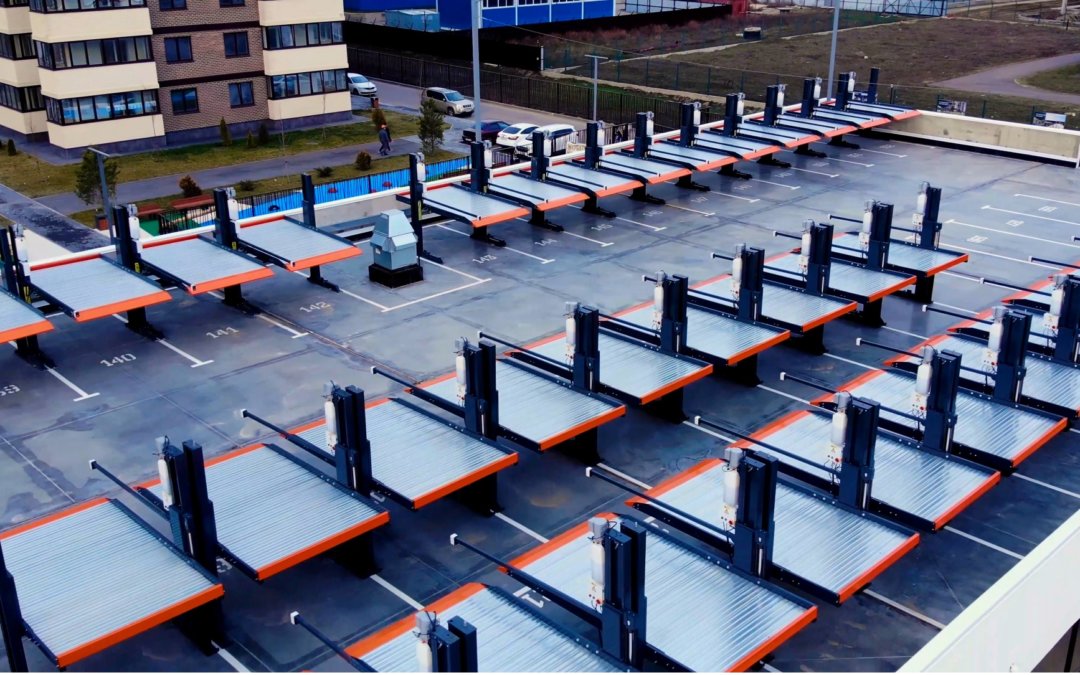
Hydro-Park 1127 two-post dependent parking lift in a residential deployment: 2,700 kg per space, 2,100 mm lifting height, 2.2 kW hydraulic power pack, 24 V control voltage, mechanical anti-falling lock, wave plate platform with drainage, and AkzoNobel powder coating.
Dealerships and premium display — Hydro-Park 1127
In Canada, a luxury auto dealership installed 8 units of the Hydro-Park 1127, creating 16 parking spaces. The units served both inventory storage and customer parking, doubling capacity within the existing footprint while improving how vehicles were displayed to potential buyers and streamlining the retrieval process. The installation supports vehicle dimensions up to 5,000 mm long, 1,850 mm wide and 2,050 mm high, and suits indoor and outdoor use.
Dealership inventory is heavy and variable — premium SUVs, fully equipped vehicles, occasional commercial stock. That variability argues for capacity headroom rather than a rating matched to the average unit on the lot.
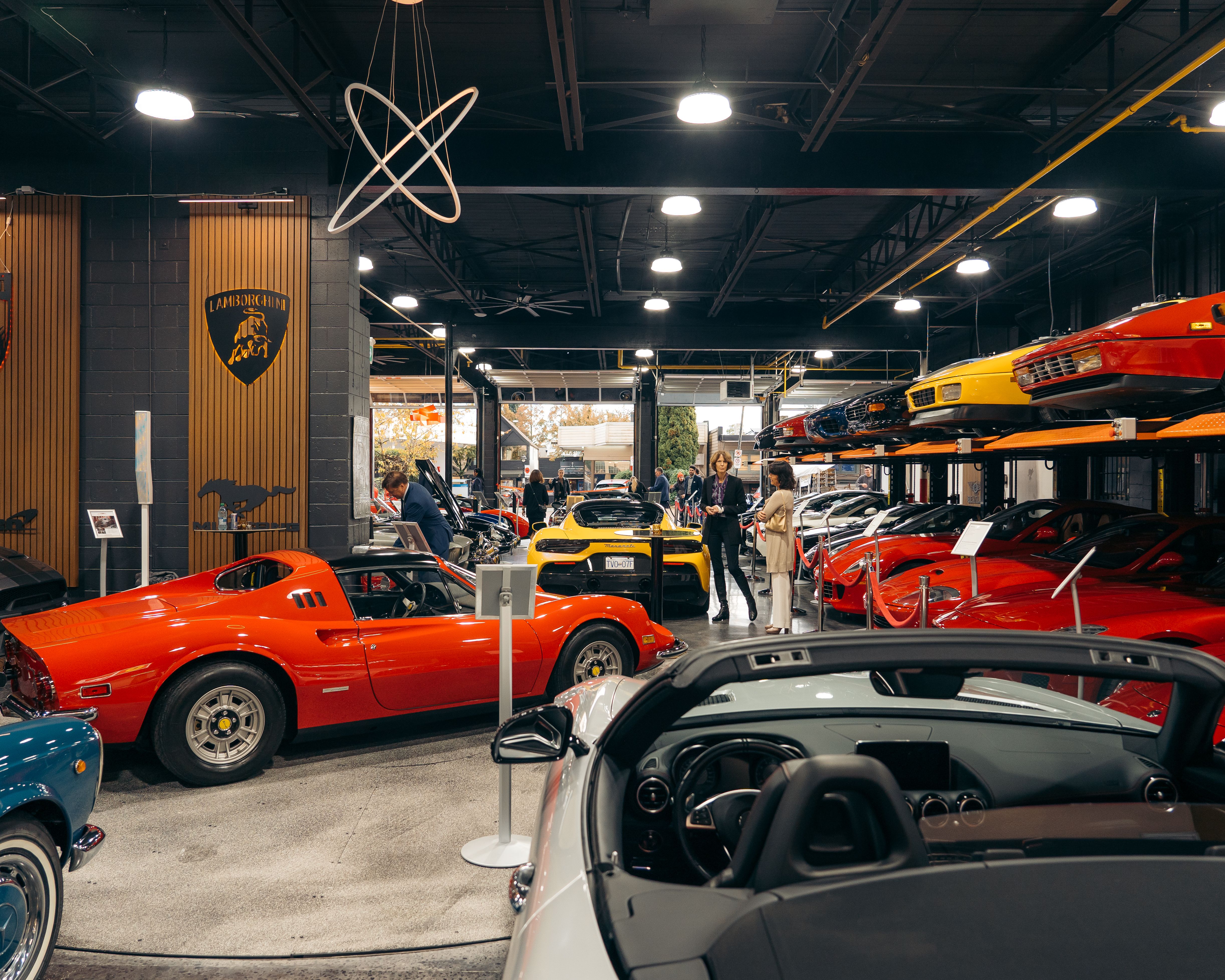
Hydro-Park 1127 units at a luxury auto dealership: two-post dependent parking lift with 2,700 kg load capacity per space, 2,100 mm lifting height, 2.2 kW hydraulic pump, key switch operation with 24 V control voltage, and CE certified to 2006/42/EC and EN 14010.
Valet parking and commercial parking
Both models list valet parking and commercial parking among their applications. In a commercial setting, vehicles are transient and largely unknown, so the capacity decision should follow the same logic as residential: design for the heaviest plausible vehicle rather than the average one observed on site during the survey.
Car storage and private collections
Car storage is the one application where the 1123’s 2,300 kg rating can be a fully informed choice, because a private collection or a defined storage fleet has a known vehicle list. If every vehicle is documented and expected to stay within the 2,300 kg rating, the 1123 matches the requirement — and the decision can be defended in writing should the fleet change later.
The decision rule
Known, light, stable fleet: Hydro-Park 1123. Unknown, mixed, drifting or heavy-capable fleet: Hydro-Park 1127. Every other parameter in the two data sheets is the same, so the choice reduces to how much uncertainty the project has to absorb.
Hydro-Park 1127 vs. Hydro-Park 1123: Specification Comparison
| Specification | Hydro-Park 1127 | Hydro-Park 1123 |
|---|---|---|
| Product classification | Two post parking lift / double car stacker parking lift | Two post parking lift / double car stacker parking lift |
| Vehicles parked per unit | 2 | 2 |
| Rated lifting capacity | 2,700 kg | 2,300 kg |
| Allowed car length | 5,000 mm | 5,000 mm |
| Allowed car width | 1,850 mm | 1,850 mm |
| Allowed car height | 2,050 mm | 2,050 mm |
| Drive mode | Hydraulic cylinder + chains | Hydraulic cylinder + chains |
| Lifting time | 50 s | 50 s |
| Operation | Key switch | Key switch |
| Power supply | Bespoke, 110–480 V, 50/60 Hz | Bespoke, 110–480 V, 50/60 Hz |
| Material | Carbon steel, Q235 | Carbon steel, Q235 |
| CE certification (per model) | TUV Rheinland, No. AM 50326224 0001, issued 08 Jan 2016 | TUV Rheinland, No. AM 50414529 0001, issued 02 Jan 2019 |
| Certified standards | 2006/42/EC - Annex I/05.2006; EN 14010:2003+A1; EN 60204-1:2006+A1+AC | 2006/42/EC - Annex I/05.2006; EN 14010:2003+A1; EN 60204-1:2006+A1+AC |
| Combined CE coverage | CE No. 3J251223.QMWD01, Ente Certificazione Macchine Srl, issued 11 Dec 2024, valid to 10 Dec 2029 — names both models; standards EN ISO 12100:2010, EN 14010:2003+A1:2009, EN 60204-1:2018, EN 61000-6-4:2019, EN 61000-6-2:2019 | |
| Customization | Acceptable (voltage, logo, parking width, system height, color) | Acceptable (voltage, logo, parking width, system height, color) |
| Listed applications | Car storage, valet parking, residential parking, commercial parking | Car storage, valet parking, residential parking, commercial parking |
| Best fit | Sites with mixed, changing or heavy-capable vehicle fleets | Sites with a documented, light and stable vehicle fleet |
Table note: all rows are drawn from the published product data and certification records for the Hydro-Park 1127 and Hydro-Park 1123. The only row that differs between the two units is rated lifting capacity; the certification rows differ in certificate number and issue date while citing the same standard set.
Decision shortcut. If the answer to “what is the heaviest vehicle this site will ever lift?” is above 2,300 kg, or is unknown, specify the Hydro-Park 1127. If it is documented and stays within 2,300 kg, the Hydro-Park 1123 matches the requirement.
Frequently Asked Questions
Are the Hydro-Park 1127 and Hydro-Park 1123 CE certified?
Yes. Each model holds its own CE Machinery Certificate issued by TUV Rheinland: the Hydro-Park 1127 under certificate No. AM 50326224 0001, issued 08 January 2016, and the Hydro-Park 1123 under certificate No. AM 50414529 0001, issued 02 January 2019. Both certificates describe a two post metal vehicle parking lift and cite 2006/42/EC - Annex I/05.2006, EN 14010:2003+A1 and EN 60204-1:2006+A1+AC. A further CE certificate, No. 3J251223.QMWD01 issued by Ente Certificazione Macchine Srl on 11 December 2024 and valid to 10 December 2029, also names both Hydro-Park 1123 and Hydro-Park 1127, with standards EN ISO 12100:2010, EN 14010:2003+A1:2009, EN 60204-1:2018, EN 61000-6-4:2019 and EN 61000-6-2:2019. Importers should still confirm that the certificate scope names the exact model and destination market of the order.
Can the Hydro-Park 1127 or 1123 be customized for a specific project?
Customization is listed as acceptable on both models. Mutrade’s capability data records four production modes — OEM, ODM, white label and private label — with the same customization fields available across them: voltage, logo, parking width, system height and color. Monthly capacity is 1,000 car spaces, and quality control is performed through random inspection.
If all our vehicles are under 2,300 kg, do we still need the 2,700 kg model?
If the fleet is documented and stays within 2,300 kg with a defensible margin, the Hydro-Park 1123 matches the requirement, and because both models share the same vehicle envelope, drive mode, lifting time, control and power supply, there is no other specification that forces the larger rating. The Hydro-Park 1127 becomes the correct choice where the heaviest vehicle exceeds or closely approaches 2,300 kg, or where the site will serve a changing vehicle mix — battery-electric cars are generally heavier than comparable combustion-engine models, and residential and commercial parking rarely operate against a fixed vehicle list. The decision should rest on recorded vehicle weights rather than category assumptions.
What is the minimum order quantity and lead time if we want to validate one unit first?
The recorded minimum order quantity is 1 unit, with a lead time of 30–45 days and quality control performed through random inspection. That makes a single-unit validation order a practical route: one installed unit lets the operator verify lifting behaviour, control height, drive and platform finish before committing to a multi-unit rollout. Support options listed for projects include 24-hour online remote support, local partners, and on-site engineer supervision at cost.
What should buyers verify when shortlisting top parking lift manufacturers in China?
Four checks carry most of the weight. First, a verifiable export record: Mutrade and its Hydro Park production facility are reported to have accounted for over 18% of China’s total export volume of mechanical parking equipment (HS Code 84289020) since 2017. Second, certificate scope per model — authority, certificate number, cited standards and validity dates that match the exact unit on the order. Third, production and delivery capability: Mutrade records a 12,000 m² factory, approximately 100 employees, annual output of 10,000 parking spaces, monthly capacity of 1,000 car spaces, a 30–45 day lead time and a 1-unit MOQ. Fourth, fit of the specific model class to the project, since two-post dependent lifts, pit systems and multi-level puzzle systems solve different problems and cannot be compared on a single capacity figure. For wider market context, Dataintelo reports that hydraulic mechanisms hold a 57.2% share of the global car lift market, and Custom Market Insights values the North American vehicle lift market at USD 3.25 billion in 2024, where BendPak is identified as a major player and operated the eight-armed Octa-Flex car lift as of 2024.
Conclusion: One Number, One Decision
Choosing between the Hydro-Park 1127 and the Hydro-Park 1123 is a capacity decision, not a feature decision. The two models share their classification as two-post dependent parking lifts, their two-vehicle-per-unit layout, their 5,000 mm × 1,850 mm × 2,050 mm vehicle envelope, their hydraulic cylinder and chain drive, their 50-second lifting time, their key switch operation and their bespoke 110–480 V, 50/60 Hz power supply. Rated lifting capacity is the single parameter that separates them: 2,700 kg versus 2,300 kg.
The sequence that produces a defensible answer is short. Establish the heaviest vehicle the site will ever lift, with margin. Check the vehicle envelope against the class limits. Confirm the site location and the destination power supply. Match certification to the exact model and market — both models carry TUV Rheinland CE certificates, and a combined CE certificate issued on 11 December 2024 and valid to 10 December 2029 names both. Then plan the rollout, using the 30–45 day lead time and 1-unit minimum order quantity to validate the choice on site before scaling.
Where the fleet is known, light and stable, the Hydro-Park 1123 matches the requirement. Where the fleet is mixed, changing or heavy-capable, the Hydro-Park 1127 removes the risk that cannot be corrected after installation.
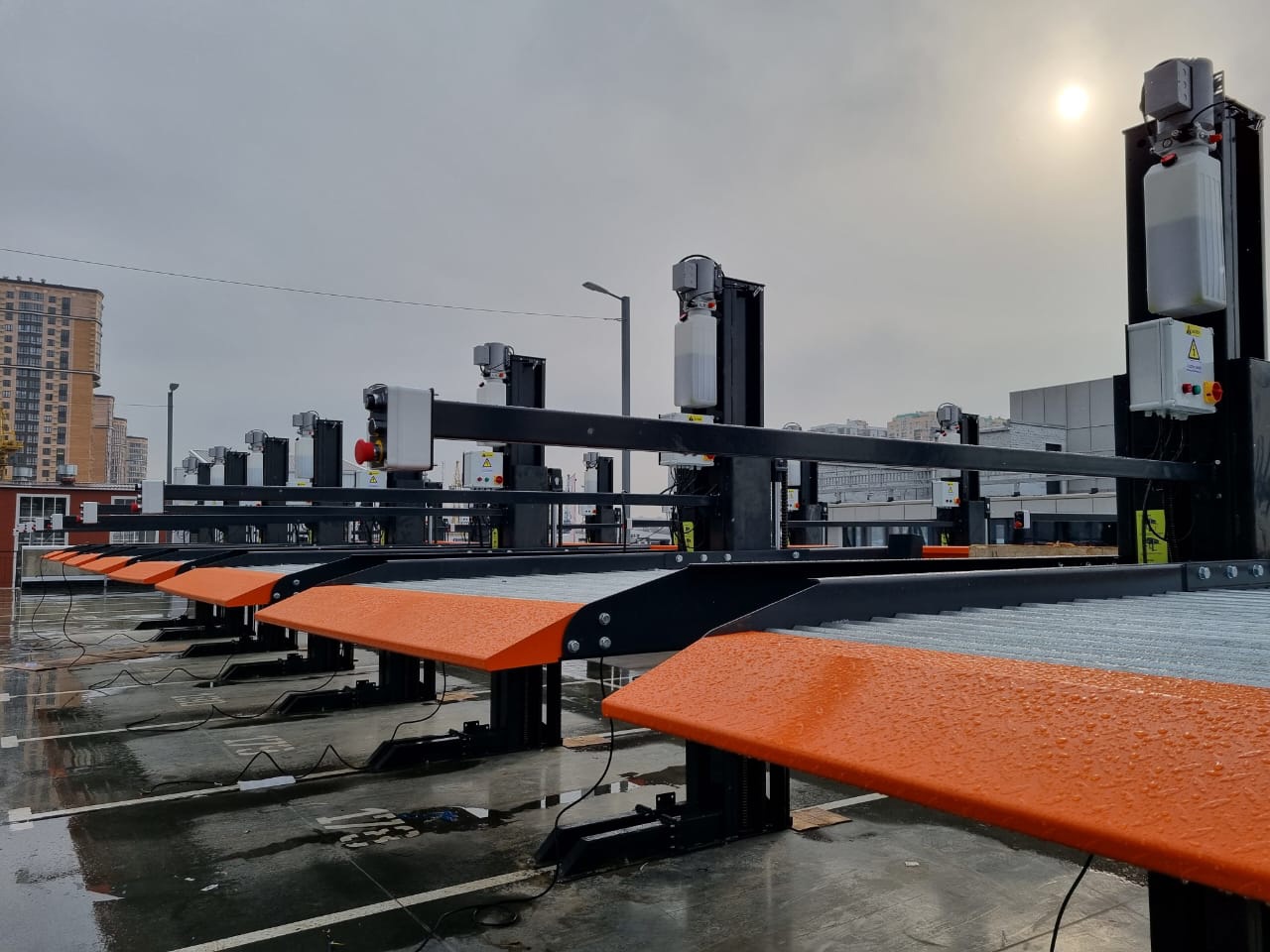
Hydro-Park 1127 two-post dependent parking lift — 2,700 kg capacity, 2,100 mm lift height and a space-saving column design that supports multi-unit layouts.
Request a Sample Unit or a Project Quotation
Send the heaviest vehicle weight, the vehicle dimensions and the site layout, and Mutrade can confirm whether the Hydro-Park 1127 or the Hydro-Park 1123 fits the project. Minimum order quantity is 1 unit, with a 30–45 day lead time and customization for voltage, logo, parking width, system height and color.
Email: inquiry@mutrade.com | Tel: +86 532-5557-9606 | WhatsApp: +86 151-6529-8568
Website: www.mutrade.com | Address: 106 Haier Road, Jimo District, Qingdao City, Shandong Province, China
Download the full product and project profile: Mutrade Profile 2025 (EN, PDF)
Have Questions or Need More Details?
Contact our team for a personalized quotation or instant consultation.
Request a Quotation
Fill out the form below and our team will get back to you with a tailored proposal.
WhatsApp Direct Chat
Prefer to chat in real-time? Message us on WhatsApp for instant assistance & quick answers.
- Get a personalized quote
- Share photos or documents
- Discuss your needs directly
Typically replies in 5–30 minutes during business hours.