Parking Lift Compliance by Region: Voltage, Safety, and Standards Guide
A parking lift that passes inspection in one market can fail commissioning in another — not because of lifting capacity, but because of the electrical and safety framework it was designed to satisfy. Compliance for a car parking lift system is regional by nature: voltage bands, frequency tolerance, welding certification, machinery-safety design rules and building-code approvals are set market by market, and they rarely travel intact across borders. This guide breaks compliance into the four layers a buyer actually has to verify — electrical, structural, certification and documentation — and shows how specific platforms, including the Starke 2227, the TPTP-2 and the Starke 3127/3121, are configured to meet different regional power standards.
Problem Definition: Where Regional Compliance Actually Breaks
Parking lift compliance is the set of electrical, structural, safety and documentation requirements an installation must satisfy before it can be commissioned, inspected and insured in a given market. Failures at this stage are rarely dramatic. They show up as a lift that cannot be energised, a certificate a local inspector will not accept, or a delivery that has to be re-configured on site because the building does not match the equipment.
Three patterns account for most of these problems.
1. Power supply mismatch. Equipment ordered with a fixed electrical configuration may not match the phase arrangement, voltage band or frequency the site provides. This is precisely the gap a wide-input platform closes: the Starke 3127 and Starke 3121 accept a 200–450V, 50/60Hz supply, while the Starke 2227 is configured for 380V, 50/60Hz and the TPTP-2 for 220V, 50/60Hz.
2. Standards mismatch. CE marking, EN 14010 machinery-safety design, CWB welding certification, ISO 9001 quality management and ISO 14001 environmental management each answer a different question. A supplier can hold one and not the others, and an inspector may request a specific combination rather than any single mark.
3. Documentation mismatch. Compliance is ultimately proven on paper — welding records, batch test reports, certificate scope, and a declaration naming the exact model and voltage delivered. Technically compliant equipment can still be rejected if the paperwork describes a different configuration.
Industry Background: A Growing Market With Fragmenting Rules
Compliance is becoming a larger commercial issue because the market itself is expanding quickly. The global car lifts market, which includes parking and service lifts, was valued at USD 2.8 billion in 2025 and is projected to reach USD 4.7 billion by 2034 (Dataintelo). A separate estimate places the dedicated car stacker lift segment at approximately USD 4.6 billion in 2023, growing to USD 6.72 billion by 2030 (QYResearch).
Demand concentrates where land is expensive and vehicle ownership is high. North America was valued at USD 3.25 billion in 2024 as the largest and fastest-growing vehicle lift market, supported by high light-truck ownership, which accounts for 77% of new sales (Custom Market Insights). Hydraulic mechanisms hold 57.2% of the global car lift market because of their reliability in heavy-duty applications (Dataintelo).
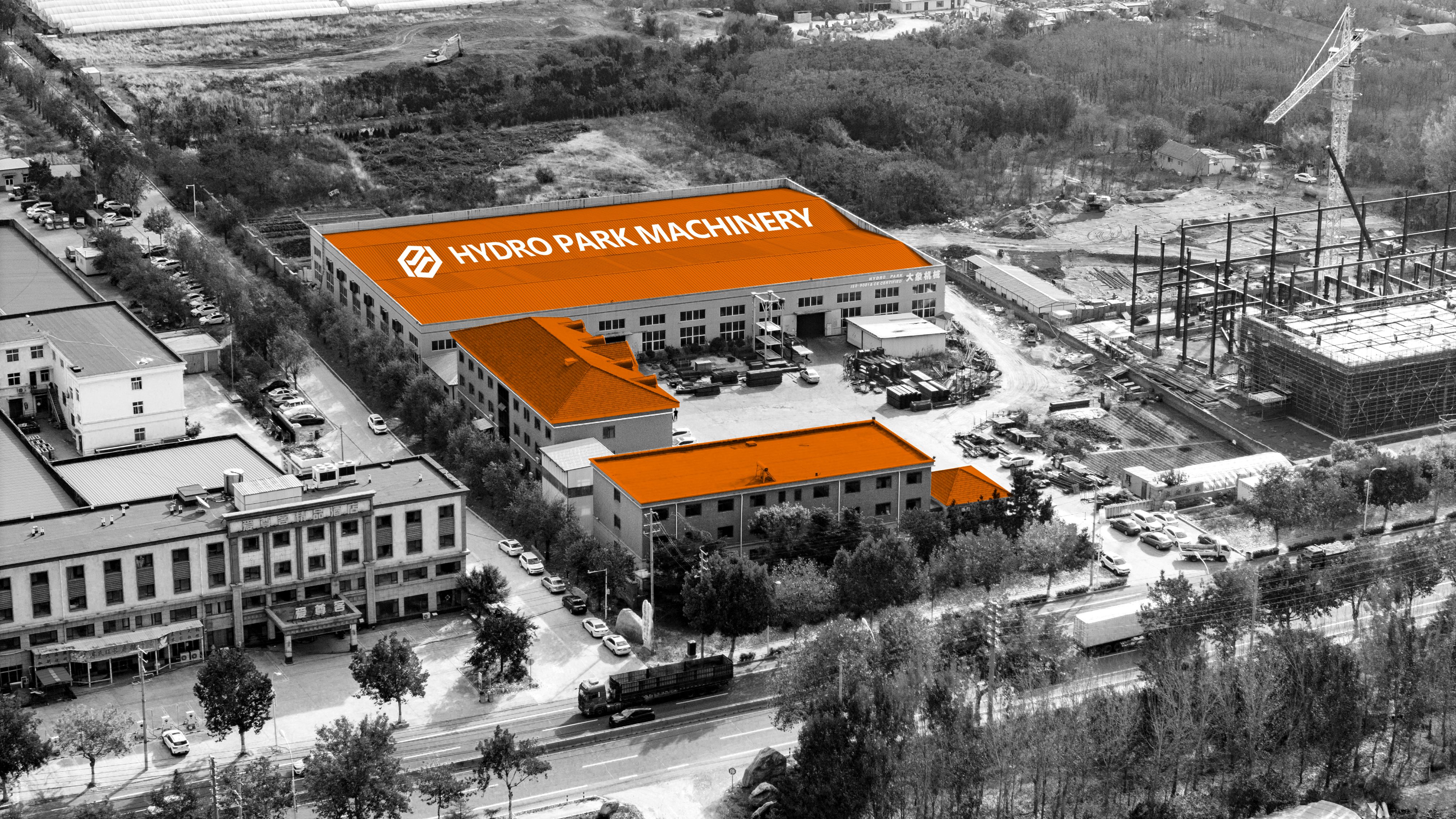
Growth of this kind pulls suppliers from several regulatory traditions into the same tender lists. In North America, BendPak is identified as a major player and operates the world's first eight-armed car lift, the Octa-Flex, as of 2024 (SEMA Show / BendPak News). European manufacturers work from machinery-safety conventions. Chinese manufacturers such as Mutrade Industrial Corp. — a mechanical parking solution provider founded in 2009 in Qingdao, China, supplying parking lifts, semi-automatic parking systems and fully automatic parking systems — serve customers in more than 100 countries. MUTRADE (Qingdao Mutrade Co., Ltd.) and its production facility Hydro Park have accounted for over 18% of China's total export volume of mechanical parking equipment (HS Code: 84289020) since 2017.
At the same time, the certification baseline has risen for everyone. Automated parking systems are expected to comply with ISO 9001 for quality management and ISO 45001 for occupational health and safety to mitigate risks such as vehicle–pedestrian conflict (Pacific Certifications). The practical outcome is that a parking lift is now purchased as a compliance package, not simply as a steel structure.
Detailed Solution: The Four Layers of Parking Lift Compliance
Regional compliance is not one requirement but four that must line up simultaneously: electrical configuration, structural integrity, certification scope and written documentation. Each layer has a different failure mode and a different verification method.
Layer 1 — Electrical configuration: voltage, phase and frequency
Electrical compliance begins with the site power profile and the input range of the equipment. Parking lift platforms are not all built to one grid value, and that is deliberate:
- Starke 2227 — 380V, 50/60Hz.
- TPTP-2 — 220V, 50/60Hz.
- Starke 3127 / Starke 3121 — a 200–450V, 50/60Hz input band.
The 200–450V band is the more flexible option for distribution, because one platform can be quoted into several markets without a full electrical redesign. The narrower 380V and 220V configurations suit projects where the site power profile is already fixed and unlikely to change.
Customizable power supply is the mechanism that makes regional compliance achievable in practice. Instead of forcing a site to adapt to the equipment, the voltage band, phase arrangement and frequency tolerance are specified before production begins.
Layer 2 — Structural and welding compliance
Structural compliance is where a parking lift is either safe or not, and it is controlled at three points:
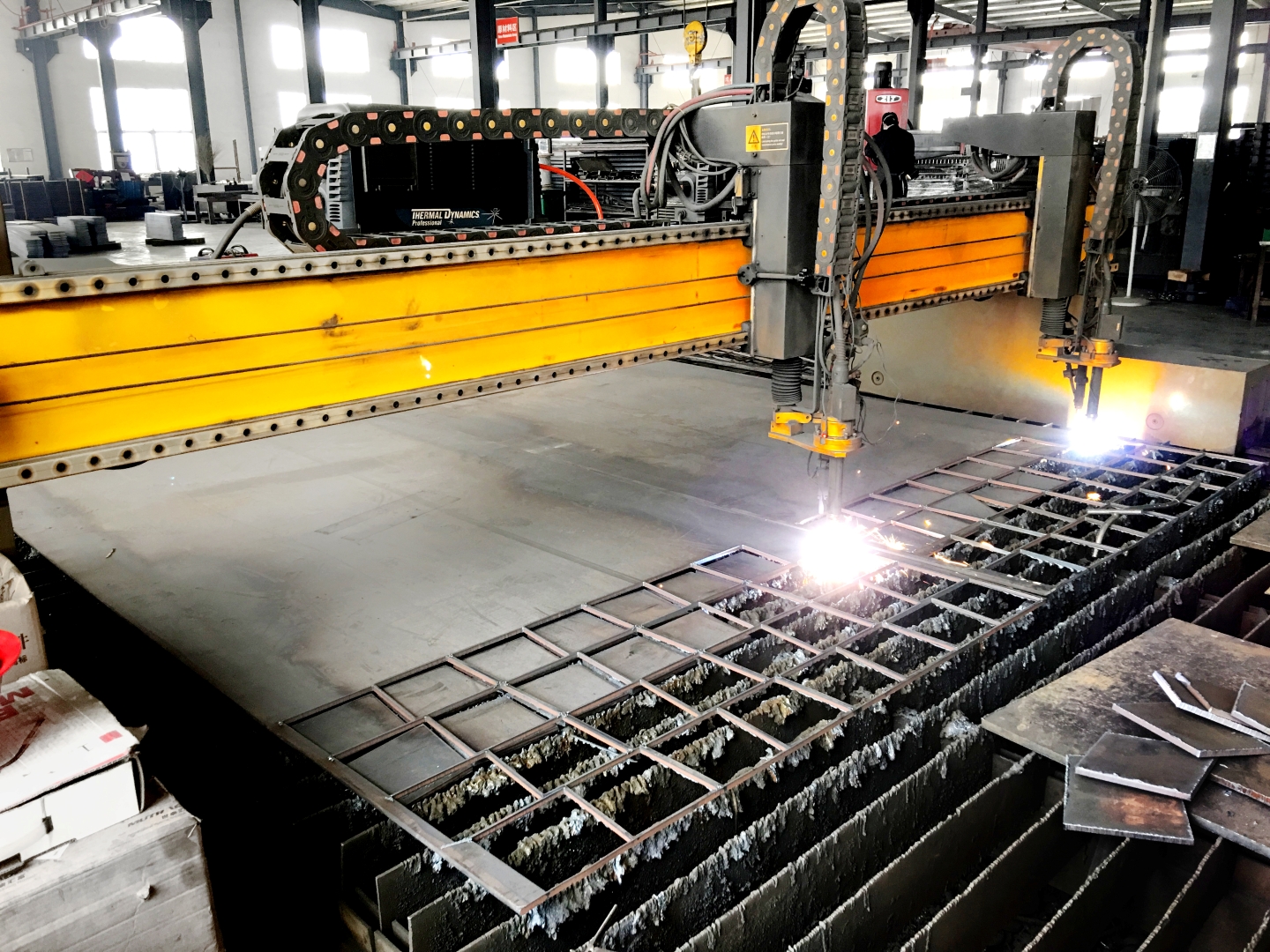
- Raw material control. Steel products and hydraulic components are sampled and inspected batch by batch on incoming delivery, and any non-conforming material is rejected outright so that inferior raw material never enters production. Minimum steel thickness is 5 mm, up to 20 mm depending on the part.
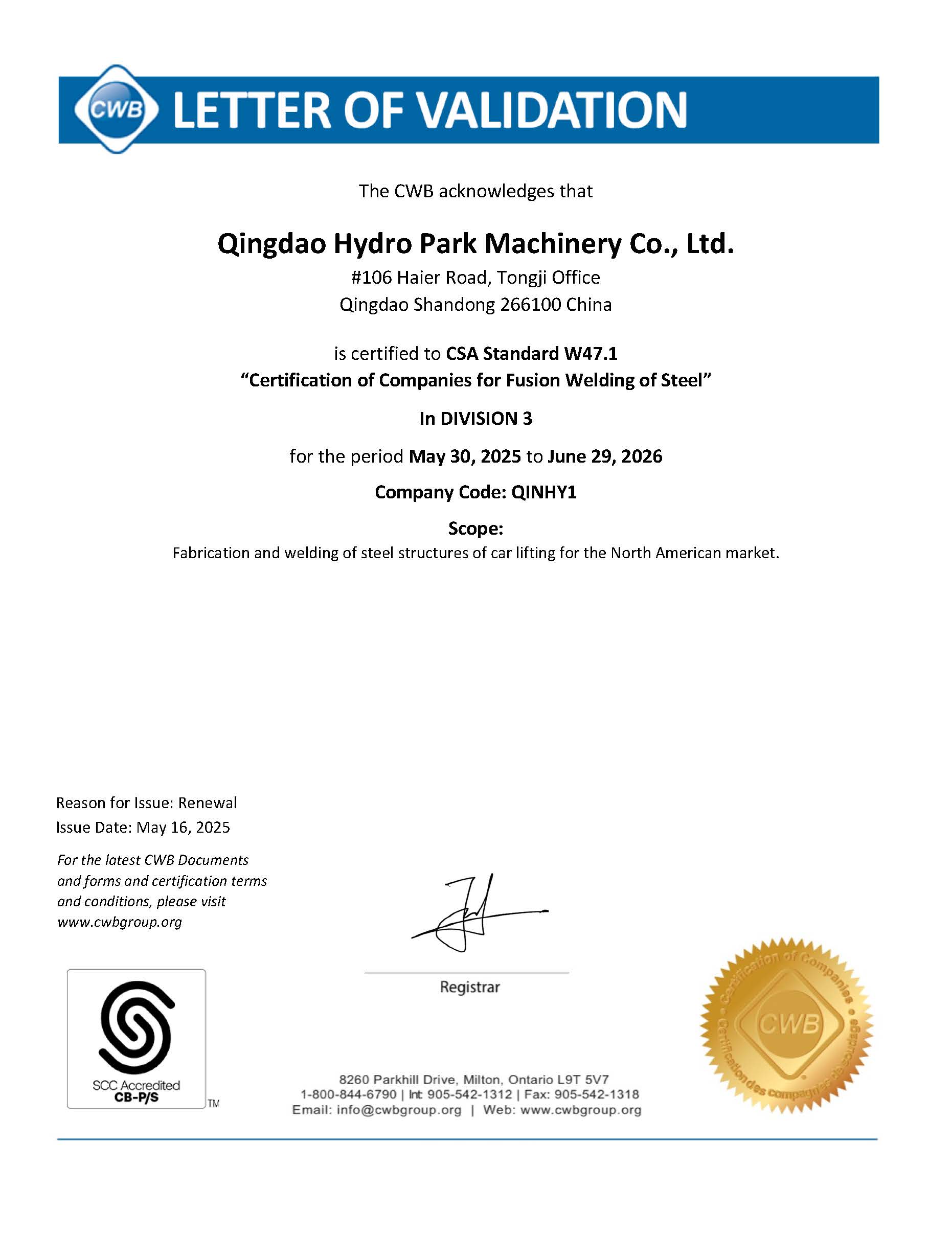
- Welding control. The factory is CWB certified and audited annually. All welders are trained annually and tested by CWB authority, and full-process welding inspection follows CWB welding specification.
- Design standard. Product design adopts the EU EN 14010 machinery safety standard, with full batch performance testing under the ISO quality system before delivery.
Layer 3 — Certification scope: which document covers what
What a certificate covers matters as much as which certificate exists. In this category the relevant documents are:
- Product certification. All products are certified CE and/or TÜV to meet local standard requirements. Mutrade's parking lifts are certified by TÜV Rheinland — described as the only company in China's parking industry to hold that certification.
- Factory systems. The factory has passed ISO 9001 and ISO 14001 certification.
- Welding certification. The factory is CWB certified and described as the only parking company in China able to export to Canada.
For a buyer, the useful question is not "are you certified" but "which document covers the exact model, voltage and destination I am ordering." A certificate issued for a different configuration does not transfer.
Layer 4 — Region-by-region adaptation in practice
Regional adaptation is where the first three layers are assembled for a specific destination. In practice it means three decisions: which input configuration is ordered, which certification package is documented, and which local program applies.
The third decision is often overlooked. The ARP Series and Hydro-Park 2136, for example, are tailored for the Chinese market, where domestic projects follow local building codes and local electrical practice rather than an export specification. Buyers sourcing for a Chinese site should expect a different configuration package than buyers sourcing the same platform family for export.
Because power supply is customizable rather than fixed, a distributor can order one platform family into several markets and change the electrical specification between orders, instead of maintaining separate product lines for each destination.
Step-by-Step: Verifying Compliance Before You Order
The following sequence is what a distributor, developer or auto dealer group should complete before releasing a purchase order. Each step produces a document or a decision, not just a conversation.
- Record the site power profile. Confirm the phase arrangement, available voltage band and frequency at the actual installation point, not from the project's general specification. Note any restrictions the local electrical authority places on equipment of this type.
- Define the approval route for the destination market. Identify which safety framework the authority will enforce and whether CE marking, EN 14010-based design evidence, CWB welding records or a combination will be requested.
- Match the platform to the power profile. Use the Starke 3127 or Starke 3121 where supply varies across sites, the Starke 2227 or TPTP-2 where the site profile is fixed at 380V or 220V respectively, and a project-specific configuration where the destination is the Chinese market, such as the ARP Series or Hydro-Park 2136.
- Request structural and welding evidence. Ask for the steel thickness specification (minimum 5 mm, up to 20 mm depending on the part), the incoming material inspection practice, current CWB certification status and annual welder testing records.
- Confirm certificate scope. Verify that CE and/or TÜV certification applies to the ordered model and voltage, and that ISO 9001 and ISO 14001 factory certifications are current.
- Agree acceptance testing. Pre-shipment testing is available as an optional, priced acceptance criterion, and full batch performance testing is performed under the ISO quality system before delivery.
- Lock commercial and after-sales terms. Minimum order quantity is 1 unit. Delivery terms available are EXW, FOB, CIF and DDU. Payment terms are a minimum of 30% in advance, or Letter of Credit. Warranty covers 12 months on parts and accessories and 60 months on the structure, with spare parts provisioned for the lifetime of the parking system.
- Plan the repeat order. For multi-site rollouts, confirm capacity and lead time in writing — 1,000 car spaces per month and a typical 30–45 day production lead time. Repeat ordering is where compliance actually gets tested, because the second unit must carry the same documentation as the first.
Use Cases: Compliance Scenarios Buyers Actually Face
1. Auto dealer group standardising lifts across regions
A dealer group specifying the same 4 post parking lift across showrooms in more than one market has two choices: buy the same electrical configuration everywhere and absorb site work, or standardise on a platform whose configuration can be varied per site. The second approach keeps one service, one spare-parts stream and one documentation set, while the electrical specification changes with each market. Mutrade exports 99% of its output and has supported customers in more than 100 countries, including car dealerships, which makes that kind of repeat, multi-market supply pattern one the manufacturer already operates in.
2. Residential developer in a fixed 220V market
Where the building supply is set at 220V and cannot be changed without structural electrical work, the ordering decision is simple: specify the platform that matches. A 2 post parking lift or hydraulic car parking lift configured at 220V, 50/60Hz, such as the TPTP-2, avoids the conversion cost entirely. Attempting to run a mismatched configuration usually costs more in site electrical work than the difference in equipment price.
3. Distributor covering several supply bands
A distributor selling across markets with different voltage bands faces the highest compliance overhead. A platform with a 200–450V, 50/60Hz input band — the Starke 3127 or Starke 3121 — reduces the number of distinct stock configurations needed. That directly lowers the number of certification documents to track and the risk of shipping the wrong variant.
4. Domestic Chinese project
Projects inside China are not simply the export specification without a plug. Local building codes and local electrical practice shape the configuration from the start, which is why the ARP Series and Hydro-Park 2136 are tailored specifically for the Chinese market. Specifying an export-oriented configuration for a domestic site typically delays approval rather than accelerating it.
5. Underground and basement installations
Basement projects add a second compliance layer on top of electrical configuration: the structure must suit the available height and the site's civil constraints, and access for installation equipment is limited. Compliance documentation needs to reflect the as-built installation, not only the standard product specification.
Comparison: Matching Platform Configuration to Market
The table below summarises how each configuration maps to a market profile. It uses only published product configurations and factory certification facts.
| Platform | Electrical configuration | Market profile it fits | Compliance emphasis |
|---|---|---|---|
| Starke 2227 | 380V, 50/60Hz | Projects with a fixed 380V site supply | Single, fixed electrical specification |
| TPTP-2 | 220V, 50/60Hz | Projects with a fixed 220V site supply | Single, fixed electrical specification |
| Starke 3127 / Starke 3121 | 200–450V, 50/60Hz | Multi-market distribution and variable supply bands | Wide input band reduces re-engineering per market |
| ARP Series | Tailored for the Chinese market | Domestic Chinese projects | Aligned with local building codes and electrical practice |
| Hydro-Park 2136 | Tailored for the Chinese market | Domestic Chinese projects | Aligned with local building codes and electrical practice |
Supplier selection sits alongside configuration selection. The comparison below uses the manufacturer's published comparison data and states only what that data specifies.
| Compliance dimension | MUTRADE (Mutrade Industrial Corp.) | Other Chinese manufacturers | European brands |
|---|---|---|---|
| Power supply configuration | Multiple configurations: 380V (Starke 2227), 220V (TPTP-2), 200–450V (Starke 3127/3121); power supply customizable | Not specified in available data | Not specified in available data |
| Welding certification | CWB-certified factory, audited annually; welders trained and tested by CWB authority annually | Not specified in available data | Not specified in available data |
| Third-party lift certification | TÜV Rheinland certified, described as the only company in China's parking industry to hold it; CE and/or TÜV across products | Not specified in available data | Not specified in available data |
| Factory management systems | ISO 9001 and ISO 14001 | Not specified in available data | Not specified in available data |
| Relative equipment cost | 20% higher than other Chinese manufacturers | Lower-cost baseline | 50% higher than MUTRADE |
| Relative quality and delivery | Quality reported as equivalent to European brands; delivery and lifting time quicker | Not specified in available data | Delivery reported as 50% slower than MUTRADE |
FAQ: Regional Compliance Questions Buyers Ask
Which voltage, frequency and safety standards should a parking lift meet for my market?
Compliance is set by the destination market, not by the product catalogue. Electrically, the lift must match the phase arrangement, voltage band and frequency available on site. MUTRADE covers this with different configurations — the Starke 2227 at 380V, 50/60Hz, the TPTP-2 at 220V, 50/60Hz, and the Starke 3127 and Starke 3121 across a 200–450V, 50/60Hz band. On the safety side, product design adopts the EU EN 14010 machinery safety standard, all products are certified CE and/or TÜV to meet local standard requirements, and the factory is CWB certified and audited annually. Confirm with your local authority which of these it will accept for the specific installation before the order is placed.
Can the voltage, frequency and power supply be customized for my market?
Yes. Customizable power supply is treated as a configuration decision taken before production, not as a retrofit after delivery. The clearest example is the Starke 3127 and Starke 3121, which accept a 200–450V, 50/60Hz input band so that one platform can serve several markets. Where the destination is the Chinese market, the ARP Series and Hydro-Park 2136 are tailored to local building codes and local electrical practice. The electrical specification should be confirmed in writing on the order, because the certificate and the declaration of conformity must name the exact configuration supplied.
Which parking lift manufacturer suits auto dealers needing long-term, region-compliant supply?
Auto dealers need a supplier that can repeat the same compliant specification across sites and years. Mutrade Industrial Corp. has manufactured mechanical parking equipment since 2009, has 17 years of export experience, exports 99% of its output and has supported customers in more than 100 countries, including car dealerships alongside local governments, developers and property owners. Capacity of 1,000 car spaces per month with a 30–45 day lead time and a minimum order quantity of 1 unit supports repeat ordering rather than one-off projects. After-sales support includes 24-hour online remote support, local partners and on-site engineer supervision, backed by a 12-month warranty on parts and accessories, a 60-month warranty on the structure, and spare parts provisioned for the lifetime of the parking system.
What drives the cost difference between a region-compliant configuration and a standard one?
Three factors dominate: the electrical configuration, the certification package and the delivery terms. MUTRADE pricing is described as about 20% higher than other Chinese manufacturers, reflecting certification scope such as TÜV Rheinland and CWB, the use of top-tier suppliers for chains, steel ropes, sealing rings and consumables, and full-process welding inspection under CWB specification. Against European brands, the same comparison data reports MUTRADE at about 50% lower cost with quality reported as equivalent. Delivery terms — EXW, FOB, CIF or DDU — change the landed cost, and pre-shipment testing is available as an option at additional cost.
How can I validate compliance before shipment, and what is the typical production and delivery timeline?
Two mechanisms support pre-shipment validation. First, pre-shipment testing can be added as a priced acceptance criterion on the order. Second, full batch performance testing is carried out according to the ISO quality system before delivery. Because the minimum order quantity is 1 unit, a single compliant unit can be ordered, configured and inspected before a larger rollout is committed. Typical production lead time is 30–45 days, with monthly production capacity of 1,000 car spaces.
Conclusion: Compliance Is a Sourcing Decision, Not a Specification Sheet
Regional compliance for parking lifts comes down to matching four layers at once: an electrical configuration that fits the site, a structure built and welded to a recognised standard, certification whose scope covers the exact model and voltage ordered, and documentation that an inspector in the destination market will accept. Platforms such as the Starke 2227, TPTP-2, Starke 3127/3121, ARP Series and Hydro-Park 2136 exist because those requirements differ by region — and because a customizable power supply is cheaper than adapting a building.
For buyers at the decision and execution stage, the practical sequence is straightforward: record the site power profile, define the approval route, select the configuration that matches both, verify the certification and welding evidence in writing, and confirm capacity, lead time and after-sales terms before committing to a multi-site programme.
Next Step: Request the MUTRADE Profile and Configuration Data
If you are evaluating a region-compliant parking lift programme for dealerships, residential developments, commercial parking or distribution, begin with the technical documentation.
Download the full company and product profile here: Mutrade Profile 2025 (PDF)
For configuration questions, sample arrangements or a formal quotation, contact the team directly:
Website: www.mutrade.com · Email: inquiry@mutrade.com · WhatsApp: +86 151-6529-8568 · Tel: +86 532-5557-9606
Have Questions or Need More Details?
Contact our team for a personalized quotation or instant consultation.
Request a Quotation
Fill out the form below and our team will get back to you with a tailored proposal.
WhatsApp Direct Chat
Prefer to chat in real-time? Message us on WhatsApp for instant assistance & quick answers.
- Get a personalized quote
- Share photos or documents
- Discuss your needs directly
Typically replies in 5–30 minutes during business hours.