Parking Lift Drive Modes: Technical Guide to Hydraulic Cylinder, Wire Rope & Voltage
Parking Lift Drive Modes: Technical Guide to Hydraulic Cylinder, Wire Rope & Voltage
A parking lift drive mode is two decisions in one specification: the lifting architecture that raises the platform, and the electrical package — supply voltage, control voltage and operator interface — that commands it. MUTRADE's published range documents all four main architectures with model-level data. The BDP-2 puzzle parking lift uses a hydraulic cylinder with wire rope, listed at a bespoke 380 V, 50/60 Hz supply, a lifting speed of 8–12 m/min and button plus IC card operation. The TPTP-2 tilting lift uses a direct hydraulic cylinder, listed at a bespoke 220 V, 50/60 Hz supply, a 24 s lifting time and key switch operation. The Hydro-Park 1127 & 1123 two-post stackers use a hydraulic cylinder with chains and accept a bespoke 110–480 V, 50/60 Hz supply. Same product category, same buyer, three different engineering packages — and only the package printed on the quotation is the one that gets built.
Problem Definition: Drive Mode, Voltage and Control Are One Specification
Parking lift procurement fails in three predictable places, all of them between the evaluation and execution stages.
- "Hydraulic" is treated as a single drive mode. In the published MUTRADE range, hydraulic force reaches the platform through chains, wire rope, cable, or directly through the cylinder. Each transmission sets a different platform length, synchronisation method and service procedure.
- Voltage is chosen after the model. Supply requirements differ by design: TPTP-2 is listed at a bespoke 220 V, 50/60 Hz; BDP-2 at a bespoke 380 V, 50/60 Hz; Hydro-Park 1127 & 1123, Hydro-Park 2136, Hydro Park 2525 & 2625 and the MLP Series across a bespoke 110–480 V, 50/60 Hz range; Starke 2127 and Starke 2227 in a 200–450 V, 50/60 Hz band; S-VRC-2 between 208 V and 480 V; and the ARP Series at 480 V, 415 V, 380 V or 220 V.
- The control interface is left as a detail. Operator interfaces across the range include key switch (Hydro-Park 1127 & 1123, Hydro-Park 2136, Hydro Park 2525 & 2625, Starke 2127, Starke 2227, TPTP-2), button and IC cards (BDP-2), code and ID card (Starke 3121 & 3127), touch screen, IC card or button (ARP Series), IC card, touch screen or manual (MLP Series), and push buttons with an optional remote controller (S-VRC-2, FP-VRC).
Industry Background: Why Drive-Mode Specifications Are Getting More Attention
Market direction supports the technical question. Dataintelo values the global car lifts market — parking and service lifts together — at USD 2.8 billion in 2025, with a projected value of USD 4.7 billion by 2034. QYResearch estimates the narrower global car stacker lift segment at approximately USD 4.6 billion in 2023, rising to USD 6.72 billion by 2030. Demand is not evenly distributed: Custom Market Insights values North America as the largest and fastest-growing vehicle lift market at USD 3.25 billion in 2024, and notes that the region's vehicle mix skews towards heavier vehicles — an argument for capacity margin rather than for any single drive mode.
Competitive structure is broadening as well. BendPak is identified as a major player in the North American vehicle lift market and, as of 2024, operates the world's first eight-armed car lift, the Octa-Flex. For specification writers this signals a market where drive architecture is being differentiated at the engineering level, not only at the price level.
MUTRADE (Mutrade Industrial Corp.) has supplied mechanical parking equipment since 2009 from a 12,000 m² production facility in Qingdao, China. The company reports 100 employees, a seven-engineer R&D team, a stated annual output of 10,000 parking spaces and an export ratio of approximately 99%, with customers in more than 100 countries, including local governments, car dealerships, developers and property owners. Its portfolio covers parking lifts, semi-automatic parking systems and fully automatic parking systems, which is why one catalogue contains four different drive architectures rather than one.
The Four Drive Architectures, With Verified Model Examples
1. Hydraulic Cylinder With Chains
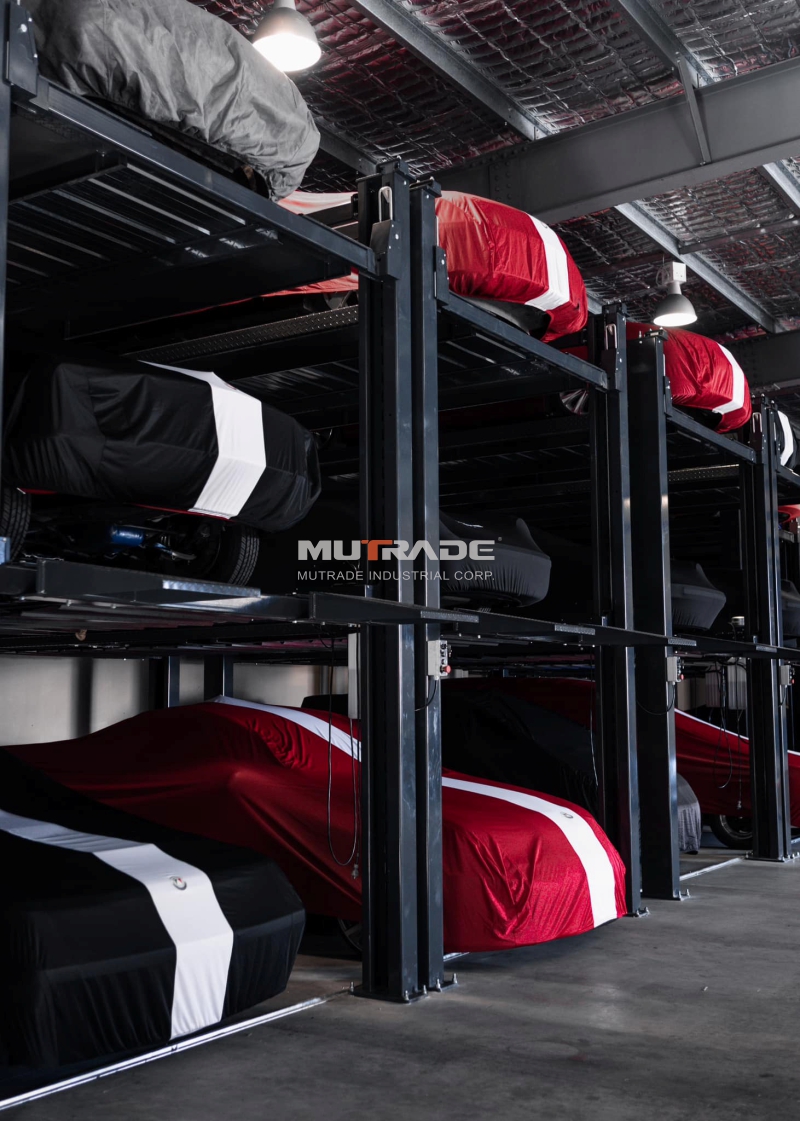
Chain transmission is the most widely represented architecture in the published range and appears on dependent two-post stackers, pit lifts and multi-level stackers where a rigid platform and high capacity per space control the design.
- Hydro-Park 1127 & 1123 — two-post parking lift / double car stacker, 2 vehicles per unit, rated lifting capacity 2700 kg & 2300 kg, lifting time 50 s.
- Starke 2127 — pit / underground parking lift, 2 vehicles per unit, 2700 kg, lifting time 30 s.
- Starke 2227 — pit parking lift (double unit), 4 vehicles per unit at 2700 kg per car, lifting time 30 s.
- Hydro Park 2525 & 2625 — triple car stacker, 3 vehicles per unit, 2500 kg on the second floor and 2000 kg on the third, lifting time 68 s.
- Starke 3121 & 3127 — semi-automatic puzzle parking lift, 8 vehicles per unit, 2700 kg, lifting speed 8–12 m/min, code and ID card operation.
- ARP Series — rotary parking lift, 8–20 vehicles per unit, 2000 kg for sedans and 2500 kg for SUVs, lifting time 90–150 s.
- MLP Series — automated parking lift, 50–120 vehicles per unit, 2350 kg, lifting speed up to 75 m/min.
Selection logic: chains suit fixed platform geometry that must stay rigid across a long span, and layouts where capacity per parking space is the controlling requirement rather than travel speed.
2. Hydraulic Cylinder With Wire Rope
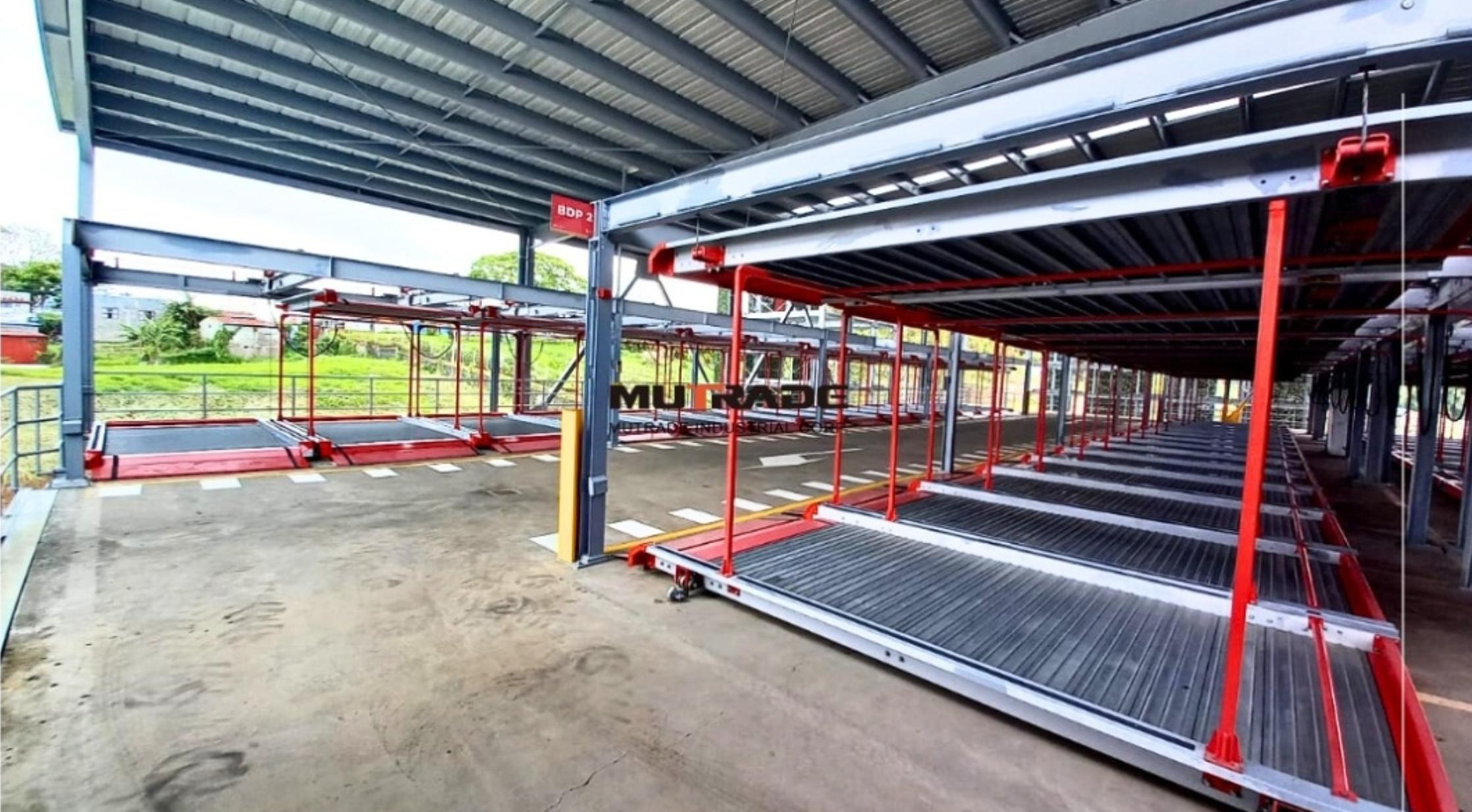
Wire rope appears where travel speed and multi-level access control matter more than single-platform rigidity. The BDP-2 puzzle parking lift carries more than 5 vehicles per unit, rated at 2000 kg / 2500 kg, with allowed car dimensions of 5000 mm length and 1850 mm width, and car heights of 1550 mm or 2050 mm. Its listed lifting speed is 8–12 m/min, operation is by button and IC cards, and the power supply is a bespoke 380 V, 50/60 Hz. The BDP-2 holds CE certification from TUV Rheinland under certificate AM 50454918 0001.
3. Hydraulic Cylinder With Cable
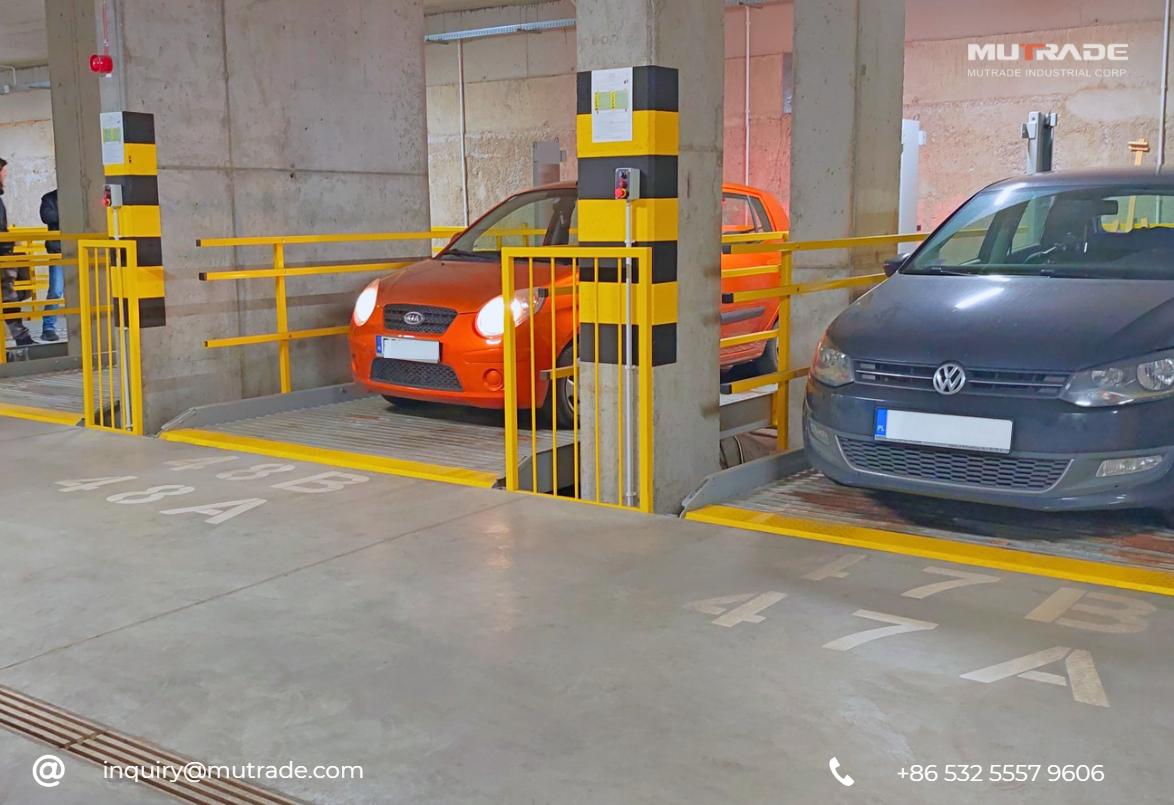
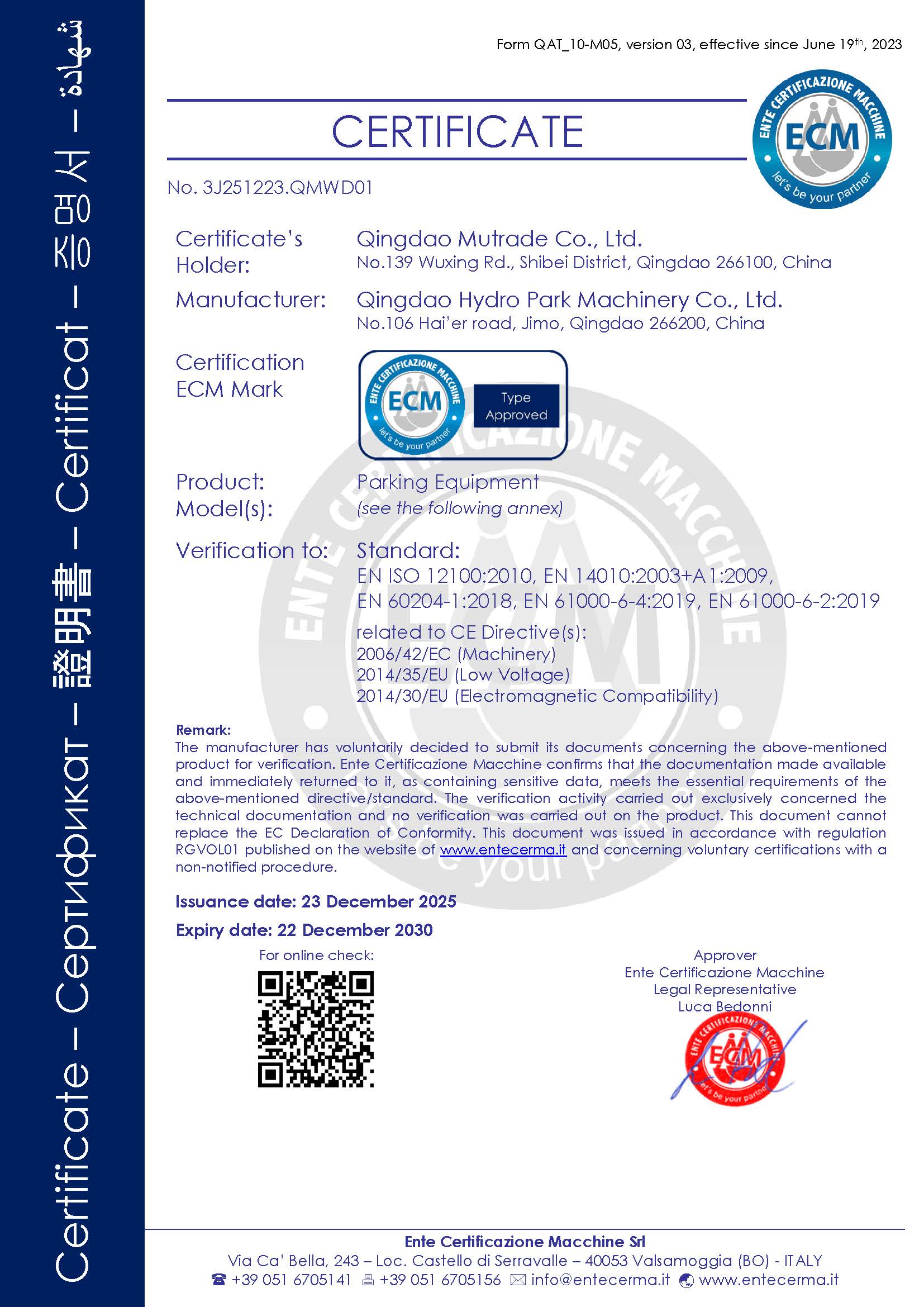
Cable transmission is documented on four-post storage lifts. The Hydro-Park 2136 parks 2 vehicles per unit with a rated lifting capacity of 3600 kg, allowed car length of 4566 mm, width of 2560 mm and height of 2442 mm, a lifting time of ≤55 s, key switch operation and a bespoke 110–480 V, 50/60 Hz supply. CE coverage for the Hydro-Park 2136 sits inside certificate No. 3J251223.QMWD01 issued by Ente Certificazione Macchine Srl and valid from 2024-12-11 to 2029-12-10.
4. Direct Hydraulic Cylinder
Direct cylinder drive is used where the platform tilts, scissor-lifts, or travels floor to floor — layouts in which a secondary traction element would add complexity without adding capability.
- TPTP-2 — tilting parking lift for low ceilings, 2 vehicles per unit, 2000 kg, lifting time 24 s, key switch operation, bespoke 220 V, 50/60 Hz.
- S-VRC-2 — subterranean garage parking lift, 2 vehicles per unit, 3000 kg, lifting speed 4 m/min, push buttons standard with optional remote controller, bespoke 208–480 V, 50/60 Hz.
- FP-VRC — floor-to-floor car elevator, 2000–10000 kg, hydraulic cylinder with double steel chains, lifting speed 4 m/min, button switch standard with optional remote controller, 4 kW hydraulic power pump.
Voltage, Control Voltage and Operator Interface
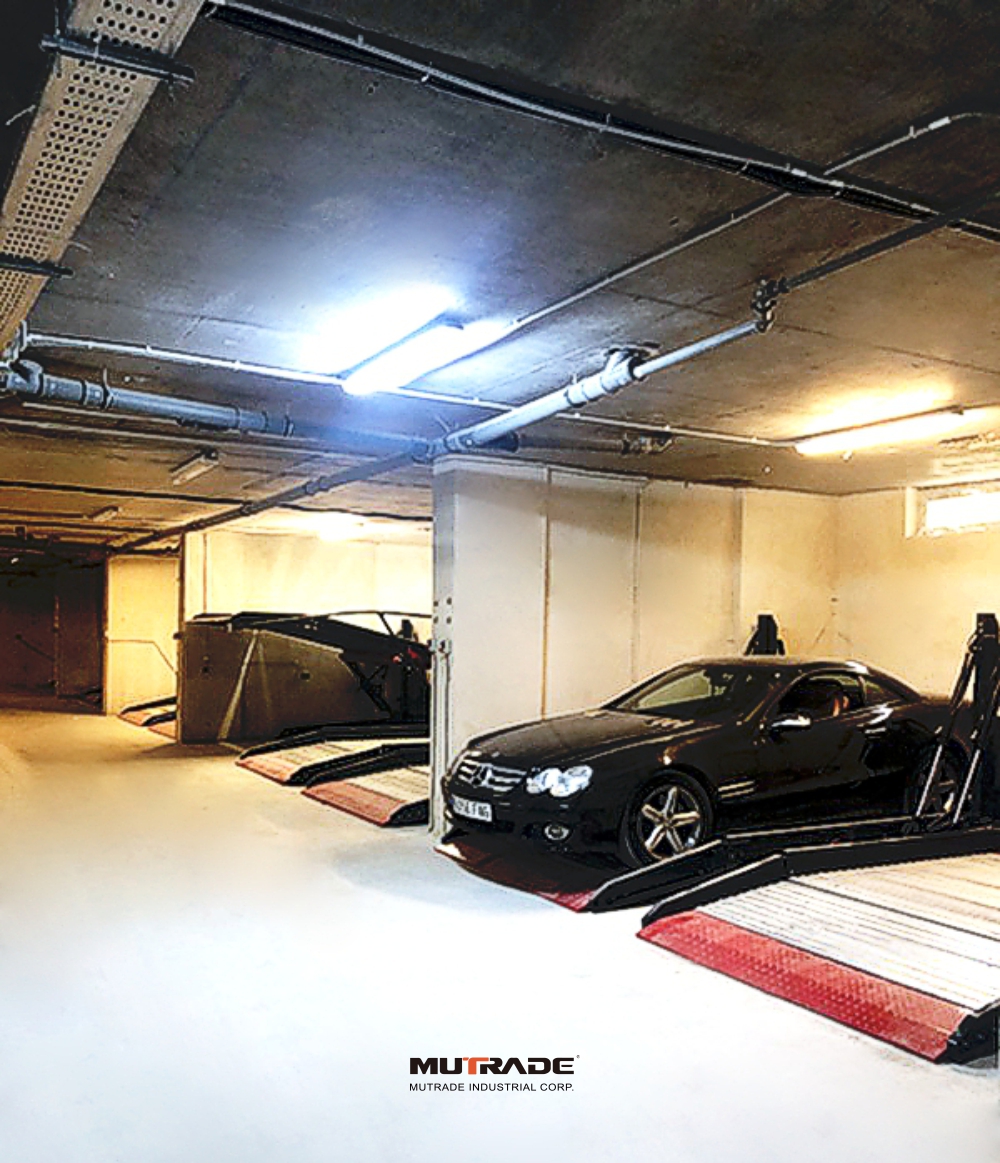
Voltage selection has two layers. The first is supply voltage, which must match the site's distribution and frequency. The second is control voltage, which project records keep low for operator protection: both the Russian Hydro-Park 1127 installation and the Romanian TPTP-2 installation specify a 24 V control voltage for electric shock protection.
| Model | Power supply (published) | Operation interface |
|---|---|---|
| Hydro-Park 1127 & 1123 | Bespoke, 110–480 V, 50/60 Hz | Key switch |
| Hydro-Park 2136 | Bespoke, 110–480 V, 50/60 Hz | Key switch |
| Hydro Park 2525 & 2625 | Bespoke, 110–480 V, 50/60 Hz | Key switch |
| Starke 2127 | Bespoke, 200–450 V, 50/60 Hz | Key switch |
| Starke 2227 | Bespoke, 200–450 V, 50/60 Hz | Key switch |
| Starke 3121 & 3127 | Bespoke, 200–450 V, 50/60 Hz | Code & ID card |
| TPTP-2 | Bespoke, 220 V, 50/60 Hz | Key switch |
| BDP-2 | Bespoke, 380 V, 50/60 Hz | Button & IC cards |
| ARP Series | Bespoke, 480 / 415 / 380 / 220 V, 50/60 Hz | Touch screen / IC card / button |
| MLP Series | Bespoke, 110–480 V, 50/60 Hz | IC card, touch screen, or manual |
| S-VRC-2 | Bespoke, 208–480 V, 50/60 Hz | Push buttons (standard) / remote controller (optional) |
| FP-VRC | Bespoke; 4 kW hydraulic power pump | Button switch (standard) / remote controller (optional) |
Step-by-Step Breakdown: How to Specify a Drive Mode Before You Order
Step 1 — Fix the vehicle envelope and capacity margin. Published allowed vehicle dimensions differ per model: Hydro-Park 1127 & 1123 accept cars up to 5000 mm × 1850 mm × 2050 mm; Hydro-Park 2136 accepts 4566 mm × 2560 mm × 2442 mm; Hydro Park 2525 & 2625 accept 5060 mm × 2802 mm × 2050 mm; Starke 2127 and Starke 2227 accept 5000 mm × 2050 mm × 1700 mm; TPTP-2 accepts 5000 mm × 1850 mm × 1550 mm. Rated capacity ranges from 2000 kg to 3600 kg across these models, so the drive mode discussion should start from the heaviest vehicle the site will realistically accept.
Step 2 — Measure vertical constraints before discussing drive mode. Pit and headroom requirements eliminate architectures faster than any other parameter. Starke 2327 requires a ceiling height above 2700 mm and a pit depth above 1600 mm; TPTP-2 was specified for low-ceiling environments with a minimum ceiling height of only 2900 mm and a 10° tilting platform; the Starke 2127 project record lists a standard pit depth from 1750 mm.
Step 3 — Match the architecture to platform geometry and duty. Tilting, scissor and floor-to-floor applications use a direct hydraulic cylinder (TPTP-2, S-VRC-2, FP-VRC). Dependent two-post stackers and pit lifts use hydraulic cylinder with chains (Hydro-Park 1127 & 1123, Starke 2127, Starke 2227, Hydro Park 2525 & 2625, Starke 3121 & 3127). Multi-level puzzle layouts that prioritise travel speed and card-based access use hydraulic cylinder with wire rope (BDP-2). Four-post long-platform storage uses hydraulic cylinder with cable (Hydro-Park 2136).
Step 4 — Lock the electrical package early. Confirm supply voltage and frequency against the table above, then confirm the control voltage for the operator circuit, then confirm the access interface the operator will actually use — key switch, buttons, IC card, code, ID card or touch screen.
Step 5 — Verify structure and finish checkpoints. The listed models in this guide are built from Q235 carbon steel. Project records add the finishing layer: galvanised platforms with antislip wave plate and drainage, AkzoNobel powder coating for rust protection, and bolts and nuts that pass a 72-hour salt spray test in the Starke 2227 private garage installation. Safety hardware is specified separately from the drive mode — dynamic anti-falling locks with electric auto release on Hydro-Park 1127 projects, and a mechanical anti-falling lock with electric auto lock release on the TPTP-2 installation.
Step 6 — Confirm compliance documentation by model. CE certification is issued per model or model group, so the certificate scope must match the model on the purchase order. TUV Rheinland certificates in the range cover, among others, Hydro-Park 1127 (AM 50326224 0001), Hydro-Park 1123 (AM 50414529 0001), Starke 2127 (AM 50423989 0001), Starke 2227 (AM 50425570 0001), TPTP-2 (AM 50537070 0001), BDP-2 (AM 50454918 0001), Starke 3121 and Starke 3127 (AM 50429276 0001) and Hydro-Park 3130 (AM 50426783 0001).
Step 7 — Confirm commercial terms. MUTRADE's standing terms are a minimum order quantity of 1 unit, delivery on EXW, FOB, CIF or DDU, payment of a minimum 30% in advance or by letter of credit, an optional pre-shipment test on cost, a lead time of 30–45 days, a monthly capacity of 1000 car spaces, random inspection as standard quality control, and after-sales support consisting of 24h online remote support, local partners and on-site engineer supervision on cost.
Use Cases: How Drive-Mode Decisions Played Out in Delivered Projects
- Romania — low-ceiling residential garage (TPTP-2, direct cylinder). 20 units were installed in a residential complex with a minimum ceiling height of only 2900 mm. The 10° tilting platform, 2000 kg capacity, 2.2 kW pump, rising/descending time under 35 seconds and 24 V control voltage doubled parking capacity inside the same footprint. The tilting geometry, not the capacity rating, was the deciding factor.
- Canada — luxury auto dealership (Hydro-Park 1127, cylinder + chains). 8 units provided 16 parking spaces indoors, with a 2100 mm lifting height, a 2.2 kW hydraulic pump and rising/descending time under 55 seconds. Operation is by key switch with 24 V control voltage, and the system is TUV compliant, CE certified to 2006/42/EC and EN14010, and supports vehicles up to 5000 mm × 1850 mm × 2050 mm.
- France — private garage (Starke 2227, cylinder + chains). A single unit delivers 2700 kg per parking space with a listing speed under 55 seconds, a cable anti-falling system, and a 5.5 kW / 7.5 kW hydraulic pump on a 200–480 V, 3-phase, 50/60 Hz supply. Bolts and nuts pass a 72-hour salt spray test; installation is indoor, in a pit.
- Australia — commercial car storage (Hydro Park 2525, cylinder + chains). 18 units created 54 parking spaces through vertical stacking at 2500 kg capacity, with TUV Rheinland and EAC certification, tripling capacity within the existing footprint.
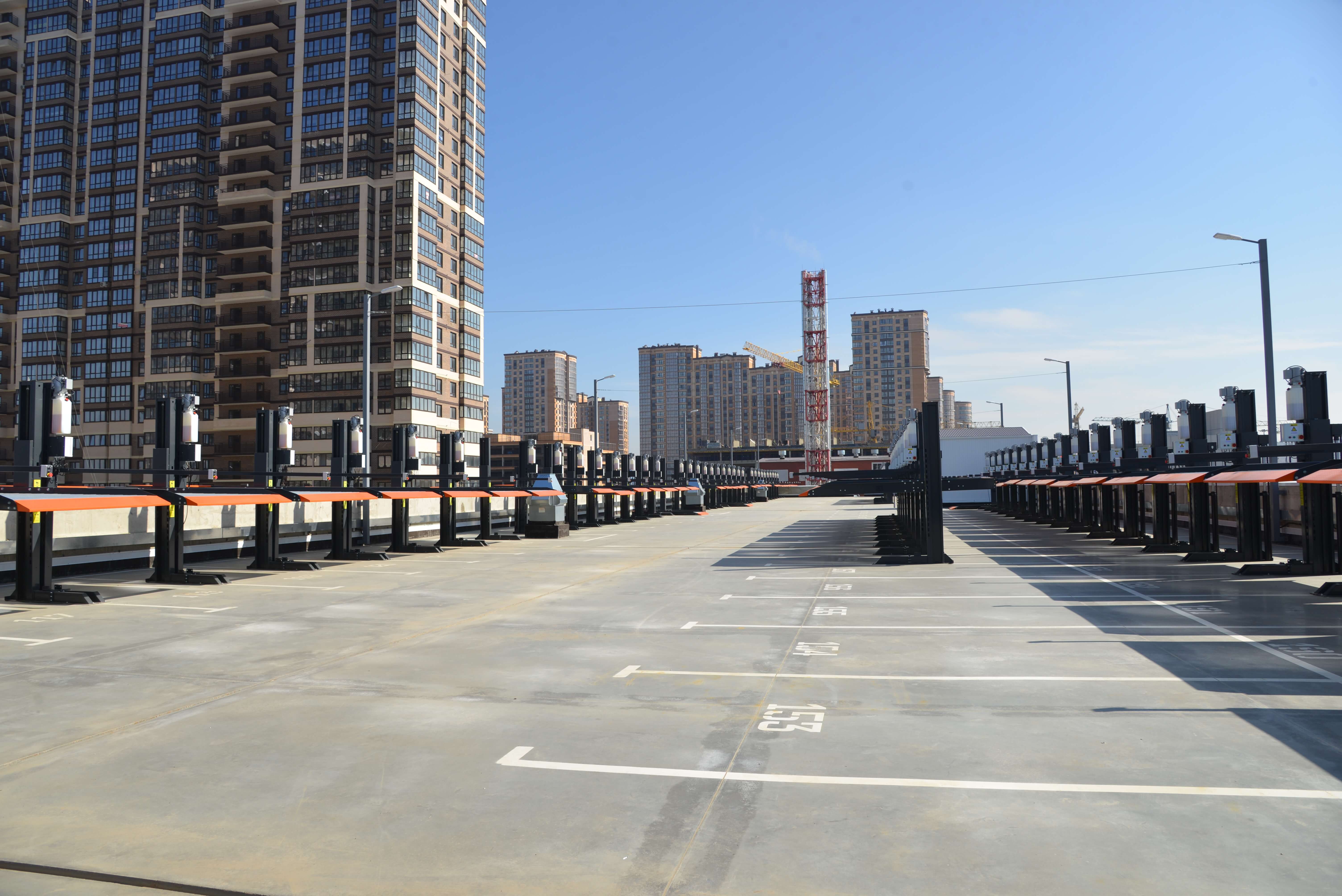
- Costa Rica — roof-level puzzle parking (BDP-2, cylinder + wire rope). One system added 216 parking spaces in two vertical levels with horizontal layouts from 3 to 10 grids wide, operated by ID card or key fob and protected by more than 15 safety devices.
- Poland and Russia — pit retrofits (Starke 2127, cylinder + chains). In Poland, 50 units doubled capacity from 50 to 100 spaces using a 5.5 kW hydraulic pump, rising/descending time under 55 seconds and a standard pit depth from 1750 mm, with zero new construction. In Russia, 35 units provided 70 spaces with independent access to both levels and no energy consumption during descent.
Comparison Table: Drive Mode, Capacity and Configuration
| Model | Configuration | Vehicles per unit | Rated capacity | Drive mode | Lifting time |
|---|---|---|---|---|---|
| Hydro-Park 1127 & 1123 | Two-post parking lift / double car stacker | 2 | 2700 kg & 2300 kg | Hydraulic cylinder + chains | 50 s |
| Hydro-Park 2136 | 4-post car storage lift | 2 | 3600 kg | Hydraulic cylinder + cable | ≤55 s |
| Hydro Park 2525 & 2625 | Triple car stacker | 3 | 2500 kg (2F) & 2000 kg (3F) | Hydraulic cylinder + chains | 68 s |
| Starke 2127 | Pit / underground parking lift | 2 | 2700 kg | Hydraulic cylinder + chains | 30 s |
| Starke 2227 | Pit parking lift (double unit) | 4 | 2700 kg per car | Hydraulic cylinder + chains | 30 s |
| Starke 2327 | Tilted pit parking lift | 2 | 2700 kg | Hydraulic cylinder + chains | Ceiling >2700 mm; pit >1600 mm |
| TPTP-2 | Tilting parking lift (low ceiling) | 2 | 2000 kg | Hydraulic cylinder | 24 s |
| BDP-2 | Puzzle / multilevel parking lift | >5 | 2000 kg / 2500 kg | Hydraulic cylinder + wire rope | 8–12 m/min |
| Starke 3121 & 3127 | Semi-automatic puzzle parking lift | 8 | 2700 kg | Hydraulic cylinder + chains | 8–12 m/min |
| S-VRC-2 | Scissor lift platform parking lift | 2 | 3000 kg | Hydraulic cylinder | 4 m/min |
Two patterns emerge from the table. First, lifting time is a function of architecture and travel, not of price: the fastest figures belong to direct-cylinder and wire-rope layouts (24 s and 8–12 m/min), while chain-driven multi-level stackers run at 50 s to 68 s. Second, capacity and drive mode are correlated but not locked — the 3600 kg four-post Hydro-Park 2136 and the 2700 kg two-post Hydro-Park 1127 sit at similar lifting times on different transmissions.
Frequently Asked Questions
Which parking lift drive modes and models are covered by CE certification?
CE certification in the MUTRADE range is issued per model or model group under directives and standards including 2006/42/EC, EN 14010:2003+A1 and EN 60204-1. TUV Rheinland certificates cover Starke 2127 (AM 50423989 0001), Starke 2227 (AM 50425570 0001), Hydro-Park 1127 (AM 50326224 0001), Hydro-Park 1123 (AM 50414529 0001), TPTP-2 (AM 50537070 0001), BDP-2 (AM 50454918 0001), Starke 3121 and Starke 3127 (AM 50429276 0001), and Hydro-Park 3130 (AM 50426783 0001). Two further certificates from Ente Certificazione Macchine Srl cover broader model groups: No. 3J251223.QMWD01, valid 2024-12-11 to 2029-12-10, covering models such as Hydro-Park 1123, 1127, 1223, 1521 and 2136; and No. 3J260613.QMTU32, valid 2026-06-13 to 2031-06-12, covering Hydro-Park 2525, 2625, 4127, 4220, 5120 and 5230, Starke 2327 and 2427, the ARP-8 to ARP-20S range, ATP-20S, MLP, HSP and MSSP. Because scope is model-specific, the certificate number should be matched against the exact model on the purchase order.
Can drive mode, voltage, control interface and finish be customized for an OEM parking lift program?
Yes. MUTRADE provides OEM, ODM, Private Label and White Label production, and customization covers voltage, logo, parking width, system height and color. This matters because published supply ranges already differ by design: Hydro-Park 1127 & 1123 accept a bespoke 110–480 V at 50/60 Hz, Starke 2127 and Starke 2227 sit in a 200–450 V band, TPTP-2 is listed at 220 V, BDP-2 at 380 V, and the ARP Series offers 480 V, 415 V, 380 V or 220 V. Control interfaces across the range cover key switch, push buttons, optional remote controller, button and IC cards, code and ID card, and touch screen, so the interface can be aligned with how the site will actually be operated.
How do I choose between chain, wire rope and cable drive?
Match the transmission to the platform geometry and duty. Chains suit dependent two-post stackers and pit lifts that need a rigid platform with high capacity per space — Hydro-Park 1127 & 1123 at 2700 kg and 2300 kg, Starke 2127 and Starke 2227 at 2700 kg, Hydro Park 2525 & 2625 at 2500 kg and 2000 kg, and Starke 3121 & 3127 at 2700 kg. Wire rope suits multi-level puzzle layouts that prioritise travel speed and card-based access, as in the BDP-2 at 8–12 m/min with button and IC card operation. Cable suits four-post storage lifts where long platforms and 3600 kg capacity are the priority, as in the Hydro-Park 2136 with a ≤55 s lifting time. Direct hydraulic cylinders suit tilting, scissor and floor-to-floor layouts — TPTP-2 at 24 s, S-VRC-2 at 4 m/min and FP-VRC at 4 m/min with a double steel chain. In every case, safety hardware and control voltage are specified separately from the drive mode; project records for Hydro-Park 1127 and TPTP-2 both use 24 V control voltage for electric shock protection.
What are the purchasing terms, MOQ and lead time?
Market-level terms for MUTRADE parking lifts are a minimum order quantity of 1 unit, delivery on EXW, FOB, CIF or DDU, and payment of a minimum 30% in advance or by letter of credit. Acceptance criteria include an optional pre-shipment test on cost, and standard quality control is random inspection. Lead time is 30–45 days against a monthly capacity of 1000 car spaces. After-sales support consists of 24h online remote support, local partners and on-site engineer supervision on cost.
Can a single unit be validated before a full project rollout?
Yes. The minimum order quantity of 1 unit means a drive mode and voltage package can be ordered, installed and reviewed on site before a multi-unit order is placed, and a pre-shipment test can be arranged on cost as an acceptance criterion. After installation, 24h online remote support, local partners and on-site engineer supervision on cost are available for commissioning and follow-up. To start, send your site parameters — voltage and frequency, pit depth or ceiling height, and the vehicle envelope — to inquiry@mutrade.com or download the Mutrade Profile 2025 EN brochure.
Conclusion
The drive mode question is answered by four pieces of site information and four published specifications. Site information: vehicle envelope and weight, pit depth or ceiling height, available supply voltage and frequency, and who will operate the lift. Published specifications: drive architecture (chains, wire rope, cable or direct cylinder), rated capacity, lifting time, and power supply with control interface. Reviewed together, these eliminate models quickly — a low-ceiling garage points to a tilting direct-cylinder lift such as the TPTP-2, a multi-level puzzle layout points to a wire-rope system such as the BDP-2, a four-post storage bay points to a cable-driven lift such as the Hydro-Park 2136, and a dependent two-post stacker points to a chain-driven lift such as the Hydro-Park 1127 & 1123.
Next Step: Confirm Drive Mode, Voltage and Control Against Your Site
MUTRADE supplies OEM, ODM, Private Label and White Label parking lift programs with customization across voltage, logo, parking width, system height and color, at a minimum order quantity of 1 unit, a monthly capacity of 1000 car spaces and a lead time of 30–45 days.
Download the Mutrade Profile 2025 EN brochure, visit www.mutrade.com, or send your site parameters to inquiry@mutrade.com. Telephone: +86 532-5557-9606. Address: 106 Haier Road, Jimo District, Qingdao City, Shandong Province, China.
Have Questions or Need More Details?
Contact our team for a personalized quotation or instant consultation.
Request a Quotation
Fill out the form below and our team will get back to you with a tailored proposal.
WhatsApp Direct Chat
Prefer to chat in real-time? Message us on WhatsApp for instant assistance & quick answers.
- Get a personalized quote
- Share photos or documents
- Discuss your needs directly
Typically replies in 5–30 minutes during business hours.