Parking Lift Specs & Certifications: A Buyer’s Checklist for 2-Post, 4-Post, and Triple Stacker Lifts
Parking Lift Specs & Certifications: A Buyer’s Checklist for 2-Post, 4-Post, and Triple Stacker Lifts
When procurement teams or property owners enter the market for a parking lift, they often begin with a simple search phrase: car parking lift, parking lift for car, or hydraulic car parking lift. The search results, however, contain everything from a compact 2-post model to a giant automated tower. To avoid costly mistakes, buyers need to compare the same set of physical and compliance parameters across all models. This article provides that comparison framework, using the specification sheets and CE/CWB certificates of Mutrade Industrial Corp. as concrete examples.
Mutrade Industrial Corp. is a Chinese mechanical parking equipment manufacturer founded in 2009. Its factory in Qingdao covers 12,000 m², and the company has supplied parking lifts, semi-automatic systems, and fully automatic systems to customers in more than 100 countries. Understanding how its product range is specified and certified helps you benchmark other suppliers.
The Hidden Variability in Parking Lift Specifications
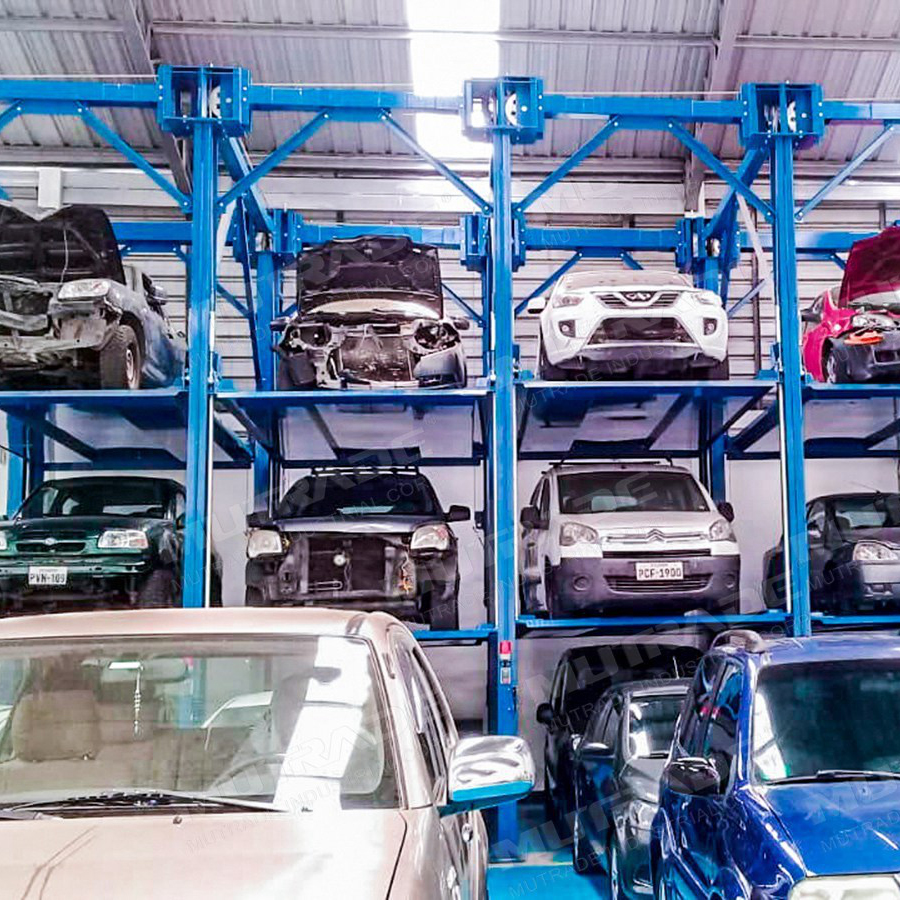
Two different quotations for a “2 post parking lift” can look similar but perform very differently. Rated lifting capacity may be 2300 kg or 3600 kg. Allowed car length may be 4566 mm or 6772 mm. Drive mode may be hydraulic or manual with handle. Lifting time may be 24 seconds or 80 seconds. Some models are CE certified for the EU market; others are additionally CWB certified for North America. These differences are not marketing details. They determine whether the equipment can handle your vehicle mix, fit your site, and pass local inspection.
Without a structured checklist, buyers often discover too late that a “cheaper” unit lacks the required certificate or has a platform that is too short for an SUV. This article addresses that risk by translating the key parameters of a parking lift into decision criteria, using verified product data from a Chinese manufacturer as reference.
Why Parking Lifts Are Growing in Demand
Quantitative market data supports the shift toward mechanical parking. The global car lifts market was valued at USD 2.8 billion in 2025 and is projected to reach USD 4.7 billion by 2034, according to Dataintelo. For the car stacker segment specifically, QYResearch estimated a market of USD 4.6 billion in 2023, growing to USD 6.72 billion by 2030. North America is the largest vehicle lift market, reaching USD 3.25 billion in 2024, driven by high light-truck ownership. Hydraulic mechanisms hold the leading share of 57.2% in the global car lift market.
For a buyer, these numbers mean one thing: suppliers are entering the segment quickly, and not all of them have the same engineering depth or compliance coverage. That is why a specification and certification checklist is more important than ever.
Key Specifications and Certifications to Evaluate in a Parking Lift
The following definitions turn a specification sheet into a useful comparison tool.
Rated Lifting Capacity
Rated lifting capacity is the maximum weight a platform can support. It must be matched to the heaviest vehicle you plan to lift. For example, the Hydro-Park 1127 two-post lift is rated at 2700 kg, while the Hydro-Park 2136 4-post lift carries a higher 3600 kg rating. If your fleet includes large SUVs or light trucks, prioritize capacity over price.
Allowed Car Length, Width, and Height
These three numbers define the vehicle envelope. The Hydro-Park 3130 triple stacker allows cars up to 6772 mm long, 2070 mm wide, and 2000 mm high. The TPTP-2 tilting lift, designed for low ceilings, accepts cars up to 5000 × 1850 × 1550 mm. Measure your largest car and add a safety margin of at least 100 mm on each side.
Vehicles Parked per Unit
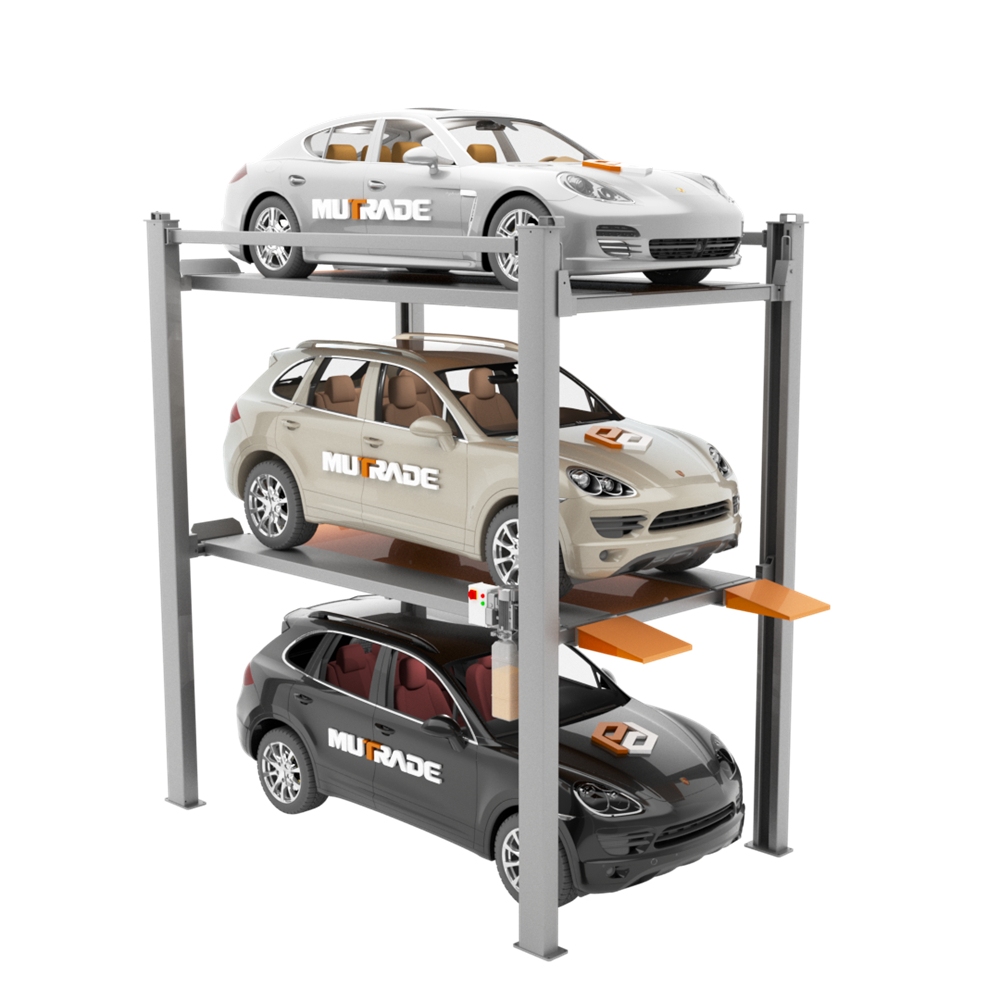
This is the stacking productivity ratio. A 2-post dependent lift parks 2 vehicles in one footprint. A triple stacker such as the Hydro-Park 3130 parks 3 vehicles, and a quad stacker like the Hydro-Park 3230 parks 4 vehicles. Commercial operators should calculate the number of units needed to meet capacity targets.
Drive Mode and Lifting Time
Most parking lifts use a hydraulic cylinder combined with chains or cables. Some models, such as the Hydro-Park 3130, use a manual handle and require 80 seconds for a full cycle. Others, like the TPTP-2, use hydraulic power and lift in 24 seconds. In a commercial facility with frequent retrieval, faster hydraulic operation is usually worth the cost.
Operation Method and Power Supply
Common operation methods are key switch, push button, IC card, and touch screen. Power supply is often bespoke, with many models accepting 110-480 V, 50/60 Hz. MUTRADE’s Hydro-Park 1127, for instance, runs on bespoke 110-480 V, while the TPTP-2 uses 220 V, 50/60 Hz. Confirm your local voltage and control preference before ordering.
Material and Construction
Carbon steel Q235 is the dominant material in MUTRADE’s parking lifts. It provides the structural strength needed for repeated lifting and is compatible with standard welding certification processes such as CWB under CSA W47.1.
MUTRADE Product Line: 2-Post, 4-Post, and Triple Stacker Examples
2-Post Parking Lifts
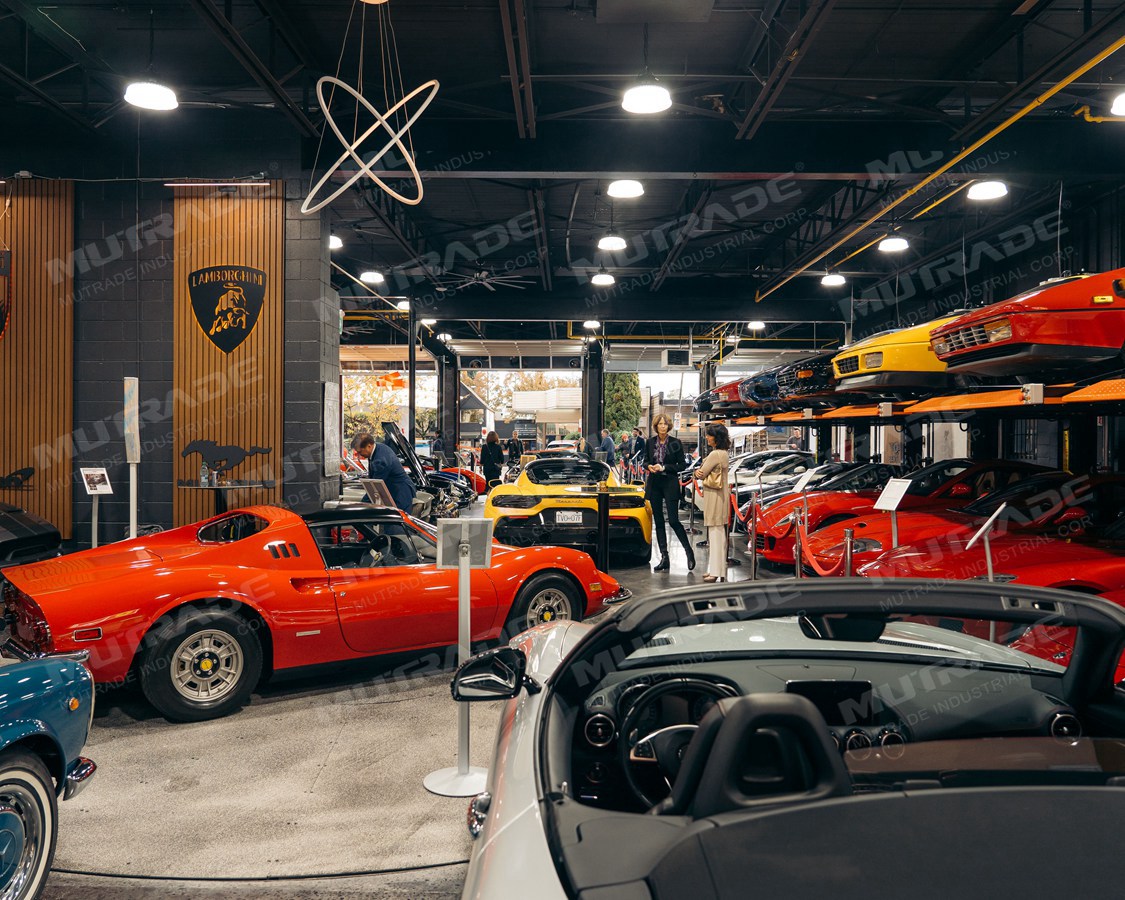
- Hydro-Park 1127 & 1123 – This two-post dependent parking lift parks 2 vehicles per unit. Rated capacity is 2700 kg for the 1127 and 2300 kg for the 1123. The vehicle envelope is 5000 × 1850 × 2050 mm. Drive mode is hydraulic cylinder + chains; lifting time is 50 seconds; operation is by key switch. Both models are CE certified under TUV Rheinland certificates AM 50326224 0001 and AM 50414529 0001. The welding for these products is also CWB certified for the North American market under certificate QINHY1.
- TPTP-2 – A tilting, low-ceiling parking lift. It parks 2 vehicles, has a 2000 kg capacity, and accepts cars up to 5000 × 1850 × 1550 mm. It is hydraulically driven, lifts in 24 seconds, uses key switch operation, and runs on 220 V, 50/60 Hz. CE certificate number AM 50537070 0001 from TUV Rheinland covers the EU market.
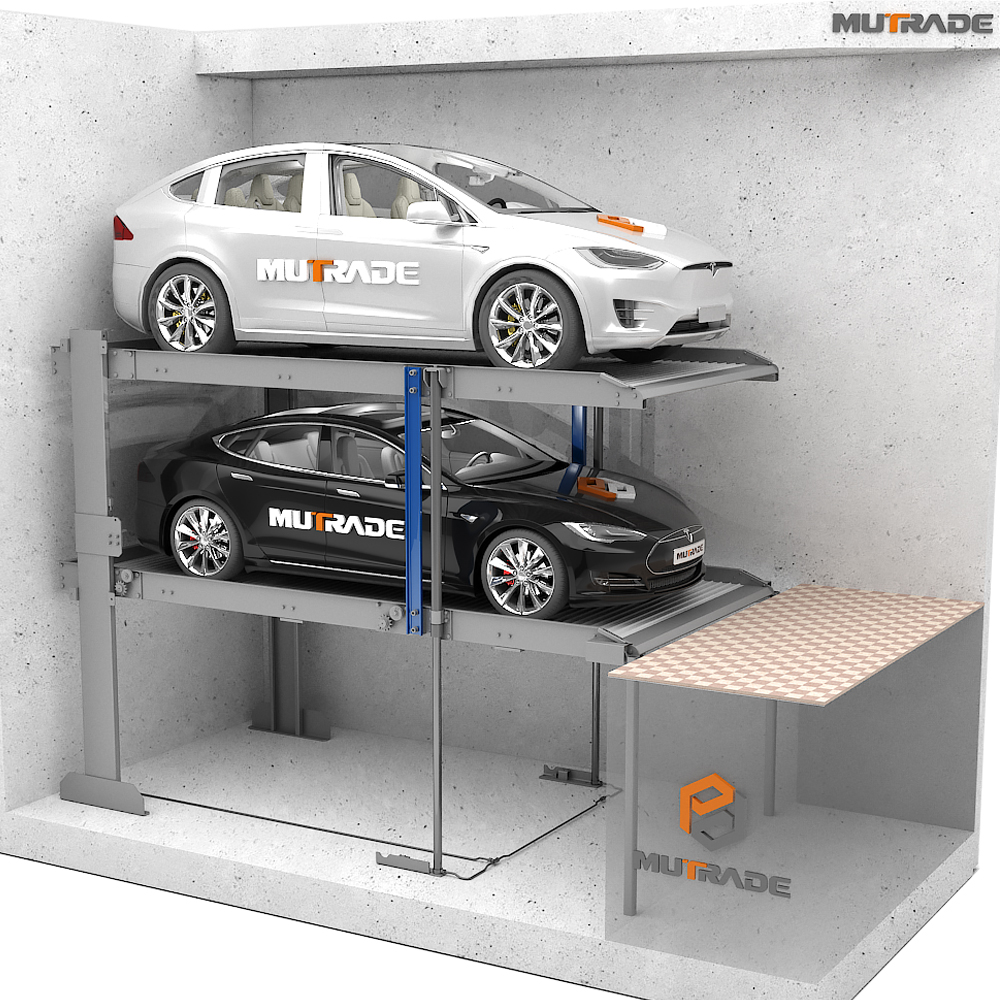
- Starke 2127 – A pit-based two-post parking lift for underground and residential parking. It parks 2 vehicles, each with a 2700 kg capacity, and the vehicle envelope is 5000 × 2050 × 1700 mm. Lifting time is 30 seconds, operation is key switch, and power supply is bespoke 200-450 V. CE certificate AM 50423989 0001, issued by TUV Rheinland, covers this model for the EU market.
4-Post and Triple Stacker Parking Lifts
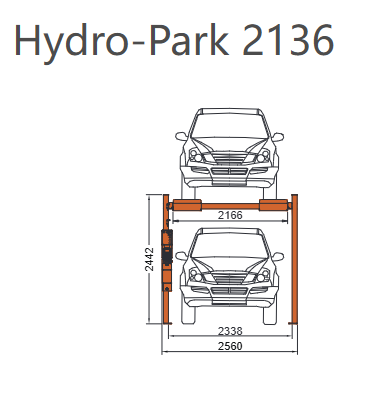
- Hydro-Park 2136 – A 4-post vehicle storage lift. It parks 2 vehicles per unit, has a rated lifting capacity of 3600 kg, and accepts cars up to 4566 × 2560 × 2442 mm. The drive mode is hydraulic cylinder + cable, with lifting time ≤55 seconds and key switch operation. It is CE certified under number 3J251223.QMWD01 issued by Ente Certificazione Macchine Srl.
- Hydro-Park 3130 – A 4-post triple stacker for car storage. It parks 3 vehicles per unit with a 3000 kg capacity. The car envelope is 6772 × 2070 × 2000 mm. Drive mode is manual with handle, lifting time is 80 seconds, and operation is via key switch. It is CE certified under number AM 50426783 0001 from TUV Rheinland.
- Hydro-Park 3230 – A four-level quad stacker. It parks 4 vehicles per unit with a 3000 kg capacity, and accepts cars up to 8912 × 2100 × 2000 mm. Drive mode is manual with handle, lifting time is 120 seconds, and operation is key switch. Customization is acceptable.
- Hydro-Park 2525 & 2625 – A 4-post triple car stacker. It parks 3 vehicles per unit, with rated capacities of 2500 kg on the second floor and 2000 kg on the third floor. The vehicle envelope is 5060 × 2802 × 2050 mm. Drive mode is hydraulic cylinder + chains, lifting time is 68 seconds, and operation is key switch. These models are covered by CE certificate 3J260613.QMTU32 issued by Ente Certificazione Macchine Srl.
Other Configurations for Specific Projects
Beyond the popular 2-post and 4-post categories, MUTRADE offers specialized configurations. The Hydro-Park 1027 is a single-post parking lift for car storage and display, with a 2700 kg capacity and a 45-second lifting time. The S-VRC-2 is a scissor lift platform for subterranean garages, with a 3000 kg capacity and push-button operation. The FP-VRC is a four-post hydraulic car elevator that moves vehicles between floors, with capacities up to 10,000 kg depending on the configuration. Automated systems such as the ARP rotary, MLP shuttle, and ATP tower are available for larger projects of 50-120 vehicles. These systems also carry CE certification from recognized European bodies.
How to Evaluate a Parking Lift: 7-Step Checklist
- Define your vehicle fleet. Record the length, width, height, and gross weight of every vehicle type you plan to park. Use the largest vehicle as the design benchmark.
- Measure the installation site. Check ceiling height, floor area, column positions, and whether a pit is feasible. Low-ceiling projects may need a tilting lift such as the TPTP-2 or a tilted pit lift like the Starke 2327, which requires a pit depth of only 1600 mm.
- Choose the stacking configuration. A 2-post lift doubles capacity in the same footprint; a 4-post or triple stacker triples it. For even higher density, consider a quad stacker or automated systems.
- Compare drive mode and cycle time. Hydraulic lifts with chains or cables are common. If vehicles are retrieved frequently, choose a hydraulic model with a short lifting time. For long-term storage, manual operation can reduce initial cost.
- Verify certifications. For EU projects, confirm that the specific model has a CE Machinery Certificate from a notified or recognized body. Ask for the certificate number and cross-check the standards, such as 2006/42/EC, EN 14010:2003+A1, and EN 60204-1. For North America, verify the welding certification, such as CWB under CSA W47.1.
- Check power supply and optional features. Most MUTRADE lifts accept bespoke 110-480 V, 50/60 Hz. Confirm your voltage, frequency, and any options such as private labels, custom platform width, system height, and paint color.
- Evaluate supplier capability. Ask about minimum order quantity, lead time, monthly capacity, and after-sales support. MUTRADE’s MOQ is 1 unit, standard lead time is 30-45 days, monthly capacity is 1000 car spaces, and after-sales includes 24-hour online remote support and local partners.
Real-World Applications of 2-Post, 4-Post, and Triple Stacker Lifts
Several installation records illustrate how specification choices affect outcomes.
Luxury Auto Dealership in Canada
A luxury dealership installed 8 units of the Hydro-Park 1127, creating 16 parking spaces in the footprint of 8. The 2700 kg capacity and 2100 mm lifting height allowed two vehicles to stack vertically in the showroom, improving vehicle display and reducing the space needed for customer parking. The project has been in operation for 2 years.
Commercial Car Storage in Australia
A commercial car storage business deployed 18 units of the Hydro-Park 2525, a 4-post, 3-level hydraulic stacker. This created 54 parking spaces in the same footprint that previously held 18 cars. Each unit parks 3 vehicles vertically, and the facility has operated for 2 years.
Residential Underground Parking in Poland
A residential and commercial complex in Poland added 50 units of the Starke 2127 pit-based parking lift. This doubled the underground capacity from 50 to 100 spaces without expanding the footprint. The design preserved the original ceiling height and gave each vehicle independent access.
Low-Ceiling Basement in Romania
An underground facility in Bucharest used 14 units of the Starke 2327 tilted pit lift to create 28 spaces in a retrofit project with limited headroom. The minimum pit depth of 1600 mm reduced excavation and waterproofing costs while still doubling the number of parked cars.
Parking Lift Comparison: 2-Post vs 4-Post vs Triple Stacker
Use the following table to compare the specification sheets of representative MUTRADE models.
| Model | Type | Vehicles per Unit | Lifting Capacity | Max Car L×W×H (mm) | Drive Mode | Lifting Time | Operation | Certifications |
|---|---|---|---|---|---|---|---|---|
| Hydro-Park 1127 | 2-post dependent | 2 | 2700 kg | 5000 × 1850 × 2050 | Hydraulic cylinder + chains | 50 s | Key switch | CE, CWB |
| TPTP-2 | 2-post tilting | 2 | 2000 kg | 5000 × 1850 × 1550 | Hydraulic cylinder | 24 s | Key switch | CE |
| Starke 2127 | 2-post pit | 2 | 2700 kg | 5000 × 2050 × 1700 | Hydraulic cylinder + chains | 30 s | Key switch | CE |
| Hydro-Park 2136 | 4-post storage | 2 | 3600 kg | 4566 × 2560 × 2442 | Hydraulic cylinder + cable | ≤55 s | Key switch | CE |
| Hydro-Park 3130 | 4-post triple stacker | 3 | 3000 kg | 6772 × 2070 × 2000 | Manual with handle | 80 s | Key switch | CE |
| Hydro-Park 3230 | 4-level quad stacker | 4 | 3000 kg | 8912 × 2100 × 2000 | Manual with handle | 120 s | Key switch | Customizable |
| Hydro-Park 2525 | 4-post triple stacker | 3 | 2500 kg (2F) / 2000 kg (3F) | 5060 × 2802 × 2050 | Hydraulic cylinder + chains | 68 s | Key switch | CE |
Frequently Asked Questions
What certifications should a CE-certified parking lift manufacturer have?
A genuine CE-certified parking lift should come with a Machinery Certificate issued under applicable European standards. For example, MUTRADE’s Starke 2227 carries CE certificate number AM 50425570 0001 from TUV Rheinland, complying with 2006/42/EC, EN 14010:2003+A1, and EN 60204-1:2006+A1+AC. For North America, look for CWB certification of steel structure welding under CSA W47.1, such as MUTRADE’s certificate number QINHY1. Always ask for the certificate number and verify it with the issuing body.
What are the key specifications to evaluate in a car parking lift?
Evaluate rated lifting capacity, allowed car length/width/height, number of vehicles parked per unit, drive mode, lifting time, operation method, power supply, and material. For instance, the Hydro-Park 3130 has a 3000 kg capacity, allows cars up to 6772 × 2070 × 2000 mm, and parks 3 vehicles per unit. Compare these values with your intended fleet and site conditions before ordering.
Can I order a sample or small quantity of a parking lift?
Yes. Many manufacturers accept small orders. MUTRADE’s minimum order quantity is 1 unit, which allows dealers, contractors, and property owners to validate the equipment before committing to larger volumes.
What is the typical lead time for a parking lift order?
Lead time depends on the model, volume, and customization. MUTRADE’s standard lead time is 30-45 days, with a monthly production capacity of 1000 car spaces. For a timely quote and production schedule, contact the factory with your project details.
How can I get a quotation or more information about parking lifts?
For a project-specific quotation, send your vehicle dimensions, site layout, and required certifications to inquiry@mutrade.com or via WhatsApp at +86 151-6529-8568. You can also download the Mutrade company profile for the full product range. The team typically responds within one business day.
Conclusion: Use Specifications, Not Just Price, to Choose Your Parking Lift
A parking lift is a long-term investment. The difference between a compliant, well-sized lift and an unsuitable one is written in the specification sheet. Evaluate lifting capacity, vehicle envelope, drive mode, lifting time, operation, and certifications before comparing price. Use the 7-step checklist in this article when you review quotes from manufacturers.
Mutrade Industrial Corp. is one such manufacturer to benchmark against. The company was founded in 2009, has a 12,000 m² factory, and has supported customers in over 100 countries. It offers a full range of CE and CWB certified parking lifts, semi-automatic systems, and fully automatic systems. For a detailed product catalog, technical drawings, and a quotation tailored to your site, download the Mutrade company profile or contact the team at inquiry@mutrade.com.
Need help choosing the right parking lift? Send your vehicle dimensions and site drawings to inquiry@mutrade.com for a quick engineering review.
Have Questions or Need More Details?
Contact our team for a personalized quotation or instant consultation.
Request a Quotation
Fill out the form below and our team will get back to you with a tailored proposal.
WhatsApp Direct Chat
Prefer to chat in real-time? Message us on WhatsApp for instant assistance & quick answers.
- Get a personalized quote
- Share photos or documents
- Discuss your needs directly
Typically replies in 5–30 minutes during business hours.