Parking Lift Types and Selection Guide: From 2-Post to Automated Towers
A parking lift is a mechanical system that stacks vehicles vertically to create additional parking spaces without expanding the building footprint. It is one of the most practical responses to rising vehicle ownership, limited urban land, and parking requirements in residential, commercial, and institutional projects. This guide explains the main types of car parking lifts, how they differ, and what to check before choosing a parking lift manufacturer.
Why parking lifts are becoming a standard solution
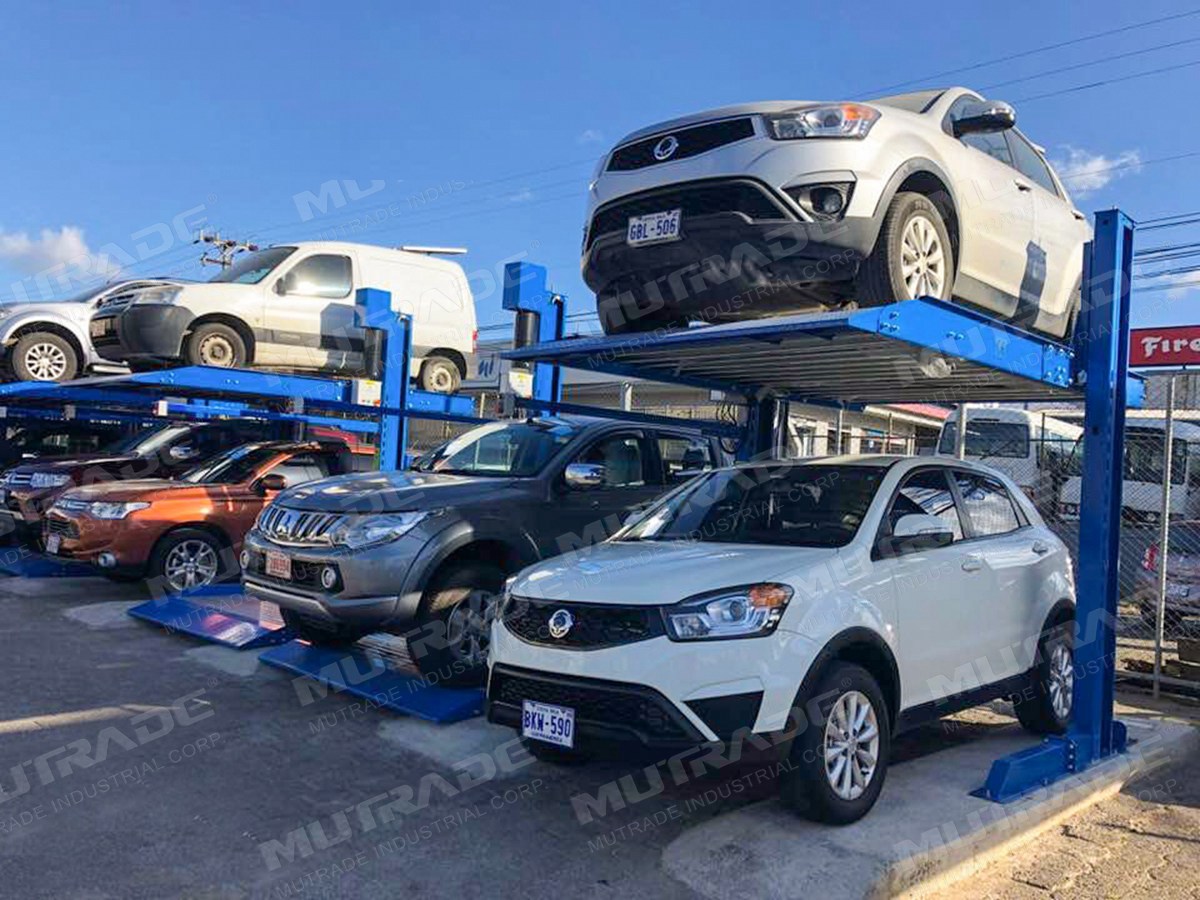
Urban parking demand has pushed developers, property owners, dealers, and fleet operators to look for ways to create more spaces on the same footprint. A parking lift does not add land; it multiplies the use of existing space.
The global car lifts market, which includes parking and service lifts, was valued at USD 2.8 billion in 2025 and is projected to reach USD 4.7 billion by 2034. Another market estimate focused on car stacker lifts was approximately USD 4.6 billion in 2023, with expected growth to USD 6.72 billion by 2030. The different figures reflect different definitions: one covers car lifts broadly, while the other focuses on stacker-type equipment. Both point in the same direction: parking lift demand is expanding.
Hydraulic mechanisms hold the largest segment share in the car lift market, about 57.2%, because they are considered reliable in heavy-duty lifting applications. Most parking lifts described in this guide use hydraulic cylinder drives.
Main types of parking lifts
Parking lifts are commonly grouped by the number of posts or by their level of automation. The most common product categories include two-post, four-post, single-post, pit-style, and fully automated systems.
2-post parking lift
A two-post parking lift stacks two vehicles in the space of one parking spot. It works for residential garages, valet parking, outdoor and indoor storage, and commercial projects where ceiling height is available.
MUTRADE offers the Hydro-Park 1127 and Hydro-Park 1123, both classified as two-post, double car stacker parking lifts. Each parks 2 vehicles per unit. The 1127 has a rated lifting capacity of 2700 kg; the 1123 has 2300 kg. Allowed car dimensions are 5000 mm length, 1850 mm width, and 2050 mm height. Both use a hydraulic cylinder and chain drive, key switch operation, and 50-second lifting time. Power supply is bespoke, from 110 to 480 V, 50/60 Hz. They are made of carbon steel Q235 and designed for residential and valet parking scenarios. Customization is acceptable.
4-post parking lift
A four-post parking lift is often used for car storage, dealerships, collections, and workshops. It provides a stable platform and can park two or more vehicles depending on the configuration.
MUTRADE’s Hydro-Park 2136 is a 4-post car storage parking lift with a rated lifting capacity of 3600 kg. It parks 2 vehicles per unit and accommodates cars up to 4566 mm length, 2560 mm width, and 2442 mm height. It uses a hydraulic cylinder and cable drive, key switch operation, and a lifting time of ≤55 seconds. It is made of carbon steel Q235. Customization is acceptable.
For higher-density storage, the Hydro-Park 3230 is a four-post quad stacker parking lift that parks 4 vehicles per unit. Its rated lifting capacity is 3000 kg. Allowed car dimensions are 8912 mm length, 2100 mm width, and 2000 mm height. Drive mode is manual with handle, lifting time is 120 seconds, and operation is via key switch. Power supply is bespoke, 208–480 V, 50/60 Hz. It is made of carbon steel Q235, and customization is acceptable.
3-car parking lift and triple stackers
For applications that need three cars in one footprint, manufacturers offer triple stacker systems. These are common in car dealerships, collections, clubs, and high-value vehicle storage.
The Hydro Park 2525 & 2625 from MUTRADE is a triple car stacker parking lift, also called a 3-car lift. Each unit parks 3 vehicles. Rated lifting capacity is 2500 kg on the second floor and 2000 kg on the third floor. Allowed car dimensions are 5060 mm length, 2802 mm width, and 2050 mm height. Drive mode is hydraulic cylinder plus chains, lifting time is 68 seconds, and operation is by key switch. Power supply is bespoke, from 110 to 480 V, 50/60 Hz. It is made of carbon steel Q235 and intended for car storage, dealership, collection, and club industries. Customization is acceptable.
The Hydro-Park 3130 is another triple stacker, but in a 4-post format. It parks 3 vehicles per unit with a rated lifting capacity of 3000 kg. Allowed car dimensions are 6772 mm length, 2070 mm width, and 2000 mm height. Drive mode is manual with handle, lifting time is 80 seconds, and operation is via key switch. Power supply is bespoke, 208–480 V, 50/60 Hz. It is made of carbon steel Q235, and customization is acceptable.
Single-post parking lift
A single-post parking lift is a compact option for car storage and display. It takes less floor space and can be installed indoors where a conventional two-post or four-post unit does not fit.
The Hydro-Park 1027 is a single-post car parking lift with a rated lifting capacity of 2700 kg. It accommodates cars up to 4148 mm length, 2679 mm width, and 2000 mm height. Drive mode is hydraulic cylinder plus chains, lifting time is 45 seconds, and operation is via key switch. Power supply is bespoke, 110–480 V, 50/60 Hz. It is made of carbon steel Q235 and designed for car storage and display. Customization is acceptable.
Pit parking lift and underground solutions
Pit-style parking lifts are installed into a recessed pit so the vehicle on the lower platform sits closer to the floor. This reduces the required ceiling height and is therefore useful for underground garages and low-clearance basements.
The Starke 2127 is an underground parking lift designed for residential and commercial parking. It parks 2 vehicles per unit. Rated lifting capacity is 2700 kg, and allowed car dimensions are 5000 mm length, 2050 mm width, and 1700 mm height. Drive mode is hydraulic cylinder plus chains, lifting time is 30 seconds, and operation is via key switch. Power supply is bespoke, 200–450 V, 50/60 Hz. It is made of carbon steel Q235, and customization is acceptable.
The Starke 2227 is a four-space pit parking lift. It parks 4 vehicles per unit, with a rated lifting capacity of 2700 kg per car. Allowed car dimensions are 5000 mm length, 2050 mm width, and 1700 mm height. Drive mode is hydraulic cylinder plus chains, lifting time is 30 seconds, and operation is via key switch. Power supply is bespoke, 200–450 V, 50/60 Hz. It is made of carbon steel Q235, and customization is acceptable.
The Starke 2327 is a tilted pit parking lift. It parks 2 vehicles per unit with a rated lifting capacity of 2700 kg. Allowed car dimensions are 5000 mm length, 2050 mm width, and 1550 mm height. Drive mode is hydraulic cylinder plus chains, operation is via key switch, and installation requires a ceiling height above 2700 mm and a pit depth above 1600 mm. It is made of carbon steel Q235.
The TPTP-2 is a tilting parking lift designed for low-ceiling applications. It is made of carbon steel Q235, operated via key switch, and uses a hydraulic system at 220 V, 50/60 Hz. It is suitable for underground and residential parking. Customization is acceptable.
Semi-automatic and puzzle parking systems
Semi-automatic systems move vehicles horizontally and vertically with less driver involvement. Puzzle systems allow vehicles to shift positions to access an inner space. These are often used in underground parking and residential projects.
The Starke 3121 & 3127 belongs to the basement, puzzle, and semi-automatic categories. It is made of carbon steel Q235, with a hydraulic cylinder and chains drive. Control is via code and ID card. Power supply is rated at 200–450 V, 50/60 Hz. Rated lifting capacity is 2700 kg, accommodating cars up to 5000 mm length, 1950 mm width, and 1700 mm height. The products are intended for underground, commercial, residential, and car parking applications.
The BDP-2 is a puzzle parking lift for commercial, residential, underground, and car parking industries. It parks more than 5 vehicles per unit. Rated lifting capacity is 2000 kg or 2500 kg. Allowed car dimensions are 5000 mm length, 1850 mm width, and 1550 mm or 2050 mm height. Drive mode is hydraulic cylinder plus wire rope, lifting time is 8–12 m/min, and operation is via button and IC cards. Power supply is bespoke at 380 V, 50/60 Hz. It is made of carbon steel Q235, and customization is acceptable.
Fully automatic and robotic parking lifts
Fully automatic systems remove the driver from the parking process. The car is driven into an entry bay, and the system transports it to a storage position automatically.
The MLP Series is an automated robotic parking lift for commercial parking, office buildings, shopping malls, and car parking applications. It is made of carbon steel and features a hydraulic cylinder and chains drive. It can park 50 to 120 vehicles per unit, with a rated lifting capacity of 2350 kg. Allowed car dimensions are 5300 mm length, 1900 mm width, and 2050 mm height. Lifting speed is up to 75 m/min. Power supply is bespoke, 110–480 V, 50/60 Hz. Operation options include IC card, touch screen, or manual control.
The ATP Series is an automated car tower parking lift with a fully automatic tower design. It can park 50 to 120 vehicles per unit. Rated lifting capacity is 2350 kg, and allowed car dimensions are 5300 mm length, 1900 mm width, and 2050 mm height. Drive mode is hydraulic cylinder plus chains, lifting time is up to 120 m/min, and operation is via IC card, touch screen, or manual. Power supply is bespoke, 110–480 V, 50/60 Hz. It is made of carbon steel Q235.
Niche and specialized parking lift types
Besides the main categories, specific projects may require car elevators, basement lifts, scissor platforms, or rotary systems.
The FP-VRC is a car elevator / floor-to-floor lift platform for car dealerships, car service centers, and car elevator applications. Its rated lifting capacity ranges from 2000 kg to 10,000 kg, and it can move cars to heights up to 13,500 mm. Drive mode is hydraulic with double steel chains, and operation is via button switch as standard or remote controller as optional.
The S-VRC-2 is an underground garage elevator parking lift, classified as a scissor lift platform parking lift. It has a rated lifting capacity of 3000 kg and accommodates cars with length 2000–6000 mm, width 2000–3000 mm, and height 2000–6000 mm. Drive mode is hydraulic cylinder, and lifting time is 4 per minute. Operation is via push buttons as standard, with a remote controller available as an option.
The ARP Series is a vertical, carousel, and rotary parking lift designed for residential, commercial, car dealership, and car parking scenarios. Made of carbon steel Q235, it offers control via touch screen, IC card, or button. Rated voltage options include 480 V, 415 V, 380 V, and 220 V at 50/60 Hz. It is intended for the Chinese market.
How to select the right parking lift type
The right type depends on the project’s space, building structure, vehicle mix, usage frequency, and budget.
Start with the number of vehicles you need to park in one footprint:
- 2 cars per unit: two-post lifts such as Hydro-Park 1127, single-post lifts, or simple pit lifts.
- 3 cars per unit: triple stackers such as Hydro Park 2525 or Hydro-Park 3130.
- 4 cars per unit: quad stackers such as Hydro-Park 3230 or four-space pit systems such as Starke 2227.
- Large-scale parking: semi-automatic puzzle systems, automated towers, or robotic systems.
Next, check the building limits:
- Ceiling height. Standard two-post and four-post lifts need roughly 2.5 to 3.5 meters. Low ceilings may require tilting or pit-style units.
- Floor conditions. Hydraulic parking lifts require a proper concrete foundation.
- Indoor or outdoor use. Outdoor installation may need a rust-resistant outdoor package.
- Power supply. Most MUTRADE lifts are built to order with voltage options from 110 V to 480 V, 50/60 Hz.
Finally, match the equipment to the vehicle mix. Confirm vehicle length, width, height, and weight against the lift’s rated capacity and allowed car dimensions. For heavier vehicles, choose a model with 2700 kg or higher capacity.
Step-by-step selection process
- Define the parking goal. Count the number of cars per space and the expected daily operation.
- Measure the site. Record ceiling height, column spacing, pit feasibility, and available footprint.
- Check vehicle dimensions. Use the largest vehicle expected in the facility.
- Shortlist lift types based on capacity, footprint, and ceiling requirements.
- Compare safety features, drive modes, operating controls, and power requirements.
- Confirm customization needs such as private labeling, bespoke color, or remote control.
- Evaluate the manufacturer’s production capability, lead time, and after-sales support.
Comparing common parking lift categories
| Type | Cars per unit | Typical capacity | Best for | Key consideration |
|---|---|---|---|---|
| 2-post lift | 2 | 2300–2700 kg | Residential, valet, small commercial | Requires adequate ceiling height |
| 4-post storage lift | 2 | 3000–3600 kg | Car storage, dealerships, workshops | Stable platform, higher steel mass |
| Triple stacker | 3 | 2000–3000 kg | Collections, clubs, dealerships | Higher stacking height |
| Quad stacker | 4 | 3000 kg | Dense storage in warehouses | Manual or key switch operation |
| Pit lift | 2–4 | 2700 kg per car | Underground garages, low-ceiling basements | Requires pit construction |
| Puzzle / semi-automatic | 5+ | 2000–2700 kg | Residential and commercial parking projects | More complex controls |
| Automated tower | 50–120 | 2350 kg | Large-scale public and commercial parking | Higher engineering scope |
Use cases across industries
Residential parking
Homeowners and property developers use parking lifts to add one or two extra spaces to private garages and underground lots. Two-post lifts, triple stackers, and pit-style lifts are common choices because they work with existing buildings and do not require major structural changes.
Car dealerships and showrooms
Dealers use parking lifts to store inventory, display vehicles, and maximize lot capacity. Triple stackers and four-post storage lifts are suitable for dealership operations because they handle multiple vehicles and provide stable access.
Car storage, collections, and clubs
Indoor covered warehouses and luxury car care centers store valuable vehicles for long periods. The Hydro-Park 2525, Hydro-Park 3230, and Hydro-Park 3130 are designed for car storage applications. These facilities may also request private-labeled logos, remote control, and manual retrieval in case of power failure.
Commercial and underground parking
For commercial projects, the goal is to meet municipal parking requirements, increase parking density, and improve property value. Semi-automatic puzzle systems such as the Starke 3121 & 3127 and BDP-2 can be installed in underground parking areas with limited headroom.
Public and high-density parking
Fully automatic systems such as the MLP Series and ATP Series suit large parking facilities where driver involvement should be minimized. They can park 50 to 120 vehicles per unit and are often used in shopping malls, office buildings, and public parking projects.
Manufacturer evaluation checklist
When comparing parking lift manufacturers, verify more than the product photo. A reliable supplier should be able to provide clear specifications, customization options, and production evidence.
- Company history and specialization. MUTRADE, founded in 2009, is a mechanical parking solution manufacturer with a 12,000 m² facility and roughly 100 employees.
- Production capacity. MUTRADE produces approximately 10,000 parking spaces annually and exports to over 100 countries, with export business accounting for about 99% of sales.
- Engineering support. MUTRADE’s R&D team consists of 7 engineers.
- Product range. A wider product range allows a manufacturer to match the right system to the project instead of forcing a single model.
- Customization. Most MUTRADE parking lifts are customizable, including voltage, dimensions, colors, and private labeling.
- Reference projects. Ask for installation photos, market applications, and project references relevant to your region.
Why MUTRADE for parking lifts
MUTRADE Industrial Corp. is a China-based manufacturer that designs and produces parking lifts, semi-automatic parking systems, fully automatic parking systems, and car lifts. The company was established in 2009 and operates a 12,000 m² factory in Qingdao. It produces about 10,000 parking spaces per year, supported by an R&D team of 7 engineers.
The company has served customers in over 100 countries, including local governments, car dealerships, developers, and property owners. Its product portfolio ranges from two-post car parking lifts to automated tower systems with 50–120 spaces. Most models are built from carbon steel Q235 and use hydraulic drive systems.
MUTRADE’s export share data, based on Chinese Customs data, indicates that MUTRADE and its production facility Hydro Park accounted for over 18% of China’s total export volume of mechanical parking equipment under HS Code 84289020 since 2017. This figure comes from company and customs sources and is cited here as an indicator of export scale.
Cost considerations
Parking lifts generally cost less than building a multilevel parking building. For urban applications, parking lifts cost about 40% less than multilevel car park buildings. This makes them an attractive option for developers and property owners who need extra spaces without the cost of a parking structure.
Actual pricing depends on the lift type, capacity, customization, shipping distance, and site preparation. A single two-post unit is lower in initial cost than an automated parking system, but the per-space cost of automated systems can be attractive at high densities.
Lead time and ordering
Typical production lead time for MUTRADE parking lifts is 30–45 days. The final schedule depends on model, customization, quantity, and order backlog.
Before ordering, provide the manufacturer with site dimensions, vehicle sizes, power supply, indoor/outdoor conditions, and any special requirements such as private labeling or remote control. A manufacturer with engineering support can help validate the selection before production.
Safety and compliance notes
Automated parking systems should meet recognized quality and safety management standards. Industry guidance references ISO 9001 for quality management and ISO 45001 for occupational health and safety as relevant frameworks for parking services. Buyers should also confirm local building, electrical, and fire codes before installation.
Hydraulic parking lifts are the dominant type in the market. Buyers should verify that the hydraulic unit, chains, cables, locks, and control system are matched to the lift’s rated capacity.
Internal links for further reading
For more detail on supplier evaluation, read How to Choose a CE-Certified Parking Lift Manufacturer.
For a broader overview of types and benefits, see Parking Lift Guide: Types, Benefits and How to Choose a Manufacturer.
For OEM and customization questions, see OEM Parking Lift Manufacturer: Custom Parking Lift Solutions for Your Project.
For a manufacturer comparison, read Top Parking Lift Manufacturers in China: How to Evaluate Suppliers.
FAQ
Look for a manufacturer with a clear product range, verifiable production capability, engineering support, and customization options. MUTRADE, for example, was established in 2009, operates a 12,000 m² facility with about 100 employees, and produces approximately 10,000 parking spaces per year. Most of its parking lifts are customizable, including power supply, dimensions, and private labeling.
A full-range manufacturer can supply two-post lifts, four-post lifts, triple stackers, quad stackers, pit-style lifts, puzzle systems, car elevators, and fully automatic towers. MUTRADE’s product portfolio covers parking lifts, semi-automatic parking systems, fully automatic parking systems, and car lifts, with models ranging from 2 vehicles per unit to automated systems with 50–120 spaces.
Most MUTRADE parking lift models accept customization. This includes bespoke power supply from 110 V to 480 V, 50/60 Hz, customized dimensions, outdoor packages, bespoke colors, and private-labeled logos. For example, the Hydro-Park 1127, Hydro-Park 2136, Hydro-Park 3230, Hydro-Park 3130, Hydro-Park 2525, Starke 2127, and Starke 2227 all list customization as acceptable.
The typical production lead time is 30–45 days. The actual schedule depends on the model, customization level, order quantity, and current production load.
For urban applications, parking lifts cost about 40% less than multilevel car park buildings. The final cost per space depends on the lift type, capacity, site preparation, customization, and shipping distance.
Contact MUTRADE at inquiry@mutrade.com or by phone at +86 532-5557-9606. You can also download the company profile for a product overview.
Conclusion
Parking lifts are a practical way to add parking capacity without expanding buildings. The best type depends on the number of vehicles, ceiling height, site conditions, and project budget. A manufacturer with a wide product range, engineering capability, and clear customization options makes the selection process simpler.
MUTRADE Industrial Corp. offers parking lifts from single-post and two-post models to automated tower systems. Founded in 2009, the company produces about 10,000 parking spaces per year in a 12,000 m² facility in Qingdao, China, and ships to customers in over 100 countries. Typical production lead time is 30–45 days.
Need help selecting a parking lift?
Contact the MUTRADE team for specifications, samples, or a quote.
Email: inquiry@mutrade.com | Tel: +86 532-5557-9606 | WhatsApp: +86 151-6529-8568
Have Questions or Need More Details?
Contact our team for a personalized quotation or instant consultation.
Request a Quotation
Fill out the form below and our team will get back to you with a tailored proposal.
WhatsApp Direct Chat
Prefer to chat in real-time? Message us on WhatsApp for instant assistance & quick answers.
- Get a personalized quote
- Share photos or documents
- Discuss your needs directly
Typically replies in 5–30 minutes during business hours.