
Two-Post vs. Four-Post Parking Lifts: A Buyer's Comparison for Tight Garages
Two-Post vs. Four-Post Parking Lifts: A Buyer's Comparison for Tight Garages
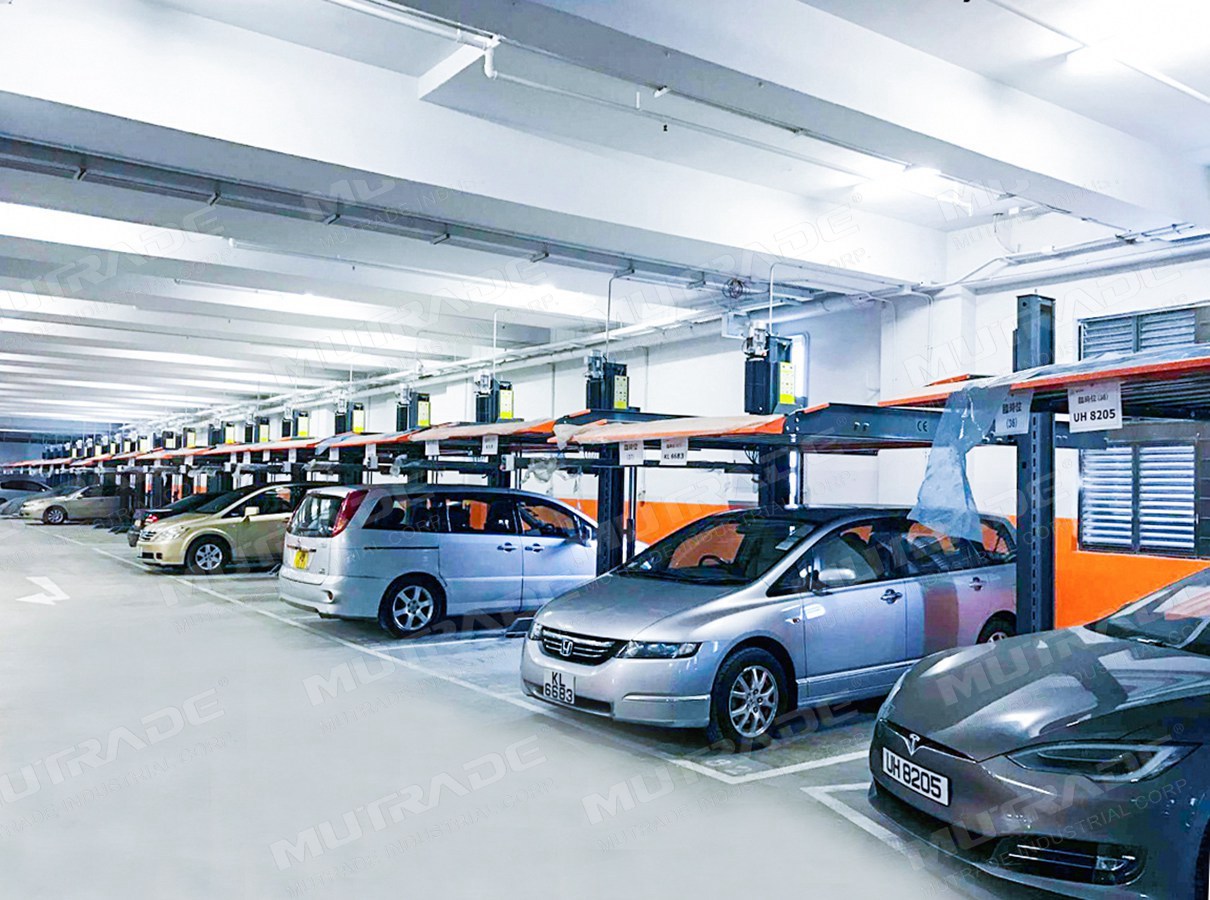
Short answer: In a tight garage, the choice between a two-post and a four-post parking lift is settled by three numbers — the clear height above the bay, the width the lift consumes, and the weight of the heaviest car that will use it. A two-post lift such as the Mutrade Hydro-Park 1127 stacks two vehicles with a rated lifting capacity of 2,700 kg and a published vehicle envelope of 5,000 mm (L) × 1,850 mm (W) × 2,050 mm (H). A four-post lift such as the Hydro-Park 2136 carries 3,600 kg and publishes a wider and taller vehicle envelope of 4,566 mm × 2,560 mm × 2,442 mm. The two-post design wins on narrow footprints; the four-post design wins on heavier vehicles and taller bodies.
This comparison is written for buyers who already know they need a car parking lift system but have not yet decided which configuration fits their building. It covers what “tight” actually means in a garage, how each design uses space, the specification gaps that decide the purchase, and the residential, dealership and commercial storage scenarios where each type performs best.
What Makes a Garage “Tight”
A garage is tight when one or more of five physical limits sits close to the edge of what a lift requires. Each limit can eliminate a configuration before price or brand is ever discussed.
- Vertical clearance. The distance from the floor to the lowest overhead obstruction — ceiling slab, beams, ductwork, sprinkler heads or a sectional door track when it is open.
- Bay width. The clear span between walls, structural columns or neighbouring parking spaces, plus the space needed to open a car door beside the platform.
- Approach and aisle. The turning space in front of the lift, which determines how easily a driver can line up on the platform.
- Floor and foundation. Whether the existing slab can carry the load or whether a concrete foundation must be poured.
- Access frequency. How often each car has to move, which decides whether a simple stacking configuration or a more automated one is justified.
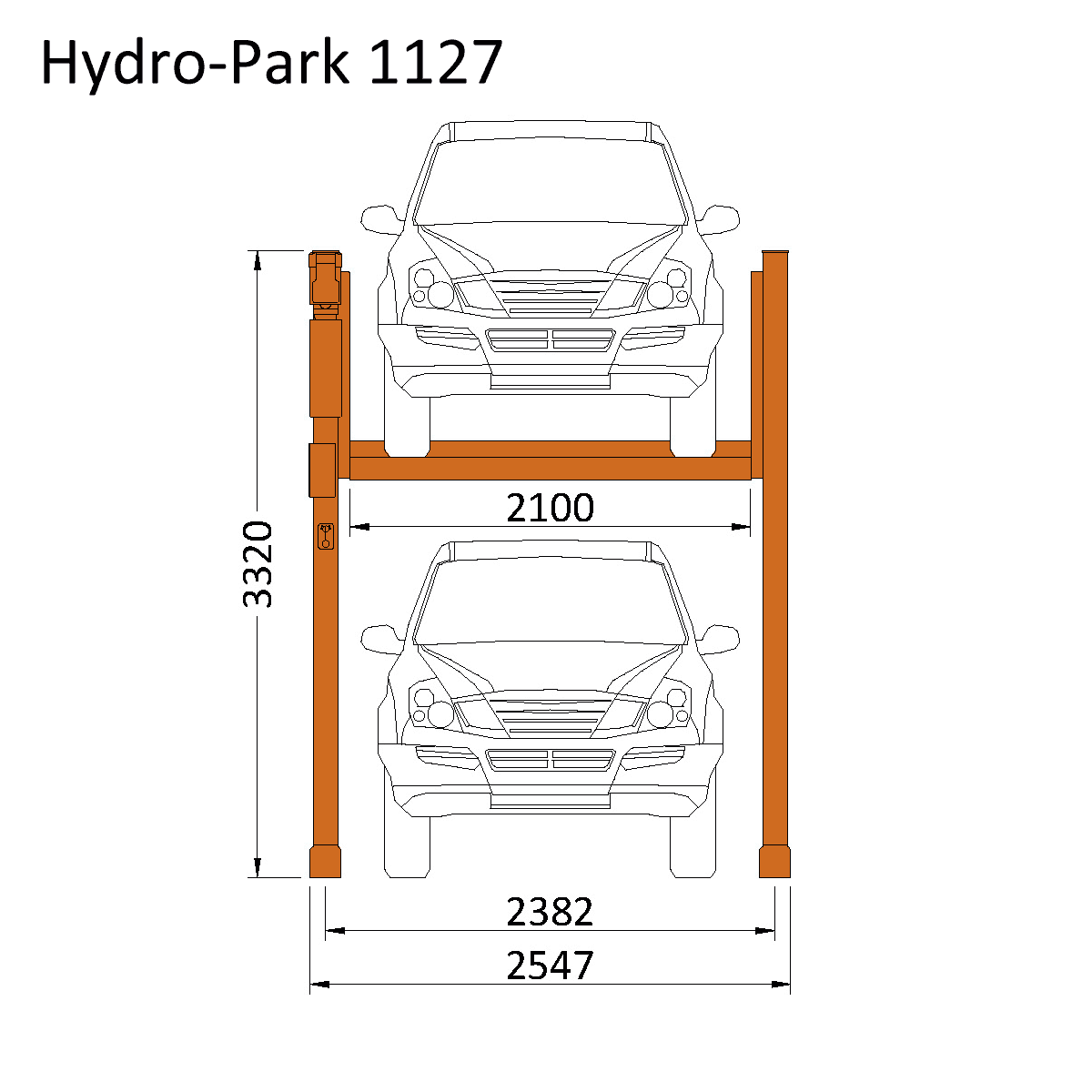
Height is usually the binding constraint in basements and converted buildings, while width is the binding constraint in apartment garages where columns divide the bays. For a two-post stacker, the vertical envelope is the lifting height plus the height of the vehicle parked on the ground level. Mutrade project records for the Hydro-Park 1127 describe a lifting height of 2,100 mm and a permitted ground-level car height of up to 2,050 mm — so a buyer planning a two-post installation has to confirm that both figures, plus space for lights and services, fit under the ceiling.
Horizontal space behaves differently. A two-post lift occupies two relatively narrow columns and lifts a platform between them, so it can be squeezed into a bay that is only slightly wider than the car. A four-post lift uses a drive-on platform supported by four columns, and its published vehicle envelope is correspondingly wider. That difference — not the number of posts itself — is what usually decides which lift a tight garage can accept.
Where the Parking Lift Market Is Heading
Demand for mechanical parking equipment has grown steadily as urban land supply has tightened. Dataintelo values the global car lifts market, which includes both parking and service lifts, at USD 2.8 billion in 2025 and projects it to reach USD 4.7 billion by 2034. QYResearch measures the narrower car stacker lift segment at approximately USD 4.6 billion in 2023, with growth to USD 6.72 billion expected by 2030.
Those two figures illustrate a practical caution for buyers: market definitions differ. As noted in the underlying data, a parking-management view of the same market is valued at USD 4.4 billion by Global Market Insights, while hardware-only estimates are lower. When comparing published market numbers, always check whether the scope includes services or only equipment.
Within the hardware market, hydraulics dominate. Dataintelo reports that hydraulic mechanisms hold 57.2% of the global car lift market, which reflects their reliability in heavy-duty applications. Both lifts compared in this article are hydraulically driven: the Hydro-Park 1127 uses a hydraulic cylinder with chains, and the Hydro-Park 2136 uses a hydraulic cylinder with cable.
Regional demand shapes capacity requirements. Custom Market Insights values the North American vehicle lift market at USD 3.25 billion in 2024 and identifies it as the largest and fastest-growing region, driven in part by high light-truck ownership — light trucks accounted for 77% of new vehicle sales there. Heavier vehicles are one reason buyers increasingly look at higher-capacity platforms in the 3,000 kg class and above, rather than assuming a 2,000 kg rating is sufficient.
Competitive structure also matters when shortlisting. BendPak is identified as a major player in the North American vehicle lift market and demonstrated an eight-armed car lift (Octa-Flex) in 2024 at the SEMA Show. Buyers who search for a “BendPak parking lift” should confirm what duty a specific model is built for: a service lift that raises a car for maintenance and a storage stacker that holds a car for months place different demands on a platform.
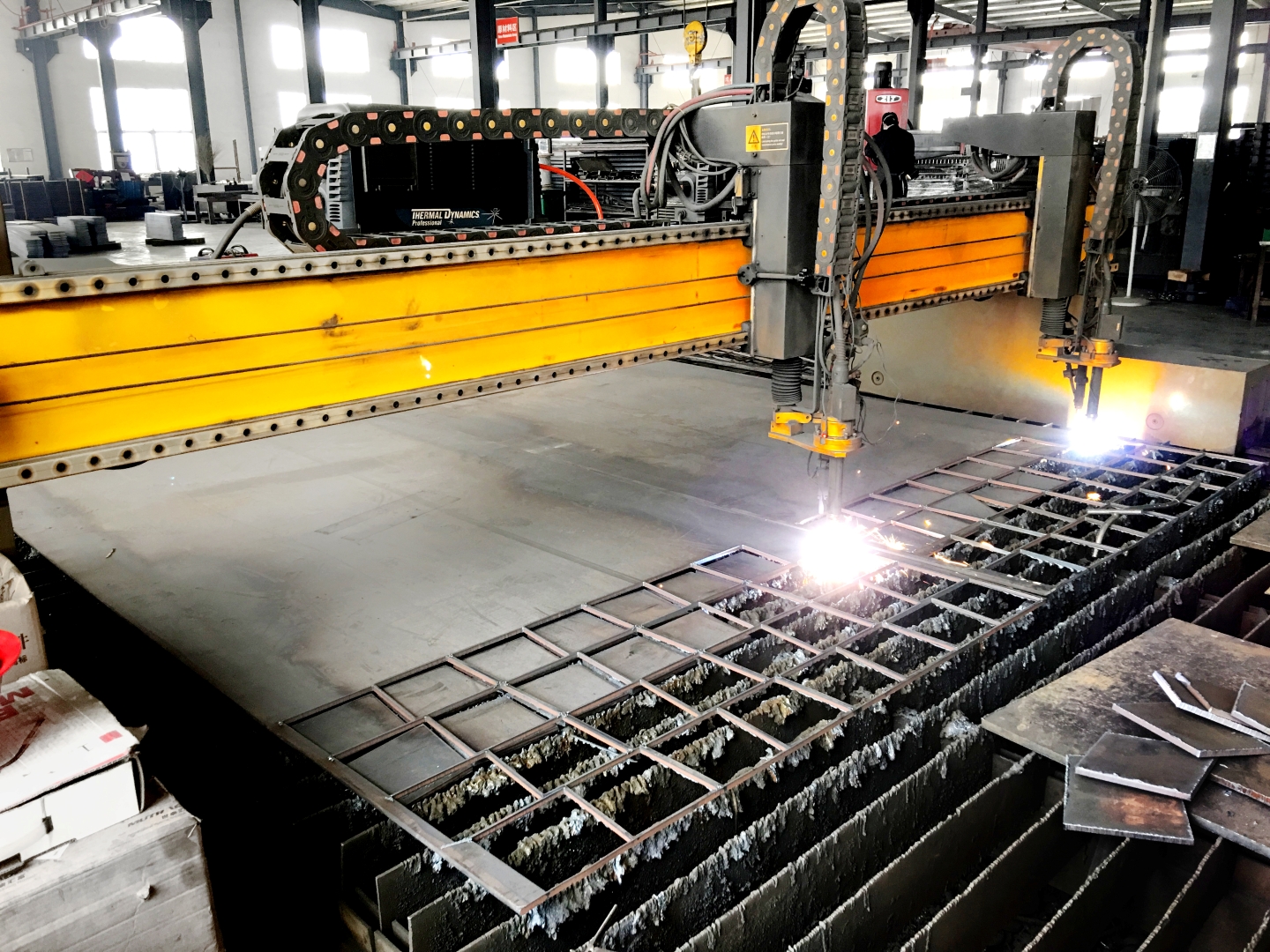
On the supply side, Mutrade Industrial Corp. is a mechanical parking equipment manufacturer based in Qingdao, China, founded in 2009, with a 12,000 m² production facility, a team of 7 engineers and an annual output of 10,000 parking spaces. According to Chinese customs data cited by the company, Mutrade and its Hydro Park production facility have accounted for over 18% of China's total export volume of mechanical parking equipment (HS Code: 84289020) since 2017.
Two-Post vs. Four-Post: How Each Configuration Uses Space
The two configurations solve the same problem — putting two cars where one fits — with different mechanics. Understanding the mechanics explains why one fits a narrow bay and the other fits a heavy vehicle.
Two-post parking lifts: the Hydro-Park 1127 in practice
A two-post parking lift raises a platform on a pair of vertical columns. Space is saved because the columns occupy a narrow strip rather than the full footprint of a driving lane. Published specifications for the Hydro-Park 1127 and its 2,300 kg variant, the Hydro-Park 1123, list the following:
- Vehicles parked per unit: 2
- Rated lifting capacity: 2,700 kg (Hydro-Park 1127) and 2,300 kg (Hydro-Park 1123)
- Allowed car length / width / height: 5,000 mm / 1,850 mm / 2,050 mm
- Drive mode: hydraulic cylinder with chains
- Lifting time: 50 seconds
- Operation: key switch
- Power supply: bespoke, 110–480 V, 50/60 Hz
- Material: carbon steel, Q235
- Typical applications: car storage, valet parking, residential parking, commercial parking
Project records add the details that matter in a constrained building. A residential development in Russia installed 206 Hydro-Park 1127 units to create 412 parking spaces, with half installed on the ground floor and half on the roof — a layout that doubled capacity inside the existing footprint. The same project data notes a column-sharing feature that allows tandem installation, saving installation space, transport cost and material, and a wave plate platform with anti-water, anti-rust and anti-slip properties plus a drainage function. The platform is finished with AkzoNobel powder coating, and the unit uses a 24 V control voltage together with a dynamic mechanical anti-falling lock with electric auto release.
A second reference project — a luxury auto dealership in Canada with 8 units providing 16 parking spaces — records TUV compliance and CE certification to the machinery standard 2006/42/EC and EN14010 for this model. The dealership doubled capacity indoors and reported a streamlined vehicle retrieval process.
Four-post parking lifts: the Hydro-Park 2136 in practice
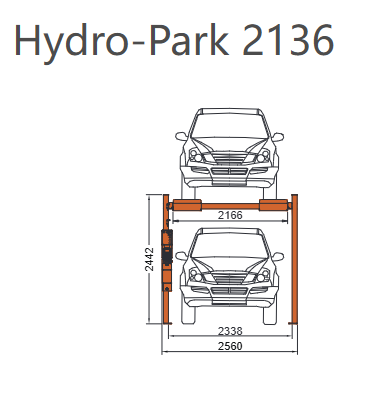
A four-post parking lift is a drive-on platform carried by four columns, which distributes load across a wider base and provides a larger, flatter surface. The Hydro-Park 2136 is specified as follows:
- Vehicles parked per unit: 2
- Rated lifting capacity: 3,600 kg
- Allowed car length / width / height: 4,566 mm / 2,560 mm / 2,442 mm
- Drive mode: hydraulic cylinder with cable
- Lifting time: ≤55 seconds
- Operation: key switch
- Power supply: bespoke, 110–480 V, 50/60 Hz
- Material: carbon steel, Q235
- Typical application: car storage
The practical consequence of these figures is straightforward. Where a two-post lift is chosen because the bay is narrow, a four-post lift is chosen because the vehicle is heavy or tall. The 3,600 kg rating gives headroom above the 2,700 kg two-post class, and the published height allowance of 2,442 mm accommodates taller bodies than the 2,050 mm figure published for the two-post model. The trade-off is width: a 2,560 mm published vehicle width allowance is substantially wider than 1,850 mm, so the bay must be able to accept it.
Comparison Table: Hydro-Park 1127 vs. Hydro-Park 2136
| Specification | Hydro-Park 1127 (two-post) | Hydro-Park 2136 (four-post) |
|---|---|---|
| Configuration | Two-post parking lift / double car stacker | Four-post car storage parking lift |
| Vehicles parked per unit | 2 | 2 |
| Rated lifting capacity | 2,700 kg | 3,600 kg |
| Allowed car length | 5,000 mm | 4,566 mm |
| Allowed car width | 1,850 mm | 2,560 mm |
| Allowed car height | 2,050 mm | 2,442 mm |
| Drive mode | Hydraulic cylinder + chains | Hydraulic cylinder + cable |
| Lifting time | 50 seconds | ≤55 seconds |
| Operation | Key switch | Key switch |
| Power supply | Bespoke, 110–480 V, 50/60 Hz | Bespoke, 110–480 V, 50/60 Hz |
| Material | Carbon steel, Q235 | Carbon steel, Q235 |
| Customization | Acceptable | Acceptable |
| Best fit | Narrow bays, residential and commercial parking, valet use | Heavier and taller vehicles, indoor car storage |
Step-by-Step: Choosing the Right Configuration
The following sequence avoids the most common ordering mistake, which is buying on capacity alone and discovering a clearance problem at installation.
- Measure the vertical envelope. Record the floor-to-obstruction height at every point above the bay, including under beams and behind a raised sectional door. For a two-post unit, plan for the lifting height plus the height of the car parked beneath it; for the Hydro-Park 1127, project data records a 2,100 mm lifting height and a ground-level car height of up to 2,050 mm.
- Measure the horizontal envelope. Record the clear width between columns and walls, then compare it with the published vehicle width allowance — 1,850 mm for the Hydro-Park 1127 and 2,560 mm for the Hydro-Park 2136. Leave working space for door opening and for a driver to step out.
- Weigh the heaviest vehicle, not the average one. Use the heaviest car that will realistically use the space and compare it with the 2,700 kg and 3,600 kg ratings. If a heavier vehicle is expected later, the higher-capacity four-post class removes the risk of an upgrade.
- Map how the cars are used. Daily-use cars and long-term stored cars place different demands on a stacker. High-turnover sites benefit from fast cycling — 50 seconds for the Hydro-Park 1127 and 55 seconds or less for the Hydro-Park 2136 — while storage sites prioritise platform stability and protection.
- Confirm environment and power. Both models are offered with bespoke voltage from 110–480 V at 50/60 Hz. Mutrade application data describes indoor use as standard, with outdoor operation possible using an outdoor package option and an operating temperature range of −15 °C to +40 °C; outdoor installations also need rust resistance against snow and de-icing agents.
- Confirm certification, customization and delivery before signing. Ask which standards the specific configuration is certified to, which customization options apply (voltage, logo, parking width, system height and colour are listed as customizable), and what the production and shipping schedule is.
Use Cases: Which Lift Fits Which Project
Residential complexes and apartment buildings
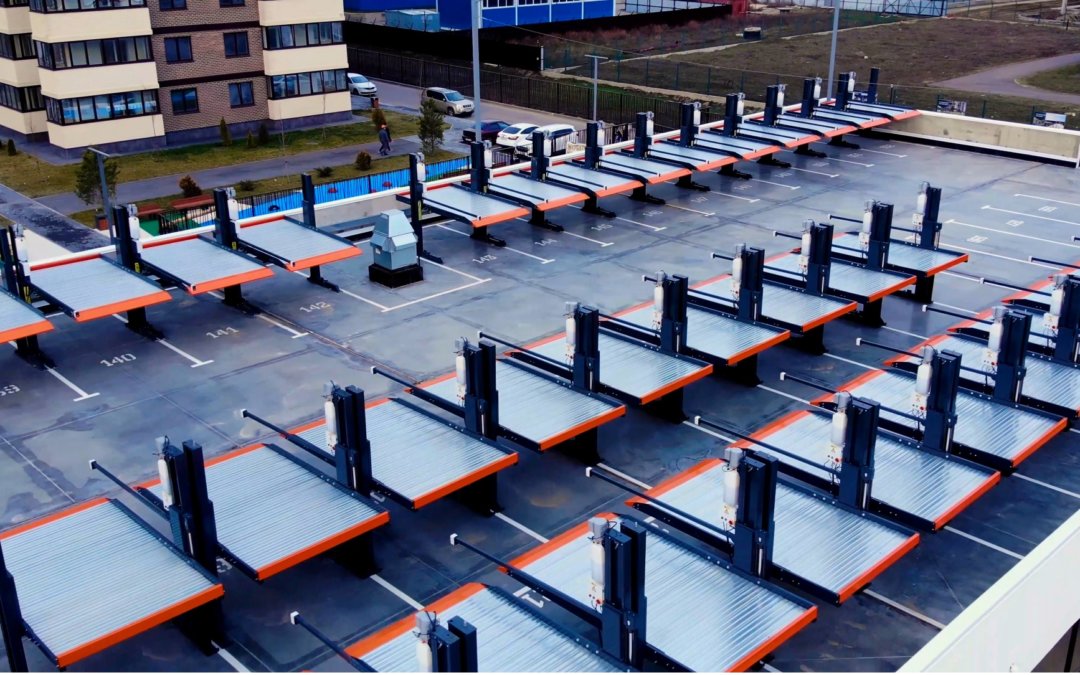
Residential projects usually need maximum spaces inside a fixed footprint, with cars parked for long periods. The Russian residential reference project — 206 Hydro-Park 1127 units creating 412 spaces over three years, with half the units installed on the ground floor and half on the roof — shows how a two-post configuration can be distributed across a building rather than concentrated in one room. Mutrade application data for indoor car warehousing lists long-term storage mode, 2–4 levels of car storage and special requirements such as manual car removal in case of power failure, remote control and a private-label logo.
Car dealerships and showrooms
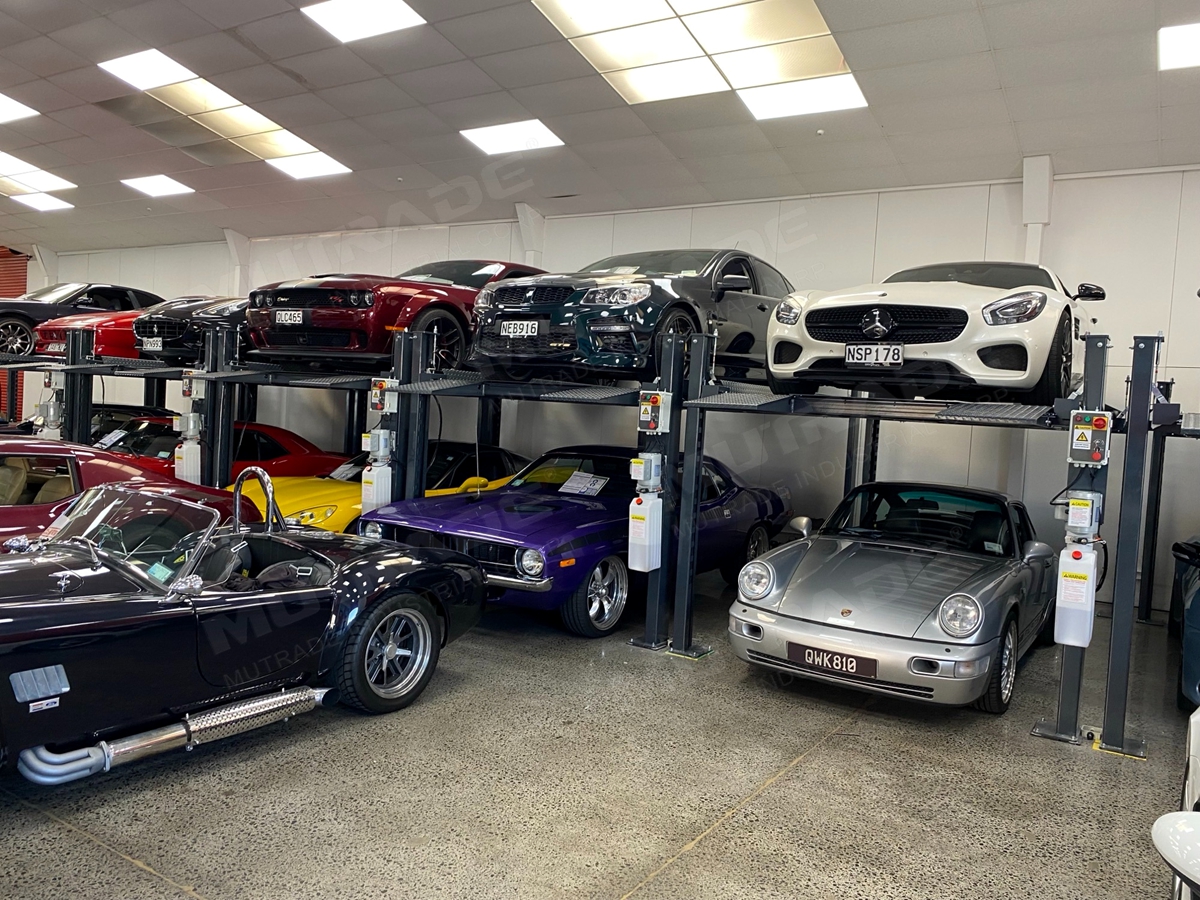
Dealerships need visible, tidy storage and fast retrieval. The Canadian reference project used 8 Hydro-Park 1127 units to create 16 spaces indoors, doubling capacity within the existing footprint and improving vehicle display for buyers. The required car envelope there — up to 5,000 mm long, 1,850 mm wide and 2,050 mm high — is typical of passenger cars and light SUVs, which is exactly the range a 2,700 kg two-post lift is designed to serve.
Indoor commercial storage, collections and care centres
Where cars are stored commercially or displayed for long periods, a drive-on platform reduces the precision needed to park and suits heavier vehicles. Mutrade application data describes indoor car collection and luxury car care centre projects as a standard scenario. The Hydro-Park 2136, with 3,600 kg capacity and a published height allowance of 2,442 mm, is the more appropriate of the two models compared here for that duty.
When two levels are not enough
If the project needs more than two cars per footprint, the decision moves to three-car lifts rather than between two-post and four-post two-car units. Two documented options are the Hydro-Park 3130, a four-post triple stacker rated at 3,000 kg with a 6,772 mm × 2,070 mm × 2,000 mm vehicle envelope, and the Hydro-Park 2525 & 2625, a three-car model rated at 2,500 kg on the second level and 2,000 kg on the third. Both use a key switch and a bespoke 208–480 V, 50/60 Hz supply.
When Neither Two-Post nor Four-Post Fits
Some buildings cannot accept a conventional stacker at all, and the answer is a different lift geometry rather than a different brand. A tilting two-post lift such as the TPTP-2 requires a minimum ceiling height of only 2,900 mm and uses a platform that tilts up to 10 degrees, with a 2,000 kg lifting capacity, a 1,600 mm lifting height and a 2,100 mm usable platform width. One reference installation placed 45 units under an urban overpass with a 3.1–3.3 m ceiling and an 8% ground slope, creating 90 parking spaces where the space had been considered unusable.
A second alternative is a pit-based lift, which trades excavation for headroom. The Starke 2127 is a two-post pit parking lift rated at 2,700 kg per space with a standard pit depth from 1,750 mm and a standard platform width of 2,300 mm. Pit solutions reduce the height needed above ground but require civil works, so they are usually evaluated against the cost of reconfiguring the building instead.
Frequently Asked Questions
Do two-post and four-post parking lifts meet European machinery standards?
Mutrade project records for the Hydro-Park 1127 installation at a Canadian dealership list TUV compliance and CE certification to the machinery standard 2006/42/EC and EN14010. On the wider question of management systems, Pacific Certifications notes that automated parking systems are expected to comply with ISO 9001 for quality management and ISO 45001 for occupational health and safety in order to mitigate risks such as vehicle–pedestrian conflict. Because certification applies to a specific configuration and destination market, buyers should ask for the certificate that matches the exact model, voltage and options they intend to order rather than relying on a general compliance statement.
How much weight can a two-post lift carry compared with a four-post lift?
In the two models compared here, the difference is 900 kg. The Hydro-Park 1127 two-post lift has a rated lifting capacity of 2,700 kg and accepts cars up to 5,000 mm long, 1,850 mm wide and 2,050 mm high. The Hydro-Park 2136 four-post lift has a rated lifting capacity of 3,600 kg with a published vehicle envelope of 4,566 mm × 2,560 mm × 2,442 mm. The four-post unit therefore suits heavier and taller vehicles, while the two-post unit suits narrower bays. Both park two vehicles per unit and both are customisable.
What drives the cost of a two-post or four-post parking lift?
Parking lifts are quoted per project rather than from a fixed list, because the variables are configuration-specific: lifting capacity, platform dimensions, voltage, colour, logo and the number of units in the order. Mutrade lists voltage, logo, parking width, system height and colour as customizable across its OEM, ODM, white-label and private-label production modes. Beyond hardware, the economics of a stacking lift come from land: Mutrade's product documentation describes the Hydro-Park 2525 & 2625 three-car stacker as functioning to reduce land cost and enhance property value by using vertical space instead of acquiring additional ground. For a specific budget, request a quotation with a bay drawing so the quotation reflects the actual installation.
Can I order a single unit as a sample, and how long does production take?
Mutrade lists a minimum order quantity of 1 unit, which allows a buyer to validate one lift before committing to a full project. Stated lead time is 30–45 days, with monthly capacity of 1,000 car spaces and quality control by random inspection. After-sales support includes 24-hour online remote support, local partners, and on-site engineer supervision at cost.
How do I choose a car parking lift manufacturer for auto shops?
Auto shops have a narrower requirement set than residential developers: they need a platform rated for the heaviest vehicle in the workshop, fast cycling so that customer cars are not waiting, and a service arrangement that keeps the lift working. For a shop using a two-post stacker for storage, the Hydro-Park 1127 class — 2,700 kg, 50-second lifting time, key-switch operation, 110–480 V bespoke supply — covers passenger cars and light SUVs, while the Hydro-Park 2136 four-post model at 3,600 kg covers heavier vehicles. Before ordering, verify the capacity rating against your heaviest vehicle, confirm the vehicle envelope figures against your actual bay, ask which standards the configuration is certified to, and confirm the sample and lead-time terms in writing. Mutrade supplies dealers, developers, distributors and end users from a 12,000 m² facility in Qingdao with an annual output of 10,000 parking spaces.
Conclusion: How to Decide
Two-post and four-post parking lifts are not competing versions of the same product; they are two ways of converting one parking space into two, each optimised for a different set of constraints. Choose the two-post Hydro-Park 1127 when bay width and floor area are the hard limits and the vehicles are within a 2,700 kg, 5,000 mm × 1,850 mm × 2,050 mm envelope. Choose the four-post Hydro-Park 2136 when the vehicles are heavier or taller and the bay can accept a wider platform, with 3,600 kg of capacity and a 2,442 mm published height allowance.
If neither geometry fits the building, the constraint is architectural rather than commercial, and a tilting or pit-based solution should be evaluated instead. In every case, the decisive step is the same: measure the real bay, weigh the real vehicles, and ask for a written specification that matches the drawing.
Next Step
If you are comparing a two-post and a four-post parking lift for a specific garage, the fastest route to a useful answer is a bay drawing. Send your measurements — clear height, clear width, aisle space and the heaviest vehicle — and Mutrade can confirm which configuration fits and quote it accordingly.
Download the company brochure: Mutrade Profile 2025 (PDF)
Request a sample or quotation: Email inquiry@mutrade.com · Tel +86 532-5557-9606 · WhatsApp +86 151-6529-8568 · www.mutrade.com
Mutrade Industrial Corp., 106 Haier Road, Jimo District, Qingdao City, Shandong Province, China.