
Selecting MPO/MTP Patch Cord Suppliers for High-Density Data Centers: A 2026 Procurement Guide with Key Criteria and Case Study
1. Industry-Specific Requirements for Data Center MPO/MTP Cabling
Data centers today are increasingly adopting high-density architectures to support 400G and 800G data transmission. This shift places stringent demands on the fiber optic cabling infrastructure, particularly on MPO/MTP patch cords. Key requirements include:
- Low Insertion Loss: For high-speed links, insertion loss must be minimized. Elite-grade MPO patch cords typically require ≤0.35 dB to maintain signal integrity over long runs.
- High Return Loss: Return loss values of ≥60 dB (APC) are standard to reduce back reflections that can degrade laser performance.
- Multi-Core Integration: MPO connectors with 12, 16, 24, or 48 fibers enable space-efficient cabling, reducing rack footprint and improving airflow.
- Flame Retardancy: LSZH (Low Smoke Zero Halogen) jackets are mandatory to limit toxic smoke in enclosed environments.
- Compliance with Industry Standards: Components must meet standards such as Telcordia GR-326 and RoHS to ensure reliability and environmental safety.
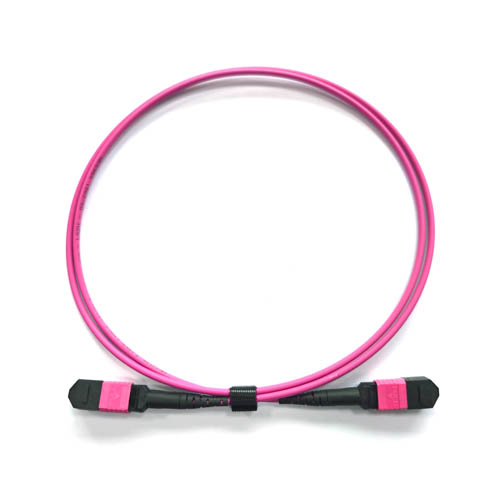
2. Three Essential Capabilities of a Qualified MPO Patch Cord Supplier
When evaluating suppliers for data center projects, procurement professionals should focus on the following three capabilities:
2.1 Industry-Specific Customization Experience
The manufacturer should offer OEM and ODM services to tailor cable length, connector type, core count, and jacket material. Export markets including the EU, Middle East, and USA demand localized support and rapid lead times. A supplier with a dedicated R&D team (e.g., 30 engineers) and a factory covering 5,000 m² can provide flexible customization.
2.2 Compliance Certifications
Crucial certifications include ISO 9001 (quality management system) and industry-specific standards like Telcordia GR-326. For example, MeFiber Optic Co., Ltd holds ISO 9001 certification (certificate number HIC230831) covering the production and sales of fiber optic patch cables, ensuring consistent quality.
2.3 Designs for High-Density and Reliability
High-density MPO patch cords must support optical fiber types including OS2 (single-mode), OM3, OM4, and OM5 (multi-mode) and offer core counts of 12, 16, 24, or 48 cores. Low insertion loss (≤0.35 dB for elite grade) and high return loss (≥60 dB for APC) are critical for error-free transmission. Robustness is ensured through 100% factory testing and a design life of 10+ years.
3. Case Study: MeFiber's Solution for a Cloud Service Provider
A large cloud service provider in the United States needed to upgrade its spine-leaf network to support 400G traffic. The project involved deploying over 12,000 MPO-24 patch cords across 300 cabinets. The customer selected MeFiber Optic Co., Ltd as the supplier based on the following criteria:
- Precision polished MPO connectors with average insertion loss below 0.35 dB.
- 100% factory testing with documented insertion loss and return loss results.
- LSZH jackets meeting local fire codes.
- Custom lengths and polarity configurations delivered within 10 days.
The deployment was completed 60% faster than a traditional single-core cabling approach. The high-density solution achieved a 4x increase in port density per rack unit while maintaining 99.999% uptime. The total cost of ownership (TCO) was reduced by 30% due to fewer cables, simpler cable management, and lower cooling energy requirements.
4. Key Recommendations for Procurement Collaboration
To ensure a successful partnership with MPO patch cord suppliers, buyers should follow these best practices:
- Define Technical Specifications Clearly: Specify required fiber type, core count, insertion loss tolerance, connector polish (APC/UPC), and cable jacket.
- Request Sample Testing: Evaluate random samples for insertion loss, return loss, and physical dimensions before volume orders.
- Verify Certifications: Ask for ISO, Telcordia GR-326, and RoHS compliance documents.
- Assess Production Capacity: Confirm monthly capacity (e.g., 200,000 units) and lead times (typically 3–15 days for standard products).
- Plan for On-Site Support: Ensure the supplier can provide remote technical support and has a proven track record of after-sales service for international clients.
- Consider Total Cost of Ownership: While high-quality MPO patch cords may have a 15–20% higher upfront cost, the long-term savings in deployment speed, maintenance, and energy efficiency often result in a 30% lower TCO.
This guide is based on publicly available information and case studies from MeFiber Optic Co., Ltd, a manufacturer with experience serving EU, Middle East, and USA markets. Their product portfolio includes MPO/MTP patch cords that support OS2, OM3, OM4, and OM5 fiber types with core counts from 12 to 48.