
Pergola Windproof Roller Blind: A 2026 Buyer's Guide
A pergola windproof roller blind is a zip-guided outdoor shading system that mounts between pergola posts and locks the fabric into a zipper track on both side rails. Because the fabric edge cannot be pushed out of the side channel, the screen keeps its shape under wind load, sheds rain at the sides, and closes the gaps where insects enter. That combination is why zip screens, rather than ordinary roller blinds, are now the default specification for open courtyards, hotel terraces and food-and-beverage seating areas.
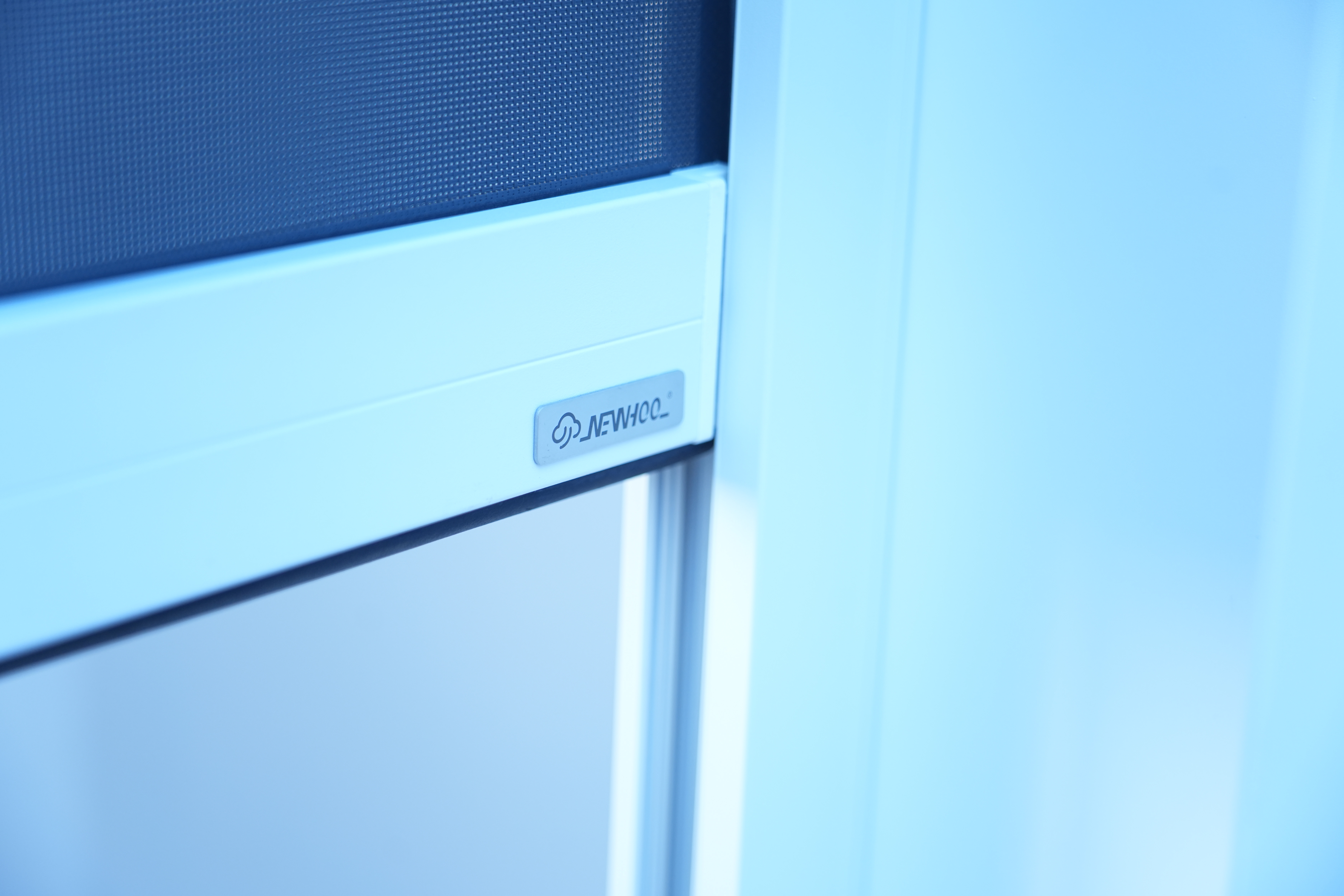
WR110A pergola-specific zip screen from NEWHOO, with a 110 × 115 mm cassette designed for pergola post mounting.
What Is a Pergola Windproof Roller Blind?
A pergola windproof roller blind is a roller shade whose fabric carries a nylon zipper along both vertical edges, and whose side rails contain matching zipper guide channels. When the motor lowers the fabric, the zipper runs inside the guide rail along its full travel, so the fabric is mechanically constrained at the edges instead of hanging free.
A purpose-built pergola version differs from a general outdoor windproof roller blind in four practical ways:
- Cassette size is matched to pergola posts. The NEWHOO WR110A and WR110B pergola-specific zip screens use a 110 × 115 mm cassette so the housing does not overhang a standard post profile.
- Mounting is designed for post-and-beam structures. WR110B uses a plug-in bracket for fast roller tube assembly; WR110A adds a smart balancer on the roller tube; WR100C uses side-mount brackets that allow the body to be installed first, then the side rail.
- Side rails are shallow and snap-in. Both two-piece snap-in and three-piece side rail designs are offered, so the rail can be fixed to a post face without a deep rebate.
- Fabric cleaning brush strip is integrated. The cassette includes a brush strip that wipes the fabric as it retracts, which matters in a garden environment where dust and pollen accumulate quickly.
Typical pergola widths sit between 0.7 m and 5.4 m per opening, depending on the roller tube selected. The detailed limits are covered in the specification section below.
Why Open Pergolas Fail Without a Zip-Guided Screen
An open pergola is a frame, not a room. Once a buyer tries to use it as an extension of the house, five problems appear in sequence:
- Low-angle sun. A fixed roof blocks midday sun but not morning or late-afternoon sun, which enters almost horizontally and makes the space unusable for several hours a day.
- Wind-driven rain. Rain rarely falls vertically. Without side closure, the pergola floor gets wet even when the roof is intact.
- Wind lift on the fabric. On a conventional roller blind, the fabric hangs free at the bottom and sides. A modest gust billows the fabric, creates a gap at the side rail, and in stronger wind can tear the fabric or pull the tube out of alignment.
- Insects. Mosquitoes and other insects pass through any open side gap. In warm climates this alone can reduce usable hours after dusk to almost zero.
- Privacy and glare. Overlooked courtyards and street-facing terraces have no visual buffer without a side screen.
The failure point is almost always the side edge. A normal roller blind has no mechanism to hold the fabric inside the side channel; a windproof roller blind does. That single structural difference is what separates a pergola that is usable year-round from one that is only usable on still, mild days.
Where the Outdoor Shading Market Is Going
The commercial context supports what installers are already seeing on site. Grand View Research estimates the global blinds and shades market at USD 17.3 billion in 2026, with a projected value of USD 24.6 billion by 2030 and a CAGR of 9.1% over 2025–2030. North America accounted for 39.3% of global revenue in 2024, which explains why North American specification habits — including the move from manual outdoor shades to motorized zip systems — tend to lead other regions.
The outdoor segment is growing from a smaller base. Market Research Future estimates the external blinds market at USD 10.77 billion in 2024, rising to USD 18.13 billion by 2035. Within that, the automated window blinds segment is growing at a CAGR of 9.1% from 2024 to 2030 and is expected to reach USD 7.6 billion by 2030, according to Cognitive Market Research. In other words, the value growth is concentrated in products that are motorized and integrated, not in basic manual shades.
Two commercial signals matter for buyers evaluating a pergola windproof roller blind:
The practical implication is that a pergola windproof roller blind should be specified as a system — cassette, roller tube, side rail, zipper, fabric and drive — rather than as a fabric plus a motor. System-level specification is what makes wind ratings and cycle-life claims meaningful.
How a Pergola Zip Screen Stays Wind-Tight
Wind resistance in a zip screen is not a fabric property. It is the result of four components working together: the zipper-track geometry, the roller tube support, the fabric-to-tube fixation, and the drive system. NEWHOO's outdoor zip screens combine several patented mechanisms at these four points.
1. Hollow zipper guide rail with a metal rail seal
The side rail is a hollow-structured PVC or aluminium profile with a metal seal at the end of the zipper track. The metal seal replaces the plastic seal used on conventional profiles. The purpose is to constrain the zipper with higher strength so it does not pop out of the track under wind load. NEWHOO holds patents on this metal zipper-track seal (2021 3080 68060 and 2021 3080 68037).
2. Smart balancer on the roller tube
A fixed roller-tube centre cannot compensate for the changing diameter of the fabric roll. As fabric builds up on the tube, the release angle of the fabric changes, and the zipper begins to enter the track at an angle rather than vertically. The result is wrinkled fabric, premature zipper wear and eventually derailment.
NEWHOO's smart balancer (patents 202010010690.4 and 202022235385) is installed on the roller tube and automatically adjusts the roller tube centre position according to how much fabric has been rolled up. The zipper therefore enters the zipper track vertically at every position, keeping the fabric flat and extending zipper life. It is the standard fitting on the WR110A pergola version and is also used on the WR120A, WR120C and WR120F outdoor models.
3. Gravity bearing and fabric support wheel
At the tube end, NEWHOO uses a gravity bearing that combines an extra-thick steel plate with a self-locking structure to reduce running resistance and improve running smoothness. On wide models, a fabric support wheel (6063-T5 aluminium with needle bearing) and vertical balancer prevent the roller tube from bending under load — the reason the WR120A and WR120C can reach 5.4 m wide without the tube sagging.
4. Roller tube and fabric tensile strength
Outdoor zip screens are typically built around a Φ63 aluminium tube, a Φ70 steel tube, a 78 double-layer aluminium tube or an 80 steel tube. Fabric tensile strength is specified at above 2500 N, and outdoor configurations use a #3.5 nylon zipper only. The heavier #3.5 zipper is specified for outdoor use because it carries higher peel and shear load than the #3 zipper used indoors.
The result of these four layers is a wind resistance rating of Class 12 on the pergola-specific WR110A, WR110B and WR100C, and above Class 12 on the outdoor WR120A, WR120C and the solar-powered WR120F. Cycle life across the series is rated at more than 10,000 cycles.
Fabric testing at NEWHOO's Guangzhou facility. Outdoor zip screen fabric is specified at tensile strength above 2500 N.
Step-by-Step: How to Specify a Pergola Zip Screen
Most specification errors on pergola zip screens come from treating the screen as a single product rather than a configurable system. The following sequence reflects how NEWHOO quotes project enquiries and how the models in the range are differentiated.
Step 1 — Measure the opening and the posts
Record the clear opening width and height between posts, and the post face width and depth. The cassette has to sit on or beside the post without protruding into the walkway. A 110 mm cassette (WR110A / WR110B) suits most standard pergola posts; a 100 mm cassette (WR100C) suits slimmer posts or bracket-mounted installations.
Step 2 — Select the roller tube for the span
Roller tube choice sets the maximum width and height:
- Φ63 aluminium or Φ70 steel: 0.7–3.8 m wide, under 5 m high, under 20 m² on WR120A / WR120C; 0.7–3.8 m wide, under 3 m high, under 12 m² on WR110A / WR110B / WR100C.
- 78 double-layer aluminium or 80 steel: 0.7–5.4 m wide, under 3.2 m high on WR120A / WR120C; 0.7–5.4 m wide, under 2.8 m high on WR110A / WR110B.
- Φ63 aluminium with solar drive (WR120F): 0.7–6 m wide, under 3.6 m high, under 20 m².
If the opening exceeds these widths, the answer is not a taller tube — it is a connectable cassette (WR120C, spliceable, up to 5.4 m per unit) or an extra-wide model from the WR120-140 series.
Step 3 — Choose the mounting method
Three pergola-compatible mounting approaches are available:
- Plug-in bracket (WR110B): the roller tube is plugged into the bracket for fast assembly. Suitable when the installer has clear access to the cassette ends.
- Smart balancer bracket (WR110A): same cassette geometry as WR110B, but the roller tube is supported by the smart balancer for flatter fabric and longer zipper life.
- Side-mount bracket (WR100C): body is installed first, then the side rail. This is the safer sequence when working on a pergola with limited access or when the side rail has to be aligned to an existing post edge.
Step 4 — Select the drive
All three pergola models support motorized, motor-plus-manual and spring-push operation. WR100C additionally offers bead-chain and hand-crank operation on the Φ63 aluminium tube. Motorized versions accept Wi-Fi, Zigbee and RS485 smart home interfaces, with a 45-30/50NM motor or spring system. Working voltage is AC230V 50Hz and the operating temperature range is −20°C to 65°C.
Step 5 — Confirm fabric fixation and openness
Outdoor configurations use a #3.5 nylon zipper. The 5 mm T-tape option is available on aluminium tubes but is specified for indoor use only. Fabric openness is a separate decision: 0% openness behaves as a blackout screen with the strongest heat and UV blocking; 3–5% openness balances heat control, insect protection, view and ventilation and is the common choice for pergola and terrace enclosures; above 5% openness prioritises view and natural ventilation.
Step 6 — Verify the wind rating and cycle life
Ask for the wind class and cycle life of the specific model, not the product family. Class 12 and above-Class-12 are different specifications, as shown in the comparison table below.
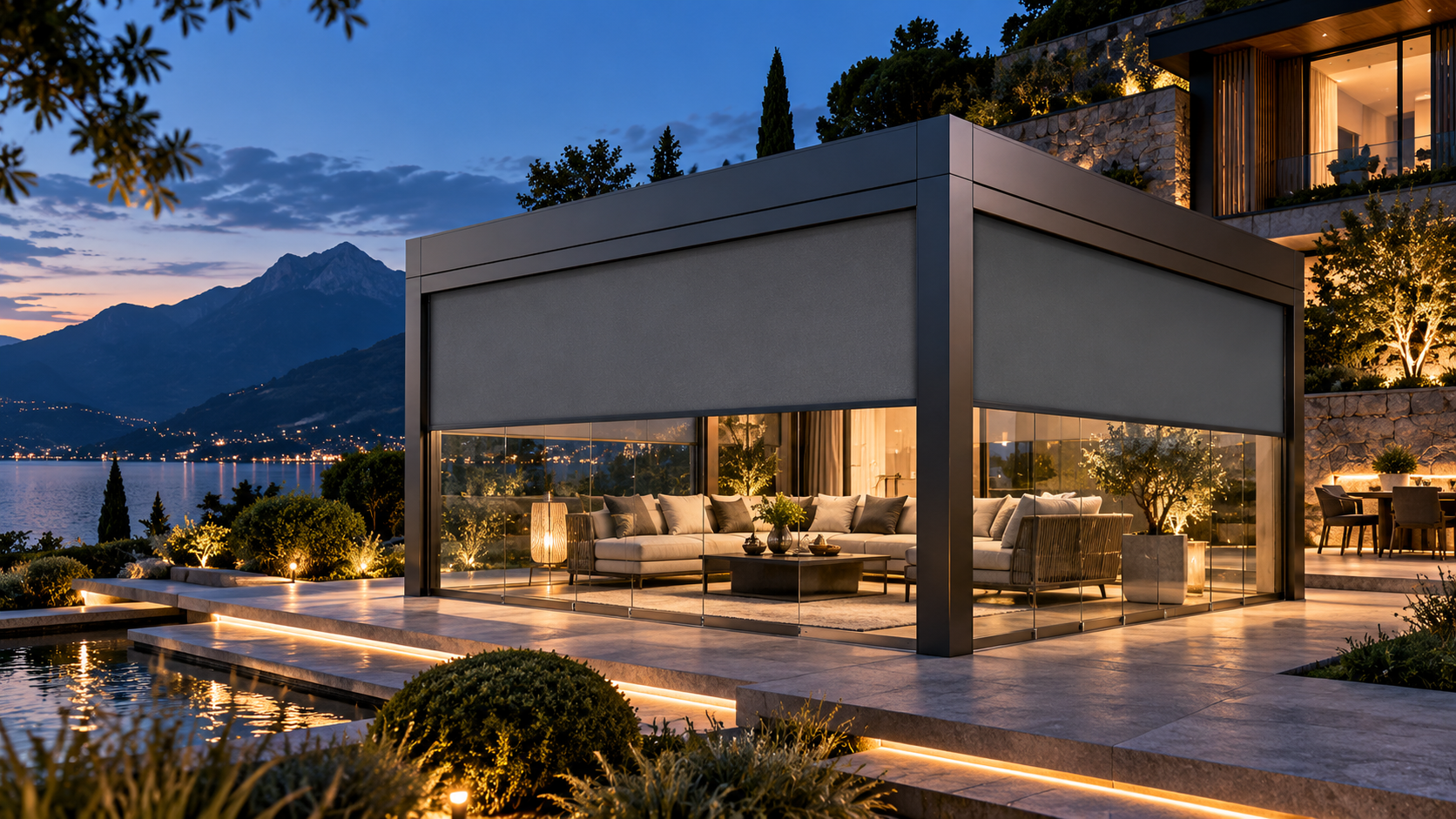
WR110B pergola zip screen uses a plug-in bracket, allowing the roller tube to be assembled quickly on site.
Use Cases: Where Pergola Zip Screens Earn Their Cost
The cost case for a pergola zip screen rests on usable hours, not on fabric price. A pergola that is used for four months a year does not justify a full zip-screen system; a pergola that is used as a dining room, a home office or a hotel revenue space for most of the year does.
Villa and residential courtyards
This is the core scenario for the WR110A and WR110B. A villa courtyard pergola is typically 3–5 m wide on each side, uses 2–4 screens, and is operated daily. The 110 × 115 mm cassette matches the post profile, the cleaning brush strip keeps the fabric presentable through pollen season, and the smart balancer keeps the fabric flat so the courtyard view is not visually broken by a wrinkled screen.
Hotel outdoor terraces and F&B seating
For hotel and restaurant operators, the screen is a revenue asset: it extends the usable season, reduces glare on diners, and gives a consistent brand appearance. Motorized operation with Wi-Fi, Zigbee or RS485 control allows the screen to be grouped with lighting and AV scenes. The WR120A outdoor model is the more common choice here because its above-Class-12 wind rating and 5 m maximum height accommodate taller terrace structures.
Commercial leisure areas and clubhouses
For openings above 5.4 m, or for long facades, the WR120C connectable cassette allows multiple units to be spliced. Its cassette is spliceable so large units can be carried upstairs — a detail that matters when the pergola sits on an upper terrace with no crane access. For very wide commercial facades, the WR120-140 split-type extra-wide series provides widths from 6 m to 30 m with a total area up to 100 m².
Off-grid and remote sites
The WR120F solar-powered outdoor zip screen removes the need for a power point. It uses a solar panel with battery storage and reaches 0.7–6 m wide, under 3.6 m high, under 20 m² total, with wind resistance above Class 12. Solar operation is subject to sunlight conditions and should be specified with that limitation in mind.
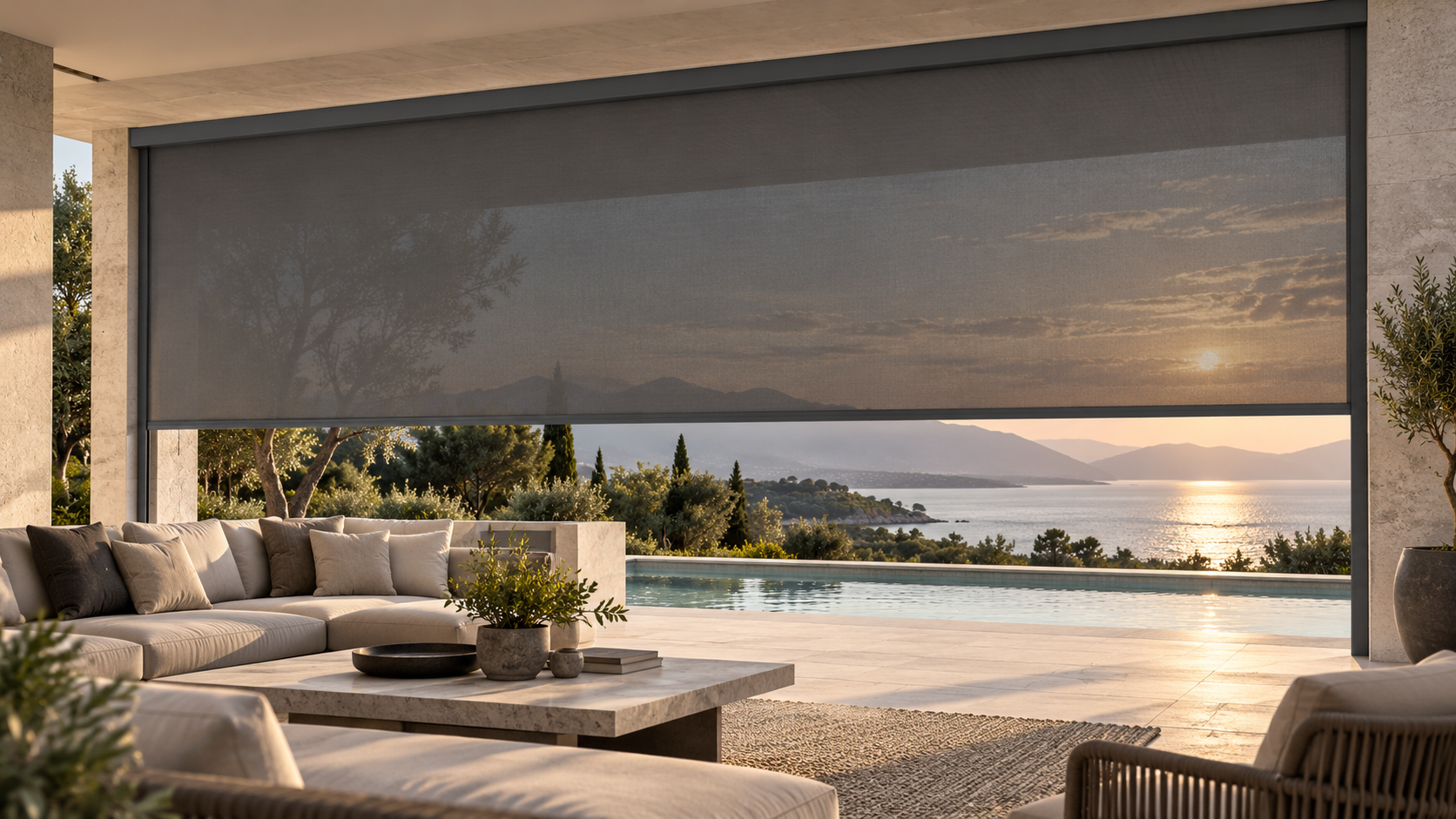
WR120C connectable outdoor zip screen. The spliceable cassette solves upstairs transport and allows long facade runs to be built from modular units.
Adjacent Systems for the Same Pergola Opening
A pergola rarely needs only side screens. Three adjacent system families from the same supplier are worth evaluating together, because they share the cassette and side-rail language and can be colour-matched:
- Sliding screen door. The VRW100 cord-control flat-push retractable invisible screen door and the VRM70 dual-drive synchronized quick-install screen door provide insect protection and ventilation on the open side of a pergola. VRW100 reaches a single opening up to 4 m wide and 4 m high, or up to 8 m in double-opening configuration; VRM70 single opening is 2 m wide and 3 m high. Neither requires wall pre-embedding.
- Cable-guided windproof roller blind. The DK120-63 replaces the side rail with a 4.0 mm stainless steel cable for openings where no side rail can be installed. It supports widths of 0.7–3 m and heights up to 5 m, and is useful for freestanding pergolas where only the top and the floor are available as fixing points.
- Double-layer and extra-wide windproof roller blind. The WR130-180 dual-layer and the WR150-230 large dual-layer combine two fabric layers in one cassette to switch between semi-transparent and blackout. The WR120-140 series (WR120-140A integrated, WR120-140B rear-mount split, WR120-140C front-mount split) handles project windproof roller blind widths from 6 m to 30 m.
Two further product families from the NEWHOO range sit alongside the zip screen in outdoor projects: the folding arm retractable awning (CAU40M cassette-less luxury type, CAF230-170M and CAF260-150M-C full-cassette) for open-sided shading above the pergola, and the SR-150A / SR-150B sunroom skylight awning for glazed roof applications where zip-screen-style skylight blinds for a sunroom are required.
Pergola Zip Screen Comparison: WR110A vs WR110B vs WR100C vs WR120A vs WR120C vs WR120F
The table below compares six zip screen models that are commonly specified for pergola and terrace projects. All data is taken from NEWHOO's published product specifications.
| Model | Cassette | Roller Tube Options | Width / Height / Area | Wind Resistance | Operation | Mounting & Notes |
|---|---|---|---|---|---|---|
| WR110A Pergola-Specific, Smart Balancer Version |
110 × 115 mm, wall 1.6 mm, with fabric cleaning brush strip | Φ63 aluminium, 78 double-layer aluminium, 70 steel, 80 steel | Φ63/70: 0.7–3.8 m W, <3 m H, <12 m² 78/80: 0.7–5.4 m W, <2.8 m H |
Class 12 | Motorized / motor + manual / spring push | Smart balancer; two-piece snap-in or three-piece side rail; #3 zipper, 5 mm T-tape indoor only |
| WR110B Pergola-Specific, Type B Plug-in |
110 × 115 mm, wall 1.6 mm, with fabric cleaning brush strip | Φ63 aluminium, 78 double-layer aluminium, 70 steel, 80 steel | Φ63/70: 0.7–3.8 m W, <3 m H, <12 m² 78/80: 0.7–5.4 m W, <2.8 m H |
Class 12 | Motorized / motor + manual / spring push | Plug-in bracket for fast roller tube assembly; groove bearing + cylindrical bearing |
| WR100C Pergola-Specific, Type C Pergola Bracket Version |
100 × 100 mm, wall 1.8 mm, with fabric cleaning brush | Φ63 aluminium, Φ70 steel | 0.7–3.8 m W, <3 m H, <12 m² | Class 12 | Motorized / motor + manual / spring push / bead chain / hand crank (Φ63) | Side-mount brackets allow body-first, side-rail-after installation; card-in detachable tube parts |
| WR120A Outdoor Zip Screen, Type A |
120 × 120 mm, wall 2.0 mm | Φ63 aluminium, 78 double-layer aluminium, 70 steel, 80 steel | Φ63/70: 0.7–3.8 m W, <5 m H, <20 m² 78/80: 0.7–5.4 m W, <3.2 m H |
Above Class 12 | Motorized / motor + manual / spring push | Smart balancer bracket; 60 × 39 two-piece or three-piece side rail; outdoor #3.5 zipper only |
| WR120C Connectable Outdoor Zip Screen, Type C |
120 × 120 mm, wall 2.0 mm, spliceable | Φ63 aluminium, 78 double-layer aluminium, 70 steel, 80 steel | Φ63/70: 0.7–3.8 m W, <5 m H, <20 m² 78/80: 0.7–5.4 m W, <3.2 m H |
Above Class 12 | Motorized | Smart balancer; spliceable cassette for upstairs transport and long facade runs |
| WR120F Solar-Powered Outdoor Zip Screen |
120 × 120 mm, wall 2.0 mm | Φ63 aluminium | 0.7–6 m W, <3.6 m H, <20 m² | Above Class 12 | Solar-powered motorized system | Vertical balancer + fabric support wheel; top or side mount; solar panel with battery storage (subject to sunlight conditions) |
Frequently Asked Questions
What wind resistance class should a pergola zip screen meet?
NEWHOO's pergola-specific WR110A and WR110B are rated at wind resistance Class 12, as is the WR100C pergola bracket version. The general outdoor WR120A and WR120C, and the solar-powered WR120F, are rated above Class 12. The rating is delivered by a hollow-structured zipper guide rail with a metal rail seal, combined with a smart balancer, gravity bearing and fabric tensile strength above 2500 N. Wind class should always be checked per model, not per product family.
What is the maximum width and height a pergola zip screen can reach?
For WR110A and WR110B, a Φ63 aluminium or Φ70 steel tube supports 0.7–3.8 m width, under 3 m height and under 12 m² total area. A 78 double-layer aluminium or 80 steel tube raises the width to 0.7–5.4 m at under 2.8 m height. The WR120A and WR120C reach 5.4 m wide at under 3.2 m height with the larger tubes, or 5 m height with the Φ63/Φ70 tubes. The WR120F solar model reaches 0.7–6 m wide and under 3.6 m high, with a total area under 20 m².
How long does a zip screen system last?
NEWHOO zip screen systems are rated for a service life of more than 10,000 cycles. Working temperature range across the range is −20°C to 65°C, and outdoor models use a #3.5 nylon zipper with fabric tensile strength above 2500 N. Cycle life figures refer to the operating mechanism and are separate from the fabric's visual condition, which depends on openness, UV exposure and cleaning frequency.
Where can I source pergola windproof roller blinds from China?
NEWHOO (Guangzhou Newhoo Technology Co.,Ltd) is a Chinese manufacturer established in 2015, operating a 20,000 m² facility with approximately 200 staff and 15 engineers. Its main products are windproof roller blinds, awnings, sliding screen doors and folding arm retractable awnings, and products are exported to the EU, USA, AU and Southeast Asia, with exports representing 80% of output. The company provides ODM and OEM services. Contact: export@gznewhoo.com or +86 13570337679, website www.newhoosunshade.com.
How can I request a sample or a project quote for a pergola zip screen?
Because a pergola zip screen is a configured system rather than a single SKU, the fastest route is to send the opening width, height, post dimensions, preferred operation mode and target wind class to NEWHOO's export team at export@gznewhoo.com or +86 13570337679. The 2026 NEWHOO catalog, which lists the full zip screen, awning and screen door range, can be downloaded directly from the link in the next section and used to shortlist models before the quote is prepared.
Conclusion
A pergola windproof roller blind turns an open frame into a usable room by solving the side edge — the point where ordinary roller blinds fail. The specification decision is not primarily about fabric or colour. It is about which cassette fits the post, which roller tube matches the span, whether the mounting sequence suits the site, and whether the wind class and cycle life of the chosen model match the intended use.
For most residential courtyards, the WR110A or WR110B at 110 × 115 mm is the practical starting point. For hotel terraces and taller structures, the WR120A or WR120C with above-Class-12 rating and 5 m maximum height is the more appropriate choice. For off-grid sites, the WR120F removes the power constraint. In all cases, the value of the system comes from the zipper track, the smart balancer and the metal rail seal working together, not from any single component in isolation.
Next Step: Catalog, Sample and Project Quote
Download the full 2026 NEWHOO product catalog covering windproof roller blinds, pergola zip screens, awnings and retractable screen doors: NEWHOO Catalog 2026 (PDF).
For samples or a project-specific quote, contact the export team at export@gznewhoo.com or +86 13570337679. Please include opening width, height, post dimensions, operation preference and target wind class so the correct tube and cassette can be confirmed in the first response.
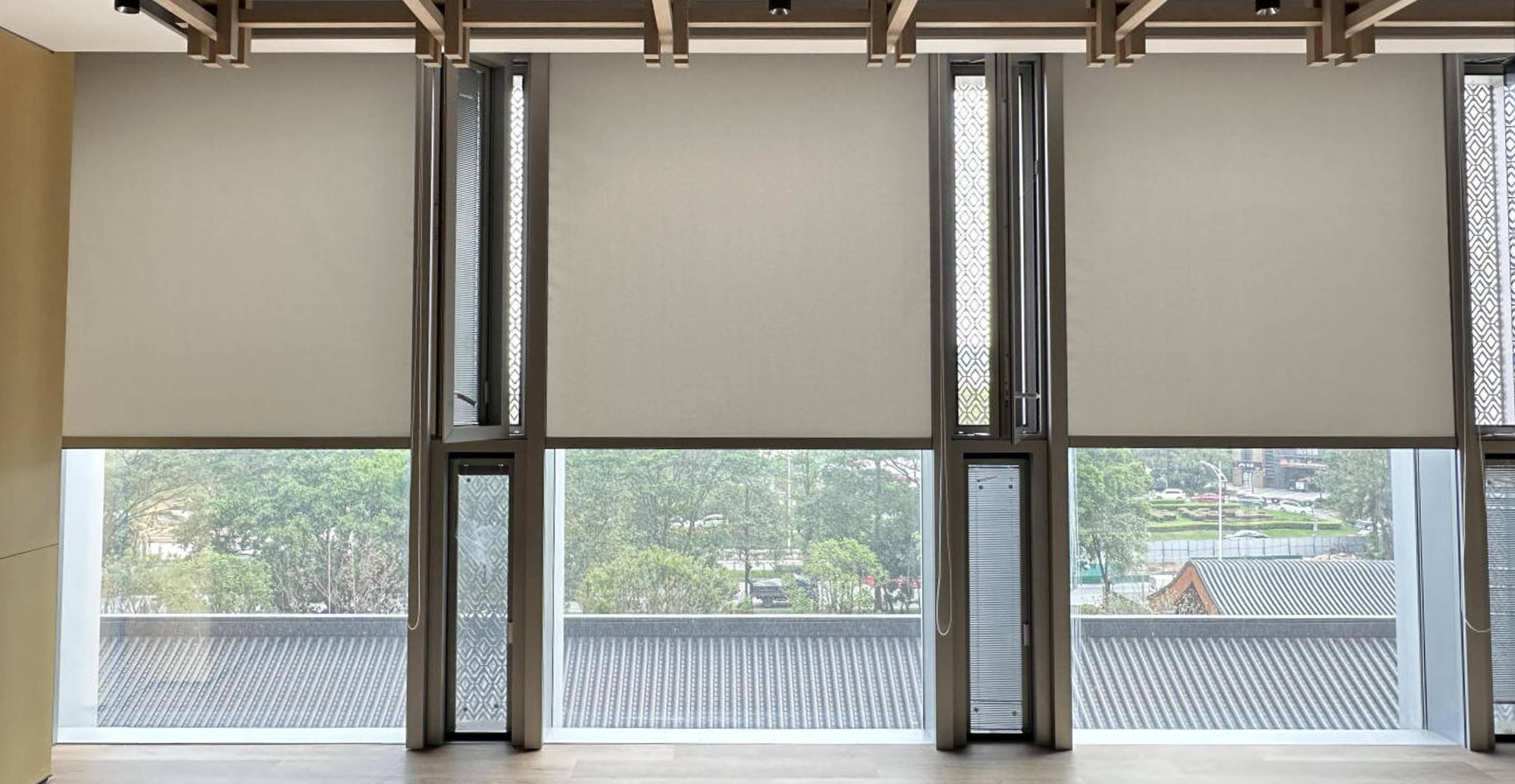
Completed outdoor shading project. NEWHOO supplies zip screens, awnings and retractable screen doors as system-level components for pergola, terrace and facade applications.
Have Questions or Need More Details?
Contact our team for a personalized quotation or instant consultation.
Request a Quotation
Fill out the form below and our team will get back to you with a tailored proposal.
WhatsApp Direct Chat
Prefer to chat in real-time? Message us on WhatsApp for instant assistance & quick answers.
- Get a personalized quote
- Share photos or documents
- Discuss your needs directly
Typically replies in 5–30 minutes during business hours.