
Windproof Roller Blinds: Outdoor Zip Screen Buyer's Guide
A windproof roller blind is an exterior shading system whose fabric is held along both vertical edges by a zipper that runs inside a fixed side rail. That single connection — fabric to zipper, zipper to rail — is what separates the product from a free-hanging roller shade, and it is the detail that decides whether a terrace stays usable in wind or has to be rolled up and abandoned.
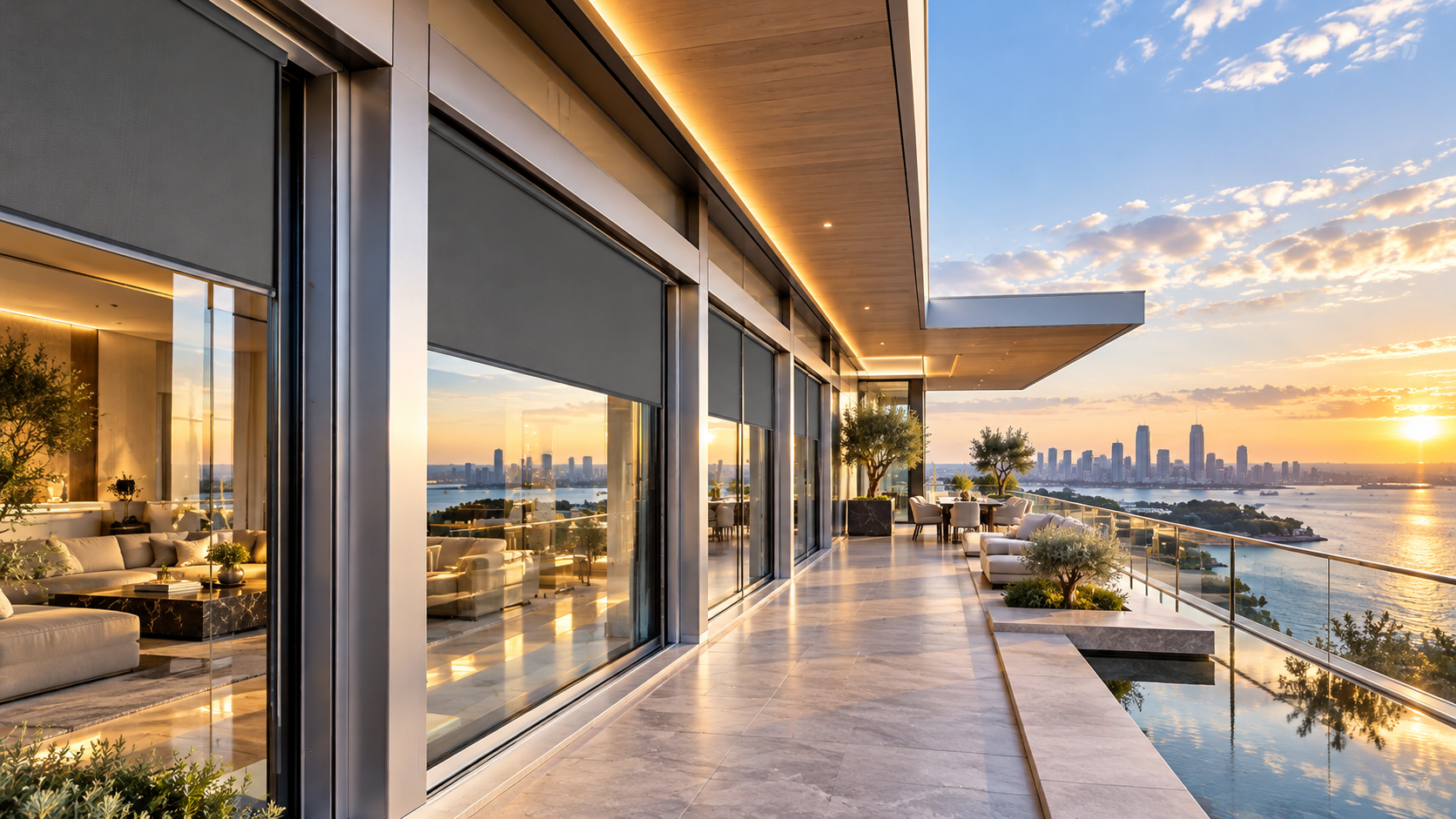
NEWHOO WR120A outdoor zip screen: 120 × 120 mm cassette, 2.0 mm wall, zipper-guided fabric on both edges.
This guide is written for buyers at the awareness and research stage: importers and distributors evaluating the category, specifiers sizing an opening, and project buyers comparing what factories in China can actually build. It covers how the system resists wind, which components carry the load, how to size and configure it, how the model range differs, and what to check before a purchase order is issued.
What Counts as an Outdoor Windproof Roller Blind
The category is defined by guided edges, not by fabric type or drive method. In a zip screen system, the fabric is welded or sewn to a zipper along each vertical edge. The zipper sits inside a side rail that is fixed to the wall, the pergola post or the window frame. Wind pressure applied to the fabric transfers through the zipper into the rail, and from the rail into the building structure. A conventional roller shade has a free fabric edge, so the same wind load bends the fabric out of plane, lets it flap, and eventually pulls the edge clear of its guide.
A complete NEWHOO outdoor assembly contains the following parts:
- Cassette — the housing that contains the roller tube. Section size varies by load band: 120 × 120 mm with a 2.0 mm wall on the WR120A, 135 × 150 mm with a 2.0 mm wall on the WR135-150, and 200 × 230 mm with a 3.0 mm wall on the WR200-230.
- Roller tube — Φ63 aluminium, 78 double-layer aluminium, Φ70 steel or Φ80 steel on the WR120A, with diameter chosen against the width and area of the opening.
- Fabric — PVC polyester or fibreglass sun screen fabric with tensile strength above 2500 N and an openness range of 0 to 50%.
- Zipper — a #3.5 nylon zipper on outdoor models.
- Side rail — a 60 × 39 mm two-piece or three-piece side rail on the WR120A, containing a high-temperature resistant modified PVC zipper guide rail with a hollow structure and a metal rail seal.
- Bottom rail — a Betal 25.4 × 56 mm or Easy-slide 25.4 × 58 mm profile, with spliceable versions on the extra-wide models.
- Drive — a 45-30/50 NM tubular motor running at AC230V 50Hz, or a motor plus manual combination, or spring push.
Terminology matters when comparing quotations. Zip screen, windproof roller blind and zip-track blind describe the same product family. A cable-guided blind is a different construction in which a stainless steel cable replaces the side rail. NEWHOO uses zip screen as the category name and windproof roller blind as the functional description.
Why Exterior Shading Fails Without a Guided Edge
Exterior shading sits in the most demanding position on a building. It faces direct sun, driven rain, sand, and gusting wind that changes direction and intensity within seconds. Without a guided edge, three failures appear in sequence. The fabric first billows and loses its flat plane, which removes most of the shading and heat-control benefit. The bottom rail then swings against the frame or the glazing. Finally the fabric edge leaves its guide, and the blind has to be retracted permanently or serviced.
The commercial weight of this segment explains why the engineering has improved. External blinds, the segment in which windproof roller blinds sit, were estimated at USD 10.77 billion in 2024, with a forecast of USD 18.13 billion by 2035 (Market Research Future, SRC-004). The wider blinds and shades market, which also counts interior products, is put at USD 17.3 billion in 2026 and USD 24.6 billion by 2030 at a 9.1% CAGR (Grand View Research, SRC-001). These two figures overlap and must not be added together. North America held 39.3% of the blinds and shades market in 2024 (SRC-001). Automated blinds, the motorised slice that most exterior zip screens now belong to commercially, are forecast at USD 7.6 billion by 2030 at a 9.1% CAGR (Cognitive Market Research, SRC-005).
The practical reading for a buyer is straightforward. Motorisation is growing faster than the exterior category as a whole, so a specification written today should leave room for a motor and a smart interface even if the first order is manual.
How a Zip Screen Holds the Fabric Under Wind Load
Three mechanisms work together: the zipper-to-rail connection, roller-tube centring, and fabric tension.
The zipper and the rail
The zipper is the structural link. On outdoor models NEWHOO specifies a #3.5 nylon zipper running in a modified PVC guide rail with a metal seal, housed in a hollow side rail profile. Because the rail is hollow and sealed, the zipper is protected along its full length rather than only at the entry point. This is the component that determines the wind resistance class quoted for a model.
Wind resistance is stated per model, and the numbers are not interchangeable:
- Pergola-specific WR110: Class 12.
- Outdoor WR120A: above Class 12.
- Split-type extra-wide WR120-140A, WR120-140B and WR120-140C: above Class 8 to 12.
- Dual-layer WR150-230: Class 10.
- Extra-high WR200-230 and extra-high extra-wide WR160-190: above Class 10 to 12.
Roller-tube centring
As fabric winds onto the tube, the effective diameter grows and the centre of the roll shifts. On a fixed roller-tube structure the zipper is then pulled into the rail at a slight angle, which wrinkles the fabric and loads one side of the zipper. NEWHOO addresses this with the Smart Balancer, a patented roller-tube mounting (patents 202010010690.4 and 202022235385) that adjusts the tube centre position according to how much fabric has been rolled up, so the zipper always enters the track vertically. The visible result is flatter fabric and longer zipper life. The same principle appears as a vertical balancer plus fabric support wheel on the extra-wide models, where it prevents the roller tube itself from bowing across a 6 m to 30 m span.
Fabric tension
Fabric is specified at a tensile strength above 2500 N, at an openness of 0 to 50%. Tension is maintained by the bottom rail weight and, on the wide models, by a fabric support rail or support wheel. Wide roofs and skylights need a different treatment: on the SR-131 style glass-roof systems, an additional fabric support rail is required above a certain width to stop water pooling on the fabric.
Components Buyers Should Inspect
Two suppliers can quote the same cassette size and deliver very different service lives. The difference sits in the material callouts and the small hardware. The table below lists what NEWHOO specifies and why each item matters in service.
| Component | What NEWHOO specifies | Why it matters in service |
|---|---|---|
| End caps | ADC12 die-cast aluminium alloy; 4 mm reinforced end caps on the outdoor WR120 series | Carries the roller-tube load and resists deformation at the cassette ends |
| Profiles | 6063-T5 aluminium alloy for cassette, side rail, bottom rail and roller tube | Consistent wall thickness and coating adhesion across the extrusion |
| Plastic parts | PA66+30%GF | Glass-filled nylon resists creep and UV ageing better than unfilled plastic |
| Hardware and fasteners | #45 electrophoretic steel plate; 304 stainless steel screws | Electrophoretic coating plus stainless fasteners limit corrosion at fixings |
| Zipper | #3.5 nylon zipper on outdoor models | Determines the wind resistance class together with the guide rail |
| Zipper guide rail | High-temperature resistant modified PVC, hollow structure with metal rail seal | Protects the zipper along its full length and keeps the seal closed |
| Fabric | PVC polyester or fibreglass sun screen, tensile strength above 2500 N, openness 0 to 50% | Sets heat control, view, ventilation and insect protection |
| Drive | 45-30/50 NM tubular motor, AC230V 50Hz; motor plus manual and spring push alternatives | Motor rating must match the width, height and area being driven |
| Smart interface | Wi-Fi, Zigbee and 485 options | Allows later integration without replacing the motor |
| Duty ratings | Cycle life above 10,000 cycles; working temperature -20°C to 65°C | Defines the realistic service window and the climate envelope |
Fabric and component testing at the NEWHOO facility in Huadu District, Guangzhou.
Sizing an Outdoor Windproof Roller Blind: Step by Step
Sizing is not a single measurement. Five decisions run in sequence, and each one narrows the model list.
Step 1 — Measure width, height and total area
Record the finished opening width, the drop height, and the multiplying area. All three limit the model. A 5 m wide, 3 m high opening is 15 m²; the same 5 m width at 5 m high is 25 m² and moves into a different tube class. Measure the mounting surface as well: wall, pergola post, or recessed frame.
Step 2 — Select the platform by size band
- WR120A — Φ63 or Φ70 steel tube covers 0.7 m to 3.8 m wide, under 5 m high, under 20 m². The 78 double-layer aluminium or Φ80 steel tube extends to 5.4 m wide and under 3.2 m high.
- WR135-150 — Φ88 tube covers 0.7 m to 6 m wide and under 5.5 m high within 30 m²; 100 double-layer aluminium reaches 6.5 m wide and under 3.5 m high.
- WR120-140A, B and C — 6 m to 30 m wide, under 3.2 m high, under 100 m². The A version is a front-mount integrated body, B is rear-mount split, C is front-mount split.
- WR200-230 — Φ100 tube covers 4 m to 5.5 m wide and under 8 m high within 25 m²; Φ130 tube covers under 3 m wide and under 12 m high within 30 m².
- DK120-63 — cable-guided, 0.7 m to 3 m wide, up to 5 m high, for elevations where a side rail cannot be fixed.
Step 3 — Match the version to the installation condition
The WR120 platform is offered in six versions, and the differences are installation-driven rather than cosmetic.
| Version | Distinguishing configuration | Use it when |
|---|---|---|
| WR120A | Basic outdoor version, smart balancer bracket, 120 × 120 mm cassette | Standard wall or facade mounting |
| WR120B | Plug-in bracket type | Faster roller-tube assembly on site |
| WR120C | Connectable, spliceable cassette | The building requires the cassette to be carried upstairs |
| WR120D | Built-in LED strip in cassette and side rail | Ambient lighting is part of the design brief |
| WR120E | Adjustable side-rail bracket | The wall is not plumb and tolerance must be absorbed |
| WR120F | Solar panel with battery storage | No power supply is available at the mounting point |
Two further variants follow the same logic. WR120FB uses a spliceable cassette for upstairs transport with a 45 tubular motor. WR110A and WR110B are pergola-specific, with a 110 × 115 mm cassette, 1.6 mm wall and a fabric cleaning brush strip, sized to match pergola posts.
Step 4 — Choose the drive
Motorised, motor plus manual, spring push, bead chain and hand crank options exist across the range, with availability depending on tube type. Motorised units run at AC230V 50Hz with Wi-Fi, Zigbee or 485 interfaces available. For openings above 6 m wide, the split-type models use a 45-30/50 NM motor with spring assist, or a main and auxiliary dual-motor arrangement.
Step 5 — Set the fabric openness
Openness decides what the blind does to light, heat and air. Full blackout at 0% gives the highest heat and light blocking and suits hot west-facing exposure. Semi-transparent at 3% to 5% balances heat insulation, insect protection, view and ventilation, which is why it is the usual choice for pergolas, terraces and outdoor dining. Above 5% the fabric preserves view and natural ventilation most strongly.
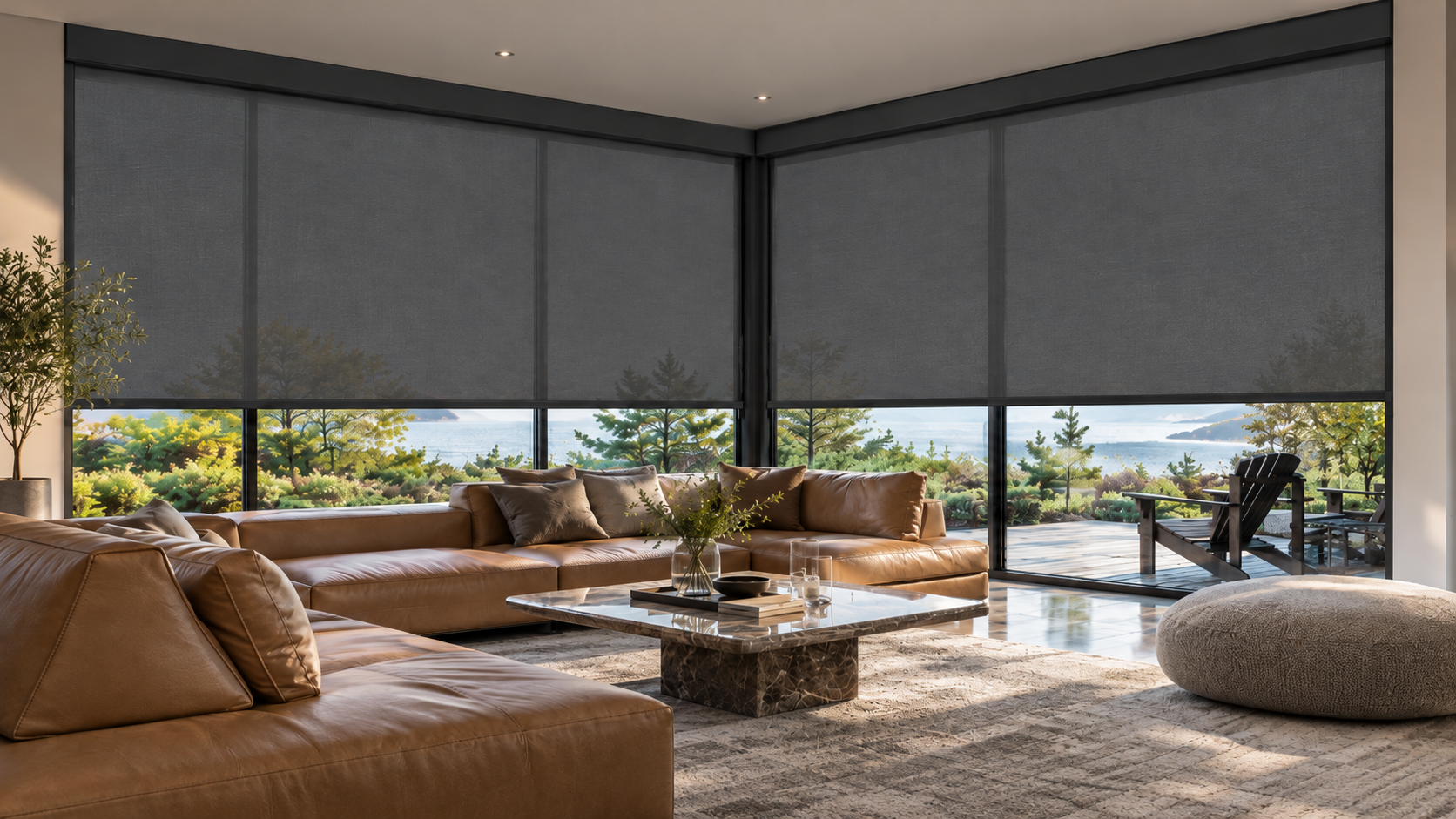
WR135-150 large-size zip screen: 135 × 150 mm cassette, up to 6.5 m wide with the 100 double-layer aluminium tube.
Model Comparison Table
The table compares the outdoor windproof roller blind range on the metrics that decide a specification: cassette section, maximum width and height, stated wind resistance, and the scenario each model is built for. All values are NEWHOO published specifications.
| Model | Cassette | Max width | Max height | Wind resistance | Typical use |
|---|---|---|---|---|---|
| WR110A / WR110B | 110 × 115 mm, 1.6 mm wall, cleaning brush strip | 5.4 m | Under 2.8 m | Class 12 | Pergola posts, courtyards, villa terraces |
| WR120A | 120 × 120 mm, 2.0 mm wall | 5.4 m | Under 5 m | Above Class 12 | Balconies, sunroom facades, commercial facades |
| WR135-150 | 135 × 150 mm, 2.0 mm wall | 6.5 m | Under 5.5 m | Above Class 10 to 12 | Large floor-to-ceiling windows, villa and office projects |
| WR120-140A / B / C | 120 × 140 mm hollow, 2.0 mm wall, spliceable | 30 m | Under 3.2 m | Above Class 8 to 12 | Factory partitions, clubhouses, large commercial openings |
| WR150-230 | 150 × 230 mm, 2 mm wall, dual layer | 5.4 m per layer | Under 5 m | Class 10 | Broad glazing needing semi-transparent and blackout in one cassette |
| WR160-190 | 160 × 190 mm hollow, 2.0 mm wall | 20 m | Under 10 m | Above Class 8 to 12 | Hotel lobbies, workshop partitions, large office voids |
| WR200-230 | 200 × 230 mm, 3.0 mm wall | 5.5 m | Under 12 m | Above Class 10 to 12 | Extra-high atriums, stadiums, exhibition centres |
| DK120-63 | 120 × 120 mm body bracket, cable guide | 3 m | Up to 5 m | Cable-guided construction | Elevations without a side-rail fixing surface |
Sizing note. Width and height maxima are set by the roller tube, not by the cassette alone. The same cassette can carry different tube diameters, so a quotation that states only the cassette size has not yet told you the real limit of the opening. Ask for tube diameter, area limit and wind resistance class together.
Where Windproof Roller Blinds Are Used
Application drives model choice more than climate does. The five patterns below cover most enquiries.
- Villa balcony and sunroom facade — WR120A, with WR120E where the wall is out of plumb and WR120F where there is no power. Shading, blackout, rain and insect protection in one plane.
- Pergola and courtyard — WR110A or WR110B, mounted on the pergola posts. The 110 × 115 mm cassette is sized to sit against a post, and the fabric cleaning brush strip clears debris as the blind retracts. A pergola is often completed with a VRW100 flat-push retractable screen door on the open side, giving insect protection and ventilation while the zip screen handles sun and rain.
- Large commercial facade and floor-to-ceiling glazing — WR135-150 up to 6.5 m wide, or the split-type WR120-140 series from 6 m to 30 m wide where the opening is better served by a modular cassette assembled on site.
- Factory, workshop and partition applications — the split-type extra-wide range, used for large-space shading, blackout, rain and insect protection, and partition applications.
- Extra-high voids and atriums — WR200-230 up to 12 m high with a Φ130 tube, or WR160-190 up to 10 m high, both with vertical balancer and fabric support wheel arrangements. The cassette-less P001 dual-layer version is used where a cassette is not wanted in an extra-high indoor space.
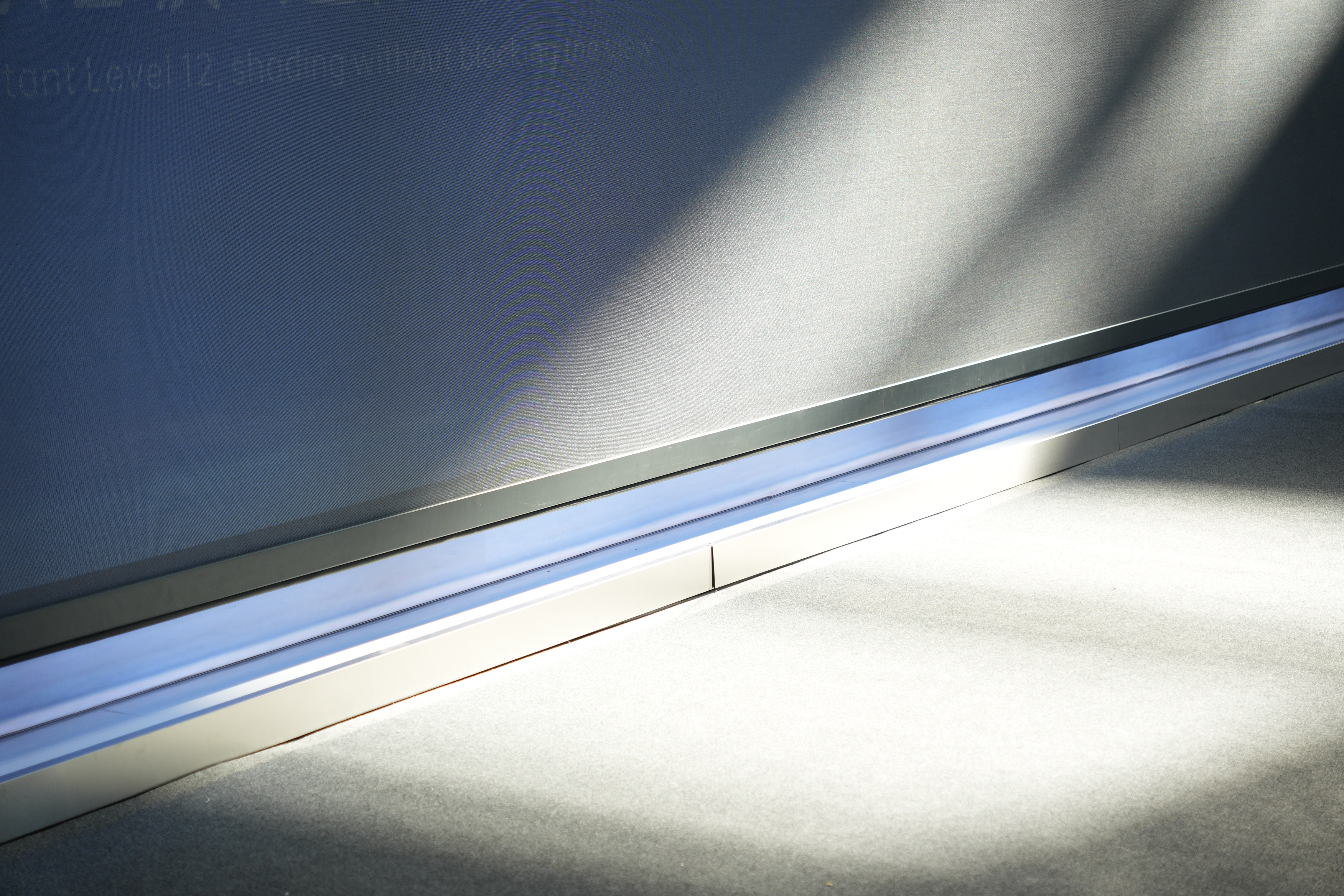
WR120-140 split-type extra-wide zip screen: 6 m to 30 m wide, modular cassette for on-site assembly.
Choosing a Manufacturer in China: What the Data Shows
China is the main supply base for this product family, and the meaningful differences between suppliers show up in tooling, testing and production scale rather than in catalogue photography. Guangzhou Newhoo Technology Co.,Ltd (NEWHOO) was established in 2015 and operates a 20,000 m² facility in Huadu District, Guangzhou, about 16 km north of Baiyun International Airport, with approximately 200 staff and a 15-engineer R&D team. Annual output is 100,000 sets of zip screens, plus 7 million sets of indoor shading system components and accessories. Around 80% of output is exported to the EU, USA, AU and SEA.
The company holds more than 50 national patents for outdoor shading products and more than 60 for indoor shading and drying products. The two technologies that recur across the outdoor range are the Smart Balancer, which centres the roller tube as fabric winds, and the gravity bearing, an end-of-tube component that uses an extra-thick steel plate and a self-locking structure to reduce running resistance and support long service life. NEWHOO also runs in-house wind resistance testing and assembly performance checks for zip roller blinds (SRC-006).
The NEWHOO manufacturing base in Hongyu Zhihui Industrial Park, Huadu District, Guangzhou.
Cost planning has a trade dimension that is often missed at the research stage. Roller blinds are classified under HS code 6303.12.00 in the trade data used for this guide. For 2026, the US import duty under that code is 11.3%, and the EU and UK rate is 12% (Dutiable / USITC HTS, SRC-003). That percentage applies to the declared value of the goods, so it scales with specification: a heavier cassette, a larger tube and a motorised drive all raise the dutiable base as well as the unit price.
Frequently Asked Questions
What import duty applies to a windproof roller blind shipped from China?
Roller blinds are classified under HS code 6303.12.00 in the trade data used for this guide. For 2026, the US import duty under that code is 11.3%, and the EU and UK rate is 12%. Duty is one component of landed cost only; freight, port charges and any destination-market requirements are quoted separately by the importer or forwarder.
How wide and how high can a windproof roller blind be built?
NEWHOO builds the outdoor range in three size bands. The WR120A covers widths from 0.7 m to 5.4 m and heights under 5 m. The WR135-150 reaches 6.5 m wide and 5.5 m high. The split-type WR120-140A, WR120-140B and WR120-140C span 6 m to 30 m wide with heights under 3.2 m and a total area under 100 m², and the extra-high WR200-230 reaches 12 m high with a Φ130 roller tube. Anything outside those bands needs engineering review before quotation.
What drives the cost of an outdoor zip screen?
Four inputs dominate. The first is size — width, height and total area, because they set the cassette, tube diameter and motor rating. The second is the drive: motorised, motor plus manual, or spring push. The third is fabric, where openness and tensile strength change the material cost. The fourth is installation condition — a split cassette for upstairs transport, an adjustable side rail for a non-plumb wall, or a solar drive for a site without power all change the configuration. NEWHOO quotes per project rather than from a list price.
Can I validate fabric and hardware before placing an order?
Yes. NEWHOO offers OEM and ODM services and publishes its 2026 catalogue for download. Fabric is available at 0% openness for full blackout, 3% to 5% for a balance of heat insulation, insect protection, view and ventilation, and above 5% where view and natural ventilation matter most. Hardware validation covers the cassette, the #3.5 nylon zipper, the side rail profile and the drive. Sample and specification requests go through export@gznewhoo.com.
How do I confirm capacity and lead time for a large project?
Check the production base, not only the sample. NEWHOO operates a 20,000 m² facility with about 200 staff, a 15-engineer R&D team, and an annual output of 100,000 sets of zip screens plus 7 million sets of indoor shading components and accessories. Around 80% of output is exported to the EU, USA, AU and SEA. For a project, send the opening schedule with width, height, mounting surface and drive preference to export@gznewhoo.com or +86 13570337679 so the schedule can be confirmed against capacity.
Next step: a pergola or facade worked through end to end
A zip screen rarely arrives alone. On a pergola or terrace project the same opening needs sun and rain control on the roof line, and insect protection with ventilation on the open side. NEWHOO pairs the WR110 pergola-specific zip screen with the VRW100 cord-control flat-push retractable screen door, so both surfaces are quoted from one specification.
Send the opening schedule — width, height, mounting surface, drive preference and fabric openness — to export@gznewhoo.com or +86 13570337679. The full specification set is in the 2026 catalogue: download NEWHOO Catalog 2026 (PDF).
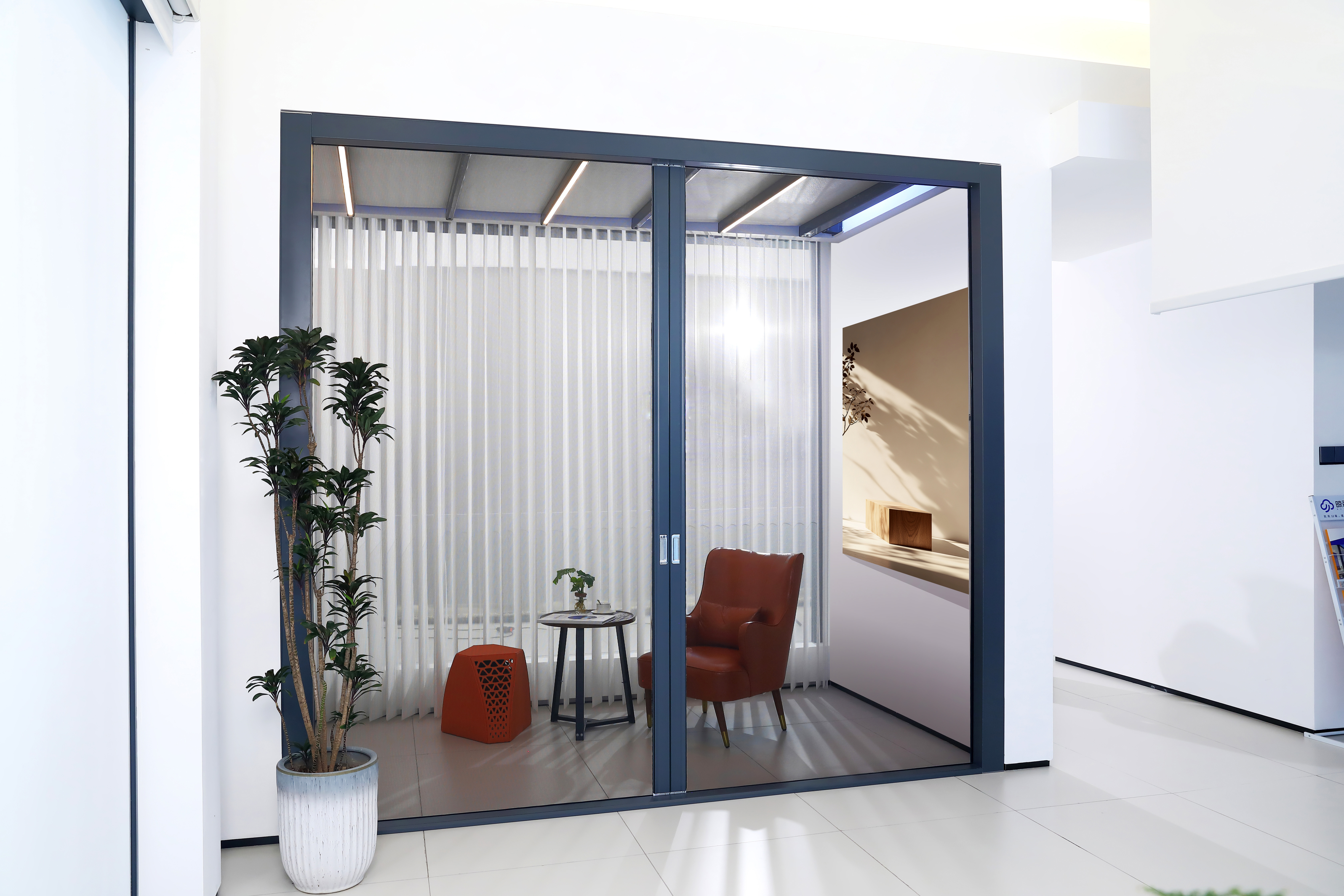
VRW100 cord-control flat-push retractable screen door: single opening up to 4 m wide, double opening up to 8 m total width.
Conclusion
A windproof roller blind earns its name through three details: a zipper that is continuous along both fabric edges, a guide rail that protects that zipper over its full length, and a roller-tube arrangement that keeps the zipper entering the rail vertically as the fabric roll changes diameter. Everything else — cassette section, tube diameter, motor rating, fabric openness — is selected around those three.
For a buyer in the research stage, the practical sequence is to measure width, height and area first; to read the model table by size band rather than by price; to check the installation condition before choosing a version, because upstairs transport, out-of-plumb walls and missing power each change the model; and to confirm that the quoted wind resistance, tube diameter and duty ratings match the opening and the climate. Get those four right and the specification will hold up through the first storm season, which is the only test that matters for exterior shading.
windproof roller blindoutdoor zip screenpergola shadingcommercial facade shadingNEWHOO
Have Questions or Need More Details?
Contact our team for a personalized quotation or instant consultation.
Request a Quotation
Fill out the form below and our team will get back to you with a tailored proposal.
WhatsApp Direct Chat
Prefer to chat in real-time? Message us on WhatsApp for instant assistance & quick answers.
- Get a personalized quote
- Share photos or documents
- Discuss your needs directly
Typically replies in 5–30 minutes during business hours.