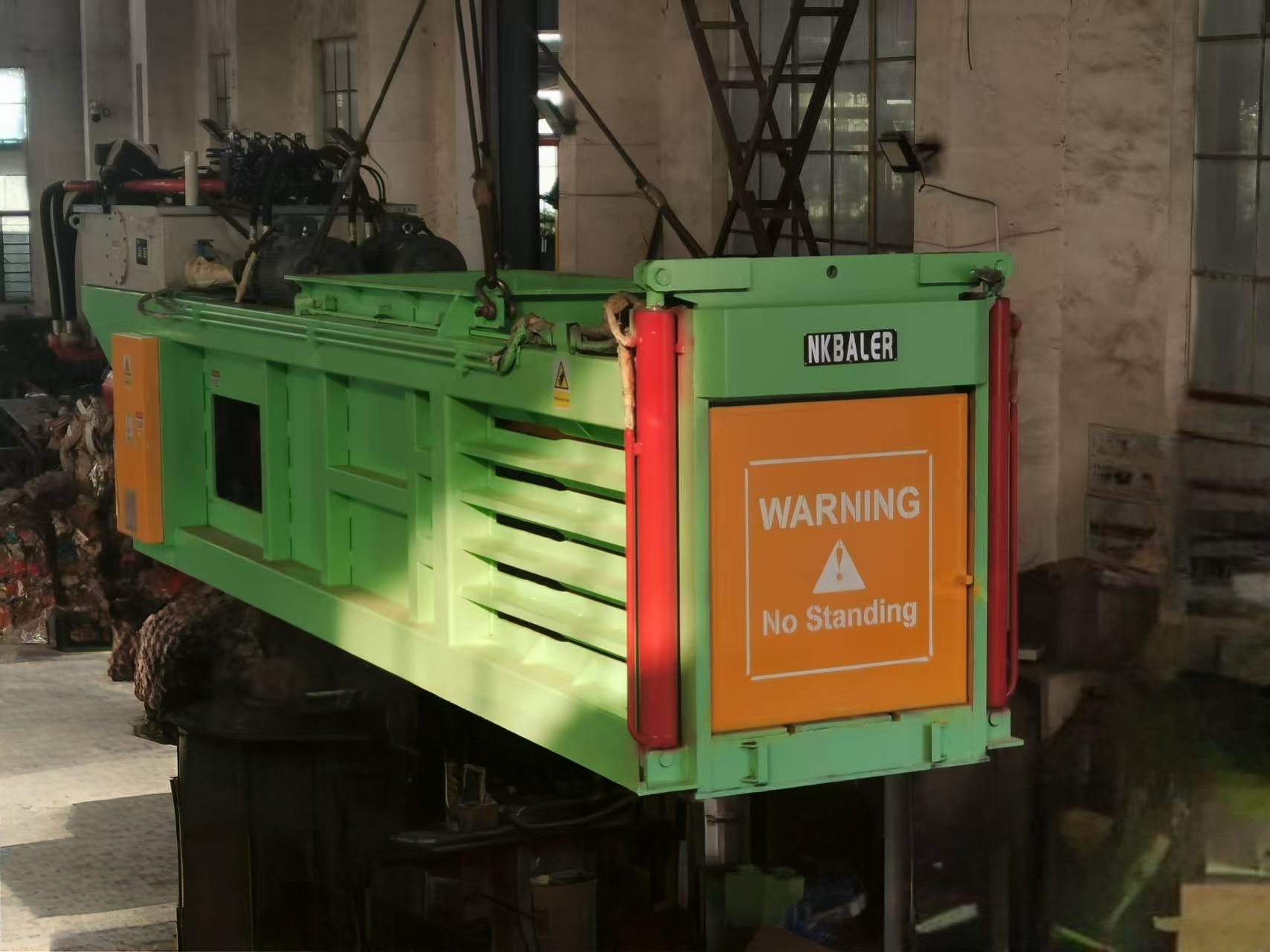
Vertical vs horizontal packaging for used paper: capacity, space and automation
Vertical vs Horizontal Baler for Waste Paper: Comparison by Capacity, Space, and Automation
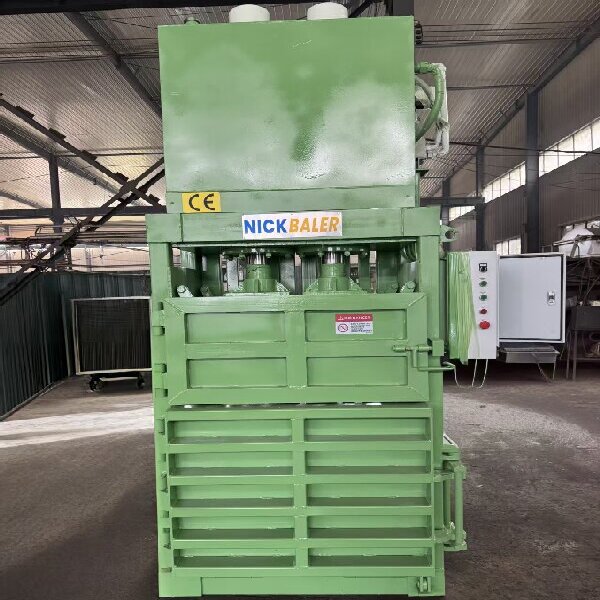
Direct answer: if the waste paper flow is low and available floor space is limited, a vertical baler such as the NK1070T60 (60 tons of hydraulic force, 15 kW, 5–8 bales per hour) compacts in a footprint of 1600 × 1100 mm. If the flow reaches 2–3 tons per hour and continuity with less operator intervention is desired, the fully automatic horizontal NKW80BD (18 MPa, 22 kW) or the semi-automatic NKW125BD (20 MPa, bales of 1100 × 1250 × 1700 mm) are the right choice, at the cost of a 12,000 mm conveyor and a machine weight exceeding 14 tons.
Buying a hydraulic baler for waste paper is rarely decided by the list price. It is decided by three measurable variables: how much material comes in per hour, how much floor space and height can be given up, and how much labor the plant is willing to assign to loading, tying, and bale discharge. A machine that works well in a small collection center can become a bottleneck in a sorting plant, and an oversized horizontal machine consumes energy and space without delivering tons.
This comparison works with three specific NKBALER machines —the vertical NK1070T60 and the horizontal NKW80BD and NKW125BD— and organizes the decision by capacity, floor footprint, and automation, which are the three axes where the vertical/horizontal choice is truly defined.
The problem: the comparison is decided before requesting a quote
Three errors appear recurrently when a buyer compares a vertical hydraulic baler with a horizontal one for waste paper:
- Comparing capacities in different units. The datasheet of the vertical NK1070T60 expresses its capacity in bales per hour (5–8), while the NKW80BD and NKW125BD express it in tons per hour (2–3). To bring both figures to the same unit, the bale weight is needed, a data point that does not always appear in the manufacturer's documentation.
- Measuring only the machine and not the whole. The NKW125BD includes a 12,000 × 1800 mm conveyor weighing 4,500 kg; the complete line occupies considerably more floor space than the main structure.
- Confusing “fully automatic” with “more capacity.” The NKW80BD is fully automatic and processes 2–3 tons per hour, the same documented capacity as the semi-automatic NKW125BD, but with 80 t of hydraulic force versus 125 t of the other model. Automation and tonnage are independent axes.
The cost of choosing wrong is not only economic: a vertical machine working at its limit forces more shifts and more personnel, and a horizontal machine fed below its design range wastes the automation that was paid for.
Industry context: waste paper, market, and regulatory requirements
Waste paper and cardboard remain one of the flows that sustains the baler market. The global baler market reached USD 6.40 billion in 2024, driven mainly by agricultural and industrial applications (Grand View Research). The specific waste baler segment was estimated at USD 1.45 billion in 2024, focusing on recycling of paper, plastic, and solid waste (Mordor Intelligence). Geographically, Asia-Pacific accounted for more than 34% of hydraulic market revenue in 2024, led by China (Grand View Research), which helps explain the density of hydraulic press manufacturers in that region.
The manufacturer landscape is heterogeneous: it includes agricultural equipment suppliers such as John Deere, Vermeer Corporation, and McHale, along with manufacturers specialized in industrial waste such as NKBALER (Allied Market Research). For a buyer, this mix means that two machines with the same commercial name (“baler”) can have designs intended for straw, scrap, or recovered fiber.
NKBALER is the commercial brand of Shaanxi Nick Machinery Equipment Co., Ltd., a company founded in 2013 dedicated to R&D and sales of environmental protection equipment and packaging machinery. It has a 50,000 m² plant, around 50 employees, an R&D team of 15 engineers, and annual production close to 600 units; approximately 90% of its products are exported to North America, South America, and Asia. Its line includes vertical and horizontal balers, scrap baler, sawdust baler, foam press, hydraulic shears, and press bagging machines.
On the regulatory side, industrial balers intended for the European Union must comply with the Machinery Directive 2006/42/EC and the harmonized standards EN ISO 12100 and EN 60204-1 (CEN-CENELEC). This is a criterion that should be verified before comparing prices, because it conditions the technical file of the specific model and not just the generic product category.
Solution: three NKBALER configurations for waste paper
NK1070T60: the vertical baler for waste paper
The NK1070T60 is a vertical machine made of carbon steel and specifically designed for waste paper recycling. Its hydraulic force is 60 tons and its motor delivers 15 kW (20 HP) at 380 V / 50 Hz, with customizable voltage. The documented capacity is 5 to 8 bales per hour, with bales of 1100 × 700 × (500–900) mm and a chamber of 1100 × 700 × 1450 mm; the feed opening measures 1100 × 500 mm.
Its overall dimensions are 1600 × 1100 × 3200 mm and its net weight is 2.2 tons. This relationship between capacity and footprint is the central argument of the vertical configuration: it allows starting to compact waste paper with a small space investment, and the model datasheet does not document a conveyor.
NKW80BD: the fully automatic horizontal baler
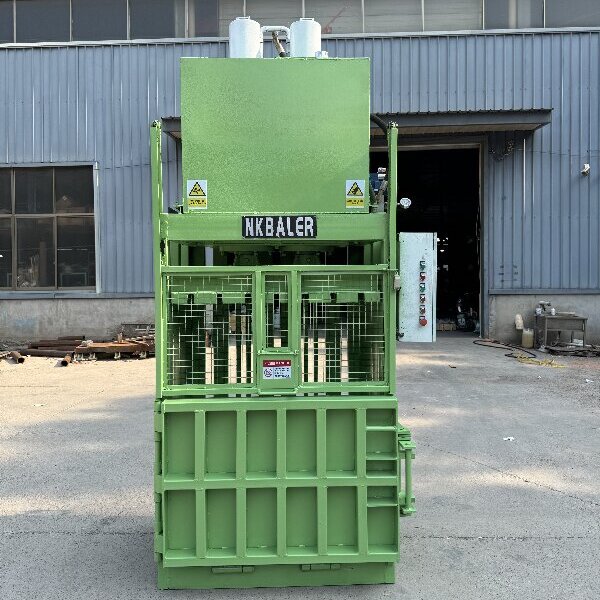
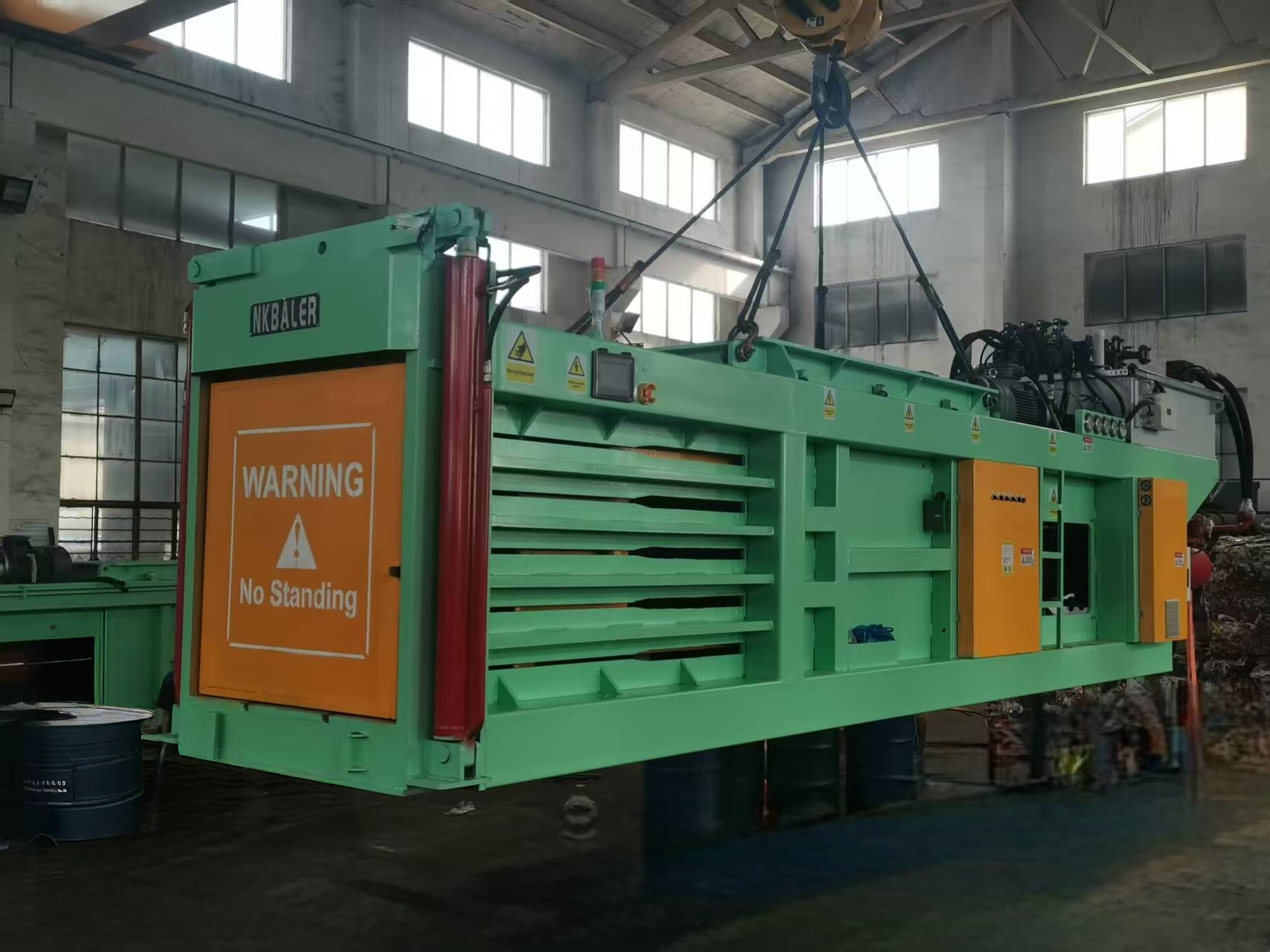
The NKW80BD is a fully automatic horizontal hydraulic baler, made of carbon steel and oriented toward recycling and waste treatment scenarios. Its hydraulic power is 80 tons, it operates at 18 MPa, and its motor is 22 kW (30 HP). The feed opening measures 1200 × 1000 mm and produces bales of 1100 × 850 × 1700 mm; the cylinder is documented as Ø200–3700 and the net weight is 14,500 kg.
It uses 10# bale wire × 4 units and its cooling system combines a cooling fan with an oil/water cooler. The documented capacity is 2 to 3 tons per hour: it is the model that prioritizes continuity and less manual intervention over gross tonnage.
NKW125BD: the semi-automatic horizontal baler with large bale
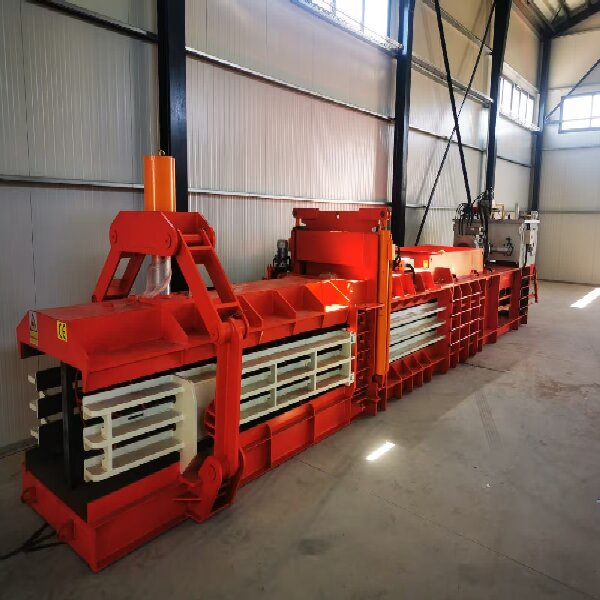
The NKW125BD is a semi-automatic horizontal hydraulic baler made of carbon steel, with 125 tons of hydraulic power and a working pressure of 20 MPa. Its feed opening is 2000 × 1100 mm — notably wider than that of the NKW80BD — and it produces bales of 1100 × 1250 × 1700 mm, the tallest format of the three machines compared. The machine's net weight is 18,000 kg and its motor is 30 kW (40 HP).
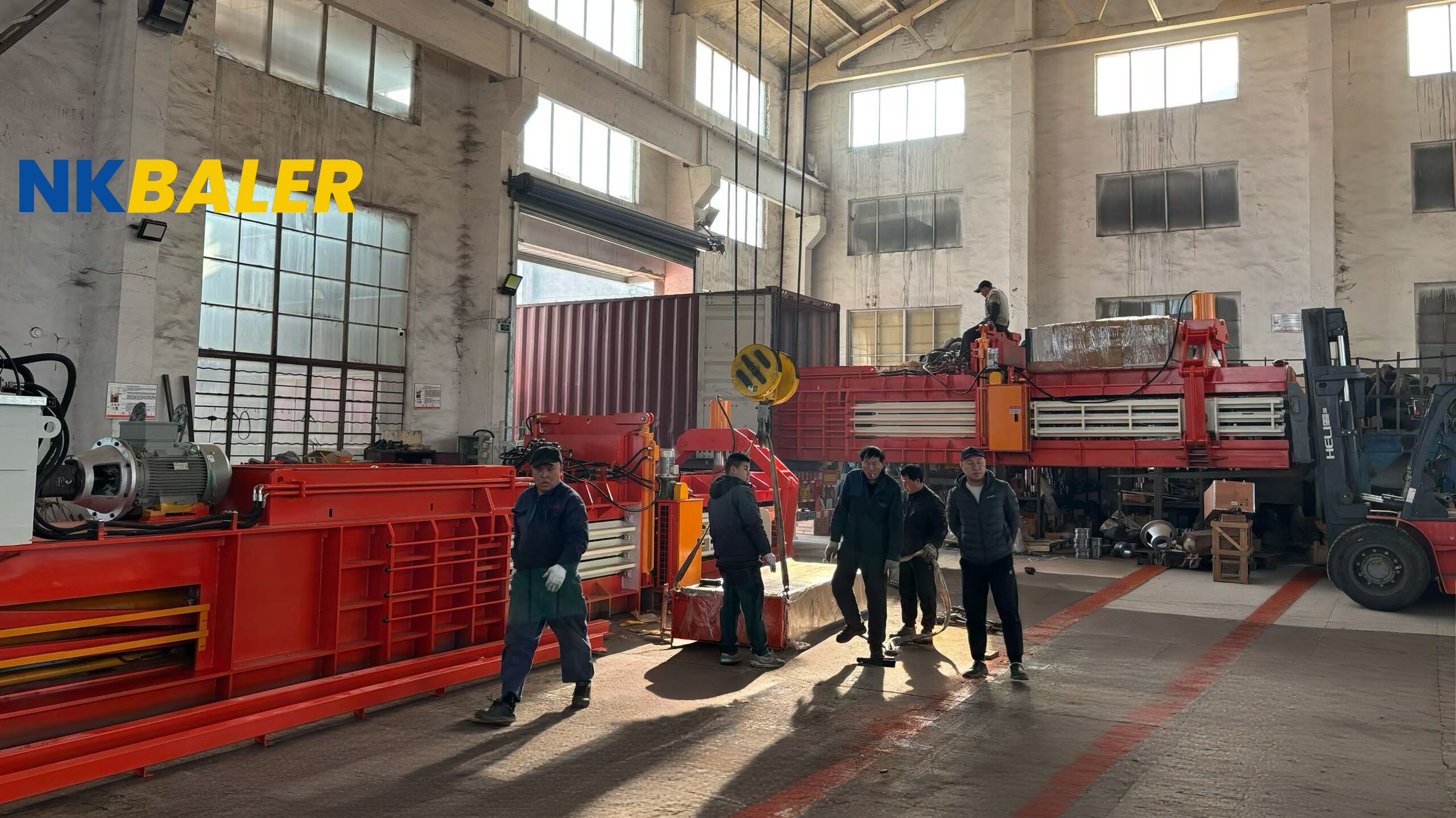
The datasheet includes a 12,000 × 1800 mm conveyor with a 4.5 kW motor and a tare weight of 4,500 kg, plus fan cooling and water cooling with oil cooler. The documented capacity is 2 to 3 tons per hour, the same as the NKW80BD, but obtained with greater hydraulic force and larger bale size.
Step by step: six checks before deciding
- Bring capacity to a common unit. Note what your plant produces per shift and compare that figure with the documented figures: 5–8 bales per hour (NK1070T60) versus 2–3 tons per hour (NKW80BD and NKW125BD). If you do not have the bale weight, ask for it before comparing; without it the two figures are not comparable.
- Measure the floor footprint and clear height. The vertical NK1070T60 occupies 1600 × 1100 mm and is 3200 mm high. The horizontal NKW125BD adds a 12,000 × 1800 mm conveyor; the sum of structure, conveyor, and bale maneuvering area is what really must be budgeted in square meters.
- Define the level of automation your operation can sustain. The NKW80BD is documented as fully automatic and the NKW125BD as semi-automatic. That difference defines how many people the line needs per shift and how much variability the process tolerates.
- Verify the bale size your fiber buyer accepts. The compared formats are 1100 × 700 × (500–900) mm for the vertical and 1100 × 850 × 1700 mm or 1100 × 1250 × 1700 mm for the horizontals. The format conditions stacking, transport, and the final price of the recovered fiber.
- Check electrical power and cooling. The rated powers are 15 kW, 22 kW, and 30 kW, and the NKW125BD adds 4.5 kW for the conveyor. Also review whether cooling is by fan, water, or oil cooler, because it determines the continuous duty regime.
- Review compliance and operating conditions. The documented rated voltage is 380 V / 50 Hz (customizable on the NK1070T60), and in industrial scenarios the machines are described operating in continuous automatic mode with PLC-controlled cycle and 24/7 service. If the destination is the EU, add the Machinery Directive 2006/42/EC file and standards EN ISO 12100 and EN 60204-1.
Use cases: where each configuration fits
- Collection center or small recycler with limited space. The NK1070T60 handles the flow with 2.2 tons of weight and a footprint of 1600 × 1100 mm, making it installable in warehouses where a horizontal line with conveyor does not fit.
- Sorting plant with continuous feed. When material arrives constantly, the NKW80BD allows working at 2–3 tons per hour with fully automatic sorting and less operator dependence.
- Recovered fiber exporter needing uniform, tall bales. The NKW125BD produces bales of 1100 × 1250 × 1700 mm with 125 tons of hydraulic force, a format designed to consolidate outgoing loads.
- 24/7 industrial operation. In compaction and packaging applications, the described scenario includes continuous automatic operation, PLC-controlled cycle, and continuous industrial service, with requirements for low noise, low consumption, and high efficiency.
- Flows other than paper. The same selection logic applies to other materials in the NKBALER portfolio: cardboard boxes (NK60LT), cans and PET bottles (NK1580T200), metal scrap (NKC150), sawdust, and foam. Change the material, change the bale format, not the decision criteria.
Comparison table: NK1070T60 vs NKW80BD vs NKW125BD
| Criterion | NK1070T60 (vertical) | NKW80BD (horizontal, fully automatic) | NKW125BD (horizontal, semi-automatic) |
|---|---|---|---|
| Configuration | Vertical, carbon steel | Horizontal, carbon steel | Horizontal, carbon steel |
| Automation level | Not specified in datasheet | Fully automatic | Semi-automatic |
| Hydraulic force | 60 t | 80 t | 125 t |
| Documented capacity | 5–8 bales/hour | 2–3 t/hour | 2–3 t/hour |
| Working pressure | Not specified in datasheet | 18 MPa | 20 MPa |
| Motor power | 15 kW (20 HP) | 22 kW (30 HP) | 30 kW (40 HP) |
| Bale dimensions | 1100 × 700 × (500–900) mm | 1100 × 850 × 1700 mm | 1100 × 1250 × 1700 mm |
| Feed opening | 1100 × 500 mm | 1200 × 1000 mm | 2000 × 1100 mm |
| Machine dimensions | 1600 × 1100 × 3200 mm | Not specified in datasheet | Structure plus 12,000 × 1800 mm conveyor |
| Net weight | 2.2 t | 14,500 kg | 18,000 kg |
| Conveyor | Not indicated in datasheet | Not indicated in datasheet | 12,000 × 1800 mm, 4.5 kW, 4,500 kg |
| Cooling | Not indicated in datasheet | Fan; oil/water cooler | Fan; water cooling / oil cooler |
| Bale wire | Not indicated in datasheet | 10# × 4 units | 10# × 5 units |
| Documented application | Waste paper recycling | Recycling and waste treatment | Recycling and waste treatment |
Reading the table: the advantage of the vertical is in space and installed power; the advantage of the horizontals is in bale format, hydraulic force, and degree of automation. No column dominates in all three criteria at once.
Frequently asked questions
What regulations must a waste paper baler intended for the European Union comply with?
Industrial balers exported to the EU must comply with the Machinery Directive 2006/42/EC and the harmonized standards EN ISO 12100 and EN 60204-1 (CEN-CENELEC). This requirement applies to the specific model and its technical file, not to the generic category of “baler.” Therefore, it is advisable to request the conformity documentation of the exact model and verify the voltage and intended operating conditions before closing the purchase.
Can a vertical NK1070T60 baler replace a horizontal one?
It depends on the volume and bale format. The NK1070T60 documents 5–8 bales per hour of 1100 × 700 × (500–900) mm, with 60 tons of hydraulic force and 15 kW. The horizontals document 2–3 tons per hour with bales of 1100 × 850 × 1700 mm (NKW80BD) or 1100 × 1250 × 1700 mm (NKW125BD) and forces of 80 t and 125 t respectively. Below the range of the horizontals, the vertical covers the operation with a much smaller space investment; when the flow requires continuous feed and large bales, the difference ceases to be size and becomes machine type.
Which consumes less energy: the vertical or the horizontal?
The documented rated power is 15 kW (20 HP) for the NK1070T60, 22 kW (30 HP) for the NKW80BD, and 30 kW (40 HP) for the NKW125BD, plus 4.5 kW for the conveyor. This rated power is not equivalent to actual measured consumption: consumption depends on cycle time, material, and shift regime. The correct comparison is per ton or per bale processed, not per nameplate power, and for that the intended duty regime must be known.
How to validate the bale format before buying?
The starting point is not the machine but the fiber receiver. Compare the documented formats —1100 × 700 × (500–900) mm on the NK1070T60, 1100 × 850 × 1700 mm on the NKW80BD, and 1100 × 1250 × 1700 mm on the NKW125BD— and confirm which one your buyer or stacking line accepts. Also review the feed opening (1100 × 500 mm, 1200 × 1000 mm, and 2000 × 1100 mm), because it determines how quickly material can be loaded without prior preparation.
What is the next step to choose the right model?
Define three data points before requesting any offer: exact material (mixed paper, corrugated cardboard, waste paper), tons or bales expected per shift, and available square meters with clear height. With these three data points, the conversation with the manufacturer becomes technical rather than commercial. NKBALER (Shaanxi Nick Machinery Equipment Co., Ltd.) handles inquiries at Sales@nkbaler.com and +86 15021631102, also via WhatsApp, and shares the model's technical datasheet so you can compare capacity, floor footprint, and automation yourself.
Conclusion
The choice between a vertical and a horizontal baler for waste paper is not resolved with a size rule, but with three figures compared in the same unit. If volume is low and floor space scarce, the NK1070T60 offers 5–8 bales per hour with 60 tons of force and 15 kW in a 1600 × 1100 mm footprint. If the flow reaches 2–3 tons per hour, the decision shifts to the level of automation: the fully automatic NKW80BD (18 MPa, 22 kW) or the semi-automatic NKW125BD (20 MPa, bales of 1100 × 1250 × 1700 mm), which adds a 12,000 × 1800 mm conveyor and 18,000 kg net weight.
The practical criterion is direct: measure your actual flow, subtract the floor space that the conveyor and bale maneuvering consume, and then decide how much manual intervention the plant can sustain. The three criteria —capacity, space, and automation— will point to the same model when the data is on the table.
Technical inquiries and product datasheet
Shaanxi Nick Machinery Equipment Co., Ltd. — brand NKBALER — manufactures vertical and horizontal hydraulic balers, scrap balers, sawdust balers, foam presses, hydraulic shears, and press bagging machines. 50,000 m² plant, around 600 units per year, and nearly 90% of production exported to North America, South America, and Asia.
Email: Sales@nkbaler.com | Phone and WhatsApp: +86 15021631102
Address: Qunsheng Street, Huishan District, Wuxi City, Jiangsu Province, China | Web: https://nkbaler.com