
Technical guide to hydraulic presses for used paper: pressure, power and cooling
Technical guide to hydraulic balers for waste paper: pressure, power and cooling
In a hydraulic baler for waste paper, the rated pressure, motor power, and cooling system are not chosen separately: they form a single decision set. Pressure defines how tightly the bale comes out; hydraulic power and motor power define cycle speed and hourly throughput; and cooling determines whether those values can be sustained over full shifts or only in intermittent operation. This guide explains how to read the three parameters and how to compare them using concrete data from three models: NKW80BD (18 MPa, 22 kW / 30 HP), NKW125BD (20 MPa, 2–3 t/h, bales of 1100 × 1250 × 1700 mm), and NKW250BD (23 MPa, 10–15 t/h, semi-automatic).
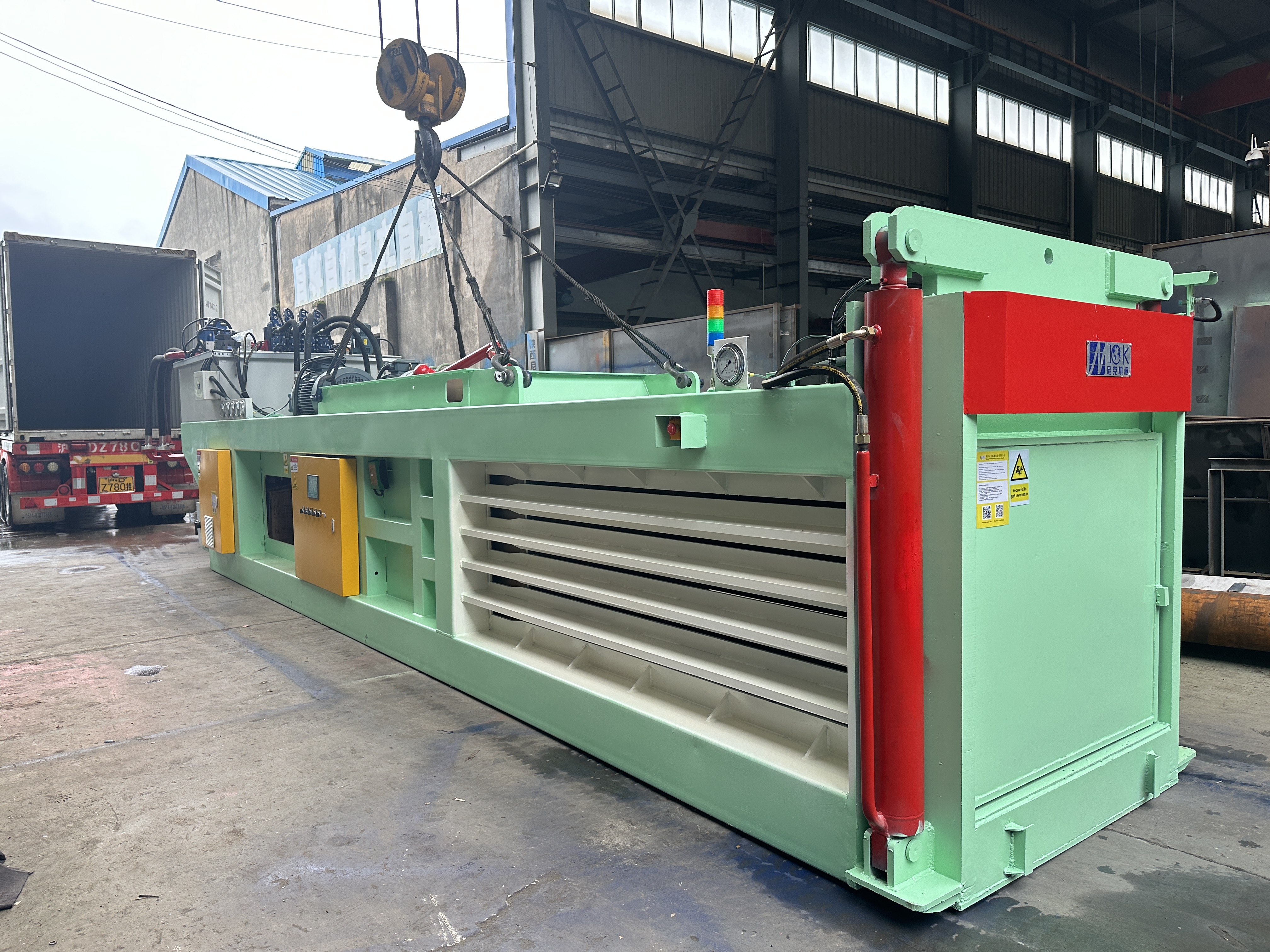
The problem: three numbers that are misread
Most comparisons fail at the same point: specification values are read as if they measured the same thing. They do not. A horizontal baler can show 20 MPa, 22 kW, and 2–3 t/h in the same table, and each answers a different buyer question.
- Rated pressure (MPa): describes the working pressure of the hydraulic circuit. It directly influences the force available on the bale and the final density achievable with materials that recover volume. It does not by itself indicate how many tons per hour the machine processes.
- Motor power (kW / HP): is the installed electrical power of the main motor. It sets electrical consumption and the energy limit available to the circuit, but it does not automatically equate to higher production.
- Hydraulic power: is the power actually delivered to the cylinder. It depends on the combination of working pressure, pump flow, and circuit design.
- Capacity (t/h): is the combined result of all the above, plus cycle time, feeding system, and degree of automation.
- Cooling: determines whether the baler can maintain those values in continuous duty or only during intermittent operation.
Rule of thumb: pressure and power describe the capacity of the hydraulic system; capacity in t/h describes the result. If a specification sheet offers only one of the three, there is not enough basis to compare equipment.
Industry context: why technical detail matters more now
The global market for hydraulic waste paper balers was valued at USD 1.45 billion in 2024 and is projected to reach USD 2.24 billion by 2032, according to the estimate reported by Data Insights Reports. That growth is not evenly distributed: in Latin America, Mexico and Brazil lead paper packaging production, with growing investments in innovation, lightweight materials, and circular economy initiatives (Packaging Insights).
The practical effect for a buyer is direct. When the volume of recovered paper and cardboard grows, the bottleneck stops being collection and becomes bale density and pressing continuity. A poorly compacted bale raises transport cost per ton. A baler that stops due to temperature raises cost per hour worked.
In classification terms, industrial machinery manufacturing—where hydraulic balers fall—corresponds to NAICS subsector 333, which groups establishments dedicated to manufacturing industrial machinery; NAICS is the standard used by U.S. federal statistical agencies to classify establishments (U.S. Census Bureau). Complementarily, hydraulic presses are described as equipment widely used in industrial applications for metal forming, assembly, molding, and material compaction (IQS Directory). Waste compaction is precisely one of those applications.
Rated pressure: what changes between 18, 20, and 23 MPa
Rated pressure is expressed in megapascals (MPa) and describes the working pressure of the hydraulic circuit. As a physical principle, the higher the rated pressure in the same cylinder, the greater the force available on the bale and the higher the density achievable in materials that tend to recover volume.
The three reference models cover a range of 18 to 23 MPa:
- NKW80BD — 18 MPa. The lowest level in the documented range, paired with a 22 kW (30 HP) motor.
- NKW125BD — 20 MPa. Intermediate pressure level, with a stated capacity of 2–3 t/h and a bale size of 1100 × 1250 × 1700 mm.
- NKW250BD — 23 MPa. The highest level in the documented range, with 10–15 t/h capacity and semi-automatic operation.
Pressure, however, does not decide alone. A light and homogeneous material can reach acceptable density at 18 MPa, while a mix with rigid cardboard, coated paper, or contaminants may require the upper end of the range to reach the same bale density. The right question is not “Which one has more MPa?” but “What density do I need for my bale to be profitable in transport?”
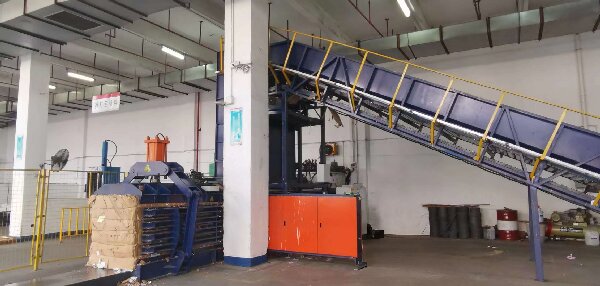
Hydraulic power and motor power are not the same
The electric motor is the energy source; hydraulic power is what the circuit delivers to the cylinder. The relationship between the two depends on pump flow, working pressure, and system losses. That is why the same 22 kW (30 HP) motor, as in the NKW80BD, can sustain different cycles depending on how the hydraulic circuit is configured.
For the buyer, this translates into three concrete checks before deciding:
- The installed motor power and its compatibility with the plant’s electrical installation.
- The stated throughput in t/h, which is the real result of the motor–pump–cylinder–cycle combination.
- The intended duty cycle, because a larger motor does not guarantee more production if working pressure or cycle time do not keep up.
Capacity: 2–3 t/h versus 10–15 t/h
Capacity is the parameter that translates engineering into daily operation. An NKW125BD, at 2–3 t/h, and an NKW250BD, at 10–15 t/h, do not compete in the same league: they respond to different intake volumes. The most useful way to read it is to convert it into shifts: how many tons per day you need to process and how many hours of actual operation you have available.
Bale size and logistics
The NKW125BD produces bales of 1100 × 1250 × 1700 mm. That data point is not secondary: bale size and density condition yard stacking, internal handling, and transport. A bale with stable dimensions and uniform density makes it possible to plan loads and reduce freight per ton, which is where a baler pays for itself.
Cooling system: cooling fan and oil/water cooler
Each pressing cycle converts energy into heat inside the hydraulic circuit. That heat accumulates in the oil and, if it is not dissipated, degrades viscosity, accelerates seal wear, and forces you to reduce the operating pace or stop the machine. In waste paper, where feeding can be almost continuous during a shift, cooling stops being an accessory and becomes an effective capacity parameter.
The cooling system available in this family of balers includes cooling fan and oil/water cooler; depending on the configuration, water cooling or oil cooler may be used. The choice depends on three working conditions:
- Duty cycle: continuous shifts or long periods of sustained cycling require greater dissipation capacity than intermittent operation of a few hours per day.
- Ambient conditions of the facility: a hot, poorly ventilated enclosure reduces the performance of any heat exchanger.
- Water availability at the plant: when there is a stable supply, water cooling is a direct option; when there is not, the oil cooler or the combination with a cooling fan avoids depending on that installation.
Excessive overheating is a risk identified in the operation of these machines, and its control is addressed with thermal protection via temperature sensors. For the buyer, this means the relevant question is not only “Does it have a cooler?” but “What thermal protection does it have, and what is measured?”
Have Questions or Need More Details?
Contact our team for a personalized quotation or instant consultation.
Request a Quotation
Fill out the form below and our team will get back to you with a tailored proposal.
WhatsApp Direct Chat
Prefer to chat in real-time? Message us on WhatsApp for instant assistance & quick answers.
- Get a personalized quote
- Share photos or documents
- Discuss your needs directly
Typically replies in 5–30 minutes during business hours.