
Hydraulic press for used paper: what it is, how it works and what to consider before buying
Hydraulic press for waste paper: what it is, how it works and what to consider before buying
A hydraulic press for waste paper is a machine that compacts recyclable paper and cardboard into dense bales using a hydraulic cylinder, to reduce volume, facilitate storage and improve the commercial value of the material. It is the central equipment of collection centers and recycling plants that work with waste paper (OCC, newspaper, office paper, mixed paper). Choosing the right model depends not only on hydraulic force, but on the volume of material entering per hour, available space, and the level of automation the operation can sustain.
The problem: waste paper takes up space and loses value if not compacted
Waste paper is a bulky, low-density material if handled loose. A warehouse without compaction fills up quickly, transportation costs rise, and the material is exposed to moisture and contamination. In recycling operations, the difference between compacted and loose material is noticeable in logistics and in negotiation with the paper mill.
The main function of the press is to compact paper into bales of homogeneous density, with regular dimensions that allow efficient stacking, loading, and transportation. Additionally, compacted paper improves the weight-to-volume ratio, reducing the number of trips needed to move the same tonnage.
Industry context: the global baling machine market continues to grow
The global baler market reached USD 6.40 billion in 2024, with agricultural and industrial applications as the main drivers, according to Grand View Research. Within this universe, the waste baler market reached USD 1.45 billion in 2024, focused on paper, plastic, and solid waste recycling, according to Mordor Intelligence. Asia Pacific dominated the global hydraulic market with a revenue share of over 34% in 2024, led primarily by China.
This context explains why more and more recyclers—from small collection centers to large transfer stations—incorporate a hydraulic press for waste paper as part of their standard workflow.
What is a hydraulic press for waste paper?
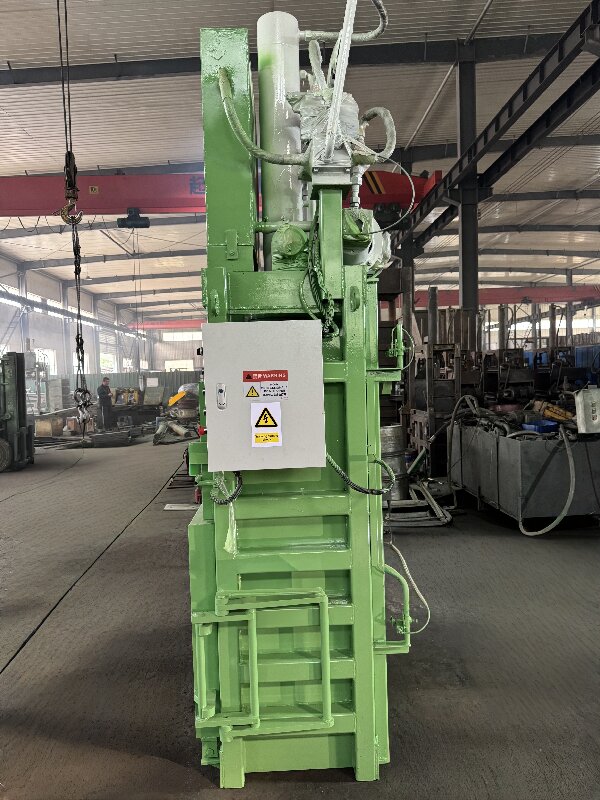
A hydraulic press for waste paper uses a hydraulic cylinder to compress the material inside a compaction chamber. The resulting bale is tied with wire (or straps) and extracted for storage or transport. Depending on the orientation of the chamber, they are divided into two main families: vertical and horizontal.
Vertical presses
Vertical presses compact material from top to bottom and are common in small and medium-sized collection centers. For example, the NK1070T60 is a vertical waste paper baler made of carbon steel, with a capacity of 5 to 8 bales per hour and hydraulic force of 60 tons. The bale dimensions are 1100 x 700 x (500-900) mm, and the net machine weight is 2.2 tons.
The NK60LT is another vertical model frequently used for cardboard boxes: hydraulic force of 60 tons, capacity of 10 to 12 bales per hour, bale weight of 150 to 200 kg, feed opening of 1000 x 460 mm, and cross strapping method with 4 pieces front to back and 2 pieces left to right.
These machines are suitable when daily volume is moderate and space is limited, as they require less floor area than a horizontal line with a conveyor belt.
Semi-automatic horizontal presses
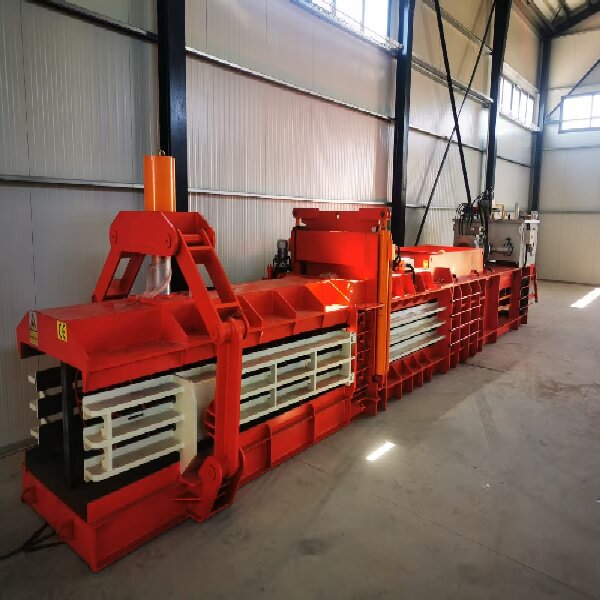
Horizontal presses compact material laterally, with the chamber in a horizontal position. They are usually integrated with a conveyor belt and allow continuous feeding with semi-automatic operation. They are the most common option in plants processing several tons per day.
- NK6040T10: capacity of 6 to 8 bales per hour, bale weight of 50 to 80 kg, working pressure of 10 MPa, power of 2.2 kW (3 HP), voltage of 220 V/50 Hz, and net weight of 600 kg. Designed for food, pharmaceutical, packaging, chemical, electronics, metal, waste treatment, and recycling industries.
- NKW125BD: working pressure of 20 MPa, feed opening of 2000 x 1100 mm, bale of 1100 x 1250 x 1700 mm, and net weight of 18,000 kg. Made of carbon steel.
- NKW180BD: capacity of 6 to 8 tons/hour, motor power of 45 kW (60 HP), hydraulic force of 180 tons, feed opening of 2400 x 1100 mm, and net weight of 24,000 kg. Includes a steel chain conveyor with a 5.5 kW motor.
- NKW250BD: capacity of 10 to 15 tons/hour, working pressure of 23 MPa, hydraulic force of 250 tons, bale of 1100 x 1250 x 1700 mm, net weight of 30,000 kg, water cooling system and oil cooler.
Fully automatic horizontal presses
When the material flow exceeds a certain scale, automation avoids bottlenecks and reduces manual intervention. The fully automatic models of the NKW series incorporate PLC control, automatic tying, and cooling systems for continuous operation.
| Model | Capacity | Bale density | Cylinder force | Structure weight |
|---|---|---|---|---|
| NKW80Q | 3-5 t/h | 300-400 kg/m³ | 80 t | 15 t |
| NKW100QT | 4-6 t/h | 400-500 kg/m³ | 100 t | 20 t |
| NKW125Q | 10-12 t/h | 500-600 kg/m³ | 125 t | 22 t |
| NKW160QT | 12-15 t/h | 500-600 kg/m³ | 160 t | 28 t |
| NKW180QT | 12-15 t/h | 500-600 kg/m³ | 180 t | 28 t |
| NKW200Q | 12-15 t/h | 650-700 kg/m³ | 200 t | 34 t |
For example, the NKW180QT is fully automatic, made of carbon steel, with approximate main dimensions of 13 × 4.3 × 5.8 m, weight of 28 tons, main cylinder force of 180 tons, and working pressure of 30.5 MPa.
How a hydraulic press for waste paper works
The working principle is relatively simple, although the engineering of the equipment is complex. The material is introduced through the feed opening, the hydraulic cylinder exerts pressure against the material, the bale is formed, tying is done automatically or manually with wire, and the bale is expelled from the opposite end or through the front door.
In semi-automatic horizontal presses, the operator controls the cycle, and tying is done manually or semi-automatically. In fully automatic presses, the cycle is controlled by PLC, can operate continuously, and supports 24/7 industrial service.
Step-by-step to select a hydraulic press for waste paper
- Calculate daily paper volume: if you process less than 2-3 tons per day, a vertical press like the NK1070T60 may be sufficient. If you exceed 5 tons per day, a semi-automatic or automatic horizontal press reduces cost per ton.
- Define target bale density: For export or sale to large mills, bale density influences price. The automatic NKW models offer densities from 300 to 700 kg/m³ depending on the model.
- Confirm bale dimensions: Bales must fit in trucks, containers, or platforms. For example, the NK1070T60 produces bales of 1100 x 700 x (500-900) mm; the NKW250BD produces bales of 1100 x 1250 x 1700 mm.
- Verify available plant voltage: Models can be customized to 380 V/50 Hz; the NK6040T10 operates at 220 V/50 Hz. Confirming voltage avoids unexpected transformation costs.
- Assess space and civil works: A 34-ton machine like the NKW200Q requires a reinforced foundation and space for the conveyor belt. A 2.2-ton vertical press can be installed in a standard shed.
- Consider auxiliary equipment: conveyor belt, feed line, steel wire, and woven bag are part of the complete system. The NKW horizontal presses include a conveyor and cooling systems.
Typical use cases
Cardboard and paper collection center
A collection center that receives cardboard boxes, newspaper, and office paper from nearby businesses needs a 60-ton vertical press, such as the NK60LT or NK1070T60, to produce bales of 150-200 kg or 50-80 kg depending on the material. The initial investment is lower, and operation can be manual.
Municipal solid waste recycling plant
In municipal solid waste sorting plants, paper and cardboard arrive mixed with other materials. A semi-automatic horizontal press like the NKW125BD or NKW180BD allows processing 5-8 tons per hour with conveyor belt feeding.
High-capacity industrial operation
Plants that generate or receive more than 10 tons of paper and cardboard daily need fully automatic lines like the NKW200Q, with bale density of 650-700 kg/m³ and capacity of 12 to 15 tons per hour, to maintain production pace without constant intervention.
Related types of balers you should know
The same hydraulic principle applies to other materials. Although the focus of this guide is waste paper, it is useful to know the variants from the same manufacturer:
- Plastic bottle (PET) baler: The NK1580T200 is a vertical model for cans/PET bottles, with hydraulic force of 200 tons, capacity of 3-6 bales/hour, bale weight of 1000-2000 kg, and automatic door opening.
- Cardboard balers: The NK60LT is a 60-ton vertical press designed for cardboard boxes.
- Metal scrap balers: The NKC150 is a vertical metal baler with cutting width of 1500 mm and cutting stroke of 1000 mm.
- Sawdust/wood chip baler machine: The manufacturer produces vertical and bagging machines for biomass materials.
- Municipal solid waste baler: The semi-automatic and automatic horizontal NKW series also apply to mixed waste.
- Wiping rags and textiles balers: The NK-T90L is a vertical model for textiles/clothing, with power of 90 tons.
- Rice husk and straw baler: The NKB280 and NKB280-1 models are vertical balers for straw/hay with chain conveyor feeding.
- Rice husk bagging machine: The NKB10, NKB20, and NKB220 models are constant-weight bagging machines.
Comparison: vertical vs. horizontal press for waste paper
| Criterion | Vertical | Semi-automatic horizontal | Automatic horizontal |
|---|---|---|---|
| Typical capacity | 5-12 bales/hour | 5-15 t/h | 3-15 t/h depending on model |
| Space required | Smaller (e.g., 1600 x 1100 x 3200 mm) | Larger (includes conveyor) | Larger (structure of 11-13 m + conveyor) |
| Automation level | Manual cycle | Semi-automatic cycle | PLC cycle, automatic tying |
| NKBALER example | NK1070T60 | NKW125BD / NKW180BD | NKW80Q / NKW200Q |
| Typical investment | Lower | Medium | Higher |
What to demand from a hydraulic press manufacturer
Choosing a supplier is as important as choosing the model. A manufacturer with experience in the field can anticipate installation problems, settle the correct voltage, and offer after-sales support.
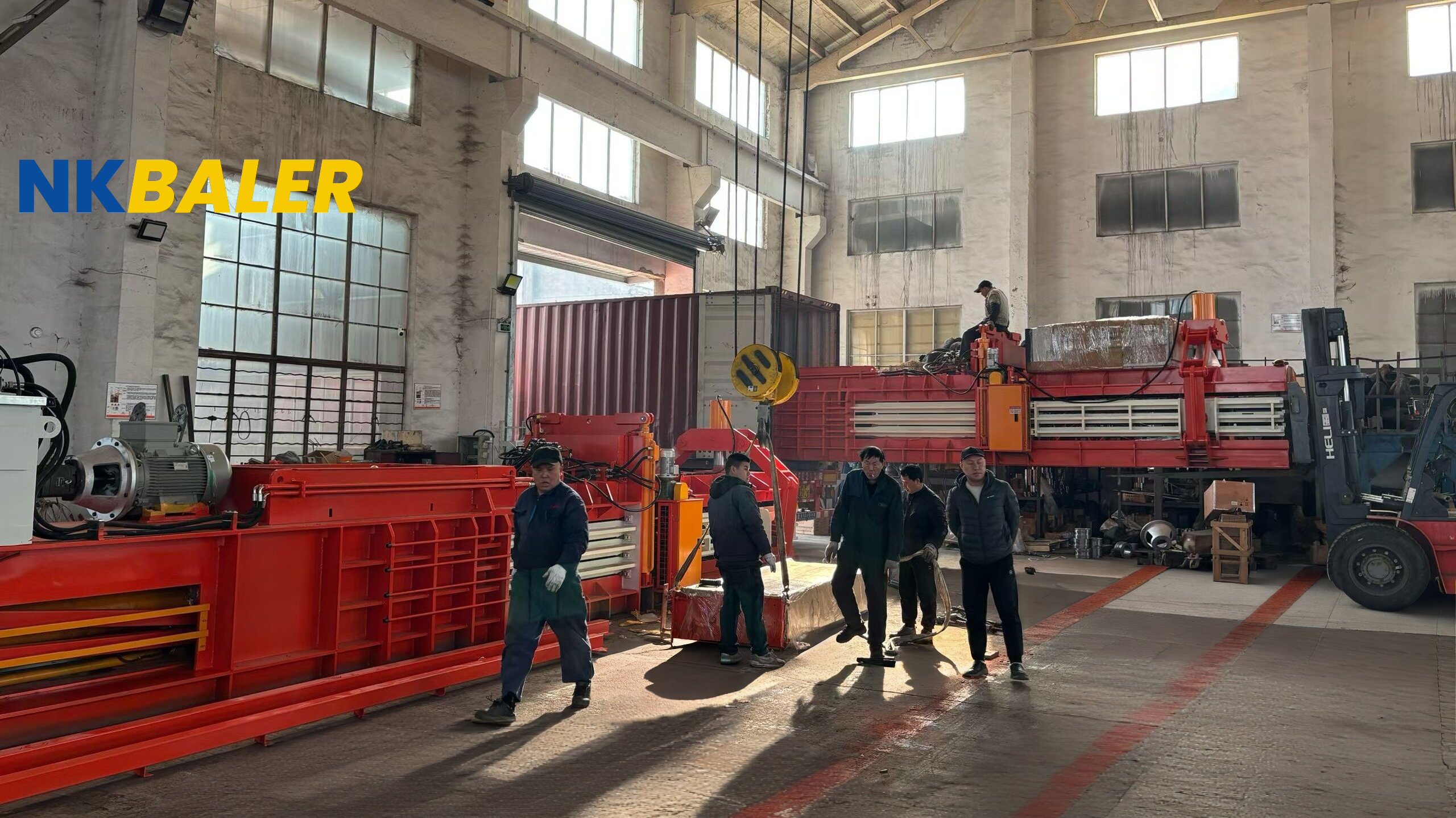
- Verifiable experience: Shaanxi Nick Machinery Equipment Co., Ltd. (NKBALER) was established in 2013, has a 50,000 m² factory, approximately 50 employees, and an R&D team of 15 engineers. It produces around 600 units per year.
- Export orientation: Approximately 90% of NKBALER's products are exported to markets in North America, South America, and Asia, which implies experience in export packaging and documentation.
- Product range: A manufacturer with vertical, semi-automatic horizontal, and automatic lines can support the growth of the operation with the same quality standard.
- Materials and construction: NKBALER balers are made of carbon steel, with structures ranging from 600 kg (NK6040T10) to 34 tons (NKW200Q).
Frequently asked questions
How much waste paper do I need to process to justify a vertical press?
If the operation generates or receives less than 2 to 3 tons of paper and cardboard per day, a vertical press like the NK1070T60 (5-8 bales/hour, 60 tons of hydraulic force) is usually sufficient. It is a reasonable starting point for collection centers and businesses that want to reduce volume before selling the material. The investment in a horizontal press is justified when daily volume grows beyond that figure.
What voltage do I need for a hydraulic press for waste paper?
Most NKBALER models use 380 V/50 Hz and can be customized to the destination voltage. The NK1070T60, for example, has a nominal voltage of 380 V/50 Hz. A special case is the NK6040T10, which operates at 220 V/50 Hz. Before buying, you must confirm the actual voltage of your plant and request the corresponding configuration from the manufacturer.
What maintenance does a hydraulic baler require?
Basic maintenance includes checking the level and quality of hydraulic oil, inspecting hoses and cylinders, cleaning sensors, and verifying the electrical system. In high-capacity horizontal models like the NKW series, the cooling system (water or oil cooler) must be checked periodically to avoid overheating in continuous operation. The manufacturer's manual and technical support define the exact intervals.
Can I request a sample or trial of the machine before buying?
Buyers can contact the manufacturer directly to request a quote, detailed technical specifications, and project references. NKBALER handles inquiries through Sales@nkbaler.com and WhatsApp (+86 15021631102). For integration or distribution volumes, it is possible to arrange factory visits or technical meetings to validate the configuration before ordering. Information about the complete line of balers and auxiliary equipment can also be requested.
What is the typical delivery time for a hydraulic press for waste paper?
The delivery time depends on the model, voltage customization, and the manufacturer's production load. As a reference, NKBALER produces approximately 600 units per year in a 50,000 m² factory. Standard high-turnover models usually have shorter lead times, while large fully automatic configurations require production scheduling. Request the confirmed deadline in writing at the time of quotation.
Conclusion
The hydraulic press for waste paper is the practical solution to turn a bulky waste into a compact commercial product. The right decision combines three variables: material volume, available space, and level of automation. A 60-ton vertical press, a 125-250 ton semi-automatic horizontal, or an automatic NKW line can all be equally correct, depending on the stage of the operation.
For those in the research stage, the next step is to compare actual specifications, request a quote with voltage and site dimensions, and validate the manufacturer's support.
Are you evaluating a press for your recycling center?
Contact NKBALER to receive technical specifications, a quote, and guidance on the right model for your waste paper volume.
Email: Sales@nkbaler.com | Tel: +86 15021631102
This article was updated on August 26, 2026, with market data available as of that date.
Have Questions or Need More Details?
Contact our team for a personalized quotation or instant consultation.
Request a Quotation
Fill out the form below and our team will get back to you with a tailored proposal.
WhatsApp Direct Chat
Prefer to chat in real-time? Message us on WhatsApp for instant assistance & quick answers.
- Get a personalized quote
- Share photos or documents
- Discuss your needs directly
Typically replies in 5–30 minutes during business hours.