
Hydraulic press for used paper: solution according to volume, material and space
Hydraulic Press for Waste Paper: Solution Based on Volume, Material, and Space
Choosing a hydraulic press for waste paper cannot be reduced to a catalog image. The correct machine depends on three project variables: the volume of paper the operation must process, the type of material arriving at the plant, and the physical space available. With these three data points, the solution leans toward a vertical baler, a semi-automatic horizontal baler, or fully automatic equipment.
This guide is aimed at recycling plant managers, waste managers, and buyers who are in the research or evaluation phase of equipment. The goal is to translate real operating conditions into a concrete technical specification. The recommendations are based on real models from NKBALER —Shaanxi Nick Machinery Equipment Co., Ltd.—, a manufacturer based in Wuxi, China, which exports approximately 90% of its production to North America, South America, and Asia.
A hydraulic press for waste paper transforms bulky material with low value per unit volume into a dense, transportable, and marketable bale. In practice, bale density and operating cost depend more on the correct configuration than on the brand or the nominal force. Therefore, it is advisable to review the selection with a method, not with intuition.
Why Hydraulic Press Selection for Waste Paper Often Fails
The most frequent mistake is choosing the machine before defining the operation. Oversized equipment increases initial investment, occupies unnecessary space, and consumes more energy than required. Undersized equipment, on the other hand, limits daily processing, creates bottlenecks, and forces overtime work or rejection of material during peak reception.
Another common error is comparing only hydraulic force in tons. The actual capacity of a baler depends on the combination of force, chamber dimensions, cycle time, and achievable material density. Two machines with the same force can offer very different results depending on the type of paper, moisture level, and equipment configuration.
The operating environment should also not be underestimated. An installation in an unheated warehouse with high temperatures requires an adequate hydraulic system and properly sized cooling. The operational result depends as much on the machine as on its adaptation to the work scenario.
Integration with the plant's existing flow is also overlooked. A baler that does not connect properly with the storage area, sorting line, or loading dock generates unnecessary material movements. The technical solution must consider the complete flow, not just the isolated machine.
Market Context for Balers and Paper Recycling
The global baler market reached an estimated value of USD 6.40 billion in 2024, according to Grand View Research, with agricultural and industrial applications as main drivers. Within this segment, the specific waste baler market was valued at USD 1.45 billion in 2024, according to Mordor Intelligence, with paper, plastic, and solid waste recycling as central focuses.
Asia Pacific concentrated more than 34% of global hydraulic market revenue in 2024, led by China. This position helps explain why Chinese recycling machinery manufacturers have expanded their export presence. NKBALER —trade name of Shaanxi Nick Machinery Equipment Co., Ltd.— is one such manufacturer: founded in 2013, it has a 50,000 m² plant, 50 employees, and a team of 15 engineers dedicated to R&D, with an annual production capacity of 600 units.
The company produces vertical balers, semi-automatic and fully automatic horizontal balers, as well as bagging equipment, hydraulic shears, and machines for applications such as scrap metal, wood, rice husk, hay, and municipal solid waste. This breadth of lines allows selecting a hydraulic press for waste paper within a complete portfolio, rather than forcing a single technology for all projects.
In paper recycling, transport economics favor those who achieve denser bales: a truck can carry more tons if the volume is better utilized. This is why high-capacity horizontal balers gain ground in plants that previously used several verticals in parallel.
Solution by Scenario: Which Hydraulic Press for Waste Paper Does Each Project Need?
The answer to the question "What machine do I need?" is organized into three typical operating scenarios.
Scenario 1: Collection center or recycler with less than 3 tons per day
For low volumes, a vertical baler is the most efficient alternative in investment and space. The NKBALER NK1070T60 is a representative model of this category. It offers 60 tons of hydraulic force, produces bales of 1100 × 700 × (500-900) mm, and achieves 5-8 bales per hour. The machine occupies a footprint of 1600 × 1100 mm and weighs 2.2 tons, allowing installation in warehouses with limited space. Its installed power is 15 kW/20 HP and it operates on 380 V/50 Hz, with customizable voltage.
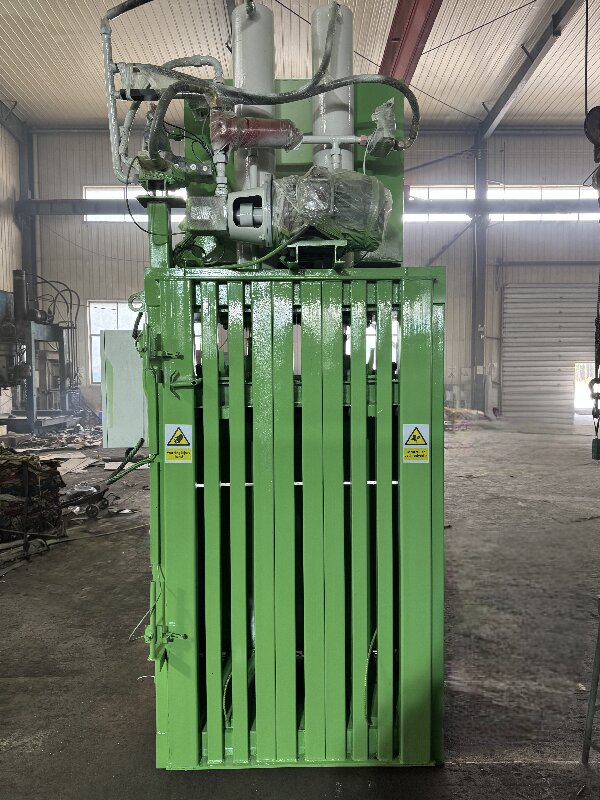
Feeding is manual or with a low-capacity conveyor. To form the bale, steel wire is used as strapping and woven bag as protection. An installation of this type requires little auxiliary equipment and can be operated by a single person.
Scenario 2: Recycling plant processing 3 to 8 tons per day
In this range, the horizontal baler begins to be more suitable than the vertical, because it allows continuous feeding with a conveyor and produces bales of higher density. The NKW80BD has 80 tons of force, produces bales of 1100 × 850 × 1700 mm, and processes between 2 and 3 tons per hour. The NKW80Q, also with 80 tons, reaches 3-5 tons per hour with a material density between 300 and 400 kg/m³.
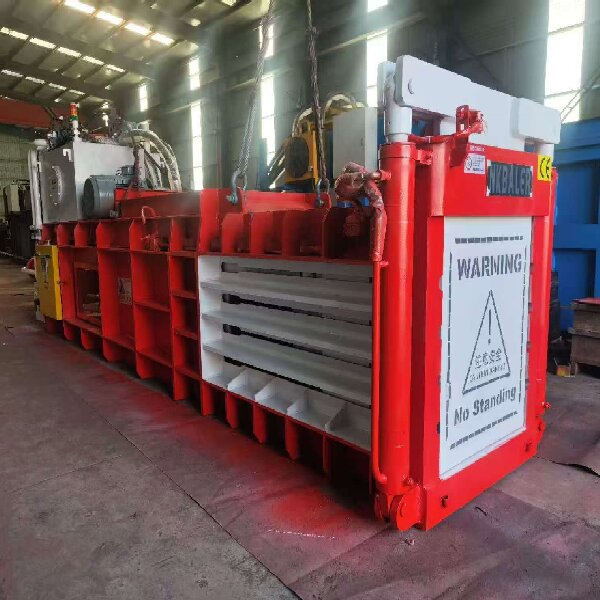
These models are offered in semi-automatic and fully automatic versions. The semi-automatic version requires an operator for strapping and bale extraction. The automatic version integrates a PLC-controlled cycle, designed for continuous operation and extended shifts.
Scenario 3: Large recycler or waste manager with more than 10 tons per day
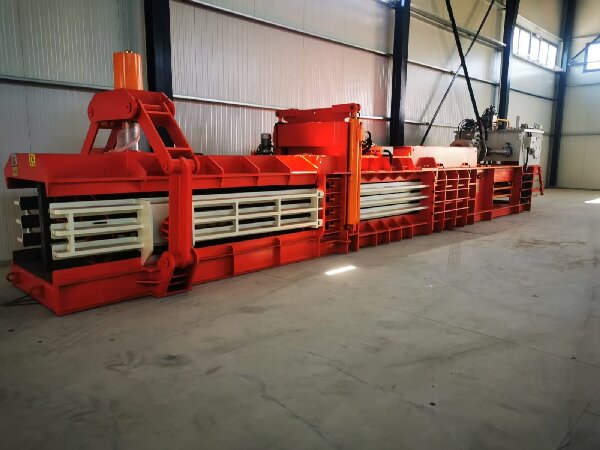
At this level, automation is not an option but a condition for maintaining competitive cost per ton. The NKW125Q produces bales of 1100 × 1100 × ~1600 mm with a density of 500-600 kg/m³ and processes between 10 and 12 tons per hour. The NKW160Q, with 160 tons of force, reaches 12-15 tons per hour and produces bales of 1100 × 1250 × ~1600 mm. For operations seeking maximum load density, the NKW200Q produces bales of 1100 × 1100 × ~1800 mm with a density of 650-700 kg/m³.
These machines require a main structure approximately 11 meters long and a conveyor belt that can exceed 12 meters. In this scenario, it is necessary to prioritize low noise design, low energy consumption, and high efficiency. High-temperature environments also require water cooling systems or oil coolers, as well as additional motors for the cooling tower in the higher capacity models.
The operating cycle in these machines is PLC-controlled, allowing adjustment of compression times, wire quantity, and bale ejection without manual intervention. This reduces process variability and protects operational continuity when the plant works in consecutive shifts.
In all scenarios, installation requires support equipment such as a conveyor line, steel wire, and woven bag. These three elements are part of the complete system and should be included in the project budget.
Step-by-Step Process to Adapt the Machine to Your Project
To determine which hydraulic press for waste paper your project needs, the following process organizes operation data before contacting a supplier.
- Calculate the real material volume. Record the amount of paper received for at least two weeks. If an 8-hour operation processes 8 tons daily, you need a minimum effective capacity of 1 ton per hour. Add a 20-30% margin to absorb reception peaks.
- Classify the type of paper. Newsprint, magazines, cardboard, and mixed paper have different compaction densities. Corrugated cardboard tends to recover volume if the force is insufficient. Paper with high moisture or plastic contamination reduces the final bale density and may require a machine with greater force.
- Measure available space. A vertical like the NK1070T60 occupies approximately 1.6 × 1.1 meters of footprint and 3.2 meters in height. A fully automatic horizontal like the NKW160Q occupies around 11 × 2.3 meters for the main structure, plus the space of the 2000 × 14000 mm conveyor belt and the bale extraction area.
- Define the automation level. If labor is scarce or expensive, automation reduces operating cost per ton. If the project is initial and capital limited, a semi-automatic allows starting with lower investment and scaling later. Some plants opt for a vertical at the start and migrate to a horizontal when volume consolidates.
- Select hydraulic force and system pressure. For waste paper, 60 tons are sufficient for small operations; 80-160 tons cover medium and large plants; more than 200 tons are justified in operations seeking maximum density to reduce logistics costs. Working pressure in NKBALER horizontal models typically varies between 18 and 30.5 MPa.
- Plan auxiliary equipment. Conveyor line, steel wire, and woven bag are part of the complete system. Verify voltage compatibility with the local grid and adequate cooling system for ambient temperature.
- Evaluate the manufacturer's capability. Confirm if they offer OEM/ODM manufacturing, customization of technical parameters, voltage, logo, block size and color, and if they perform quality tests before shipping.
Application Cases and Evidence of Scenario Adaptation
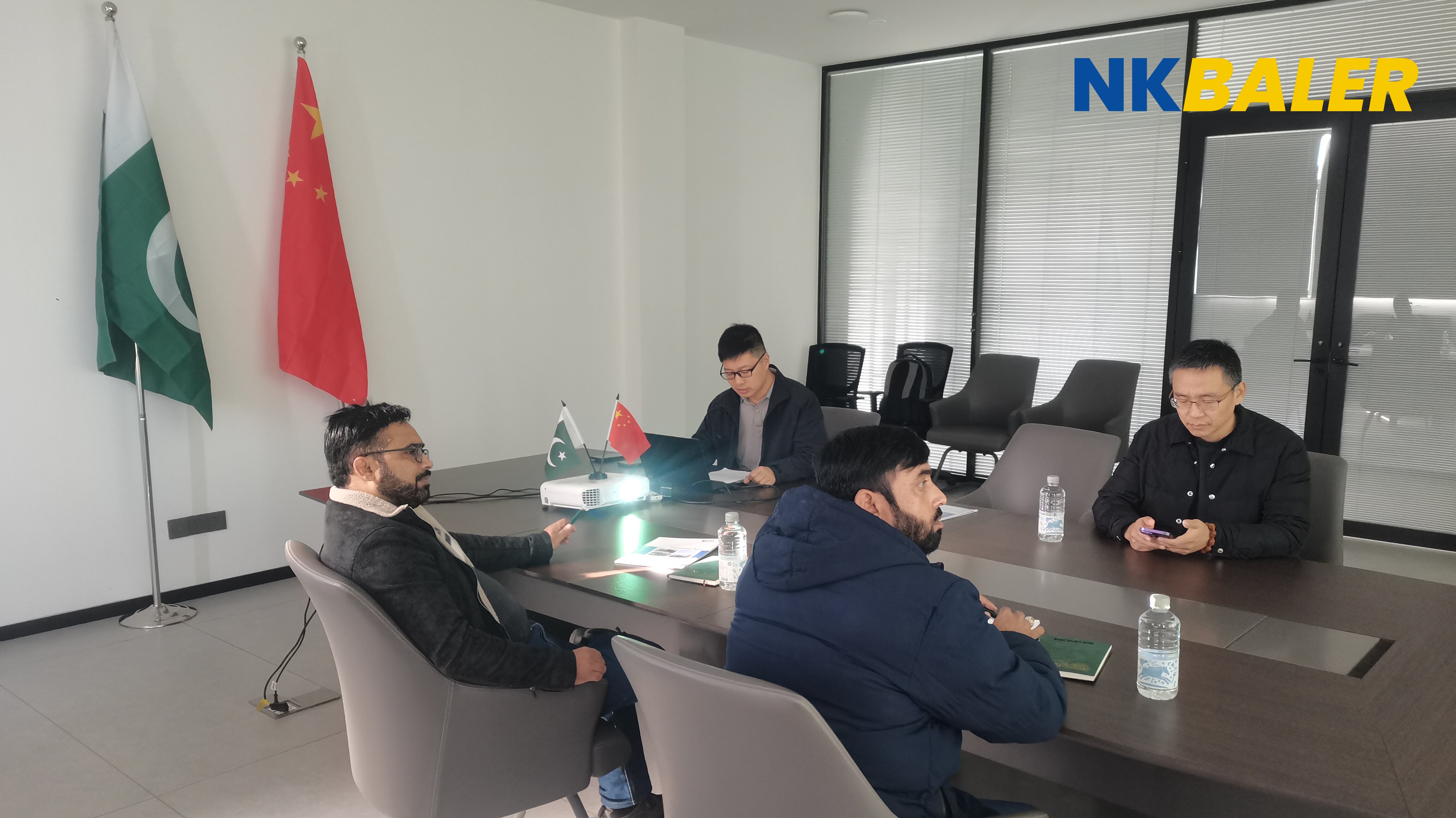
NKBALER's documented experience includes projects where scenario adaptation was decisive for the outcome.
In Indonesia, a recycling station manufacturer purchased a baler for plastic waste and paper waste. According to the manufacturer's record, the equipment has been operating for 10 to 15 years with stable performance. The most valued aspects are low noise and low energy consumption, critical features when the machine operates in urban or residential areas.
In Romania, a farm installed a fully automatic alfalfa hydraulic baler. The project required on-site customization for high temperature and fluctuating humidity conditions. After commissioning, bale density increased to over 400 kg/m³ and transport costs reduced by approximately 30%. Although the material is agricultural, the case demonstrates how NKBALER adjusts compaction parameters to environmental conditions.
In Pakistan, an agricultural manufacturer uses another baler for straw and alfalfa, also with a history of 10-15 years of stable operation.
The lesson from these projects is that the supplier not only delivers a machine but a system adapted to local conditions of temperature, humidity, material type, and operating capacity. That adaptability should be part of the manufacturer's evaluation criteria.
Comparison: Vertical vs Horizontal Baler for Waste Paper
The following table compares a representative model from each category to facilitate the initial decision.
| Criterion | Vertical NK1070T60 | Semi-automatic Horizontal NKW180BD | Automatic Horizontal NKW160Q |
|---|---|---|---|
| Hydraulic force | 60 tons | 180 tons | 160 tons |
| Production capacity | 5-8 bales/hour | 6-8 tons/hour | 12-15 tons/hour |
| Bale dimensions | 1100 × 700 × (500-900) mm | 1100 × 1150 × 1800 mm | 1100 × 1250 × ~1600 mm |
| Installed power | 15 kW / 20 HP | 45 kW / 60 HP | 45 kW + 11 kW |
| Machine weight | 2.2 tons | 24 tons | 28 tons |
| Footprint / space | 1.6 × 1.1 m | With conveyor 14000 × 2000 mm | Structure ~11 × 2.3 m |
| Automation level | Manual | Semi-automatic | Fully automatic |
| Recommended application | Collection center | Medium-sized plant | Large recycler |
Frequently Asked Questions
What certifications must a hydraulic press for waste paper exported to the European Union comply with?
Equipment exported to the EU must comply with the Machinery Directive 2006/42/EC and the harmonized safety standards EN ISO 12100 and EN 60204-1. These standards cover risk assessment, safe design, and requirements for machinery electrical systems. An exporting manufacturer must be able to document compliance with these requirements and maintain a quality assurance system.
How do I know what production capacity my paper recycling plant needs?
Divide the daily paper tonnage by the operating hours. For example, 8 tons in 8 hours requires 1 ton per hour of effective capacity, plus a margin of 20-30%. A vertical baler like the NK1070T60 produces 5-8 bales per hour. At the intermediate level, the NKW80Q processes 3-5 tons per hour. For large volumes, the NKW125Q reaches 10-12 tons per hour and the NKW160Q between 12 and 15 tons per hour.
Is it worth investing in an automatic horizontal baler instead of a vertical one?
It depends on the sustained volume and labor cost. A vertical has lower initial investment and is sufficient for less than 3 tons per day. An automatic horizontal increases investment, but reduces manual intervention per ton, improves bale density, and lowers transport costs. In operations of more than 8 tons per day, the automatic horizontal usually presents a lower total cost per ton processed.
How can I verify that the machine will work correctly before paying?
NKBALER applies 100% testing to each machine before delivery. Additionally, in OEM/ODM projects, technical parameters, voltage, logo, block size, and color can be customized. The manufacturer offers after-sales remote support, allowing technical assistance during installation and commissioning.
What is the delivery time for a custom hydraulic press for waste paper?
For custom orders, the standard lead time is 30 to 45 days, with a minimum order of 1 unit and a monthly manufacturing capacity of up to 10 units. The lead time includes customization, 100% testing, and export preparation. To get an equipment recommendation based on your volume, material, and space, you can contact the NKBALER team at Sales@nkbaler.com or via WhatsApp at +86 15021631102.
Conclusion
The choice of a hydraulic press for waste paper should be based on the real material volume, waste type, available space, and the level of automation the operation can sustain. No machine is "the best" in abstract: the best is the one that adapts to the specific project.
NKBALER manufactures vertical, semi-automatic horizontal, and fully automatic horizontal balers, with the ability to customize each machine according to the client's scenario. Its plant in Wuxi produces up to 600 units per year and exports approximately 90% of its manufacturing.
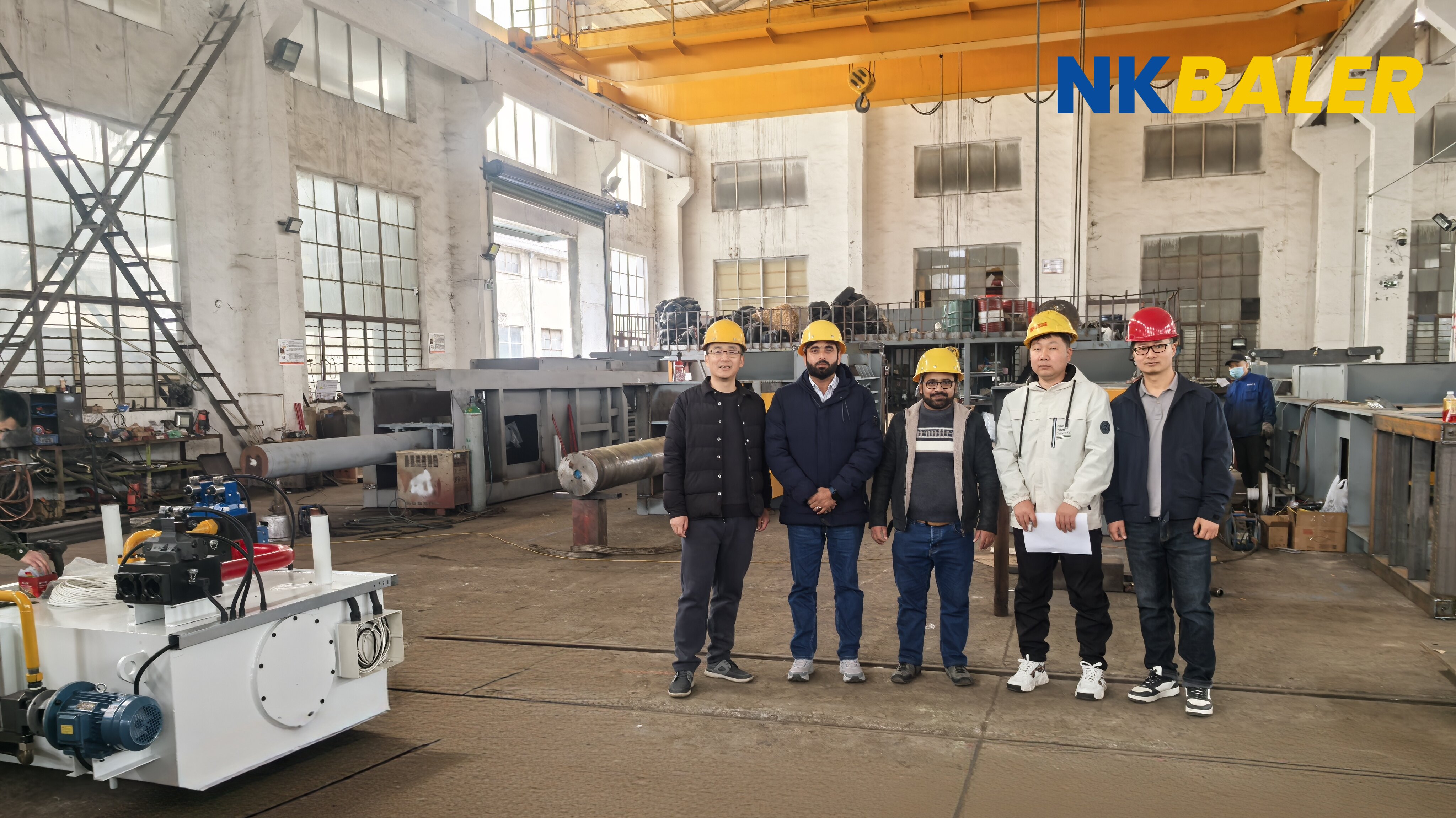
Need a technical recommendation for your paper recycling project?
Before requesting a quote, prepare four data points: tons per day, type of paper or cardboard, dimensions of the installation area, and operator availability. With that information, the NKBALER team can size the machine, auxiliary equipment, and delivery time according to your specific conditions.
Email: Sales@nkbaler.com | WhatsApp: +86 15021631102