
Vertical hydraulic press vs horizontal for used paper: which to choose?
Vertical vs Horizontal Hydraulic Press for Waste Paper: Which to Choose?
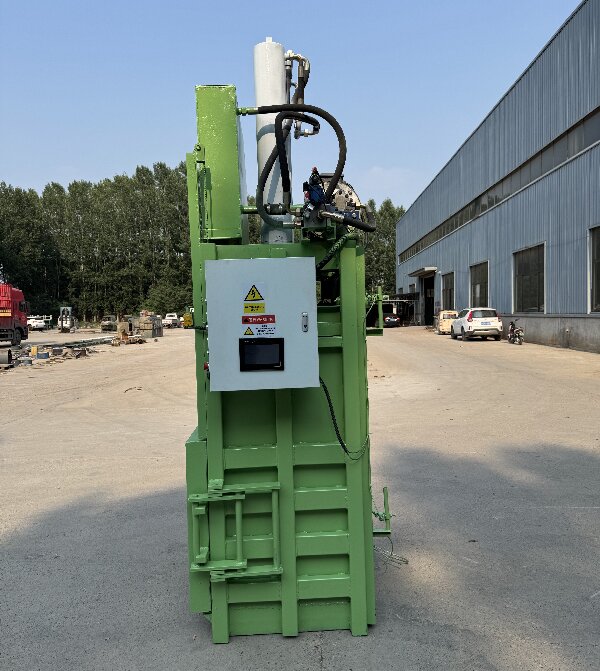
The short answer is that there is no universally superior technology when comparing a vertical hydraulic press for waste paper with a horizontal one. The correct decision depends on three specific variables: the volume of paper entering the plant, the available physical space, and the investment budget. To guide the choice, this article compares two real families from NKBALER: the vertical NK1070T60 and NK60LT, and the horizontal NK6040T10, NKW80BD, NKW125BD, NKW180BD and NKW250BD, using technical specification data and application criteria.
The Real Problem: It's Not Just the Machine, It's the Recycling Scenario
The most frequent mistake in purchasing a hydraulic baler for waste paper is choosing only by the cylinder tonnage or initial price, without relating the machine to the way the material arrives at the compaction area. A vertical press works in cycles and produces individual bales. A horizontal press, especially when integrated with a conveyor, can sustain a more continuous flow of material and measure its performance in tons per hour.
The comparison must answer questions such as: How many hours will the machine operate per day? Does the paper arrive loose, in boxes, or already pre-sorted? How much free space is available for installing the equipment and moving the bale? Is the goal a lower manual intervention operation or a simple equipment with dedicated personnel? Based on these answers, one of the two configurations usually fits the scenario better.
Market Context: Why the Comparison Is Relevant in 2026
Compaction and packaging of waste paper are part of a broad baler market. According to Grand View Research, the global baler market reached USD 6.40 billion in 2024, with agriculture and industry as main drivers. Within that total, the specific segment of waste balers reached USD 1.45 billion in 2024, according to Mordor Intelligence, focused on paper, plastic, and solid waste recycling.
For a Latin American, European, or Asian buyer, this means that the machine offering is wide and that the technical specifications contain comparable data among manufacturers. Therefore, it is important to understand what each parameter measures before deciding between a vertical and a horizontal solution.
How Does a Vertical Press Differ from a Horizontal One?
A vertical baler compresses the material using a cylinder that acts from top to bottom, inside a vertical chamber. A horizontal baler compresses the material along a horizontal channel; the bale is formed and extracted longitudinally. In practice, this generates visible differences in the feeding form, the loading height, and the integration with auxiliary equipment such as conveyor belts.
NKBALER, whose legal name is Shaanxi Nick Machinery Equipment Co., Ltd., manufactures both types within its catalog. The company is located on Qunsheng Road, Huishan District, Wuxi, Jiangsu Province, China, and exports approximately 90% of its production to North America, South America, and Asia. For the waste paper sector, the company offers specific vertical models and a horizontal series with varying degrees of automation.
Vertical: NK1070T60 and NK60LT
The NK1070T60 is a vertical machine identified in the catalog as a waste paper baler. Its hydraulic power is 60 tons. It forms bales of 1100 x 700 x (500-900) mm, with a compression chamber of 1100 x 700 x 1450 mm and a feed opening of 1100 x 500 mm. Its declared capacity is 5 to 8 bales per hour. It operates with 380 V/50 Hz, although the voltage is customizable, and features a motor of 15 kW/20 HP. The machine dimensions are 1600 x 1100 x 3200 mm and its weight is 2.2 tons.
The NK60LT is a vertical machine documented as a cardboard box baler, a material that is often managed on the same line as waste paper. It has 60 tons of hydraulic power, system pressure of 25 MPa, and forms bales of 1000 x 700 x (400-800) mm. Its chamber measures 1000 x 700 x 1250 mm and the feed opening is 1000 x 460 mm. Each bale weighs between 150 and 200 kg. The declared capacity is 10 to 12 bales per hour, with a cross tying system: 4 pieces front to back and 2 pieces left to right. It uses 380 V/50 Hz, a 15 kW/20 HP motor, dimensions of 1700 x 1000 x 3780 mm, and a weight of 2900 kg.
Within the comparison, these two verticals represent a solution with a smaller footprint in the plant and lower installed power compared to the large horizontals of the NKW series.
Horizontal: NK6040T10, NKW80BD, NKW125BD, NKW180BD and NKW250BD
The NK6040T10 is a semi-automatic horizontal hydraulic baler of 10 tons. It forms bales of 600 x 400 x (350-600) mm, with a feed opening of 540 x 450 mm, a capacity of 6 to 8 bales per hour, and a bale weight of 50 to 80 kg. It operates with 220 V/50 Hz and a 2.2 kW/3 HP motor. The machine measures 870 x 780 x 2150 mm and weighs 600 kg. It is a compact option within the horizontal group, suitable for those who prefer this compression principle while occupying very little space.
The NKW80BD is a fully automatic horizontal baler according to its technical specification. It has 80 tons of hydraulic power and forms bales of 1100 x 850 x 1700 mm. Its feed opening is 1200 x 1000 mm and its declared capacity is 2 to 3 tons per hour. It uses a 22 kW/30 HP motor, wire for bales 10# in 4 pieces, and weighs 14,500 kg. It can be integrated with a conveyor of 4,500 kg.
The NKW125BD is a semi-automatic horizontal baler of 125 tons. It forms bales of 1100 x 1250 x 1700 mm, with a feed opening of 2000 x 1100 mm and a capacity of 5 to 7 tons per hour. Its motor is 30 kW/40 HP, it uses 5 units of wire 10#, weighs 18,000 kg, and accepts a conveyor of 12,000 x 1800 mm with a 4.5 kW motor.
The NKW180BD is another semi-automatic horizontal baler from the NKW series, with 180 tons of hydraulic power. It forms bales of 1100 x 1150 x 1800 mm, with a feed opening of 2400 x 1100 mm and a capacity of 6 to 8 tons per hour. It uses a 45 kW/60 HP motor, 5 units of wire 6#/8#, weighs 24,000 kg, and is offered with a steel chain conveyor of 14,000 x 2000 mm and a 5.5 kW motor.
The NKW250BD is the highest capacity in the analyzed group, with 250 tons of hydraulic force. It forms bales of 1100 x 1250 x 1700 mm, with a feed opening of 2000 x 1100 mm and a capacity of 10 to 15 tons per hour. Its main motor is 45 kW/60 HP, it uses 5 units of wire 6#/8#, weighs 30,000 kg, and accepts a conveyor of 12,000 x 2000 mm with a 4.5 kW motor and a weight of 5,000 kg.
In this series, an important difference in automation is observed: while the NKW80BD is classified as fully automatic, the NKW125BD, NKW180BD, and NKW250BD are classified as semi-automatic. Therefore, within the horizontal group, one must also choose the desired level of operation.
Parameter Comparison: Vertical vs Horizontal for Waste Paper
The following table summarizes the verifiable data of the considered models. It does not include prices because they depend on configuration, conveyor, and export conditions.
| Model | Documented Configuration | Hydraulic Force | Bale Size | Capacity | Power | Machine Weight |
|---|---|---|---|---|---|---|
| NK1070T60 | Vertical, waste paper | 60 t | 1100x700x(500-900) mm | 5-8 bales/h | 15 kW/20 HP | 2200 kg |
| NK60LT | Vertical, cardboard/paper | 60 t | 1000x700x(400-800) mm | 10-12 bales/h (150-200 kg/bale) | 15 kW/20 HP | 2900 kg |
| NK6040T10 | Horizontal semi-automatic | 10 t | 600x400x(350-600) mm | 6-8 bales/h (50-80 kg/bale) | 2.2 kW/3 HP | 600 kg |
| NKW80BD | Horizontal fully automatic | 80 t | 1100x850x1700 mm | 2-3 t/h | 22 kW/30 HP | 14,500 kg |
| NKW125BD | Horizontal semi-automatic | 125 t | 1100x1250x1700 mm | 5-7 t/h | 30 kW/40 HP | 18,000 kg |
| NKW180BD | Horizontal semi-automatic | 180 t | 1100x1150x1800 mm | 6-8 t/h | 45 kW/60 HP | 24,000 kg |
| NKW250BD | Horizontal semi-automatic | 250 t | 1100x1250x1700 mm | 10-15 t/h | 45 kW/60 HP | 30,000 kg |
Step-by-Step Decision for Your Plant
Recommended Usage Scenarios
Use cases help connect the technical specification with real operation:
- A recycling plant that receives sorted paper from offices and businesses can process the material with a semi-automatic horizontal from the NKW series when volume is sustained and conveyor operation is desired.
- A collection center or warehouse with limited space may prefer the vertical NK1070T60, since it occupies 1600 x 1100 mm of base and compacts waste paper in cycles of 5 to 8 bales per hour.
- A company that also receives cardboard boxes can use the NK60LT, whose bales of 150-200 kg are formed at a rate of 10-12 units per hour.
- A small waste paper generator, such as a printing house or distribution center, can opt for the compact horizontal NK6040T10, with bales of 50-80 kg and an equipment weight of only 600 kg.
- A large-scale recycling plant with high continuous flow and the need to maximize load density can evaluate the NKW180BD or NKW250BD according to daily tonnage.
OEM, Customization, and Factory Support
The purchase of a hydraulic press for waste paper does not end with the technical specification. Shaanxi Nick Machinery Equipment Co., Ltd., under the NKBALER brand, integrates design, sales, and after-sales service. The company has its own R&D area and experience in packaging and waste recovery machinery. For the buyer, this means that you can request a configuration adapted to local voltage, paper type, bale dimensions, and plant requirements.
The declared customization capacity includes technical parameters, voltage, logo, block size, and color. The standard manufacturing time is 30 to 45 days, and the company declares a capacity of 10 units monthly. The MOQ is 1 unit, which facilitates the initial purchase for medium-sized recyclers. Additionally, factory tests are performed on 100% of units before shipment.
Frequently Asked Questions
When is a vertical or horizontal suitable for waste paper?
A vertical such as the NK1070T60 or NK60LT is suitable when the work is measured in bale cycles, space is limited, and the initial investment must be contained. A horizontal is suitable when paper flow justifies an operation measured in tons per hour; at NKBALER, that need is covered from the NKW80BD with 2-3 t/h up to the NKW250BD with 10-15 t/h.
What regulations must hydraulic balers exported to the European Union comply with?
To export to the EU, industrial balers must comply with the Machinery Directive 2006/42/EC and the harmonized safety standards EN ISO 12100 and EN 60204-1, according to CEN-CENELEC reference. The buyer in the EU must request the declaration of conformity from the manufacturer and verify that the delivered equipment corresponds to the declared configuration. NKBALER declares among its export markets the EU and the Middle East, with 100% testing of units.
What is the capacity difference between the 60 t verticals and the NKW horizontals?
The verticals NK1070T60 and NK60LT have 60 tons of force and their capacity is expressed in bales per hour: 5-8 and 10-12 respectively. The horizontals NKW80BD, NKW125BD, NKW180BD, and NKW250BD are expressed in tons per hour: 2-3, 5-7, 6-8, and 10-15, respectively. This difference in metric already indicates that the horizontal is designed for a more continuous flow.
If the budget is limited, is it better to start with a vertical?
In general, a vertical implies lower machine weight, lower installed power, and fewer civil works requirements. For example, the NK1070T60 weighs 2.2 tons and uses 15 kW, while the higher-capacity NKW horizontals weigh between 14.5 and 30 tons and use motors of 30 to 45 kW. A company that is starting out or processes low volume can begin with a vertical and later expand with a horizontal.
Can I request a sample or validate the equipment before a full purchase?
NKBALER accepts OEM/ODM orders with an MOQ of 1 unit, which allows validating a machine in a specific application before scaling the program. The process may include customization of voltage, logo, and technical parameters, as well as 100% factory testing before shipment. To coordinate times, samples, and specifications, you can contact NKBALER's sales team.
Conclusion and Next Step
The choice between a vertical and a horizontal hydraulic press for waste paper should be based on waste volume, available space, automation level, and growth projections. The verticals NK1070T60 and NK60LT offer an accessible solution with a smaller footprint for cyclic operation. The horizontals NK6040T10, NKW80BD, NKW125BD, NKW180BD, and NKW250BD cover from compact applications to lines of 10-15 tons per hour.
Next step: if you need to choose between a vertical and a horizontal, request the technical specification for the models NK1070T60, NK60LT, NK6040T10, NKW80BD, NKW125BD, NKW180BD, or NKW250BD. The team at Shaanxi Nick Machinery Equipment Co., Ltd. can help you define the layout, voltage, and packaging options. Contact: Sales@nkbaler.com | WhatsApp: +86 15021631102 | Web: https://nkbaler.com