High Precision Gear Procurement: Risk Mitigation Guide for Buyers
High Precision Gear Procurement: A Risk Mitigation Guide for Industrial Buyers
Procuring high precision gears for critical applications—such as wind turbines, marine thrusters, locomotive transmissions, or machine tool spindles—is a high-stakes task. A single gear failure can lead to costly downtime, safety hazards, and reputational damage. This guide provides a structured framework for buyers to efficiently complete procurement while mitigating common risks like quality inconsistency, delivery delays, and hidden costs. We draw on industry best practices and real-world capabilities of manufacturers like Jiangsu New Yinye Transmission Electromechanical Co., Ltd (NYY), a recognized National "Little Giant" High-Tech Enterprise based in Wuxi, China.
What Are High Precision Gears and Why Do They Matter?
High precision gears are components manufactured to tight tolerances (e.g., DIN class 4–5) that ensure smooth, quiet, and reliable power transmission under heavy loads and high speeds. They are used in applications where vibration, noise, and wear must be minimized—such as wind power gearboxes, marine propulsion systems, aerospace actuators, and precision machine tools. The quality of these gears directly affects the efficiency, lifespan, and safety of the entire system.
Defining the Procurement Challenge
Buyers of high precision gears often face the following pain points:
- Inconsistent quality: Variations in material, heat treatment, or machining can lead to premature failure.
- Long lead times: Custom-engineered gears require specialized production scheduling.
- Hidden costs: Poor quality triggers rework, warranty claims, and operational losses.
- Supplier credibility: Verifying a factory’s true capabilities is difficult from afar.
Efficient procurement means balancing cost, quality, and delivery while building a partnership with a supplier that invests in rigorous process control and traceability.
Industry Context: Where High Precision Gears Are Critical
High precision gears are vital across multiple industries:
| Industry | Application Example | Key Requirement |
|---|---|---|
| Wind Power | Main gearbox increasing gear | Continuous operation under variable loads, smooth transmission |
| Marine | Thrust system gearbox | Classification society certification, corrosion resistance |
| Locomotive & Railway | Traction gearbox | High reliability, impact resistance |
| Machine Tools | 5-axis machine spindle gear | Ultra-high precision, low backlash |
| Aerospace | Actuator drives | Light weight, extreme durability |
| Mining & Construction | Exciter gearbox for vibrating screens | High load capacity, wear resistance |
How to Efficiently Procure High Precision Gears and Avoid Risks
Based on industry standards and proven supplier practices, here is a step‑by‑step procurement framework:
Step 1: Define Technical Specifications Clearly
Start by documenting gear type (spur, helical, bevel, ring, planet), material grade (e.g., 17CrNiMo6, 18CrNiMo7-6, 42CrMoA), heat treatment (carburizing & quenching, nitriding, induction hardening), dimensional range, and precision class (e.g., DIN 3962/3965 Class 4 or 5). Example: NYY’s high precision gears cover cylindrical and bevel types with outer diameters up to 3000 mm and accuracy above DIN Class 4.
Step 2: Evaluate Supplier Manufacturing Capabilities
- Equipment: Look for German Hoefler RAPID/HELIX gear grinding machines, Liebherr LCS 1200, and Japanese O-M vertical turning/milling centers—these are indicators of top-tier precision.
- Bevel gear systems: Ability to process Klingelnberg, Gleason, and Oerlikon systems ensures flexibility.
- Heat treatment: In-house carburizing, induction, and nitriding with deformation control for thin-walled parts.
NYY operates a 25,308 m² factory with 120+ employees and a 30‑person R&D team, producing 50,000+ gears annually.
Step 3: Verify Quality Assurance and NDT Processes
Reliable suppliers invest in non‑destructive testing (NDT) beyond basic dimensional checks:
- German Fraunhofer non‑destructive case depth/hardness tester
- Barkhausen grinding burn detection (rare in standard gear factories)
- Large Zeiss CMMs (3000×6000×2000 mm) and Hexagon CMMs
- Klingelnberg P152 & Gleason M&M gear inspection centers
Step 4: Assess Traceability and Risk Control
Each gear should carry a traceability mark linking it to raw material lots. 100% ultrasonic testing (UT) and magnetic particle testing (MT) on materials, plus tooth surface burn inspection for hardened gears, are essential. NYY implements these measures to ensure no quality escapes.
Step 5: Understand Commercial Terms
Clear payment and delivery terms reduce commercial risk. For example:
- Minimum order quantity: 2 pieces
- Incoterms: FOB Shanghai, EXW, FCA Shanghai
- Payment: 30% down payment + 70% before delivery (new customers); 30 days at sight of B/L (established customers)
- Acceptance: Inspection report sent to buyer before shipment
Real-World Use Cases
Case 1: Metallurgical Steel‑Making Furnace Gears (Luxembourg)
Application: Transmission gearbox at the top of a steel‑making furnace. Over 2,000 gears supplied over 10 years.
Result: Zero quality complaints. The product exceeded its designed lifespan and helped the customer improve product quality. NYY was awarded "Outstanding Supplier" multiple times.
Case 2: Wind Power Gearbox Gears (China)
Application: Planet and ring gears for wind turbine main gearboxes. More than 10,000 pieces delivered over 5 years.
Result: No quality complaints. The customer granted NYY the "Excellent Quality Award."
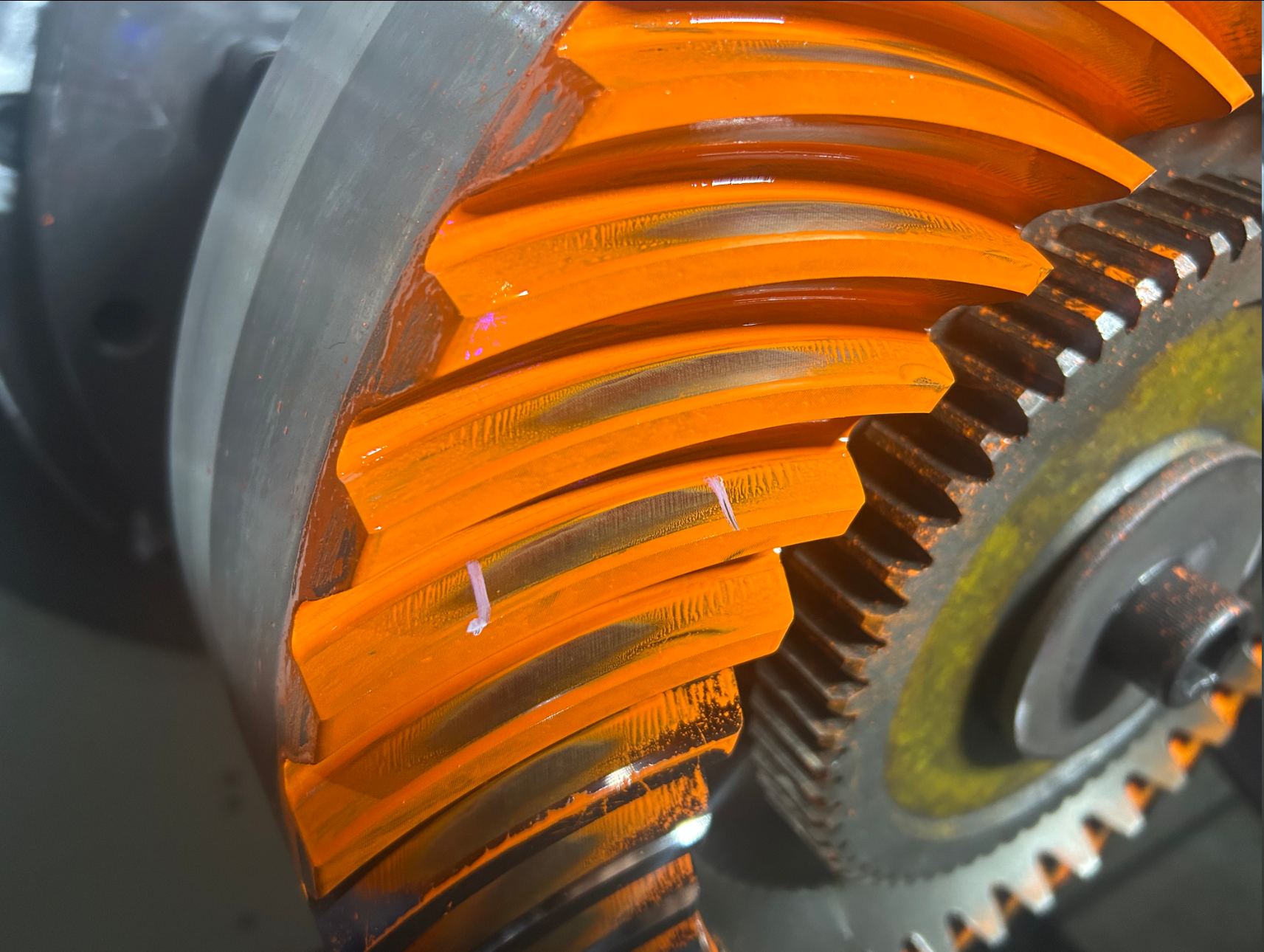
Comparison: Good vs. Poor Contact Pattern in Spiral Bevel Gears
One common risk is poor gear contact pattern leading to noise and premature wear. The image below illustrates a good contact pattern achieved through optimal machine setup and heat treatment control, compared to poor patterns. NYY’s spiral bevel gears consistently achieve good contact patterns, reducing equipment investment cost by 30% and maintenance needs.
Frequently Asked Questions
What is the typical lead time for custom high precision gears?
Lead time depends on complexity and quantity, typically 60–90 days for standard custom orders (MOQ 2 pcs).
How do I verify a supplier’s quality claims?
Request evidence of equipment list, NDT capabilities (e.g., Barkhausen detector, CMM reports), and a sample inspection report. Certifications like ISO 9001:2015 (cert. no. 02423Q32061057R2M) provide a baseline.
What materials are best for wind power gears?
Low‑carbon alloy steels like 18CrNiMo7-6 with carburizing and quenching achieve DIN class 5 and hardness above 58 HRC. NYY uses this for planet gears in wind applications.
Can I get small batches for prototyping?
Yes, minimum order quantity is 2 pieces, making small‑batch prototyping feasible.
Conclusion
Efficient procurement of high precision gears requires a systematic approach: define precise specs, vet supplier capabilities, verify quality control, and align commercial terms. By partnering with an established manufacturer like NYY—which combines German‑level precision machines, in‑house heat treatment, and rigorous NDT—buyers can significantly reduce the risk of premature failure and hidden costs. Start your procurement journey with a clear checklist and always demand traceability and independent inspection reports.
Download the company brochure for detailed capabilities: NYY Product Brochure (PDF)
Contact NYY at jane@wxyinye.com or visit www.wxnyy.com for inquiries.