Woven Apparel Fabric: A Buyer's Guide for Sourcing Teams
Woven apparel fabric spans everything from a 94 gsm cotton-Tencel shirting to a 359 gsm water-repellent bottom weight. The term describes a manufacturing method, not a product, so two rolls sold under the same category name can differ in fiber, yarn count, weave, finish, test result and price. This guide breaks the category into the decisions a sourcing team actually has to make, and shows how those decisions are handled at PT Golden Tekstil Indonesia (GTI), an integrated woven fabric manufacturer in Kendal, Central Java.

Why Woven Apparel Fabric Is Difficult to Specify
The difficulty is structural. "Woven" states only that two sets of yarns — warp and weft — were interlaced on a loom. It says nothing about which fiber was used, how fine the yarn is, how heavy the fabric is, how it was coloured, or what was done to it in finishing. Those five variables decide performance, price and compliance, and each can be changed independently of the others.
The practical result is that fabric quotations which look comparable often are not. A quote for a cotton poplin at one weight and one yarn count cannot be measured against a lighter, stretch version of the same weave. The same logic applies to certification: a supplier listing organic or recycled fiber categories has not, by that listing alone, demonstrated a chain-of-custody certificate for a specific order.
The gap between a fabric name and a purchasable specification
A purchasable specification fixes at least eight attributes: fiber composition with percentages, yarn count, weave construction, fabric weight in gsm, width, dyeing route, finish, and the test standard the fabric must meet. Without those, sampling becomes a guessing cycle and bulk production becomes a dispute about what was actually ordered.
What a buyer has to decide before asking for a price
Before an RFQ is useful, the buyer needs to know what garment the fabric will become. A formal business shirt, a resort shirt, a pair of chinos and a water-repellent jacket each pull the specification in a different direction — toward non-iron and dobby structure, toward seersucker and linen look, toward 200 gsm-plus bottom weights, or toward a repellent finish. The six decisions set out below are ordered so that each one narrows the next, which keeps sampling rounds and development cost under control.
Industry Background: Where Woven Apparel Fabric Sits in 2026
Demand for woven apparel fabric sits inside a large, material-mixed market. One commercial market analysis places the global textile fabrics market at USD 732.38 billion in 2026, covering cotton, polycottons and polyester. The same analysis reports that polyester held 54.1% of market share by volume in 2025 — a reminder that cost and durability still drive the volume end of apparel programmes, while cotton and cellulosic blends hold the handfeel, formal-wear and print end.
Sourcing geography matters as much as material mix. Indonesia exported USD 13.5 billion of textiles in 2024 according to Observatory of Economic Complexity data, which places the country among established Asian supply bases rather than a marginal option. Buyers searching for woven apparel fabric manufacturers typically compare China, Vietnam, India and Indonesia within the same shortlist. That comparison only becomes meaningful when it is run on identical specifications — the same yarn count, weight, finish and test standard — because a country label says nothing about what a specific mill can hold to tolerance.
One structural factor does change outcomes across suppliers: vertical integration. When yarn dyeing, weaving, finishing and testing happen on one site, shade control, rework loops and lead-time compression behave differently than when greige fabric is bought in and finished elsewhere. GTI, established in 2019, operates yarn dyeing, piece dyeing, digital printing and fabric finishing inside a 171,401 m² facility, with 2,828 employees and a 30-engineer R&D team.
Definition: What Woven Apparel Fabric Means in a Purchase Order
Woven apparel fabric is fabric produced by interlacing warp and weft yarns on a loom, as opposed to knitted fabric where loops are intermeshed. In apparel it is the base material for shirting, trousers, outerwear, uniforms and dresses that require dimensional stability and a clean surface.
In a purchase order, the definition resolves into a specification line. GTI's range illustrates the spread: published product weights run from 94 gsm on a Cotton-Carbon Zero Tencel blend to 359 gsm on a heavy-weight cotton or cotton-blend outer and bottom fabric, and the company lists yarn-count capability from 16s/1 to 100s/1 and 20/2 to 200/2. The same mill therefore serves a formal shirting programme and a workwear bottom programme with different loom settings, different finishing routes and different quality thresholds.
The Six Decisions That Define a Woven Apparel Fabric
1. Fiber composition
Fiber choice sets handfeel, care behaviour, certification eligibility and price. GTI's fiber library spans natural cotton and linen blends, recycled polyester, recycled cotton, organic cotton, Lenzing EcoVero and Refibra, synthetic and cellulosic fibers, and stretch constructions from simple cotton spandex to 4-way stretch.
Composition also determines which sustainability claims are even possible. A 98% organic cotton / 2% spandex construction (model B01939-03, 160 gsm) can be positioned against GOTS and Organic 100 certification. A 60% cotton / 40% recycled polyester blend (model B01308-03, 109–112 gsm) sits inside the GRS framework instead. Buyers should treat composition percentages as the first filter in the process, not the last one.
2. Weave construction
Construction controls surface character, drape and how the fabric reads in a finished garment. The main families in GTI's range are distinct enough to be selected by end use rather than by preference:
- Regular poplin — a fine, smooth plain weave used for dress and business shirting. GTI's stretch poplin (models B00295-02, 550887-04, 550887-01 and 573984-08) runs 113–136 gsm at 40D50×40D50, with 90–91% cotton or BCI cotton and 9–10% spandex, giving a 4-way stretch.
- Oxford — a basket-derived structure with visible texture. GTI's Oxford range covers 142–171 gsm at 40×20/2 to 40×40D16, in 100% cotton or 98% cotton / 2% spandex.
- Dobby — small geometric patterns woven into the cloth. GTI's dobby fabrics run 110–130 gsm in 100% cotton, 97/3 cotton-spandex and 64/32/4 cotton-polyester-spandex, with a mechanical stretch variant available.
- Seersucker — a puckered texture that holds the fabric away from the skin. GTI's versions (S01183-01 and S01151-01) run 109–111 gsm in 97/3 cotton-spandex or 56/40/4 organic cotton-polyester-spandex.
- Flannel — a brushed surface that gives seasonal warmth without bulk. GTI's flannel range runs 119–175 gsm in 100% cotton, 65/35 rayon-polyester and 60/40 cotton-polyester.
- Heavy-weight outer and bottom — 204–359 gsm at 10×10 to 30×70D21 yarn counts, in 100% cotton, water-repellent cotton-polyester-spandex, or cotton-spandex.

3. Weight and yarn count
Weight in gsm decides season, drape, garment structure and cost per garment. Yarn count decides how fine the surface reads and how the fabric behaves under a needle. These two numbers should always appear together in a brief: a 40s poplin at 115 gsm and a 40s poplin at 136 gsm are different products even though the construction name is identical.
For orientation within GTI's published range, lightweight shirting sits around 94–130 gsm (Carbon Zero Tencel, dobby, seersucker, Cool-Dry), mid-weight shirting around 132–175 gsm (Oxford, flannel, cotton spandex easy care), and bottom and outer weights from 204 gsm upward.
4. Dyeing route: yarn dyed, piece dyed or digital print
The colouring method is often the largest hidden variable in a quote, because it drives minimum order, lead time and the pattern complexity a designer can attempt.
- Yarn dyed — yarns are dyed before weaving, so stripes, checks and plaids are built into the cloth rather than applied to it. Colour consistency is structural, but planning starts earlier because yarn must be dyed to shade first.
- Piece dyed — greige fabric is woven and then dyed to a solid shade. It is the most direct route for solid-colour programmes and allows shade matching against an approved standard.
- Digital print — artwork is printed directly onto fabric, which suits complex, multi-colour or short-run designs without print-screen set-up. GTI operates a digital print line for woven apparel fabric that is scaling toward 0.45 million yards per month, or 5.4 million yards annually.

5. Finish and function
Finishing is where a commodity fabric becomes a product claim. GTI's finishing menu includes mercerized, anti-bacterial, anti-UV, wrinkle-free, water/oil/stain repellent, cooling, thermal and smart-temperature finishes.
Three examples show how a finish changes the purchasing decision:
- Non-iron, formaldehyde-free — 100% cotton at 80/2×80/2, 113.5–142 gsm, models S00098-01, 556607-01, 572711-02 and S00904-03. The finish reduces ironing requirements for the end consumer and avoids formaldehyde, which matters for skin-contact and chemical-safety compliance.
- Cool-Dry — 64% cotton / 32% polyester / 4% spandex, 106–156 gsm, combining a non-iron finish with wicking and quick-dry performance. The Aeroloft variant is described as adding a lightweight air-layer effect for breathability.
- Cooling Comfort — 96% cotton / 4% spandex, 118.26–134 gsm, using a Liquid Ammonia plus Moisture Cure treatment to create a cooling sensation against the skin, aimed at business shirting in warm and humid markets.
Practical caution: a functional claim is only as strong as the test method behind it. When a fabric is specified as wicking, quick-dry or cooling, the brief should name the test standard and the acceptance threshold, and the supplier should provide the corresponding report. A finish name on a product page is a description; a test report is evidence.
6. Testing and certification
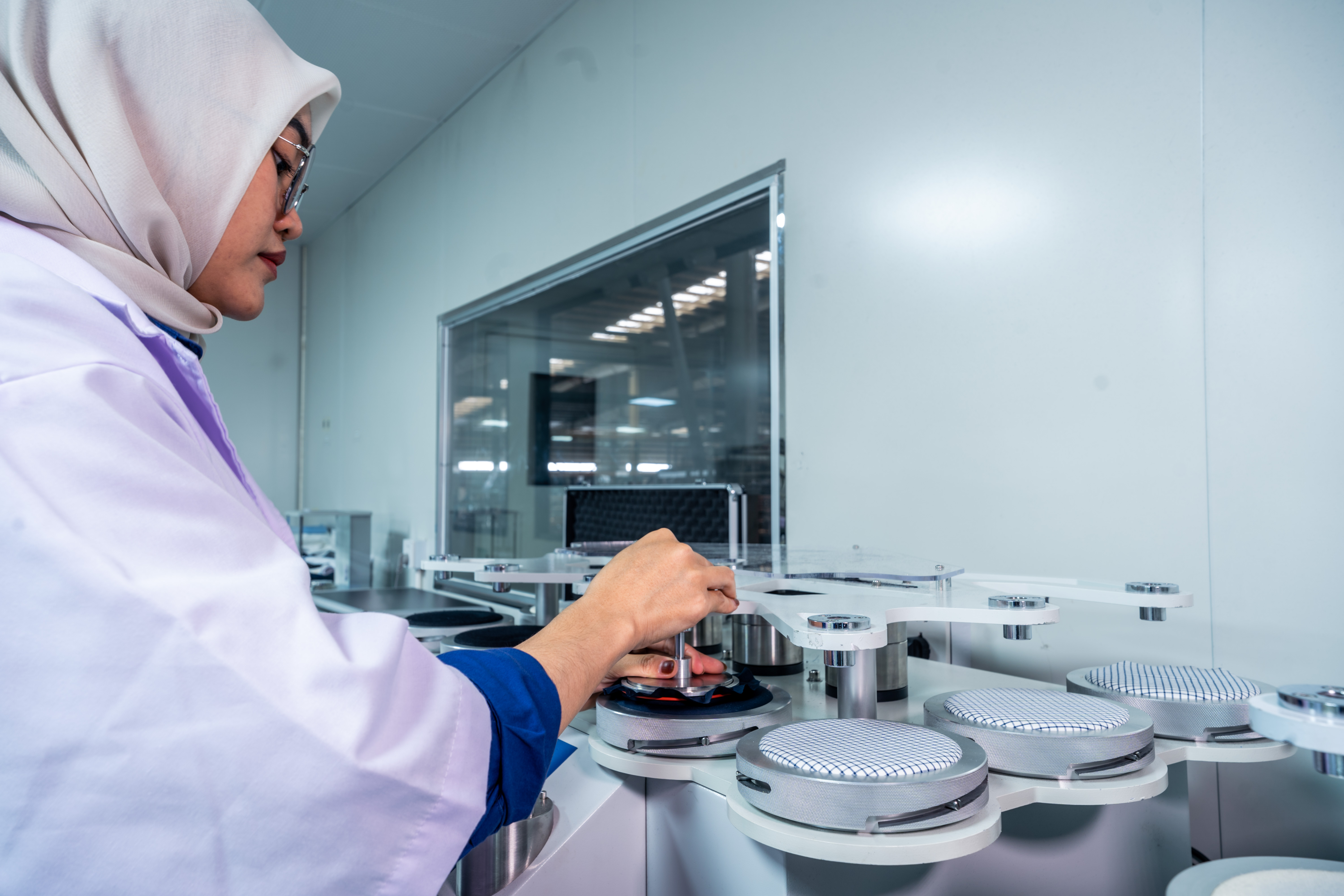
Testing closes the loop. GTI operates an in-house testing centre certified to AATCC, ASTM D, JIS and the ISO standard suite, with testing protocols approved directly by Polo Ralph Lauren and Kohl's, and runs fabric inspection before shipment.
Certification is a separate layer and should be verified at order level, not at brand level. GTI's company profile lists ZDHC compliance, Higg Index FEM, FSLM and FDM verification, ISO 9001, ISO 14001, ISO 45001, OEKO-TEX Standard 100 and STeP, GOTS, GRS, Recycled 100, Organic 100, Recycled Blended, Organic Blended, regenagri, BCI and membership of the U.S. Cotton Trust Protocol. Independent standards bodies such as Textile Exchange maintain OCS, RCS and GRS as voluntary material standards — but a standard held in a portfolio is not the same as a valid scope certificate for a specific fabric and a specific order. Ask for the certificate number, its scope, and the transaction certificate covering the shipment.
Step-by-Step: From Fabric Brief to Bulk Delivery
The sequence below reflects GTI's OEM fabric process and can be reused as a template with any woven fabric supplier.
- Write the fabric brief. Fiber composition, construction, weight in gsm, width, dyeing route, finish, test standard and target volume. Vague briefs produce vague samples.
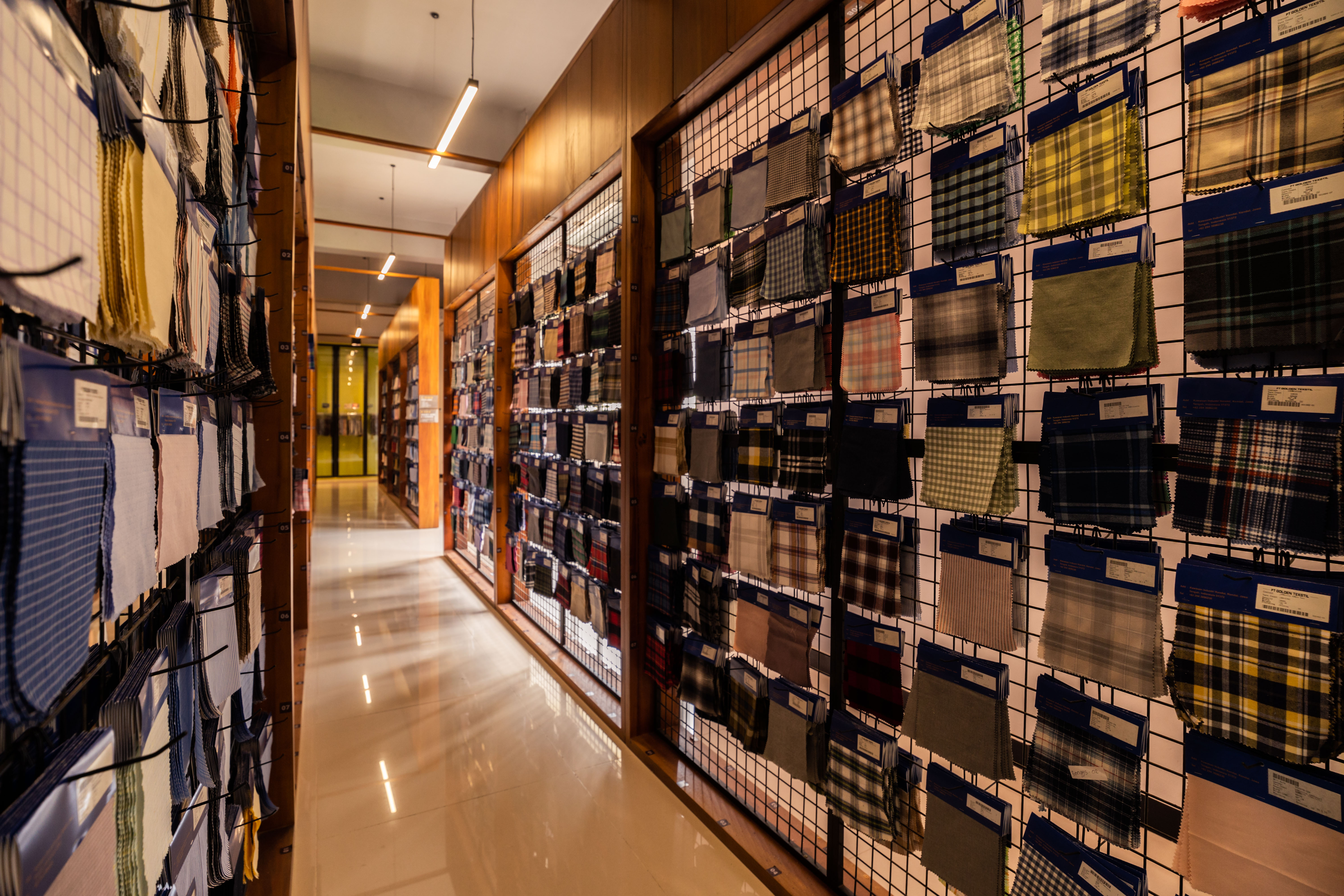
- Shortlist against the reference library. Compare existing developments or a physical fabric library before commissioning new work. GTI maintains a fabric library and a digital fabric e-library, and uses design systems including YX Weave, Ned Graphics and Penelope during development.
- Develop a hand sample, lab dip or strike-off. GTI's R&D centre supports 1,500 handlooms per month for sample weaving, which is the capacity that decides how quickly a brief becomes something a buyer can physically evaluate.
- Approve the hand sample in writing. Colour, construction and finish are locked here. Written approval prevents later disagreement about shade or handfeel.
- Develop and approve a big sample. A larger-yardage run confirms that the construction behaves the same at production width and speed.
- Confirm the bulk order. Fabric MOQ is 3,000 meters per colour, with colourway and delivery schedule agreed at this stage.
- Run bulk production. Lead time is approximately 30–45 days depending on construction and finish complexity.
- Test and inspect before shipment. In-house testing against the agreed standard, followed by fabric inspection.
- Ship and review. Compare bulk test results against the approved sample and record deviations for the next programme.
Two failure points are worth flagging. First, changing finish type after sample approval usually triggers a new sample cycle, because the finish alters handfeel and sometimes shrinkage. Second, certification requirements must be raised at order stage — a GOTS or GRS claim cannot be added retrospectively to a shipment that was not produced under the applicable chain of custody.
Use Cases: Matching Construction to End Product
Formal and business shirting
Non-iron 100% cotton at 113.5–142 gsm, dobby at 110–130 gsm and stretch poplin at 113–136 gsm are the working options. Where climate is a factor, Cooling Comfort at 118.26–134 gsm or Cool-Dry at 106–156 gsm adds a functional layer without abandoning a cotton-rich handfeel.
Casual and preppy shirting
Oxford at 142–171 gsm is the default, in pure cotton or with 2% spandex for fit recovery. Flannel at 119–175 gsm covers the autumn and winter end of the same programme.
Summer and resort
Seersucker at 109–111 gsm and linen or linen-look constructions at 132–190 gsm are the natural picks. The linen-look route offers a 100% cotton version (569717-01) alongside a 55% linen / 45% rayon blend (B00353-01), so buyers can trade price against true linen content. Cotton-Carbon Zero Tencel at 94–110 gsm suits lightweight warm-climate shirting.
Performance and travel shirting
Cool-Dry combines non-iron with wicking and quick-dry for travel and business-casual use. Recycled nylon in the BioDry variant (S01601-04, 113 gsm, 43% cotton / 31% recycled nylon / 21% Tencel blend family) adds a moisture-wicking option built on a lower-impact fiber base.
Bottoms and outerwear
Heavy-weight constructions at 204–359 gsm, including water-repellent cotton-polyester-spandex variants and stretch bottom fabrics, are built for trousers, workwear and outerwear where abrasion resistance matters more than drape.
Sustainable and ESG-linked programmes
Organic cotton, regenerative cotton, recycled polyester and recycled nylon let a brand connect a fabric to a stated sustainability commitment. Regenerative cotton (S01232-02 and B00390-04, 171–173 gsm) links to regenagri certification; recycled polyester at up to 65% content links to GRS. The claim only survives audit if the certificate chain is intact from fiber to finished roll.
Comparison Table: Woven Apparel Fabric Families at a Glance
The table uses specifications from GTI's published product data. Weight and composition ranges describe a model family, not a single SKU.
| Fabric family | Weight (gsm) | Composition options | Typical apparel use |
|---|---|---|---|
| Regular Poplin Stretch (B00295-02 / 550887-04 / 550887-01 / 573984-08) | 113–136 | 90–91% cotton or BCI cotton with 9–10% spandex; 4-way stretch | Menswear and womenswear shirting |
| Oxford (B00390-03 / 565584-01 / B01177-07 / B01109-01) | 142–171 | 100% cotton; 98% cotton / 2% spandex | Casual and preppy shirting |
| Dobby (556602-02 / 562993-02 / B00098-11 / B00012-01 / B02599-01) | 110–130 | 100% cotton; 97/3 cotton-spandex; 64/32/4 cotton-polyester-spandex | Formal and business shirting |
| Seersucker (S01183-01 / S01151-01) | 109–111 | 97/3 cotton-spandex; 56/40/4 organic cotton-polyester-spandex | Summer and resort shirting |
| Flannel (574259-03 / 574259-06 / 549625-03 / 552492-01) | 119–175 | 100% cotton; 65/35 rayon-polyester; 60/40 cotton-polyester | Fall and winter shirting |
| Heavy Weight Outer and Bottom (S01582-01 / B03076-04 / S01506-01 / S00804-01 / B00902-05 / B01294-02 / B02260-02) | 204–359 | 100% cotton; cotton-polyester-spandex with water repellency; cotton-spandex | Outerwear and trousers |
| Non-Iron, free formaldehyde (S00098-01 / 556607-01 / 572711-02 / S00904-03) | 113.5–142 | 100% cotton, 80/2×80/2 | Formal and business shirting |
| Cool-Dry (B02568-02 / B02587-04) | 106–156 | 64% cotton / 32% polyester / 4% spandex | Performance and active-casual shirting |
| Cooling Comfort (B02454-01 / B02508-01) | 118.26–134 | 96% cotton / 4% spandex | Business and warm-climate shirting |
| Linen and Linen Look (B00353-01 / 569717-01) | 132–190 | 55% linen / 45% rayon; 100% cotton | Casual and resort wear |
| Cotton Spandex Easy Care (B01447-01 / B01447-02 / 573518-01 / B01233-01) | 108–132.26 | 96–98% cotton / 2–4% spandex | Menswear and womenswear |
| Organic Cotton (B01939-03) | 160 | 98% organic cotton / 2% spandex | Sustainable and ESG-driven programmes |
| Regenerative Cotton (S01232-02 / B00390-04) | 171–173 | 56.7% regenerative cotton blend; 65.5/34.5 cotton-regenerative cotton | Sustainable and ESG-driven programmes |
| Recycled Polyester (B01308-03 / B01718-14) | 109–112 | 60% cotton / 40% recycled polyester; 65% recycled polyester / 35% cotton | Sustainable casualwear |
| Carbon Zero Tencel (506520-02 / B01109-01) | 94–110 | 60% cotton / 40% Carbon Zero Tencel; 68.2/31.8 cotton-Tencel | Low-carbon and ESG-driven programmes |
| Modal (464980-02) | 108 | 45.1% Modal / 19.4% micro polyester / 35.5% Cupro | Premium casual and dress shirting |
| Sorona (S00543-03 / B01075-05) | 156–168 | 65% cotton / 35% Sorona; 65% rayon / 35% Sorona | Casual and business-casual shirting |
| Recycled Nylon (S01601-01 / S01601-04) | 113 | 43% cotton / 31% recycled nylon / 21% Tencel | Performance and sustainable casualwear |
What to request from any woven fabric supplier
| Evaluation criterion | What to request | Why it changes the decision |
|---|---|---|
| Specification completeness | Composition percentages, yarn count, gsm, width, finish | Without these, two quotations are not comparable |
| Sampling capability | Hand sample and lab dip cycle time | Decides how many development rounds fit before the buy deadline; GTI supports 1,500 handlooms per month |
| Colour route | Yarn dyed, piece dyed or digital print | Pattern complexity, minimum order and lead time all shift with the route |
| Testing | Named test standard and report per shipment | Functional claims are unverifiable without method and threshold |
| Certification | Scope certificate and transaction certificate | A listed standard is not a certified order |
| Commercial terms | MOQ per colour, bulk lead time | GTI states 3,000 meters per colour and 30–45 days bulk production |
Manufacturing Context: How GTI Is Set Up
GTI was established in 2019 and specialises in woven apparel fabric, producing approximately 38,000,000 meters per year from a 171,401 m² site in Kendal Industrial Park, Central Java, with 2,828 employees and a 30-engineer R&D team. Its product range covers cotton, linen blends, recycled polyester, recycled cotton, organic cotton and stretch woven fabrics, and its operations include yarn dyeing, piece dyeing, digital printing and fabric finishing.
Two capability details matter for sourcing decisions more than scale does. First, the design and development pipeline is digital — fabric design systems, a digital fabric e-library, and 3D garment design tools — which shortens the distance between a garment concept and a woven sample. Second, environmental controls are built into the plant rather than reported separately: a wastewater treatment facility processing 4,000 tons per day, a recycling system cutting water consumption by 300,000 tons annually, 26,000 m² of rooftop solar, and a shift from coal to biomass from January 2025 that the company's sustainability report credits with eliminating 12,000 tons of CO₂ emissions per year.
Frequently Asked Questions
Which certifications should a buyer verify before ordering woven apparel fabric from GTI?
GTI's company profile lists ZDHC compliance, Higg Index FEM, FSLM and FDM verification, ISO 9001, ISO 14001, ISO 45001, OEKO-TEX Standard 100 and STeP, GOTS, GRS, Recycled 100, Organic 100, Recycled Blended, Organic Blended, regenagri, BCI and U.S. Cotton Trust Protocol membership. For a specific order, ask for the scope certificate that covers the fabric being bought and the transaction certificate that covers the shipment. Textile Exchange maintains OCS, RCS and GRS as the relevant voluntary material standards, and independent standards bodies are the right place to confirm a certificate number. Any functional claim — wicking, quick-dry, cooling, non-iron — should be supported by a test report against a named standard.
What yarn counts, fabric weights and finishes can GTI produce?
GTI lists yarn-count capability from 16s/1 to 100s/1 and 20/2 to 200/2, and its published product weights run from 94 gsm on Cotton-Carbon Zero Tencel up to 359 gsm on heavy-weight outer and bottom fabrics. Finishing services include mercerized, anti-bacterial, anti-UV, wrinkle-free, water/oil/stain repellent, cooling, thermal and smart-temperature finishes. Construction types in the range include regular poplin, Oxford, dobby, seersucker, flannel, linen and linen look, and heavy-weight outer and bottom qualities.
What is the minimum order quantity for GTI woven apparel fabric?
GTI's stated fabric MOQ is 3,000 meters per colour, confirmed at the bulk order stage after hand sample and big sample approval. Because the MOQ is expressed per colour, the number of colourways in a programme affects total order volume more than the number of constructions. Colourway planning should therefore be settled before the bulk confirmation step, together with the delivery schedule.
How does sampling work before bulk production?
The process runs from a customer sample or request for fiber and construction selection, to handloom, lab dip or strike-off hand sample development, to written sample approval, then big sample development and approval, then bulk order confirmation. GTI's R&D centre supports 1,500 handlooms per month for sample weaving. Approving the hand sample in writing is the step that locks colour, construction and finish; changing finish after that point typically requires a new sample cycle.
How long does bulk production take, and how should Indonesian mills be compared with Chinese manufacturers?
GTI states a bulk lead time of approximately 30–45 days depending on construction and finish complexity, followed by in-house testing and inspection before shipment. When comparing woven apparel fabric manufacturers in China with Indonesian mills, the useful comparison is specification by specification — identical yarn count, weight, finish, test standard and MOQ basis — rather than by country. Indonesia exported USD 13.5 billion of textiles in 2024, so it is an established supply base; what separates suppliers is whether they can document construction, colour route, test results and certificate chain for the specific order. Buyers who want to start that comparison can request a sample and the current company profile from GTI's team.
Conclusion
Woven apparel fabric is not one product, and treating it as one is the most common reason sourcing programmes lose time. The category only becomes manageable when it is reduced to six linked decisions — fiber, construction, weight and yarn count, dyeing route, finish, and testing and certification — and when those decisions are written into a brief before any quotation is requested.
For an integrated mill such as GTI, the advantage is not a single number but the ability to hold those six decisions inside one facility: yarn dyeing, piece dyeing, digital printing, finishing and in-house testing across a 94–359 gsm range. For a buyer, the discipline is the same either way — specify precisely, sample deliberately, approve in writing, and verify certification at order level rather than at brand level.
Next step
To evaluate a woven apparel fabric programme, request a sample, a quotation or the 2026 company profile. The profile covers GTI's manufacturing setup, product range, finishing menu and certification portfolio.
Company profile (PDF): GTI Company Profile 2026
Website: goldenteks.com
Email: ada.shao@goldenteks.id
WhatsApp / Tel: +62 882-21744008
Address: Saptarengga St. No. 6-8, RW.8, Tambak, Wonorejo, Kaliwungu, Kendal Regency, Central Java 51372
Have Questions or Need More Details?
Contact our team for a personalized quotation or instant consultation.
Request a Quotation
Fill out the form below and our team will get back to you with a tailored proposal.
WhatsApp Direct Chat
Prefer to chat in real-time? Message us on WhatsApp for instant assistance & quick answers.
- Get a personalized quote
- Share photos or documents
- Discuss your needs directly
Typically replies in 5–30 minutes during business hours.