Woven Apparel Fabric: A Buyer's Guide to Constructions and Finishes
Woven apparel fabric is fabric made by interlacing lengthwise warp yarns with crosswise weft yarns on a loom, then dyeing and finishing it for garment production. The category runs from shirting poplin at roughly 113 gsm to water-repellent bottom fabric at 359 gsm, and from 100% cotton to a 65% recycled polyester blend. Because one term covers all of it, a buyer who specifies only “woven apparel fabric” receives quotations that cannot be compared.
This guide is written for sourcing teams in the awareness and research stage — buyers who know a garment needs woven fabric but have not yet fixed the specification. It explains how the category is actually structured, which four decisions drive cost and performance, how yarn count, weight and finish interact, and how a vertically integrated mill such as PT Golden Tekstil Indonesia builds, tests and ships these fabrics.
What Woven Apparel Fabric Means in a Sourcing Conversation
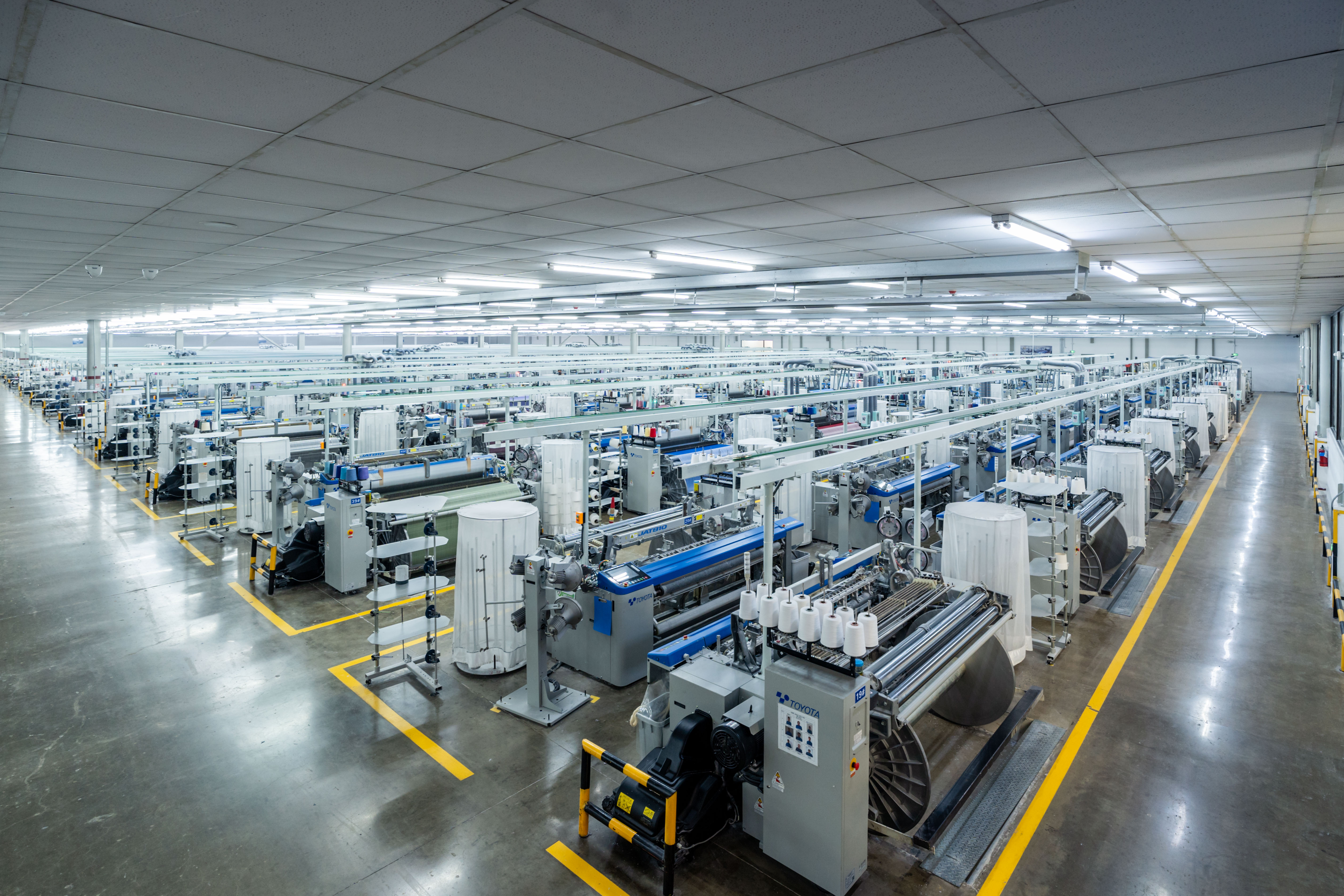
Woven fabric is built from two yarn systems. The warp runs lengthwise and is held under tension on the loom; the weft runs crosswise and is inserted over and under the warp. The way those two systems interlace is the construction, and the construction determines how the cloth hangs, how stable it is when cut, and what surface it presents.
Three properties are decided at the loom at the same moment: yarn count, weave structure and fabric weight. Fiber blend is decided one step earlier, at yarn selection. Performance finishes are added afterwards, at the finishing stage. That sequence is the single most useful thing a new buyer can learn about this category, because it explains the limits of every later change. No finish can turn a 110 gsm poplin into a 350 gsm outerwear shell, and no finishing route can convert a plain weave into a seersucker pucker.
The term also excludes whole material families. Knitted fabric is formed by interlooping yarns rather than interlacing them, so it stretches and recovers differently. Nonwovens are bonded rather than woven. When a shirting or trouser brief specifies “woven”, the buyer is specifying drape, seam stability and a cuttable, dimensionally predictable structure — not simply a fiber.
The Buyer's Problem: One Keyword, Incomparable Quotations
A typical first-round RFQ reads: “woven apparel fabric, cotton, shirting, good quality.” Five mills reply with five prices that differ by a wide margin, and none of the quotes can be lined up against each other. One is quoting a 113 gsm stretch poplin, another a 171 gsm Oxford, a third a 359 gsm bottom weight, and a fourth has assumed a yarn-dyed check rather than a solid shade. The prices are not wrong; the specification behind them is missing.
The problem is that four independent variables move at once inside this category:
- Fiber composition, including the exact percentages of cotton, spandex, polyester, recycled or organic content.
- Construction and yarn count, which set weight, surface texture and handfeel.
- Dyeing route — yarn dyed, piece dyed or digital print — which changes both appearance and the order cycle.
- Finish, which is where most claims about non-iron, wicking, cooling or water repellency actually live.
A buyer who has not fixed all four is comparing suppliers on price alone, and price is the least stable variable in the chain. The practical fix is a specification sheet with eight fields, sent with the RFQ: fiber composition with percentages, yarn count, fabric weight in gsm, weave or construction name, dyeing route, finish plus the performance claim it must support, certification requirement by destination market, and the buyer's own usable width and shrinkage tolerance.
Decision rule: if two quotations cannot be compared field by field against the same eight-point specification, they are not competing quotations. They are two different products.
Industry Background: A Mature Category With a Compliance Overlay
Woven apparel fabric is a mature, high-volume material category, and the commercial context has shifted in two directions at once: scale on one side, traceability on the other.
On scale, a 2026 commercial research estimate places the global textile fabrics market at USD 732.38 billion, and the same research puts polyester at 54.1% of global textile fabric volume in 2025. Indonesia is a significant exporter in this trade: OEC data records total Indonesian textile exports of USD 13.5 billion in 2024. For a buyer, those figures describe a deep, competitive supply base rather than a constrained one — which is precisely why supplier selection has to be specification-led.
On traceability, material claims have become formal systems rather than marketing language. Textile Exchange, the standards owner, defines the Organic Content Standard (OCS), the Recycled Claim Standard (RCS) and the Global Recycled Standard (GRS) as voluntary content-claim standards covering organic and recycled textile materials. Each operates through chain-of-custody documentation, which means a recycled or organic fabric claim is only as strong as the scope certificate and transaction certificates behind the specific order.
The practical consequence is that the specification sheet now has a compliance column. A fabric that meets a garment's performance target but cannot be documented to the destination market's requirement is not a viable source, however good the sample looks.
How Woven Apparel Fabric Is Built: The Four Decisions That Set Cost and Performance
PT Golden Tekstil Indonesia (GTI) is a woven apparel fabric manufacturer in Indonesia, established in 2019 and located in Kendal Industrial Park, Central Java. Its operation is integrated: yarn dyeing, piece dyeing, digital printing and fabric finishing run on one site covering 171,401 m², with annual output of 38,000,000 meters of woven apparel fabric and a 30-engineer R&D team. That structure makes it a useful reference for how the four decisions below connect in practice.
1. Fiber composition sets the handfeel and the compliance file
Fiber selection determines what the fabric feels like next to skin, how it takes dye, and which certificates can be attached to it. GTI's range shows how far that decision can be pushed within one mill:
- Conventional cotton and cotton blends. Model B00390-03 is a 100% cotton Oxford; the free-formaldehyde non-iron range (S00098-01, 556607-01, 572711-02, S00904-03) is 100% cotton woven from 80/2 × 80/2 yarns at 113.5–142 gsm.
- BCI cotton with stretch. Regular Poplin Stretch Quality B00295-02 is 91% cotton / 9% spandex; 550887-04 is 90% BCI cotton / 10% spandex, both at 113–136 gsm on a 40D50 × 40D50 count.
- Organic cotton. B01939-03 is 98% organic cotton / 2% spandex at 160 gsm, woven 40 × 40D16.
- Regenerative cotton. S01232-02 is 56.7% regenerative cotton / 43.3% cotton; B00390-04 is 65.5% cotton / 34.5% regenerative cotton, both at 171–173 gsm on a 40 × 20/2 count.
- Recycled polyester. B01308-03 is 60% cotton / 40% recycled polyester; B01718-14 reverses the emphasis at 65% recycled polyester / 35% cotton, both on a 45 × 45 count at 109–112 gsm.
- Recycled nylon with Tencel. S01601-01 and S01601-04 are specified as 43% cotton, 31% recycled nylon and 21% Tencel at 113 gsm.
- Low-carbon cellulosics. Carbon Zero Tencel Fabric 506520-02 is 60% cotton / 40% Carbon Zero Tencel; B01109-01 is 68.2% cotton / 31.8% Tencel — both in the 94–110 gsm range.
- Linen and linen look. B00353-01 is a 55% linen / 45% rayon blend on an 11 × 11 count; 569717-01 is a 100% cotton linen-look on 21 × 21, across 132–190 gsm.
- Bio-based and regenerated blends. Sorona Fabric S00543-03 is 65% cotton / 35% Sorona and B01075-05 is 65% rayon / 35% Sorona at 156–168 gsm; Modal Fabric 464980-02 is 45.1% modal, 19.4% micro polyester and 35.5% cupro at 108 gsm.
For buyers, the commercial reading is straightforward: a specification that states “cotton shirting” is incomplete, because 91/9 cotton-spandex poplin, 100% cotton Oxford and 55/45 linen-rayon sit in the same loose category but behave as different products in cutting, washing and costing.
2. Yarn count and weave set the weight and the surface
Yarn count is written as the warp count multiplied by the weft count. Finer yarns produce lighter, smoother cloth; coarser yarns produce heavier, more textured cloth. Construction then shapes the surface. GTI's construction range illustrates the spread:
- Poplin — a fine, close plain weave. Regular Poplin Stretch Quality runs 40D50 × 40D50 at 113–136 gsm with 4-way stretch from the spandex content.
- Oxford — a basket-derived structure with visible texture. GTI's Oxford range runs 40 × 20/2 to 40 × 40D16 at 142–171 gsm, available in 100% cotton (B00390-03) and 98/2 cotton-spandex (B01177-07, B01109-01).
- Dobby — small geometric patterns woven into the cloth rather than printed on it. Models 556602-02 and 562993-02 are 100% cotton; B00098-11 and B00012-01 are 97/3 cotton-spandex; B02599-01 is 64/32/4 cotton-polyester-spandex. All sit at 110–130 gsm.
- Seersucker — a puckered structure created in the weave. S01183-01 is 97% cotton / 3% spandex on a 40D40+70 × 40D40+70 count; S01151-01 is 56% organic cotton / 40% polyester / 4% spandex, at 109–111 gsm.
- Flannel — a brushed surface producing a soft handfeel. The range spans 40 × 40 to 21 × 21 at 119–175 gsm, in 100% cotton, rayon-polyester and cotton-polyester blends.
- Heavy weight outer and bottom fabric — 10 × 10 to 30 × 70D21 at 204–359 gsm, in 100% cotton, cotton-spandex and cotton-polyester-spandex with a water-repellent option.
Weight range is the fastest way to sanity-check a quotation. If a supplier offers a 110 gsm cloth against a brief written for 200 gsm outerwear, the sample may look acceptable on the table but will fail in the garment.
3. Dyeing route decides how the colour gets into the cloth
There are three routes in commercial use, and they are not interchangeable.
Yarn dyeing colours the yarn before weaving, so stripes, checks and structural colour are built into the fabric itself. It adds a process step ahead of the loom, which is why yarn-dyed articles carry a longer development cycle than solids.
Piece dyeing colours the woven greige fabric as a whole, producing a solid shade. It is the standard route for single-colour shirting and bottoms, and shade consistency between lots is the main control point.
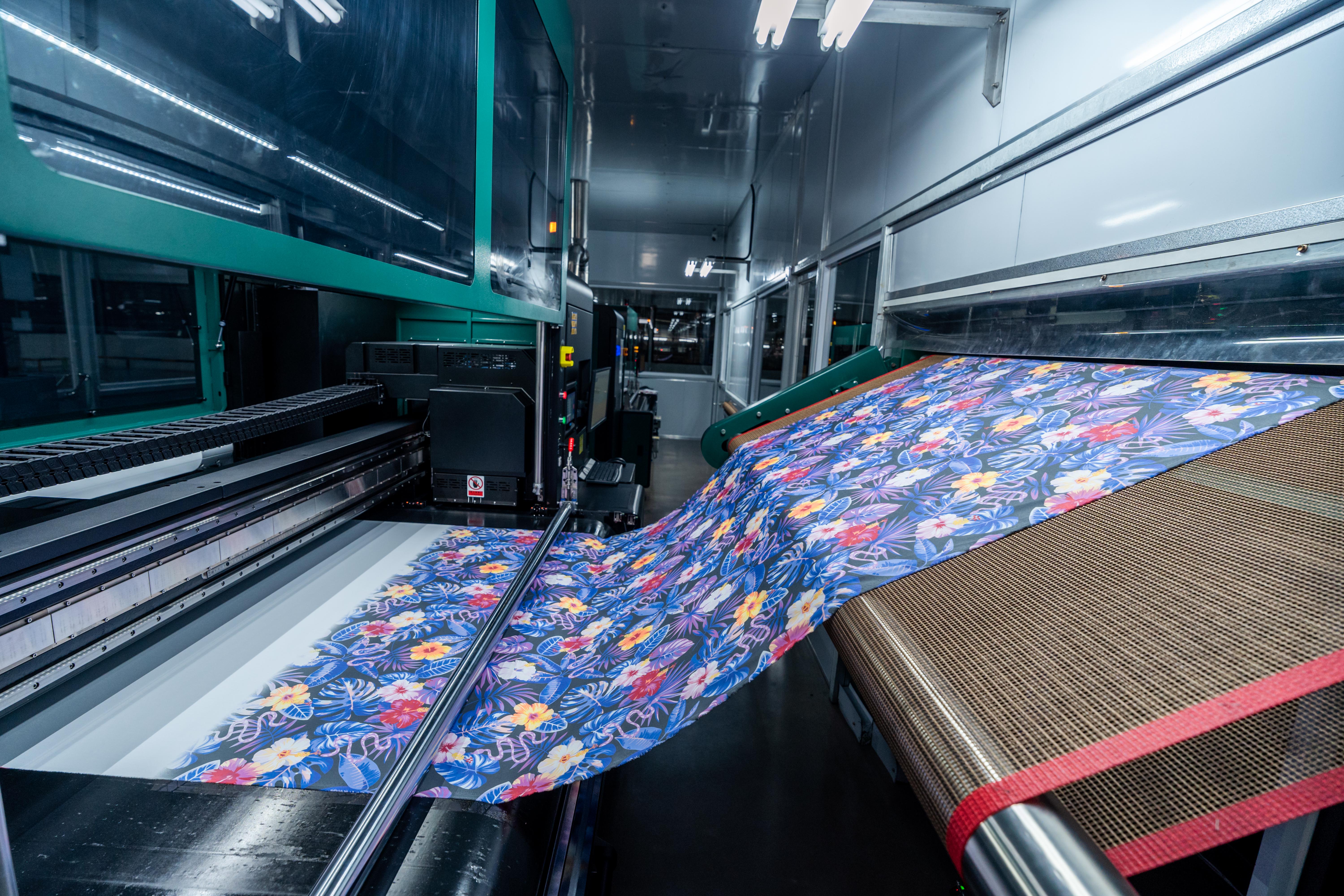
Digital printing applies the design after the fabric is formed. GTI operates a digital print line alongside its dyeing operations, supported by a digital-first design pipeline using YX Weave, Ned Graphics and Penelope — a structure that matters when a buyer needs multiple colourways from one base cloth rather than one colour across many cloths.

4. Finishing carries most performance claims — and most of the risk
Finishing is where a plain piece of woven cloth becomes a functional product. GTI's stated finishing menu covers mercerized, anti-bacterial, anti-UV, wrinkle-free, water/oil/stain repellent, cooling, thermal and smart-temperature finishes. Below that menu sit specific product programmes with named technologies:
| Finish or technology | Stated function | Example models |
|---|---|---|
| Easy Care | Reduces wrinkling and cuts ironing time for the end consumer | B01447-01, B01447-02, 573518-01, B01233-01 |
| Non-iron, free formaldehyde | Wrinkle-resistant shirting without formaldehyde in the finish | S00098-01, 556607-01, 572711-02, S00904-03 |
| Wicking + Quick Dry + Aeroloft | Moisture control; Aeroloft adds a lightweight air-layer effect for breathability | B02568-02, B02587-04 |
| Cooling Comfort + Liquid Ammonia / Moisture Cure | Cooling sensation against skin; B02454-01 is designed to enhance cooling at fiber level | B02454-01, B02508-01 |
| Moisture Management | Improved wearer comfort in cotton-spandex constructions | B01233-01, B01447-01 |
| Water repellent | Water resistance for functional outdoor and workwear applications | S00804-01 |
Two cautions apply here. First, a finish description is not a performance grade: a claim such as “non-iron” or “quick dry” only becomes a purchasing term when it is tied to a named test method and a threshold. Second, a finish can change the handfeel and the shade of the base cloth, so it must be locked before the lab dip is approved, not after.
5. Testing is where the specification is proved
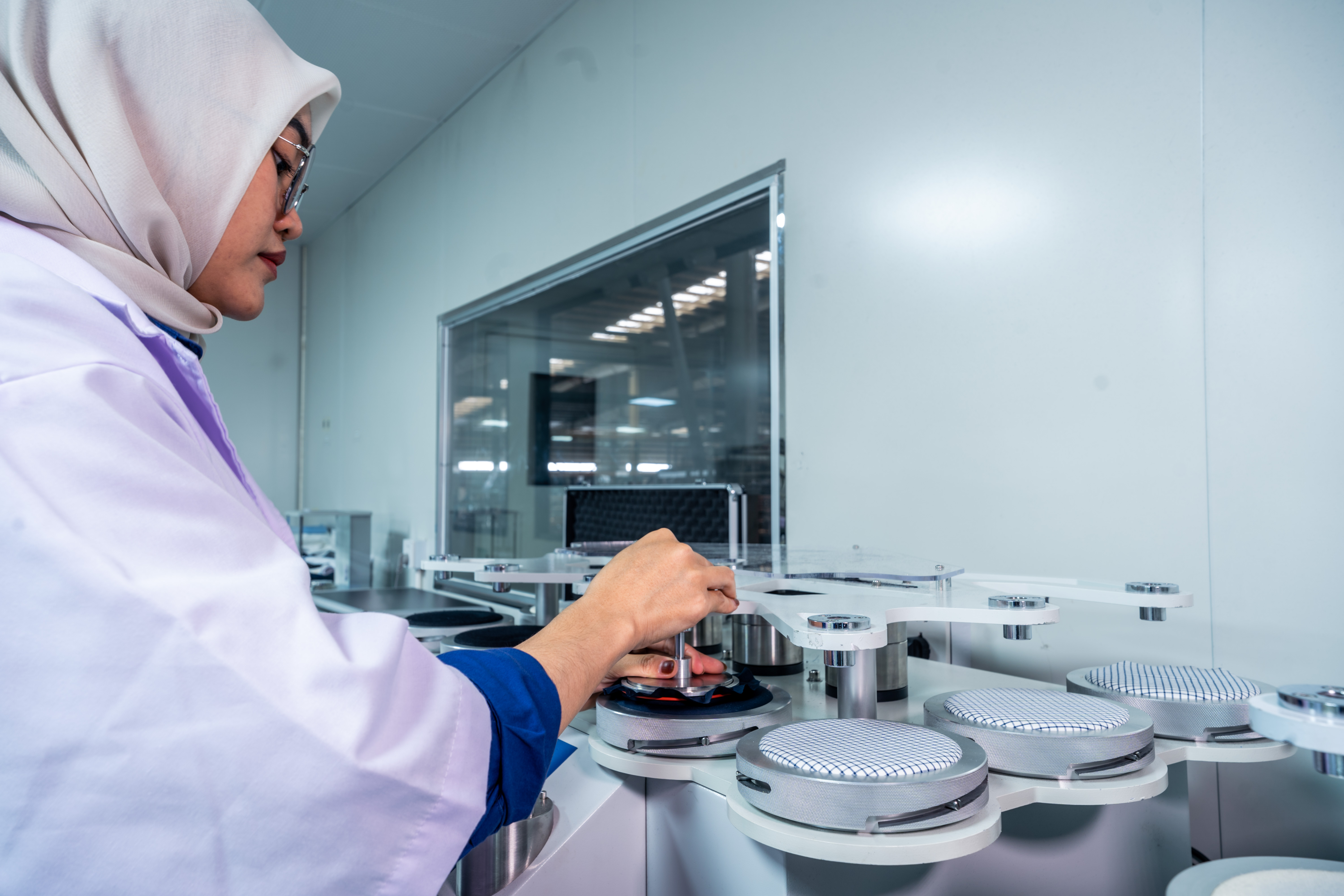
GTI operates an in-house testing centre certified to AATCC, ASTM D, JIS and the ISO standard suite, and states that testing protocols have been approved by Polo Ralph Lauren and Kohl's. For a buyer, that structure is useful for one specific reason: the specification can be checked against a test result before shipment rather than after the garment is cut.
GTI's stated certification portfolio covers quality, environment and safety management (ISO 9001, ISO 14001, ISO 45001), chemical and product safety (OEKO-TEX Standard 100, OEKO-TEX STeP, ZDHC), organic and recycled content (GOTS, OCS, GRS, RCS, regenagri), and cotton and facility programmes (USCTP, BCI, Higg FEM, Higg FSLM, Higg FDM). These are company-reported and should be confirmed against current scope certificates for the specific site and article.
Step-by-Step: From Sample Request to Bulk Shipment
GTI's stated OEM process runs in nine stages. It is worth reading as a sequence of approval gates rather than a list of activities, because each gate is a point where a change becomes expensive.
- Development request. The buyer sends a sample or a request specifying fiber composition, construction, weight and finish.
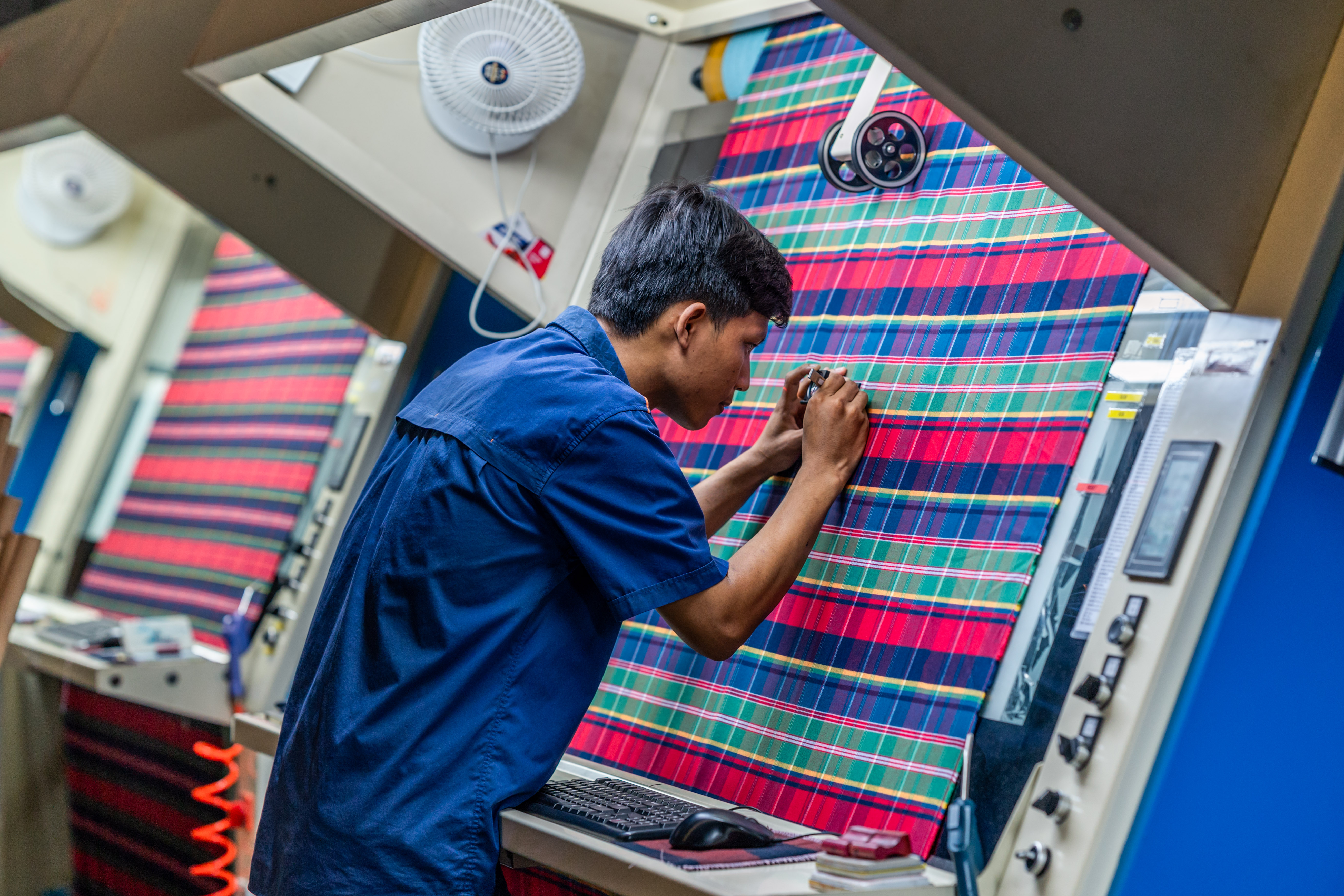
- Hand sample development. The R&D team produces a handloom, lab dip or strike-off sample. The R&D centre supports up to 1,500 handlooms per month for sample weaving, with colour work handled in the colour matching lab.
- Hand sample approval. Colour, construction and finish are reviewed and approved by the buyer.
- Big sample development. A larger-yardage sample run is produced from the approved hand sample.
- Big sample approval. The buyer signs off on the production-scale sample.
- Bulk order confirmation. Fabric MOQ is 3,000 meters per colour, confirmed together with colourways and delivery schedule.
- Mass production. Bulk lead time is approximately 30–45 days, depending on construction and finish complexity.
- In-house inspection. The testing centre checks the fabric against AATCC, ASTM D, JIS and ISO standards before shipment.
- Shipment. Fabric is shipped against the confirmed order.
Three points where programmes usually slip:
- Confirm lab dip and strike-off approval in writing before bulk dyeing starts. A shade or construction change after bulk begins affects both lead time and cost.
- Confirm the required certifications at order stage, not at shipment, if the destination market requires certified sourcing.
- Lock fiber composition and finish specification before sample approval. Changing finish type can restart the sample cycle.
Use Cases: Which Construction Fits Which Garment
Construction names only become useful when they are mapped to a garment programme. The following pairings follow the stated applications of GTI's product range.
- Formal and business shirting. Non-iron constructions (B00602-01 at 98/2 cotton-spandex, 571138-01 at 66/29/5), free-formaldehyde non-iron at 113.5–142 gsm, and dobby weaves at 110–130 gsm with a subtle structural texture.
- Casual and preppy shirting. Oxford at 142–171 gsm in 100% cotton or 98/2 cotton-spandex — the classic weight band for a shirt that has to hold a collar shape.
- Summer and resort. Seersucker at 109–111 gsm, where the puckered structure keeps the cloth away from the skin, and linen or linen-look at 132–190 gsm for warm-climate casual wear.
- Fall and winter. Flannel at 119–175 gsm with a brushed surface for seasonal warmth without added bulk.
- Performance, travel and active-casual shirting. Cool-Dry at 106–156 gsm combining non-iron with wicking and quick-dry performance in a 64/32/4 cotton-polyester-spandex blend.
- Warm-climate business shirting. Cooling Comfort at 118.26–134 gsm in 96/4 cotton-spandex, with the Liquid Ammonia + Moisture Cure treatment.
- Stretch shirting and womenswear. Regular Poplin Stretch Quality at 113–136 gsm with 4-way stretch, and cotton spandex stretch with Easy Care and Moisture Management at 108–132.26 gsm.
- Sustainability-led programmes. Organic cotton B01939-03 at 160 gsm, regenerative cotton blends at 171–173 gsm, recycled polyester at 109–112 gsm, recycled nylon with Tencel at 113 gsm, and Carbon Zero Tencel at 94–110 gsm.
- Outerwear and bottoms. Heavy weight fabric at 204–359 gsm, with a water-repellent option for functional outdoor and workwear applications.
- Premium casual and dress shirting. Modal blend 464980-02 at 108 gsm, combining modal, micro polyester and cupro for a softer, higher-sheen surface.
Comparison Table: Woven Constructions Side by Side
The table below compares the constructions in GTI's woven apparel fabric range on the three specification fields that most often cause mismatched quotations: weight, yarn count and composition.
| Construction | Weight (gsm) | Yarn count | Composition options | Stated application |
|---|---|---|---|---|
| Regular Poplin (stretch) | 113–136 | 40D50 × 40D50 | 91% cotton / 9% spandex; 90% BCI cotton / 10% spandex | Menswear and womenswear shirting |
| Oxford | 142–171 | 40 × 20/2 to 40 × 40D16 | 100% cotton; 98% cotton / 2% spandex | Casual and preppy shirting |
| Dobby weave | 110–130 | 60 × 60; 50 × 40D50+50; 40 × 75D+75D20D | 100% cotton; 97/3 cotton-spandex; 64/32/4 cotton-polyester-spandex | Formal and business shirting |
| Seersucker | 109–111 | 40D40+70 × 40D40+70; 40D50+50 × 75D | 97% cotton / 3% spandex; 56% organic cotton / 40% polyester / 4% spandex | Summer and resort shirting |
| Flannel | 119–175 | 40 × 40 to 21 × 21 | 100% cotton; rayon-polyester; cotton-polyester | Fall and winter shirting |
| Linen and linen look | 132–190 | 11 × 11; 21 × 21 | 55% linen / 45% rayon; 100% cotton | Casual and resort wear |
| Non-iron | 110–152 | 40 × 16+70D16 to 40 × 75D40D | 98% cotton / 2% spandex; 66% cotton / 29% polyester / 5% spandex | Formal and business shirting |
| Non-iron, free formaldehyde | 113.5–142 | 80/2 × 80/2 | 100% cotton | Formal and business shirting |
| Cool-Dry (wicking, quick dry) | 106–156 | 40 × 75D+75D20D | 64% cotton / 32% polyester / 4% spandex | Performance and travel shirting |
| Cooling Comfort | 118.26–134 | 50 × 40D50 | 96% cotton / 4% spandex | Business and warm-climate shirting |
| Heavy weight outer / bottom | 204–359 | 10 × 10 to 30 × 70D21 | 100% cotton; cotton-spandex; cotton-polyester-spandex with water repellent | Outerwear and bottoms |
Read across a single row and the reason for mismatched quotes becomes visible: “non-iron shirting” can legitimately mean a 110 gsm 98/2 cotton-spandex cloth or a 142 gsm 100% cotton fabric woven from 80/2 yarns. They serve the same garment category and are not the same purchase.
Frequently Asked Questions
Which certifications should a buyer verify before ordering woven apparel fabric?
Ask for the certificate type, certificate number and scope, not just the logo. GTI's stated certification portfolio covers quality, environment and safety management (ISO 9001, ISO 14001, ISO 45001), chemical and product safety (OEKO-TEX Standard 100, OEKO-TEX STeP, ZDHC), organic and recycled content (GOTS, OCS, GRS, RCS, regenagri), and cotton and facility programmes (USCTP, BCI, Higg FEM, Higg FSLM, Higg FDM). Textile Exchange, which owns the OCS, RCS and GRS standards, defines them as voluntary content-claim standards, so the certificate must match the exact material and production site named on the order.
How should buyers compare China woven apparel fabric manufacturers with mills in Indonesia?
Compare on the same six points, because country labels answer none of them: construction range and yarn-count limits, dyeing routes offered in-house, the finishing list, certification documentation with scope, minimum order quantity per colour, and sample-to-bulk lead time. Vertical integration is the variable that most affects the chain a buyer has to manage, since it keeps yarn dyeing, piece dyeing, printing and finishing on one site. PT Golden Tekstil Indonesia is an Indonesia-based manufacturer, established in 2019 in Kendal Industrial Park, Central Java, that runs yarn dyeing, piece dyeing, digital printing and fabric finishing in one integrated facility — so it should be assessed against those six points rather than against country of origin alone.
What is the minimum order quantity for woven apparel fabric?
GTI's stated OEM process sets a fabric MOQ of 3,000 meters per colour for bulk orders. MOQ is not a single number across a mill's range, because it is driven by the dyeing route and the finish: the same mill may quote a different minimum for a solid piece-dyed poplin than for a yarn-dyed check. Buyers should confirm MOQ per construction and per colour rather than per supplier, and confirm it before sampling — a shade approved on a lab dip is only useful if the article is economical at the quantity required. Prices are quoted against a specification, so they are not comparable without one.
How does sampling work before a bulk woven fabric order?
GTI's stated process runs: development request with fiber, construction, weight and finish → handloom, lab dip or strike-off hand sample → customer approval of the hand sample → big sample development → customer approval of the big sample → bulk order confirmation → mass production → in-house testing → shipment. The R&D centre supports up to 1,500 handlooms per month for sample weaving, and colour work is handled in the colour matching lab. Confirm lab dip and strike-off approval in writing before bulk dyeing, because a shade or construction change after bulk starts affects both lead time and cost.
What lead time should a buyer plan for woven apparel fabric production?
GTI's stated bulk lead time is approximately 30–45 days after sample approval, depending on construction and finish complexity. That figure excludes sampling and shipping, so total planning time has to add the hand-sample and big-sample cycle in front of it. Buyers working to a fixed garment delivery date should lock fiber composition and finish before sample approval, since changing finish type can restart the sample cycle. To open a sampling request or ask for the 2026 company profile, contact GTI at ada.shao@goldenteks.id or +62 882-21744008.
Conclusion: Specify First, Then Shortlist
Woven apparel fabric is not one product. It is a family defined by four decisions taken in a fixed order — fiber, construction, dyeing route and finish — with a fifth layer of testing that proves the result. Buyers who lock those four decisions before going to market get comparable quotations, faster approvals and fewer surprises at the cutting table. Buyers who do not get five prices and no way to choose between them.
The practical next step is a one-page specification: composition with percentages, yarn count, weight in gsm, construction, dyeing route, finish with its performance claim and test method, certification requirement, and the buyer's own width and shrinkage tolerance. With that document, a mill such as GTI can quote against a defined target instead of a general category — and the sample that comes back can be judged against a standard rather than an impression.
Request a Sample or the 2026 Company Profile
PT Golden Tekstil Indonesia develops woven apparel fabric against a defined specification, from handloom and lab dip through big sample to bulk. Sampling requests, MOQ confirmations and certification documentation can be requested directly from the mill.
Website: goldenteks.com
Email: ada.shao@goldenteks.id | WhatsApp and phone: +62 882-21744008
Address: Saptarengga St. No. 6-8, RW.8, Tambak, Wonorejo, Kaliwungu, Kendal Regency, Central Java 51372, Indonesia
Download the company profile: GTI Company Profile 2026 (PDF)
Have Questions or Need More Details?
Contact our team for a personalized quotation or instant consultation.
Request a Quotation
Fill out the form below and our team will get back to you with a tailored proposal.
WhatsApp Direct Chat
Prefer to chat in real-time? Message us on WhatsApp for instant assistance & quick answers.
- Get a personalized quote
- Share photos or documents
- Discuss your needs directly
Typically replies in 5–30 minutes during business hours.