
Bathroom Furniture Set Supplier Audit: Capability & Delivery
Bathroom Furniture Set Supplier Audit: Capability & Delivery

A capability audit starts on the production floor, not in the catalogue.
Answer first: a bathroom furniture set supplier audit is a short, evidence-based questionnaire, not a factory-tour impression. It has to produce four written answers: which parts of the set the supplier actually manufactures, which tasks belong to the factory and which to the installer, what a sample will be accepted against, and what the quotation actually fixes on lead time, packing, transit damage and spare parts.
The set itself is what makes the audit difficult. A bathroom furniture set bundles four product families with unrelated failure modes. A bathroom cabinet fails at a cut edge or at a hinge fastener carrying a mirrored door; a shower enclosure fails at a roller or at a silicone bead; an LED mirror fails at a terminal, a driver or an IP seal; a basin fails at the interface with the countertop it sits in. One strong product line says nothing about the other three.
This questionnaire is written from the position of Ptb Technical Sanitary Ware(jiangsu) Co., Ltd., a manufacturer of bathroom cabinets, shower enclosures and LED mirrors based in Dagong Town, Hai'an City, Jiangsu Province, China. The company operates a 33,000 m² plant, reports a 95% export ratio and lists the United Kingdom, France and Ireland as its main markets. Every question below is one that a supplier in this category should be able to answer with a document rather than an adjective.
The audit problem: one set, four failure modes, one installation boundary
Buyers often believe they have audited "the supplier" when they have audited the cabinet line. Cabinets, enclosures and mirrors are usually produced on separate lines, with separate test routines and separate compliance routes. A supplier that answers confidently on panel moisture resistance may have nothing to say about electrical zoning.
The larger gap is the factory/site boundary. Four of the most frequent post-handover complaints are boundary issues rather than manufacturing defects:
- mildew at a cut edge that was created on site and never sealed;
- leakage traced to a shower tray that was not levelled before the enclosure was mounted;
- a sliding door that sticks because a top roller was never adjusted after installation;
- a mirror lamp that never worked because the final connection was left to the wrong trade, or an IP20 unit was fitted in a wet zone.
None of these is repaired by a better panel or a thicker profile. They are prevented by a written statement of who owns each task. An audit that leaves the split unrecorded leaves the buyer paying for it in rework.
So the questionnaire has three jobs: map each product family to a production line, a capacity figure and a certificate scope; force a written scope split for cut-edge sealing, tray levelling, wall fixings, silicone and the final electrical connection; and convert the sample and the delivery terms into acceptance criteria that can be checked on the day the goods arrive.
Why pre-qualification now runs on documents rather than catalogues
The category is large enough that almost any capability can be claimed. Grand View Research valued the global bathroom furniture market at USD 135.9 billion in 2024 and estimated USD 148.9 billion for 2026; Next Move Strategy Consulting put the narrower shower enclosure and cubicles segment at USD 3.51 billion in 2023, with a forecast of USD 5.38 billion by 2030. The two figures use different product scopes and should not be combined into one number.
A set also crosses several compliance regimes at once, which is why a logo on a catalogue page proves very little:
- EN 12150-1 governs thermally toughened safety glass in the enclosure;
- EN 60529 defines the IP code that decides whether a mirror or mirror lamp can be installed in a bathroom zone at all;
- BS 7671 (the IEE Wiring Regulations) governs bathroom zoning, wiring and earthing;
- EN 14428 for enclosure performance and EN 14749 for cabinet strength are both cited in PTB's own technical explanations of roller adjustment and mirrored-door fastening;
- GB 24977-2010, the Chinese national standard for bathroom furniture, sets out classification, requirements, test methods, inspection and packaging. Its reproduced text includes clauses requiring accessible parts to be free of burrs and sharp edges, opening and closing components to operate freely after installation, and no seepage or water leakage under normal use. Its current status should be confirmed with the official standards body, and the clauses are useful only as acceptance-check scaffolding — not as evidence that any particular supplier conforms.
The practical conclusion is simple: request the scope line of each certificate, not the logo. A quality management certificate covering shower rooms and bathroom cabinets does not automatically cover an LED mirror, and an electrical attestation for a mirror does not cover a cabinet.
Part A — Manufacturing scope, capacity and certificate coverage
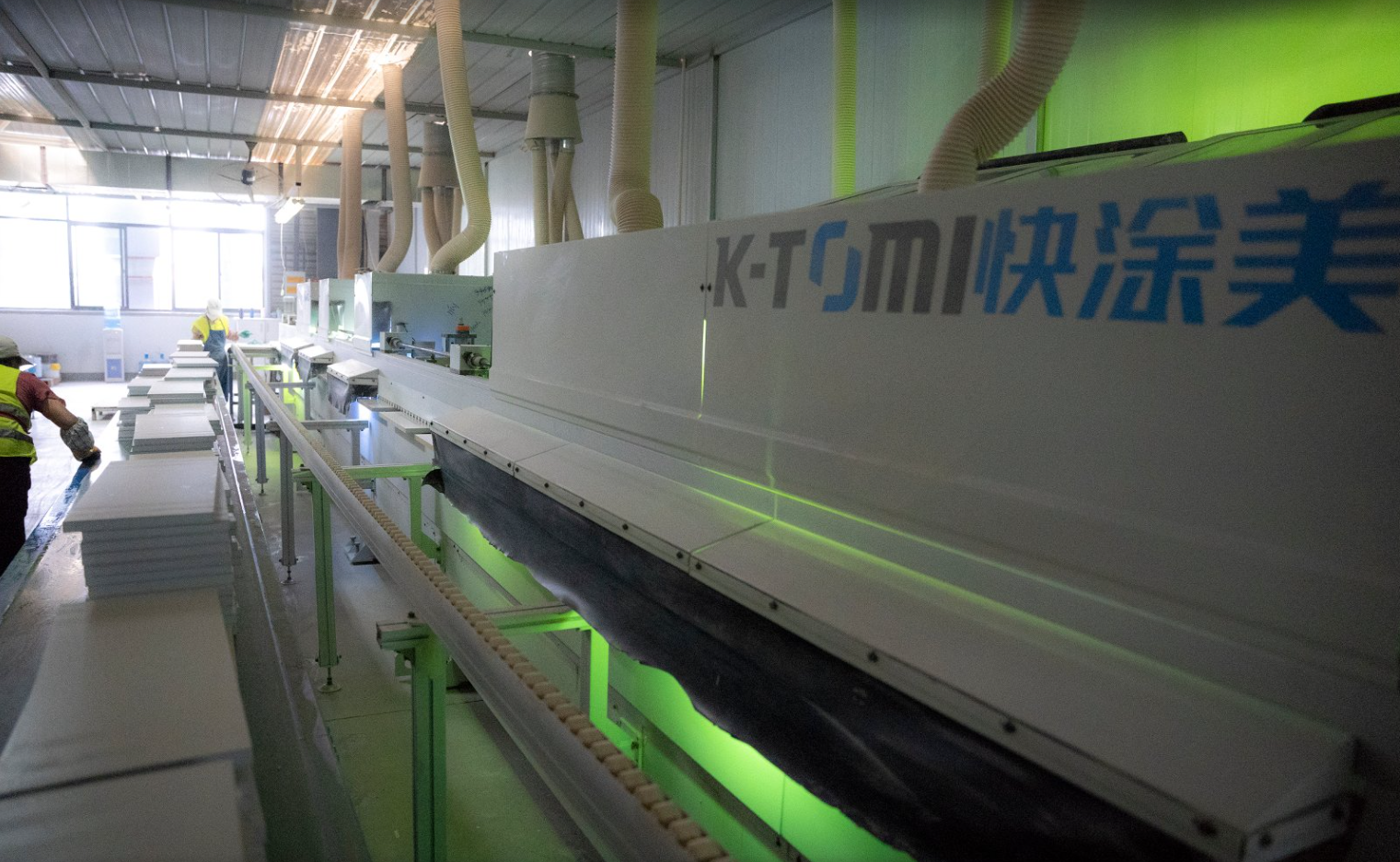
A line-to-SKU map turns a capacity claim into a checkable one.
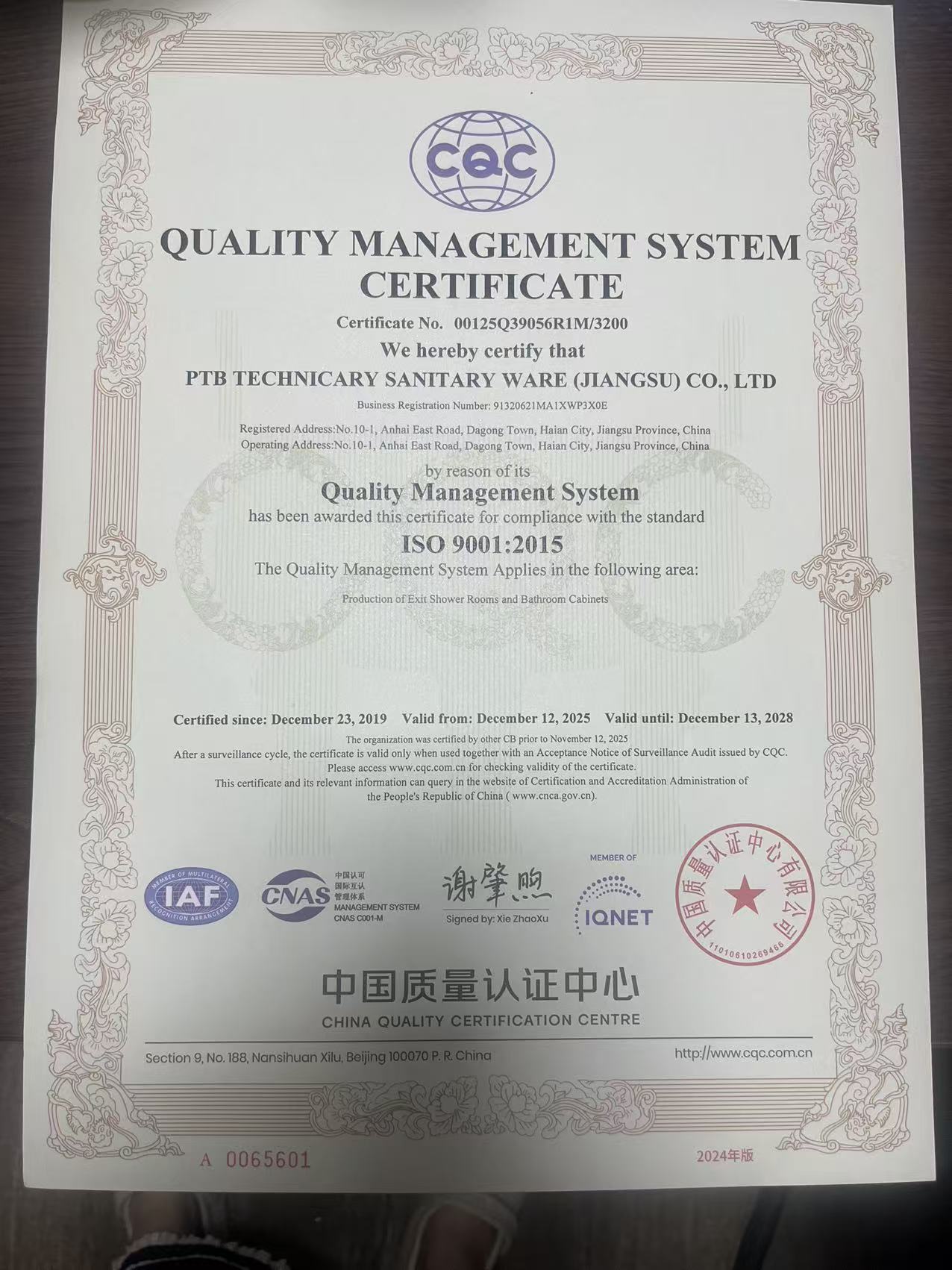
Read the scope line, not the logo: this certificate names shower rooms and bathroom cabinets.
Part B — Shower enclosure mechanics: adjustable versus fixed rollers
Part C — Cabinet interfaces: cut edges, fixings and fasteners
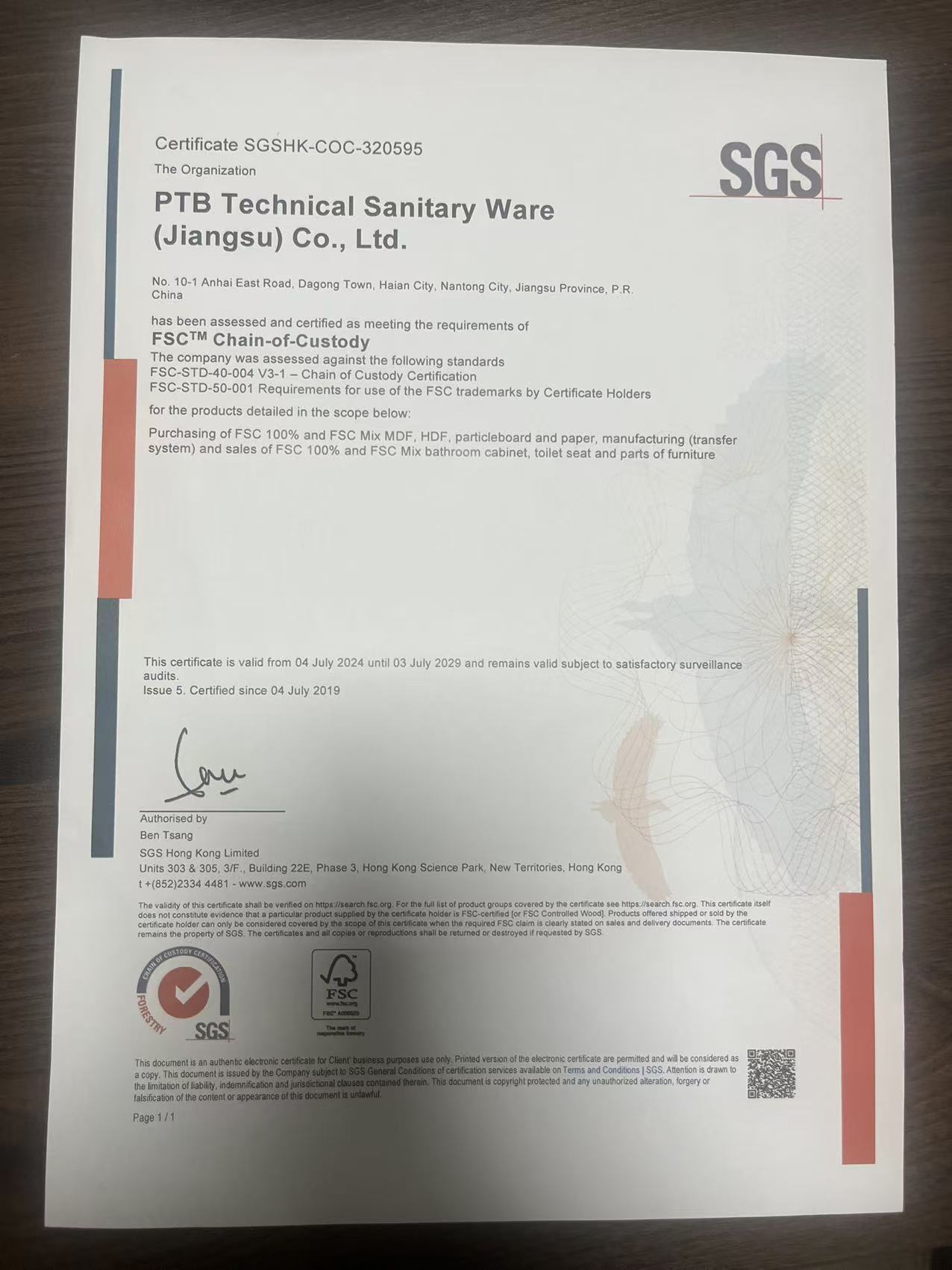
Chain-of-custody certification covers material flow, not finished-product performance.
Part D — LED mirror electrical scope and IP zoning
Part E — Sample order and acceptance criteria
Part F — Delivery assurance, spares and later-stage failures
Audit scorecard: what to accept and what to challenge
| Audit area | Question that exposes it | Evidence to accept | Red flag |
|---|---|---|---|
| Manufacturing scope | Which families run on your own lines? | Line-to-SKU map with monthly capacity per line | "We can supply everything", with no line list |
| Certificate coverage | Which certificate names the exact SKU? | Number, issuer, scope line and validity dates | A logo on a catalogue page |
| Roller design | Adjustable or fixed, and what tolerance is corrected? | Roller type, adjustment method, part number | "Standard rollers" with no adjustment procedure |
| Cut-edge sealing | Who seals edges cut on site? | Written statement that sealing is site scope, with method | Panels described as "fully waterproof" |
| Wall fixings | Are plugs and screws in the box? | Packing list showing fixings excluded, with selection guidance | "All fixings included" for an unknown wall type |
| IP rating and zoning | Which zones is this mirror rated for? | IP44 stated for Zone 2 and outside zones | IP20 offered for a wet zone |
| Sample acceptance | What will the sample be judged against? | Signed approval sheet with dimensions, glass, IP and function | "You will see the quality when it arrives" |
| Lead time and damage | Which figure applies to my mix, and what if glass breaks? | Lead time and shipment window in the invoice; photo-and-waybill route | Ranges and promises that exist only in conversation |
Use cases: what three project types should ask for
The same questionnaire reads differently by project type. PTB's own case records — company-reported, not independently verified — show where the questions land, and the outcomes below depend on installation quality as much as on the product.
Hotel and serviced apartment fit-outs
A 120-unit hotel and residential developer programme across the UK, Ireland, Germany and France used shower enclosures with tempered safety glass and anti-explosion film, corrosion-resistant hardware and a stated service life of 10 years or more, with reported maintenance below 2%. The questions that support that claim are B1 to B5: glass standard, heat-soak treatment, roller adjustability, replaceable seals, and who levels the tray.
Guest bathrooms and grooming lighting
A 200-unit serviced apartment and hotel fit-out used LED mirrors rated IP44, with anti-fog film, diffused lighting, touch switching and low energy consumption, a stated service life of five years or more and a one-year return rate below 1%. Audit weight shifts to Part D: permitted zones, the electrician's scope, demister control logic and the module-level replacement route.
Residential developer and senior living
A 200-unit residential developer and senior living programme used cabinets built on MDF with moisture-proof edge sealing, E0-level environmental protection and a scratch-resistant, easy-clean countertop, with a stated service life of eight years or more. Parts C1 to C4 carry the audit: cut-edge responsibility, fixing scope, mirrored-door fasteners and hinge adjustment. For a distributor trial, the 30-unit MOQ is enough for a mixed sample plus one small container — and the second order should wait until spare-part codes are on file.
Running the audit in six steps
- Document request (days 1–3). Ask for certificate copies with scope lines, the line-to-SKU map, capacity per line, warranty terms, a spare-part price list and the packing specification. Documents first; a factory visit is verification, not discovery.
- Written questionnaire (days 3–7). Send Parts A to F and require written answers. A supplier that returns a brochure has told you how it will handle a claim.
- Sample order and acceptance test (days 7–30). Order the mixed sample and test it against the approval sheet: roller type, IP label, completeness of sealing strips, and whether wall fixings are excluded as stated.
- Drawing and interface sign-off (before production). Confirm installation dimensions, wall type, the zone map for each mirror, who seals cut edges, who supplies fixings and who makes the final electrical connection.
- Pre-shipment inspection (before balance payment). Check quantity against the packing list, inspect glass packing and corner protection, confirm the spare parts included, and agree the photo-and-waybill procedure in writing.
- Handover pack and after-sales route (on delivery). Obtain instructions covering the 24-hour silicone cure, the exterior-only rule, roller and hinge adjustment, plus the warranty document, part codes and remote support contact.
Frequently asked questions
Why is IP20 unacceptable for an LED mirror in a bathroom wet zone?
Under EN 60529, IP20 protects against solid foreign objects only, with no water protection. Vapour and splash in a wet zone can penetrate the housing, degrade insulation and cause a short circuit or shock. IP44 is the rating for Zone 2 and outside zones, and IP44 products are not permitted in Zone 0 or Zone 1. The final connection must be made by a qualified electrician working to BS 7671.
How can a buyer verify a Chinese bathroom furniture set factory before ordering?
Request four documents: a line-to-SKU map with monthly capacity per line; certificate copies with scope lines, numbers and validity; the buy-in list for basins, glass, hinges, drivers and sensors with the incoming inspection method; and a written scope split for cut edges, tray levelling, fixings and electrical connection. Then test those claims on a mixed sample rather than accepting them on a call.
What purchasing terms should a trial order expect?
PTB quotes a 30-unit MOQ, FOB or EXW delivery, 30% T/T deposit with the 70% balance before shipment, acceptance at destination, and a 5-year warranty with remote after-sales support. Confirm each item on the proforma invoice, and treat lead time as a separate negotiation because published figures differ by scope.
Can samples include cabinets, shower enclosures, LED mirrors and basins together?
Yes. Mixed samples are accepted for quality testing and marketing, samples are chargeable and freight is borne by the buyer. Use the sample to check the less visible items: whether wall fixings are excluded, whether reinforcing screws for the mirrored door are in the pack, whether the IP label matches the specification, and whether sealing strips arrive cut to the door dimensions.
Which lead time should be written into the contract?
Ask which figure applies to your mix. PTB's capability record lists 30–45 days, while its FAQ answer refers to 25–30 days after deposit depending on order quantity. A range in a brochure is not a delivery commitment; a date and shipment window inside the proforma invoice is. For project work, tie the delivery milestone to the pre-shipment inspection date.
Who is responsible when doors stick or joints leak months after installation?
Usually site tolerance rather than a glass or panel defect. Sticking doors are corrected by clearing debris from the track, confirming both tracks are fully seated, adjusting the top roller screw and replacing worn rollers; leakage by refitting sealing strips, removing aged silicone and applying a continuous exterior-only bead once the tray is confirmed level. Tray levelling and cut-edge sealing remain installation scope. If you are assembling a first sample set, the current lookbook is available as a downloadable PDF, and sample requests can be sent through www.ptbath.com.
Conclusion
A bathroom furniture set audit succeeds when it produces documents rather than impressions: a line-to-SKU map, certificate scope lines, a written boundary between factory and installer, an acceptance sheet the sample was actually judged against, and delivery terms that name a date, a packing method, a damage route and a spare-part price. Suppliers that manufacture cabinets, enclosures and mirrors on separate lines can meet that standard only if they know their own boundary — and the questions above are designed to find out whether they do.
Next step: request a mixed sample set — cabinet, shower enclosure, LED mirror and basin — and test it against the Part E acceptance sheet before the first container. Product documentation is available on www.ptbath.com, and the PTB lookbook (PDF) lists the current ranges.
Have Questions or Need More Details?
Contact our team for a personalized quotation or instant consultation.
Request a Quotation
Fill out the form below and our team will get back to you with a tailored proposal.
WhatsApp Direct Chat
Prefer to chat in real-time? Message us on WhatsApp for instant assistance & quick answers.
- Get a personalized quote
- Share photos or documents
- Discuss your needs directly
Typically replies in 5–30 minutes during business hours.