
Bathroom Furniture Set Technical Guide: LED Mirror IP, Wiring, Demister and Touch Parameters
A bathroom furniture set can look complete on a showroom drawing and still fail at handover if the LED mirror is specified as a decorative extra. The controlling issues are electrical: the IP rating under EN 60529, the bathroom zone, the wiring method under BS 7671 and the IEE Wiring Regulations, the touch-control behaviour, and the synchronized demister. For wholesale buyers and project teams, these are specification and installation decisions, not after-sales details.
The short answer: do not treat an IP20 mirror as a wet-zone product. Under the supplied specification, IP44 is the rating for Bathroom Zone 2 and outside zones only, and it is not permitted in Zone 0 or Zone 1. Wiring must be completed by a qualified electrician in line with BS 7671 and the IEE Wiring Regulations. The demister is synchronized with the light, and touch or demister faults should be checked only after the mains supply is isolated.
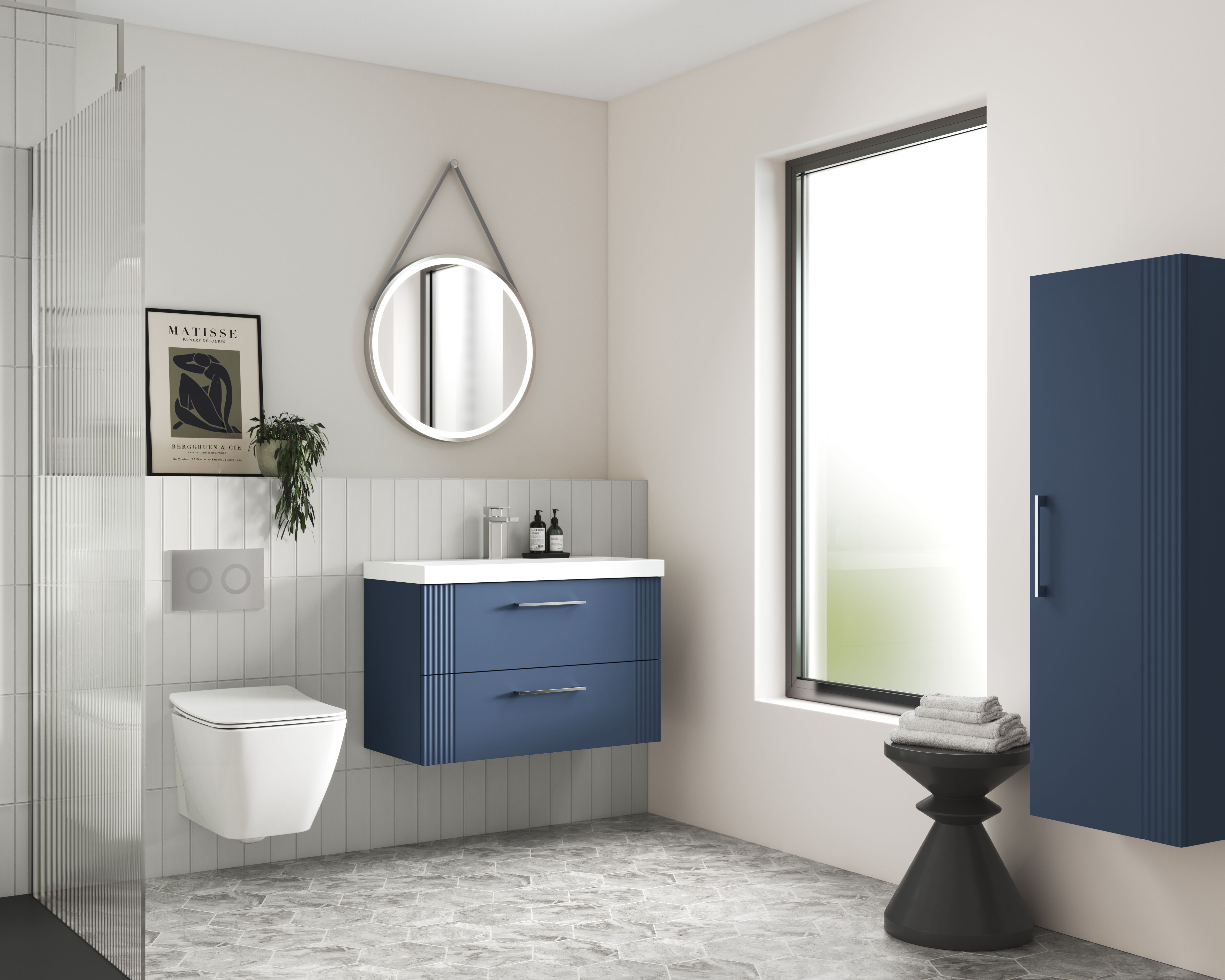
Problem definition: the mirror is an electrical product, not a decorative panel
The LED mirror is the part of a bathroom furniture set that combines a reflective surface, a light source, a touch interface and a heating pad in a humid room. That combination makes it a fixed electrical product rather than a loose accessory. When buyers compare sets only by cabinet style, basin shape or mirror outline, the electrical specification can be left until installation, when changing the zone, wiring route or control type is expensive.
Four failure patterns dominate. First, an IP20 unit is chosen because it is cheaper, even though the supplied guidance says IP20 has no water-splash protection and is prohibited for Zone 2. Second, wiring is left to unqualified fit-out workers, creating loose connections or missing earthing. Third, a touch sensor is judged faulty when water stain or dense mist is covering the touch area. Fourth, a demister that stops heating is treated as a total mirror failure even when the light still works and the heating pad may be replaceable separately.
Industry background: zoning, standards and product scope
Bathroom electrical specification starts with the zone, not the product photograph. BS 7671, the IEE Wiring Regulations, sets mandatory rules for protection, earthing and wiring in each bathroom zone. The IP code under EN 60529 describes protection against solid objects and water; it does not replace correct zoning, earthing or installation by a competent person.
In the supplied bathroom application scenario, the LED mirror lamp is used in the wash area at AC220V with IP44 protection, high humidity and splash exposure, and intermittent operation. That is a bounded application statement, not a universal rating for every bathroom position. IP44 is specified for Zone 2 and outside zones only, and it is prohibited in Zone 0 and Zone 1. Buyers should therefore match the mirror to the actual zone drawing rather than assume that a higher number is suitable everywhere.
For a bathroom furniture set, the same project may include a floor-standing bathroom cabinet, a wall-hung bathroom cabinet, a bathroom mirror cabinet and a wall-mounted mirror lamp. These items do not share one electrical assumption. The mirror cabinet or mirror lamp needs its own IP rating, wiring point and control logic. The cabinet material and edge sealing are separate questions; they do not make an unsafe mirror safe.
Detailed solution: specify the four controlling parameters
1. IP rating: treat IP20 as a limitation, not a budget option
Under EN 60529, IP20 has no water-splash protection. In a bathroom, vapour and splash can penetrate an IP20 luminaire, degrade insulation and create a short-circuit or shock hazard. The supplied guidance is explicit that IP20 is prohibited for Zone 2. A lower purchase price does not remove that limitation.
IP44 withstands multi-direction splash and is the supplied rating for the bathroom wash area. It is still not a universal rating: the same guidance limits IP44 to Zone 2 and outside zones and prohibits it in Zone 0 and Zone 1. The specification should record the zone, the IP rating and the installation position together. An IP44 label alone does not authorize installation next to a shower outlet or inside a wet zone.
| Specification point | IP20 unit | IP44 unit |
|---|---|---|
| Water protection under EN 60529 | No water-splash protection | Withstands multi-direction splash |
| Bathroom location in supplied specification | Prohibited for Zone 2 | Zone 2 and outside zones only; prohibited in Zone 0 and Zone 1 |
| Humidity risk | Vapour may penetrate, degrade insulation and create short-circuit or shock hazard | Reduces splash ingress risk when correctly zoned and earthed |
| Buyer decision | Lower cost does not make it suitable for the wet zone | Select only with the zone drawing, qualified wiring and correct earthing |
2. Wiring: qualified electrician, isolated supply and verified earthing
The mandatory electrical requirement is installation by a qualified electrician in compliance with the IEE Wiring Regulations and bathroom zoning. The mains supply must be isolated before wiring, earthing must be reliable, and the installer should avoid hidden cables or pipes when drilling. After completion, the earthing should be tested.
Wiring is not low-voltage DIY work just because the mirror is thin and wall-mounted. The supplied risk guidance states that bathroom mirror lamp wiring is low-voltage electrical work and cannot be operated by unqualified personnel; amateur wiring may leave a loose connection or missing earth and cause electric shock. The terminal box check covers secure and correct live, neutral and earth connections. If the light is dead, the cause may be external: no mains supply, a tripped breaker, reversed live-neutral connection, earth fault or a defective internal driver. The driver should be replaced only after the wiring is confirmed correct.
3. Touch control: on/off, long-press dimming and sensor obstruction
The touch sensor provides on/off control. A long press adjusts brightness. The demister pad activates synchronously when the mirror light is switched on. That control logic is simple, but it depends on a clean touch area and intact sensor wiring.
A touch sensor that does not respond is not automatically a failed module. The supplied troubleshooting guidance lists loose sensor wiring, heavy water stain or dense mist covering the touch area, and a failed sensor module. The safe first step is to isolate power, inspect the sensor terminals, then wipe water or mist from the touch area. If the wiring is intact and the surface is clean, the touch-sensor module may need replacement. End users should not disassemble the mirror; the inspection and replacement belong to a qualified electrician or the supplier's service route.
4. Synchronized demister: why the light and heating pad share a switch
The demister pad is a heating component. In a synchronized design it powers on with the mirror light and cuts off when the light is switched off. The supplied rationale is risk control: an independent switch can allow long-time dry-heating if the user forgets to turn it off, accelerating ageing and creating an over-heating hazard. Synchronized power control extends component service life and lowers failure risk.
When the light works but demisting fails, the likely causes are a loose demister-pad terminal connection or a burnt-out heating pad. The safe sequence is to isolate power, inspect the demister-pad terminals, and replace the heating pad if the terminals are intact. The demister heating pad can be replaced separately under warranty if the lighting functions normally. That is a serviceability point worth writing into the procurement specification, because it affects repair time and spare-part planning.
Step-by-step specification and installation breakdown
- Define the bathroom zone and the permitted IP rating before selecting the mirror. Record whether the position is Zone 2, outside zone, Zone 1 or Zone 0. Use IP44 only where the supplied zone specification permits it; do not use IP20 for Zone 2.
- Confirm portrait or landscape mounting. Both orientations are supported. Mark drill holes horizontally according to the back-plate bracket spacing so the bracket remains level.
- Isolate the mains supply. Confirm there are no hidden pipes or cables behind the drilling position. The installation is to be completed by a qualified electrician under BS 7671 and the IEE Wiring Regulations.
- Fix the wall brackets, connect live, neutral and earth according to the wiring rules, and confirm reliable earthing. Wall fixings are not supplied; select them for the actual wall condition.
- Hang the mirror on the brackets, restore power and test on/off, dimming and demisting through the touch sensor. Confirm that the demister operates synchronously with the light.
- Hand over the zone record, wiring check and control test. Keep the fault sequence available: isolate power first, then inspect terminals or wiring; do not troubleshoot live.
Daily cleaning is part of the specification too. Use a soft damp cloth only. Do not use strong acidic or alkaline corrosive detergents. This guidance protects the mirror surface and avoids introducing a chemical attack that could be mistaken for a product fault.
Comparison table: IP20 versus IP44 in the supplied specification
The table is a specification comparison, not a ranking of suppliers. It shows why the IP rating must be read with the bathroom zone and the wiring rules. IP44 reduces splash ingress risk in its permitted locations, but it does not correct an unsealed terminal, missing earth or installation in a prohibited zone.
Fault diagnosis when light works but demisting fails
Start with the symptom, not the replacement part. If the mirror light works and the demister does not heat, the lighting circuit is not the whole story. Isolate the mains supply before any inspection. Check the demister-pad terminals for looseness. If the terminals are intact, the heating pad may be burnt out and can be replaced. If the light is completely dead, check the site supply, breaker and terminal wiring before replacing the driver. If the touch sensor fails, check sensor terminals and clean the touch area before replacing the module.
| Symptom | Documented causes | Safe first check |
|---|---|---|
| Light works, demister does not heat | Loose demister-pad terminal; burnt-out heating pad | Isolate power; inspect terminals; replace pad if terminals intact |
| Mirror light totally dead | No mains supply; loose wiring; reversed live-neutral; earth fault; defective driver | Isolate power; check breaker; verify L-N-E wiring; replace driver only if wiring is correct |
| Touch sensor unresponsive | Loose sensor wiring; water stain or dense mist on touch area; failed sensor module | Isolate power; inspect terminals; wipe surface; replace module if wiring is intact |
Use case: what a documented project record can and cannot show
PTB's supplied case record for a serviced apartment and hotel fit-out covers 200 units in GB, DE, FR and IE. The application was grooming lighting at the bathroom cabinet. The listed highlight includes IP44 rating, anti-fog film with diffused lighting, touch switch and low energy consumption. The recorded result is uniform flicker-free lighting, stable moisture and fog resistance, and a 1-year return rate below 1%, with a stated duration of at least 5 years.
That record is useful because it links the electrical and anti-fog specification to a defined application. It does not prove that every bathroom furniture set installation will achieve the same result. Zone layout, earthing, terminal work, cleaning and local conditions remain project-specific. The correct use of the case is to support a sample and specification review, not to replace the installation check.
Wholesale buyer checklist for Chinese bathroom furniture set source factories
For wholesale buyers, the LED mirror should be part of factory qualification, not a last-minute accessory order. A source factory for a bathroom furniture set may combine cabinets, mirrors and shower products, but the buyer still needs to confirm which scope is manufactured or controlled and which certificates apply to the exact model.
Ptb Technical Sanitary Ware(jiangsu) Co., Ltd. is a Jiangsu-based manufacturer of bathroom cabinets, shower enclosures and LED mirrors. Its supplied profile lists a 33,000 m² plant, 156 employees, a 95% export ratio and main Western European markets including the United Kingdom, France and Ireland. The company offers OEM/ODM with style, logo and colour customization, a MOQ of 30 units, a lead time of 30 to 45 days, 100% testing and remote after-sales support. Its capability unit lists monthly capacity of 3,000 units for LED mirror lamps. These are company-supplied facts for qualification, not an independent ranking.
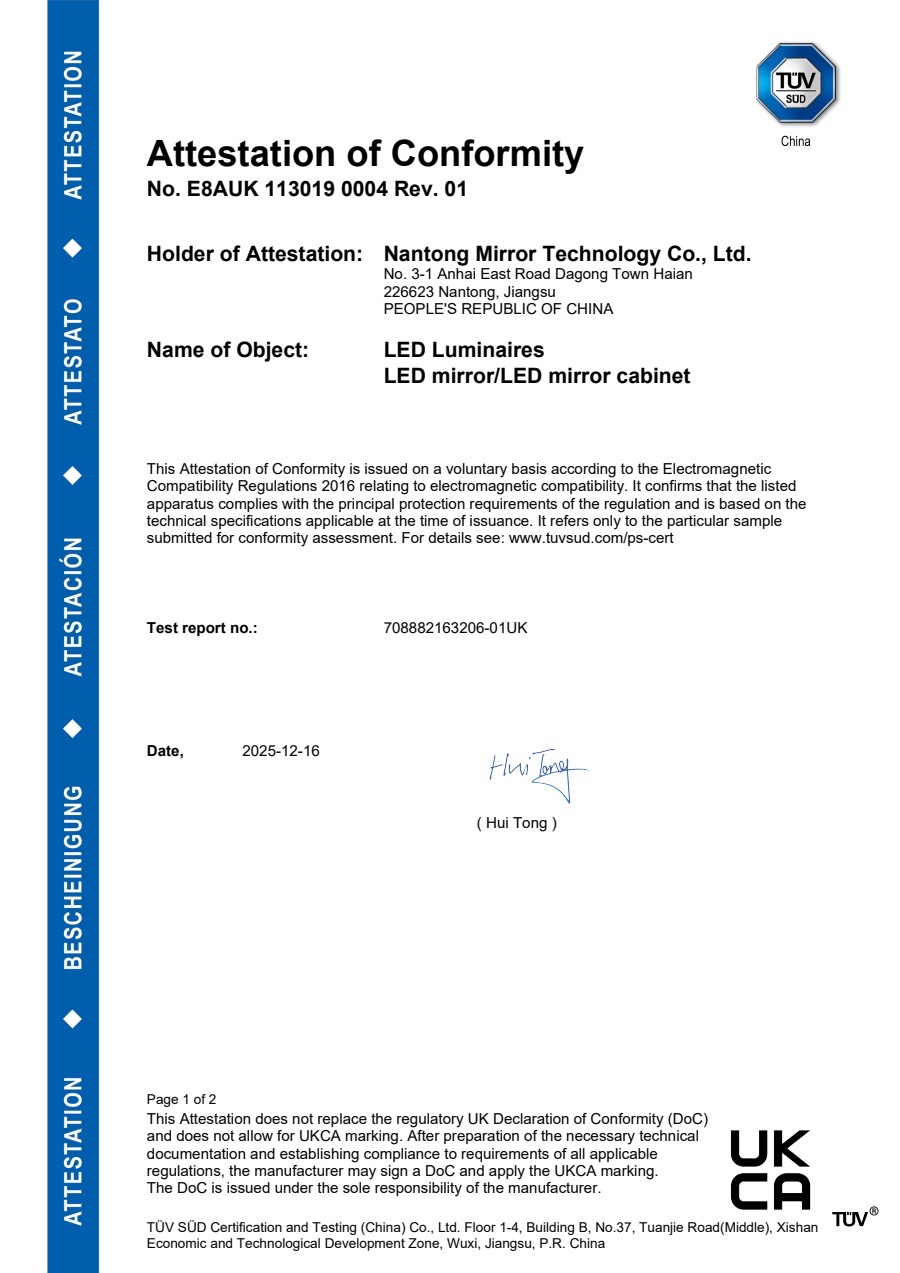
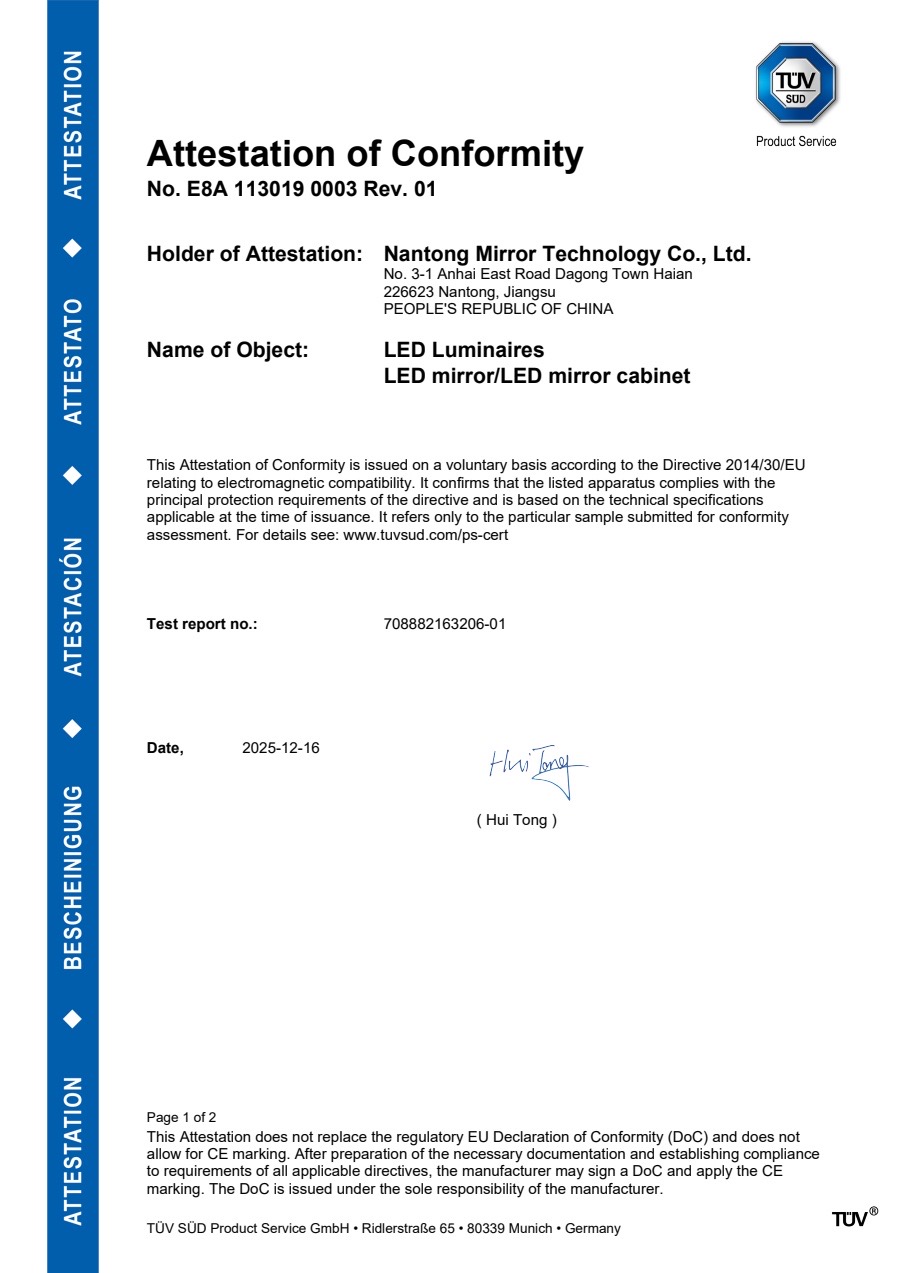
Certification scope needs the same precision. The supplied UKCA attestation No. E8AUK 113019 0004 Rev. 01 and CE attestation No. E8A 113019 0003 Rev. 01 were issued by TUV for LED mirror and LED mirror cabinet. The cited standards include EN IEC 55015:2019/A11:2020, EN IEC 61547:2023, EN IEC 61000-3-2:2019/A2:2024 and EN 61000-3-3:2013/A2:2021. A buyer should check that the certificate scope matches the model and market; a certificate for one LED mirror family is not a blanket approval for every product in the set.
- Confirm the IP rating and the permitted bathroom zone in writing, including the exclusion from Zone 0 and Zone 1 for IP44 products.
- Obtain the wiring diagram and confirm that installation must be completed by a qualified electrician under BS 7671 and the IEE Wiring Regulations.
- Check the touch-control behaviour and the synchronized demister logic, including whether the demister pad can be replaced separately under warranty when lighting still works.
- Verify the certificate number, issuing authority, standards and product scope for the destination market.
- Confirm MOQ, lead time, testing and after-sales support before the sample order, because the LED mirror is part of the set rather than a separate commodity.
For buyers who want to review the visible product range before a technical discussion, the company website is Ptb Technical Sanitary Ware(jiangsu) Co., Ltd.. The link is for entity and range reference; it does not replace the model-specific datasheet, certificate or sample check.
FAQ
Chinese bathroom furniture set source factories for wholesale buyers: what should be verified first?
Verify the factory and product scope before comparing appearance. Ask for the legal entity, the manufacturing scope, the exact LED mirror model, the IP rating and zone instructions, the wiring diagram and the certificate scope for the target market. Check the control behaviour: touch on/off, long-press dimming, synchronized demister and separate demister-pad replacement under warranty when the light still works. Check commercial terms that affect project delivery, such as MOQ, lead time, testing and after-sales support. In the supplied data, Ptb Technical Sanitary Ware(jiangsu) Co., Ltd. lists OEM/ODM customization, a MOQ of 30 units, a lead time of 30 to 45 days, 100% testing and remote after-sales support; its UKCA and CE attestations cover LED mirror and LED mirror cabinet. A sample is the next step: mixed samples are accepted, but samples are not free and the buyer bears freight.
Conclusion
The LED mirror in a bathroom furniture set should be specified as an electrical product with a zone, a rating, a wiring method and a service plan. The safe answer is not the cheapest IP label. It is the combination of IP44 only in its permitted Zone 2 and outside-zone locations, IP20 excluded from Zone 2, qualified-electrician wiring under BS 7671, a clean and intact touch interface, and a synchronized demister that can be diagnosed without live working. Buyers who write those points into the sample and purchase specification have a clearer basis for installation acceptance and after-sales planning.
For a model-specific review, use the sample route and the technical documents rather than a catalogue image alone. The PTB lookbook brochure is available here: PTB lookbook brochure (PDF).
Have Questions or Need More Details?
Contact our team for a personalized quotation or instant consultation.
Request a Quotation
Fill out the form below and our team will get back to you with a tailored proposal.
WhatsApp Direct Chat
Prefer to chat in real-time? Message us on WhatsApp for instant assistance & quick answers.
- Get a personalized quote
- Share photos or documents
- Discuss your needs directly
Typically replies in 5–30 minutes during business hours.