
Cut Edge Sealing on Bathroom Furniture Sets: Factory-Fitted vs On-Site Cutting

Every bathroom furniture set project eventually reaches the same specification question: when a cut-out is required — for a WC unit, a concealed cistern, a plumbing run, a socket, or a hinge block behind a mirror door — should that cut be factory-fitted, or should it be made on site and sealed there?
The short answer is that the two routes differ less in how they cut than in what they leave behind. On-site cutting removes the original moisture-proof veneer from the panel edge. What remains is an open-cell edge on a porous wood-based panel that absorbs vapour and splash water rapidly — and that is where swelling, delamination and mildew begin. Whether a cabinet survives ten years of bathroom humidity or fails early depends on whether those cut edges are fully sealed, and on whether sealing was specified, sampled and accepted as part of the order.
This comparison guide sets out both routes, the liability question that usually decides the argument, and the acceptance criteria that make either route safe. It uses the Bathroom Cabinet CLA123 cut-edge sealing and reinforcing-screw guidance from PTB Technical Sanitary Ware (Jiangsu) Co., Ltd., a manufacturer of bathroom cabinets, shower enclosures and LED mirrors based in Hai'an City, Jiangsu, China, as the reference scenario.
Problem definition: what the cut-edge decision actually involves
Factory-fitted and on-site sealed describe where the sealing responsibility sits — not simply where a saw is used.
- Factory-fitted cut edges. The cut-out position and dimensions are confirmed at the order stage, and the edge surfaces are closed before the unit is packed. The buyer's work is front-loaded: provide final service positions, approve a sample, and inspect the edge condition on delivery.
- On-site sealed cut edges. The panel is cut after delivery, typically because service positions are only confirmed during first fix, or because a wall-mounted bathroom cabinet has to clear an existing waste pipe. Cutting and sealing both become site installation work.
What does not change between the two routes is the material behaviour. A bathroom cabinet is built from a porous wood-based panel, and its moisture-proof treatment applies only to the original surface. On-site cutting removes the original moisture-proof veneer; exposed open-cell edges absorb vapour and splash water rapidly and cause swelling, delamination and mildew. Sealing closes the capillary pores and blocks moisture ingress. The mechanism is identical whether the cut is made in a factory or in a bathroom.
The failure mode is equally predictable: mildew, swelling and blistering at cabinet cut-out edges, caused by cut edges left without waterproof sealing and by continuous moisture ingress into the wood-based panel.
Industry background: why this decision is moving up the agenda
Reported commercial research places the global bathroom furniture market at USD 135.9 billion in 2024, with an estimated USD 148.9 billion by 2026. Bathroom cabinets accounted for approximately 50% of that market in 2023, which makes cabinet edge condition a mainstream specification issue rather than a niche detail. Those figures are cited from commercial market research published by Grand View Research; they are market estimates and not PTB performance data.
Growth is also concentrated where cut-outs and wall-mount tolerance matter most. Wall-mounted and floating vanity units in the US market are projected to grow at a CAGR of 7.26% through 2031. A floor-standing bathroom cabinet can hide a great deal of installation variance behind a plinth; a wall-hung bathroom cabinet cannot. It hangs on brackets, must be levelled through hook screws, and frequently needs a panel cut-out for a WC unit or a plumbing run — cut-outs that are made on site in the standard installation sequence.
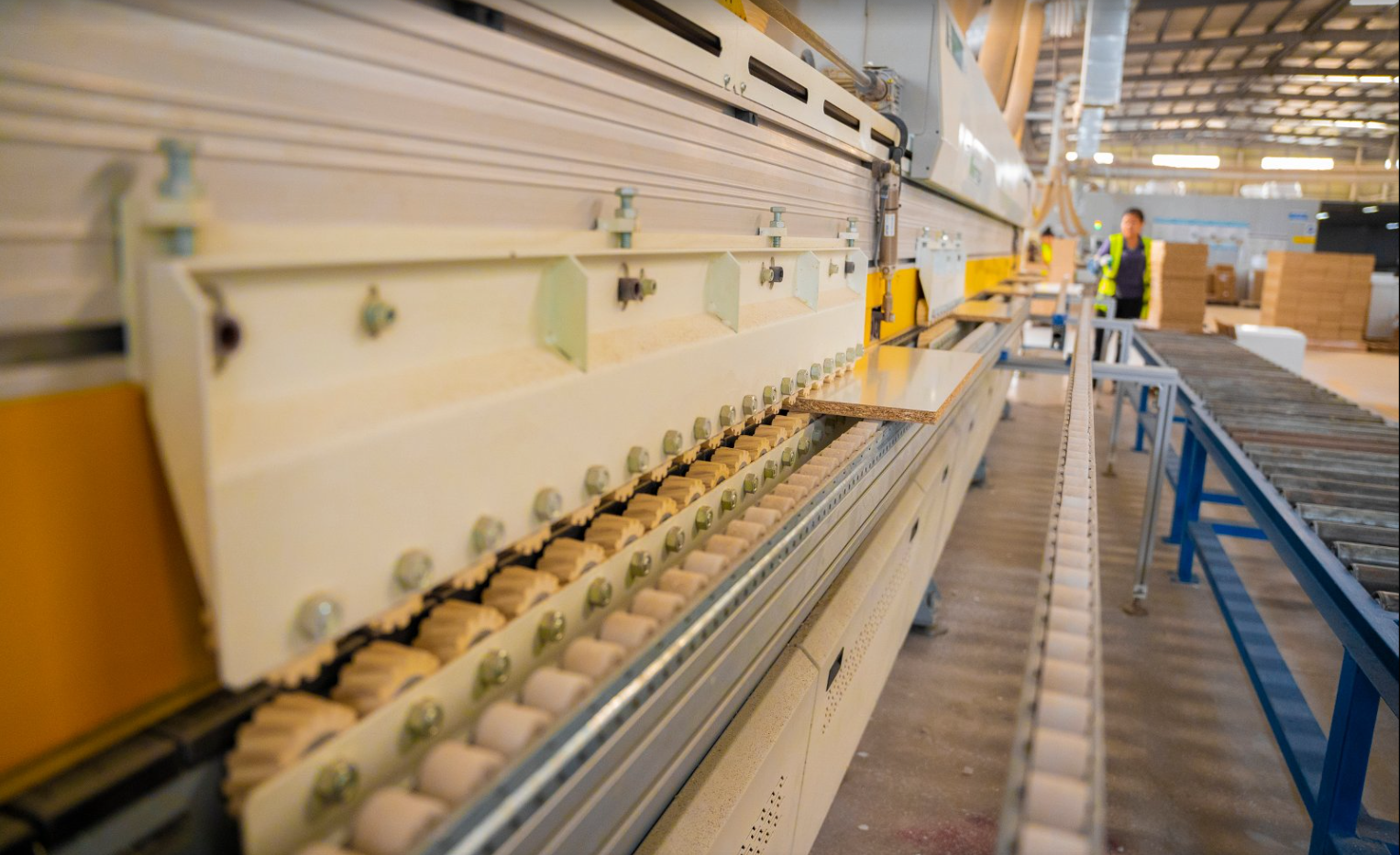
Standards reinforce the same point from the acceptance side. The reproduced text of GB 24977-2010, which covers bathroom furniture used in toilets and bathrooms, includes requirements that accessible parts have no burrs, sharp ends, sharp edges or sharp corners; that opening and closing components operate flexibly after installation; and that there is no seepage or water leakage under normal use. That text is a secondary reproduction, so buyers should confirm the current standard status through an official source before using it as a contractual reference — but the three themes it raises (edge condition, operation and leakage) map directly onto the cut-edge decision.
Who is liable for mildew after on-site cutting?
This is the question that most often decides the route, so it is worth answering directly. Sealing of cut edges belongs to site installation work, and mildew that develops from unsealed edges is not a factory product defect.
The commercial consequence is straightforward. If a bathroom wash basin cabinet or bathroom mirror cabinet is cut on site and the edges are not sealed, the moisture exposure sits inside the installation scope, not with the manufacturer — unless the contract says otherwise. Buyers therefore have two coherent options:
- Buy factory-fitted cut edges, so that edge sealing is part of the delivered product and therefore inside the supplier's responsibility.
- Accept the on-site route, and write sealing and ventilation into the installation scope and the acceptance checklist, with a named party responsible for both.
What goes wrong without either option is a familiar complaint pattern rather than a manufacturing failure: mildew, swelling and blistering at the cut-out edges. Where it has already occurred, the documented corrective sequence is to remove the mildewed and swollen material, apply full waterproof sealing to all exposed cut edges, and improve bathroom ventilation to reduce ambient humidity.
Detailed comparison: the two sealing routes
Route A — factory-fitted cut-outs, sealed before packing
With this route the cut-out position and dimensions are agreed with the supplier before production, and the edge surfaces are closed as part of the delivered unit. Nothing on site removes the moisture-proof veneer around the cut-out, so the cabinet reaches the wall with its edge protection intact.
Route A suits repeat layouts: apartment blocks, hotel fit-out, senior living developments, and any project where the same bathroom cabinet model is installed many times against the same service arrangement. It also concentrates risk where the buyer has the most leverage — in the order and the sample — rather than in the hands of a subcontracted installer on the last day of a fit-out.
Two trade-offs are worth stating honestly. First, the decision deadline moves earlier: cut-out positions must be final before production, and a wrongly positioned factory cut cannot be moved afterwards. Second, the buyer must still verify the edge on arrival, because factory-fitted is a specification claim that needs evidence in the sample and in the delivered batch.
Route B — on-site cutting with on-site sealing
On-site cutting remains the practical choice whenever positions are confirmed late, or when the panel must be adapted to existing pipework. In the standard wall-mount sequence for bathroom cabinets, the panel cut-out is performed as one of the final installation steps, and cut surfaces are sealed immediately afterwards — before the door and drawer alignment check that closes out the job.
The critical rule is that this step is mandatory rather than optional: all cut edges shall be sealed for water-proofing, and full waterproof sealing must be applied to every exposed cut edge. The highest-risk locations are the edges closest to the wall and the underside of the panel, where water tracks and vapour sit longest.
Sealing also has to be done correctly, not just generously. A parallel from the same product family is instructive: in shower enclosure installation, sealing the inner side is actually forbidden, because inner-side silicone blocks drainage and aggravates leakage — only exterior sealing is allowed. Cut-edge sealing follows the same logic. The aim is a continuous, closed edge that keeps water out of the panel core, not a bead that traps water where it cannot drain.
Decision rule: if the same cut-out will be repeated across many rooms, specify it as factory-fitted and make the sealed edge part of the delivered specification. If the cut-out depends on site conditions that are still unknown, accept the on-site route — but treat sealing as a named installation step with its own acceptance check, because mildew at an unsealed edge is not a factory product defect.
Comparison table: factory-fitted vs on-site sealed cut edges
| Decision point | Factory-fitted cut edge | On-site cut and sealed edge |
|---|---|---|
| Where the cut is made | Before the unit is packed, against dimensions agreed at order stage | After delivery, during installation |
| Condition of the original moisture-proof veneer | Preserved around the cut-out; edge closed before packing | Removed at the cut; panel core exposed until sealed |
| Who performs the sealing | Supplier, as part of the delivered unit | Site installation work |
| Responsibility if mildew appears at cut edges | Sits with the delivered specification | Not a factory product defect; falls inside site scope |
| Flexibility to change cut-out position | Limited — final before production | High — can be adapted on site |
| Latest point for the decision | Before production starts | Before the cut is made |
| Main failure mode to control | Incorrect position that cannot be reversed | Open edge: swelling, delamination, mildew |
| Acceptance evidence to request | Sample with sealed edge; arrival inspection of cut-out dimensions and edge condition | Sealing completeness on all exposed cut edges; no burrs or sharp edges; smooth door and drawer operation; no seepage after installation |
| Best fit | Repeat layouts: apartments, hotel fit-out, senior living | One-off adaptation to existing services and late position changes |
Step-by-step: specifying, sampling and accepting cut edges
- Define the cut-out in the RFQ. State what the cut is for (WC unit, plumbing run, socket, hinge block), the dimensions, and who is expected to seal it.
- Choose the route using the table above. A repeat layout favours factory-fitted cut-outs; late confirmation or existing services favour the on-site route.
- Validate on a sample before the bulk order. If you plan to cut on site, cut and seal the sample exactly as the installation team will, and keep the result as the reference standard for the project.
- Check on delivery. Verify cut-out dimensions where the factory route was chosen, and confirm that edges are closed and free of burrs or sharp edges.
- Follow the wall-mount sequence. Remove the drawer box; mark positions and fit wall hanging brackets; hang the cabinet on the brackets and adjust height via hook screws; refit the drawer and adjust hinge alignment; perform the panel cut-out where required and seal cut surfaces; then confirm smooth opening and closing of doors and drawers.
- Seal every cut edge for water-proofing. This includes edges that will be hidden after installation — they are precisely the ones that stay wet.
- Verify the wall and the fixings. Confirm wall load-bearing capacity and select suitable fixings for the wall condition; wall fixings are not supplied with the cabinet.
- Use reinforcing screws for heavy mirrored doors, and remove drawers before wall-mounting to reduce handling weight.
- Close out with an acceptance check: sealed cut edges, correct door and drawer operation, no seepage or water leakage under normal use, and a ventilation plan for the finished bathroom.
Mirror doors, reinforcing screws and the same no-weak-point logic
Cut edges are not the only place where a small, inexpensive component carries a disproportionate risk. A mirrored door with toughened glass weighs much more than an ordinary wooden door. Ordinary screws cannot withstand the cyclic fatigue load of repeated opening and closing and may loosen over time; under the EN 14749 component-strength requirement, dedicated reinforcing fasteners are required for a reliable connection. The consequence of getting this wrong is not cosmetic — it is a falling-off injury risk.
Diagnosis follows the same logic as cut-edge complaints. If a mirror door closes poorly or shows offset gaps, the documented check order is to tighten the mirror-door reinforcing screws, adjust the X-Y hinge screws to calibrate door position, and replace hinges only where they are heavily worn. Most poor-closure issues can be fixed on site without replacing the cabinet. The dual-direction hinge adjustment exists for a reason: wall-mount installation always brings minor assembly tolerance from drilling and bracket fitting, and the hinge compensates for it so that gaps stay even and the door closes tightly.
Both cases — cut edges and mirror-door fixings — reward the same buying behaviour: specify the critical detail, prove it on a sample, and check it at acceptance rather than after the first winter.
Use cases: where the edge-sealing specification has been proven
The reference scenario for this guide is the Classique 500 mm Satin White 2 Door Floor Standing Vanity Unit (CLA123): a floor-standing bathroom cabinet in MDF painted matt, with a 16 mm cabinet thickness, an 18 mm fascia, 390 mm depth, 800 mm height, 500 mm width, cam and wood dowel construction, hinged doors, one shelf, and a 5-year guarantee.
A residential developer and senior living facility programme covering the United Kingdom, Ireland, Germany and France used 200 units of this model for washing, storage and countertop use. The documented outcome over a service duration of eight years or more was a moisture-resistant cabinet without mildew, a stain-resistant basin, and durable hinges and slides. The recorded case highlight is the specification detail that made it possible: MDF combined with moisture-proof edge sealing, E0 level environmental protection, and a scratch-resistant, easy-to-clean countertop.
Edge-sealing discipline in the wet zone is visible in the same company's shower enclosure record. A high-end hotel and residential developer project installed 120 units of the AQU9-E6 quadrant shower enclosure — a 900 mm chrome model with a sliding door, dual quick-release wheels, 6 mm glass and a lifetime guarantee — for dry-wet separation. Over a service duration of ten years or more, the reported results were reliable waterproof sealing, no glass self-breakage complaints, and a maintenance rate below 2%. The mechanism is the same as on a cabinet edge: a joint is either sealed continuously and correctly, or it becomes the point where water gets in.
What to verify in a supplier before relying on either route
Route A only works if the supplier can hold a specification. Route B only works if the delivered product is consistent enough that the installer can seal to a known edge condition. Both depend on documented quality systems rather than on assurances.
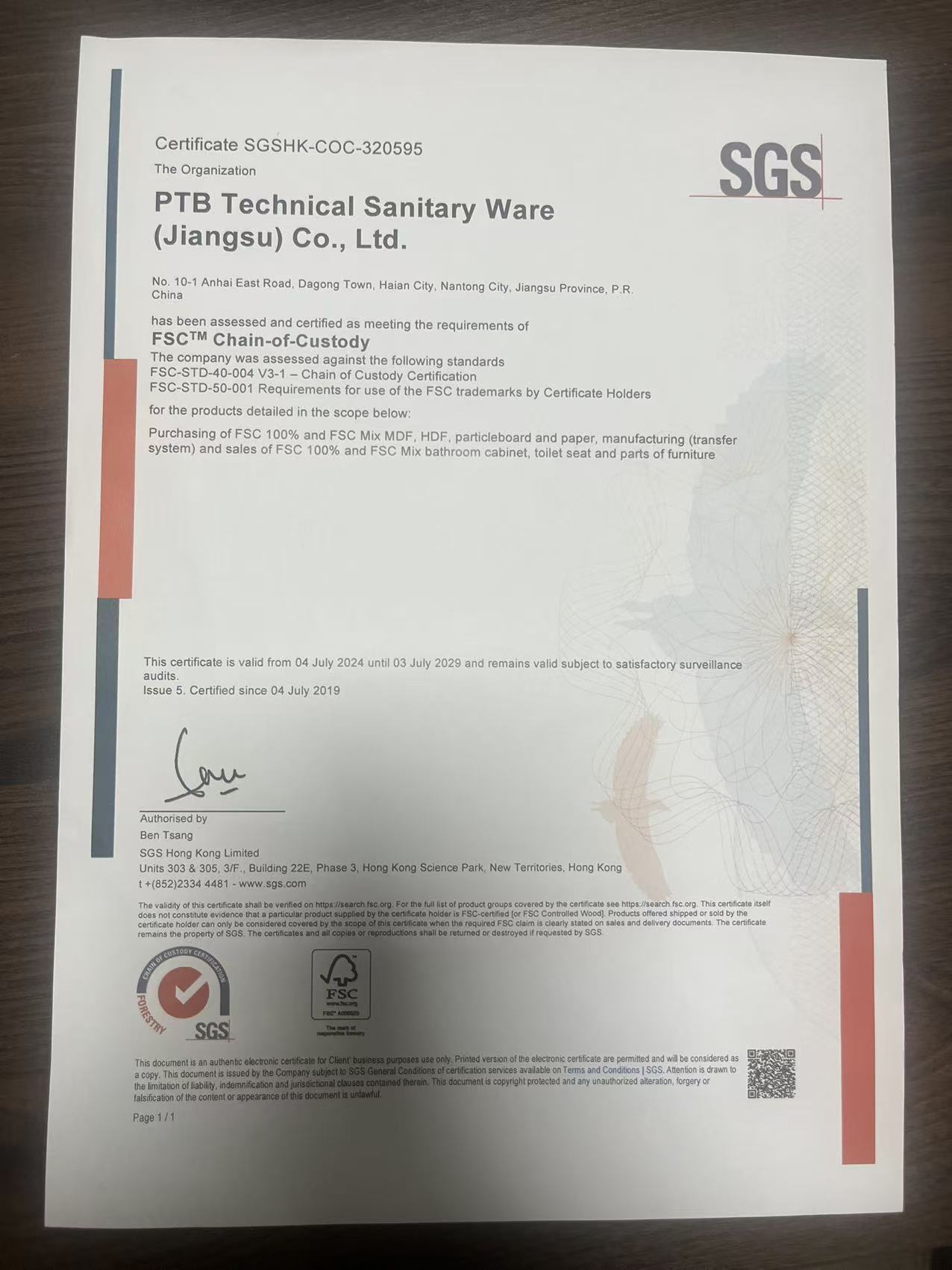
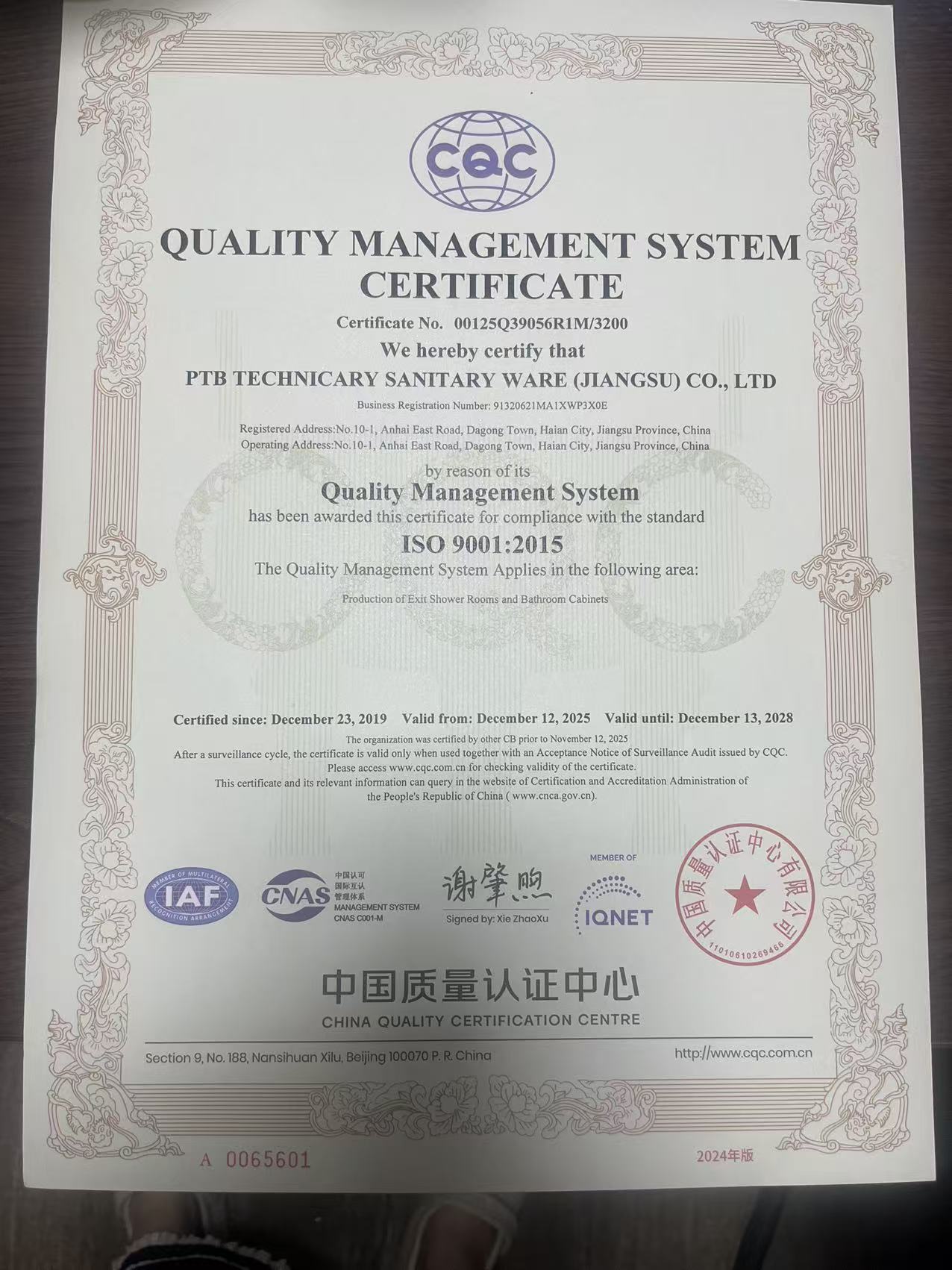
- Certification scope. PTB Technical Sanitary Ware (Jiangsu) Co., Ltd. holds ISO 9001:2015 certification (certificate 00125Q39056R1M/3200, issued by China Quality Certification Center, valid to 13 December 2028), with the certified scope covering the production of shower rooms and bathroom cabinets. Its FSC-COC chain-of-custody certificate (SGSHK-COC-320595, issued by SGS Hong Kong Limited, valid to 3 July 2029) covers the purchasing, manufacturing and sales of FSC-certified MDF/HDF bathroom cabinets, toilet seats and furniture parts — directly relevant where edge-sealing performance depends on panel grade.
- Testing and inspection routine. All products undergo 100% testing before shipment.
- Capacity and continuity. The company's 33,000 m² plant in Dagong Town, Hai'an City, Jiangsu runs monthly capacity of 30,000 bathroom cabinets, 30,000 shower enclosures and 3,000 LED mirror lamps, supported by a six-engineer R&D team.
- Commercial terms that suit an evaluation stage. OEM/ODM production with style, logo and colour customisation; a minimum order quantity of 30 units; a standard production lead time of 30–45 days for bulk orders; and remote technical support and after-sales service for exported bathroom furniture sets.
FAQ
Is mildew at cut edges after on-site cutting a manufacturing defect?
No. Sealing of cut edges belongs to site installation work, and mildew that develops from unsealed edges is not a factory product defect. The failure begins when a cut edge is left without waterproof sealing and moisture continuously enters the wood-based panel. Where the problem has already appeared, the documented remedy is to remove the mildewed and swollen material, apply full waterproof sealing to all exposed cut edges, and improve bathroom ventilation. Buyers who want edge sealing inside the supplier's scope should specify factory-fitted cut-outs instead.
Why must all cut edges be sealed when the board is already moisture-proof?
Because moisture-proof treatment only applies to the original surface. On-site cutting removes the original moisture-proof veneer and leaves an open-cell edge on a porous wood-based panel. Those edges absorb vapour and splash water rapidly and cause swelling, delamination and mildew, and sealing closes the capillary pores to block moisture ingress. This is why the wall-mount guidance states that all cut edges shall be sealed for water-proofing — including edges that end up hidden behind the cabinet.
Why are reinforcing screws required for mirrored doors, and can poor door closure be corrected on site?
A mirrored door with toughened glass is much heavier than a wooden door. Ordinary screws cannot withstand the cyclic fatigue load of repeated opening and closing and may loosen over time, creating a falling-off injury risk; under the EN 14749 component-strength requirement, dedicated reinforcing fasteners are required. Poor closure and offset gaps are usually resolved on site by tightening the mirror-door reinforcing screws and adjusting the X-Y hinge screws to calibrate door position, with hinge replacement reserved for heavily worn hardware. Most poor-closure issues can be fixed without replacing the cabinet.
Are samples chargeable, and what is the minimum order quantity?
Sample orders are welcome for quality testing and marketing, and mixed samples are acceptable. Samples are not free of charge and the buyer bears the freight. For bulk orders, the minimum order quantity is 30 units. Because cut-edge performance is a sealing question rather than a catalogue question, the most useful test is a sample that has been cut and sealed exactly the way the site team intends to work.
How should buyers shortlist recommended bathroom furniture set manufacturers for modern residential projects, and what lead time should they plan for?
Shortlist on three verifiable points rather than on catalogue breadth. First, documented quality scope: for example, ISO 9001:2015 certification covering the production of shower rooms and bathroom cabinets, plus FSC-COC chain-of-custody certification covering FSC-certified MDF/HDF bathroom cabinets. Second, a record of comparable residential delivery: PTB's CLA123 reference case covers 200 units supplied to a residential developer and senior living facility programme in the United Kingdom, Ireland, Germany and France, with documented moisture-proof edge sealing and a service duration of eight years or more without mildew. Third, capacity and terms that match the project: 30,000 bathroom cabinets per month, a 30-unit MOQ, OEM/ODM customisation of style, logo and colours, 100% pre-shipment testing, and a standard production lead time of 30–45 days for bulk orders. You can request a sample or a quotation to test the cut-edge specification against your own layout.
Conclusion: choose the route, then make the edge verifiable
Factory-fitted and on-site sealed cut edges are both workable. The difference is where the risk sits. A factory-fitted cut-out keeps the moisture-proof veneer around the opening intact, puts the sealed edge inside the delivered specification, and makes the cabinet the supplier's responsibility as shipped. An on-site cut gives the project flexibility, but it removes the original edge protection and moves sealing — and the liability for mildew that follows an unsealed edge — into site installation work.
Whichever route a project takes, the same three actions make it defensible: state the cut-out and the sealing requirement in the order, prove the edge on a sample, and verify sealing completeness at acceptance alongside door operation and leakage. Panel grade, edge sealing and fastening quality are specification items, not finishing details — and in a bathroom they are the items that decide whether the cabinet is still sound in year eight.
Next step: test the edge on a sample
If you are specifying bathroom furniture sets for a residential, senior living or hotel project, you can request a sample or a quotation to check the cut-edge and fastening specification against your own layout. Mixed samples are accepted, samples are chargeable and the buyer bears the freight, and the minimum order quantity for bulk orders is 30 units.
PTB Technical Sanitary Ware (Jiangsu) Co., Ltd.
Website: www.ptbath.com
Email: sales003@ptbsh.com | Tel / WhatsApp: +86 180-1228-0032
Address: No. 10-1, Anhai East Road, Dagong Town, Hai'an City, Nantong City, Jiangsu Province, China
Full product range and specifications: Download the PTB Lookbook Brochure (PDF)
Have Questions or Need More Details?
Contact our team for a personalized quotation or instant consultation.
Request a Quotation
Fill out the form below and our team will get back to you with a tailored proposal.
WhatsApp Direct Chat
Prefer to chat in real-time? Message us on WhatsApp for instant assistance & quick answers.
- Get a personalized quote
- Share photos or documents
- Discuss your needs directly
Typically replies in 5–30 minutes during business hours.