
Ranking Bathroom Furniture Set Features by Failure-Risk Reduction: Rollers, Sealing, and Hinges
Direct answer: ranked by how much they reduce real site failure, the configurable features of a bathroom furniture set fall in this order: (1) waterproof sealing of cabinet cut edges, (2) spring-loaded adjustable rollers on the shower enclosure, (3) exterior-only silicone sealing on the enclosure, (4) X-Y dual-direction hinges on cabinet doors, and (5) synchronized demister control on the mirror. The ranking follows each failure mechanism's reversibility, the severity of a single affected unit, and whether the feature surfaces during installation or only later as an after-sales complaint.
Every item below is judged against an actual failure: the symptom, the root cause, how the configuration blocks the damage, and what can still be done when it fails. Reasons are given as failure causes rather than general preferences, because at decision stage a buyer is not paying for a feature list — they are paying for a specification sheet that decides who carries the repair cost over the next five years.
Problem Definition: Failures in Bathroom Furniture Sets Come From Tolerance and Moisture, Not From Daily Use
A bathroom furniture set spans three component groups with different failure paths. The cabinet is a wood-based panel box mounted in a wet, splash-exposed area. The shower enclosure is a glass-and-aluminium structure fixed against a wall that may not be perfectly plumb and onto a tray that may not be perfectly level. The illuminated mirror hangs in the same humid room and is connected to mains electricity.
The common operating condition across all three is intermittent water exposure combined with continuous ambient high humidity, together with cold water supply and gravity drainage at the basin. That condition is what turns small installation tolerances into visible defects.
Cabinet-side failures concentrate on cut edges. Cut-outs for basin bowls, waste pipes and side panels are made on site. Each cut removes the original moisture-proof veneer and exposes open-cell timber, which absorbs vapour and splash water quickly. The result is swelling, delamination, mildew and blistering — damage that cannot be reversed once the board has expanded.
Enclosure-side failures concentrate on alignment and sealing. Building work always leaves tolerance on wall plumbness and tray level. Where the enclosure cannot absorb that tolerance, the door sticks, gaps become uneven, the seal no longer closes properly, and water escapes at the bottom or side joint. A non-adjustable model cannot compensate for those errors and is prone to sticking doors and leakage, which produces a higher whole-life maintenance cost.
Mirror-side failures concentrate on heat and moisture. The demister pad is a heating component. An independent switch design risks long-time dry-heating if the user forgets to power off, which accelerates ageing and creates an over-heating hazard. Separately, water vapour and splash within bathroom Zone 2 can penetrate an IP20 luminaire, degrade insulation and trigger short-circuit or shock.
Industry Background: Why Specification Detail Now Carries Commercial Weight
The category the buyer is sourcing into is large and still expanding. Grand View Research reported the global bathroom furniture market at USD 135.9 billion in 2024 and estimated USD 148.9 billion by 2026, with bathroom cabinets accounting for approximately 50% of that share in 2023. Within the cabinet segment, wall-mounted and floating vanity units are projected to grow at a CAGR of 7.26% through 2031 in the US market. Next Move Strategy Consulting valued the global shower enclosure and cubicles market at USD 3.51 billion in 2023, forecast to reach USD 5.38 billion by 2030.
Growth of that order pushes volume through installation teams who are not the manufacturer's own staff. That is precisely the condition under which tolerance-compensating and moisture-blocking features stop being nice-to-have and become the difference between a clean handover and a warranty claim.
Standards already frame the acceptance criteria. GB 24977-2010 covers bathroom furniture used in toilets and bathrooms and specifies classification, requirements, test methods, inspection rules, marking, packaging, transport, storage and use instructions. Among its stated requirements: parts or accessories that may be touched during normal use shall not have burrs, sharp ends, sharp edges or sharp corners; opening and closing components shall operate flexibly after installation; and there shall be no seepage or water leakage under normal use after installation between all parts of the product. Those three clauses map directly onto sealing, hinges and enclosure alignment.
On the glass and electrical side, EN 12150-1 defines toughened safety glass behaviour — it breaks into blunt small granules to cut injury risk, while ordinary glass forms sharp large fragments. EN 14428 is the reference cited for tolerance-compensating roller performance, and BS 7671 (IEE Wiring Regulations) sets the mandatory protection, earthing and wiring rules for each bathroom zone, with EN 60529 defining the IP44 ingress protection level that withstands multi-direction splash in humid bathroom conditions.
PTB Technical Sanitary Ware (Jiangsu) Co., Ltd. is a manufacturer of bathroom cabinets, shower enclosures and LED mirrors based in Hai'an City, Jiangsu Province, China, exporting to markets including the United Kingdom, France and Ireland. The company operates a 33,000 m² manufacturing plant with 156 employees and an annual output of 360,000 sets, and holds ISO9001, EU CE, British WRAS, FSC and Customs AEO Advanced certification. Its bathroom products carry a 5-year warranty and can be custom made to customer requirements. Full product documentation is available through www.ptbath.com.
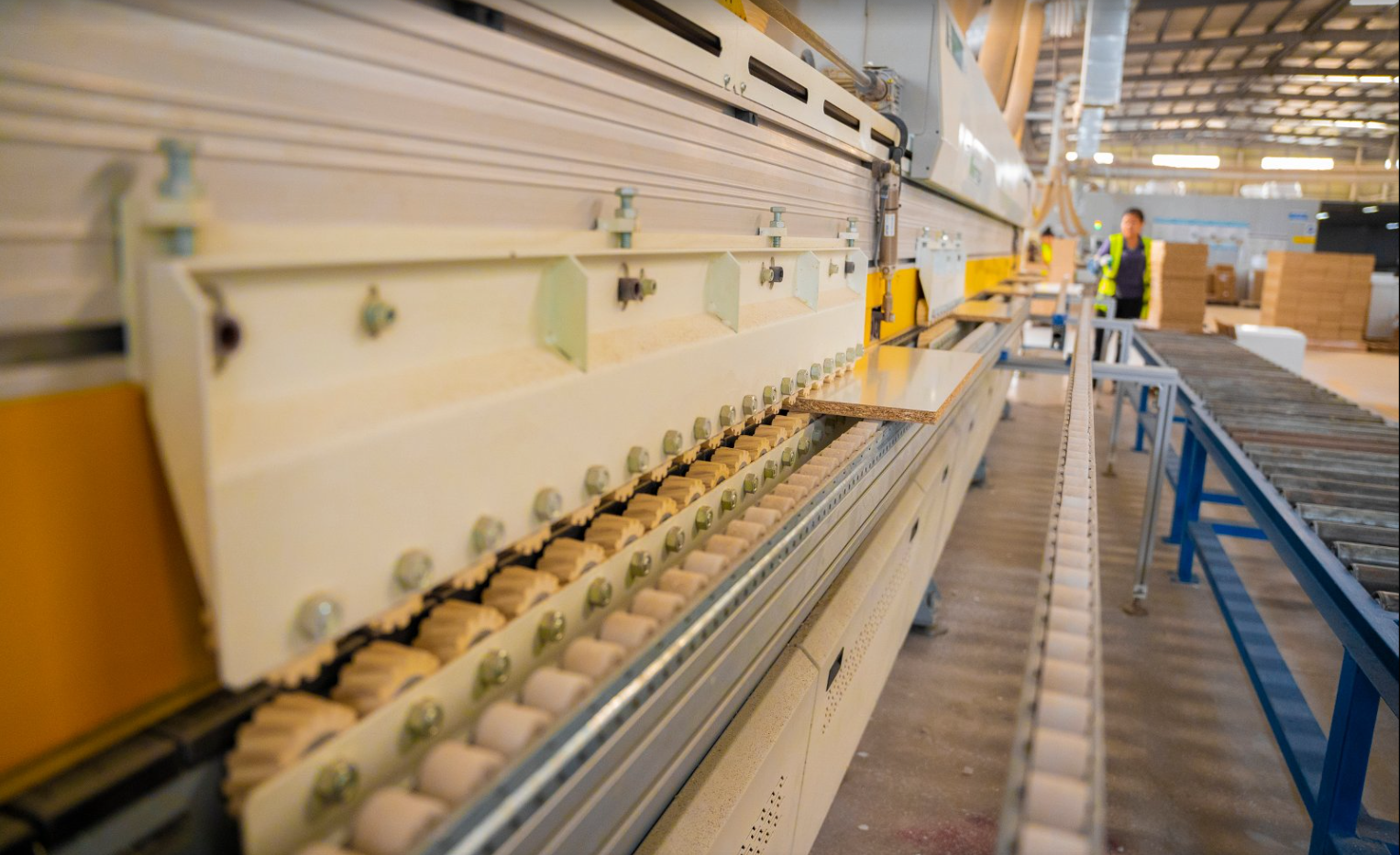
Sequenced panel processing and assembly: the stage at which cut-edge sealing and hardware specification are fixed, long before the set reaches site.
How the Ranking Was Built
Three criteria were applied in a fixed order. Any feature list can be argued in any direction, so the criteria need to be stated before the order is claimed.
- Reversibility of the failure. A defect that can be corrected on site during commissioning costs labour. A defect that destroys the panel or forces component replacement costs a unit. Irreversible failures rank above reversible ones.
- Severity per affected unit. Water escaping onto a floor, or a mirror door loosening under cyclic load, carries consequences beyond the product itself. Failures contained inside a single component rank lower.
- Exposure window. A feature that is decided during installation and then hidden behind a finished wall or a sealed joint is harder to correct later than one that remains accessible for adjustment.
Cost was deliberately excluded from the ranking criteria. Commercial difference is reported separately for each item, because a feature that reduces failure risk at a modest premium and a feature that reduces it at a large premium should not be forced into the same score.
Failure-Risk Reduction Ranking: Five Configurable Features
Rank 1 — Waterproof Sealing of Cabinet Cut Edges
Failure it prevents: mildew, swelling and blistering at cabinet cut-out edges.
Root cause: bathroom cabinets use porous wood-based panels. On-site cutting removes the original moisture-proof veneer, and the exposed open-cell edges absorb vapour and splash water rapidly. Continuous moisture ingress into the panel then produces swelling, delamination and mildew.
How the feature blocks the damage: sealing closes the capillary pores and blocks moisture ingress. It works at the material level rather than the surface level, which is why it sits at the top of this ranking — the failure it prevents is the only one on the list that cannot be undone. Once a panel has swollen, removing the mildewed and swollen material and re-sealing is the only remedy, and on a fitted set that often means replacing the affected component.
What to specify: the specification has to state which edges are sealed at the factory and what sealing material or instruction is supplied for the edges cut on site. This matters because sealing of cut edges belongs to site installation work, and mildew arising from unsealed edges is not treated as a factory product defect. A buyer who does not write this into the RFQ has effectively accepted the risk without pricing it.
Risk-reduction evidence: against ordinary bathroom cabinets, a mildew-proof and stain-resistant surface construction reports an 85% lower mildew probability and 50% less surface stain penetration. That figure is a surface-performance comparison, not a cut-edge test, but it indicates the direction of the design intent. The same comparison places the initial cost at 10% higher, and the product is positioned for residential and serviced apartment bathrooms, with maintenance limited to easy cleaning and durable hinges and slides.
Rank 2 — Spring-Loaded Adjustable Rollers on the Shower Enclosure
Failure it prevents: sticking doors, uneven gaps when the door is closed, poor seal performance and consequent leakage.
Root cause: building work brings tolerance on wall plumbness and tray level. Additional contributors include top or bottom tracks not fully seated, debris trapped inside the track, and worn rollers or a failed spring. For Shower Enclosure AQU9-E6 specifically, uneven gaps when the door is closed commonly trace to uncalibrated adjustable top-rollers and plumb deviation of the wall installation.
How the feature blocks the damage: spring-loaded adjustable rollers allow on-site adjustment to offset wall plumbness and tray level tolerances, preventing sticking doors and poor seal performance, in compliance with EN 14428. The important distinction is not that adjustable rollers are better in the abstract — it is that a simple non-adjustable model cannot compensate for errors at all. The same tolerance that an adjustable model absorbs becomes a permanent leak path or a permanent drag on a fixed model.
Troubleshooting path when it does occur: clear hair and debris inside the track; ensure full seating of the top and bottom tracks; adjust the top-roller screw for horizontal and vertical fine-tuning until uniform door gaps are achieved; replace damaged rollers; re-verify shower tray level. Uneven gaps usually stem from site construction tolerance and can be corrected by roller adjustment, not manufacturing defect.
What to specify: confirm that the rollers are adjustable rather than fixed, and confirm the enclosure adjustment range. For AQU9-E6 the enclosure adjust range is 860 mm to 880 mm, glass thickness is 6 mm, the door type is sliding with a dual quick-release wheel, and the enclosure carries CE marking and a lifetime guarantee.
Rank 3 — Exterior-Only Silicone Sealing on the Shower Enclosure
Failure it prevents: water leakage at the bottom or side joint.
Root cause: an incorrectly cut or missing sealing strip, cracked or debonded exterior silicone, poor sealing due to an unlevel tray, and — the most damaging case — inner-side silicone blocking drainage.
How the feature blocks the damage: exterior-only silicone application supports drainage and pressure release, which helps avoid water seepage in shower enclosures. Inner silicone blocks drainage; trapped water accelerates seal failure and aggravates leakage. Sealing both sides to be "safer" produces the opposite result.
This ranks third because it is the cheapest item on the list but also the most frequently inverted. A site team that seals both sides has actively created a failure where a correctly executed joint would have been maintenance-free. The corrective sequence is: inspect the sealing strips and recut or refit as required; remove aged silicone; apply continuous new sanitary-grade silicone on the exterior only, never on the inner side; then confirm tray level.
What to specify: a continuous exterior silicone bead at the joints between the profiles and the wall, a written external-only instruction in the installation manual, tray levelling verified before assembly, and a minimum 24-hour silicone curing period before water exposure.
Rank 4 — X-Y Dual-Direction Hinges on Cabinet Doors
Failure it prevents: loose mirror doors, poor closure and offset gaps.
Root cause: loose mirror-door reinforcing screws, a mis-adjusted X-Y hinge setting, and worn hinge hardware. Wall-mount installation itself brings minor assembly tolerance from drilling and bracket fitting, which the door mechanism has to absorb.
How the feature blocks the damage: dual-direction adjustment corrects horizontal and vertical position separately, fixing uneven gaps and poor closure, optimising user experience and reducing mechanical stress on the hinges. A single-axis hinge leaves one axis of installation error permanently visible as an uneven gap.
Why it sits below ranks 1–3: a cabinet can be mounted level, and the hinge still needs dual-direction adjustment because installation deviation is unavoidable. But most poor-closure issues can be fixed on site without cabinet replacement — tighten the mirror-door reinforcing screws, adjust the X-Y hinge screws to calibrate door position, replace heavily worn hinges. The failure is real and frequent; it is simply more recoverable than board swelling or an active leak.
One related safety point: special reinforcing screws are mandatory for a mirrored door instead of ordinary screws. A mirrored door with toughened glass weighs much heavier than an ordinary wooden door, ordinary screws cannot withstand the cyclic fatigue load from repeated opening and closing and may loosen over time, and EN 14749 cabinet strength requirements call for dedicated reinforcing fasteners for a reliable connection. The hinge specification is only as good as the fastener holding it.
Rank 5 — Synchronized Demister Control on the Mirror
Failure it prevents: demister pad losing heating effect while the light still works, and accelerated ageing or over-heating from dry-heating.
Root cause: a loose demister-pad terminal connection or a burnt-out heating pad. Where the demister runs on an independent switch, the design risks long-time dry-heating if users forget to power off, accelerating ageing and creating an over-heating hazard.
How the feature blocks the damage: synchronized power control powers the demister on with the light and cuts it off upon switch-off, extending component service life and lowering failure risk. It also removes one user action, which is where independent-switch designs fail in practice.
It ranks fifth because the consequence is contained inside one component and can be resolved without disturbing the installation: the demister heating pad can be replaced separately under warranty if lighting functions normally. That is a genuine low-severity, low-reversibility-cost failure — worth specifying, but not worth trading against ranks 1–3.
Electrical context that belongs in the same decision: the LED mirror is IP44 rated and suitable for Bathroom Zone 2 and outside zones only. Per EN 60529, IP20 resists solid foreign objects only and provides no water-splash protection, so vapour and splash in Zone 2 may penetrate an IP20 luminaire, degrade insulation and trigger short-circuit or shock. IP44 is mandatory for Bathroom Zone 2. Installation must be carried out by a qualified electrician in compliance with IEE wiring rules and bathroom zoning; mains power must be isolated before wiring and reliable earthing ensured.
Step-by-Step Breakdown: Where Each Feature Is Decided
The five features are not decided at the same moment. Mapping them to the installation and commissioning sequence shows which ones can still be corrected late and which are locked in early.
- Pre-order specification. Cut-edge sealing scope, roller adjustability, hinge adjustment axes and demister control mode are all fixed here. Nothing downstream can recover a decision missed at this step.
- Goods receipt and pre-installation check. Confirm the enclosure adjustment range against the measured opening, confirm the hinge type and reinforcing screws, and confirm the mirror carries CE, EMC, LVD, RoHS and WEEE certification documentation.
- Tray and wall verification. Before starting installation, ensure the shower tray is level. Handle toughened safety glass carefully against impact and use a two-person installation team.
- Panel cut-out and immediate sealing. Perform the panel cut-out where required and seal the cut surfaces in the same working step. Leaving a cut edge open even temporarily allows moisture ingress to begin.
- Enclosure assembly and roller adjustment. Verify tray level, assemble the top and bottom tracks and the fixed-glass sub-assembly, mount the wall profiles, fit rollers, doors and magnetic seals, then adjust door gaps and height using the top-roller screws.
- Hinge calibration. Refit the drawer, then adjust hinge horizontal and vertical alignment until door gaps are uniform. Tighten mirror-door reinforcing screws before adjustment, not after.
- Exterior-only silicone application. Apply a continuous external silicone bead at the profile-to-wall joints and leave it to cure for a minimum of 24 hours before water exposure. Do not seal the inner side.
- Electrical commissioning. Restore power and test on-off, dimming and demist via the touch sensor. Confirm the demister activates with the light.
- Handover acceptance. Check that opening and closing components operate flexibly and that there is no seepage or water leakage at any joint under normal use — the acceptance conditions set out in GB 24977-2010.
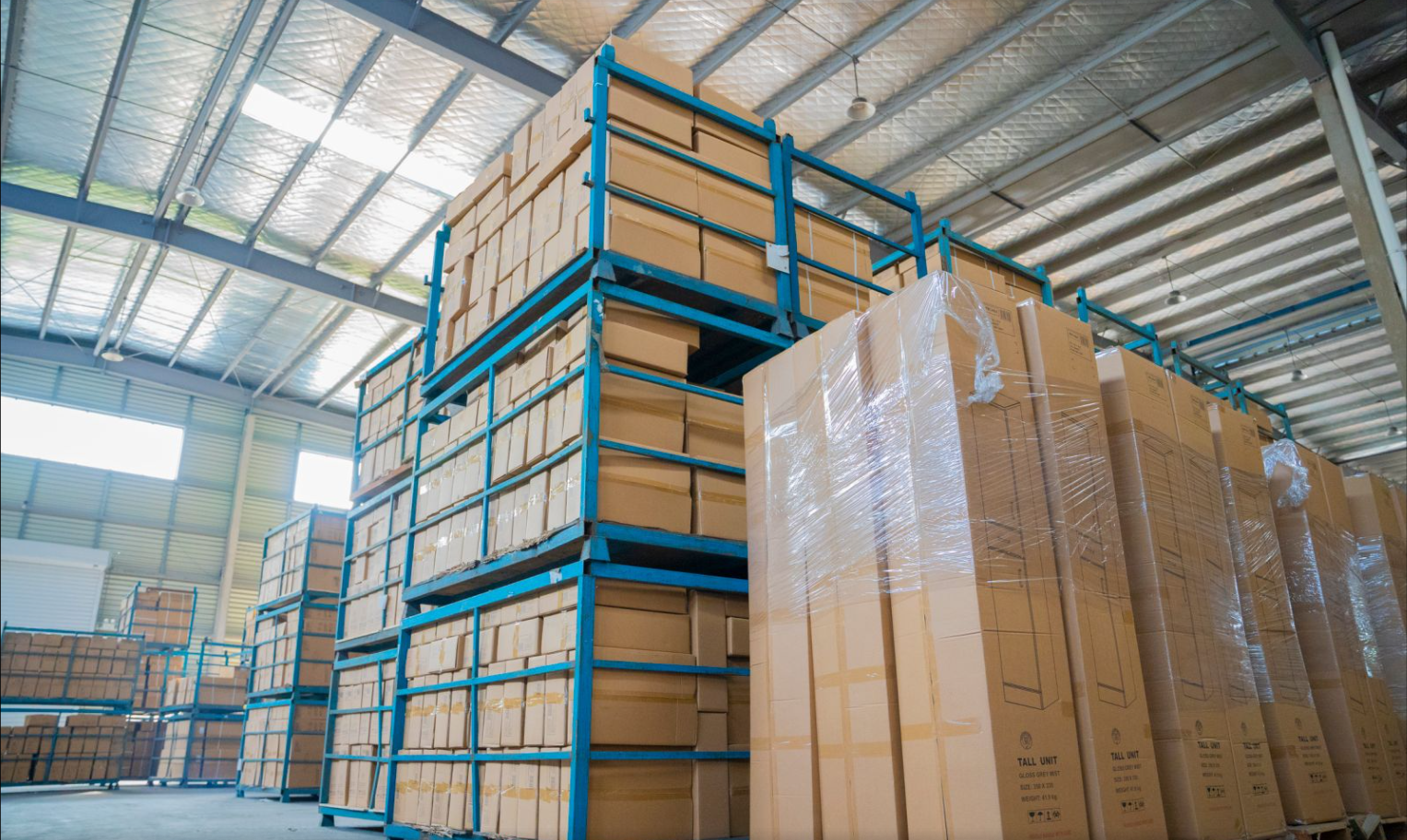
Staged sets before dispatch: specification errors made at order stage cannot be corrected at this point.
Use Cases: How the Ranking Shifts by Project Type
Residential and serviced apartment bathrooms
Here the cabinet dominates the risk profile, because the basin cut-out is the most moisture-exposed machined edge in the room and the occupant will live with any swelling for years. Rank 1 and Rank 4 carry most of the value. The mildew-proof and stain-resistant surface construction is positioned for exactly this application, with maintenance limited to easy cleaning and durable hinges and slides. Products in this class carry a 10% higher initial cost than ordinary bathroom cabinets.
Apartment and hotel vanity areas
The mirror becomes the failure of record. Anti-fog operation, flicker-free LED lighting and an IP44 waterproof rating address the two dominant complaints — fog and mist on the surface, and electrical reliability in a humid zone. The comparison position for this class is energy efficiency class A with 30% power saving, an expected lifespan 2x longer than conventional mirror lamps, a lower failure rate in long-term operation and lower maintenance through simple replacement, at an 8% higher initial cost.
Hotel and high-end residential bathrooms
The enclosure carries the consequence, because a leak in a hotel bathroom affects the floor below and the room's availability. Ranks 2 and 3 matter most. The comparison position for this class is a zero leakage rate and a 90% reduction of glass burst risk over ordinary shower enclosures, fewer after-sales repairs and a longer service life, at a 12% higher initial cost. Toughened safety glass to EN 12150-1 is the baseline expectation, not an upgrade.
UK, Ireland, France, Belgium, Netherlands, Luxembourg and Germany
In these markets the electrical and glass compliance points are not optional. IP44 for Zone 2, BS 7671 zoning compliance, qualified-electrician installation and EN 12150-1 toughened glass are entry conditions. The ranking itself does not change, but ranks 2, 3 and 5 move closer together because non-compliance at any of them blocks handover entirely.
Comparison Table
The table below ranks the five features against the failure they address and how recoverable that failure is once it occurs.
| Rank | Configurable feature | Failure addressed | How the feature reduces risk | Recoverability after failure |
|---|---|---|---|---|
| 1 | Waterproof sealing of cabinet cut edges | Mildew, swelling, blistering at cut-outs | Closes capillary pores in porous wood-based panels and blocks moisture ingress | Not reversible — mildewed and swollen material must be removed |
| 2 | Spring-loaded adjustable rollers | Sticking doors, uneven gaps, poor seal, leakage | Offsets wall plumbness and tray level tolerance on site, in compliance with EN 14428 | Adjustable on site by top-roller screw |
| 3 | Exterior-only silicone sealing | Leakage at bottom or side joint | Enables drainage and pressure release; inner sealing blocks drainage and aggravates leakage | Reworkable — remove aged silicone and reseal externally |
| 4 | X-Y dual-direction hinges | Loose mirror door, poor closure, offset gaps | Corrects horizontal and vertical position separately and reduces mechanical stress | Adjustable on site; hinge replacement if worn |
| 5 | Synchronized demister control | Demister pad losing heat; dry-heating ageing | Powers the demister with the light and cuts off on switch-off | Pad replaceable separately under warranty |
The second table reports the published comparison positions behind the cost and performance statements used above. These are comparative product positions, not quotes for a specific project.
| Product group | Compared to | Core difference | Reported performance gap | Initial cost difference | Best suited to |
|---|---|---|---|---|---|
| Bathroom cabinet | Ordinary bathroom cabinet | Mildew-proof and stain-resistant surface | 85% lower mildew probability; 50% less surface stain penetration | 10% higher | Residential and serviced apartment bathroom |
| Mirror lamp | Conventional mirror lamp | Anti-fog, flicker-free LED, IP44 waterproofing | 30% lower power consumption; 2x longer lifespan; energy efficiency class A | 8% higher | Bathroom vanity area of apartment and hotel |
| Shower enclosure | Ordinary shower enclosure | Higher safety and better waterproof performance | Zero leakage rate; 90% reduction of glass burst risk; 20% reduction of hot water heat loss | 12% higher | Hotel and high-end residential bathroom |
RFQ Checklist: Turning the Ranking Into Specifications
Each ranking position converts into one or two lines that belong in the purchase specification. Without them, the feature exists in the catalogue and not in the product delivered.
- Cut edges: list every factory-sealed edge; require sealing material or instructions for edges cut on site; state that unsealed edges are an installation responsibility, not a factory defect.
- Rollers: require spring-loaded adjustable rollers to EN 14428, and state the required adjustment range against the measured opening (AQU9-E6: 860–880 mm).
- Silicone: require a written exterior-only instruction, a continuous bead at profile-to-wall joints, tray levelling verification, and a 24-hour curing period.
- Hinges: require X-Y dual-direction adjustment and dedicated reinforcing screws for mirrored doors, consistent with EN 14749 strength requirements.
- Demister: require synchronized control with the light; confirm the touch sensor provides on/off and long-press dimming.
- Compliance documents: request CE, EMC, LVD, RoHS and WEEE certification for the mirror, and EN 12150-1 evidence for the glass.
- Drawings: share design drawings with size and shape requirements so that technical engineers can review them and recommend models based on the latest product development.
FAQ
Is mildew at cabinet cut edges a manufacturing defect?
No. Sealing of cut edges belongs to site installation work, and mildew from unsealed edges is not a factory product defect. The symptom is mildew, swelling and blistering at cabinet cut-out edges; the cause is cut edges without waterproof sealing plus continuous moisture ingress into the wood-based panel. The remedy is to remove the mildewed and swollen material, apply full waterproof sealing to all exposed cut edges, and improve bathroom ventilation to reduce ambient humidity.
Which bathroom furniture set suits apartment projects better: wall-hung or floor-standing cabinets?
Both suit apartment projects, and the choice turns on wall load-bearing capacity and installation tolerance rather than on style. Bathroom cabinets accounted for approximately 50% of the global bathroom furniture market in 2023, and within that segment wall-mounted and floating vanity units are projected to grow at a CAGR of 7.26% through 2031 in the US market, so both formats are established supply. Floor-standing units such as the Classique CLA123 — 500 mm wide, 800 mm high, 390 mm deep, MDF painted matt, 16 mm cabinet thickness, 18 mm fascia thickness, hinged doors, rigid construction, 21 kg, 5-year guarantee — remove the wall-load variable entirely. A wall-hung specification should confirm the wall structure, use appropriate fixings (wall rawlplugs and fixing screws are not supplied with the enclosure range and must be selected for the on-site wall condition), and rely on X-Y hinge adjustment to absorb residual assembly tolerance.
What does specifying these failure-reduction features add to the budget?
Published comparison positions place the bathroom cabinet with a mildew-proof and stain-resistant surface at 10% higher initial cost than an ordinary bathroom cabinet, the mirror lamp with anti-fog operation, flicker-free LED and IP44 waterproofing at 8% higher than a conventional mirror lamp, and the shower enclosure with higher safety and waterproof performance at 12% higher than an ordinary shower enclosure. Those are comparative positions, not project quotations — a quotation depends on the configuration, quantity and destination. The counterweight is stated in the same sources: lower failure rates, fewer after-sales repairs, longer service life, and against non-adjustable enclosure models, avoidance of the higher whole-life maintenance cost caused by sticking doors and leakage.
Can mixed samples be ordered for quality testing and marketing?
Yes. Sample orders are welcome for quality testing and marketing purposes, and mixed samples are acceptable. Samples are not free of charge and the buyer bears the freight. Samples can cover bathroom cabinets, shower enclosures, LED mirror lights and basins, and the manufacturer also offers a 5-year warranty on its bathroom products and can custom make products according to customer requirements.
What determines lead time once an order is placed?
Normally it takes 25–30 days after receiving the deposit, depending on the order quantity. Lead time is therefore driven by volume rather than by product category. To start, send your design drawings with size and shape requirements — technical engineers will review them and recommend models based on the latest product development. For a project sample set or a formal quotation, contact the team at www.ptbath.com or email sales003@ptbsh.com, and download the full product range from the PTB product brochure.
Next step: if the specification review above has narrowed your options, the fastest way to close the decision is a sample set. PTB Technical Sanitary Ware (Jiangsu) Co., Ltd. supplies bathroom cabinets, shower enclosures and LED mirrors to the United Kingdom, France, Ireland and other European markets, with ISO9001, EU CE, British WRAS, FSC and Customs AEO Advanced certification.
Email sales003@ptbsh.com · WhatsApp +86 180-1228-0032 · Download the product brochure
Please note: no specific offer can be made here; the price, packing, delivery and payment terms will be confirmed in the proforma invoice.

Finished sets prepared for dispatch. Sample orders and volume orders are scheduled from the same stock and production flow.
Conclusion
Ranked by failure-risk reduction, the order is clear: seal the cut edges first, because board swelling is the only failure on this list that cannot be reversed; then insist on spring-loaded adjustable rollers, because construction tolerance is unavoidable and a non-adjustable enclosure converts it into a permanent defect; then enforce exterior-only silicone, because an over-sealed joint is worse than an under-sealed one; then specify X-Y dual-direction hinges with dedicated reinforcing screws, because installation deviation is certain and correction is cheap; and finally specify synchronized demister control, because dry-heating ageing is a contained, replaceable failure.
The ranking does not change between residential, serviced apartment, hotel and high-end residential projects. What changes is which two or three positions carry the commercial weight — cabinets in residential work, mirrors in apartment and hotel vanity areas, enclosures in hotel and high-end bathrooms. In UK, Irish and continental European markets, ranks 2, 3 and 5 are additionally gated by IP44, BS 7671 and EN 12150-1 compliance, which makes them entry conditions before they are differentiators.
Bathroom furniture sets built and supplied by PTB Technical Sanitary Ware (Jiangsu) Co., Ltd. are supported by ISO9001, EU CE, British WRAS, FSC and Customs AEO Advanced certification, a 33,000 m² manufacturing plant with annual output of 360,000 sets, a 5-year warranty and custom manufacturing to customer drawings. Full specifications and the current range are available at www.ptbath.com.
Have Questions or Need More Details?
Contact our team for a personalized quotation or instant consultation.
Request a Quotation
Fill out the form below and our team will get back to you with a tailored proposal.
WhatsApp Direct Chat
Prefer to chat in real-time? Message us on WhatsApp for instant assistance & quick answers.
- Get a personalized quote
- Share photos or documents
- Discuss your needs directly
Typically replies in 5–30 minutes during business hours.