
Supplier Evaluation for Bathroom Furniture Sets: Samples, Liability and Spare-Part Support

A bathroom furniture set bundles four product families with four different failure modes, so a supplier has to be evaluated on evidence rather than on catalogue pages. Three layers carry most of the weight: a paid mixed sample order, a written liability split for failures that occur during installation, and a confirmed spare-part route for the parts that wear out.
A bathroom furniture set, as the term is used in wholesale and project procurement, normally combines a bathroom cabinet (floor-standing, wall-hung or a mirror cabinet), a wash basin, an LED mirror lamp with demisting, and a shower enclosure. Each of those four items fails differently and is installed by a different trade. That is why supplier evaluation for a bathroom furniture set cannot stop at specifications: it has to reach samples, liability and spare parts.
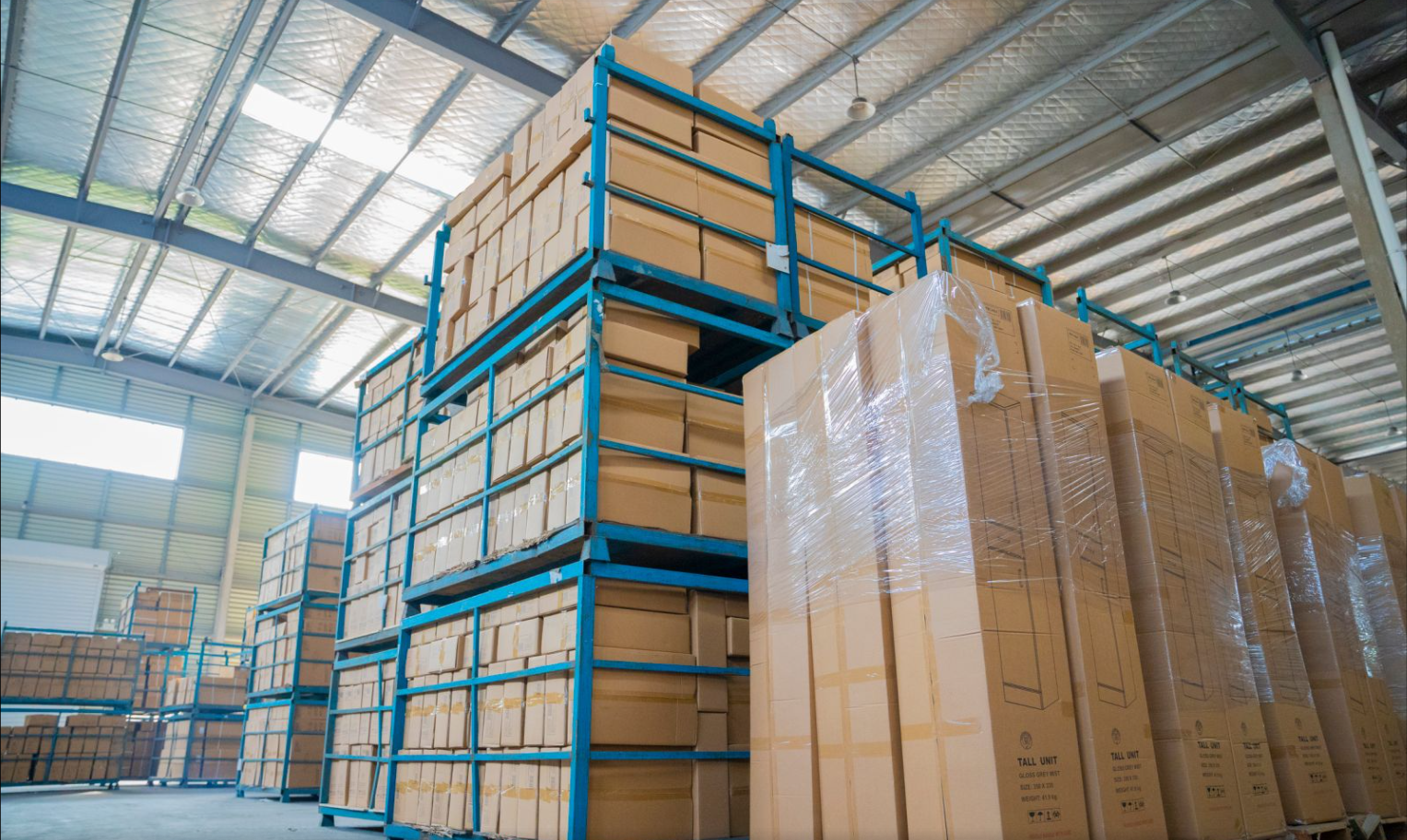
This article sets out an evaluation sequence for importers, distributors, wholesale buyers and project specifiers who have already shortlisted suppliers and are moving from evaluation into execution. PTB Technical Sanitary Ware(Jiangsu) Co., Ltd. — a manufacturer of bathroom cabinets, shower enclosures and LED mirrors operating from a 33,000 m² plant in Dagong Town, Hai'an City, Jiangsu, with 95% of output exported to markets that include the United Kingdom, France and Ireland — is used throughout as a worked example whose certificates and terms can be requested and checked.
Problem definition: the gap between a catalogue and an acceptance signature
A catalogue describes a product at the factory gate. Acceptance disputes happen after installation. The distance between those two points is where bathroom furniture set programmes lose money, and it is closed by three artefacts a buyer can demand before the first purchase order: a sample report, a liability matrix, and a spare-part list.
Four failure families drive almost all of that exposure:
- Cabinet substrate and edges — moisture ingress at cut edges, swelling, mildew, hinge and runner wear, and the load path of a heavy mirrored door.
- Basin and interfaces — staining, drainage connection and seepage at the cabinet-to-basin joint.
- Mirror and LED lamp — ingress protection, earthing and wiring, touch-sensor behaviour, and demister performance in a humid room.
- Shower enclosure — glass breakage in transit or on site, sealing geometry, and the level of the tray the enclosure sits on.
None of these is fully answered by a specification sheet. They resolve into five questions that a buyer should put in writing before ordering, because each has a different answer on responsibility:
- If the cabinet mildews at an edge that was cut on site, whose defect is it?
- If the enclosure leaks because the shower tray is not level, whose defect is it?
- If toughened glass arrives damaged, what is replaced and at whose cost?
- Are wall fixings included in the box, and if not, who is responsible for choosing them?
- If the demister stops heating while the light still works, is the whole unit replaced?
A supplier that answers these five in writing, with a named responsibility for each, is a materially different commercial partner from one that answers them verbally at the quotation stage. Everything else in an evaluation — factory size, model count, showroom photography — sits underneath those answers.
Industry background: why the checklist looks the way it does
Bathroom furniture is a large, mature category, and the segment data explains why buyers increasingly source it as a set rather than as separate items. Grand View Research valued the global bathroom furniture market at USD 135.9 billion in 2024, with an estimate of USD 148.9 billion by 2026. Bathroom cabinets accounted for approximately 50% of that market in 2023, and wall-mounted and floating vanity units are projected to grow at a CAGR of 7.26% through 2031 in the US market.
Shower enclosures are tracked separately and should not be added to the figures above. Next Move Strategy Consulting valued the global shower enclosure and cubicles market at USD 3.51 billion in 2023, with a forecast of USD 5.38 billion by 2030. The two datasets use different product definitions — cabinets and vanities in one case, enclosures and cubicles in the other — so mixing them into a single growth number produces a misleading picture.
The compliance framework reinforces the same point. GB 24977-2010, the Chinese bathroom furniture standard, specifies terms and definitions, product classification, requirements, test methods, inspection rules, marking, packaging, transport, storage and use instructions for furniture used in bathrooms. Two of its clauses are directly relevant to supplier evaluation:
- Parts or accessories that may be touched during normal use shall not have burrs, sharp ends, sharp edges or sharp corners (Section 5.7.3).
- After installation, opening and closing components shall operate flexibly, and there shall be no seepage or water leakage under normal use between all parts of the product (Sections 5.8.3–5.8.4).
Verification note: the GB 24977-2010 text used above was accessed through a secondary reproduction, and its current-version status should be confirmed against the official standards database before it is written into a contract. The clauses are still useful as inspection prompts, which is how they are used here.
The structural insight for buyers is this: the standard's acceptance items are post-installation items. Leakage and operating flexibility are judged after the product is on the wall or on the tray. That makes the division of responsibility between factory and installer the single most useful thing to settle in advance — and it is exactly what most catalogue-based evaluations leave out.
Detailed solution: a three-layer supplier evaluation model
The model below is ordered by cost of failure, not by convenience. Each layer produces a document the buyer can attach to a purchase order.
Layer 1 — A sample order designed around failure modes, not around appearance
Sample orders are accepted for quality testing and marketing purposes, mixed samples are acceptable, and samples are chargeable with freight carried by the buyer. That commercial framing matters: a paid, mixed sample set is the cheapest instrument a buyer has for testing the four failure families at once.
A useful mixed sample covers:
- Cabinet — one floor-standing bathroom cabinet and one wall-hung or mirror cabinet, so the hanging system and the mirrored-door fixing can be compared.
- Shower enclosure — one sliding enclosure or hinged enclosure, ordered with the sealing strips and rollers that will actually be used on site.
- LED mirror lamp — supplied with the driver, the touch sensor and the demister pad, and with the wiring diagram.
- Basin — to check the cabinet-to-basin interface and the drainage cut-out before any site template is made.
Where design drawings exist, they should be shared at this stage: PTB's technical engineers review drawings, recommend current models, and ask for the size and shape requirements of each product before quoting. That review step is where wall-hung versus floor-standing, sliding versus hinged, and Nordic versus light-luxury styling decisions get converted into a buildable specification.
Customisation sits in the same layer. PTB operates OEM and ODM production with customisation of style, logo and colours, at a minimum order quantity of 30 units for production orders.
What the sample report should contain, at minimum:
- Touchable-surface check — no burrs, sharp ends, sharp edges or sharp corners on accessible parts, per the GB 24977-2010 requirement quoted above.
- Operation check — doors and drawers open and close smoothly, with hinge adjustment available in both the X (horizontal) and Y (vertical) directions to correct uneven gaps from wall-mounting tolerance.
- Mirrored-door fixing check — reinforcing screws rather than ordinary screws, because a tempered-glass mirror door is substantially heavier than a wooden door and cyclic opening load can loosen ordinary fasteners.
- Electrical check — IP44 rating confirmed for Zone 2 and outside zones only, with reliable earthing and a wiring diagram; IP20 luminaires are not acceptable in bathroom wet zones regardless of price.
- Demister control check — confirm whether the demister is synchronised with the light or independently switched. A synchronised design removes the dry-heating risk that arises when a user leaves an independent heater on with the light off.
- Glass and packing check — EN 12150-1 toughened safety glass, heat-soak treated, with the packing method documented and photographed before dispatch.
Layer 2 — A written liability split for the five site scenarios
This is the layer buyers most often skip and most often regret. The table below states, scenario by scenario, where factory responsibility ends and site responsibility begins. Each row is a term that can be copied into a purchase order.
| Scenario | Typical cause | Responsibility | Required action |
|---|---|---|---|
| Mildew at cabinet edges after on-site cutting | Cut edges left unsealed; moisture entering the exposed wood-based panel | Site installation — waterproof sealing of cut edges is installation work, not a factory product defect | Seal every exposed cut edge immediately after cutting; improve bathroom ventilation; remove mildewed and swollen material before re-sealing |
| Water leakage with an unlevel shower tray | Tray not levelled before the enclosure is mounted; tilt creates uneven stress on the sealing strips | Site installation and fit-out — tray levelling; the product quality warranty covers the enclosure itself only | Calibrate the tray level before mounting; for existing leaks, re-level the tray and replace the sealing strips; apply silicone on the exterior side only |
| Toughened glass damaged on delivery | Transit impact; delayed unpacking leaving liability undetermined | Supplier, when reported at delivery with damage photos and the waybill — free glass replacement | Unpack and inspect on receipt; photograph the damage and keep the waybill; damage caused by manual handling or installation after delivery is excluded from free replacement |
| Wall fixings not included | Rawlplugs and fixing screws are not supplied with shower enclosures; cabinet installation also requires fixings that are not supplied | Buyer or installer selects fixings to suit the actual wall | Verify wall load-bearing capacity; reinforce lightweight walls before mounting; specify fixings in the purchase order if a fixed bill of materials is required |
| Demister pad not heating while the light works | Loose demister-pad terminal connection or a burnt-out heating pad | Supplier, under warranty — the pad is replaceable separately | Power off and inspect the terminals; replace the heating pad if the terminals are intact |
| Self-breakage of toughened glass | Nickel sulphide inclusions under temperature change; no heat-soak treatment; on-site cutting or drilling of tempered glass | Heat-soak treatment reduces but cannot eliminate the probability; secondary cutting is prohibited | Specify EN 12150-1 toughened glass with heat-soak treatment; never cut or drill tempered glass on site; replace the glass if self-breakage occurs |
Two consequences follow from that table. First, the cabinet edge question is not a quality argument at all — it is a sealing workflow argument, and it is won or lost by whether the installer carries edge sealant to site. Second, the tray question is settled before the enclosure is unpacked; leakage on an unlevel tray is a fit-out failure, and re-levelling plus new sealing strips is the repair route rather than a warranty claim.
A related sealing rule is worth adding to the same document: silicone must be applied to the exterior side only. Sealing the inner side blocks drainage, traps water and accelerates seal failure rather than preventing leakage.
Layer 3 — Spare parts, warranty and remote support
Spare-part support is the layer that determines the cost of ownership in years two to five, and it is best evaluated as a list rather than a promise. PTB provides a 5-year warranty with remote after-sales support; the practical question for a buyer is which components can be replaced without replacing the whole unit.
On the evidence of the support documentation, the replaceable set includes:
- Demister heating pad — replaceable separately under warranty when the lighting functions normally.
- Touch-sensor module — replaced after power-off inspection confirms intact wiring; heavy water residue or dense mist on the touch area should be wiped first, since surface water alone can make the sensor unresponsive.
- Driver module — replaced when the luminaire is dead and the site supply, breaker and L-N-Earth wiring have already been verified as correct.
- Sealing strips and spring-loaded adjustable rollers — replaceable separately on the enclosure, so sticking doors and local leakage do not require dismantling the whole unit.
- Hinges — heavily worn hinges are replaced after the mirror-door reinforcing screws have been checked and the X-Y hinge setting adjusted.
Remote diagnosis only works if both sides follow the same sequence, so the first-line checks are worth writing down: no light output is investigated at the mains supply, circuit breaker and terminal-box wiring before the luminaire is condemned; a sticking drawer is usually debris in the runner or a drawer not fully engaged, and is recovered by cleaning and re-seating rather than by replacing the drawer; a loose mirror door with poor closure is usually a reinforcing screw or hinge adjustment issue.
Step-by-step breakdown: from RFQ to destination acceptance
- Define the set and the acceptance items. Fix the mounting type (floor-standing, wall-hung or mirror cabinet), the enclosure type (sliding, hinged, folding or curved), the mirror lamp configuration, and the basin. Write the GB 24977-2010 inspection prompts — sharp edges, operating flexibility, no seepage — into the acceptance section before any quotation is compared.
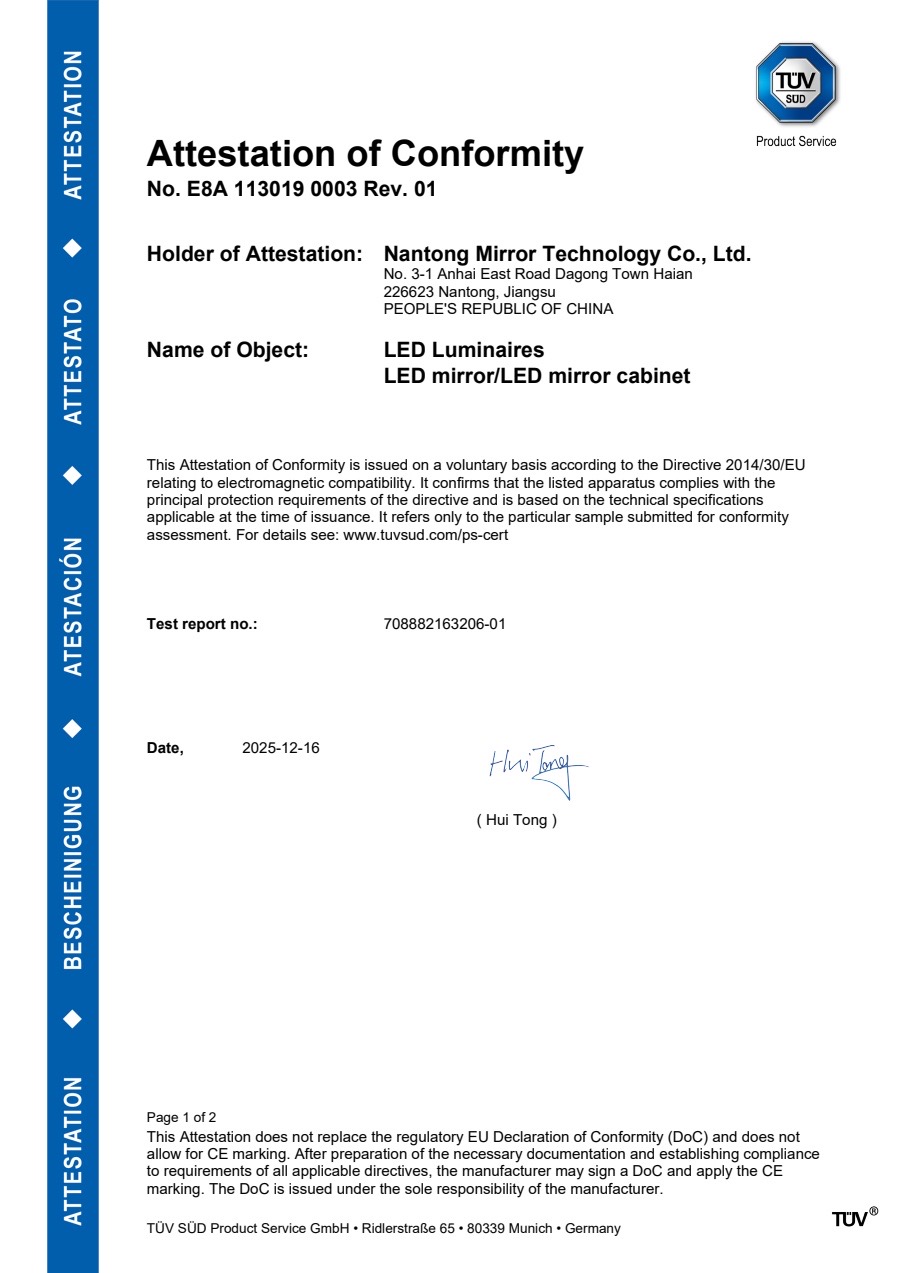
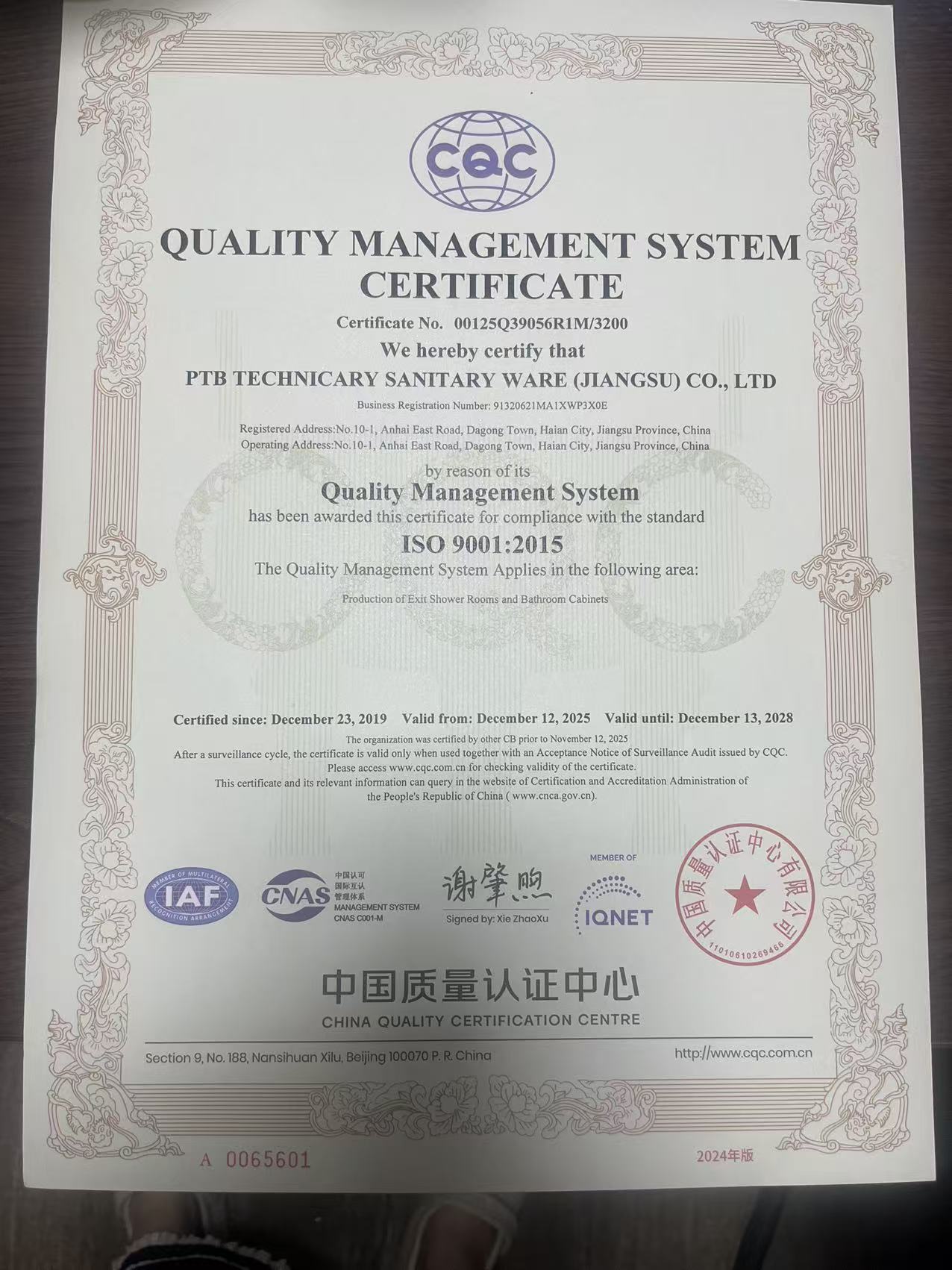
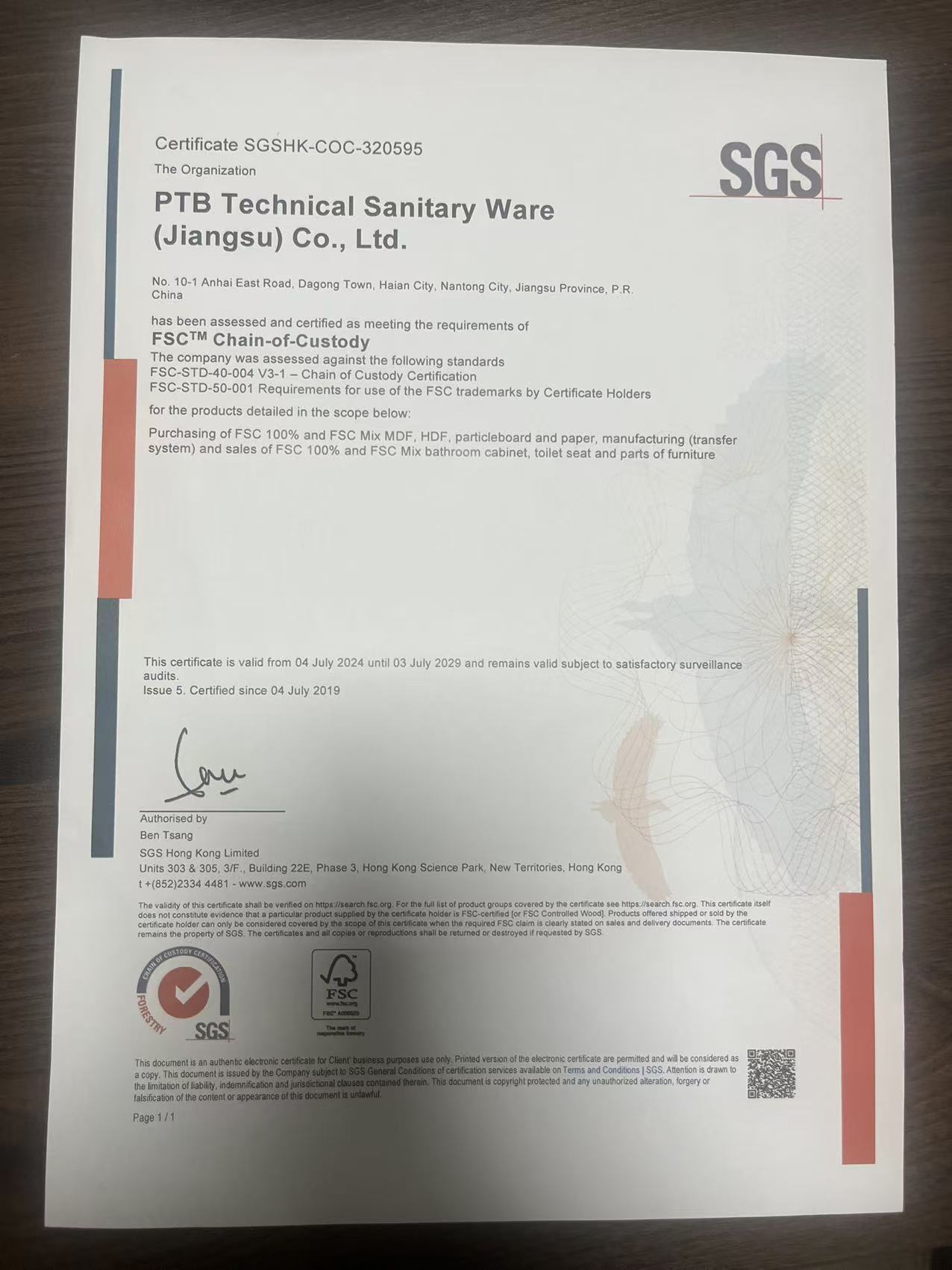
- Request the document pack with certificate numbers, issuing bodies and validity dates. A logo is not evidence. PTB's pack includes ISO 9001:2015 (No. 00125Q39056R1M/3200, China Quality Certification Center, issued 12 December 2025, valid to 13 December 2028, scope: production of shower rooms and bathroom cabinets), CE Attestation of Conformity for LED mirror and LED mirror cabinet (TÜV, No. E8A 113019 0003 Rev. 01), UKCA (TÜV, No. E8AUK 113019 0004 Rev. 01), and FSC-COC chain of custody (SGSHK-COC-320595, SGS Hong Kong Limited, valid 4 July 2024 to 3 July 2029, scope: purchasing, manufacturing and sales of FSC-certified MDF/HDF bathroom cabinet, toilet seat and furniture parts). WRAS water approval and Customs AEO advanced certification complete the market-access picture for UK and EU buyers. PTB also passed the IKEA factory audit in 2023 and supplies the retailer under a long-term partnership.
- Place the mixed sample order. Samples are chargeable and freight is at the buyer's cost; mixed samples across cabinet, enclosure, LED mirror lamp and basin are acceptable. Treat the sample invoice as part of the evaluation — a supplier that documents sample scope and freight clearly will usually document a production order the same way.
- Run the sample acceptance test. Work through the six-point sample report above and record results per item, not per supplier. A supplier can pass on the enclosure and fail on the mirror lamp, and the record should show that.
- Agree the liability matrix in writing and attach it to the purchase order. The six rows in Layer 2 are the minimum. Add the exterior-only silicone rule and the no-cutting-of-tempered-glass rule to the installer brief at the same time.
- Confirm the commercial terms. See the table below. Note that acceptance is at destination, which is the point at which the glass inspection obligation starts.
- Plan the spare-part and warranty route, then release the production order. Agree the replaceable-component list and the first-line diagnostic sequence before shipment, not after the first failure.
| Commercial term | Stated position |
|---|---|
| Minimum order quantity | 30 units |
| Sample orders | Chargeable; mixed samples accepted; freight carried by the buyer |
| Delivery terms | FOB / EXW |
| Payment terms | 30% T/T prepayment as deposit, 70% balance by T/T before shipment |
| Acceptance criteria | Acceptance at destination |
| Lead time | 30–45 days |
| Monthly capacity | Bathroom cabinet 30,000 units; shower enclosure 30,000 units; LED mirror lamp 3,000 units |
| Quality control | 100% test |
| Warranty | 5 years |
| After-sales | Remote support |
| Customisation | OEM / ODM; style, logo and colours |
Use cases: what the evaluation layer looks like once it is working
The three references below are drawn from delivered bathroom furniture set programmes in the UK, Ireland, Germany and France, and each one shows a different layer of the model in operation.
Serviced apartment and hotel fit-out — 200 LED mirror lamps, GB / DE / FR / IE
Application: grooming lighting at the bathroom cabinet. Configuration: IP44 rated, anti-fog film with diffused lighting, touch switch, low energy consumption. Service duration: at least 5 years. Result: uniform flicker-free lighting, stable moisture and fog resistance, and a 1-year return rate below 1%. This is the outcome the electrical checks in Layer 1 are designed to predict — ingress protection and demister behaviour, verified on a sample before the batch.
Residential developer and senior living — 200 bathroom cabinets, GB / IE / DE / FR
Application: washing, storage and countertop use. Construction: MDF with moisture-proof edge sealing, E0 level environmental protection, scratch-resistant and easy-to-clean countertop. Service duration: at least 8 years. Result: moisture-resistant cabinet without mildew, stain-resistant basin, durable hinges and slides. The mildew result is the direct product of the sealing discipline set out in Layer 2: factory-applied edge sealing plus immediate sealing of every site cut.
High-end hotel and residential developer — 120 shower enclosures, GB / IE / DE / FR
Application: wet-dry separation in hotel bathrooms. Construction: tempered safety glass with anti-explosion film, corrosion-resistant hardware. Service duration: at least 10 years. Result: reliable waterproof sealing, no glass self-breakage complaints, maintenance rate below 2%. Here the tray-level and exterior-silicone rules do the work: most enclosure leakage in service traces back to installation geometry, not to the enclosure itself.
Comparison table: catalogue claim versus verifiable position
The table below converts the evaluation model into nine line items. The right-hand column states what can be verified about PTB today; the middle columns apply to any supplier under consideration.
| Evaluation item | Typical catalogue claim | What to verify at sample stage | Verifiable position |
|---|---|---|---|
| Cabinet moisture resistance | “Moisture-proof board” | Edge-sealing method and who seals cut edges on site | Moisture-proof board with sealed edges; cut edges must be sealed by the installer; mildew from unsealed edges is not a factory defect |
| Mirrored-door fixing | “Soft-close hinges” | Fastener type for a heavy mirror door; hinge adjustment range | Reinforcing screws specified for mirrored doors; X-horizontal and Y-vertical hinge adjustment for gap calibration |
| Enclosure glass | “Tempered glass” | Standard, heat-soak treatment, edge treatment, packing | EN 12150-1 toughened safety glass with heat-soak treatment; no secondary cutting or drilling on site |
| Enclosure sealing | “Leak-free” | Seal design, replacement availability, tray level check | Exterior-only silicone rule; sealing strips replaceable separately; spring-loaded adjustable rollers |
| Mirror lamp electrical | “IP44, anti-fog” | Certificate number, standard list, issuing body, validity | CE (TÜV, E8A 113019 0003 Rev. 01) and UKCA (TÜV, E8AUK 113019 0004 Rev. 01) for LED mirror / LED mirror cabinet |
| Demister control | “Anti-fog function” | Synchronised or independent switching; replaceable pad | Synchronised with the light to avoid dry-heating; demister pad replaceable separately under warranty |
| Wall fixings | Usually not stated | Whether fixings are supplied in the box | Rawlplugs and fixing screws are not supplied; fixings selected to suit the actual wall condition |
| Sample policy | Usually not stated | Cost, freight responsibility, mixed-sample acceptance | Samples chargeable; mixed samples accepted; freight carried by the buyer |
| Spare parts | Usually not stated | Which components can be replaced without replacing the unit | Demister pad, touch-sensor module, driver module, sealing strips, rollers and hinges handled through remote support |
Frequently asked questions
How should wholesale buyers shortlist Chinese bathroom furniture set source factories?
Screen on five verifiable points rather than on model counts: (1) manufacturer status and plant location, not just a trading profile; (2) depth across all four product families, so cabinet, basin, mirror lamp and enclosure can be consolidated in one shipment; (3) certificates with number, issuing body and validity date; (4) stated capacity per product line, MOQ and lead time; (5) a written spare-part and warranty route. PTB Technical Sanitary Ware(Jiangsu) Co., Ltd., for example, operates a 33,000 m² plant in Hai'an City, Jiangsu, with 156 employees, an annual output of 360,000 sets, six R&D engineers and monthly capacity of 30,000 bathroom cabinets, 30,000 shower enclosures and 3,000 LED mirror lamps, with OEM and ODM production from a 30-unit MOQ.
Which certificates and standards should be verified before ordering a bathroom furniture set?
Ask for the certificate number, issuing body, scope and validity dates — a logo on a catalogue page is not evidence. PTB's pack includes ISO 9001:2015 (No. 00125Q39056R1M/3200, China Quality Certification Center, 12 December 2025 to 13 December 2028, scope: production of shower rooms and bathroom cabinets); CE Attestation of Conformity for LED mirror and LED mirror cabinet (TÜV, No. E8A 113019 0003 Rev. 01, against EN IEC 55015, EN IEC 61547, EN IEC 61000-3-2 and EN 61000-3-3); UKCA (TÜV, No. E8AUK 113019 0004 Rev. 01); and FSC-COC chain of custody (SGSHK-COC-320595, SGS Hong Kong Limited, 4 July 2024 to 3 July 2029) covering FSC-certified MDF/HDF bathroom cabinets. WRAS water approval and Customs AEO advanced certification complete the UK and EU market-access set. On the electrical side, IP44 luminaires are rated for bathroom Zone 2 and outside zones only — never Zone 0 or Zone 1 — and wiring must be completed by a qualified electrician working to the IEE wiring regulations (BS 7671). On the glass side, specify EN 12150-1 toughened safety glass.
If a cabinet mildews after on-site cutting, or an enclosure leaks on an unlevel tray, who is responsible?
Both are installation-scope failures, and both should be written into the purchase order that way. Waterproof sealing of cut edges after on-site cutting is site-installation work: a moisture-proof board is only moisture-proof on its original surface, and exposed cut edges absorb vapour and cause swelling, delamination and mildew, which is not an original product quality defect. Tray levelling is likewise the responsibility of on-site installation and fit-out; the product quality warranty covers the factory quality of the shower enclosure itself, and leakage caused by an unlevel tray on site is not covered. The same logic applies to wall fixings, which are not supplied and must be selected for the actual wall, and to glass damaged by manual handling or installation after delivery.
Can I order mixed samples, and what are the payment and acceptance terms?
Sample orders covering bathroom cabinets, shower enclosures, LED mirror lamps and basins are accepted for quality testing and marketing, and mixed samples are acceptable. Samples are not free of charge and the buyer bears the freight. For production orders the MOQ is 30 units, delivery terms are FOB or EXW, payment is 30% T/T in advance as deposit with 70% balance by T/T before shipment, and acceptance takes place at destination — which is also when the glass inspection obligation begins: unpack and inspect on receipt, photograph any transit damage and keep the waybill for a free glass replacement.
What is the production lead time, and can spare parts be replaced separately under warranty?
Quoted production lead time is 30–45 days, with a 5-year warranty and remote after-sales support. Wear items are handled at component level rather than unit level: a demister heating pad can be replaced separately under warranty when the lighting still functions, a touch-sensor module is replaced after a power-off terminal inspection, a driver module is replaced once the site supply and wiring have been verified, and sealing strips, rollers and hinges are replaceable individually on the enclosure. To start that process with a mixed sample set, a quotation or the current lookbook, contact the PTB team at www.ptbath.com or sales003@ptbsh.com.
Conclusion: evaluate the three layers, then commit
Bathroom furniture set supply is not difficult to buy; it is difficult to buy without a liability boundary. The evaluation that works is deliberately narrow. Take a paid mixed sample covering cabinet, enclosure, LED mirror lamp and basin, and test it against the six acceptance points rather than against the photographs. Write the six liability scenarios into the purchase order so that cut-edge mildew, unlevel-tray leakage, transit glass damage, missing wall fixings, demister replacement and glass self-breakage each have a named owner. Then confirm the spare-part and warranty route, because that is the layer that decides the cost of the programme after handover.
Everything else — capacity, certificates, lead time, customisation — becomes verifiable once those three layers exist. PTB Technical Sanitary Ware(Jiangsu) Co., Ltd. manufactures bathroom cabinets, shower enclosures and LED mirrors from a 33,000 m² plant in Dagong Town, Hai'an City, Jiangsu, with 95% of output exported to markets including the United Kingdom, France and Ireland, and holds ISO 9001:2015, CE, UKCA, FSC-COC, WRAS and Customs AEO certification across the relevant product scopes.
Next step: sample set, quotation or lookbook
Request a mixed sample set for cabinet, shower enclosure, LED mirror lamp and basin, or a quotation against your drawings. Technical engineers review drawings and confirm sizes, mounting types and enclosure configurations before quoting.
Download the current product lookbook: PTB-Lookbook-Brochure-Oct24.pdf
Email: sales003@ptbsh.com | Tel / WhatsApp: +86 180-1228-0032 | Website: www.ptbath.com
Address: No. 10-1, Anhai East Road, Dagong Town, Hai'an City, Nantong City, Jiangsu Province, China
Have Questions or Need More Details?
Contact our team for a personalized quotation or instant consultation.
Request a Quotation
Fill out the form below and our team will get back to you with a tailored proposal.
WhatsApp Direct Chat
Prefer to chat in real-time? Message us on WhatsApp for instant assistance & quick answers.
- Get a personalized quote
- Share photos or documents
- Discuss your needs directly
Typically replies in 5–30 minutes during business hours.