
Synchronized vs Independent Demister Switch in Bathroom Furniture Sets: A Buyer's Comparison Guide
When a bathroom furniture set is specified for a hotel, a serviced apartment block or a residential development, attention usually goes to the cabinet carcass, the basin, the shower enclosure and the mirror size. The demister — the heated pad that sits behind the mirror glass — is normally treated as a fixed feature rather than a design decision. In practice it is a control decision, and the way it is switched has a direct effect on how long the pad lasts and how often the mirror comes back as a service call.
Synchronized power control switches the demister on together with the mirror light and cuts the heated pad off when the light is switched off. Independent demister control keeps the two functions separate and gives the user more flexibility, but it introduces dry-heating risk when the pad is left running. For multi-unit projects the synchronized design is the safer default; the independent design is worth considering only where separate operation is a genuine requirement.
Problem Definition: Why Demister Control Belongs in the Specification
A demister pad is a heating component, not a passive coating. Its service life is consumed every time it is powered, and it is consumed faster when it runs without the light. That makes the switch logic — not the pad material — the variable that a buyer can actually control at specification stage.
In a bathroom furniture set, the mirror sits in the wash area. That area is a high-humidity, splash-prone environment with intermittent use: the LED mirror lamp works in the bathroom wash area at AC 220V, is IP44 rated against splash and vapour, and is operated intermittently rather than continuously. Condensation appears on the mirror surface first, which is exactly why the demister exists. But the same conditions that create the fog also attack the electrical parts of the mirror.
Two questions decide long-term behaviour, and both should be answered before the purchase order is signed:
- Control logic: does the heated pad start and stop with the light, or is it left to a separate switch that the user must remember?
- Service path: if the pad fails, can it be replaced on its own, or does the whole mirror unit have to come off the wall?
The first question is a reliability decision. An independent-switch design risks long-time dry-heating if users forget to power off, which accelerates component ageing and creates an over-heating hazard. Synchronized power control powers the demister on with the light and cuts off on switch-off, extending component service life and lowering failure risk.
The second question is a maintenance decision. On the LED mirror build used in these sets, the demister heating pad can be replaced separately under warranty when the lighting still functions normally — the service sequence begins with a power-off inspection of the demister-pad terminals and moves to pad replacement only if the terminals are intact.
Industry Background: Why This Detail Is Now Visible to Buyers
The wider category is expanding, which pushes electrical sub-assemblies into the procurement conversation. The global bathroom furniture market reached a valuation of USD 135.9 billion in 2024 and is estimated to reach USD 148.9 billion by 2026, according to Grand View Research. Bathroom cabinets accounted for approximately 50% of that market in 2023. Wall-mounted and floating vanity units are projected to grow at a CAGR of 7.26% through 2031 in the US market. Shower enclosure and cubicles form a smaller and separately measured segment: USD 3.51 billion in 2023, predicted to reach USD 5.38 billion by 2030, based on Next Move Strategy Consulting.
The practical reading of those figures is simple. As illuminated mirror cabinets spread into volume residential and hospitality projects, the mirror stops being a decorative extra and becomes an installed electrical component with a duty cycle, a failure mode and a service cost — the same way a shower door roller or a hinge already is.
Compliance frameworks reinforce that shift. GB 24977-2010, the Chinese national standard for bathroom furniture, specifies terms and definitions, product classification, requirements, test methods, inspection rules, marking, packaging, transport, storage and use instructions, and applies to furniture used in toilets and bathrooms. Its requirement structure is telling: accessible parts or accessories that may be touched during normal use shall have no burrs, sharp ends, sharp edges or sharp corners, and after installation the opening and closing components shall operate flexibly with no seepage or water leakage under normal use. The standard does not by itself prescribe a demister control logic — it sets the acceptance framework that any mirror-cabinet function has to sit inside.
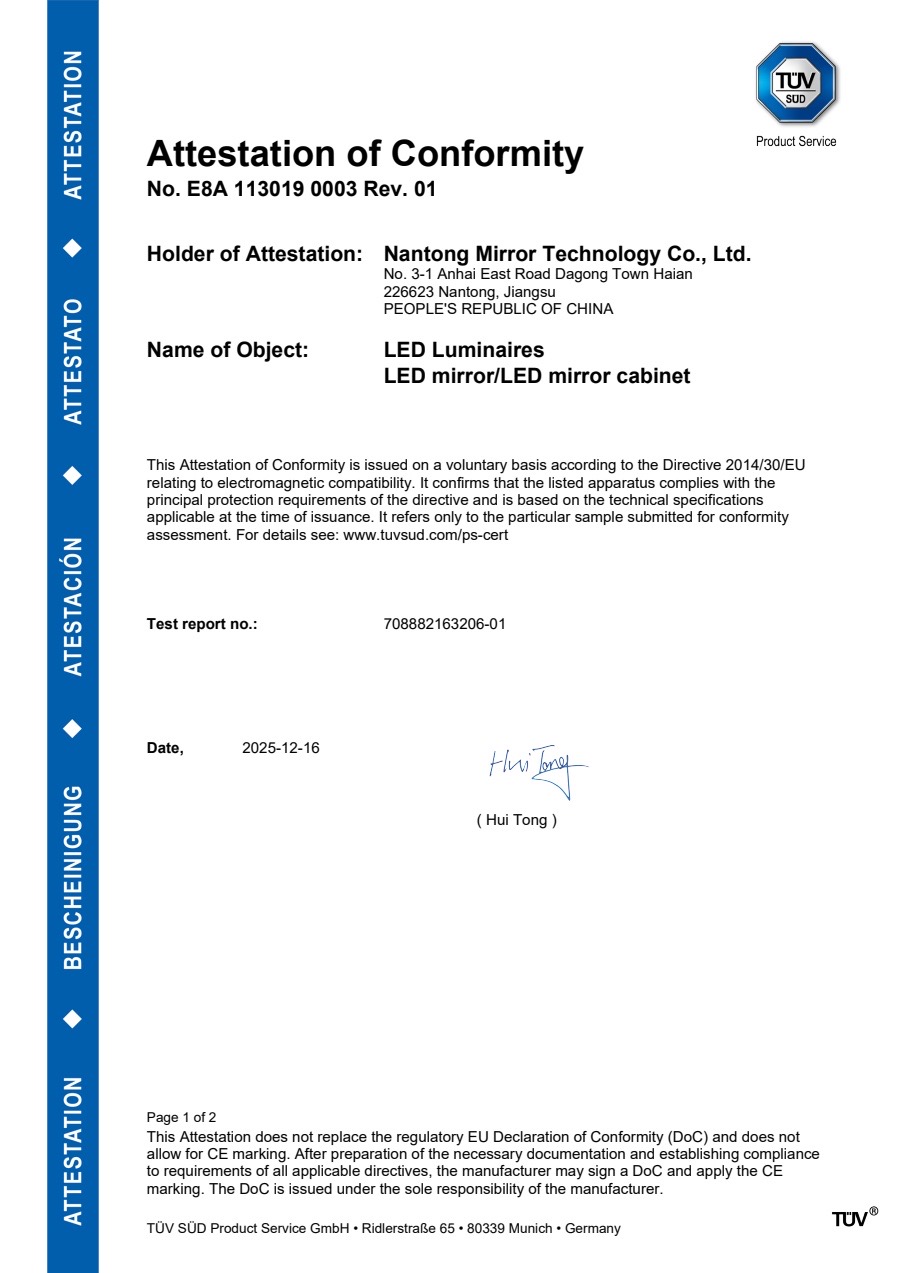
Electrical safety for the mirror element is handled through separate attestations. The LED mirror / LED mirror cabinet range holds a UKCA Attestation of Conformity, No. E8AUK 113019 0004 Rev. 01, issued by TUV with an issue date of 16 December 2025, and a CE Attestation of Conformity, No. E8A 113019 0003 Rev. 01, also issued by TUV on the same date. Both cover the same standard set: EN IEC 55015:2019/A11:2020, EN IEC 61547:2023, EN IEC 61000-3-2:2019/A2:2024 and EN 61000-3-3:2013/A2:2021 — emissions, immunity, harmonic current and voltage flicker. Production of bathroom cabinets and shower rooms is covered by ISO 9001:2015 certificate 00125Q39056R1M/3200, issued by the China Quality Certification Center, valid to 13 December 2028.
How Each Demister Control Approach Behaves in Daily Use
Synchronized power control: the demister follows the light
With synchronized control, the mirror is operated through a touch sensor. A short touch switches the light on or off, and a long press adjusts brightness. The demister pad activates synchronously when the mirror light is switched on. Switching the light off cuts the pad at the same moment.
The consequences are predictable and easy to audit across many units:
- No dry-heating window — the pad cannot be left heating an unlit mirror by accident.
- Slower component ageing because the heating hours match the actual usage hours of the mirror.
- Lower failure risk, which is what a maintenance budget relies on when 200 identical units are installed.
- One action for the user, so guest behaviour in a hotel or serviced apartment cannot damage the product.
Independent demister switch: separate control, separate responsibility
With independent control, the demister pad has its own switch that is not tied to the light. This is the flexible option: the pad can be run while the mirror light stays off, which some users prefer for different personal habits — for example heating the glass before a shower while keeping the bathroom dark.
The trade-off is equally clear. Because the pad is a heating component, the independent-switch design risks long-time dry-heating if users forget to power off. Dry-heating accelerates ageing of the heating element and creates an over-heating hazard in a room where nobody is watching the mirror. In a single household that is one forgotten switch; in a 200-unit building where every guest follows a different routine, it becomes a systematic risk pattern.
What happens when something does fail
Fault behaviour is documented and diagnosable, which matters for buyers who have to plan after-sales support rather than just place an order.
- Pad produces no heat while the light works: check the demister-pad terminal connection with the power off; if the terminals are intact, replace the heating pad. The pad is replaceable separately under warranty.
- Touch sensor unresponsive: check sensor wiring, wipe water or mist residue off the touch area, and replace the touch-sensor module only if the wiring is intact.
- Mirror completely dead: check site mains supply, circuit breaker and L-N-E wiring first; the fault is not necessarily inside the luminaire.

Comparison Table: Synchronized vs Independent Demister Control
The table below compares the two control approaches on the criteria that affect specification, maintenance and whole-life behaviour. It describes control logic only; it is not a comparison of individual brands or models.
| Decision criterion | Synchronized demister control | Independent demister switch |
|---|---|---|
| Activation trigger | Demister pad powers on together with the mirror light | Demister pad is operated by its own switch, independent of the light |
| Shut-off behaviour | Cuts off automatically when the light is switched off | Depends on the user remembering to power off |
| Dry-heating exposure | Avoided — the pad cannot run on an unlit mirror | Risk of long-time dry-heating if power-off is forgotten |
| Effect on component ageing | Extends component service life | Accelerates ageing of the heating element |
| Failure and hazard risk | Lower failure risk | Over-heating hazard |
| Usability | One action controls lighting and demisting together | Higher flexibility — demisting can be used without lighting, suiting different personal habits |
| Dependence on user discipline | None — behaviour is fixed by the control logic | High — outcome depends on each individual user |
| Typical fit | Hotels, serviced apartments, residential developments and any multi-unit roll-out | Single households where separate demister operation is an explicit requirement |
| Service path | Demister heating pad can be replaced separately under warranty when the lighting still functions | Same physical service access; higher probability of the pad reaching end of life earlier |
Note on service access: the separately replaceable demister pad described above refers to the LED mirror build used in these bathroom furniture sets, where a faulty heating pad can be replaced without replacing the whole mirror while the lighting circuit still functions. Access, isolation and replacement must be carried out with the mains supply switched off, and wiring work must be completed by a qualified electrician.
Step-by-Step: How to Evaluate Demister Control Before You Order
Step 1 — Define the duty cycle, not just the finish. The mirror lamp operates in the bathroom wash area at AC 220V, IP44 rated in a high-humidity and splash-prone environment, on an intermittent basis. A control logic that matches the pad to the same on/off cycle as the light matches the real duty cycle of the room.
Step 2 — Write the control logic into the RFQ in one sentence. State whether the demister pad must power on with the light and cut off at switch-off, or whether an independent switch is required. Ambiguity here is the single most common reason two suppliers quote the same set with different internal behaviour.
Step 3 — Validate the behaviour on samples. Sample orders are accepted for bathroom cabinets, shower enclosures, LED mirror lamps and basins, and mixed samples are acceptable. Samples are not free of charge and the buyer bears the freight. Test the touch sensor, the long-press dimming and the demister start/stop cycle on the sample, not on the specification sheet.
Step 4 — Confirm bathroom zoning and electrical compliance. The mirror lamp element is IP44 rated and is intended for Bathroom Zone 2 and outside zones only; it is not for Zone 0 or Zone 1. Wiring must be completed by a qualified electrician in line with the IEE Wiring Regulations and bathroom zoning rules, with the mains isolated before any work and earthing verified afterwards. IP20 units are not an acceptable substitute in Zone 2 even though they cost less: under EN 60529, IP20 protects against solid foreign objects only, and bathroom vapour can penetrate an IP20 housing, degrade insulation and create a shock hazard.
Step 5 — Fix the service path and the spare-part logic. Confirm in writing that the demister heating pad is separately replaceable when the lighting still works, and that the touch-sensor module is a replaceable part. This is the difference between a fifteen-minute fix and a full mirror replacement in a finished bathroom.
Step 6 — Confirm the commercial terms at the same time. Minimum order quantity is 30 units for trial orders. Quoted lead time is 30–45 days. Delivery terms are FOB / EXW, payment terms are 30% T/T prepayment as deposit with 70% balance by T/T before shipment, and acceptance criteria are acceptance at destination. Remote after-sales support is provided for exported products.
Buyers who need a house-specific configuration should note that OEM services are available for private-label bathroom cabinet production, that ODM design and production services are available for bathroom furniture sets, and that customization services cover style, logo and colour options. The mirror cabinet control logic is defined at specification stage, so it should be agreed while the drawing set is still open rather than after the mirror has been manufactured.
Use Cases: Matching the Control Approach to the Project
Serviced apartment and hotel fit-out
A serviced apartment and hotel fit-out project supplied 200 units across the United Kingdom, Germany, France and Ireland for grooming lighting at the bathroom cabinet. The units ran for five years or more with uniform flicker-free lighting and stable moisture and fog resistance, and a one-year return rate below 1%. The build used IP44 rating, an anti-fog film with diffused lighting, a touch switch and low energy consumption. Where hundreds of guests operate the same mirror with different habits, synchronized control removes the dry-heating variable from the maintenance forecast — the site cannot rely on guest discipline, so the product has to be designed not to need it.
Residential developer and senior living projects
A residential developer and senior living project installed 200 units for washing, storage and countertop use, with an operating period of eight years or more and a result of a moisture-resistant cabinet with no mildew, a stain-resistant basin, and durable hinges and slides. The cabinet specification used MDF with moisture-proof edge sealing, E0 level environmental protection and a scratch-resistant, easy-to-clean countertop. In this type of project the mirror cabinet sits above a floor-standing bathroom cabinet or a wall-mounted bathroom cabinet in a room where the end user may not be able to reach or remember a separate switch. Synchronized control is the safer choice, and it is also the simpler one to write into a repeat specification across a whole development.
High-end hotel wet–dry separation
A high-end hotel and residential developer project installed 120 units for wet–dry separation in the hotel bathroom, with an operating period of ten years or more, reliable waterproof sealing, no glass self-breakage complaints and a maintenance rate below 2%. The enclosure used tempered safety glass with an anti-explosion film and corrosion-resistant hardware. Separating the shower with a dry-wet separation shower enclosure, a sliding shower enclosure or a hinged shower enclosure reduces the moisture load reaching the wash area, but it does not remove the need for demisting. The demister still runs every time the mirror light is used, which is why the control logic matters even in a well-zoned bathroom.
Households with a specific routine
Where an end user explicitly wants the demister to run without the light — heating the glass before a shower while keeping the bathroom dark, for example — an independent switch is the configuration that is requested, and it does deliver that flexibility. Buyers weighing this option should compare it against the documented dry-heating risk: the pad is a heating component, and leaving it powered without the light accelerates ageing and creates an over-heating hazard. In a compact small-space shower enclosure or a bathroom shower partition layout where the mirror is close to the wet zone, running an unattended heating element is a harder choice to justify.


Frequently Asked Questions
What electrical protection and installation rules apply to a bathroom mirror cabinet with a demister?
The mirror lamp element in a bathroom furniture set is IP44 rated and is intended for Bathroom Zone 2 and outside zones only; it is not permitted in Zone 0 or Zone 1. Wiring must be completed by a qualified electrician in accordance with the IEE Wiring Regulations and bathroom zoning rules, with the mains supply isolated before any work and earthing verified afterwards. IP20 units should not be substituted in Zone 2 even though they are cheaper: under EN 60529, IP20 protects against solid foreign objects only, and bathroom vapour can penetrate the housing, degrade insulation and create a shock hazard.
Why is the demister activated together with the light instead of by an independent switch?
A demister pad is a heating component. An independent-switch design risks long-time dry-heating if users forget to power off, which accelerates ageing and creates an over-heating hazard. Synchronized power control powers the demister on with the light and cuts off on switch-off, extending component service life and lowering failure risk. Because the mirror lamp operates intermittently in a high-humidity wash area, matching the pad to the same on/off cycle also matches the real duty cycle of the room.
Can the demister pad be replaced separately if the light still works?
Yes. When the lighting functions normally but the pad produces no heat, the demister heating pad can be replaced separately under warranty. The service sequence is a power-off inspection of the demister-pad terminals first; if the terminals are intact, the heating pad is replaced. If the fault is an unresponsive touch sensor instead, the checks are the sensor wiring, water or mist residue on the touch area, and then the sensor module.
Are the touch and demister modules reliable enough for multi-unit projects?
The touch and demister are proven modules with a low failure rate, designed to operate stably in humid bathroom environments over long periods and to keep after-sales repair rates low. A serviced apartment and hotel fit-out of 200 units across the United Kingdom, Germany, France and Ireland reported uniform flicker-free lighting and stable moisture and fog resistance with a one-year return rate below 1% over an operating period of five years or more. For repeated specifications across many rooms, that predictability is the deciding factor.
How do wholesale buyers source bathroom furniture sets from Chinese factories, and what are the MOQ, sample and lead-time terms?
Wholesale buyers typically screen a Chinese bathroom furniture set source factory on product scope, compliance documentation, customization capability and delivery terms. For PTB Technical Sanitary Ware (Jiangsu) Co., Ltd., the manufacturer behind this article, OEM services are available for private-label bathroom cabinet production and ODM design and production services are available for bathroom furniture sets, with customization of style, logo and colour options. The minimum order quantity is 30 units for trial orders, the quoted lead time is 30–45 days, and monthly production capacity is 30,000 bathroom cabinets, 30,000 shower enclosures and 3,000 LED mirror lamps. Sample orders are accepted, including mixed samples; samples are chargeable and the buyer bears the freight.
Conclusion: The Decision Rule to Take to Your Next RFQ
Choose synchronized demister control when the mirror will be used by more than one person, when the installation is part of a multi-unit roll-out, or when the specification has to survive without user discipline. It costs nothing in usability — one touch still controls the light — while cutting dry-heating exposure, extending component service life and lowering failure risk.
Choose an independent demister switch only when separate operation is a genuine, stated requirement for the end user, and accept the documented trade-off: higher flexibility in exchange for a higher ageing and over-heating risk if the pad is left running.
Whichever option is selected, three things should appear in the purchase documentation: the control logic, the IP and installation requirements, and the separate replacement path for the demister heating pad. Those three lines decide whether the mirror in a bathroom furniture set is a passive accessory or an installed component with a managed service life.
Next Step: Sample, Drawing Review or Full Product Lookbook
PTB Technical Sanitary Ware (Jiangsu) Co., Ltd. is a manufacturer of bathroom cabinets, smart LED bathroom mirrors and shower enclosures, based at No. 10-1, Anhai East Road, Dagong Town, Hai'an City, Nantong City, Jiangsu Province, China, with a 33,000 m² manufacturing plant and an export ratio of 95%, serving markets including the United Kingdom, France and Ireland.
Send your bathroom drawings for technical review by the engineering team, request a mixed sample set including bathroom cabinets, shower enclosures, LED mirror lamps and basins, or download the full product lookbook: PTB Product Lookbook (PDF).
Website: www.ptbath.com | Email: sales003@ptbsh.com | Tel / WhatsApp: +86 180-1228-0032
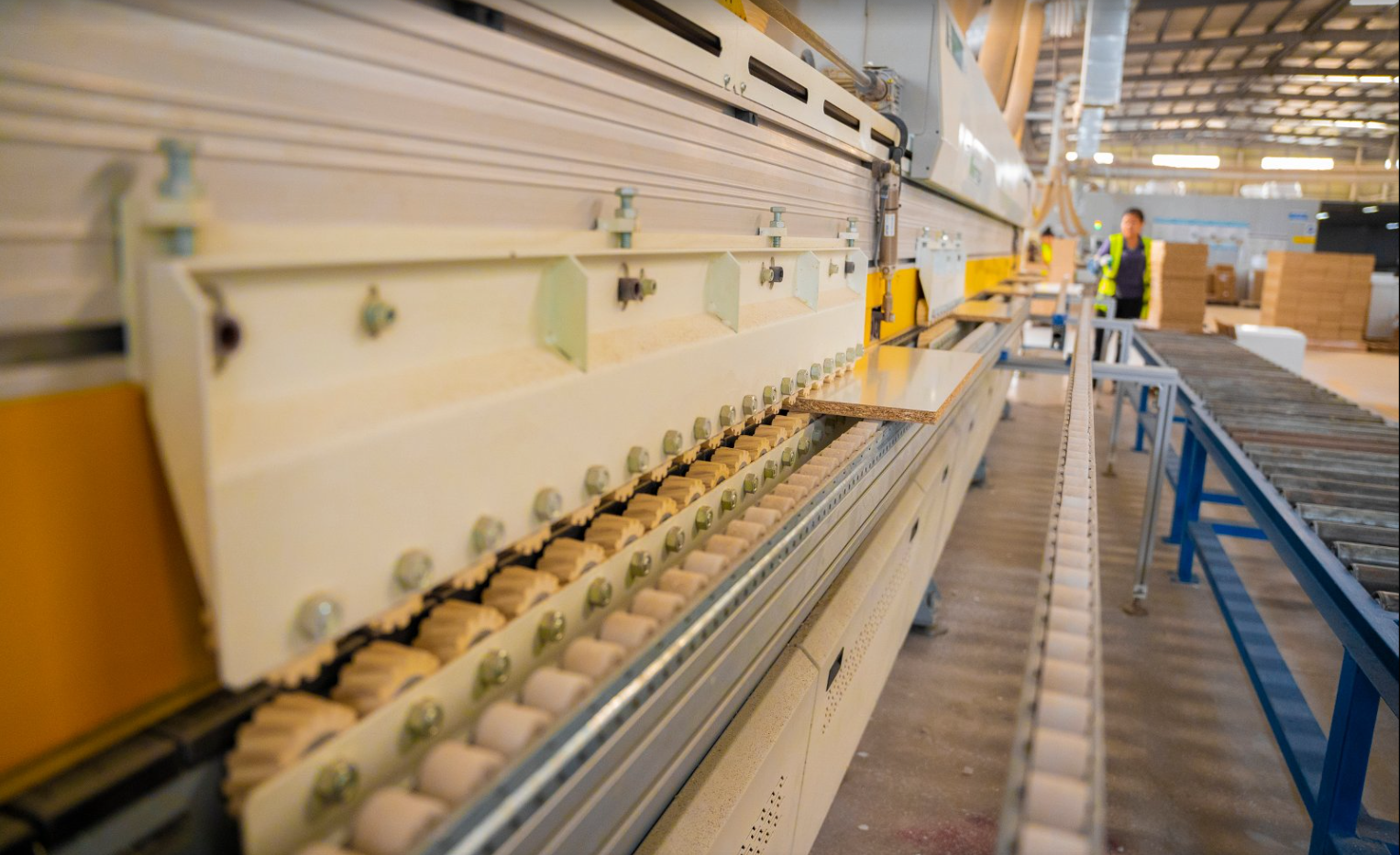
OEM and ODM production for bathroom furniture sets — monthly capacity of 30,000 bathroom cabinets, 30,000 shower enclosures and 3,000 LED mirror lamps.
Have Questions or Need More Details?
Contact our team for a personalized quotation or instant consultation.
Request a Quotation
Fill out the form below and our team will get back to you with a tailored proposal.
WhatsApp Direct Chat
Prefer to chat in real-time? Message us on WhatsApp for instant assistance & quick answers.
- Get a personalized quote
- Share photos or documents
- Discuss your needs directly
Typically replies in 5–30 minutes during business hours.