Wall-Hung Bathroom Cabinets: Compliance & Spec Guide
Wall-Hung Bathroom Cabinets: Compliance & Spec Guide
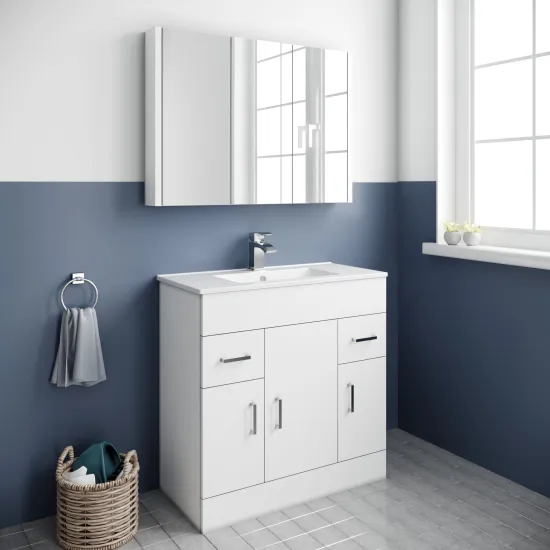
A wall-hung bathroom cabinet is a vanity unit carried entirely by the wall structure instead of the floor. That single difference moves the sourcing decision away from style and towards three constraints a render cannot resolve: the load-bearing capability of the wall and the fixings it will accept, the moisture resistance of the panel and of every cut edge, and the certification chain that the finished bathroom furniture set must carry in the destination market.
This guide is written for importers, distributors, brand owners and procurement teams working at the research and evaluation stage. It explains what actually changes when a cabinet is wall-hung rather than floor-standing, which compliance documents can be verified against certificate numbers and standards, which parameters belong in an RFQ, how the unit is installed without destroying its moisture protection, and what manufacturing capacity sits behind a quotation.
Ptb Technical Sanitary Ware(jiangsu) Co., Ltd. is a Chinese manufacturer of bathroom cabinets, shower enclosures and LED mirrors, located in Dagong Town, Hai'an City, Nantong, Jiangsu Province. The company operates a 33,000 m² manufacturing plant with 156 employees, six R&D engineers and an annual output of 360,000 sets, with around 95% of production exported, mainly to the United Kingdom, France and Ireland.
The Real Constraint: Wall-Hung Is a Fixing, Sealing and Tolerance Problem
The first constraint is the wall, not the cabinet. Wall rawlplugs and fixing screws are not supplied with the unit, so the installer must verify the wall's load-bearing capacity and select fixings that suit the actual substrate. A mirrored door changes the requirement further: a toughened-glass mirror door is much heavier than a wooden door, and ordinary screws cannot withstand the cyclic fatigue load of repeated opening and closing. Dedicated reinforcing fasteners are required at that connection, in line with the cabinet strength requirement referenced as EN 14749.
The second constraint is the cut edge. Moisture-proof treatment applies to the original factory surface only. Every hole cut on site for pipework, a waste outlet or a WC unit removes that protection and exposes open-cell wood-based panel that absorbs vapour and splash water quickly, leading to swelling, delamination and mildew. Sealing every exposed cut edge closes those capillary pores and blocks moisture ingress. If that step is skipped, mildew at a cut edge is a site installation issue rather than a factory product defect, and the remedy is to remove the swollen material, fully waterproof-seal all exposed edges and improve bathroom ventilation.
The third constraint is tolerance. Wall mounting brings minor assembly deviation from drilling and bracket fitting that cannot be eliminated in a factory. Hinges are therefore built with X-horizontal and Y-vertical dual-direction adjustment: the hinge corrects position in two axes so door gaps stay even and the door closes tightly, which also reduces mechanical stress on the hinge assembly over the life of the unit.
The fourth constraint appears as soon as the cabinet is part of a bathroom furniture set with integrated lighting — a bathroom mirror lamp, a wall-mounted mirror lamp or a bathroom mirror cabinet. In a bathroom, IP44 is the appropriate protection level for Zone 2 and outside zones, and IP20 is not acceptable even where the product is not directly splashed, because continuous vapour can penetrate an IP20 enclosure, degrade insulation and create a shock hazard. Wiring must be carried out by a qualified electrician to the applicable wiring regulations, with correct live-neutral-earth connection and reliable earthing, and power must be isolated before any work inside the terminal box.
Market Context: Where Wall-Hung Units Sit Inside the Category
Global demand data gives wall-hung specification a commercial basis, not only a technical one. The global bathroom furniture market reached USD 135.9 billion in 2024 and is estimated to reach USD 148.9 billion by 2026, according to Grand View Research. Within that category, bathroom cabinets accounted for approximately 50% of the market in 2023 — which is why the cabinet, rather than the accessory, normally anchors a bathroom furniture set.
The growth signal is specific to this format. Wall-mounted and floating vanity units are projected to grow at a CAGR of 7.26% through 2031 in the US market, ahead of the category as a whole. Buyers moving into wall-hung cabinetry are therefore not experimenting with a niche format; they are following the segment where demand is shifting fastest.
Customs classification has to be handled separately from product selection. Wooden furniture intended for bathrooms falls under HS 940360 as defined by the United Nations Statistics Division, while plastic sanitary ware such as baths, shower-baths, sinks and wash-basins is referenced under HS 3922. A mixed bathroom furniture set commonly spans more than one code, so product-by-product classification should be agreed before any landed-cost comparison is made.
Wall-hung vanity planning is also usually decided together with shower zoning in the same drawing. The shower enclosure and cubicles segment was valued at USD 3.51 billion in 2023 and is predicted to reach USD 5.38 billion by 2030, per Next Move Strategy Consulting — a reminder that the cabinet and the wet zone are specified as one project even when they are supplied as separate items.
The Compliance Chain Behind a Wall-Hung Cabinet Set
Compliance for a bathroom furniture set is not one document. A wall-hung set usually crosses three regimes: quality management for the cabinet manufacturing process, chain-of-custody for the wood-based panels, and electrical safety for any illuminated element such as a mirror lamp or mirror cabinet.
| Certificate | Certificate number | Issued by | Scope | Markets | Validity |
|---|---|---|---|---|---|
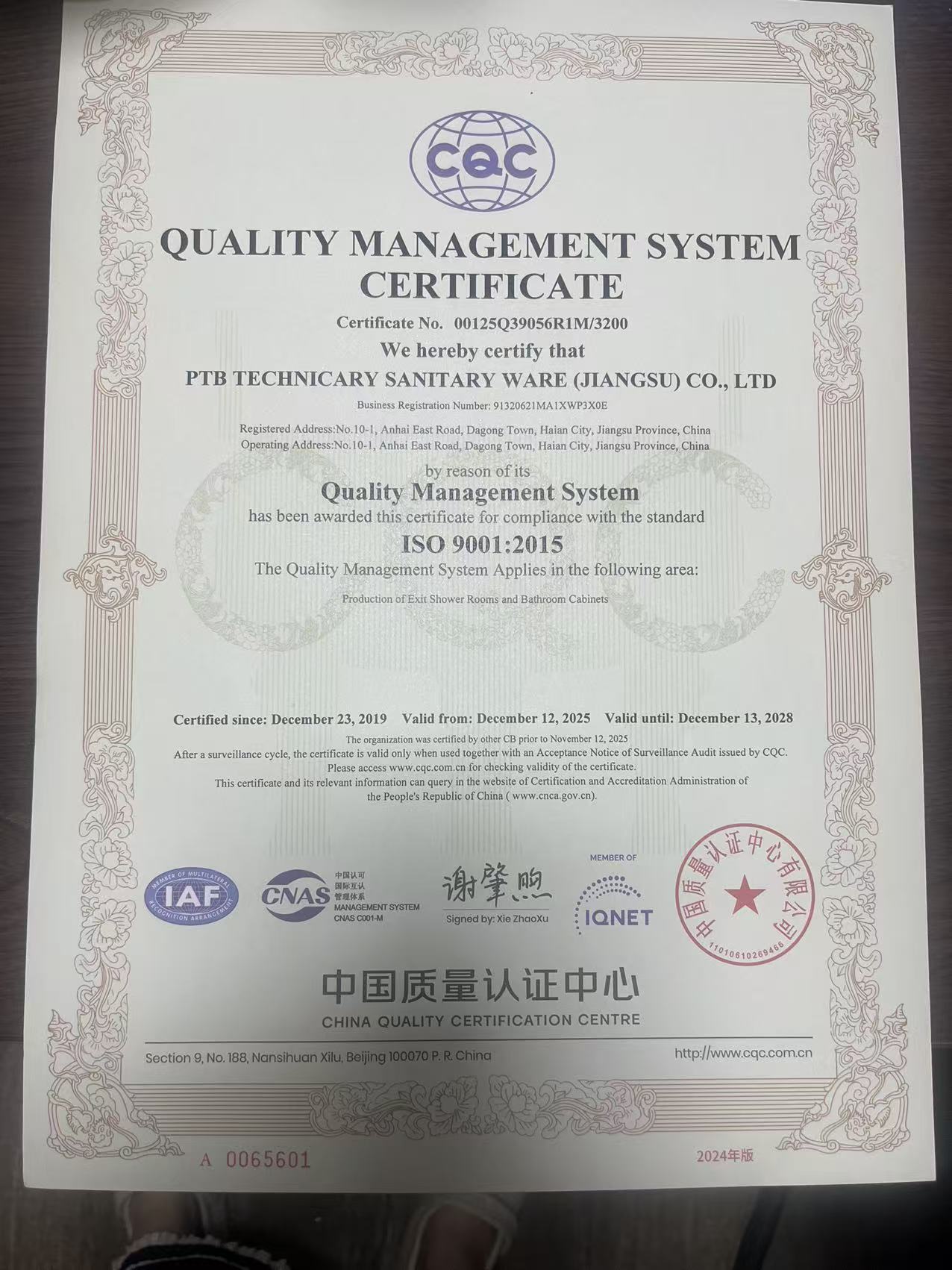
| ISO 9001:2015 Quality Management System | 00125Q39056R1M/3200 | China Quality Certification Center | Production of shower rooms and bathroom cabinets | Global | Issued 2025-12-12, expires 2028-12-13 |
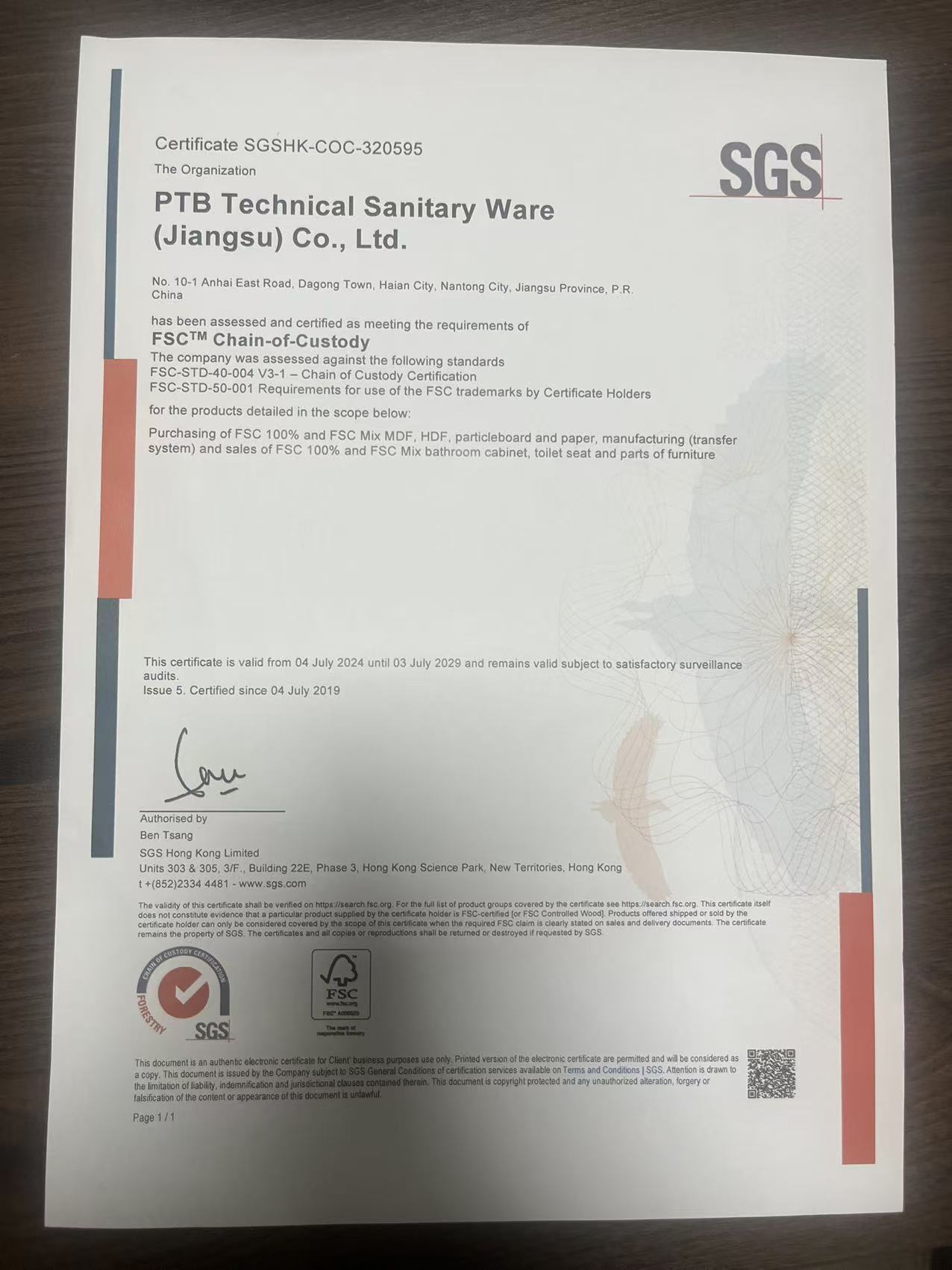
| FSC-COC Chain-of-Custody | SGSHK-COC-320595 | SGS Hong Kong Limited | Purchasing, manufacturing and sales of FSC-certified MDF/HDF bathroom cabinet, toilet seat and furniture parts (applies to Bathroom Cabinet CLA123) | Europe, North America, Oceania, Middle East, Southeast Asia | Issued 2024-07-04, expires 2029-07-03 |
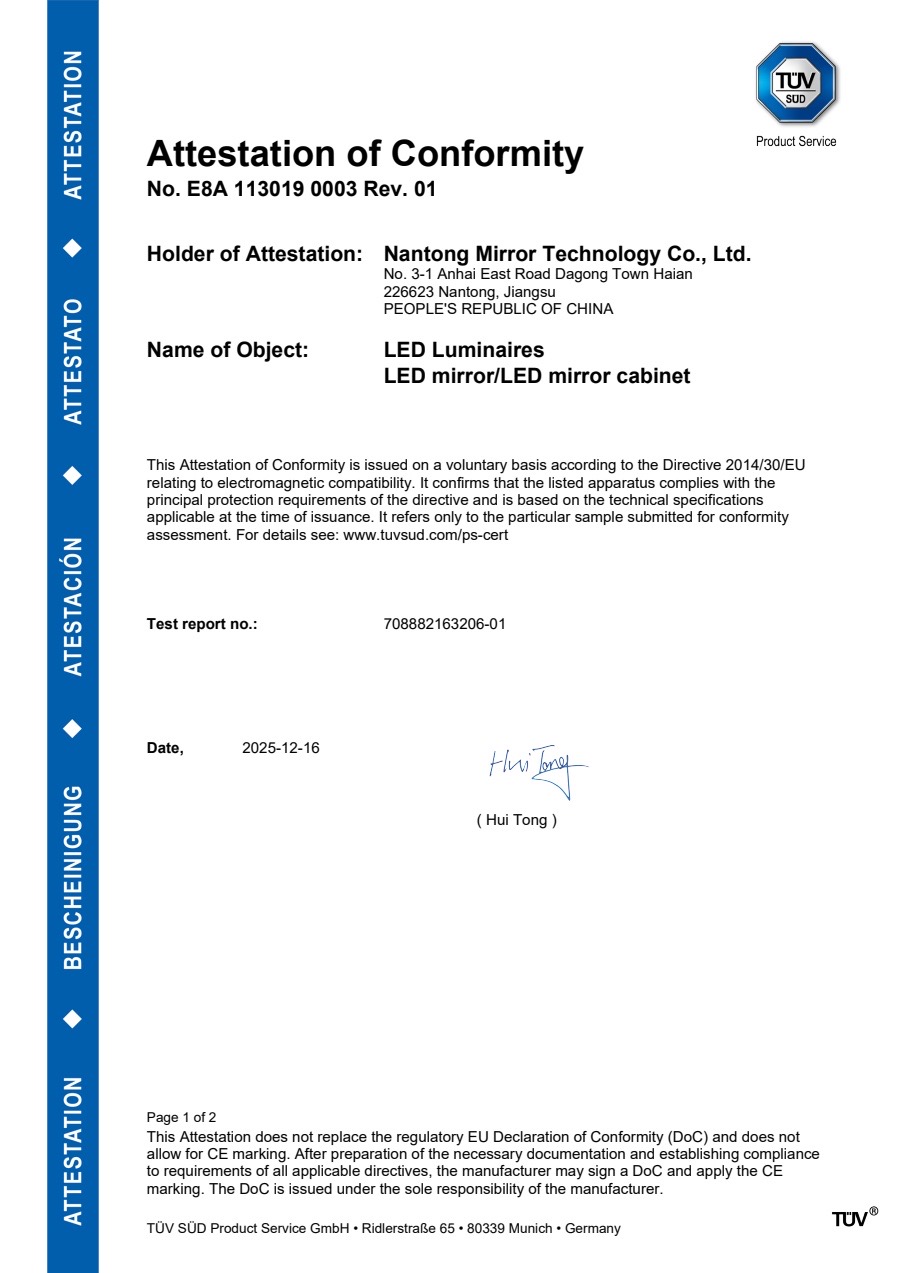
| CE Attestation of Conformity | No. E8A 113019 0003 Rev. 01 | TUV | LED mirror / LED mirror cabinet (model LQ752) | Europe, North America, Oceania, Middle East, Southeast Asia | Issued 2025-12-16 |
| UKCA Attestation of Conformity | No. E8AUK 113019 0004 Rev. 01 | TUV | LED mirror / LED mirror cabinet (model LQ752) | United Kingdom | Issued 2025-12-16 |
FSC-COC certification applies specifically to Bathroom Cabinet CLA123 and covers the purchasing, manufacturing and sales of FSC-certified MDF/HDF bathroom cabinet, toilet seat and furniture parts under standards FSC-STD-40-004 V3-1 and FSC-STD-50-001. The certification is also stated as applying to the Oceania, Middle East and Southeast Asia markets in addition to Europe and North America.
Electrically, LED mirror model LQ752 is covered by CE Attestation of Conformity No. E8A 113019 0003 Rev. 01 for the European market and UKCA Attestation of Conformity No. E8AUK 113019 0004 Rev. 01 for the UK market, both issued by TUV on 2025-12-16 and both covering the scope of LED mirror and LED mirror cabinet. The applicable standards are EN IEC 55015:2019/A11:2020, EN IEC 61547:2023, EN IEC 61000-3-2:2019/A2:2024 and EN 61000-3-3:2013/A2:2021. The mirror additionally carries EMC, LVD, RoHS and WEEE certification and an IP44 splash-proof rating.
For teams that also buy from China and want a clause-level inspection checklist, GB 24977-2010, the Chinese national standard for bathroom furniture, specifies terms and definitions, product classification, requirements, test methods, inspection rules, marking, packaging, transport, storage and use instructions for furniture used in toilets and bathrooms. Two clauses translate directly into incoming inspection points: parts or accessories that may be touched during normal use must not have burrs, sharp ends, sharp edges or sharp corners; and after installation, opening and closing components must operate flexibly with no seepage or water leakage between parts under normal use. The standard's current status should be confirmed against an official standards database before it is written into a contract as a mandatory requirement.
What Belongs in the RFQ: Specifying a Wall-Hung Bathroom Cabinet
Cabinet construction should be fixed in writing before price. Bathroom Cabinet CLA123 uses MDF with a painted matt finish, a 16 mm cabinet thickness and an 18 mm fascia thickness, cam-and-wood-dowel assembly and a rigid body, with two hinged doors, a knob handle and one internal shelf. Its documented dimensions are 500 mm wide, 390 mm deep and 800 mm high, with a product weight of 21 kg, and its documented mount type is floor-standing. For a wall-hung specification, confirm the mount type, panel material, cabinet and fascia thickness, and the supplied fitting set on the exact model quoted, because those five items decide the wall loading and the moisture behaviour of the finished unit.
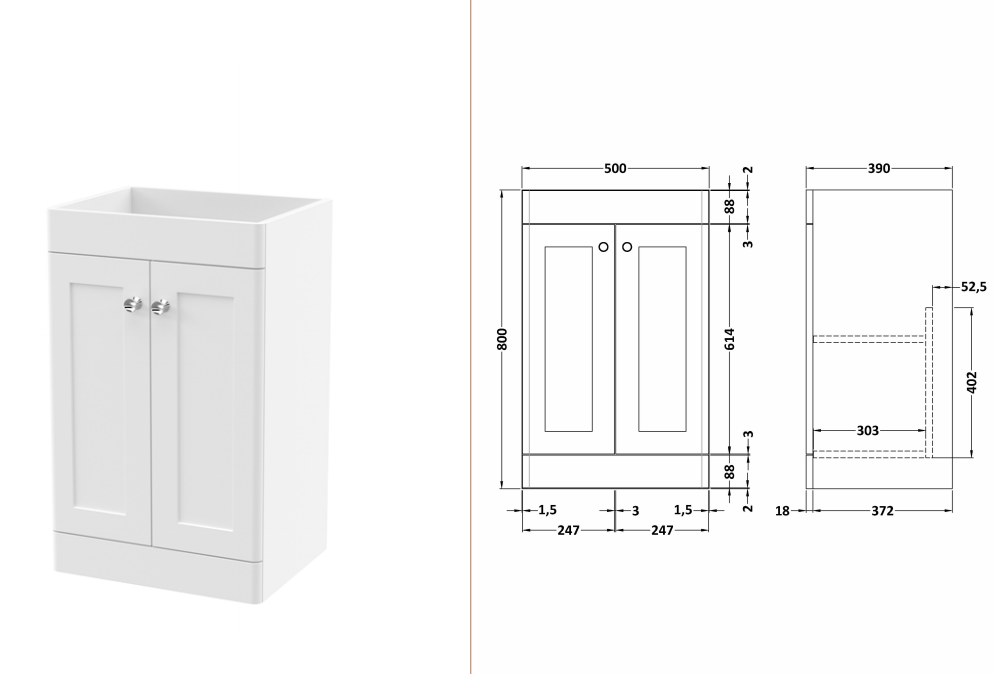
Scope exclusions matter as much as scope. On the reference cabinet, the worktop, basin, tap and waste are sold separately, so a comparable quotation must state whether those items are included, and any cut-outs for them have to be sealed on site. Fixings and the handle are included with the cabinet, while wall fixings for the cabinet and the enclosure are not.
If the set includes a bathroom mirror cabinet or wall-mounted mirror lamp, specify the electrical data: model LQ752 measures 800 x 800 mm and 47 mm deep, weighs 6.5 kg, uses an aluminium body with a brushed brass inset frame in a round vertical format, provides two LED 6000K lights at 21 W from a mains supply, and includes a touch sensor and a demister, with film-backed glass and a one-year manufacturer guarantee. Brightness is adjusted by long-pressing the touch sensor, and the demister pad activates synchronously when the mirror light is switched on, which avoids dry-heating of the heating pad.
Where the same project includes a wet zone, the enclosure follows the same documentation logic. Model AQU9-E6 is a 900 mm quadrant enclosure in chrome, built from 6 mm toughened glass with an aluminium frame and metal components, framed construction, two sliding doors with dual quick-release wheels, an enclosure adjustment range of 860–880 mm, a product height of 1850 mm and a product weight of 44.8 kg, CE marked and backed by a lifetime manufacturer guarantee. Toughened safety glass is specified because, per EN 12150-1, it breaks into blunt small granules rather than the sharp fragments formed by ordinary glass.
Because a wall-hung cabinet is rarely bought alone, the RFQ usually covers the wider set: a bathroom wash basin cabinet and bathroom mirror cabinet above the vanity, a wall-mounted mirror lamp or anti-fog mirror lamp for grooming light, and a dry-wet separation zone built from a sliding shower enclosure, a hinged shower enclosure or a small-space shower enclosure in the same finish family. Specifying the set as one elevation — cabinet, mirror, lamp and bathroom shower partition — keeps mounting heights, colour direction and electrical points consistent, whether the project follows a Nordic style or a light luxury direction.
For own-brand programmes, production runs in OEM and ODM modes with customisation of style, logo and colours. Monthly capacity is 30,000 bathroom cabinets, 30,000 shower enclosures and 3,000 LED mirror lamps, with a minimum order quantity of 30 units and a lead time of 30–45 days. Every unit is 100% tested, and after-sales support is handled remotely.
Step-by-Step: Installing a Wall-Hung Cabinet Without Compliance Gaps
The sequence below reflects the wall-mount procedure used for PTB bathroom cabinets and covers the points that most often create a later warranty dispute.
- Remove the drawer box. Drawers come out before the cabinet goes on the wall so the unit can be lifted and positioned accurately.
- Mark positions and fit the wall hanging brackets. Verify the wall's load-bearing capacity first; wall fixings are not supplied and must be selected for the actual substrate.
- Hang the cabinet on the brackets. Adjust the height using the hook screws until the unit is level.
- Refit the drawer and align the hinge. Adjust the hinge horizontally and vertically so door gaps are even and the door closes tightly.
- Cut and seal. If a panel cut-out is required for pipework or a WC unit, make the cut and waterproof-seal all exposed edges.
- Commission. Check that doors and drawers open and close smoothly, then confirm the mirror lamp or mirror functions through the touch sensor before handover.
Points to write into the site method statement: fit extra reinforcing screws for heavy mirrored doors; remove drawers before wall-mounting to reduce lifting weight; seal every cut edge for waterproofing; verify wall load-bearing capacity and use appropriate fixings, which are not supplied with the unit.
Two field issues are commonly misdiagnosed. A drawer that sticks and will not close fully is normally caused by debris inside the runner, a drawer that is not properly engaged in the runner channel, or a deformed slide rail — in most cases the drawer can be recovered by cleaning the runner and re-engaging it rather than replacing the whole drawer assembly. A mirror door that hangs loose with offset gaps is usually a loose reinforcing screw or a hinge that needs X-Y adjustment, and can be corrected on site without replacing the cabinet. For illuminated products, a mirror light with no output should be checked at the site power supply, circuit breaker and wiring before the luminaire itself is condemned, and a touch sensor that is unresponsive under a wet surface often recovers once water residue and mist are wiped from the touch area.
Use Cases: Where Wall-Hung Cabinets Are Specified
Residential developer and senior living facility
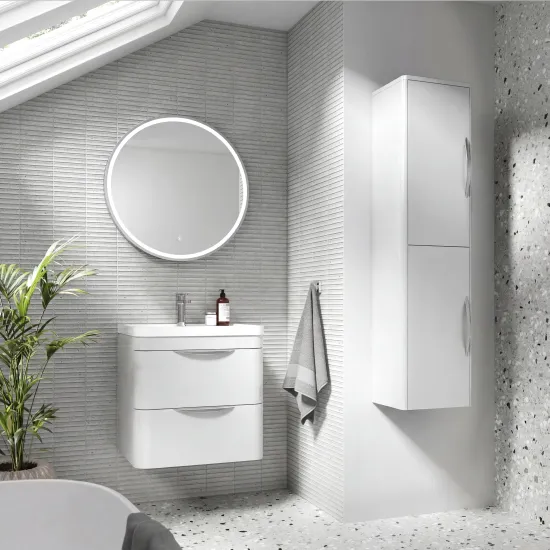
A residential developer and senior living programme across the United Kingdom, Ireland, Germany and France ordered 200 units for washing, storage and countertop use. The units have been in service for at least eight years, with the reported result of a moisture-resistant cabinet showing no mildew, a stain-resistant basin, and durable hinges and slides. The specification highlights were MDF construction with moisture-proof edge sealing, E0 level environmental protection, and a scratch-resistant, easy-clean countertop.
Serviced apartment and hotel fit-out
A serviced apartment and hotel fit-out across the same four markets ordered 200 LED mirrors for grooming lighting at the bathroom cabinet. After a minimum of five years in service, the reported outcome was uniform, flicker-free lighting with stable moisture and fog resistance and a one-year return rate below 1%. The specification highlights were an IP44 rating, anti-fog film with diffused lighting, a touch switch and low energy consumption.
High-end hotel and developer project
A high-end hotel and residential developer project ordered 120 shower enclosures for wet-dry separation in hotel bathrooms. After at least ten years, the reported result was reliable waterproof sealing with no glass self-breakage complaints and a maintenance rate below 2%. The specification highlights were tempered safety glass with anti-explosion film, corrosion-resistant hardware and zero leakage after installation.
Small bathrooms, en-suites and cloakrooms
In compact bathrooms and en-suites, a wall-hung cabinet is chosen because the floor area beneath the unit stays clear and the visual line of the room stays uninterrupted. The trade-off is the wall: the substrate, the fixing selection and the sealing of cut edges all become critical, and the mounting height has to be agreed against the basin, the bathroom mirror cabinet and any wall-mounted mirror lamp in the same elevation.
Wall-Hung vs Floor-Standing: Decision Table
| Decision factor | Wall-hung bathroom cabinet | Floor-standing bathroom cabinet |
|---|---|---|
| Load path | Carried entirely by the wall; requires verified wall load-bearing capacity and correct fixings, which are not supplied | Carried by the floor; weight transfers through the base. Documented product weight of the reference model CLA123 is 21 kg |
| Installation sequence | Drawer removed, brackets fitted, cabinet hung, height adjusted via hook screws, drawer refitted, hinge aligned, cut-outs sealed | Supplied rigid and positioned on the floor; hinge and drawer alignment still required |
| Hinge tolerance | Dual-direction X-horizontal and Y-vertical hinge adjustment compensates wall-mount tolerance | The same hinge adjustment applies, but the tolerance source is floor and wall level rather than bracket position |
| Cut-edge risk | Higher, because pipework and waste cut-outs are normally made after the unit is set in the elevation | Present wherever cut-outs are made; all exposed edges must be sealed |
| Cleaning and floor access | Floor beneath the unit stays clear and is easy to clean | Base panel sits on the floor and must be kept dry |
| Best-fit space | Small bathrooms, en-suites and cloakrooms where floor area matters | Larger bathrooms and traditional layouts |
| Reference model in the PTB range | Confirm mount type, wall fixing provision and reinforcing fasteners on the exact model quoted | Bathroom Cabinet CLA123, 500 x 390 x 800 mm, floor mount, 5-year manufacturer guarantee |
| Documentation position | ISO 9001:2015 covers production of shower rooms and bathroom cabinets; FSC-COC applies to Bathroom Cabinet CLA123 | Same documentation applies |
Frequently Asked Questions
Which certificates should a wall-hung bathroom cabinet set carry for the UK and EU markets?
Three regimes matter. For the cabinet manufacturing process, ISO 9001:2015 certificate 00125Q39056R1M/3200 was issued by the China Quality Certification Center, is valid from 2025-12-12 to 2028-12-13, and covers the production of shower rooms and bathroom cabinets. For the wood-based panels, FSC-COC Chain-of-Custody certificate SGSHK-COC-320595 was issued by SGS Hong Kong Limited, applies to Bathroom Cabinet CLA123 under standards FSC-STD-40-004 V3-1 and FSC-STD-50-001, is valid from 2024-07-04 to 2029-07-03, and covers purchasing, manufacturing and sales of FSC-certified MDF/HDF bathroom cabinet, toilet seat and furniture parts. For any illuminated element, LED mirror model LQ752 holds CE Attestation of Conformity No. E8A 113019 0003 Rev. 01 and UKCA Attestation of Conformity No. E8AUK 113019 0004 Rev. 01, both issued by TUV on 2025-12-16 for the scope of LED mirror and LED mirror cabinet, alongside an IP44 splash-proof rating and EMC, LVD, RoHS and WEEE certification.
What customisation and manufacturing capacity sits behind a wall-hung bathroom cabinet order?
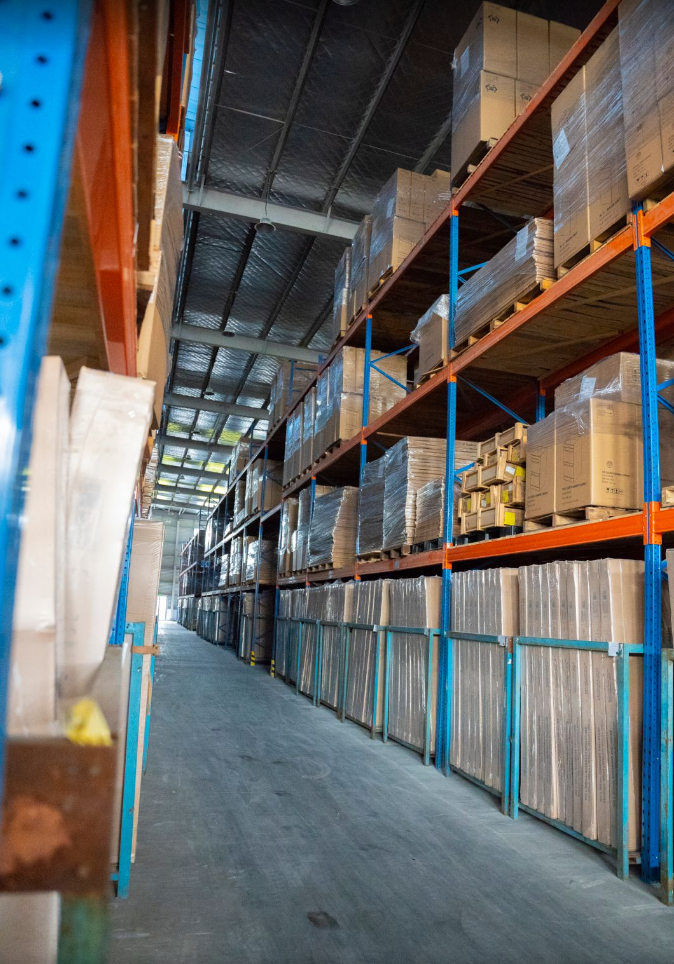
Production runs in OEM and ODM modes, with customisation of style, logo and colours. Monthly capacity is 30,000 bathroom cabinets, 30,000 shower enclosures and 3,000 LED mirror lamps, supported by a 33,000 m² plant, 156 employees, six R&D engineers and an annual output of 360,000 sets. Units are 100% tested, the minimum order quantity is 30 units, lead time is 30–45 days, and after-sales support is provided remotely.
What drives the cost of a compliant wall-hung bathroom cabinet?
Cost is driven by certified inputs and sealing work rather than by unit size alone: FSC-certified MDF/HDF panels and their chain-of-custody documentation, panel thickness — 16 mm cabinet and 18 mm fascia on the documented reference — dual-adjustment hinges, dedicated reinforcing fasteners for mirrored doors, waterproof sealing of every cut edge, and electrical compliance for integrated lighting, which is covered by EMC, LVD, RoHS and WEEE certification on the mirror. Scope also affects the number: the worktop, basin, tap and waste are sold separately on the reference cabinet, so quotations should be compared on identical scope, and a minimum order quantity of 30 units applies.
Can samples be ordered before placing a bulk order?
Sample orders are welcome for quality testing and marketing purposes, and mixed samples are acceptable. Samples are not supplied free of charge, and the buyer bears the freight cost.
What is the lead time, and how do I start a wall-hung cabinet enquiry?
Lead time is 30–45 days, with a minimum order quantity of 30 units. To start, send the bathroom elevation or design drawings — including the cabinet size and shape requirements — to sales003@ptbsh.com or via WhatsApp on +86 180-1228-0032, and the technical team will review the drawings and recommend suitable models from current production. The full product lookbook can be downloaded from the brochure link below, and mixed enquiries covering bathroom cabinets, shower enclosures, LED mirrors and basins are accepted.
Conclusion: Fix the Constraints Before the Finish
A wall-hung bathroom cabinet is decided by four things that no render shows: whether the wall can carry the load and accept the right fixings, whether every cut edge is sealed against vapour, whether the hinges can take up wall-mount tolerance, and whether the electrical items in the set hold the certification the destination market requires. Get those right and the finish, the mirror lamp and the shower enclosure in the same bathroom furniture set can be chosen freely. Get them wrong and the failure surfaces eighteen months later as swelling around a pipe cut-out, a door that will not sit square, or a rejected shipment.
The verifiable position is straightforward: ISO 9001:2015 covering the production of shower rooms and bathroom cabinets, FSC-COC chain-of-custody on the MDF/HDF bathroom cabinet range, CE and UKCA attestations on the LED mirror platform, a 30-unit minimum order quantity, a 30–45 day lead time, and 100% testing before shipment.
Next Step: Sample, Quotation or Full Lookbook
Send your bathroom elevation or design drawings and the required cabinet size and shape, and the technical team will review the drawings and recommend suitable models for a wall-hung bathroom cabinet specification.
Email: sales003@ptbsh.com · WhatsApp: +86 180-1228-0032 · Website: www.ptbath.com
Download the full product brochure: PTB Lookbook Brochure (PDF)
Have Questions or Need More Details?
Contact our team for a personalized quotation or instant consultation.
Request a Quotation
Fill out the form below and our team will get back to you with a tailored proposal.
WhatsApp Direct Chat
Prefer to chat in real-time? Message us on WhatsApp for instant assistance & quick answers.
- Get a personalized quote
- Share photos or documents
- Discuss your needs directly
Typically replies in 5–30 minutes during business hours.