Dry Strength Agent vs. Wet Strength Agent: A Sourcing Comparison for Recycled Packaging Lines
For paper mills and packaging converters running recycled pulp, choosing between a dry strength agent and a wet strength agent is not an either/or decision. Each chemistry solves a different physical stress on the paper web. This sourcing comparison defines how dry strength and wet strength agents function in recycled packaging applications, maps them to specific grades such as JH-1699 and JH-1201, and explains when they should be used separately or in combination.

Why This Comparison Matters for Recycled Packaging Buyers
Recycled fiber differs from virgin pulp in an important way: each cycle shortens fibers and damages the bonding sites that give paper its strength. Packaging grades made with high recycled content therefore require chemical assistance to meet ring crush, burst, tensile, and ply-bond targets. The chemicals that provide that assistance fall into two broad families: dry strength agents, which improve the strength of paper in its normal dry state, and wet strength agents, which help paper retain a portion of its strength when saturated with water.
Buyers sourcing chemicals for recycled packaging lines often ask whether they should purchase a dry strength agent or a wet strength agent. The correct answer depends on the end-use requirement, not on a generic preference. Corrugated box plants producing standard dry cartons typically need dry strength development. Tissue, towel, pulp molded food service ware, and certain specialty packaging applications need wet strength performance. Some applications need both.
Defining Dry Strength and Wet Strength Chemistries
What a Dry Strength Agent Does
A dry strength agent is a wet-end additive that increases inter-fiber bonding once the paper web is dried. It improves the hydrogen bonding network and macromolecular bridging between fibers, which translates into higher tensile strength, burst strength, ring crush strength, and stiffness in the finished sheet. It does not protect the sheet from water. It helps the paper resist the forces it meets during conversion, printing, corrugating, stacking, and end-use handling under normal dry conditions.
For recycled pulp packaging, dry strength agents address a mechanical weakness created by fiber degradation. In a recycled pulp system with high ash content, short fibers, and contaminated furnish, a dry strength agent also helps retain fines and filler solids that would otherwise be lost during sheet forming. This dual action—fiber bonding improvement plus retention enhancement—is why many packaging mills treat dry strength agents as a core wet-end chemical rather than a specialty option.
What a Wet Strength Agent Does
A wet strength agent introduces covalent crosslinks into the paper structure, so the fiber network can resist breakage when the paper is wet. This is why products like tissue paper, napkins, tea bags, paper towels, certain food wraps, and molded pulp trays maintain usable strength after exposure to moisture, hot water, or high-humidity conditions.
Most commercially important wet strength resins belong to the PAE (polyamide epichlorohydrin) resin family. PAE resins are absorbed onto the negatively charged fiber surface, then cure and crosslink during paper drying. For a recycled packaging line, wet strength chemistry is relevant when the final product is expected to encounter liquid, condensation, or humid environments.
Reference Products: JH-1699 and JH-1201
Qingzhou Jinhao New Material Co., Ltd., branded as JHDA, supplies both chemical families from its production base in Qingzhou City, Shandong Province, China. The company was founded in 2005 and focuses on R&D, production, and export of professional papermaking fine chemicals. Its paper strength additive line includes JH-1699 Paper Tensile Strength Enhancer as a cationic dry strength product and JH-1201 Wet Strength Agent as a PAE-based wet strength resin. Both are used in paper grades where recycled fiber forms a meaningful part of the furnish.
JH-1699: Cationic Dry Strength Agent
JH-1699 is a white powder dry strength agent with an active ingredient content ≥95.0%. It is cationic, water-soluble, and formulated from polyacrylamide, polyamine, polyamide epichlorohydrin resin, and starch derivatives. Its application scope covers recycled paper dry strength enhancement, corrugated paper strengthening, box board and test liner production, fluting additive use, and waste paper pulp reinforcing.
Because it is supplied in powder form with 12 months shelf life, JH-1699 offers compounding flexibility and simplifies long-distance export logistics compared with liquid polymers that require tighter temperature management.
JH-1201: PAE Wet Strength Agent
JH-1201 is a light-yellow-to-amber cationic liquid resin with solid content of 12.5 ±1.0%, pH of 2.0–5.0, and viscosity ≤500 cps at 25°C. It is a PAE wet strength resin suitable for tissue paper and pulp molding applications, where wet tensile and wet burst performance are decisive quality parameters. Its cationic ionic type promotes efficient retention on recycled pulp fibers, which are generally anionic.
Different Jobs, Different Molecular Mechanisms
The two chemistries improve different properties through different mechanisms:
- Dry strength agents such as JH-1699 are fundamentally bonding promoters. They increase hydrogen bonding and polymer bridging between fibers, raising tensile, burst, ring crush, and stiffness in the dry sheet.
- Wet strength agents such as JH-1201 are network protectors. They create covalent crosslinks that keep the fiber network intact when water disrupts hydrogen bonding, preserving a percentage of wet strength that dry strength additives cannot deliver.
One practical consequence is that a dry strength agent cannot make recycled paper truly water resistant, and a wet strength agent is not an efficient substitute for a dry strength agent when the only problem is low dry ring crush or burst. For recycled packaging lines, a well-designed chemical program often includes both: the dry strength agent builds baseline dry mechanical performance, while wet strength chemistry is added only for grades that must survive moisture exposure.
Typical Use Cases in Recycled Packaging
Dry Strength in Containerboard and Corrugated Grades
Recycled linerboard and corrugating medium are produced from old corrugated containers (OCC), mixed waste paper, or other recycled furnish. These fibers average lower fiber length, carry more contaminants, and generate weaker sheet structure than virgin pulp. Dry strength agents are widely used in these grades to meet box compressive strength requirements. In fact, dry strength additives can be used to help lower basis weight while maintaining acceptable strength, or to increase strength without raising grammage.
JHDA’s technical team routinely supports formula adjustments for customers using recycled pulp, virgin wood pulp, or blends, with the goal of reducing chemical consumption and production cost while keeping paper machine operation stable.
Wet Strength in Tissue, Towel, and Pulp Molded Products
Wet strength resin is a standard component in tissue products where wet burst strength is an essential property. It also serves pulp molding applications, including egg trays and molded fiber packaging, where the product can be exposed to moisture during use. JH-1201, with its cationic PAE chemistry, is listed by JHDA for tissue and pulp molding applications, supported by laboratory verification of wet tensile, wet burst, and wet ply bond properties.
Combined Use in Specialty Packaging Grades
There is no conflict between dry strength and wet strength agents; they operate on different failure modes. For packaging grades requiring both high dry stacking strength and resistance to moisture, a proportioned two-part program can be justified. A dry strength agent like JH-1699 lifts dry mechanical values, and a wet strength resin like JH-1201 then provides the necessary wet integrity. Since these are wet-end cationic polymers, the dosage sequence and retention system must be tuned to avoid interference. This is the kind of trial that paper mills can run with JHDA’s free sample program and pre-shipment laboratory testing support.
Sourcing Checklist: Dry vs. Wet Strength
Before talking to a supplier, verify the failure mode:
- Is the packaging carton failing under compressive load in a dry warehouse? Start by evaluating a dry strength agent.
- Is the paper product losing integrity when wet, such as tissue, towel, paper bags for wet goods, or molded pulp trays? Evaluate wet strength resin.
- Is the board failing during converting after moisture pickup? Investigate both wet strength and water-resistant sizing programs, since these are different properties.
For recycled furnish, specify the fiber source clearly: OCC, mixed waste, or de-inked pulp. Recycled pulp quality directly influences chemical demand and the final bonding result. JHDA’s formulation development team tailors chemical formulas based on pulp composition (recycled pulp or virgin wood pulp) and actual paper machine operating parameters.
| Attribute | JH-1699 Dry Strength Agent | JH-1201 Wet Strength Agent |
|---|---|---|
| Function | Improves dry-state fiber bonding strength, tensile, burst, ring crush | Improves wet-state strength via covalent crosslinking of fiber network |
| Appearance | White powder | Light yellow to amber-colored liquid |
| Active content | ≥95.0% | 12.5% ±1.0% solid content |
| Ionic type | Cationic | Cationic |
| pH | N/A (powder form) | 2.0–5.0 |
| Shelf life | 12 months | 6 months |
| Base chemistry | Polyacrylamide, polyamine, PAE resin, starch derivatives | PAE (polyamide epichlorohydrin resin) |
| Typical application | Corrugated paper, testliner, box board, recycled waste paper pulp | Tissue paper, pulp molding products requiring wet strength |
Cost and Supply Considerations
Supply format affects logistics cost and runnability. JH-1699 is a powder with high active content, minimizing freight cost per unit of active polymer. JH-1201 is a liquid resin, and liquid products normally demand more logistics planning, especially if the consuming market has high ambient temperatures or long transit times.
When evaluating quotations, compare the effective active cost, not just the price per kilogram or per liter. MOQ and sample policy also matter. JHDA operates with a standard MOQ of 1 MT and offers free trial samples for laboratory evaluation. Before large-volume commitment, buyers can validate the product against their own recycled furnish in a laboratory trial or a plant trial.
Evidence of Capability: Laboratory and Field Support
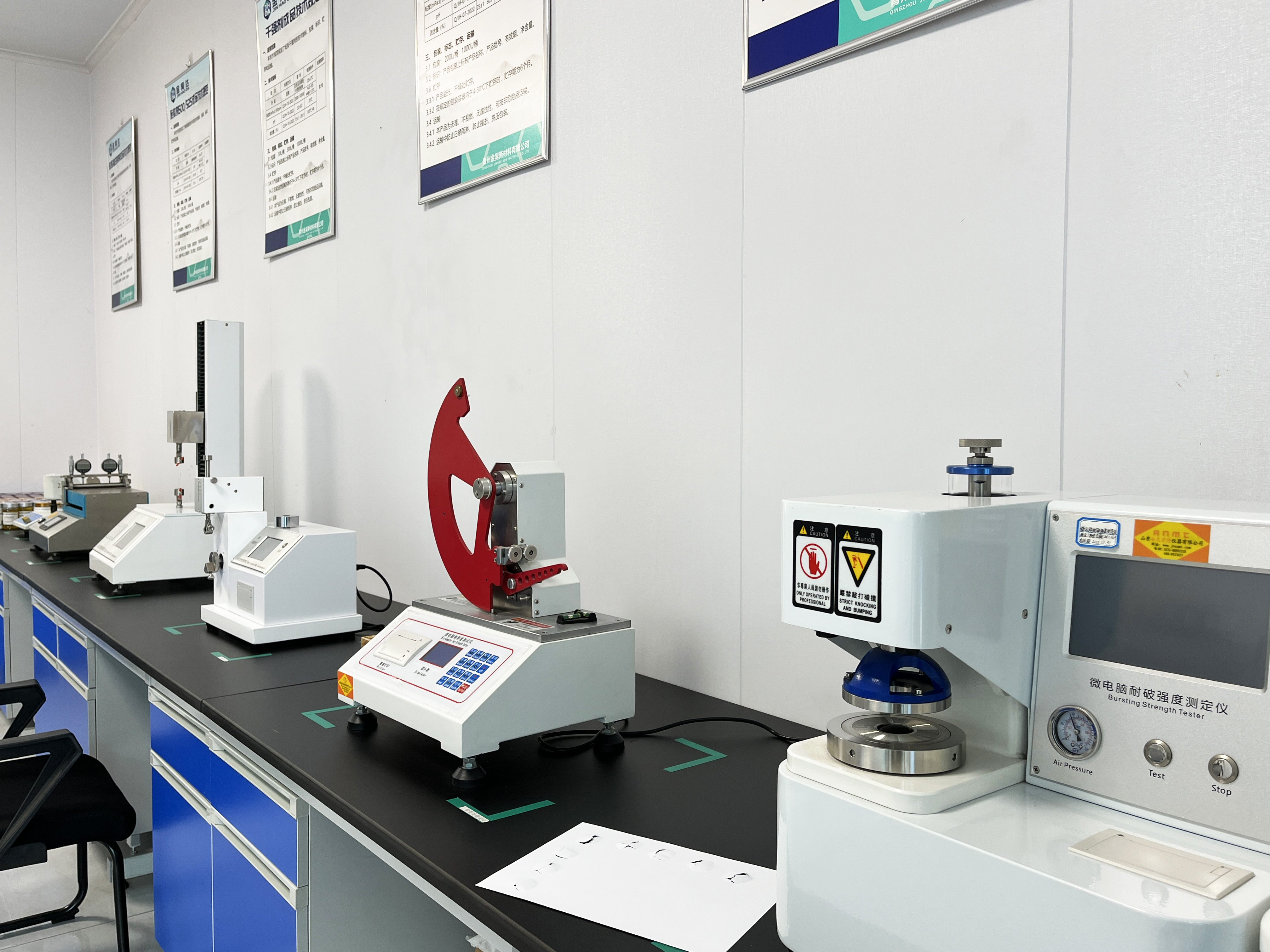
Dry strength and wet strength results can be confirmed only when the supplier has both formulation capability and physical testing infrastructure. JHDA’s technical team conducts field machine debugging for paper mills, optimizing core paper indicators including Cobb water absorption, ring crush strength, and bursting strength. The company also supports pre-shipment laboratory testing and provides complete TDS and MSDS documentation to support overseas customs clearance and L/C settlement. On-site engineering support is available through the after-sales program.
Certification and Compliance Signals
Regulatory compliance is increasingly important when paper chemicals cross borders or contact food. JHDA holds ISO9001 quality management certification, ISO14001 environmental management certification, and SGS product compliance test reports. Part of the product range has been independently certified as compliant with food-contact-grade requirements. All exported chemicals complete CAS registration and GHS hazard labeling, complying with IMDG international marine shipping regulations.
For buyers serving food-contact packaging markets, these certifications materially reduce supplier qualification time.
Decision Rules for Recycled Packaging Sourcing
- If the target property is dry ring crush, burst, tensile, or stiffness, evaluate dry strength agents first.
- If the target property is wet tear, wet burst, wet tensile, or water soak resistance, wet strength resin is the principal chemistry.
- If both dry and wet properties are required, build a program that includes both and validate retention compatibility.
- Ask the supplier for pre-trial support on recycled pulp, because recycled furnish varies by region and source.
- Match the supplier’s service depth to your requirement: powder or liquid, MOQ, sampling, export documents, and on-site troubleshooting all affect long-term supply reliability.
Where to Start
Qingzhou Jinhao New Material (JHDA) supplies both JH-1699 dry strength agent and JH-1201 wet strength resin from one source, with free trial samples available to qualified mills. Email info@sdqzjinhao.com or contact the international sales team on WhatsApp at +86 139 6468 8976 for sample requests and quotation.
Download the corporate brochure for a full product profile and company capability overview: JHDA Introduction 2026 (PDF)