
Paper Losing Moisture Resistance in Humid Storage? A Surface Sizing Fix for Packaging Mills
Paper Losing Moisture Resistance in Humid Storage? A Surface Sizing Fix for Packaging Mills
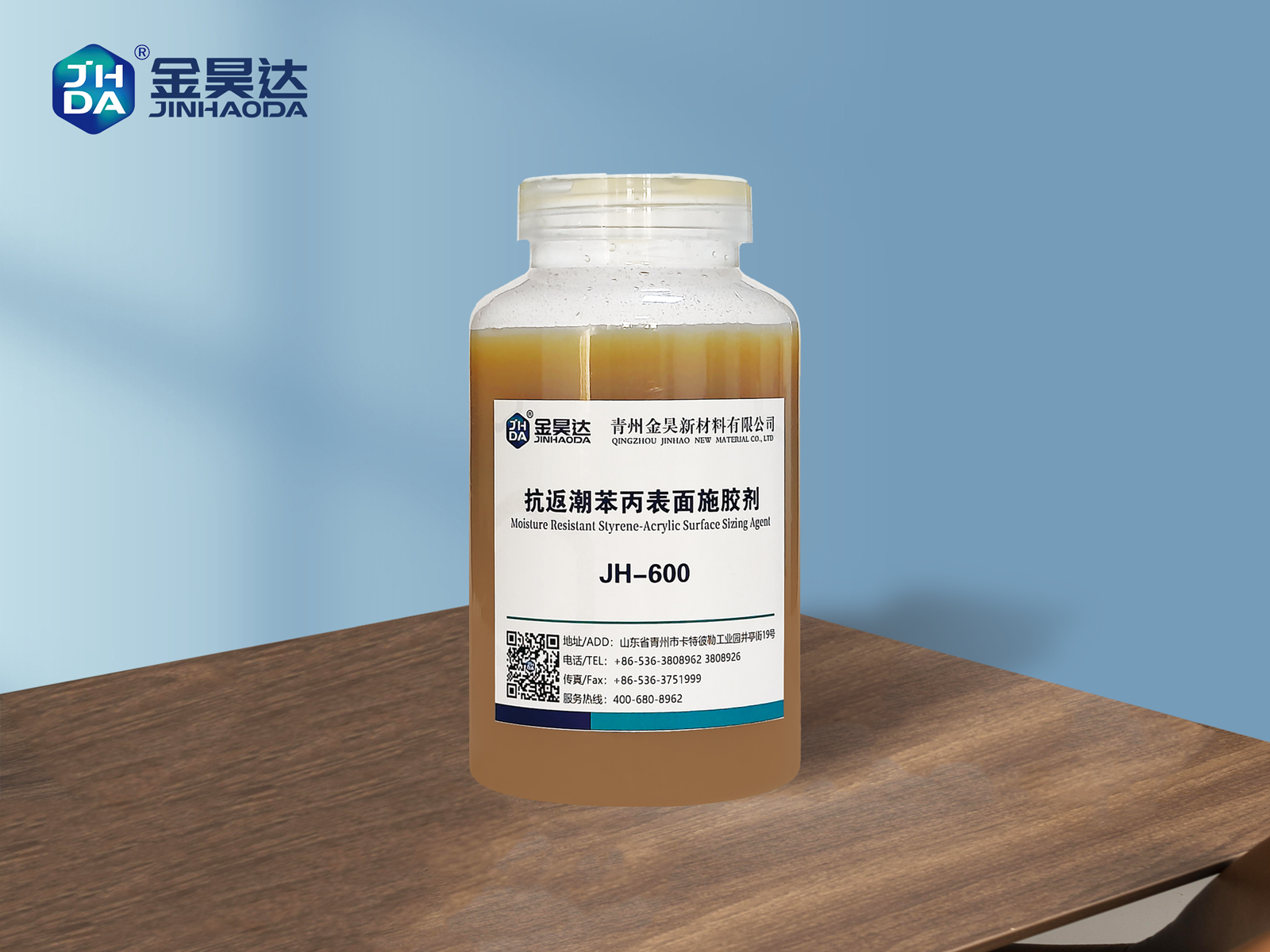
JH-600 moisture resistant SAE surface sizing agent — developed for board and paper that must hold water resistance through humid storage and long-distance transport.
A carton board grade that passed Cobb and ring crush checks at the mill can still arrive at the customer soft, wavy-edged and structurally weaker than when it was reeled. In most of the cases mills bring to us, the cause is not a pulp recipe fault. It is moisture re-absorbed at the paper surface during weeks of storage in a humid warehouse, a cold store, or a sea container moving between climates.
This article works through a surface sizing solution path for packaging paper mills — corrugated medium, testliner, kraft linerboard and boxboard producers. It covers how to diagnose whether the loss of water resistance sits in internal sizing, surface sizing, or both; how moisture-resistant surface sizing chemistry behaves on a running machine; and how to decide between a single moisture-resistant SAE product and a composite AKD/SAE additive.
The chemistry referenced here is produced by Qingzhou Jinhao New Material Co., Ltd. (branded JHDA), a papermaking fine chemicals manufacturer founded in 2005 and located in Mihe Industrial Park, Qingzhou City, Shandong Province, China. Its portfolio covers AKD sizing emulsions, cationic and anionic styrene-acrylic surface sizing agents, strength additives and wet-end process auxiliaries for paper mills. Product and certificate information is published at en.sdqzjinhao.com.
The short answer: when a grade holds water resistance at the reel but loses it after storage, the failure is usually a surface phenomenon — the sheet re-absorbs atmospheric moisture because the size-press film is not hydrophobic enough. A moisture-resistant styrene acrylic (SAE) surface sizing agent such as JH-600, or a composite AKD/SAE additive such as JH-WH3364, corrects that at the size press without changing the pulp recipe or the wet-end additive system.
Problem Definition: When Water Resistance Fades After the Reel Leaves the Mill
Moisture resistance is not a single property, and it is not permanent. It is the ability of a sheet to resist water and water vapour uptake through two different routes: the fibre network inside the sheet, and the surface film formed by the size press. When the second route fails, the first one usually follows, because a wet surface feeds moisture inward.
The symptoms that reach the quality department are recognisable and repeatable:
- Edge wicking, wavy edges and dimensional movement on palletised board after a few weeks in humid air.
- Ring crush and bursting strength values that re-test lower in the customer's warehouse than at the mill.
- Cartons that bulge, sag or collapse after pallet stacking in a tropical or monsoon-season climate.
- Printing defects — mottling, ink feathering, linting and picking — that never appeared on the machine.
- Blocking and ply separation in stacked sheets or reels.
The pattern that separates moisture reversion from a production fault is timing. If the grade meets its water-resistance target immediately after the drying section but fails after two to six weeks of storage or transit, the machine is not the problem. The sheet is taking moisture back from the environment faster than the surface film can resist it.
Two mechanisms explain most of these cases. Inside the sheet, internal sizing chemistry must react with cellulose and cure so that the fibre network itself resists water. Surface sizing works on the outside instead: a film former is applied together with starch at the size press, and the quality of that film decides how much ambient moisture the sheet can take up during storage. A starch-only film is hygroscopic and offers limited holdout. A hydrophobic film former applied with the starch changes that balance.
Industry Background: Why Moisture-Resistant Sizing Is Moving Up the Agenda
Sizing chemistry is a large and still growing category. According to Dataintelo, the global paper sizing agent market was valued at approximately USD 3.8 billion in 2025, and the same source projects the market to reach USD 5.9 billion by 2033 at a CAGR of 5.8%. Market Reports World places global sizing agent consumption volume above 3.8 million metric tons in 2024.
The chemistry mix matters for packaging mills. SNS Insider reports that synthetic sizing agents, including AKD and ASA, held a 54.5% market share in 2024, and Dataintelo estimates AKD sizing accounts for roughly 48% of synthetic sizing agent volume worldwide. By form, SNS Insider recorded liquid sizing agents at a 57.8% market share in 2024, driven by ease of application; solid grades are nevertheless projected to grow at a 5.11% CAGR through 2032 for logistical reasons.
Demand is not only a chemistry story. The American Forest & Paper Association reported that US packaging paper capacity increased by 4.6% in 2024, and Asia Pacific already accounts for a 42.3% revenue share of the sizing agent market as of 2025 (Dataintelo). More capacity shipping into humid climates and longer supply chains means more board spending longer periods in uncontrolled storage.
Compliance has tightened in parallel. Food-contact paper and board must satisfy Regulation (EC) No 1935/2004 in the European Union and FDA 21 CFR requirements in the United States, which pushes mills to document exactly which chemistry touches a food-contact surface. Major international suppliers competing in this market include Kemira, BASF and Arakawa Chemical Industries, according to Mordor Intelligence — alongside regional manufacturers such as JHDA that supply the same functional categories with local delivery and formulation support.
Diagnose First: Internal Sizing, Surface Sizing, or Both?
Changing chemistry before you know which layer is failing is the most expensive way to solve a moisture problem. Three checks usually settle it.
1. Where does the water enter?
If the board swells, wicks at the edges and loses strength through its thickness, the fibre network is taking water and the internal sizing system deserves the first look. If the core tests acceptably but the surface absorbs, picks, feathers ink and loses surface strength after storage, the surface film is the weak layer.
2. When does it fail?
Immediate failure at the machine points to dosing, retention, curing or drying. Failure only after humid storage points to moisture reversion and insufficient surface hydrophobicity. Re-test the same sample twice — once immediately after production, once after a simulated humid storage period — and compare ring crush, surface strength and water absorption.
3. What is happening to the internal sizing that is already there?
Wet-end AKD chemistry reacts with cellulose to build hydrophobicity, but a share of the active material can be lost in white water circulation and the fibre retention process, and the reaction needs curing time. Surface-applied sizing avoids both losses: the active ingredients act directly on the paper surface, so utilisation is higher and the effect is set once the sheet passes the drying cylinder. That is the mechanical reason a surface fix is often the faster correction when the failure appears in storage rather than in the wet end.
The Surface Sizing Fix: JH-600 and the Composite Route
For the storage-failure scenario described above, JHDA offers two surface-applied options that address it from different directions.
JH-600 Moisture Resistant SAE Surface Sizing Agent
JH-600 is a cationic, water-soluble styrene acrylic surface sizing agent built specifically around moisture reversion. Its anti-moisture molecular structure forms a dense, closed protective film on the paper surface that slows the continuous infiltration of ambient moisture — the mechanism behind softening and box collapse in rainy seasons, cold storage and long-distance maritime transport.
- Appearance: light brown to dark brown liquid
- Solid content: 30 ± 1%
- pH: 2.0 – 5.0
- Viscosity (25 °C): < 50 cps
- Ionic type: cationic; soluble in water
- Storage period: 6 months
Two properties make it practical for an existing packaging line. First, no curing period is required: finished paper obtains its anti-moisture performance immediately after drying, so the grade can be reeled and shipped without curing storage. Second, it is designed to blend with ordinary industrial starch in the size press, so the workshop does not have to rebuild its feeding process to adopt it. The product is positioned as capable of fully replacing an internal sizing agent for production, and it is described as suitable for both acidic sizing systems using aluminium sulfate and modern neutral papermaking systems. It is also stated to be compatible with retention aids and defoamers without system flocculation, with low foaming behaviour for high-speed surface sizing machines.
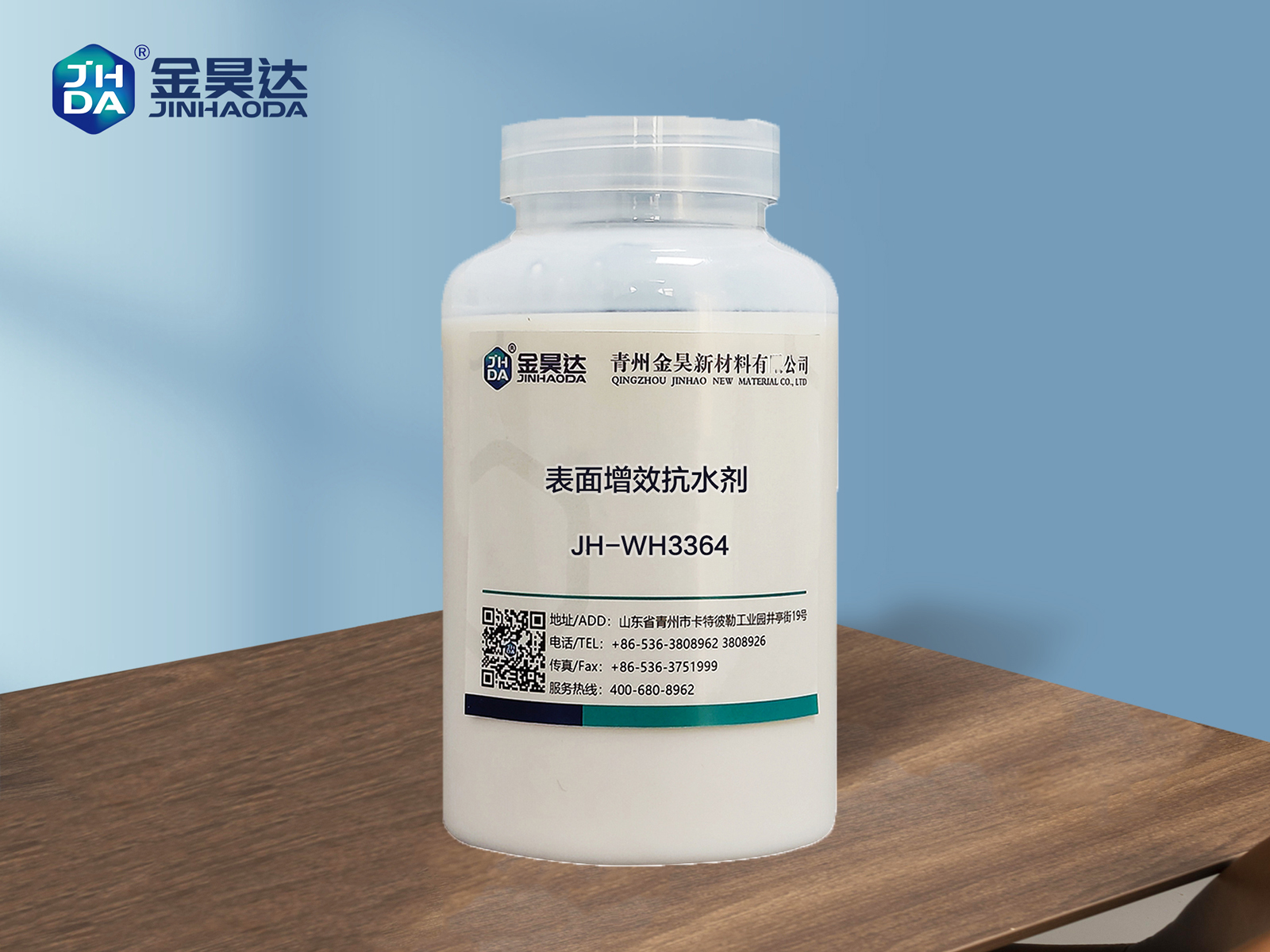
JH-WH3364 surface enhanced water resistant agent — a composite of weak anionic styrene acrylic and AKD for dual water resistance and surface strength.
JH-WH3364 Surface Enhanced Water Resistant Agent
JH-WH3364 is a composite product made from weak anionic styrene acrylic and AKD. It is designed for mills that have more than one problem on the same grade: water resistance that fades in storage, and surface dry strength that is not good enough for high-speed offset printing.
- Appearance: milky white to pale yellow liquid
- Solid content: 25.0 ± 1.0%
- pH: 2.0 – 5.0
- Viscosity (25 °C): ≤ 50 cps
- Ionic type: weak cationic; soluble
- Shelf life: 4 months
The dual function is the point. The AKD component reacts chemically with cellulose to lock in long-term hydrophobicity, while the styrene acrylic resin forms a tough continuous film that reinforces the surface structure. Because the film former fixes the sizing effect immediately after drying, the product overcomes the slow-curing limitation of a pure AKD emulsion, and the finished paper can be rolled and delivered without a long curing period. On the strength side, it is positioned to reduce linting, picking and ink feathering in high-speed offset printing, and to crosslink evenly with oxidised starch and modified starch so that water absorption is consistent across the full web rather than varying from point to point.
Where a packaging line also needs board stiffness rather than surface water resistance alone, JH-611 surface strength sizing agent is the relevant grade: a cationic styrene acrylic copolymer surface sizing agent intended for corrugated paper and boxboard, positioned to improve ring crush stiffness, surface hardness and surface smoothness. Where the diagnosis instead points to the fibre network, JH-103 AKD internal sizing agent remains the wet-end route for neutral and alkaline papermaking systems.
Compatibility, Shear Resistance and Foam: Fitting the Line You Already Have
Surface sizing chemistry only works if it survives the size press. Three practical constraints decide that.
Starch compatibility. Both JH-600 and JH-WH3364 are designed to blend with common industrial starch carriers, including oxidised starch and cationic modified starch, and both are supplied as liquids that can be stirred into the starch preparation with simple mixing. A mixed liquor that separates or gels in the tank will show up as uneven water absorption across the web — exactly the defect the mill is trying to eliminate.
Wet-end and system compatibility. Sizing additives share the circulation system with retention aids, defoamers and, in some mills, bentonite-based retention systems. JH-600 is described as compatible with retention aids and defoamers without flocculation, and JH-WH3364 is likewise described as compatible with retention aids and defoamers under a neutral papermaking system. Ionic balance is the reason this matters: a cationic SAE surface sizing agent and a weak cationic composite behave differently in a system where the anionic charge load fluctuates with recycled pulp quality.
Shear resistance and foaming. On a high-speed surface sizing machine, the sizing liquor is pumped, metered and recirculated continuously. Products with poor mechanical shear stability break down, and products that foam generate bubble pinholes and longitudinal stripes on the sheet. Both JH-600 and JH-WH3364 are described as having excellent mechanical shear resistance and low foaming characteristics, which is what allows them to run on a high-speed sizing machine without producing surface defects or destabilising the circulation system. Reduced sticky deposit build-up on sizing rollers and drying cylinders is a further stated benefit, because it directly reduces downtime cleaning frequency.
Step-by-Step Breakdown: Running the Fix on a Live Grade
The sequence below is the practical order in which a moisture-resistance problem should be closed out. It is deliberately front-loaded with measurement, because most failed conversions are selection errors rather than chemistry errors.
- Define the failure in numbers. Record baseline water absorption, ring crush strength and surface strength immediately after production. Then re-test the same reel after a humid storage period. The gap between the two data sets is the size of the problem you are buying chemistry to close.
- Split internal and surface contribution. Run a small set of reels with the wet-end sizing system unchanged and the surface treatment adjusted, and, where feasible, the reverse. This tells you whether you are correcting a fibre-level deficiency, a surface-film deficiency, or both at the same time.
- Audit the starch system. Confirm the starch type, preparation solids and mix temperature, and check that the sizing additive and the starch carrier form a uniform, stable mixture without separation. Starch is the carrier; the sizing agent is the functional component.
- Decide single product or composite. If the only defect is moisture reversion, start with JH-600. If surface dry strength and printability are also failing, JH-WH3364 addresses both in one dosing point instead of two.
- Run a laboratory formulation trial before the machine trial. JHDA operates a pilot laboratory that is used for targeted formula customisation and free sample testing, and the company offers free trial samples with a 1 MT minimum order quantity. Verifying the blend on a bench scale first removes one variable from the machine trial.
- Trial on the machine and watch three things. Whether the sizing liquor stays uniform in the circulation system, whether the sheet surface stays free of foam pinholes and stripes, and whether deposit build-up on rollers and cylinders changes. Liquid products support metering-pump feeding into the starch pipeline, so the trial should not require manual dilution steps.
- Verify after storage, then lock the specification. Re-test water absorption, ring crush and surface strength after a humid storage simulation before releasing the grade commercially. Only after that verification should the dosing recipe be written into the grade standard.
Use Cases: Where Moisture-Resistant Surface Sizing Pays Back
Corrugated medium and testliner for humid export markets. Board produced in a dry climate and shipped to Southeast Asia or the Middle East spends weeks in transit with day-to-night temperature swings. A hydrophobic surface film reduces the moisture the sheet takes up during that period and protects ring crush values that were achieved at the mill. JHDA's export markets include Vietnam, Thailand, Malaysia, Indonesia, Myanmar, Cambodia and packaging paper zones in the Middle East, and the company operates a supporting production entity, CRM Chemical Technology Co., Ltd., in Long An Province, Vietnam, for local ASEAN delivery.
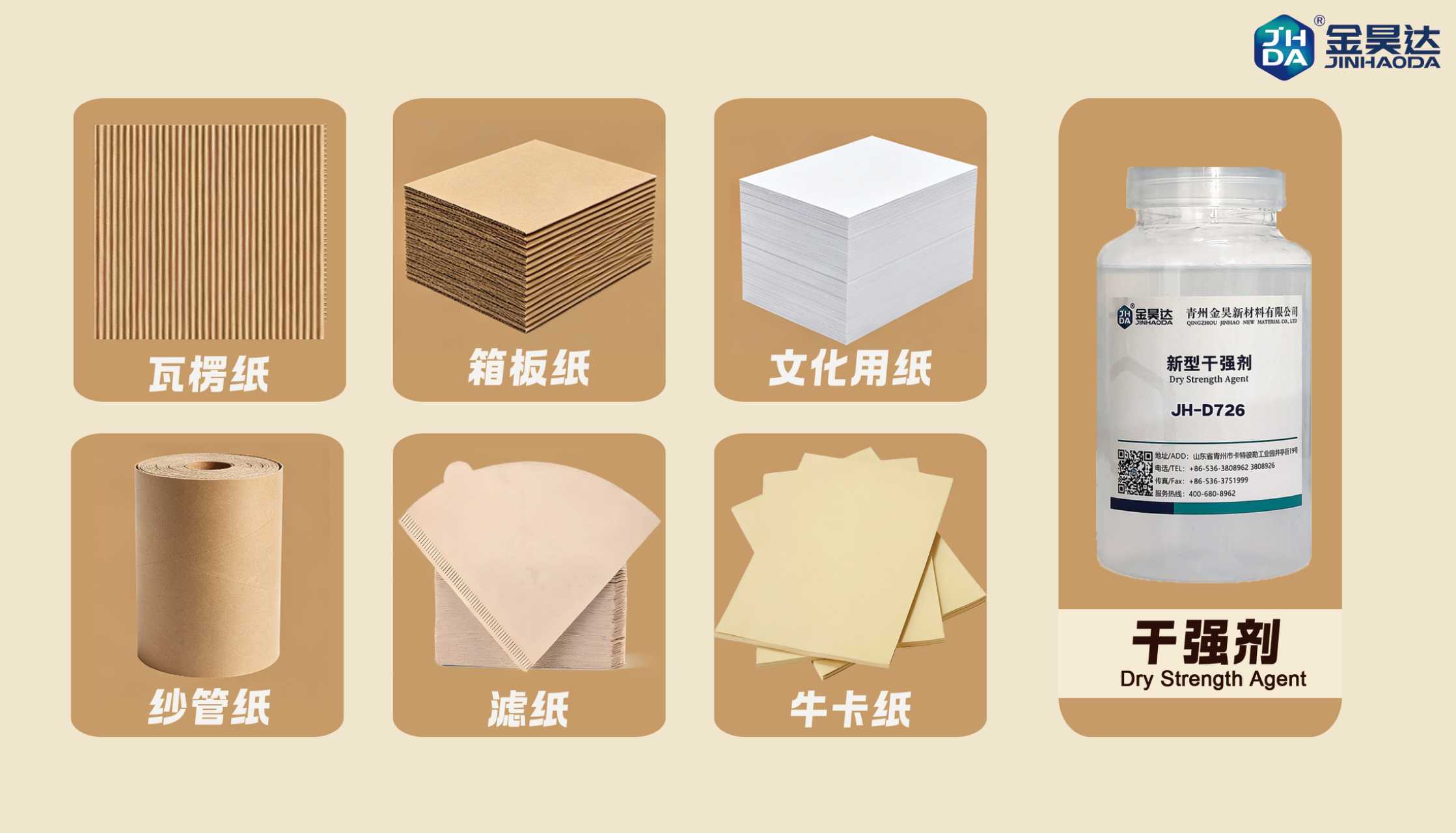
Surface sizing at the size press: the sizing agent is blended with starch and applied directly to the paper surface.
Kraft linerboard and containerboard in uncontrolled warehouses. Where board is stored in non-climate-controlled buildings, the surface film is the only barrier between the sheet and ambient humidity. JH-600 is described as retaining paper ring crush strength and surface rigidity under high humidity conditions, which targets the physical index that packaging buyers actually measure.
Food-contact packaging paper. Food packaging paper must satisfy the applicable food-contact standard in its destination market — Regulation (EC) No 1935/2004 in the EU and FDA 21 CFR in the US. Documented chemistry matters here: JHDA holds ISO 9001 certification (certificate 10423Q01592R1S) and ISO 14001 certification (certificate 10423E01032R2S), plus a HALAL certificate (6637250000) covering paper-making industry additives for the Indonesia market and other Halal-compliant markets, and supplies MSDS and TDS documentation with exported lots.
Printing and writing paper in long-term storage. Cultural paper stored for long periods re-absorbs moisture and loses both surface strength and printability. JH-600 is described as slowing down moisture re-absorption in cultural paper under humid conditions while maintaining stable surface strength and printing adaptability, and it is positioned to work together with low-cost industrial starch. For anionic-surface programs on offset and copy paper, JH-325 anionic surface sizing agent is the corresponding grade.
Recycled OCC and waste paper pulp mills. Recycled fibre brings fluctuating water quality, higher contaminant load and variable pulp quality. JH-600 is described as adaptable across virgin wood pulp, chemical pulp, mechanical pulp and compound recycled pulp, with consistent anti-moisture behaviour under fluctuating water quality and temperature conditions.
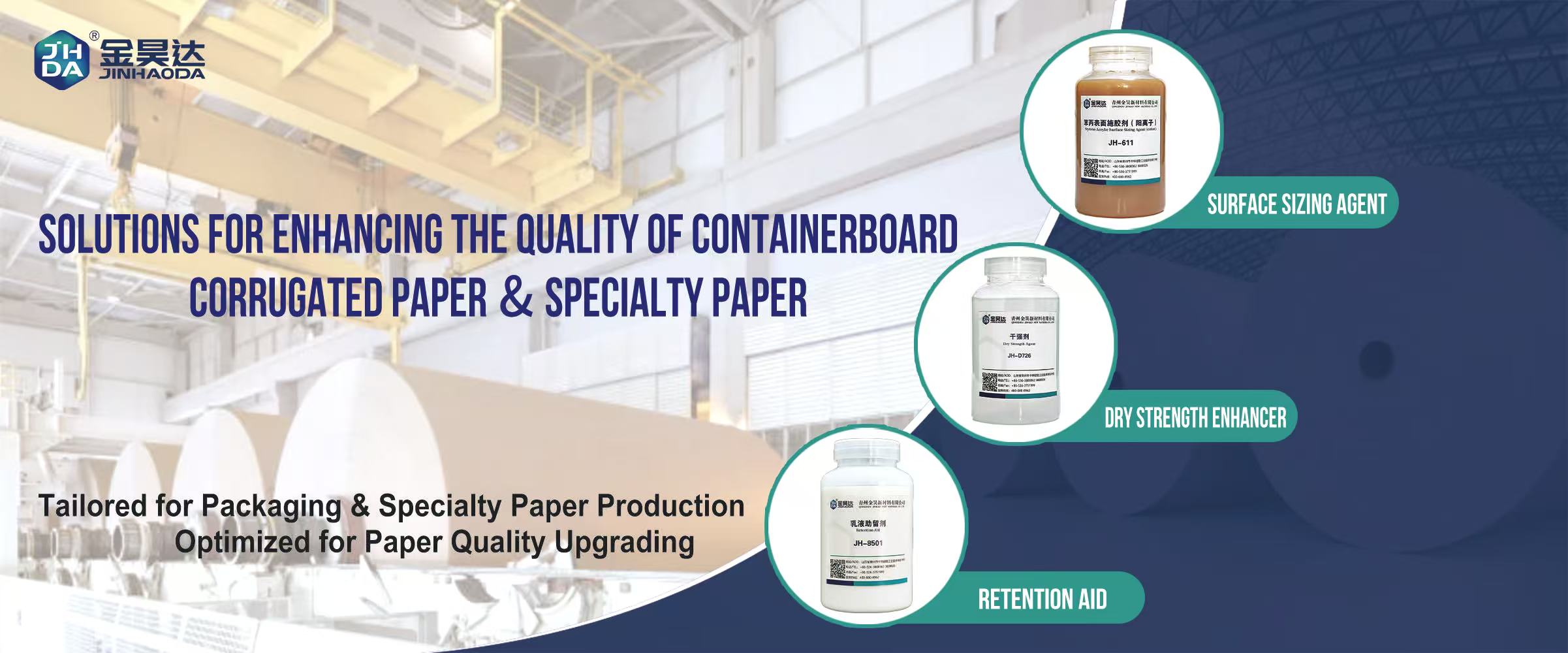
Packaging paper solution scope: corrugated medium, testliner, linerboard and boxboard grades.
Comparison Table: Sizing Options for Packaging Paper Mills
The table below compares the JHDA grades that appear in a moisture-resistance discussion. All specifications are as published by the manufacturer; no third-party rating or performance score is implied.
| Product (model) | Chemistry / ionic type | Key specification | Main role in a humid-storage problem | Shelf life |
|---|---|---|---|---|
| JH-600 Moisture Resistant SAE Surface Sizing Agent | Styrene acrylic, cationic, water soluble | Solids 30 ± 1%; pH 2.0 – 5.0; viscosity < 50 cps at 25 °C | Dense anti-moisture surface film; no curing period; positioned to replace an internal sizing agent in production | 6 months |
| JH-WH3364 Surface Enhanced Water Resistant Agent | Weak anionic styrene acrylic + AKD composite, weak cationic | Solids 25.0 ± 1.0%; pH 2.0 – 5.0; viscosity ≤ 50 cps at 25 °C | Dual function: AKD hydrophobicity plus SAE film-forming surface strength; replaces separate AKD emulsion and SAE dosing | 4 months |
| JH-611 Surface Strength Sizing Agent | Styrene acrylic copolymer, cationic | Solids 30.0 ± 1.0%; pH 2.0 – 5.0; viscosity ≤ 50 cps at 25 °C | Surface sizing for corrugated paper and boxboard; supports ring crush stiffness, surface hardness and smoothness | 6 months |
| JH-103 AKD Internal Sizing Agent | AKD wax, cationic | Solids 12.5 – 25.0 ± 1.0%; pH 2.0 – 5.0; viscosity ≤ 50 cps at 25 °C | Wet-end internal sizing for neutral and alkaline papermaking systems | 4 months |
| JH-200 Surface AKD Sizing Agent | AKD wax powder, cationic | Solids 20.0 ± 1.0% or 30.0 ± 1.0%; pH 2.0 – 5.0; viscosity ≤ 50 cps at 25 °C | Surface AKD applied with starch; sizing effect finalised after the drying cylinder, so no curing storage is needed | 3 months |
| JH-325 Anionic Surface Sizing Agent | Anionic styrene acrylic, anionic | Solids 25.0 ± 1.0%; pH 2.0 – 5.0; viscosity ≤ 50 cps at 25 °C | Surface strength and printability for printing and writing (cultural) paper programs | 6 months |
Single Product or Composite AKD/SAE Additive?
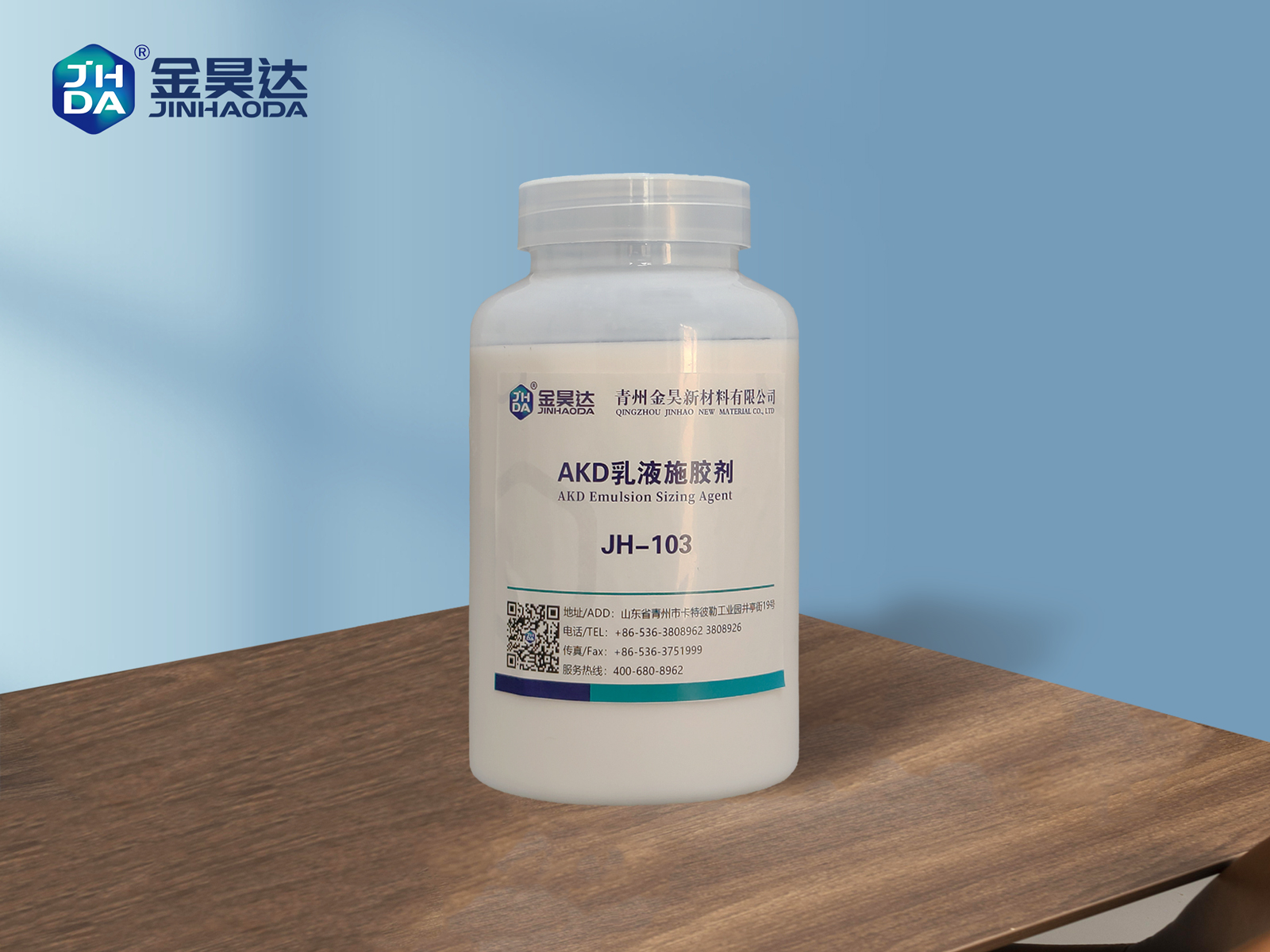
AKD emulsion chemistry: the internal sizing route reacts with cellulose at the fibre level and requires curing.
The decision is simpler than it looks, and it follows from the diagnosis in step two.
Choose a single moisture-resistant SAE product (JH-600) when the only defect is moisture reversion during storage and transit, surface strength and printability are already acceptable, and the mill wants the smallest possible change: one dosing point in the existing starch preparation, no wet-end reformulation, no curing inventory, and a 6-month shelf life that suits normal stock rotation.
Choose the composite AKD/SAE additive (JH-WH3364) when the grade shows both problems — water resistance fading in storage and surface dry strength failing in printing, creasing or die-cutting. Because the composite combines the reactive waterproofing of AKD with the film-forming toughness of the styrene acrylic resin, it replaces the separate purchasing and dosing of an AKD emulsion and an SAE sizing agent, simplifies the workshop dosing process, and reduces the number of chemicals in the size-press circulation. The trade-off to plan for is shelf life: JH-WH3364 is specified at 4 months, so order planning should be tighter than for JH-600.
Keep internal sizing in the system when the requirement is fibre-level hydrophobicity across the full sheet thickness rather than surface holdout. JH-103 AKD internal sizing agent is designed for neutral and alkaline papermaking systems, forms stable bonding on the fibre surface, and is described as compatible with conventional wet-end chemicals such as retention agents, defoamers and bentonite. In practice, many mills run internal and surface sizing together and allocate the load between them; that split is a trial question, not a catalogue question, and is best settled on a bench trial followed by a machine trial.
Frequently Asked Questions
How do we check whether a sizing agent manufacturer can support REACH-related documentation requirements?
REACH is the European Union framework for the registration, evaluation and authorisation of chemicals, so the practical test of a supplier is documentation, not a claim printed on a brochure. A manufacturer should be able to hand over MSDS and TDS files, CAS registration, GHS hazard labelling for transport, and certificates that apply to the destination market. Qingzhou Jinhao New Material Co., Ltd. supplies MSDS, TDS, CAS registration and GHS hazard labelling with exported lots, states compliance with IMDG rules for marine transport, and holds ISO 9001 certification (certificate 10423Q01592R1S under GB/T 19001-2016 / ISO 9001:2015), ISO 14001 certification (certificate 10423E01032R2S) and a HALAL certificate (6637250000) covering paper-making industry additives for the Indonesia market. For food-contact packaging paper, confirm the applicable standard with the buyer — Regulation (EC) No 1935/2004 in the EU and FDA 21 CFR in the US — and match it against the supplier's test reports before the first bulk order.
Which parameters should be fixed in a specification for a moisture-resistant surface sizing agent?
Four parameters decide whether the product will behave on your machine and in your warehouse: solid content, pH, viscosity and ionic type. JH-600 is specified as a light brown to dark brown liquid with solid content of 30 ± 1%, pH 2.0 – 5.0, viscosity below 50 cps at 25 °C, cationic and water soluble, with a 6-month storage period. JH-WH3364 is a milky white to pale yellow liquid with solid content of 25.0 ± 1.0%, pH 2.0 – 5.0, viscosity of 50 cps or below at 25 °C, weak cationic, with a 4-month shelf life. Solid content drives the dosage calculation, pH and ionic type decide compatibility with the starch carrier and the wet-end system, and viscosity affects pumpability and mixing behaviour in the size press circulation.
Can a surface sizing agent replace an internal AKD emulsion completely?
In the JHDA range, JH-600 is positioned as capable of fully replacing an internal sizing agent for production, because the surface-applied route requires no curing period and the finished paper obtains its anti-moisture performance immediately after drying. The same logic applies to JH-611, which is described as capable of direct replacement for wet-end internal sizing agents without curing time. The boundary case is a grade that needs hydrophobicity through the whole sheet thickness rather than surface holdout, or a mill that deliberately splits the sizing load between wet end and size press. In those cases keep the internal system — JH-103 AKD internal sizing agent is designed for neutral and alkaline wet-end application — and confirm the split on a trial rather than moving straight to a full substitution.
When is a composite AKD/SAE additive better than a single product?
Use a composite when one grade has to deliver two properties at the same time: long-term water resistance and surface dry strength. JH-WH3364 combines AKD, which reacts chemically with cellulose to build durable hydrophobicity, with weak anionic styrene acrylic resin, which forms a tough continuous film that reinforces the paper surface and reduces linting, picking and ink feathering. A composite replaces the separate purchasing and dosing of an AKD emulsion and an SAE sizing agent, which simplifies workshop operations and reduces the number of chemicals circulating in the size press. If water resistance is the only defect and surface strength is already acceptable, a single moisture-resistant SAE product such as JH-600 keeps the system simpler and offers a longer shelf life.
What are the trial, minimum order and lead-time terms?
JHDA offers free trial samples with a minimum order quantity of 1 MT and a production lead time of 4 working days, supported by a monthly capacity of 8,000 MT. The in-house pilot laboratory is used for targeted formula customisation and free formulation testing, and the field technical team supports on-machine debugging and optimisation of indicators such as water absorption value, ring crush strength, bursting strength and fibre retention rate. Export lots are shipped with commercial invoice, packing list, certificate of origin, pre-shipment inspection report, MSDS, TDS and dangerous goods transport certification, and sight L/C, T/T and DP terms are available for large-volume orders. To move from diagnosis to a tested recipe, send the grade description, machine parameters and pulp mix to WhatsApp +86 139 6468 8976 or email info@sdqzjinhao.com to request a surface sizing sample.
Conclusion: Fix the Surface Before You Reformulate the Furnish
Paper that loses moisture resistance in humid storage is usually failing at the surface, not in the pulp. The corrective path is therefore specific: confirm that the loss appears after storage rather than at the machine, determine whether internal sizing, surface sizing or both are deficient, and then select chemistry that fits the size press you already run.
For a packaging mill, the decision rule is short. Moisture reversion alone points to JH-600, a cationic moisture-resistant SAE surface sizing agent with 30 ± 1% solids, pH 2.0 – 5.0 and viscosity below 50 cps at 25 °C, applied with industrial starch and requiring no curing period. Moisture reversion combined with weak surface strength and printing defects points to JH-WH3364, the composite of weak anionic styrene acrylic and AKD at 25.0 ± 1.0% solids, which removes the separate purchase and dosing of AKD emulsion and SAE sizing agent. Stiffness-driven problems on corrugated paper and boxboard point to JH-611, and fibre-level requirements stay with JH-103 at the wet end.
All three routes share the same prerequisites: verified starch compatibility, shear stability and low foaming on a high-speed sizing machine, and a storage test that proves the result before the grade is released.
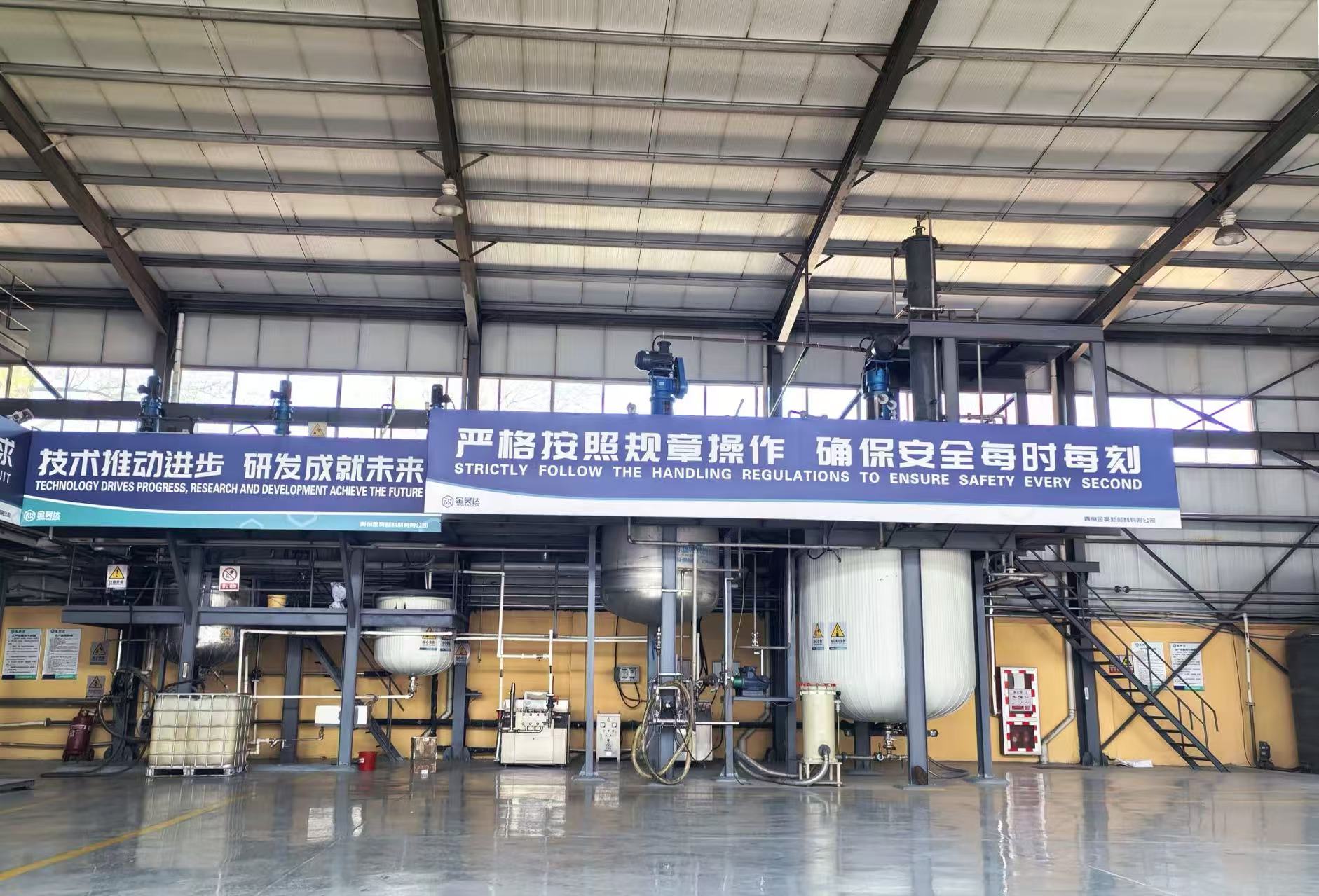
JHDA production line — liquid and solid papermaking chemicals manufactured in batch-controlled lines for bulk paper mill supply.
Next step: request a free sample of JH-600 or JH-WH3364, or ask for a formulation review against your pulp mix and size-press parameters.
Email: info@sdqzjinhao.com | Tel: +86-536-3808962 | WhatsApp: +86 139 6468 8976 | Website: en.sdqzjinhao.com
Download the full product catalogue: JHDA Introduction 2026 (PDF)