
Ranked: 5 JHDA Sizing Agents for Moisture Resistance, Surface Strength, and AKD Sizing
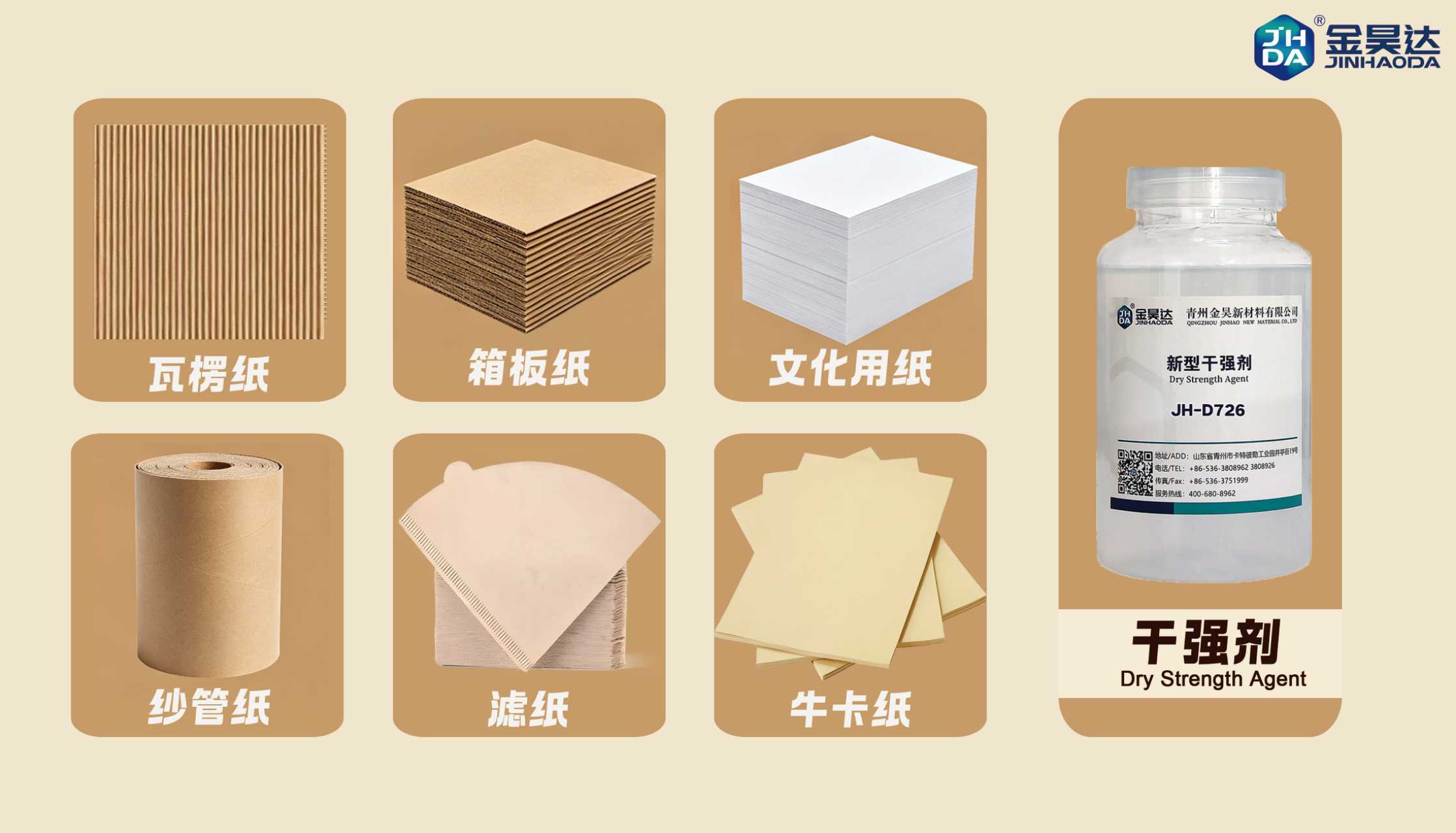
Surface sizing in production: the AKD and SAE grades ranked in this guide are supplied by Qingzhou Jinhao New Material Co., Ltd. (JHDA).
Direct answer: Ranked by application fit across moisture resistance, surface strength and AKD sizing behaviour, the five JHDA sizing agents in this guide are 1) JH-600 for moisture-resistant SAE surface sizing, 2) JH-WH3364 as a dual-function composite combining AKD and SAE benefits, 3) JH-103 for neutral / alkaline internal AKD sizing, 4) JH-200 for surface AKD sizing with starch compatibility, and 5) JH-325 for anionic surface sizing in cultural paper. The order reflects which product matches which paper grade and sizing route most directly — it is not a claim that any single grade outperforms the others on every machine.
Sizing sits on the line between a paper machine's wet-end chemistry and its commercial results. A packaging mill that loses ring crush strength after eight weeks in a humid warehouse, and a cultural paper mill that sees linting and picking on a high-speed offset press, are both looking at sizing problems — but they need different chemistry, different application points, and different verification tests. This ranking separates what the product data states from what a mill still has to validate on its own machine.
Qingzhou Jinhao New Material Co., Ltd. — branded as JHDA — is a papermaking fine chemicals manufacturer founded in 2005 and based at No.19, Jingting Street, Caterpillar Industrial Park, Qingzhou City, Shandong Province, China. The manufacturing facility covers approximately 20,000 square metres, the company employs more than 80 people including 20 R&D and on-site technical service engineers, and annual production capacity reaches 100,000 tons. Its product portfolio covers AKD sizing emulsion, cationic styrene-acrylic surface sizing agent, paper dry strength agent, PAE wet strength resin, optical brightening agent, high temperature resistant paper defoamer, stickies control enzyme, sludge encapsulant, dryer release agent, biocide, deodorant, food-grade water vapour barrier coating and hydrophobic coating for food packaging paper.
The Real Problem: Three Sizing Decisions Are Usually Made in Three Different Places
Most mills do not select "a sizing agent". They separately decide whether to size in the pulp or on the surface, whether to buy an AKD emulsion and an SAE surface sizing agent as two line items or one, and how much curing and warehouse time the finished sheet can absorb before it ships. Those three decisions are often owned by different people — wet-end chemistry, surface sizing, and production planning — which is why sizing systems drift over time.
The consequences show up as specific, costly failure modes. Under-dosed surface sizing appears as linting, picking and ink feathering on press. An internal AKD system that cures slowly ties up finished paper in the warehouse instead of shipping it. And chemistry that performs in a beaker but re-absorbs moisture over a six-week sea freight consignment can produce strength attenuation, sheet softening and carton collapse at the customer's end. JHDA's own product documentation frames the trade-off in exactly these terms: JH-200 is positioned against the slow curing drawback of traditional AKD products, JH-600 against the gradual weakening of water resistance that general-purpose surface sizing agents can show over long storage, and JH-325 against the loss of balance between water resistance and ink affinity in cultural paper.
A second, quieter problem is purchasing structure. When a mill buys an AKD emulsion and an SAE sizing agent separately, it manages two dosing points, two stock items and two shelf lives — JH-103 and JH-WH3364 carry a 4-month shelf life, JH-200 carries 3 months, and JH-325 and JH-600 carry 6 months. Where a composite grade covers both functions, the purchasing and dosing structure simplifies even if the chemistry itself does not change dramatically.
Industry Background: Sizing Demand Is Growing and the Chemistry Mix Is Shifting
According to Dataintelo, the global paper sizing agent market was valued at approximately USD 3.8 billion in 2025 and is projected to reach USD 5.9 billion by 2033, a CAGR of 5.8%. Published estimates vary with scope — Market Research Future places the 2024 sizing agent market at USD 3.16 billion while SNS Insider puts it at USD 3.95 billion — so the direction of growth is more dependable than any single figure.
Synthetic sizing agents, including AKD and ASA, held a 54.5% market share in 2024 (SNS Insider), and AKD sizing alone accounts for approximately 48% of synthetic sizing agent volume worldwide (Dataintelo). Liquid sizing agents took 57.8% of the market in 2024 on ease of application, while solid sizing agents are projected to grow at a 5.11% CAGR through 2032 on logistical efficiency. Rosin sizing still represents 32.4% of revenue as of 2025, and bio-based sizing agents reached 38% of global consumption in 2024 — a reminder that AKD and SAE coexist with older chemistries rather than replacing them outright.
Regionally, Asia Pacific holds a 42.3% revenue share as of 2025, and China's annual sizing agent consumption is estimated at 650,000 tons. China also exported USD 36.5 billion in paper goods in 2024 (OEC), which is the downstream demand that sizing chemistry ultimately serves. Major global competitors include Kemira, BASF and Arakawa Chemical Industries (Mordor Intelligence). For a mill shortlisting a supplier, the practical question is rarely who the largest producer is, but whether chemistry, documentation and technical support arrive together — which is what the ranking below is designed to help evaluate.
Ranked: Five JHDA Sizing Agents by Application Fit
How This Ranking Was Built
Each grade was assessed against five criteria that a mill can check before committing to a trial: the failure mode the product is formulated to address (moisture regain, surface strength, or internal sizing); its ionic type and how that interacts with starch, retention aids and defoamers; the physical parameters that constrain dosing (solid content, pH and viscosity at 25 °C); whether the sizing effect requires a curing period; and whether the grade simplifies or complicates the purchasing structure. The order reflects application fit against these criteria as described in JHDA's published product data. It is an editorial shortlist, not a laboratory benchmark, and it is not a substitute for a machine trial.
1. JH-600 — Moisture-Resistant SAE Surface Sizing Agent
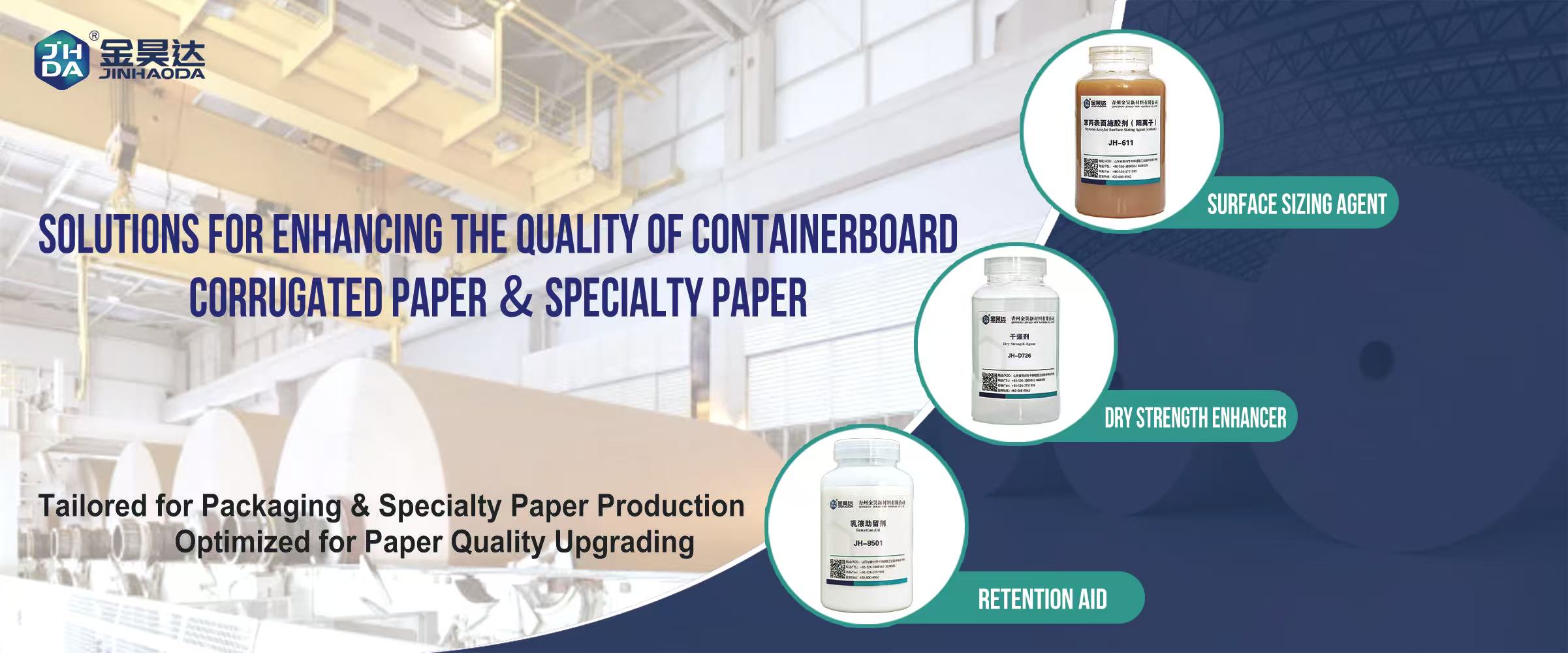
Packaging paper output — the grade group where moisture regain and box collapse during humid storage and sea freight drive sizing selection.
JH-600 is a moisture-resistant SAE surface sizing agent classified as a papermaking surface coating agent, based primarily on styrene acrylic. Its data sheet records an appearance of light brown to dark brown liquid, solid content of 30 ± 1%, pH 2.0–5.0, viscosity below 50 cps at 25 °C, water solubility, and a 6-month storage period. It ranks first in this group because moisture regain after storage and transport is the most expensive sizing failure for packaging grades: JHDA describes the product as forming a dense, closed protective film on the paper surface and as maintaining stable hydrophobic performance after long placement in humid conditions, which addresses the gradual loss of water resistance that general-purpose surface sizing agents can show over time.
Two further data-sheet points matter for production planning. First, JHDA states the product can fully replace internal sizing agent in production with no curing period required, so finished paper obtains its anti-moisture performance after drying rather than after warehouse curing. Second, compatibility with common industrial starch is stated, so the existing starch kitchen does not need to be rebuilt. The sheet also lists adaptability to virgin wood pulp, chemical pulp, mechanical pulp and compound recycled pulp, retention of ring crush strength and surface rigidity under high humidity, low foaming behaviour for high-speed surface sizing machines, and reduced viscous deposit build-up on sizing rollers and drying cylinders.
2. JH-WH3364 — Dual-Function Composite Combining AKD and SAE
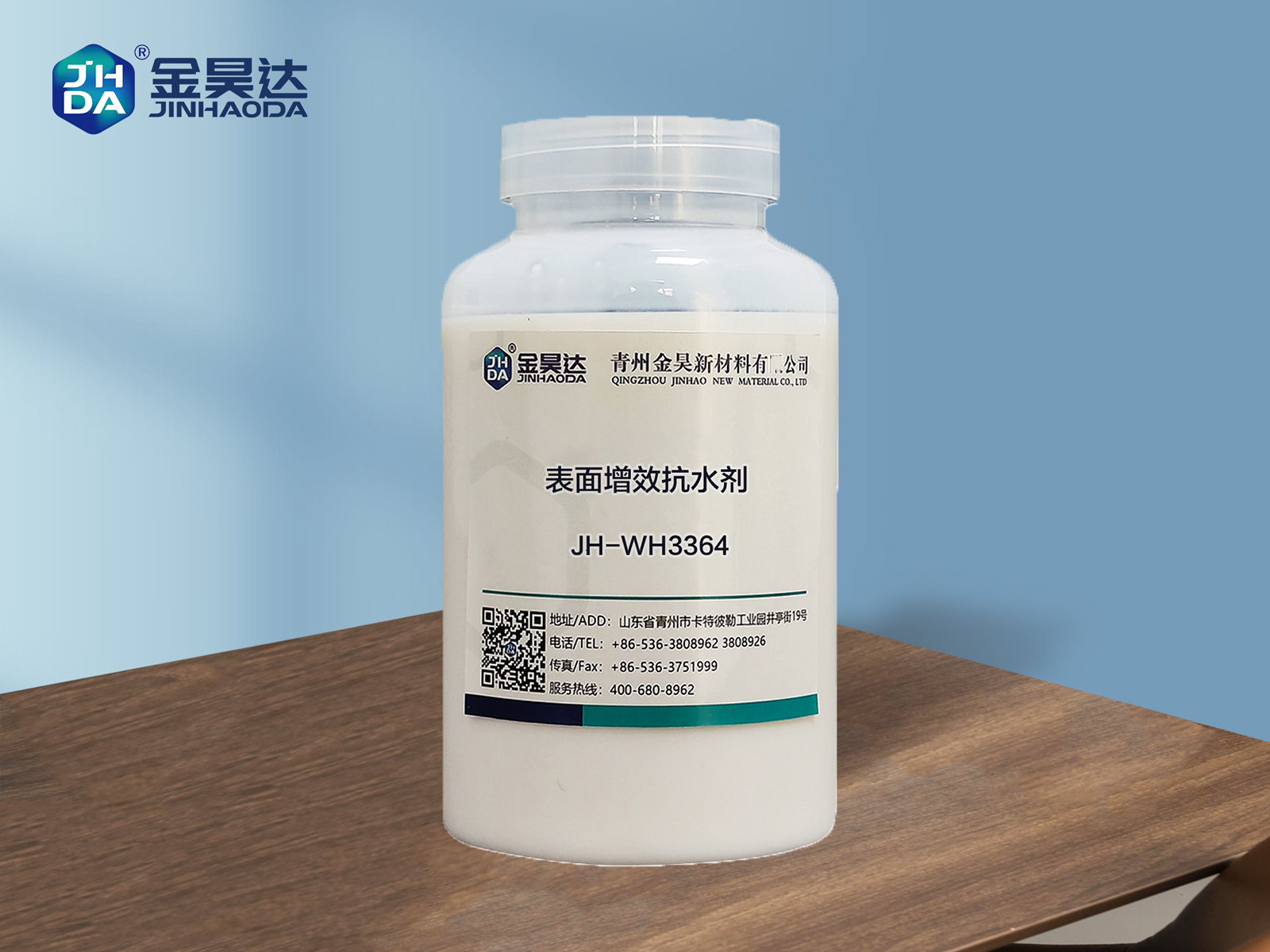
JH-WH3364, a composite surface sizing agent built from weak anionic styrene acrylic and AKD.
JH-WH3364 is a composite surface sizing agent and dual-function composite sizing additive made from weak anionic styrene acrylic and AKD. JHDA states that it integrates the reactive waterproofing advantage of AKD with the high film-forming toughness of SAE styrene-acrylic resin, delivering water resistance and surface strength as a single product. Its parameters are an appearance of milky white to pale yellow liquid, solid content of 25.0 ± 1.0%, pH 2.0–5.0, viscosity of ≤50 cps at 25 °C, weak cationic ionic type, water solubility, and a 4-month shelf life.
It ranks second because it answers the purchasing-simplification question directly: JHDA states the grade can replace the separate purchase and dosing of AKD emulsion and SAE sizing agent. The data sheet also states that the SAE component fixes the sizing effect instantly after drying, removing the long curing period associated with pure AKD emulsion; that the composite restrains paper linting, picking and ink feathering during high-speed offset printing; and that it blends with oxidized starch and modified starch without delamination. On the machine side, JHDA lists excellent mechanical shear resistance and low foaming characteristics, designed for neutral systems with no acidic corrosion of cylinders, sizing rollers and metal equipment, and compatibility with retention aids and defoamers without flocculation failure. The stated storage behaviour is room-temperature stability with no precipitation or oil separation during long-distance transport. It also claims improved surface smoothness and rigidity with reduced edge breakage during carton indentation, die-cutting and trimming.
3. JH-103 — AKD Internal Sizing Emulsion for Neutral and Alkaline Lines
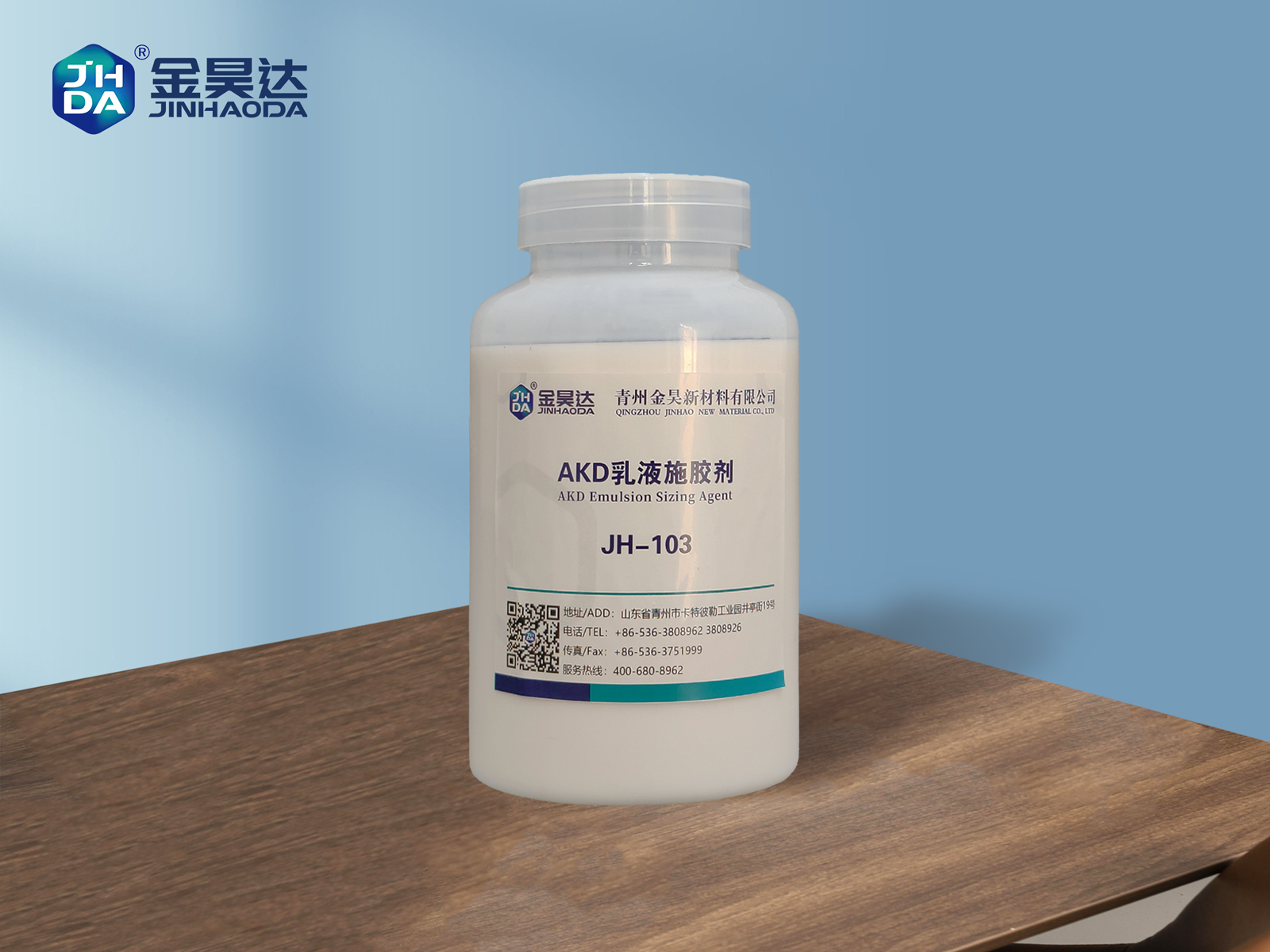
JH-103 AKD emulsion — an internal sizing grade for neutral and alkaline papermaking production lines.
JH-103 is an AKD internal sizing agent for papermaking, also described as an alkyl ketene dimer emulsion and a neutral internal sizing agent, supplied as a liquid that functions as a papermaking internal waterproof sizing chemical. It is made from AKD wax, is cationic and water-soluble, with an appearance of white to light brown liquid, solid content in the range of 12.5–25.0 ± 1.0%, pH 2.0–5.0, viscosity ≤50 cps at 25 °C, and a 4-month shelf life. It ranks third because internal sizing remains the correct route for grades that must resist moisture through the fibre network rather than at the surface.
JHDA's documentation states that the grade uses a high-molecular polymer emulsifier formula for a rapid curing reaction, forming a covalent bond on the fibre surface after cylinder drying. It also claims outstanding emulsion anti-ageing stability that holds a uniform liquid state through long-distance transport and normal-temperature storage without layering under seasonal temperature change — a relevant property for mills importing emulsion into tropical or high-humidity markets. The cationic molecular structure is stated as compatible with conventional wet-end chemicals including retention agents, defoamers and bentonite, without abnormal flocculation, white water deterioration or sticky deposition on machine clothing. Feeding is described as direct continuous addition into the pulp pipeline by metering pump, with no manual dilution step. Stated pulp adaptability covers wood pulp, chemical pulp, mechanical pulp and blended pulp, and stated end uses cover cultural printing paper, copy paper, box board, craft paper and moulded pulp products.
4. JH-200 — Surface AKD Sizing Agent with Starch Compatibility
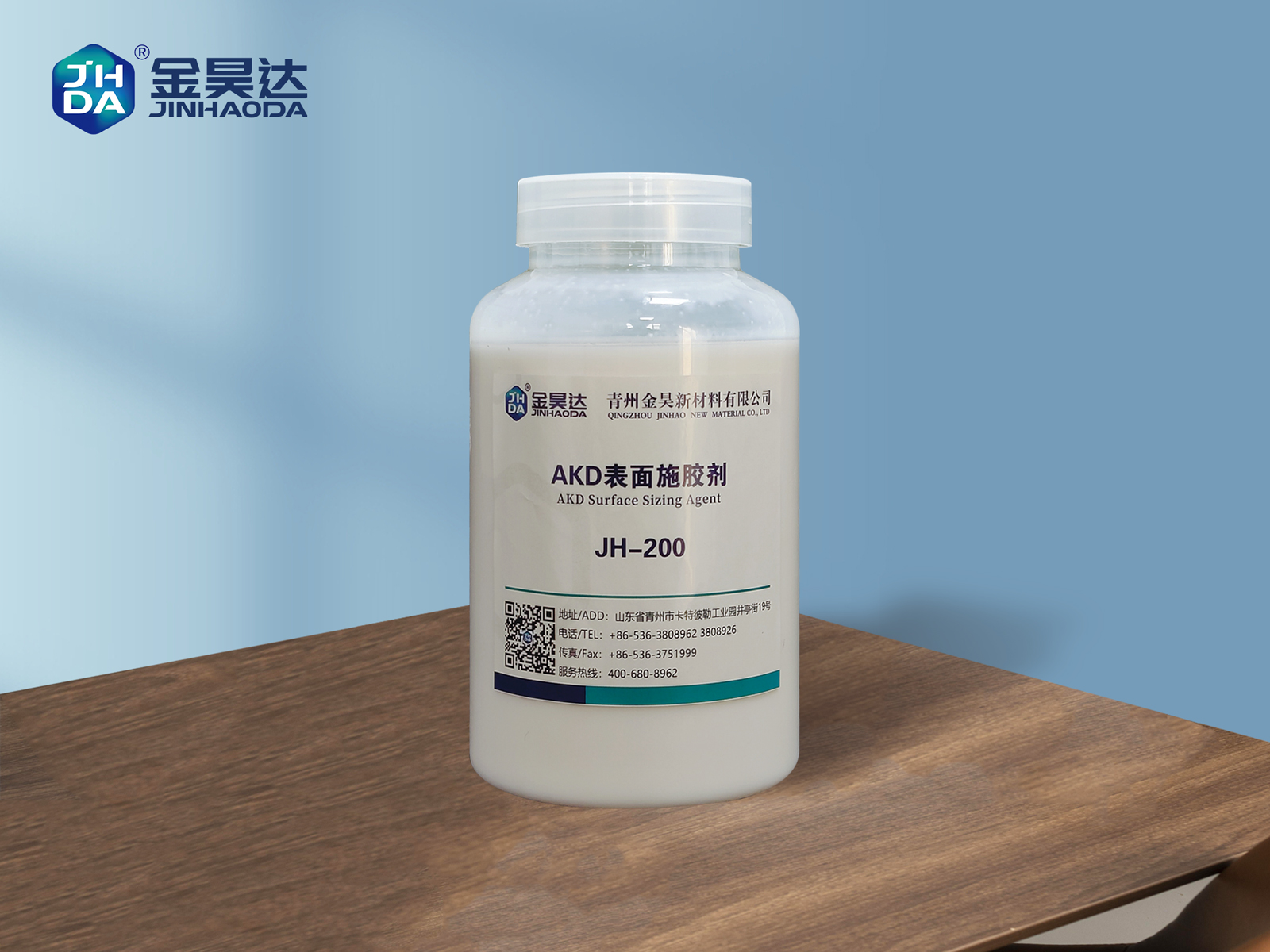
JH-200, a surface AKD sizing emulsion based on AKD wax powder, supplied at 20.0 ± 1.0% or 30.0 ± 1.0% solid content.
JH-200 is a surface AKD sizing agent, classified as an AKD surface sizing emulsion and made from AKD wax powder. It is cationic and soluble, with solid content available at 20.0 ± 1.0% or 30.0 ± 1.0%, pH 2.0–5.0, viscosity ≤50 cps at 25 °C, and a 3-month shelf life. It ranks fourth because it occupies a narrower but very practical position: applying AKD reactive chemistry at the surface sizing station instead of the wet end.
The inclusion reason is the dosing route rather than the chemistry class. JHDA states that JH-200 can be evenly blended with industrial starch and coated on the paper surface, that the reactive component reacts with cellulose to build a waterproof barrier, and that the sizing effect is finalised once the paper passes the drying cylinder — so finished paper can be rolled and delivered without a curing period. Compared with pulp-added AKD, the surface route is stated to avoid AKD loss in white water circulation and fibre retention, so more of the active ingredient acts where it is needed. The sheet also states improved surface bonding and printing adaptability with fewer fuzzing and picking failures, compatibility with oxidized starch, cationic modified starch and industrial starch, neutral and alkaline suitability with reduced corrosion of sizing rollers, drying cylinders and pipelines, and mechanical shear stability with low foaming for high-speed sizing machines. The lowest transformation cost in the group is stated explicitly: chemicals are added in the surface sizing tank, with no change to the pulp formula or the internal additive system.
5. JH-325 — Anionic Surface Sizing Agent for Cultural Paper
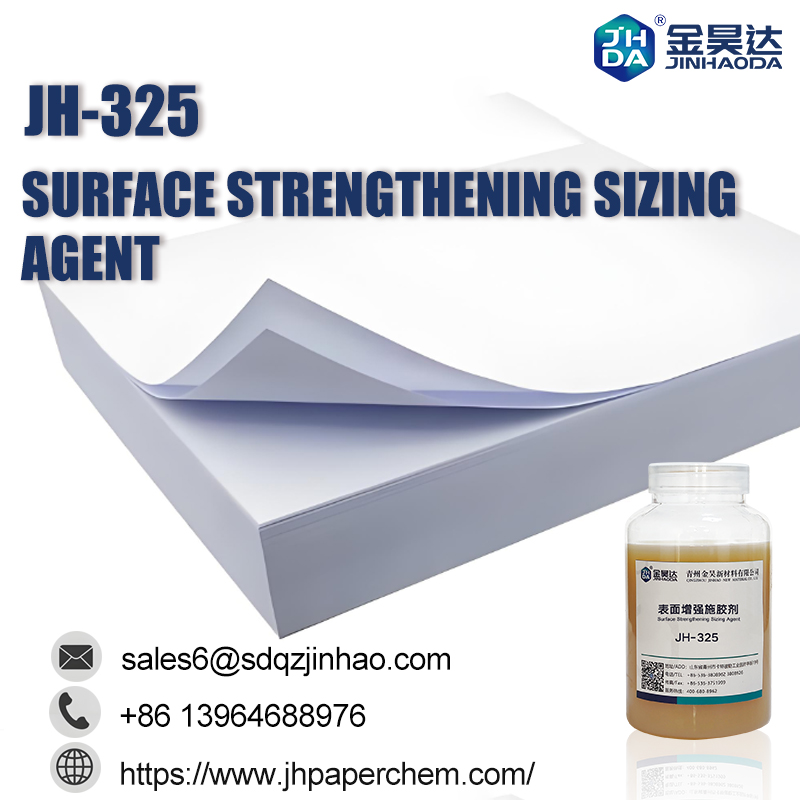
JH-325 anionic SAE surface sizing agent, positioned for cultural paper such as offset, copy and book paper.
JH-325 is an anionic surface sizing agent made from anionic styrene acrylic copolymer and classified as a cultural paper surface sizing agent. Its data sheet records an appearance of white to light brown liquid, solid content of 25.0 ± 1.0%, pH 2.0–5.0, viscosity ≤50 cps at 25 °C, anionic ionic type, water solubility, and a 6-month shelf life — the longest shelf life in this five-product group. It ranks fifth only because the ranking criteria weight moisture resistance and AKD reactive chemistry first; on its own terms it is the most directly targeted grade for printing and writing paper.
JHDA states that the anionic styrene-acrylic copolymer reacts and crosslinks rapidly with starch components to build a tight protective coating with even coverage across the full paper width. The stated positioning is a balance of moderate water resistance and ink affinity that inhibits ink bleeding and penetration on clear, uniform printed text and colour. Stated strength benefits include improved dry and wet surface strength on offset printing paper, copy paper and book paper, with reduced linting, picking and blanking in high-speed rotary printing. The grade is stated as suitable for both acidic sizing with aluminium sulfate and modern neutral systems, compatible with retention aids and defoamers without system flocculation, shear resistant and low foaming on high-speed surface sizing machines, and finished-paper stable without curing. It also claims to work with low-cost industrial starch to reduce the addition of higher-priced sizing agent, and to narrow the physical performance gap between the two sides of the sheet.
Step-by-Step: Matching These Five Grades to a Machine
Step 1 — Name the failure mode before naming the product
Write down what actually goes wrong: moisture regain and box collapse in storage and transit point toward the moisture-resistance route (JH-600); linting and picking on a high-speed press point toward surface strength (JH-325, JH-200, JH-WH3364); and inconsistent water resistance across the web points toward an internal sizing gap (JH-103). Fixing the failure mode first prevents selecting on price alone.
Step 2 — Choose the sizing route: internal, surface, or both
Internal sizing (JH-103) treats the fibre network and suits box board, craft paper, cultural printing paper and moulded pulp. Surface sizing (JH-600, JH-325, JH-200, JH-WH3364) treats the sheet surface and, in the case of JH-200 and JH-WH3364, can be applied in the surface sizing tank without changing the pulp formula or the internal additive system.
Step 3 — Check ionic compatibility against your starch and wet-end chemicals
JH-325 is anionic and is stated to crosslink with starch components; JH-200, JH-103 and JH-611 are cationic; JH-WH3364 is weak cationic and is stated to be compatible with retention aids and defoamers without flocculation. On a machine carrying anionic starch, cationic retention aids or bentonite, the charge interaction is the first beaker test worth running.
Step 4 — Review the physical parameters against your dosing system
All five grades sit at pH 2.0–5.0 with viscosity at or below 50 cps at 25 °C, so pumping and metering behaviour is broadly comparable within the set. The differentiation is solid content: JH-103 at 12.5–25.0%, JH-200 at 20.0 or 30.0%, and JH-600, JH-WH3364 and JH-325 at 25.0–30.0%. Higher solid content changes the dilution ratio in the starch kitchen, not necessarily the delivered dry dosage.
Step 5 — Confirm shelf life against your shipping and stocking pattern
JH-200 carries a 3-month shelf life; JH-103 and JH-WH3364 carry 4 months; JH-325 and JH-600 carry 6 months. For mills ordering in large lots or holding stock through a monsoon season, that difference should be matched to purchase frequency rather than treated as a minor data-sheet field.
Step 6 — Validate on the machine, not on the datasheet
JHDA's technical team states that it performs on-site machine debugging to optimise core paper indicators including Cobb water absorption value, ring crush strength, bursting strength, paper brightness, fibre retention rate and overall machine runnability. A trial should measure the same indicators before and after the change, on the same pulp furnish and machine speed.
Use Cases: Which Grade Fits Which Paper
- Packaging paper exposed to humid storage and long sea freight — JH-600 as a surface sizing route, with ring crush strength and surface rigidity retention under high humidity as the stated benefit.
- Mills that want water resistance and surface strength from one product, and want to stop buying AKD emulsion and SAE sizing agent separately — JH-WH3364.
- Neutral and alkaline internal sizing on box board, craft paper, copy paper and moulded pulp — JH-103.
- Old production lines where the pulp formula and internal additive system must stay unchanged — JH-200, dosed in the surface sizing tank with industrial starch.
- Offset printing paper, copy paper and book paper where printing clarity matters more than maximum water resistance — JH-325.
- Corrugated paper and boxboard surface sizing — JH-611 (outside the ranked five).
JHDA states that its additives are applicable to kraft linerboard, corrugated medium paper, printing and writing paper, household tissue paper and food-grade cardboard, so several of these grades will run on the same machine family with different chemistry selections.
Comparison Table: JHDA Sizing Agents at a Glance
| Rank & Model | Chemistry / ionic type | Solid content | pH | Viscosity (25 °C) | Shelf life | Best-fit application |
|---|---|---|---|---|---|---|
| 1. JH-600 | Styrene acrylic (SAE); ionic descriptor varies by JHDA document — confirm on TDS | 30 ± 1% | 2.0–5.0 | <50 cps | 6 months | Moisture-resistant surface sizing for packaging grades facing humid storage and long transport |
| 2. JH-WH3364 | Composite: weak anionic styrene acrylic + AKD; weak cationic | 25.0 ± 1.0% | 2.0–5.0 | ≤50 cps | 4 months | Mills that want moisture resistance plus surface strength and want to replace separate AKD + SAE purchases |
| 3. JH-103 | AKD wax emulsion; cationic | 12.5–25.0 ± 1.0% | 2.0–5.0 | ≤50 cps | 4 months | Neutral / alkaline internal sizing: cultural paper, copy paper, box board, craft paper, moulded pulp |
| 4. JH-200 | Surface AKD emulsion from AKD wax powder; cationic | 20.0 ± 1.0% or 30.0 ± 1.0% | 2.0–5.0 | ≤50 cps | 3 months | Surface AKD sizing with industrial starch, without changing the pulp formula |
| 5. JH-325 | Anionic styrene acrylic copolymer; anionic | 25.0 ± 1.0% | 2.0–5.0 | ≤50 cps | 6 months | Cultural paper surface sizing: offset printing paper, copy paper, book paper |
| JH-611 (not ranked) | Cationic, starch-based styrene acrylic | 30.0 ± 1.0% | 2.0–5.0 | ≤50 cps | 6 months | Corrugated paper and boxboard surface sizing |
All parameters as published in JHDA product data for the listed models. Values are nominal data-sheet figures and should be confirmed against the current TDS before ordering.
FAQ: Compliance, Capability, Budget, Samples and Lead Time
Q1. What compliance and documentation evidence does JHDA provide for regulated paper grades?
JHDA holds ISO9001 quality management system certification and ISO14001 environmental management system certification, along with SGS product compliance test reports. For packaging paper chemicals, the company states that it has completed SGS food contact safety testing. Exported chemical products complete CAS registration and GHS hazard labelling and comply with IMDG international marine shipping regulations. Documentation supplied for export orders includes commercial invoice, packing list, certificate of origin, pre-shipment inspection report, MSDS, TDS and dangerous goods transport certification where applicable. For destination-market rules, EU food contact materials must comply with Regulation (EC) No 1935/2004 and US paper packaging chemicals must meet FDA 21 CFR food-contact standards; mills should confirm the specific clearance required for the target grade, because the portfolio's dedicated food-contact products are the food-grade water vapour barrier coating and the hydrophobic coating for food packaging paper, while the sizing grades described in this article are supplied with the standard compliance documentation.
Q2. Can one product replace buying AKD emulsion and SAE sizing agent separately?
Yes — JH-WH3364 is designed for that purpose. It is a composite surface sizing agent made from weak anionic styrene acrylic and AKD that integrates AKD's reactive waterproofing with SAE's film-forming toughness, and JHDA states that it can replace the separate purchase of AKD emulsion and SAE sizing agent. Its data sheet lists 25.0 ± 1.0% solid content, pH 2.0–5.0, viscosity ≤50 cps at 25 °C, weak cationic ionic type and a 4-month shelf life, with stated compatibility with retention aids, defoamers and starch systems. Mills that need internal sizing as well as surface sizing still require a separate internal grade such as JH-103.
Q3. What drives total sizing chemical cost when choosing between these five grades?
Four cost levers appear in the product data rather than in price lists. First, starch substitution: JH-600 and JH-325 are both stated to work with low-cost industrial starch, which reduces the addition amount of higher-priced sizing agent. Second, dosage efficiency: JH-200 is stated to reach target waterproofing with less dosage than separate internal AKD addition, and JH-103 is described as having a high effective utilisation rate of active components. Third, purchasing structure: JH-WH3364 replaces two separate purchases. Fourth, indirect cost: JH-600, JH-325, JH-200 and JH-WH3364 are all stated to require no curing period, which reduces finished-goods warehouse occupation. JHDA's minimum order quantity is 1 MT, and the company offers sight L/C, T/T and DP payment terms for large-volume chemical orders. Per-ton pricing should be requested against a specific grade and volume.
Q4. How does a trial work before a bulk order?
The typical sequence is sample trial, laboratory confirmation, then machine validation. JHDA provides pre-shipment laboratory testing, complete TDS and MSDS documents, and on-site technical support for machine debugging, where the field team optimises core paper indicators including Cobb water absorption value, ring crush strength, bursting strength, paper brightness, fibre retention rate and machine runnability. A central R&D laboratory is under construction at the Qingzhou headquarters to expand raw material inspection, finished-product testing and personalised formula customisation. Because the sizing result depends on pulp composition, water hardness and machine parameters, the trial should be run on the mill's own furnish rather than on a generic sample. Sample requests can be placed directly with the JHDA international sales team.
Q5. What does lead time and supply continuity look like for export orders?
JHDA operates an overseas supporting production entity, CRM Chemical Technology Co., Ltd., in Long An Province, Vietnam, established to provide local delivery for ASEAN clients and shorten delivery cycles. Annual production capacity reaches 100,000 tons, and the company states that export business accounts for 35% to 50% of total sales volume, with major markets including Vietnam, Thailand, Malaysia, Indonesia, Myanmar, Cambodia and major packaging paper industrial zones in the Middle East. Standardised automated production lines for liquid and solid papermaking chemicals support consistent batch quality for bulk orders from a 1 MT minimum order quantity. The next step is to send your paper grade, target wet-end chemistry and required volume to the international sales team for a specific quotation and lead-time confirmation.
Conclusion: Match the Chemistry to the Failure Mode, Then Validate
The five grades in this ranking do not compete for the same application. JH-600 addresses moisture regain in packaging grades that must survive humid storage and long transport. JH-WH3364 collapses two purchases into one composite for mills that want water resistance and surface strength together. JH-103 handles internal AKD sizing on neutral and alkaline lines. JH-200 moves AKD reactivity to the surface sizing tank without touching the pulp formula. JH-325 targets the printing-performance balance that cultural paper grades need. Selection should start from the failure mode, move to the sizing route, and only then move to the model number.
Two practical checks remain before any order: confirm the current TDS parameters for the specific grade and lot, and run a trial against your own furnish and machine conditions. JHDA supplies 20 R&D and on-site technical service engineers for exactly that purpose, alongside a product portfolio that extends from AKD sizing emulsion and cationic styrene-acrylic surface sizing agent through dry strength agents, defoamers, biocides and food-grade barrier coatings.
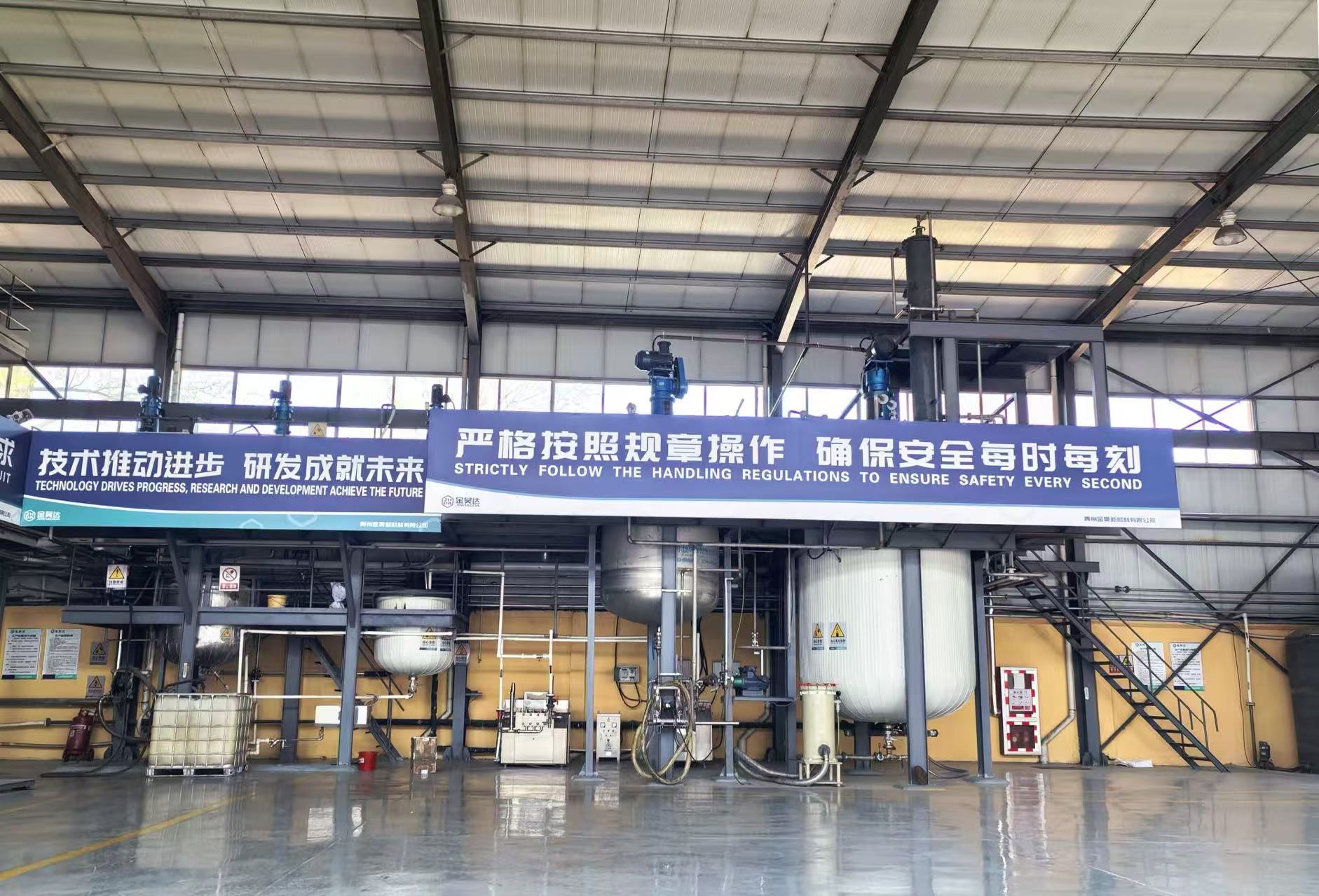
JHDA automated production lines for liquid and solid papermaking chemicals in Qingzhou, Shandong Province, China.
Next Step: Trial Sample, TDS and Quotation
Send your paper grade, sizing route (internal, surface or composite) and target indicators — Cobb value, ring crush strength or surface strength — to the JHDA international sales team. Technical data sheets, MSDS and trial samples are available for assessment against your furnish.
Request a sample on WhatsApp Download the 2026 Product CatalogueEmail: info@sdqzjinhao.com | Tel: +86-536-3808962 | Website: en.sdqzjinhao.com
Have Questions or Need More Details?
Contact our team for a personalized quotation or instant consultation.
Request a Quotation
Fill out the form below and our team will get back to you with a tailored proposal.
WhatsApp Direct Chat
Prefer to chat in real-time? Message us on WhatsApp for instant assistance & quick answers.
- Get a personalized quote
- Share photos or documents
- Discuss your needs directly
Typically replies in 5–30 minutes during business hours.