Solid vs. Liquid Dry Strength Agents: JH-1699 vs JH-D726 for Recycled Pulp
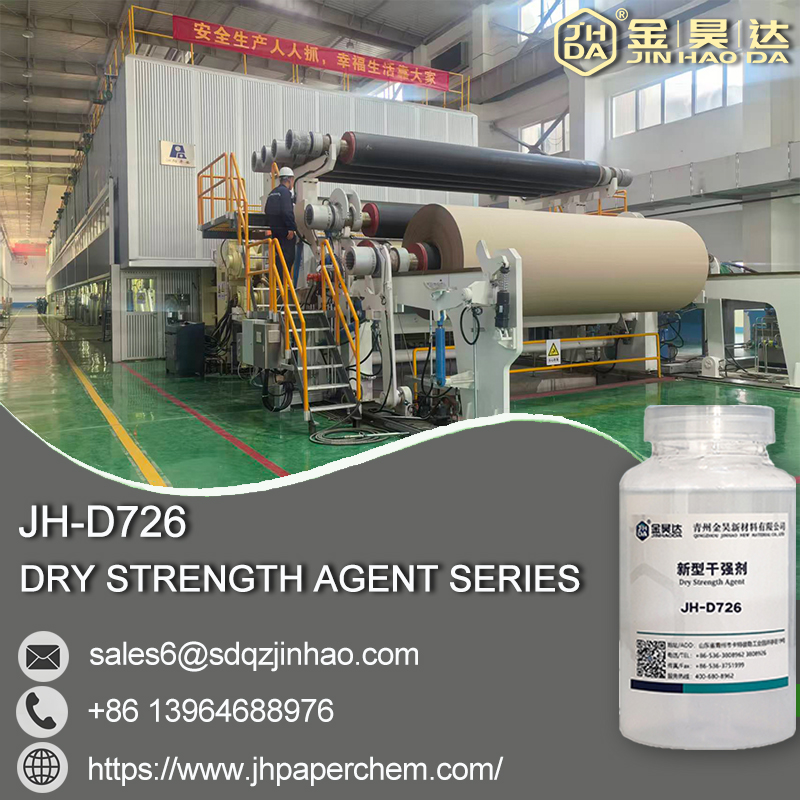
Liquid dry strength agent JH-D726 in a recycled pulp application. Source: Qingzhou Jinhao New Material Co., Ltd.
Recycled pulp mills usually have two practical formats to choose from when buying a paper strength agent: a white powder and an aqueous liquid. The decision is not about which format is inherently better — it is about which one fits the mill's dosing system, storage profile, pulp variability and cost structure.
Qingzhou Jinhao New Material Co., Ltd. — known in the papermaking chemical trade as JHDA — manufactures both formats. JH-1699 is a cationic white powder with an active ingredient content of ≥95.0% and a 12-month shelf life, designed for recycled OCC pulp reinforcement. JH-D726 is an amphoteric liquid with 15–20% solids (±1.0) and pH 3.0–6.0 that raises fiber retention rate by 8%–15% and reduces wet-end chemical cost per ton of paper by 10%–18%. A third product, JH-1697, is a solid powder option positioned for food contact paper and pulp molding, and it adapts to fluctuating pulp quality, pH value and water hardness.
This comparison guide works through the points recycled pulp mills actually evaluate before locking a format: handling and dosing, active content versus delivered solids, compatibility with AKD sizing agents, OBA optical brighteners and defoamers, the strength metrics each product targets, and the compliance documentation that has to travel with the shipment.
The Problem: Recycled Fiber Has Fewer Bonding Sites to Work With
Every time a fiber is dried, repulped, formed and dried again, its ability to bond to neighboring fibers drops. Recycled OCC pulp therefore produces a sheet with weaker inter-fiber bonding than a virgin-fiber sheet of the same basis weight, and the mill sees the result as lower tensile strength, lower ring crush strength, lower burst strength and more breaks on the machine.
The strength agent itself is rarely the only question. Two additional variables decide whether a program works:
- How the chemical is delivered into the pulp. A powder has to be dissolved and mixed; a liquid can be metered straight from a tote through a pump into a pulp pipeline. Mills with automatic dosing systems and limited manual labor tend to prefer one; mills with constrained warehouse space and long shipping routes often prefer the other.
- Whether the wet-end system stays stable when the chemical is added. A strength agent that interferes with sizing performance, dulls paper brightness, or creates sticky deposits on forming wires and press felts creates more cost than it removes.
JHDA's own field technical team positions this as a matching problem rather than a format contest: the additive is selected against pulp composition (recycled pulp or virgin wood pulp) and the mill's actual paper machine operating parameters.
Industry Background: Recycled Fiber Keeps Growing, and So Does the Strength Gap
Recycled fiber is not a niche feedstock. According to the American Forest & Paper Association, recycled paper's share of all fiber used at U.S. mills increased to 44.4% in 2024. As recycled content rises, the demand for additives that restore strength in secondary fiber rises with it.
The market figures point the same direction. Intel Market Research valued the global paper dry strength agent market at approximately USD 864 million in 2024, with Asia-Pacific accounting for roughly 40% of that share. Fact.MR's dry strength resin analysis places packaging and containerboard as the leading paper grade segment at a 38.0% share, and estimates that polyacrylamide (PAM) based resins hold about 40.0% of the dry strength resin market. Both JH-1699 and JH-1697 list polyacrylamide among their base materials, which is consistent with that dominant chemistry.
What this means at the mill level is straightforward. Packaging grades — linerboard, corrugated medium, testliner, fluting — carry the largest share of dry strength additive consumption, and they are also the grades most exposed to recycled fiber quality swings. A strength program that works on paper in a laboratory but not on a machine running variable OCC will not survive a budget review.
Detailed Solution: What JH-1699, JH-D726 and JH-1697 Actually Are
Before comparing formats, it helps to separate the three products by their chemistry and their intended paper grades. They are not interchangeable substitutes; they solve overlapping but different problems.
JH-1699 — Solid Cationic Powder for Recycled OCC Pulp
JH-1699 is a dry strength agent supplied as a white powder, soluble in water, cationic in ionic type, with an active ingredient content of ≥95.0% and a 12-month shelf life. Its declared material composition covers polyacrylamide, polyamine, polyamide epichlorohydrin resin and starch derivatives.
The product is positioned as a waste paper pulp reinforcing agent, fluting paper strength additive, testliner paper strength agent and box board dry strength agent, and it is designed for use in recycled paper pulp strengthening and high-speed paper machine production.
The operating logic of the powder format is density. A mill buys and stores mostly active chemistry rather than water, which is why JHDA describes the powder form as convenient for transportation, storage and dosing operation with low logistics cost. On the machine side, the reported behaviors are:
- Improved fiber bonding of secondary recycled fiber, lowering dependence on fresh long fiber
- Reduced paper breaking rate during high-speed paper machine production
- Improved paper surface stiffness and structural stability for high-load packaging and carton processing
- Less residue deposition on paper machine wire, felt and roller, reducing cleaning maintenance frequency
- Stable product performance across a wide pH and temperature working range
- No adverse impact on paper sizing effect and water resistance, allowing synergy with an internal sizing agent
The last two points matter most in a recycled pulp line, because recycled stock is exactly where pH and temperature drift, and where sizing performance is easiest to disturb.
JH-D726 — Amphoteric Liquid with Built-In Retention Benefit
JH-D726 is a colorless semi-transparent liquid, amphoteric in ionic type and soluble in water. Its declared parameters are solid content 15.0/20.0% (±1.0), pH 3.0–6.0, and viscosity 4000–12000 cps at 25°C, with a 6-month shelf life. The material system is composed of polymer, surfactant-type materials, organic/inorganic composite liquids and functional small-molecule additives.
What distinguishes JH-D726 from a plain strength additive is that its function set spans strength and wet-end economics simultaneously. According to the product specification, at the same dosage it lifts ring crush, burst, tensile and folding resistance of recycled linerboard, corrugated paper and kraft paper — the properties that determine whether a carton collapses or breaks at the edge during production and logistics.
Beyond strength, the specification documents four measurable effects:
- Fiber retention rate increased by 8%–15%, reducing fine fiber loss
- Wet-end chemical cost per ton of paper reduced by 10%–18%, largely by reducing starch consumption for strength reinforcement
- Post-wet-end paper moisture reduced by 3%–5%, cutting drying steam consumption by 5%–10%
- Fabric service life extended by 20%–30%, by lowering pitch and stickies accumulation on forming wires, press felts and dryers
Because it is a liquid with a stable formulation that resists stratification and gelation during long-distance shipping and storage, JH-D726 suits automatic pipeline feeding. That is a handling advantage in mills that already run metering pumps for their wet-end chemicals.
JH-1697 — The Second Solid Option, Aimed at Food Contact and Variable Pulp
JH-1697 is a solid dry strength agent supplied as a white powder with an active ingredient content of ≥95.0%, cationic ionic type, water solubility and a 12-month shelf life. Its base materials are cationic polyacrylamide, polyamide epichlorohydrin resin, modified cationic starch and an amphoteric polymeric reinforcing monomer, and it is positioned for the papermaking and pulp molding industry.
Two characteristics separate it from JH-1699 in practice. First, it is suitable for food contact paper and for papermaking and pulp molding scenarios, and it contains no formaldehyde or harmful volatile substances — which makes it relevant to food-grade pulp tableware, food packaging paper and green packaging cardboard. Second, the specification states it adapts stably to fluctuating pulp quality, pH value and water hardness, which is the failure mode most often reported when recycled fiber sourcing shifts between suppliers or seasons.
Like the other two products, it is described as compatible with starch, sizing agents, defoamers and other wet-end chemicals, with no flocculation or system blockage in the paper machine circulation system, and with less sticky deposit on forming mesh, press felt and molding dies.
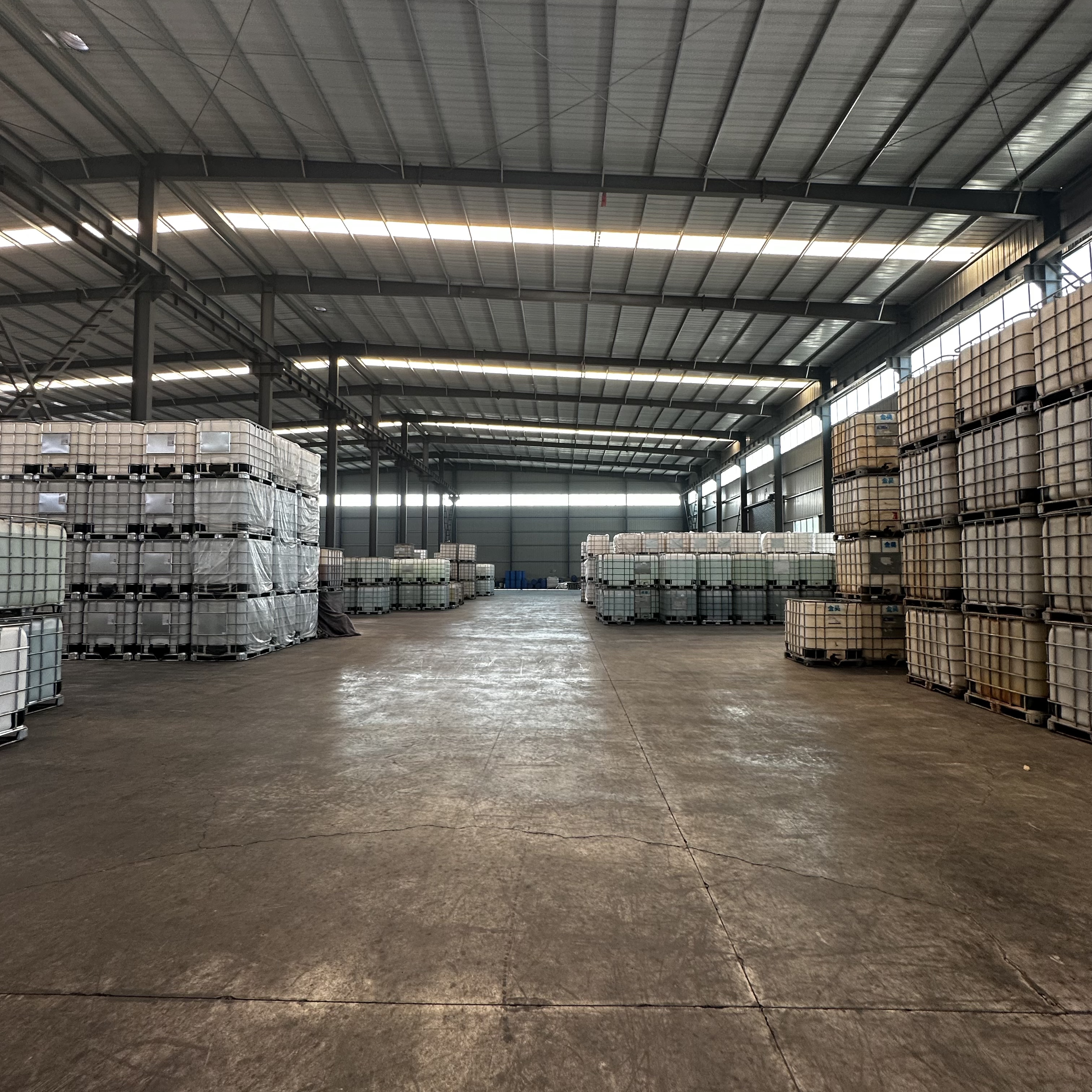
Powder and liquid paper strength agents require different storage and inventory profiles. Source: Qingzhou Jinhao New Material Co., Ltd.
Compatibility With AKD, OBA, Defoamers and Starch
Compatibility is where a strength agent program is most often lost. A product that lifts ring crush strength but dulls brightness or breaks sizing has simply moved cost from one line item to another.
JH-D726 is specified as having excellent compatibility with AKD sizing agent, OBA optical brightener, defoamer and other wet-end chemicals, without damaging sizing performance or paper brightness. The same specification notes that it lowers pitch and stickies accumulation on forming wires, press felts and dryers — a deposit-control benefit that is normally bought separately through a stickies control enzyme or a cleaning program.
JH-1699 is specified as having good compatibility with other wet-end papermaking chemicals, supporting stable operation of the paper machine system, with no adverse impact on paper sizing effect and water resistance, so that it works with an internal sizing agent rather than against it.
JH-1697 is specified as compatible with starch, sizing agents, defoamers and other wet-end chemicals. Because starch is one of the largest single wet-end cost items in a recycled packaging line, compatibility with the starch system is not a minor detail — it determines whether the mill can reduce starch dosage when it adds the strength agent.
Practical reading: when a mill evaluates a strength agent against an existing AKD/OBA/defoamer package, the useful test is not only strength gain. It is whether sizing degree, brightness and machine cleanliness hold steady at the same time. All three JHDA products are specified with that combined compatibility behavior.
Qualification and Compliance Constraints
For mills exporting finished paper or buying through L/C, the documentation attached to a paper strength agent can be as decisive as its specification sheet.
Qingzhou Jinhao New Material Co., Ltd. holds ISO 9001:2015 quality management system certification and ISO 14001:2015 environmental management system certification. The ISO 9001 scope covers the production of papermaking additive products, and the ISO 14001 scope covers the production of papermaking additives and related environmental management activities. Both certifications were issued by Shandong Seatone International Certification Co., Ltd. and apply globally. The company also holds SGS product compliance test reports.
For the Indonesian market specifically, the dry strength agent, paper tensile strength enhancer and wet strength agent products are covered by HALAL certification issued by Shandong Halal Certification Service (SHC), certification number 6637250000, under the Indonesia Halal Law and Regulations and MS1500:2019, valid through 28 August 2028.
Where food contact paper is involved, the relevant external frameworks reinforce why a food-grade positioned product such as JH-1697 matters. Paper and board intended for food contact in the EU must comply with EN 645, EN 646 (colorfastness) and EN 648 (fluorescent fastness), and BfR Recommendation XXXVI sets the safety framework for paper and board chemicals in contact with food in Germany, a reference often cited globally. In the wet strength category, low residual epichlorohydrin (ECH below 50 ppm) and formaldehyde-free formulations are treated as critical thresholds for EU market access — a direction JH-1697's formaldehyde-free specification already aligns with.
Step-by-Step Breakdown: Choosing a Format for a Recycled Pulp Line
The following sequence mirrors how a recycled pulp mill can narrow the choice between a solid and a liquid paper strength agent without running a full trial on every candidate.
Step 1 — Fix the target strength metric first. Ring crush, burst, tensile and folding resistance are not interchangeable targets. A line chasing ring crush strength on corrugated medium is solving a different problem from a line chasing tensile strength on testliner. JH-D726 is specified across ring crush, burst, tensile and folding resistance on recycled linerboard, corrugated paper and kraft paper; JH-1699 targets tensile reinforcement, surface stiffness and structural stability on recycled OCC pulp.
Step 2 — Match the format to the dosing system. If the mill already runs metering pumps and wants automatic pipeline feeding, a stable liquid that resists stratification and gelation during storage is the lower-friction option. If the mill prefers batch preparation and wants to minimize warehouse footprint per ton of active chemistry, a ≥95% active powder carries far less water per delivered unit.
Step 3 — Review shelf life against inventory policy. JH-1699 and JH-1697 are both specified at a 12-month shelf life; JH-D726 is specified at 6 months. For mills that hold buffer stock, ship long distances, or face unpredictable lead times, the difference changes how much safety stock is prudent.
Step 4 — Check compatibility before checking dosage. Confirm the candidate against the existing AKD sizing agent, OBA optical brightener, defoamer and starch system. A sizing failure or a brightness drop usually costs more than the strength gain is worth.
Step 5 — Evaluate total wet-end cost, not unit price. A liquid that raises fiber retention by 8%–15% and cuts wet-end chemical cost per ton by 10%–18% can win on total cost even at a higher unit price. A powder that reduces fresh long fiber consumption and lowers freight per active unit can win the opposite way. Both effects are specified behaviors, and both should be modeled before purchase.
Step 6 — Test against the worst pulp the mill actually runs. Recycled stock quality moves. JH-1697 is specified to adapt stably to fluctuating pulp quality, pH value and water hardness; JH-1699 is specified to hold performance across a wide pH and temperature range. A trial run on an unusually clean OCC batch proves very little.
Step 7 — Run a pilot sample on the mill's own furnish. JHDA operates an in-house pilot laboratory and supports free sample testing, customized formula adjustment based on waste pulp proportion, paper machine speed and target strength indexes, plus on-site technical commissioning.
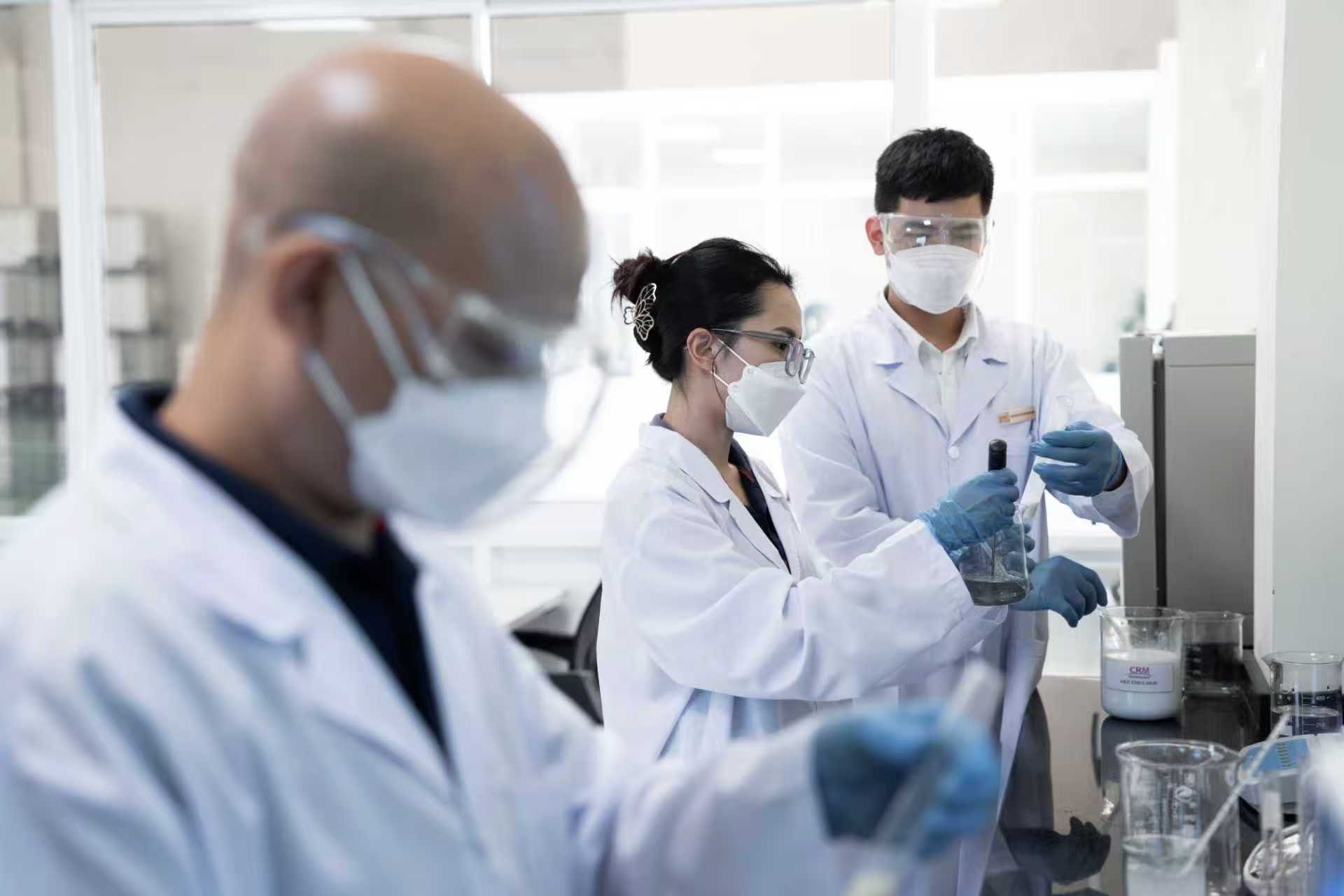
Pilot laboratory testing supports formulation matching before bulk supply. Source: Qingzhou Jinhao New Material Co., Ltd.
Use Cases: Which Format Fits Which Recycled Pulp Scenario
The three products map onto different production realities rather than onto a single ranking.
Recycled OCC linerboard and fluting lines with falling tensile and ring crush
JH-1699 fits here. It is specified for recycled paper pulp strengthening and high-speed paper machine production, reduces dependence on fresh long fiber, and improves paper surface stiffness and structural stability for high-load packaging and carton processing. The powder format also keeps storage simple where warehouse space is limited.
Recycled containerboard lines under pressure to cut starch and wet-end chemical spend
JH-D726 fits here. Its specified economics are the differentiator: fiber retention rate up 8%–15%, wet-end chemical cost per ton of paper down 10%–18%, post-wet-end moisture down 3%–5%, drying steam consumption down 5%–10%. For a mill where starch is a visible line item, reducing starch consumption for strength reinforcement is a direct budget effect.
Lines with automatic chemical dosing and limited manual labor
A liquid that can be fed through automatic pipeline systems without stratification or gelation removes a manual dissolution step from the shift routine. JH-D726's liquid formulation is designed for that configuration.
Food-grade pulp tableware and food packaging paper
JH-1697 fits here, along with JH-2219 for pulp molding applications. JH-1697 is suitable for food contact paper and contains no formaldehyde or harmful volatile substances; JH-2219 is designed for use in recycled pulp applications and is suitable for food packaging pulp molds and food-grade pulp tableware, and is compatible with antifoaming agents and sizing agents.
Mills sourcing waste pulp from multiple suppliers or seasons
JH-1697 is specified to adapt stably to fluctuating pulp quality, pH value and water hardness, keeping finished product physical indicators consistent even when waste pulp quality is unstable. That is the scenario where a strength agent most often fails quietly.
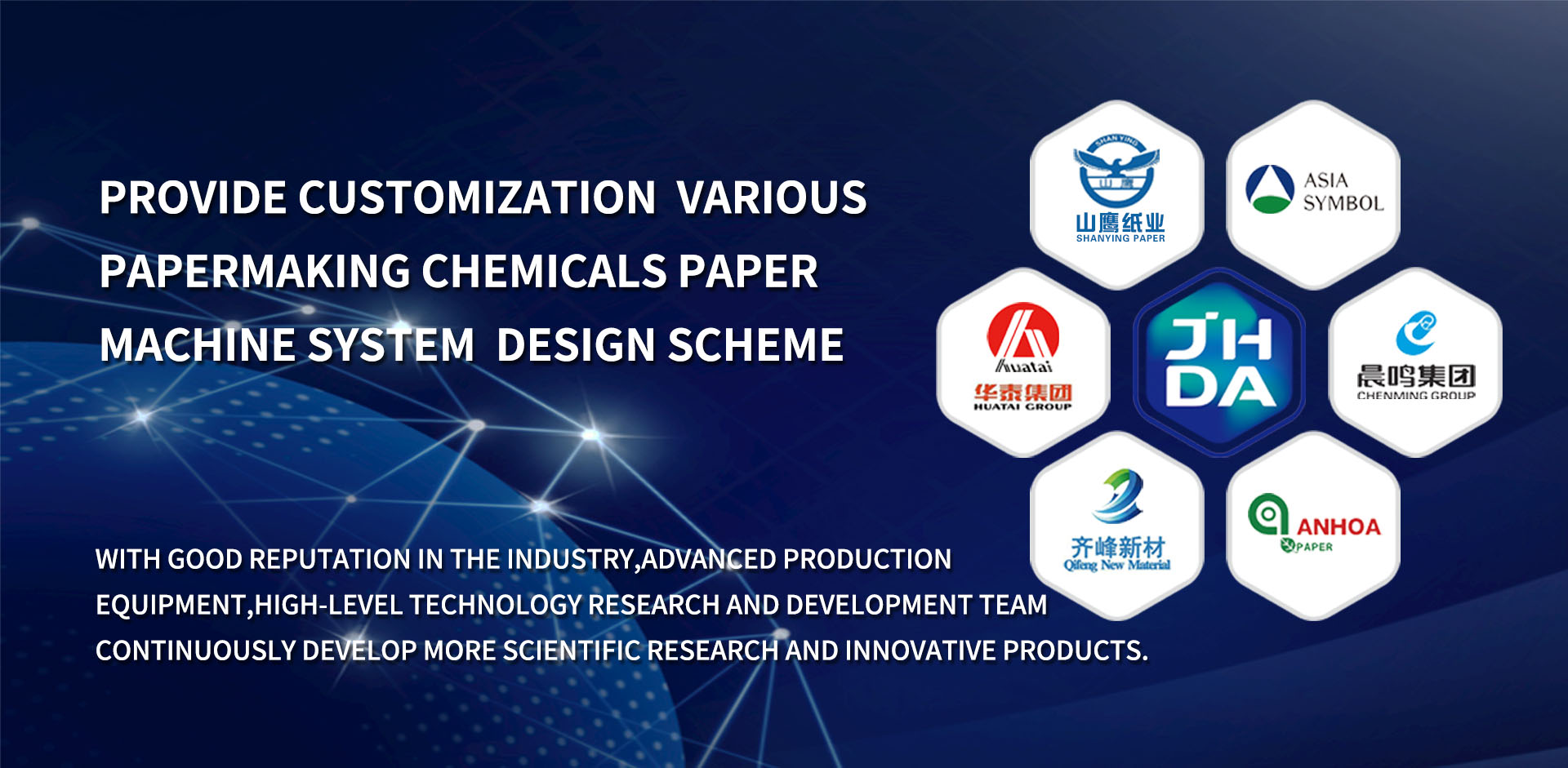
Recycled pulp and packaging paper mills are the core application segment. Source: Qingzhou Jinhao New Material Co., Ltd.
Comparison Table: JH-1699 vs JH-D726 vs JH-1697
The table below compares the three products strictly on declared specification data.
| Parameter | JH-1699 | JH-D726 | JH-1697 |
|---|---|---|---|
| Format | White powder | Colorless semi-transparent liquid | White powder |
| Active ingredient / solid content | ≥ 95.0% | 15.0/20.0% (±1.0) | ≥ 95.0% |
| Ionic type | Cationic | Amphoteric | Cationic |
| pH | Not specified in product data | 3.0 – 6.0 | Not specified in product data |
| Viscosity (25°C) | Not applicable (powder) | 4000 – 12000 cps | Not applicable (powder) |
| Solubility | Soluble | Soluble | Soluble |
| Shelf life | 12 months | 6 months | 12 months |
| Primary base materials | Polyacrylamide, polyamine, polyamide epichlorohydrin resin, starch derivatives | Polymer, surfactant-type materials, organic/inorganic composite liquids, functional small-molecule additives | Cationic polyacrylamide, polyamide epichlorohydrin resin, modified cationic starch, amphoteric polymeric reinforcing monomer |
| Positioned paper grades | Recycled OCC pulp, testliner, fluting, box board, corrugated paper | Recycled linerboard, corrugated paper, kraft paper | Papermaking and pulp molding; food contact paper |
| Declared strength effect | Tensile reinforcement, improved surface stiffness and structural stability, reduced break rate | Ring crush, burst, tensile and folding resistance improvement at equal dosage | Rapid inter-fiber bonding for recycled pulp; tensile, ring crush stiffness and compression resistance |
| Wet-end system effect | Less residue deposition on wire, felt and roller; no adverse impact on sizing or water resistance | Fiber retention +8%–15%; wet-end chemical cost −10%–18%; fabric life +20%–30% | Less sticky deposit on forming mesh, press felt and molding dies; stable under pulp quality fluctuation |
| Energy / moisture effect | Not specified | Post-wet-end moisture −3%–5%; drying steam −5%–10% | Not specified |
| Food contact positioning | Not specified | Not specified | No formaldehyde or harmful volatile substances; suitable for food contact paper |
| Best suited to | Mills needing strength recovery on recycled OCC with simple storage | Mills optimizing wet-end cost, starch reduction and automatic dosing | Mills running food-grade or highly variable recycled pulp |
A second, simpler decision rule is often easier to apply on site:
| If your constraint is… | Start with |
|---|---|
| Warehouse space and freight cost per active unit | JH-1699 or JH-1697 (powder, ≥95% active) |
| Automatic dosing with minimal manual handling | JH-D726 (liquid, pipeline feeding) |
| Starch and wet-end chemical cost reduction | JH-D726 |
| Fiber retention loss and fine fiber carry-over into white water | JH-D726, supported by a retention aid such as JH-8501 |
| Unstable waste pulp quality, pH or water hardness | JH-1697 |
| Food contact paper or food-grade pulp molding | JH-1697 / JH-2219 |
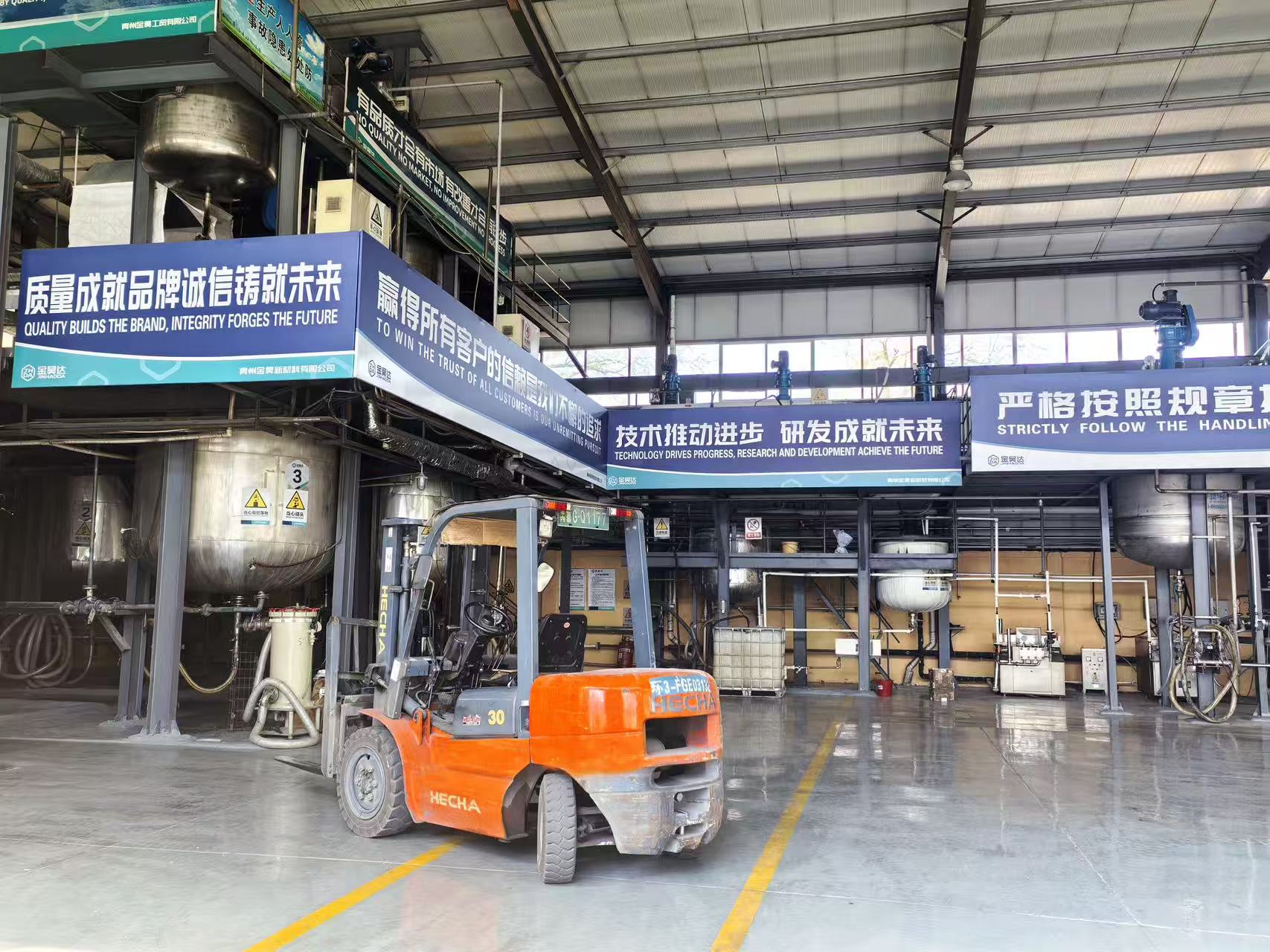
Liquid and solid papermaking chemical production lines at JHDA. Source: Qingzhou Jinhao New Material Co., Ltd.
Frequently Asked Questions
What certifications cover JHDA dry strength agents for paper mills?
The manufacturer, Qingzhou Jinhao New Material Co., Ltd., holds ISO 9001:2015 quality management system certification covering the production of papermaking additive products, and ISO 14001:2015 environmental management system certification covering production and related environmental management activities. Both were issued by Shandong Seatone International Certification Co., Ltd. and apply globally. For the Indonesian market, the dry strength agent, paper tensile strength enhancer and wet strength agent are covered by HALAL certification number 6637250000 issued by Shandong Halal Certification Service (SHC) under the Indonesia Halal Law and Regulations and MS1500:2019, valid through 28 August 2028.
How do I evaluate dry strength agent manufacturers for paper mills before committing to a bulk order?
Four things separate a capable dry strength agent manufacturer from a trader. First, whether the supplier can customize the formulation to your waste pulp proportion, paper machine speed and target strength indexes rather than selling a fixed grade. Second, whether it operates its own testing capability — JHDA runs an in-house pilot laboratory and supports targeted formula customization and free sample trials. Third, whether it can supply full TDS and MSDS documentation plus export certification to support customs clearance and L/C settlement. Fourth, whether it can provide on-site technical commissioning rather than only remote guidance. JHDA also supports factory audit visits for global chemical distributors and terminal paper manufacturers.
What drives the cost of a dry strength agent program beyond the unit price?
Three cost drivers usually outweigh the quoted price. The first is starch displacement: JH-D726 is specified to greatly decrease starch consumption for strength reinforcement, cutting overall wet-end chemical cost per ton of paper by 10%–18%. The second is retention and fiber loss — a fiber retention rate improvement of 8%–15% reduces the fine fiber that would otherwise leave with the white water. The third is energy and consumables: JH-D726 is specified to lower post-wet-end paper moisture by 3%–5% (drying steam down 5%–10%) and to extend fabric service life by 20%–30%. For powder formats, freight and storage per active unit are lower because JH-1699 and JH-1697 both carry ≥95.0% active content. JHDA supports bulk export quotations with flexible payment terms including sight L/C, T/T and DP for large-volume chemical orders.
Can a recycled pulp mill test JH-1699, JH-D726 and JH-1697 before ordering?
Yes. JHDA offers free trial samples, and the MOQ for bulk orders is 1MT. The company's pilot laboratory is available for formulation testing and performance verification, and the technical team adjusts chemical formulas according to the customer's pulp composition (recycled pulp or virgin wood pulp) and actual paper machine operating parameters. Common QA checks across the product line include particle size, appearance, solids, pH, viscosity and functional tests, with specific QC procedures and reports provided per order.
What are the MOQ, production lead time and monthly capacity?
MOQ is 1MT with free trial samples available. Production lead time is 4 working days, and monthly capacity is 8,000MT. The company operates standardized automated production lines for both liquid and solid papermaking chemicals, and runs an overseas supporting production entity, CRM Chemical Technology Co., Ltd., in Long An Province, Vietnam, to shorten delivery cycles for ASEAN customers. Export documentation includes commercial invoice, packing list, certificate of origin, pre-shipment inspection report, MSDS, TDS and dangerous goods transport certification.
Which format should a mill with fluctuating recycled pulp quality choose?
Where the constraint is unstable waste pulp quality rather than storage or dosing, JH-1697 is the solid option specified for that condition: it adapts stably to fluctuating pulp quality, pH value and water hardness and is designed to keep finished product physical indicators consistent. Where the constraint is wet-end cost and automatic dosing, JH-D726 is the liquid option. If you send JHDA your current furnish mix, machine speed and target ring crush or tensile values, the technical team can recommend a starting grade and prepare a sample for on-machine verification — reach the international sales team at info@sdqzjinhao.com or via WhatsApp on +86 139 6468 8976.
Conclusion: Match the Format to the Mill, Not the Other Way Around
Solid and liquid dry strength agents solve the same underlying problem — secondary fiber that bonds less strongly — but they impose different demands on a mill. JH-1699 delivers ≥95.0% active content in a 12-month-stable powder, aimed at recycled OCC pulp, testliner, fluting and box board where tensile reinforcement, surface stiffness and low residue on wire and felt matter most. JH-D726 delivers a liquid at 15–20% solids and pH 3.0–6.0 that raises fiber retention by 8%–15% and cuts wet-end chemical cost per ton of paper by 10%–18%, with the added effects of lower drying steam consumption and longer fabric life. JH-1697 covers the food contact and highly variable pulp scenarios with a formaldehyde-free solid powder.
The decisive variables are the same in almost every evaluation: dosing system, shelf life versus inventory policy, compatibility with the existing AKD sizing agent, OBA and defoamer package, and whether the mill is optimizing strength alone or strength plus wet-end cost. Those four questions, answered against the mill's own furnish and machine parameters, narrow the choice faster than any generic comparison.
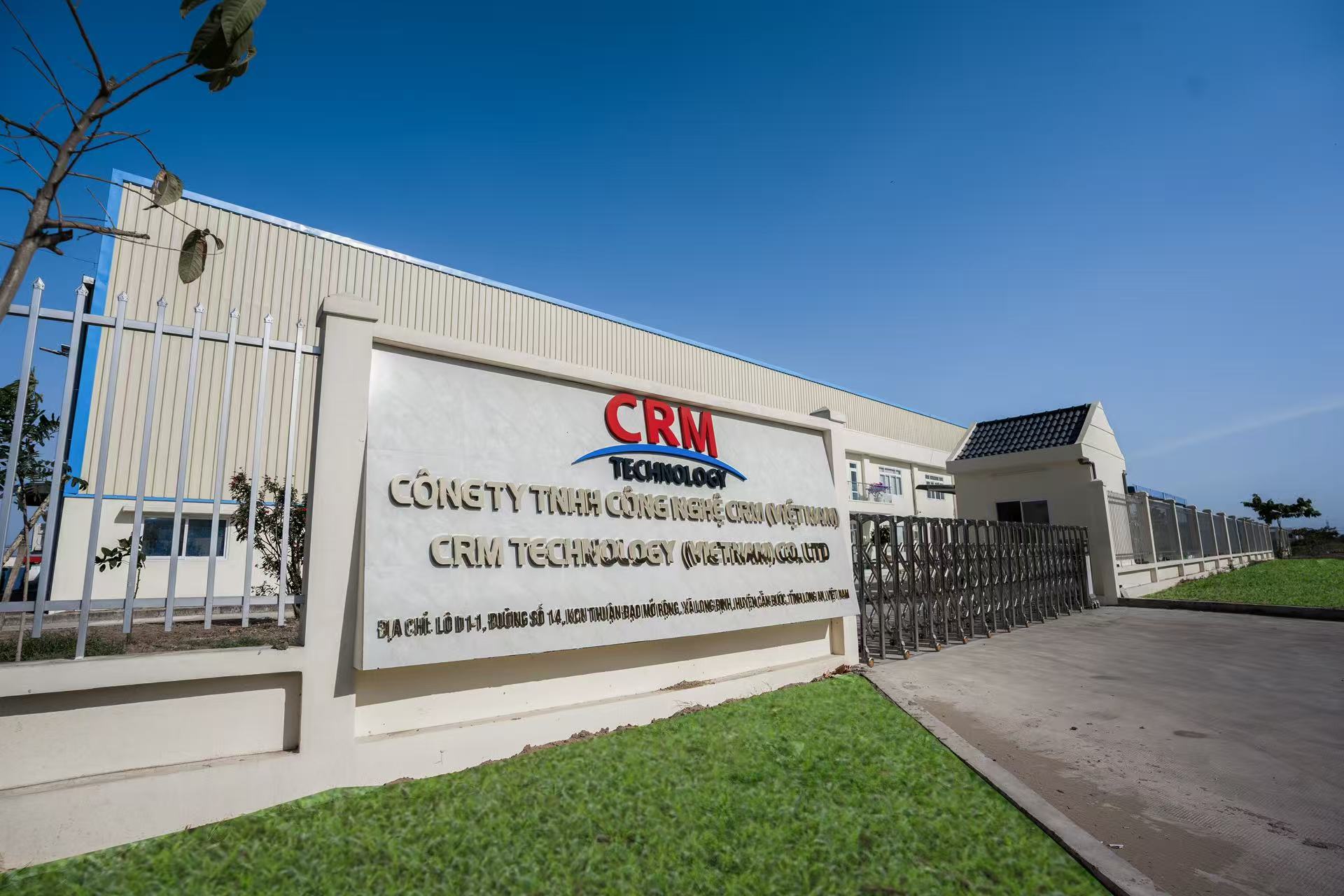
JHDA operates production in China and an overseas supporting base in Vietnam. Source: Qingzhou Jinhao New Material Co., Ltd.
Request a Sample or a Wet-End Cost Review
Qingzhou Jinhao New Material Co., Ltd. (JHDA) supplies dry strength agents, wet strength resin, retention enhancers, sizing agents, defoamers and full-series papermaking fine chemicals to packaging paper, cultural paper, tissue paper and food-grade paper mills.
Send your furnish mix, machine speed and target strength indexes, and the technical team will recommend a starting grade and prepare a free trial sample.
Email: info@sdqzjinhao.com | WhatsApp: +86 139 6468 8976 | Tel: +86-536-3808962
Website: en.sdqzjinhao.com | Download product brochure: introduction2026.pdf
Have Questions or Need More Details?
Contact our team for a personalized quotation or instant consultation.
Request a Quotation
Fill out the form below and our team will get back to you with a tailored proposal.
WhatsApp Direct Chat
Prefer to chat in real-time? Message us on WhatsApp for instant assistance & quick answers.
- Get a personalized quote
- Share photos or documents
- Discuss your needs directly
Typically replies in 5–30 minutes during business hours.