
Top 6 Sizing Agents for Paper Mills: Ranked by Application Fit
Top 6 Sizing Agents for Paper Mills: Ranked by Application Fit
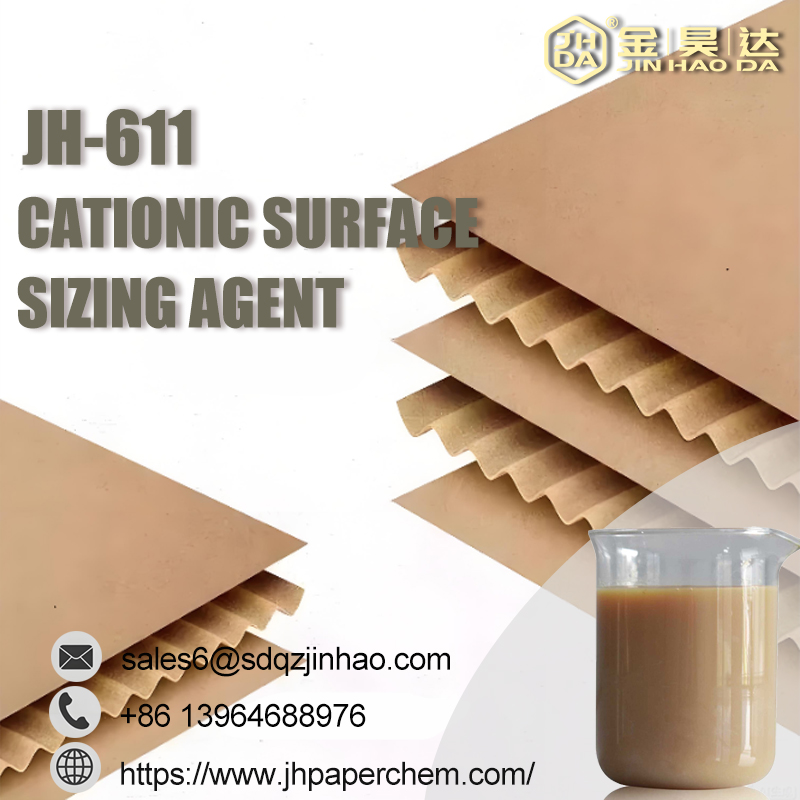
Most sizing problems in a paper mill are not chemistry problems — they are fit problems. A surface-strength complaint is treated with a wet-end additive. A humidity complaint is treated with a general-purpose emulsion. A price comparison is run per tonne of liquid instead of per tonne of active ingredient. This guide ranks six sizing agents from the JHDA (Qingzhou Jinhao New Material Co., Ltd.) portfolio — JH-611, JH-600, JH-325, JH-WH3364, JH-103 and JH-200 — by application fit for common papermaking scenarios, and justifies every position with the parameters that actually decide the outcome: process position, ionic type, solids content, pH, viscosity and shelf life.
Quick answer: Ranked by application fit across the JHDA sizing range, the order is #1 JH-611 (cationic surface sizing agent, 30.0 ± 1.0% solids, 6-month shelf life) for packaging, corrugated and boxboard; #2 JH-600 (moisture-resistant SAE surface sizing agent, 30 ± 1% solids, 6-month shelf life) for humid storage and long sea freight; #3 JH-325 (anionic surface sizing agent, 25.0 ± 1.0% solids, 6-month shelf life) for printing and writing grades; #4 JH-WH3364 (composite AKD + SAE surface sizing agent, 25.0 ± 1.0% solids, 4-month shelf life) for mills consolidating two dosing steps into one; #5 JH-103 (cationic internal AKD sizing agent, 12.5–25.0% solids, 4-month shelf life) for wet-end and molded pulp applications; and #6 JH-200 (surface AKD sizing agent, 20.0 ± 1.0% or 30.0 ± 1.0% solids, 3-month shelf life) for low-disruption retrofit trials.
Problem Definition: The Three Decisions Behind Every Sizing Failure
Sizing agent selection collapses into three decisions, and each has a measurable consequence on the machine, on the finished paper and on the delivered cost per tonne of paper produced.
- Process position — internal or surface. An internal sizing agent such as JH-103 is dosed into the pulp line and protects the sheet from the inside. A surface sizing agent such as JH-611, JH-600, JH-325, JH-WH3364 or JH-200 is applied with starch at the size press and builds its barrier on the sheet surface. A mill without a size press cannot use the surface route at all; a mill whose real complaint is print picking should usually stop answering it only in the wet end.
- Ionic type — anionic or cationic. Charge determines how the product behaves with starch, retention aids, defoamers and the rest of the wet-end chemistry. Among the six products ranked here, JH-325 is anionic, JH-WH3364 is weak cationic, and JH-611, JH-600, JH-103 and JH-200 are cationic.
- Grade and environment fit. The same chemistry can be ideal for corrugated medium and wrong for offset paper. Water resistance that survives a dry warehouse may behave differently after a humid season or a long sea freight leg.
Four comparison mistakes appear repeatedly when mills evaluate sizing agents:
- Comparing price per tonne of liquid. Solids content across this range runs from 12.5–25.0% (JH-103) to 30.0 ± 1.0% (JH-611) and 30 ± 1% (JH-600). Two products can carry similar price tags and deliver very different amounts of active ingredient per tonne of paper.
- Choosing a process position by habit. Surface AKD (JH-200) avoids the active-ingredient loss that occurs when AKD is dosed into the pulp and passes through white-water circulation and fiber retention. Internal AKD (JH-103) reaches parts of the sheet that a surface film does not touch. The two routes solve different problems and are not substitutes.
- Ignoring shelf life against transit time. Shelf life across the range is 6 months (JH-611, JH-600, JH-325), 4 months (JH-WH3364, JH-103) and 3 months (JH-200). For importers and distributors, that difference is a supply-chain variable, not a footnote.
- Testing only in the laboratory. Cobb water absorption value, ring crush strength, bursting strength, brightness and fiber retention rate all respond to machine conditions. A trial on the actual line is the only reliable validation.
Industry Background: Where Sizing Demand Is Growing
The global paper sizing agent market was valued at approximately USD 3.8 billion in 2025, and global sizing agent volume exceeded 3.8 million metric tons in 2024, according to Dataintelo and Market Reports World respectively. Dataintelo projects the market reaching USD 5.9 billion by 2033 at a 5.8% CAGR. Published estimates do diverge: Market Research Future put the 2024 market at USD 3.16 billion against SNS Insider's USD 3.95 billion, and CAGR projections range from 4.14% to 5.8% depending on scope. Any single market figure should be treated as a directional indicator rather than a fixed reference.
The chemistry mix is more consistent across sources. Synthetic sizing agents, including AKD and ASA, held 54.5% of the market in 2024 (SNS Insider), with AKD alone accounting for approximately 48% of synthetic sizing agent volume globally (Dataintelo). Rosin sizing agents still represented 32.4% of sizing agent market revenue in 2025 (Dataintelo). By form, liquid sizing agents held 57.8% of the market in 2024 because of ease of application, while solid sizing agents are expected to grow at 5.11% CAGR through 2032 on logistical efficiency (SNS Insider).
Demand is concentrated in Asia Pacific, which accounted for 42.3% of revenue share as of 2025 (Dataintelo). China's annual sizing agent consumption is estimated at 650,000 tons in 2025 (Dataintelo), and the country exported USD 36.5 billion in paper goods in 2024 (OEC) — a volume that depends directly on sizing performance surviving long-distance shipment. On the packaging side, US packaging paper capacity increased by 4.6% in 2024 (American Forest & Paper Association), adding new sizing demand. Sustainability is also reshaping specifications: bio-based sizing agents reached 38% of global consumption in 2024 (Market Reports World), and food-contact paper projects must satisfy Regulation (EC) No 1935/2004 in the European Union and FDA 21 CFR food contact substance requirements in the United States.
How This Ranking Was Built
"Application fit" here means how well a product matches the way a paper mill actually runs — not how strong the chemistry is in absolute terms. Each product was assessed against four criteria drawn from published technical parameters:
- Grade coverage — which paper grades and end uses the product is specified for.
- Process fit — internal or surface position, and how much the mill must change to adopt it.
- System compatibility — starch pairing, wet-end chemical compatibility, and suitability for acidic or neutral papermaking.
- Practical handling — solids content, dosing method and shelf life against transit and storage time.
Scope note: this ranking covers only JHDA sizing agent models with published technical parameters. JHDA's wider portfolio also includes rosin sizing agents and other papermaking auxiliaries, which are outside this comparison because no equivalent parameter set is published for them.
The Top 6 Sizing Agents, Ranked by Application Fit
#1 JH-611 — Surface Strength Sizing Agent (Cationic)
JH-611 takes first place because it combines the highest solids content in the range with the longest shelf life and the widest packaging-grade coverage. It is specified as a corrugated paper surface sizing agent and boxboard surface waterproof agent, and it can be used as a direct replacement for wet-end internal sizing agents.
Three properties explain the ranking. First, its cationic molecular structure combines uniformly with anionic starch, so the sizing coverage is consistent across the full paper web — no uneven water repellency. Second, it works with ordinary raw starch, which lets a mill hold low-cost starch as the carrier instead of buying a high-priced dosing package. Third, it requires no curing time: stable waterproof performance is obtained immediately after the paper is dried, so finished paper can be rolled and shipped without occupying curing space.
On the machine, the product forms a compact cross-linked waterproof film that improves ring crush stiffness, surface hardness and smoothness, and reduces breakage during printing, creasing, die-cutting and deep processing. It also lowers sticky deposits on sizing rolls and drying cylinders, which cuts cleaning downtime.
Best fit: kraft linerboard, corrugated medium and boxboard lines where the mill wants to move waterproofing and surface strength from the wet end to the size press. Limit to check: as a surface product it requires an existing size press or film press, and the starch preparation step must be in place.
#2 JH-600 — Moisture Resistant SAE Surface Sizing Agent (Cationic)
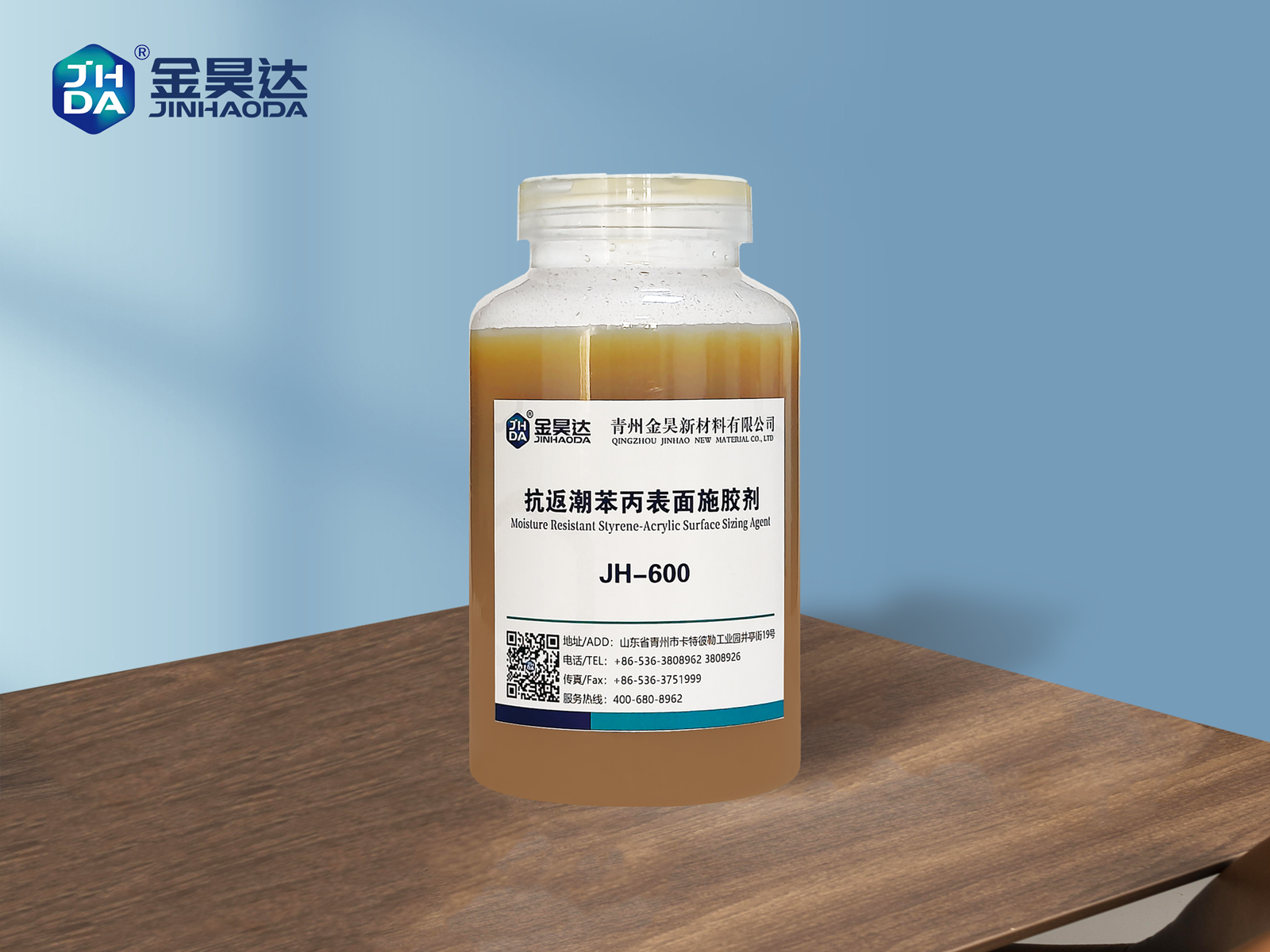
JH-600 ranks second because it solves the single most expensive complaint in packaging paper: moisture reversion. Its molecular structure is customised to form a dense closed protective film on the paper surface that blocks continuous infiltration of ambient moisture, preventing the strength decline, softening and box collapse that follow moisture backflow in rainy seasons, cold storage and long-distance maritime transport.
The distinction from a general-purpose surface sizing agent is durability of the effect: JH-600 is designed to maintain stable hydrophobic performance after long placement in humid conditions, rather than losing water resistance progressively over time. It retains paper ring crush strength and surface rigidity under high humidity, which is exactly what protects physical indexes during damp storage and transport.
Operationally it is straightforward. JH-600 is compatible with common industrial starch and is mixed directly with the starch liquid, so the existing feeding process does not need to change. It can fully replace an internal sizing agent with no curing period, and it shows wide adaptability across virgin wood pulp, chemical pulp, mechanical pulp and compound recycled pulp. Its low-foaming behaviour suits high-speed surface sizing machines and avoids bubble pinhole defects.
Best fit: packaging paper and board stored or shipped in high humidity, and mills chasing down box-collapse complaints. Limit to check: the value is deliberately narrow — if the main gap is print mottling on writing grades, JH-325 is the better match.
#3 JH-325 — Anionic Surface Sizing Agent
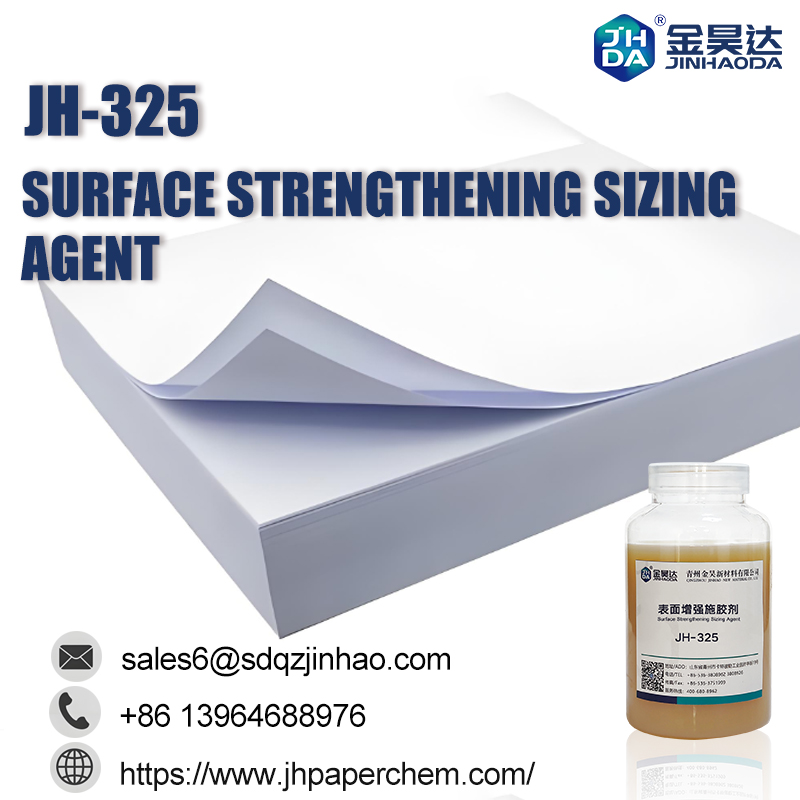
JH-325 ranks third as the dedicated cultural paper surface sizing agent, specified for offset printing paper, copy paper and book paper. Its film-forming characteristic strengthens the paper surface bonding force and improves dry and wet surface strength, which is what eliminates linting, picking and blanking faults during high-speed rotary printing.
The balance point is different from the packaging products. Anionic styrene-acrylic copolymer reacts and crosslinks rapidly with starch components, building a tight protective coating on the paper surface and achieving even sizing coverage across the full web width, while simultaneously preserving ink affinity — inhibiting ink bleeding and penetration so printed text stays clear and colours stay uniform. It suits both the acidic sizing process with aluminum sulfate and modern neutral papermaking systems, and it shows good compatibility with retention aids and defoamers without system flocculation.
Because the paper obtains stable water-proof performance directly after surface sizing and drying, no curing wait is required, which shortens the finished paper turnover cycle. JH-325 also works with low-cost industrial starch to reduce the addition amount of high-priced sizing agent, giving cultural paper producers a measurable cost lever in mass production.
Best fit: offset, copy, book and writing paper where printability matters as much as water resistance. Limit to check: the anionic charge is the product's defining property — confirm the starch pairing and wet-end chemical combination during the trial rather than assuming a like-for-like swap with a cationic grade.
#4 JH-WH3364 — Surface Enhanced Water Resistant Agent (Weak Cationic Composite)
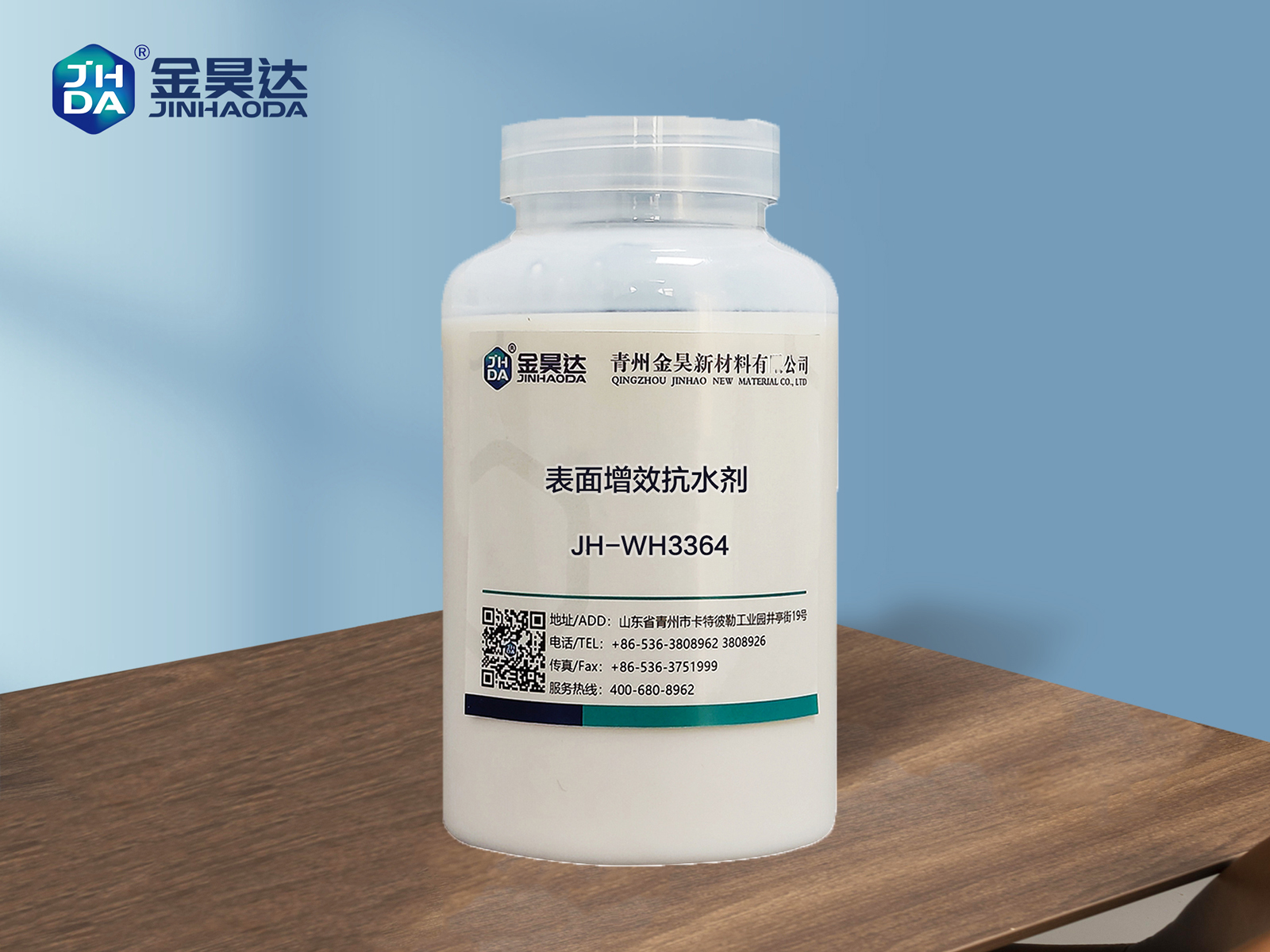
JH-WH3364 ranks fourth as a consolidation product. It is a dual-function composite sizing additive made of weak anionic styrene acrylic and AKD, integrating the reactive waterproof advantage of AKD with the high film-forming toughness of SAE styrene-acrylic resin. In practice it can replace the separate purchasing and dosing of AKD emulsion and SAE sizing agent.
The mechanical logic is worth understanding. The AKD component reacts chemically with cellulose fibre to lock in long-term hydrophobic performance, while the SAE component forms a tough continuous film that reinforces the surface structure — delivering water resistance and surface strength improvement in one product. The SAE fraction also fixes the sizing effect immediately after drying, removing the long curing period that slows down pure AKD systems, so finished paper can be rolled and delivered directly. Added surface strength reduces linting, picking and ink feathering during high-speed offset printing, and the optimised surface rigidity reduces edge breakage during carton indentation, die-cutting and trimming.
It is designed for neutral papermaking systems, contains no acidic components that attack drying cylinders or sizing rollers, and is compatible with retention aids and defoamers without flocculation. Its position at #4 rather than higher reflects the trade-off: its value is consolidation rather than a unique grade or environment fit, and its 4-month shelf life narrows the window between production, shipment and use for export customers.
Best fit: neutral lines that want one surface product instead of two, and grades that need both surface strength and waterproofing. Limit to check: inventory planning — a 4-month shelf life leaves less slack than the 6-month products above it.
#5 JH-103 — AKD Internal Sizing Agent (Cationic)
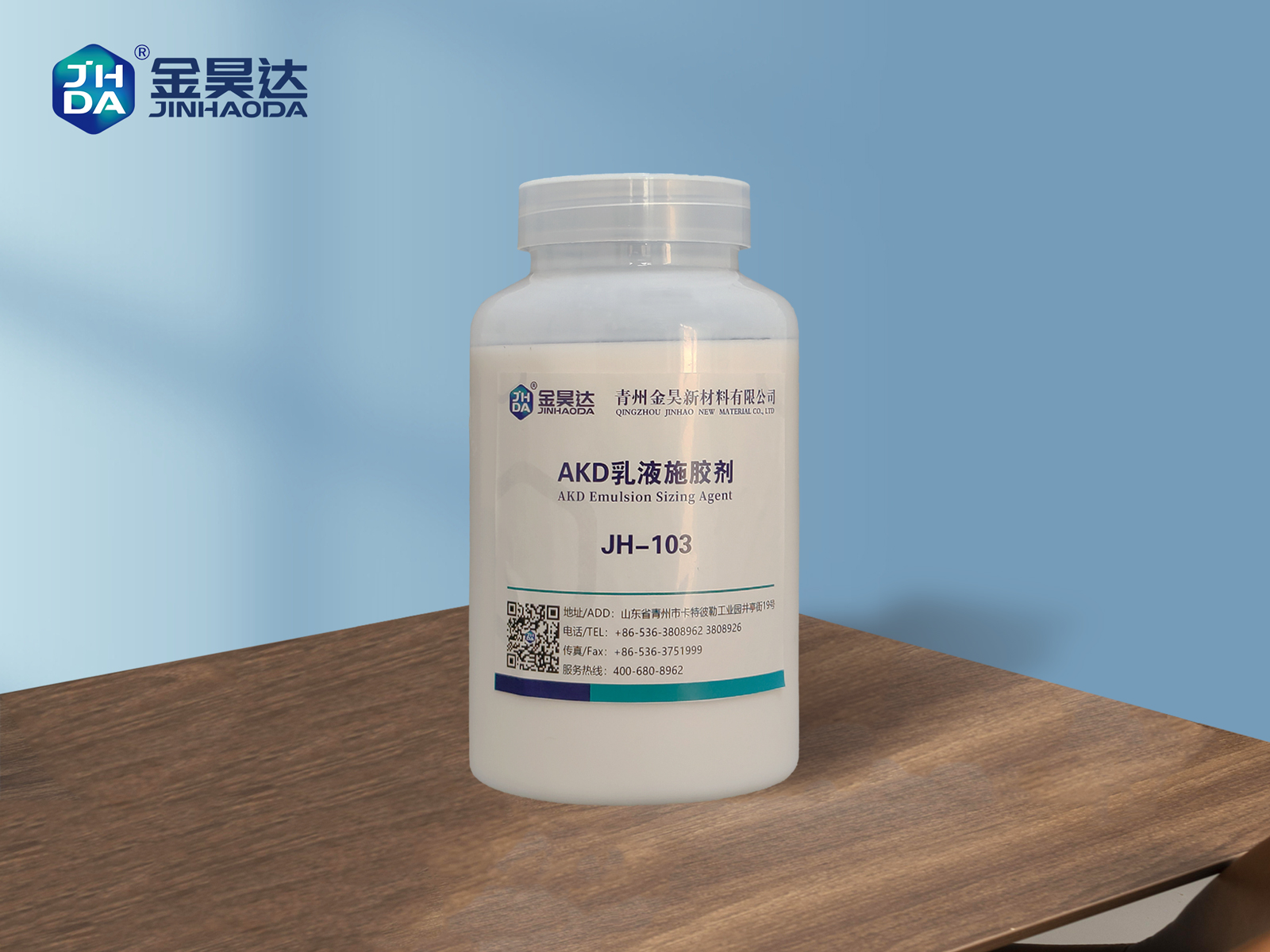
JH-103 ranks fifth and is the only internal product in this group. It is an alkyl ketene dimer emulsion used as a pulp sizing additive, supplied as a liquid that can be dosed continuously into the pulp pipeline by metering pump — no manual dilution or stirring step. It supports neutral and alkaline papermaking production lines, which removes the corrosion load that alum-acid sizing systems place on drying cylinders, forming wires and metal pipelines.
Its strength is coverage and pulp adaptability. It works with wood pulp, chemical pulp, mechanical pulp and blended pulp, and covers cultural printing paper, copy paper, box board, craft paper and molded pulp products with waterproof requirements. A high-molecular polymer emulsifier formula supports a rapid curing reaction, so the hydrophobic structure bonds firmly with fibre after cylinder drying and finished paper gains reliable water-proof performance without the long turnover cycle associated with ordinary AKD emulsions. Emulsion anti-aging stability keeps it uniform during long-distance transport and normal-temperature storage, without layering under seasonal temperature swings.
It ranks fifth rather than higher because it is a system-level product. It changes the wet end, requires dosing equipment, and — unlike the surface route — part of the active ingredient can be lost to white-water circulation and the fiber retention process. Product selection therefore depends on whether the mill actually has a size press available; where one exists, the four products above usually deliver a faster return.
Best fit: mills without a size press, producers needing water resistance through the sheet rather than on the surface, and molded pulp applications. Limit to check: white-water circulation losses and dosing equipment requirements.
#6 JH-200 — Surface AKD Sizing Agent (Cationic)
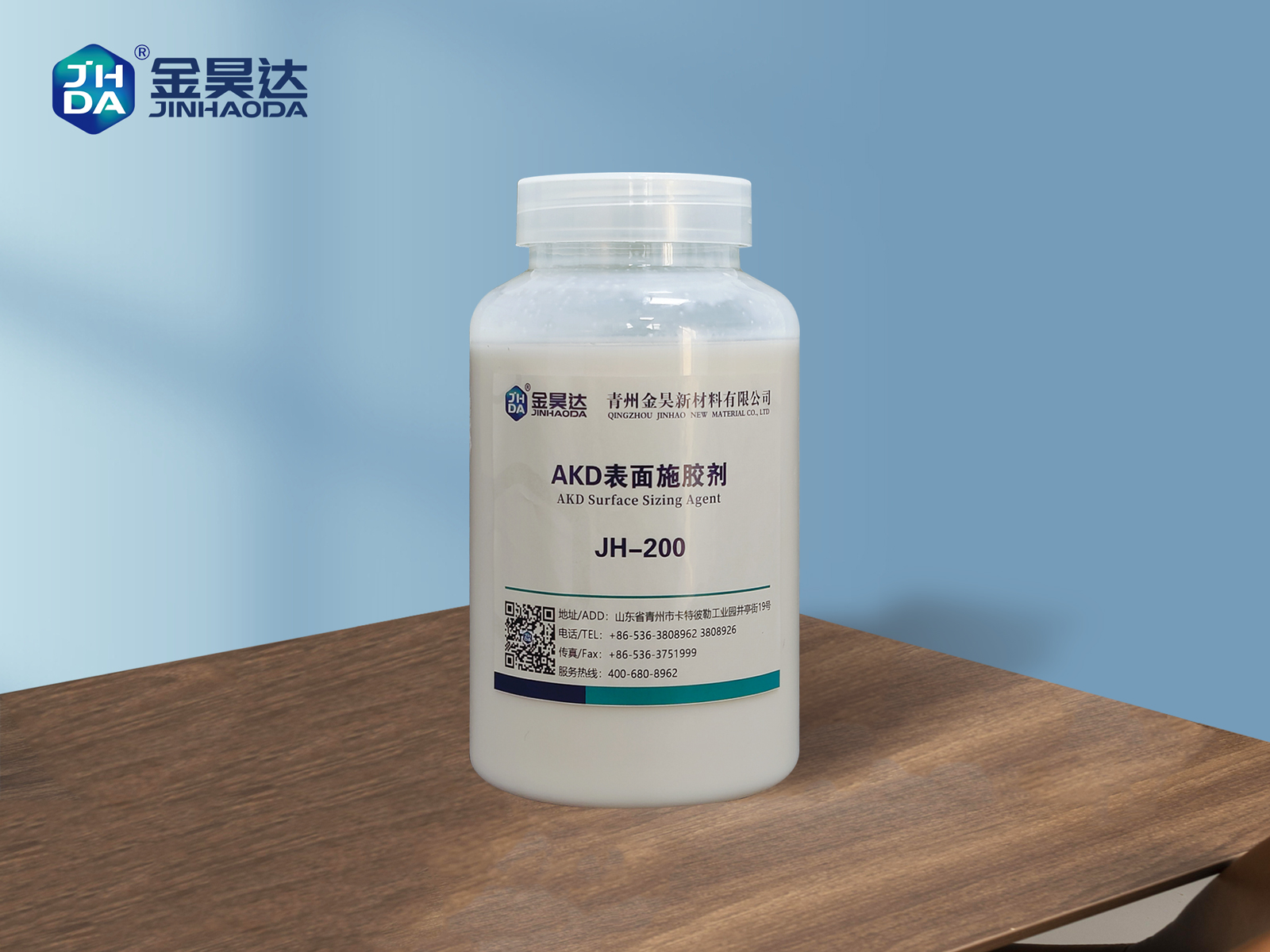
JH-200 closes the ranking because it is the lowest-barrier entry point for a mill that wants to test surface sizing without rebuilding anything. The transformation cost is the selling point: chemicals are added in the surface sizing tank only, with no adjustment to the pulp formula or the internal auxiliary agent system, which makes it convenient for old production line renovation and first trials.
Technically it is a surface AKD sizing emulsion that is evenly blended with industrial starch and coated onto the paper surface. The reactive component reacts with cellulose to build a tight waterproof barrier, and the sizing effect is finalised once the paper passes through the drying cylinder — factories can roll and deliver finished paper directly, saving curing space. Because the active ingredient acts on the surface rather than through the pulp, it avoids the AKD loss that occurs in white-water circulation and fiber retention. The composite film formed with starch also strengthens surface bonding, improving printability and reducing fuzzing and surface picking. It suits neutral and alkaline environments and shows excellent compatibility with oxidized starch and cationic modified starch.
It ranks last for two factual reasons rather than performance ones: the 3-month shelf life is the shortest in the range, which creates the tightest planning window for importers and distributors, and it overlaps with JH-WH3364 and JH-600 on surface waterproofing, so it wins mainly where a single-function, low-disruption trial is the priority.
Best fit: retrofit trials on existing lines, first-time surface sizing, and neutral or alkaline production where the pulp formula must stay unchanged. Limit to check: shelf life planning against sea freight and warehouse turnover.
Step-by-Step Breakdown: Shortlisting a Sizing Agent in Five Steps
- Name the failure mode before naming the chemistry. Write down the complaint in measurable terms: Cobb water absorption value, ring crush strength, surface picking or linting, ink penetration, or box collapse after storage. Each failure mode points to a different process position.
- Fix the process position. Internal (JH-103) or surface (JH-611, JH-600, JH-325, JH-WH3364, JH-200). If the line has no size press, the surface group is unavailable and the comparison narrows immediately.
- Check the charge pairing. Confirm the sizing agent's ionic type against the starch type and the wet-end chemical set, including retention aids and defoamers. JH-325 is anionic; JH-WH3364 is weak cationic; JH-611, JH-600, JH-103 and JH-200 are cationic.
- Compare on active solids, not on price per tonne. 30.0 ± 1.0% (JH-611), 30 ± 1% (JH-600), 25.0 ± 1.0% (JH-325 and JH-WH3364), 12.5–25.0% (JH-103), 20.0 ± 1.0% or 30.0 ± 1.0% (JH-200). Also check whether the product removes a second dosing step or reduces curing and warehouse requirements.
- Match shelf life to your supply chain, then run a machine trial. Six months (JH-611, JH-600, JH-325), four months (JH-WH3364, JH-103), three months (JH-200). JHDA supports laboratory sample testing and on-machine trial work, with field engineers carrying out on-site debugging to optimise Cobb value, ring crush strength, bursting strength, brightness and fiber retention rate.
Use Cases: Matching the Scenario to the Model
- Rainy-season storage or long sea freight (packaging paper): JH-600 first, JH-611 as the broader packaging alternative.
- Carton board and corrugated converting — creasing, die-cutting, ring crush: JH-611, which improves ring crush stiffness, surface hardness and smoothness while reducing breakage in converting.
- Offset, copy and book paper — linting, picking, ink feathering: JH-325, balanced for water resistance and ink affinity.
- A mill dosing both an AKD emulsion and an SAE sizing agent: JH-WH3364 consolidates the two into one composite product for neutral systems.
- No size press on site, or through-sheet water resistance needed, including molded pulp: JH-103 in the wet end.
- Recycled and mixed pulp streams: JH-611 shows strong adaptability for wood pulp, chemical pulp, mixed recycled pulp and mechanical pulp; JH-600 is adaptable across virgin wood pulp, chemical pulp, mechanical pulp and compound recycled pulp.
- First surface-sizing trial with zero formula change: JH-200 added in the surface sizing tank only.
Comparison Table: The Six JHDA Sizing Agents at a Glance
| # | Model | Position | Ionic type | Solids (%) | pH | Viscosity (cps, 25 °C) | Shelf life | Primary fit |
|---|---|---|---|---|---|---|---|---|
| 1 | JH-611 | Surface | Cationic | 30.0 ± 1.0 | 2.0–5.0 | ≤ 50 | 6 months | Kraft linerboard, corrugated medium, boxboard |
| 2 | JH-600 | Surface | Cationic | 30 ± 1 | 2.0–5.0 | < 50 | 6 months | Humid storage, rainy season, long sea freight |
| 3 | JH-325 | Surface | Anionic | 25.0 ± 1.0 | 2.0–5.0 | ≤ 50 | 6 months | Offset, copy, book and writing paper |
| 4 | JH-WH3364 | Surface | Weak cationic | 25.0 ± 1.0 | 2.0–5.0 | ≤ 50 | 4 months | Neutral lines consolidating AKD + SAE dosing |
| 5 | JH-103 | Internal (wet-end) | Cationic | 12.5–25.0 ± 1.0 | 2.0–5.0 | ≤ 50 | 4 months | Wet-end sizing, molded pulp, no size press |
| 6 | JH-200 | Surface | Cationic | 20.0 ± 1.0 or 30.0 ± 1.0 | 2.0–5.0 | ≤ 50 | 3 months | Retrofit trials, first surface sizing |
FAQ
Do JHDA sizing agents meet food-contact and quality certification requirements?
Qingzhou Jinhao New Material Co., Ltd. (JHDA) holds ISO9001 quality management system certification, ISO14001 environmental management system certification and HALAL certification, and part of its product range is produced to food grade standard. The company provides SGS product compliance test reports, including food contact safety testing for packaging paper chemicals. Exported chemical products complete CAS registration and GHS hazard labeling in line with IMDG international marine shipping regulations. For food-contact paper projects, the selected sizing agent must also be checked against the destination market's rules — Regulation (EC) No 1935/2004 in the European Union and FDA 21 CFR food contact substance requirements in the United States — and against the specific end use of the paper. Complete TDS and MSDS documents are supplied to support customs clearance and L/C settlement.
Can JHDA sizing agents replace imported sizing chemicals such as Kemira or BASF products?
Kemira, BASF and Arakawa Chemical Industries are the major global competitors identified in the sizing agent market, and imported branding is one reason mills hesitate to switch. For most packaging paper mills, JHDA positions its styrene-acrylic surface sizing agents as a replacement route rather than a downgrade: the company states that its surface sizing agents deliver comparable Cobb water absorption values and curing behaviour to imported products, with shorter delivery lead times, local technical commissioning and lower procurement cost, and that they are optimised for high-speed domestic paper machines and recycled OCC pulp. Two situations justify keeping an original imported product: a machine with a mandated original auxiliary formula, and a high-grade food-contact export line carrying fixed chemical audit records. In both cases the switch should be validated by a machine trial before any commercial commitment.
How should we compare sizing agent costs fairly?
Compare on active solids rather than price per tonne of liquid. In this range JH-611 is supplied at 30.0 ± 1.0% solids and JH-600 at 30 ± 1%; JH-325 and JH-WH3364 at 25.0 ± 1.0%; JH-200 at either 20.0 ± 1.0% or 30.0 ± 1.0%; and JH-103 between 12.5% and 25.0%. A higher-solids product carries more active ingredient in every tonne of delivered liquid, so a higher unit price can still be the cheaper option per tonne of paper. Three further factors belong in the same calculation: whether the product pairs with low-cost industrial starch (JH-611, JH-600 and JH-325 all do), whether it removes a second dosing step (JH-WH3364 replaces separate purchasing of AKD emulsion and SAE sizing agent), and whether it needs a curing period and extra warehouse space before the paper can be shipped.
Can we run a sample trial on our own paper machine before ordering in bulk?
Yes. JHDA's standard route is laboratory sample testing followed by on-machine trial support. Field technical engineers carry out on-site machine debugging for paper mills and optimise core paper indicators including Cobb water absorption value, ring crush strength, bursting strength, paper brightness, fiber retention rate and overall paper machine runnability. Bulk production runs on standardised automated lines for liquid and solid papermaking chemicals with an MOQ of 1 MT, and formulas can be tailored to the mill's pulp composition — recycled pulp or virgin wood pulp — and to actual machine operating parameters. All exported goods are subject to unified quality control standards to support stable long-term supply for contracted paper mill customers.
What lead time and documentation should an overseas mill plan for?
JHDA operates an overseas supporting production entity, CRM Chemical Technology Co., Ltd., in Long An Province, Vietnam, to serve ASEAN clients with local delivery and shorter delivery cycles. Core export markets cover Vietnam, Thailand, Malaysia, Indonesia, Myanmar, Cambodia and the major packaging paper industrial zones in the Middle East, and export business accounts for 35% to 50% of total sales volume. The company supplies one-stop export documents including commercial invoice, packing list, certificate of origin, pre-shipment inspection report, MSDS and TDS, with sight L/C, T/T and DP available for large-volume chemical orders. Because shelf life differs by model — 6 months for JH-611, JH-600 and JH-325, 4 months for JH-WH3364 and JH-103, and 3 months for JH-200 — align the shipment schedule with your monthly consumption rate. To move forward, request a sizing agent sample, a technical data sheet or a bulk quotation from the JHDA international sales team.
Conclusion: One Rule Before You Choose
The ranking above is a fit ranking, not a quality ranking. Read it as a decision shortcut: if the complaint is on the surface — picking, print mottling, dusting — go to surface chemistry, with JH-611 for packaging and JH-325 for printing and writing grades. If the complaint is moisture reversion after storage or sea freight, start with JH-600. If the goal is to stop dosing two products, look at JH-WH3364. If there is no size press, work with JH-103 in the wet end. And if the objective is simply a low-disruption first trial, JH-200 is the smallest step available.
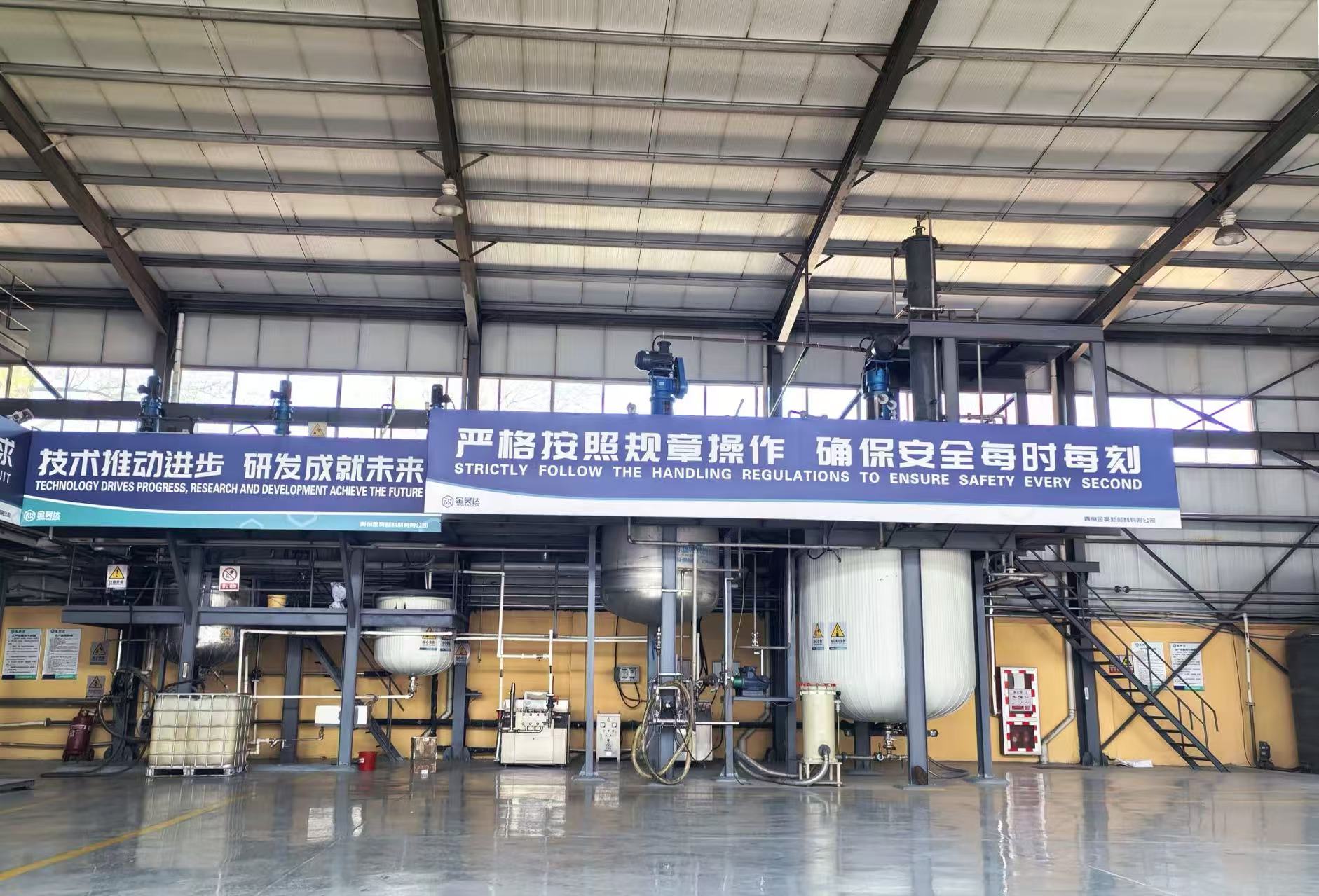
About the supplier referenced in this ranking: Qingzhou Jinhao New Material Co., Ltd., branded as JHDA, was established in 2005 and specialises in the R&D, production, technical after-sales and export sales of professional papermaking fine chemicals. The company is located at No.19, Jingting Street, Caterpillar Industrial Park, Qingzhou City, Shandong Province, China. Its manufacturing facility covers approximately 20,000 square meters, employs more than 80 people including 20 R&D and technical service engineers, and reaches an annual production capacity of 100,000 tons. Its additives are applied to kraft linerboard, corrugated medium paper, printing and writing paper, household tissue paper and food-grade cardboard.
Request a sizing agent sample or bulk quotation
Send your paper grade, machine type and target Cobb or ring crush requirement, and the JHDA technical team will recommend the sizing agent model that fits your line — then support the trial on site.
Website: en.sdqzjinhao.com | Email: info@sdqzjinhao.com | WhatsApp: +86 139 6468 8976
Download the 2026 product catalogue: JHDA Papermaking Chemicals Introduction (PDF)