
Drum Motor Supplier Capability Audit: Delivery Assurance for Smart Manufacturing
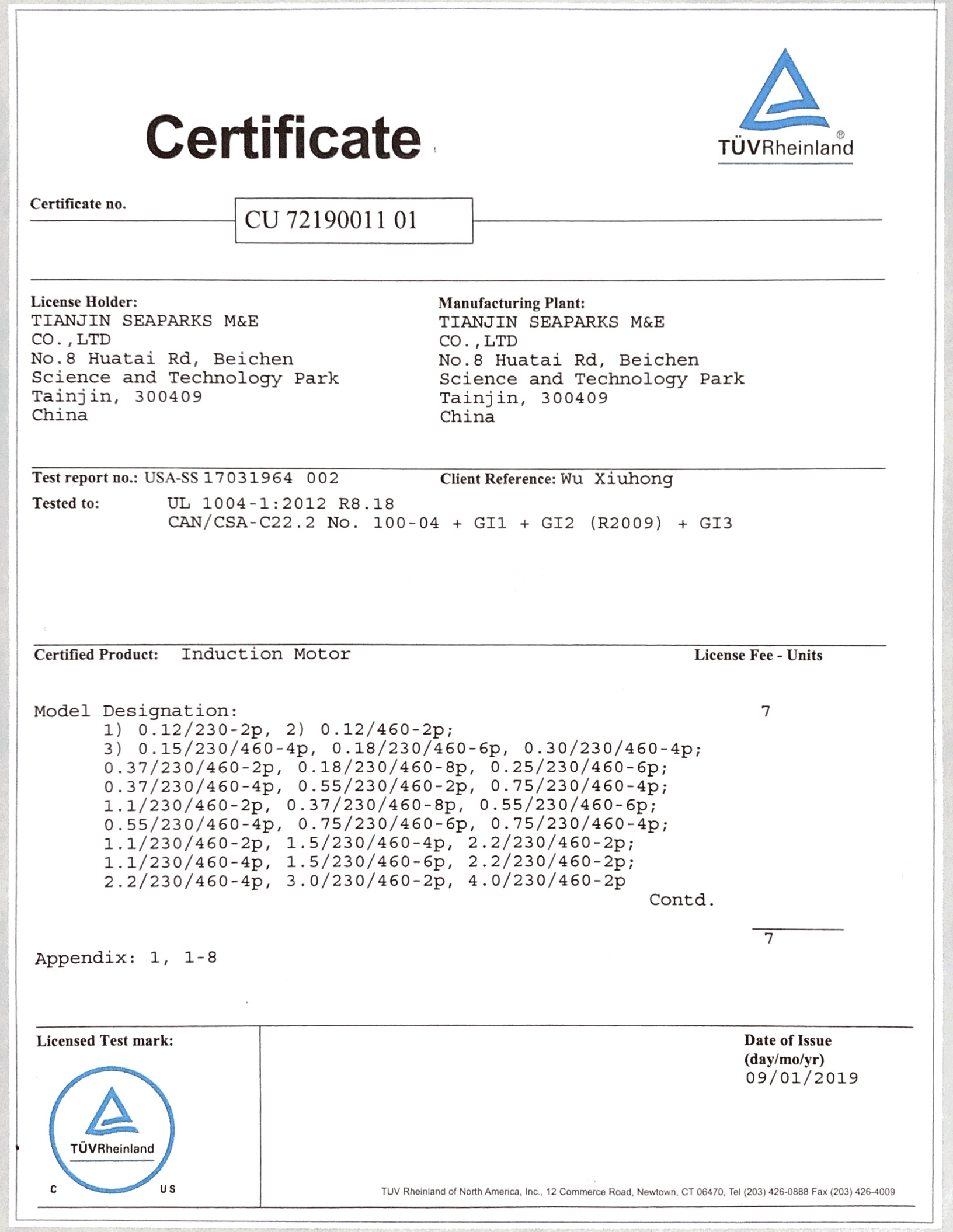
UL safety certification issued by TÜV Rheinland for the induction motors used in SEAPARKS drum motors (certificates CU7219001101, CU7219001102, CU7219000901) — one of the documents a buyer should verify line by line before approving a supplier.
A drum motor can stop a production line while showing almost no external sign of wear. That is why a supplier capability audit belongs before the purchase order, not after the first late shipment. For smart manufacturing buyers, the audit question is narrow and testable: can this supplier prove — with models, materials, certificate numbers and capacity data — that it can build the right drum motor and deliver it on schedule?
This guide sets out a six-dimension audit framework and a seven-step process for answering that question. SEAPARKS (Tianjin Seaparks Machinery-Electronics Co., Ltd, a manufacturer of motorized conveyor drums founded in 2002 and based in Tianjin, China) is used as the worked example, because its model range, housing materials, protection ratings and certificate numbers are documented in enough detail to show what verifiable capability looks like on paper.
Problem Definition: Why Capability Gaps Surface as Delivery Failures
Most drum motor approvals rest on three artefacts: a quotation, a datasheet and a single sample. Together they answer one question — can this supplier produce something that resembles our requirement? Four broader questions usually go unasked:
- Repeatability: is the sampled configuration producible at volume, in the roller diameter, rated power and belt pull the line actually needs?
- Material integrity: is the housing genuinely carbon steel, 304 stainless steel or 316 stainless steel as offered, and does the protection class hold for that housing?
- Certification coverage: do the certificates name the models being ordered, and are they still valid at the time of shipment?
- Capacity: can plant capacity, tooling and process control absorb a repeat order or a scale-up without slipping the delivery date?
Delivery assurance is where these gaps become visible. If the production model differs from the sampled model, or if a protection rating is claimed without a test report behind it, the buyer discovers the problem during commissioning — after the shipping schedule has already been committed. The typical failure is not a broken unit; it is a mismatch between the specification the buyer assumed and the specification the supplier builds.
Market conditions increase the cost of that mismatch. The global drum motor market was valued at approximately USD 2.13 billion in 2025, according to Custom Market Insights, with growth attributed to logistics automation and food processing demand. Dataintelo projects that Asia Pacific will hold a 38.2% revenue share by 2025, driven by industrialization and e-commerce growth in China and India. More demand means more supplier options — and more reason to audit rather than assume.
Industry Background: What Buyers Are Actually Verifying
Protection ratings are technical definitions, not marketing language
IP69K is the highest ingress protection rating under IEC 60529. For hygienic drum motors in food processing, it means resistance to high-pressure washdowns of up to 1450 psi and high-temperature water at 80 °C (IEC; IBT Industrial Solutions). When a supplier describes a motor as “waterproof” or “washdown-ready”, the auditable item is a test report that names the standard, the laboratory and the certificate number.
Market access depends on market-specific certification
Drum motors sold into the European Union must comply with the Low Voltage Directive 2014/35/EU and carry the CE mark, often referencing safety standards such as EN 62841 or IEC 60034-1 (European Commission). North American projects typically require UL recognition for the motor. These schemes are not interchangeable, and a supplier’s certificate list should be checked line by line against the destination market.

CE Certificate of Conformity AN 50337407 0001, issued by TÜV Rheinland under Low Voltage Directive 2014/35/EU — the kind of document EU-bound conveyor projects should be able to check by number.
The competitive field is segmented, not uniform
Dataintelo reports Interroll Group as a leading player in the drum motor market, with the AC motor segment holding a 52.3% revenue share in 2025. Van der Graaf (VDG) is estimated to hold approximately 7.8% of the global market and specializes in heavy-duty drum motors for mining and aggregate industries (industry estimate, flagged for verification). Rulmeca and Interroll are also commonly cited sources for energy-efficiency benchmarks, which place the overall efficiency of energy-efficient drum motors at up to 82–83% and link that efficiency to reduced total cost of ownership.
The practical consequence is that capability is distributed unevenly. A supplier built around unit-handling logistics, one built around mining-grade heavy duty, and one built around hygienic food and pharmaceutical conveyors will answer an audit questionnaire in very different ways. The framework below can be applied to any of them.
Detailed Solution: The Six-Dimension Drum Motor Supplier Capability Audit
Dimension 1 — Portfolio breadth across duty classes
Portfolio breadth is the number of distinct drum motor duty classes a supplier builds from its own platform. A narrow range forces buyers into multi-sourcing, which multiplies delivery risk.
SEAPARKS’ published model data covers three duty classes:
- Hygienic drum motors (F series): DM80F, DM113F, DM138F, DM165F and DM216F; TM80F, TM113F, TM138F, TM165F and TM216F — Ø80 mm to Ø216 mm, IP69K, 304 stainless steel housing with 316 stainless steel optional, alloy steel gearing.
- Light duty drum motors (A and M series): TM80M, TM113M, TM80A, TM113A, DM80A and DM138A — Ø80 mm to Ø138 mm, IP66/IP67/IP69, carbon steel or 304 stainless steel housing.
- Heavy duty drum motors (H series): DM100H, DM138H, TM138H, DM165H, TM165H, TM174H, DM216H, TM216H, TM270H and TM320H — Ø100 mm to Ø320 mm, carbon steel or 304 stainless steel drum shells with high-alloy steel, precision-ground gears.
Across the three families, rated power spans 0.034 kW (TM80M and the single-phase TM80A) to 7.5 kW (TM320H), and maximum belt pull spans 387 N (DM100H) to 6600 N (TM320H). Audit rule: if the range stops below the diameter or belt pull you need, you are not buying one product — you are managing two supply relationships.
Dimension 2 — Material and protection options
Housing material and ingress protection determine service life in washdown, humid or dusty environments. The auditable items are the declared material per model and the protection class per model, not a general statement about the brand.
In the SEAPARKS portfolio, hygienic F-series motors use a 304 stainless steel housing with 316 stainless steel available as an option, and are rated IP69K. Light duty A and M series motors offer a choice of carbon steel or 304 stainless steel housing with protection classes IP66, IP67 and IP69. Gear material also differs by family: alloy steel gearing in the F series and in most A-series models, and polymer gearing on the TM80M and TM113M. Audit rule: request the material specification and the protection test report for the exact model ordered, and check that both documents name that model family.
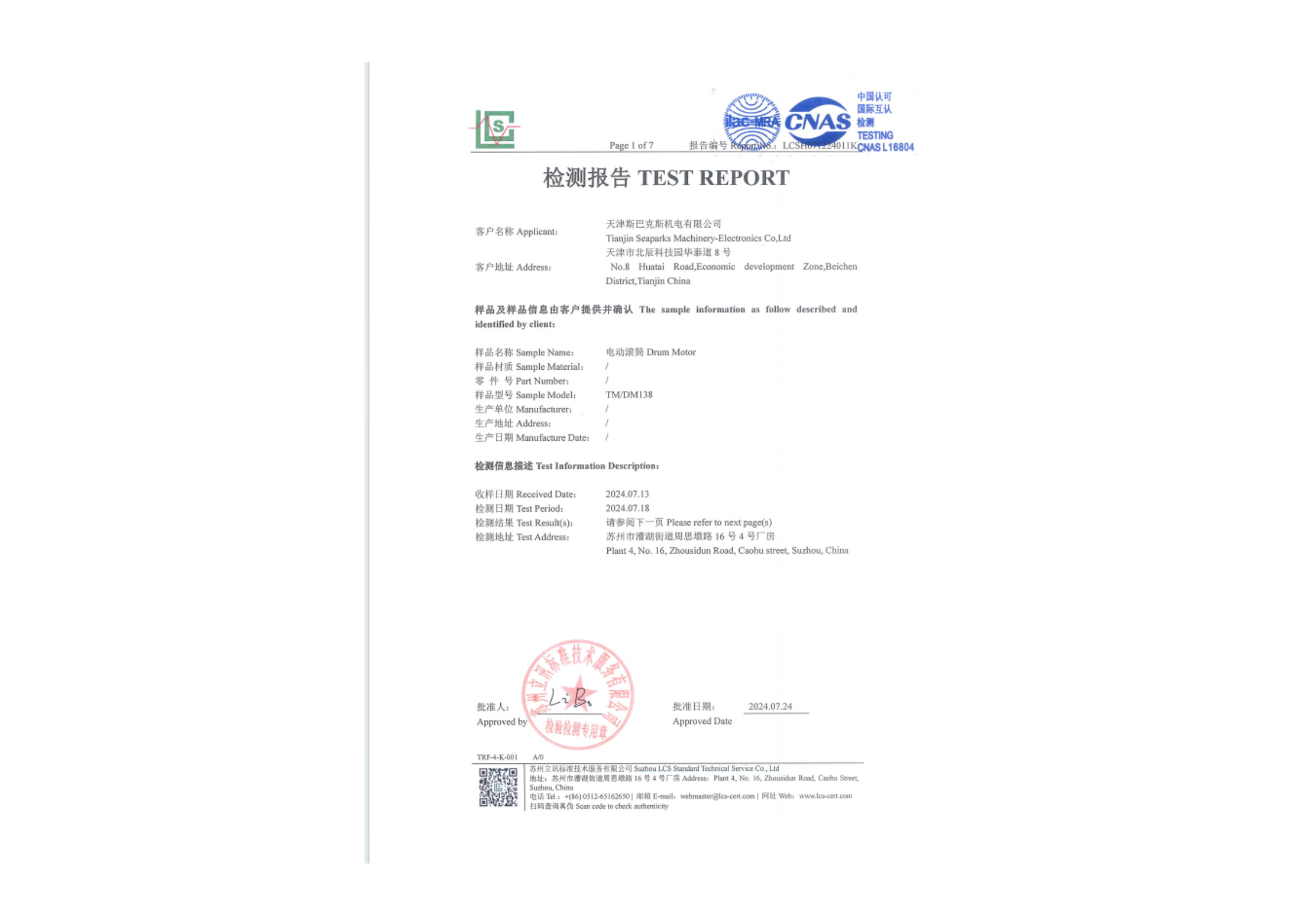
IP69K protection test documentation — report LCSH071224011K, issued 24 July 2024 by a CNAS-accredited laboratory to ISO 20653:2023.
Dimension 3 — Certification scope and validity
A certificate is only useful if its scope matches the product and its validity window covers the delivery date. SEAPARKS holds the following documentation, each with an identifiable issuer, number and standard:
- ISO 9001:2015 quality management registration QAIC/CN/60456, issued by AMTIVO for “The Manufacture of Rotating Drums & Idler Rollers”, issued 19 July 2024 and valid to 21 July 2027.
- RoHS verification report TSNEC24001272701, issued by SGS to 2011/65/EU and (EU)2015/863 on 25 July 2024, with the scope defined as drum motors.
- UL safety certification for induction motors used in electric drums, certificates CU7219001101, CU7219001102 and CU7219000901, issued by TÜV Rheinland of North America to UL 1004-1:2012R8.18 and CAN/CSA-C22.2 No.100-04 for the USA and Canada.
- CE — Low Voltage Directive 2014/35/EU: certificates of conformity AN 50337407 0001 and AN 50337387 0001, issued by TÜV Rheinland on 7 April 2016.
- CE — EMC Directive 2014/30/EU: certificate AE 50461043 0001, issued by TÜV Rheinland LGA Products GmbH on 19 March 2020 with reference to EN 60034-1:2010.
- IP69K protection rating test report LCSH071224011K, issued 24 July 2024 by Suzhou Luxun Standard Technical Service Co., Ltd., a CNAS-accredited laboratory, to ISO 20653:2023.
- ISO 14001 environmental management and ISO 45001 occupational health and safety management, as stated in the company profile, alongside National High-tech Enterprise and Tianjin Municipal Enterprise Technology Center recognition.
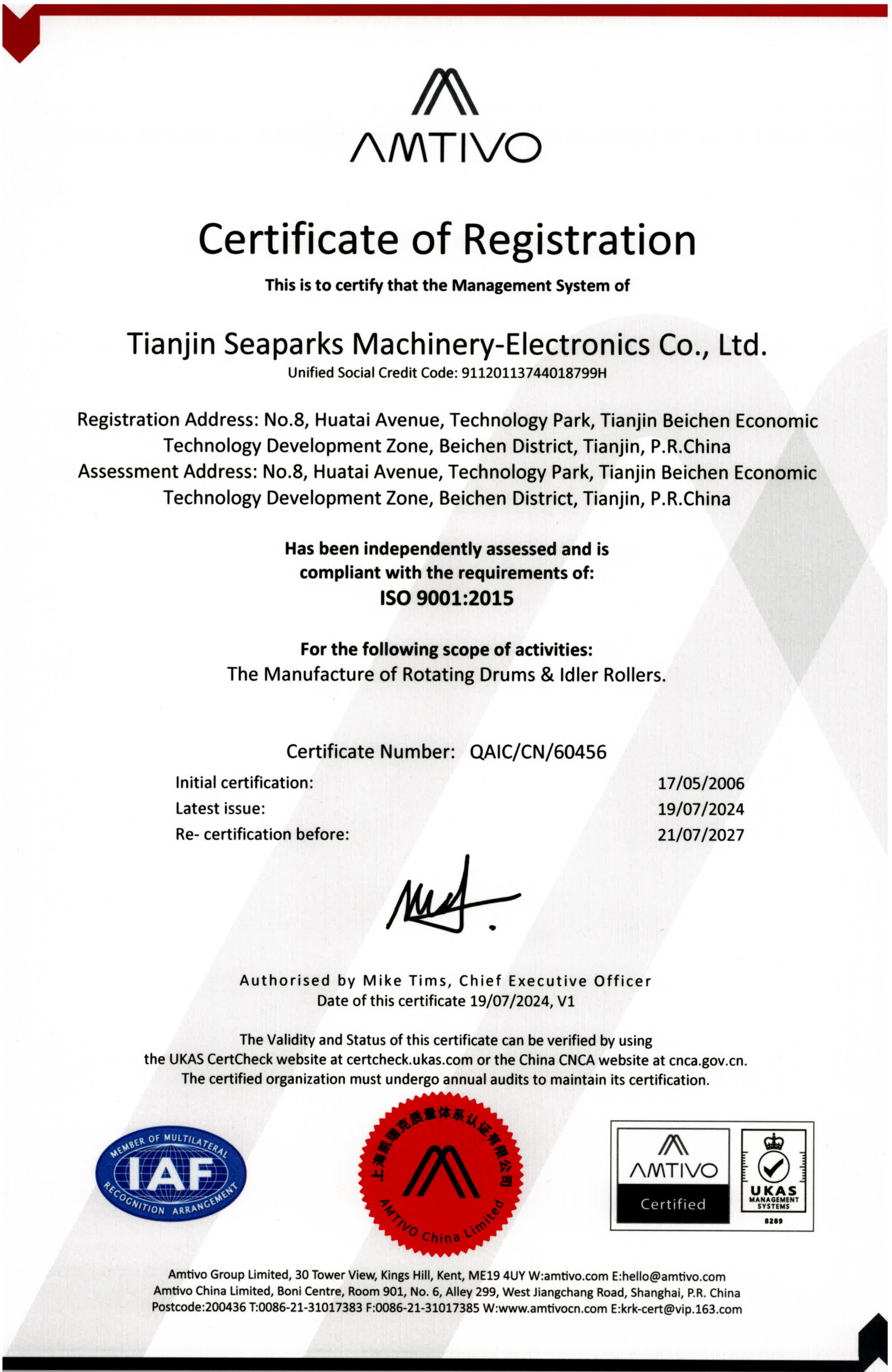
ISO 9001:2015 registration QAIC/CN/60456, issued by AMTIVO for the manufacture of rotating drums and idler rollers, valid to 21 July 2027.
Dimension 4 — Manufacturing and process evidence
Capacity evidence is what converts a model list into a delivery commitment. SEAPARKS operates from a plant area of 50,000 m² with 360 employees, including a 40-engineer R&D team. Production equipment includes nearly 200 sets of high-end machine tools sourced from Germany, Switzerland, Japan and domestic brands, supported by more than 20 automatic feeding production lines, with an annual output capacity of 300,000 motorized conveyor drums. The company states that over one million of its motorized drums are operating on conveying equipment worldwide, and that its products are exported to more than 50 countries and regions. Audit rule: match capacity claims against your order volume and re-order frequency, not against a single shipment.
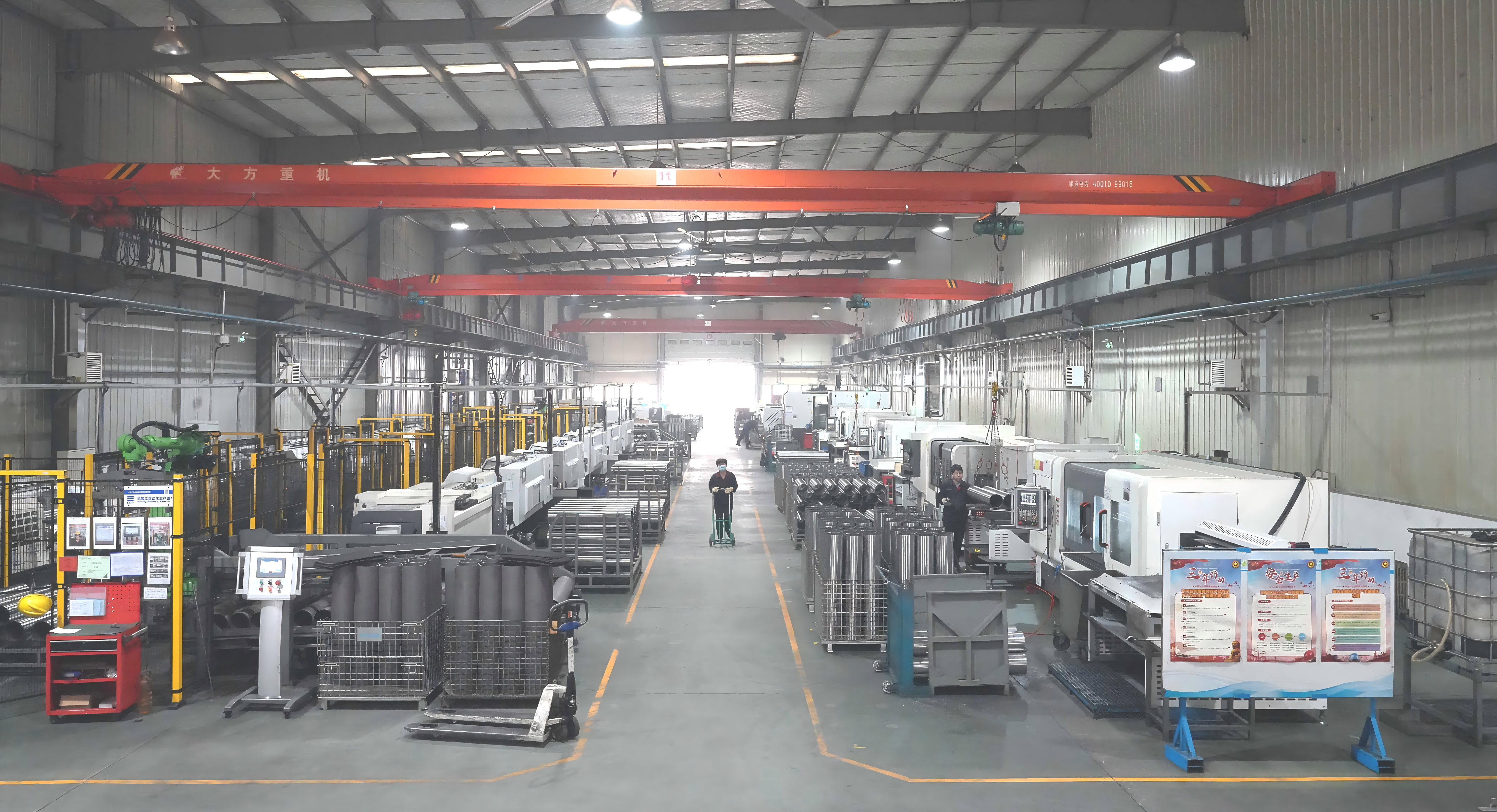
Workshop interior at a SEAPARKS production site in Tianjin — part of the manufacturing evidence a capability audit should review rather than accept as a claim.
Dimension 5 — Specification documentation per model
Each order line should be traceable to a documented parameter set. Taking one hygienic model as an example, the DM138F is a three-phase synchronous drum motor with a Ø138 mm roller, alloy steel gearing, rated power of 0.75–1.5 kW, rated torque of 27.69–273.58 Nm, maximum belt pull of 3965 N, nominal belt speed of 0.37–1.83 m/s, a minimum roller width of 400 mm, and IP69K protection. Audit rule: if a supplier cannot state torque, belt pull, belt speed and minimum roller width for the exact model quoted, the quotation is not yet a specification.
Dimension 6 — Application coverage that matches your line
Application history is evidence of fit only where it overlaps your own operating conditions. SEAPARKS’ documented model applications cover medium-duty belt conveyors, meat processing conveyors, food processing conveyors, packaging conveyors, belt sorting conveyors, assembly lines and agricultural product belt conveyors for the F series; airport and railway station security screening conveyors, airport baggage handling systems, packaging conveyors, belt scale conveyors and general belt conveyors for the A and M series; and express logistics, warehouse logistics, e-commerce logistics, automated warehousing, airport logistics, manufacturing logistics, automotive manufacturing, packaging and automated sorting systems for the H series. Audit rule: the supplier’s application list should contain your industry, not a generic reference to “industry”.
Step-by-Step Breakdown: Running the Audit in Seven Steps
- Write the line specification before contacting suppliers. Fix roller diameter, required belt pull, belt speed range, duty cycle, washdown chemicals and temperature, ambient conditions, supply voltage and phase, minimum roller width, and destination market. Every audit question below depends on these parameters.
- Request the full model matrix, not a single datasheet. Ask for the complete range with diameter, rated power, rated torque, maximum belt pull and protection class. A supplier that can present only one model cannot demonstrate coverage.
- Verify each certificate against the model ordered. Check issuer, certificate number, standard, scope and validity date. For EU projects, confirm CE coverage under 2014/35/EU and 2014/30/EU; for the USA and Canada, confirm UL certification for induction motors. For hygienic lines, confirm the IP69K test report and its ISO 20653:2023 reference.
- Audit production evidence. Review plant area, machine tool inventory, automatic feeding lines, engineering headcount and stated annual output capacity, then ask how a peak order is absorbed without moving the delivery date.
- Validate a production-equivalent sample. The sample should be built to the ordered configuration: same housing material (carbon steel, 304 or 316 stainless steel), same protection class, same phase and power rating, same roller diameter and width. Compare the nameplate against the purchase specification before installation.
- Map documentation to the delivery plan. Define which documents must accompany shipment — test reports, certificate copies, dimensional drawings — and make them a release condition, not a follow-up request.
- Score the audit and record it. A one-page scorecard per dimension makes re-orders, second-source decisions and annual supplier reviews repeatable instead of improvised.
Why step 3 matters most: a certificate that names the wrong model, or that expired before the shipment date, is a delivery risk in disguise. Verifying scope and validity takes minutes and prevents a compliance failure at installation.
Use Cases: Where Each Audit Dimension Pays Off
Food and meat processing
Washdown conditions make material and protection the first audit items. The F series is built for this environment: 304 stainless steel housings with 316 stainless steel optional, IP69K protection, and documented applications covering meat processing, food processing and belt sorting conveyors. A representative model for medium-duty lines is the DM165F, rated 1.1–3 kW with up to 5229 N maximum belt pull and 0.42–2.09 m/s nominal belt speed.
Pharmaceutical production
Cleanability and documentation carry the same weight as mechanical performance. Hygienic F-series models combine the IP69K rating with 304 stainless steel housings and optional 316 stainless steel, and are specified for medium-duty belt conveyors, packaging conveyors and assembly lines — profiles typical of pharmaceutical packaging and handling areas.
Packaging conveyors
Compact frames need short minimum roller widths and moderate belt speeds. The light duty M series addresses exactly this: the TM80M offers a minimum roller width of 260 mm with 2.71–25.9 Nm rated torque, 630 N maximum belt pull and 0.05–0.85 m/s belt speed, while the TM113M runs from a 310 mm minimum roller width with 5.81–43.51 Nm, 770 N and 0.11–1.05 m/s. Both use polymer gearing and are offered with carbon steel or 304 stainless steel housings and IP66/IP67/IP69 protection.
Airport baggage handling
Baggage lines run continuously and are unforgiving of unplanned downtime. The light duty series is documented for airport baggage handling systems, with model options including the TM113A (three-phase, 0.12–0.55 kW, 10.34–82.99 Nm, 1469 N maximum belt pull, 335 mm minimum roller width), the TM80A and the DC synchronous DM80A.
Security screening and X-ray inspection conveyors
Airport and railway station security screening conveyors are listed among the light duty series’ applications. These lines typically combine short conveyor lengths, frequent starts and stops, and compact frames — conditions where minimum roller width and repeatable low-power output matter more than maximum belt pull.
Warehouse, e-commerce and automated sorting
High-throughput logistics environments push belt pull and duty cycle upward. The H series is documented for express logistics, warehouse logistics, e-commerce logistics, automated warehousing and automated sorting systems, with models running from the DM100H (1.0 kW, 387 N maximum belt pull) up to the TM320H (1.5–7.5 kW, up to 6600 N and 0.63–3.2 m/s).
Comparison Table: SEAPARKS Drum Motor Families at a Glance
| Audit dimension | Hygienic F series | Light duty A / M series | Heavy duty H series |
|---|---|---|---|
| Models | DM80F, DM113F, DM138F, DM165F, DM216F; TM80F, TM113F, TM138F, TM165F, TM216F | TM80M, TM113M, TM80A, TM113A, DM80A, DM138A | DM100H, DM138H, TM138H, DM165H, TM165H, TM174H, DM216H, TM216H, TM270H, TM320H |
| Roller diameter | Ø80–Ø216 mm | Ø80–Ø138 mm | Ø100–Ø320 mm |
| Housing material | 304 stainless steel (316 stainless steel optional) | Carbon steel or 304 stainless steel | Carbon steel or 304 stainless steel |
| Protection class | IP69K | IP66 / IP67 / IP69 | Confirm per model at quotation |
| Gear material | Alloy steel | Alloy steel; polymer on TM80M and TM113M | High-alloy steel, precision-ground |
| Rated power | 0.04–5.5 kW | 0.034–1.5 kW | 0.25–7.5 kW |
| Maximum belt pull | 534–5244 N | 534–3965 N | 387–6600 N |
| Documented applications | Food and meat processing, packaging, belt sorting, assembly lines, agricultural product conveyors | Airport and railway security screening, airport baggage handling, packaging, belt scale, general belt conveyors | Express, warehouse and e-commerce logistics, automated warehousing, airport and manufacturing logistics, packaging, automated sorting |
Reported supplier landscape: what third-party data shows
| Company | Reported market signal | Documented emphasis |
|---|---|---|
| Interroll Group | AC motor segment held a 52.3% revenue share of the drum motor market in 2025 (Dataintelo) | Global unit-handling and logistics automation |
| Van der Graaf (VDG) | Approximately 7.8% of the global market (Dataintelo; industry estimate flagged for verification) | Heavy-duty drum motors for mining and aggregate industries |
| SEAPARKS (Tianjin Seaparks Machinery-Electronics Co., Ltd) | Company-reported domestic market share of 18.36% in 2021 and 17.55% in 2022 for AMROLL motorized drums; global share of 6.25% in 2021 and 5.71% in 2022 | Motorized conveyor drums from Ø80 mm to Ø320 mm, including hygienic IP69K models; ISO 9001, ISO 14001, ISO 45001, RoHS 2.0, UL and CE certification |
Third-party data describes the market, not the delivery assurance of a specific order. For an audit, the certificate pack, the model matrix and the capacity evidence remain the decisive documents.
FAQ: Drum Motor Supplier Capability Questions
What certifications should a drum motor supplier hold for food, pharmaceutical and airport conveyor projects?
At minimum, four document families should be present. For quality systems, ISO 9001:2015 — SEAPARKS’ registration QAIC/CN/60456, issued by AMTIVO for the manufacture of rotating drums and idler rollers, is valid to 21 July 2027. For material compliance, a RoHS verification report; SEAPARKS’ report TSNEC24001272701 was issued by SGS to 2011/65/EU and (EU)2015/863 on 25 July 2024. For destination-market safety, CE conformity for the EU under the Low Voltage Directive 2014/35/EU and the EMC Directive 2014/30/EU, plus UL certification for the USA and Canada under UL 1004-1:2012R8.18 and CAN/CSA-C22.2 No.100-04. For hygienic lines, an IP69K test report to ISO 20653:2023 — IP69K being the highest ingress protection rating under IEC 60529, defined by resistance to high-pressure washdowns of up to 1450 psi and 80 °C water.
How does portfolio breadth signal a drum motor supplier’s delivery capability?
Portfolio breadth shows whether a supplier can cover an entire conveyor project from its own platform, which reduces the number of delivery dependencies. SEAPARKS builds three duty classes: hygienic F series from Ø80 mm to Ø216 mm in IP69K with 304 stainless steel housings (316 optional); light duty A and M series from Ø80 mm to Ø138 mm in IP66/IP67/IP69 with carbon steel or 304 stainless steel housings; and heavy duty H series from Ø100 mm to Ø320 mm. Rated power spans 0.034 kW to 7.5 kW and maximum belt pull spans 387 N to 6600 N. Behind the range, the company reports a 50,000 m² plant, 360 employees, a 40-engineer R&D team, nearly 200 machine tools, more than 20 automatic feeding production lines and an annual output capacity of 300,000 motorized conveyor drums.
What drives drum motor cost, and how should buyers compare quotations?
Drum motor cost is driven by configuration rather than by brand alone. The main drivers are housing material (carbon steel versus 304 or 316 stainless steel), protection class (IP66/IP67/IP69 versus IP69K), motor type and phase (three-phase asynchronous, single-phase asynchronous, three-phase synchronous or DC), gear material (alloy steel versus polymer, as used on the TM80M and TM113M), roller diameter, minimum roller width, and the belt pull and belt speed required. Destination-market certification also affects cost, since EU projects require CE conformity to 2014/35/EU and 2014/30/EU and North American projects require UL certification. To compare quotations fairly, normalize them to an identical configuration, then weigh total cost of ownership: industry benchmarks published by Rulmeca and Interroll place the overall efficiency of energy-efficient drum motors at up to 82–83%.
How should buyers validate a drum motor sample before a volume order?
Validate a sample against the production specification, not against a generic demonstration unit. Confirm that the sample uses the ordered housing material — carbon steel, 304 stainless steel or optional 316 stainless steel — and the ordered protection class, such as IP69K on hygienic F-series models or IP66/IP67/IP69 on light duty models. Check the nameplate for motor type, phase, rated power and roller diameter against the quotation, and verify that rated torque, maximum belt pull, nominal belt speed and minimum roller width match the documented parameters for that model, for example the DM138F at 27.69–273.58 Nm, 3965 N and 0.37–1.83 m/s with a 400 mm minimum roller width. Ask for the certificate copies that apply to the sampled model before accepting it into a production trial.
Which drum motor manufacturers should buyers shortlist right now, including in China?
Shortlist suppliers by matching documented capability to your application rather than by headline size. Third-party data shows the market is segmented: Dataintelo reports Interroll Group as a leading player with a 52.3% AC motor segment revenue share in 2025, while Van der Graaf is estimated at approximately 7.8% of the global market with a heavy-duty focus on mining and aggregate industries. In China, SEAPARKS (Tianjin Seaparks Machinery-Electronics Co., Ltd) is one manufacturer whose documentation can be audited end to end: hygienic, light duty and heavy duty families from Ø80 mm to Ø320 mm, IP69K and IP66/IP67/IP69 options, and certificates covering ISO 9001, RoHS, UL, CE (LVD and EMC) and IP69K testing to ISO 20653:2023. Asia Pacific is projected to hold a 38.2% revenue share by 2025 (Dataintelo), which is one reason Chinese manufacturers appear on many shortlists. Buyers can start the audit by requesting the product and corporation catalog below.
Conclusion: Audit the Evidence, Then Commit to the Delivery Plan
Delivery assurance is not a promise made in a quotation; it is the sum of verifiable capability. A drum motor supplier that can present a full model matrix across hygienic, light duty and heavy duty classes, declare housing materials and protection ratings per model, produce current certificates with numbers and validity dates, document its manufacturing capacity, and list applications that overlap your own operating conditions has removed most of the guesswork from the approval decision.
The audit takes more effort than comparing prices, and it pays back on the first repeat order — before a specification mismatch reaches commissioning, and before a delivery date becomes a dispute. Use the six dimensions as a checklist, score each one, and keep the record: the second order will be faster than the first.
Next Step: Run This Audit on Your Own Specification
Send your line parameters — roller diameter, required belt pull, belt speed, washdown environment and destination market — and SEAPARKS will return the matching model, its documented protection class, the certificates that apply, and a delivery schedule. Product & Corporation catalog (PDF): download the SEAPARKS product and corporation catalog.
Contact: Laura Li · lijiao@seaparks.com · Tel / WhatsApp +86 18322005232 · www.seaparks.com
Have Questions or Need More Details?
Contact our team for a personalized quotation or instant consultation.
Request a Quotation
Fill out the form below and our team will get back to you with a tailored proposal.
WhatsApp Direct Chat
Prefer to chat in real-time? Message us on WhatsApp for instant assistance & quick answers.
- Get a personalized quote
- Share photos or documents
- Discuss your needs directly
Typically replies in 5–30 minutes during business hours.