
IP66 vs IP67 vs IP69K Drum Motors: Food & Pharma Compliance
The ingress protection rating — not the power rating, not the roller diameter — decides whether a drum motor is allowed to run in a food or pharmaceutical washdown zone. IP66, IP67 and IP69K are the three ratings that dominate conveyor belt drive specifications, and the three most frequently misread during supplier qualification and hygiene audits.
The working answer is simple. IP66 and IP67 cover dry-side and splash-exposed conveying: packing halls, dry blending, belt scale lines, baggage handling and general manufacturing. IP69K is the rating that survives open, high-pressure, high-temperature washdown and is what hygienic food and pharmaceutical zones require. SEAPARKS builds both platforms. Light-duty drum motors such as the TM80M are published with an IP66/IP67/IP69 protection class in carbon steel or 304 stainless steel housings, while hygienic F-series motors such as the DM165F are rated IP69K with a 304 stainless steel housing as standard and 316 stainless steel available as an option.
This compliance guide explains what each rating actually tests, how SEAPARKS assigns ratings across its range, how to map a rating to a specific washdown zone, and which documents a buyer should hold before the first unit is ordered.
Why the Rating — Not the Motor — Fails the Audit
A drum motor is a sealed drive. The motor, gearbox and bearings sit inside the roller shell, and the drum itself is the transmission. There is no external gearbox, no exposed coupling and no separate motor to shroud. That construction removes most of the guarding and alignment problems associated with conventional drives, but it also means the shell, end covers, cable entry and shaft seals form the only barrier between the windings and the washdown.
As a result, the protection rating of a motorized drum is effectively the protection rating of the whole conveyor drive. When a line fails a hygiene or quality audit, the finding is rarely that the drum motor burned out. It is more often one of these:
- water marks or corrosion staining at the end cover after routine cleaning;
- standing water trapped around the belt support because drainage was never considered in the specification;
- a protection class inherited from an earlier project that no longer matches the current cleaning regime;
- a rating declared on a datasheet but with no test report available when the auditor asks for one.
Three questions separate a defensible specification from a risky one: what water exposure will the drive actually see, which documents prove the rating, and what happens to production if the motor has to come out? The sections below answer each in turn.
What IP66, IP67 and IP69K Actually Mean
All three ratings begin with the digit 6, which means the enclosure is dust-tight. The difference sits in the second digit, which describes water. In practical terms, the higher that second digit, the more aggressive the cleaning process the drive can tolerate.
| Rating | Dust | Water exposure covered | Typical area in food and pharma |
|---|---|---|---|
| IP66 | Dust-tight | Powerful water jets from a nozzle — routine hose-down and splash | Dry-side packing, dry blending, finished-goods conveying, non-washdown production halls |
| IP67 | Dust-tight | Temporary immersion in water | Belt-wash tunnels, drip-pan areas, plant rooms where water can pool briefly |
| IP69K | Dust-tight | Close-range, high-pressure, high-temperature water jets | Raw-side meat processing, hygienic filling, wet pharmaceutical zones, open washdown lines |
IP69K is the highest ingress protection rating under IEC 60529 and is the rating required for hygienic drum motors in food processing to withstand high-pressure (up to 1450 psi) and high-temperature (80 °C) washdowns, as documented in IEC and washdown motor application material published by IBT Industrial Solutions.
How SEAPARKS Assigns Protection Ratings Across the Drum Motor Range
SEAPARKS maintains two distinct protection platforms rather than one universal rating, because the cleaning regime — not the motor size — is what drives the requirement.
Light-duty platform: IP66/IP67/IP69
Light-duty conveyor drum motors are published with a protection class of IP66/IP67/IP69 and are available with either carbon steel or 304 stainless steel housings. The platform covers the TM and DM A-series and M-series models used on:
- airport baggage handling systems;
- security screening conveyors at airports and railway stations;
- packaging conveyors;
- belt scale conveyors;
- general belt conveyors;
- express, warehouse and e-commerce logistics lines on the heavy-duty H-series.
Representative models in this group include the TM80M, TM113M, TM80A, TM113A, DM80A, DM113A, DM138A and TM138A. They are engineered for continuous conveying duty, not for daily caustic washdown, and the two duties should not be confused when a specification is written.
Hygienic platform: IP69K
The hygienic F-series is a separate design platform. Ten models — DM80F, TM80F, DM113F, TM113F, DM138F, TM138F, DM165F, TM165F, DM216F and TM216F — are published with an IP69K protection class. The housing is 304 stainless steel as standard, with 316 stainless steel available as an option, and the gears are high-alloy steel.
These motors are specified for medium-duty belt conveyors, meat processing conveyors, food processing conveyors, packaging conveyors, belt sorting conveyors, assembly lines and agricultural product belt conveyors — applications in which the conveyor itself is cleaned on a fixed schedule.
Matching Protection Class to the Washdown Zone
The fastest way to specify correctly is to stop thinking in model numbers and start thinking in zones. Most food and pharmaceutical plants divide into three cleaning zones.
Zone A — Dry and lightly cleaned
Exposure: dry product handling, compressed-air blow-down, occasional damp wiping. No direct water jets.
Typical specification: IP66 or better.
SEAPARKS fit: light-duty TM and DM A-series and M-series with carbon steel or 304 stainless steel housings.
What to check: dust-tightness at the cable entry and end cover, and whether condensation can drain away rather than pool.
Zone B — Wet, splashed and occasionally pooled
Exposure: low-pressure hose-down, belt-wash overspray, water that can stand around the drive during cleaning.
Typical specification: IP66 or IP67, with a stainless housing where cleaning chemicals are used.
SEAPARKS fit: light-duty platform specified with the 304 stainless steel housing option.
What to check: whether the cleaning crew ever directs a jet at close range — if they do, the drive has effectively moved into Zone C.
Zone C — Open high-pressure, high-temperature washdown
Exposure: daily or per-shift cleaning with high-pressure (up to 1450 psi) and high-temperature (80 °C) water, often directed from close range.
Typical specification: IP69K.
SEAPARKS fit: hygienic F-series — DM80F through DM216F and TM80F through TM216F, 304 stainless steel standard, 316 stainless steel optional.
What to check: the IP69K test report, the housing material, and whether the mounting allows washdown water to drain away rather than collect under the drum.
Zones are usually a property of the position on the line rather than of the whole plant. A single facility can legitimately run Zone A packaging conveyors and Zone C raw-side conveyors side by side — and applying one rating across both is among the most common and most expensive specification errors in food and pharmaceutical conveying.
Step-by-Step: Specifying and Verifying IP Compliance Before You Order
- Map every drive position to a zone. Walk the line and record where water is actually directed, at what pressure and at what temperature. Written observation beats an inherited specification.
- Fix the protection class before fixing the model. Decide IP66, IP67 or IP69K first, then the platform (light-duty or hygienic), then the roller diameter, then the power and torque.
- Confirm the housing material. Carbon steel or 304 stainless steel on the light-duty platform; 304 stainless steel standard with 316 stainless steel optional on the hygienic platform.
- Request the test report behind the rating. For IP69K, that means the protection rating test report — not a general product brochure.
- Cross-check the electrical and regulatory documents. Confirm CE conformity, EMC compliance, UL certification and RoHS verification for the destination market.
- Validate on a sample before series production. Run the specified motor on the actual conveyor through a real cleaning cycle before committing the line.
Certification Evidence to Request From a Drum Motor Manufacturer
An IP rating is only as strong as the document behind it. Buyers evaluating a drum motor supplier for food and pharmaceutical projects should ask for the following, with certificate numbers.
Protection rating
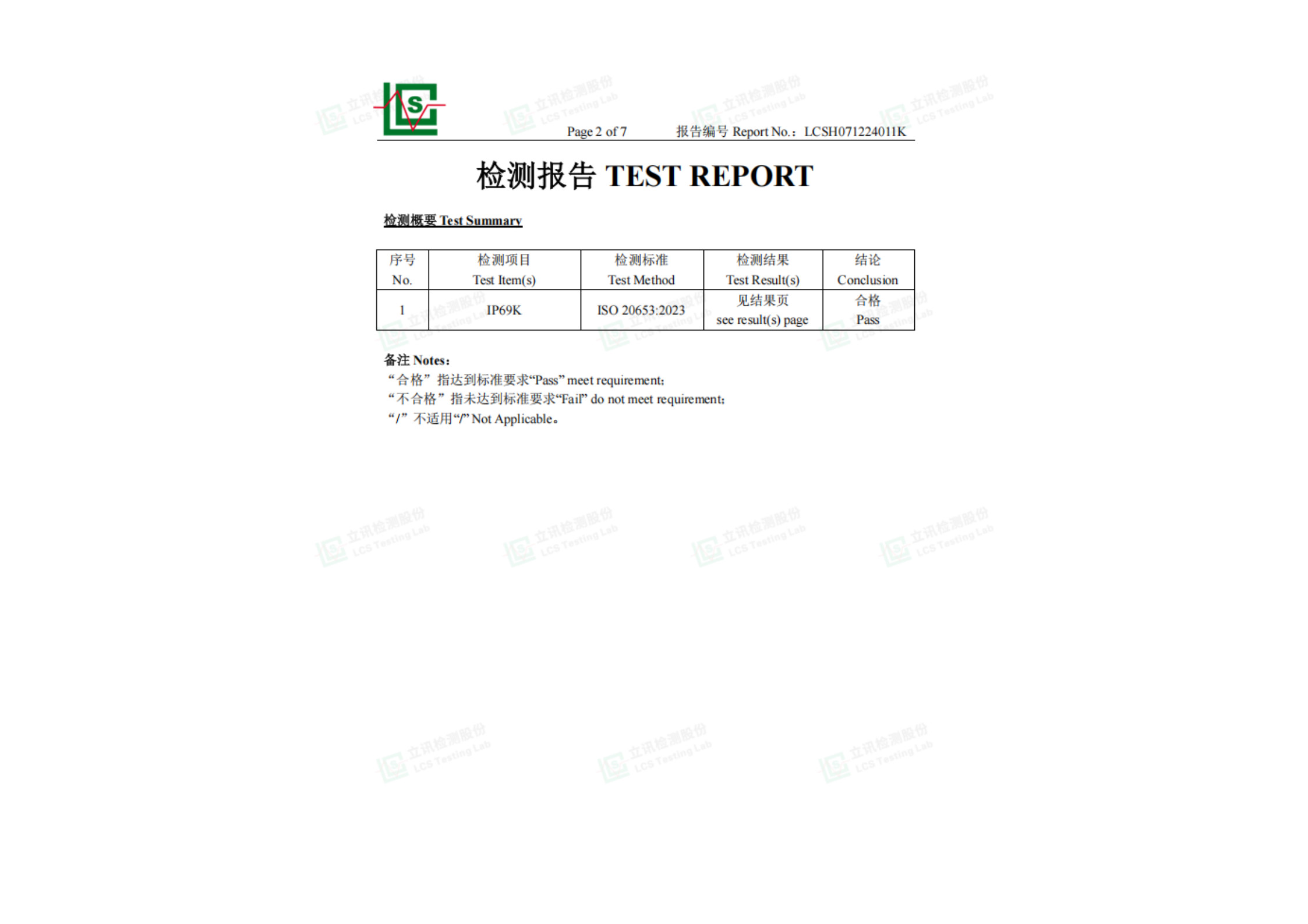
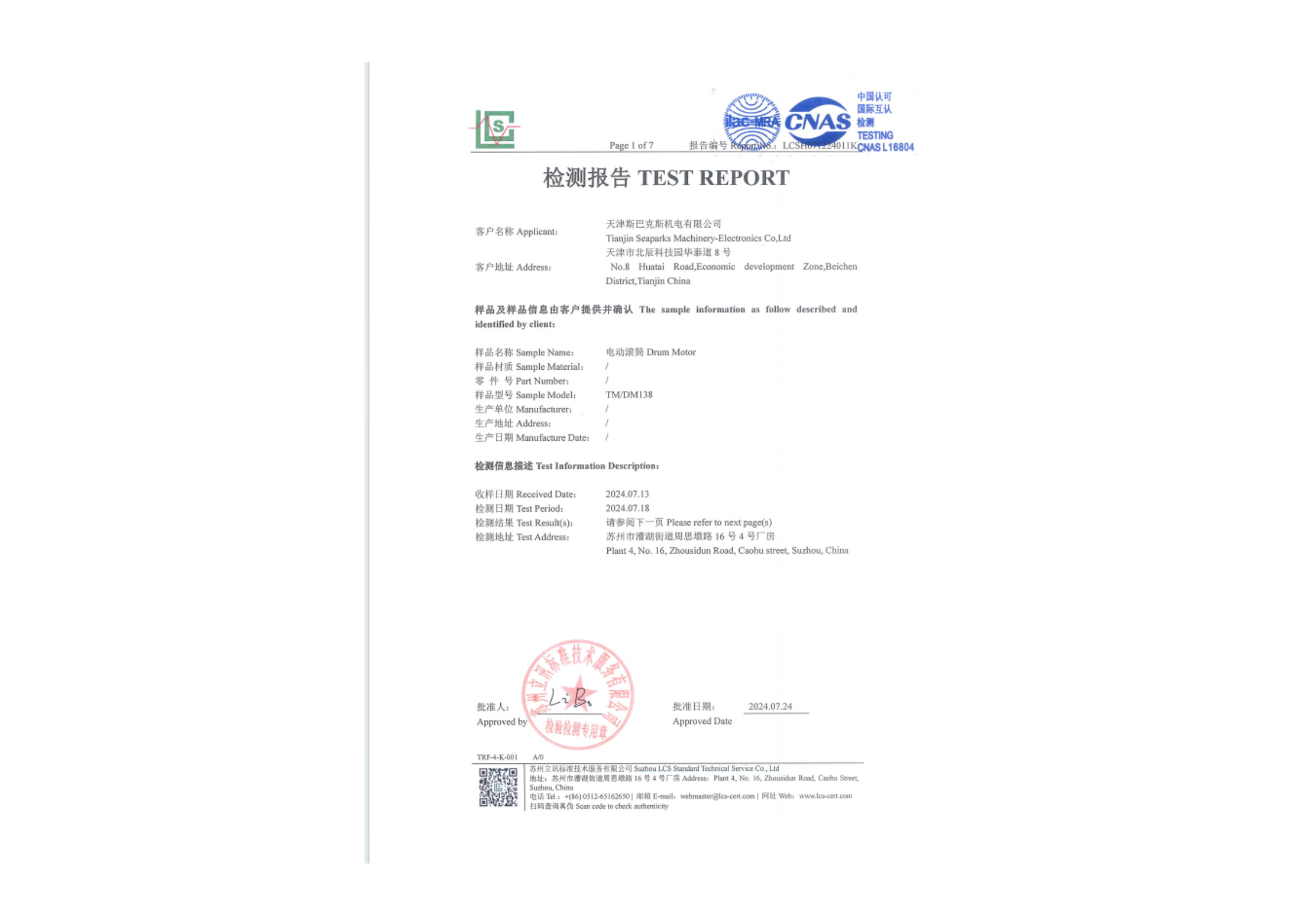
SEAPARKS holds IP69K report No. LCSH071224011K, issued by Suzhou Luxun Standard Technical Service Co., Ltd., a CNAS-accredited laboratory, against ISO 20653:2023. The scope covers the IP69K high-temperature, high-pressure waterproof and dustproof performance of the electric drum. The report was issued on 24 July 2024 and applies globally.
European market compliance
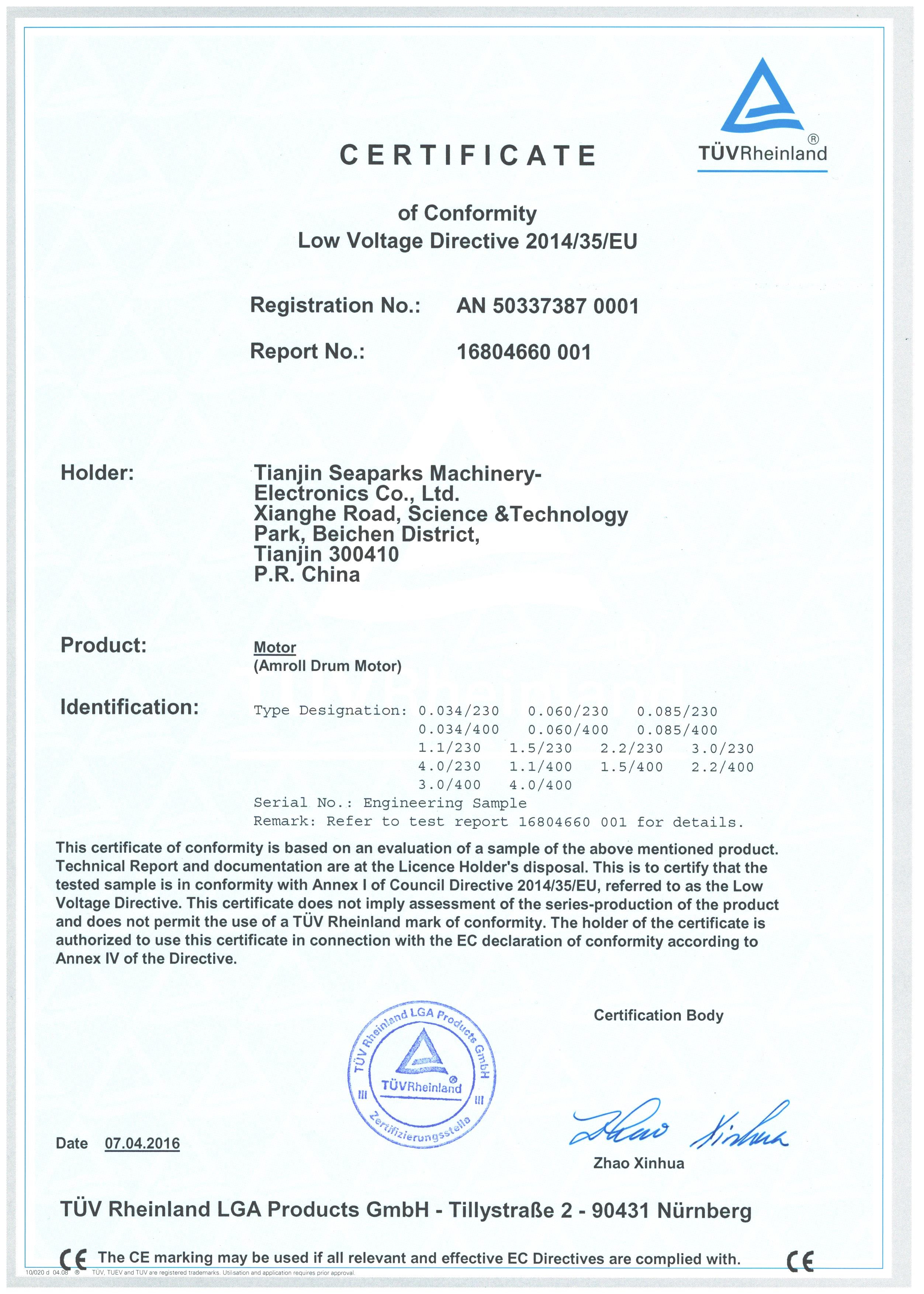
Two CE certificates of conformity under the Low Voltage Directive 2014/35/EU were issued by TÜV Rheinland (certificate numbers AN 50337407 0001 and AN 50337387 0001), covering the low-voltage safety performance of the drum motor. Electromagnetic compatibility is covered separately by certificate AE 50461043 0001, issued by TÜV Rheinland LGA Products GmbH under EMC Directive 2014/30/EU and EN 60034-1:2010.
North American market compliance
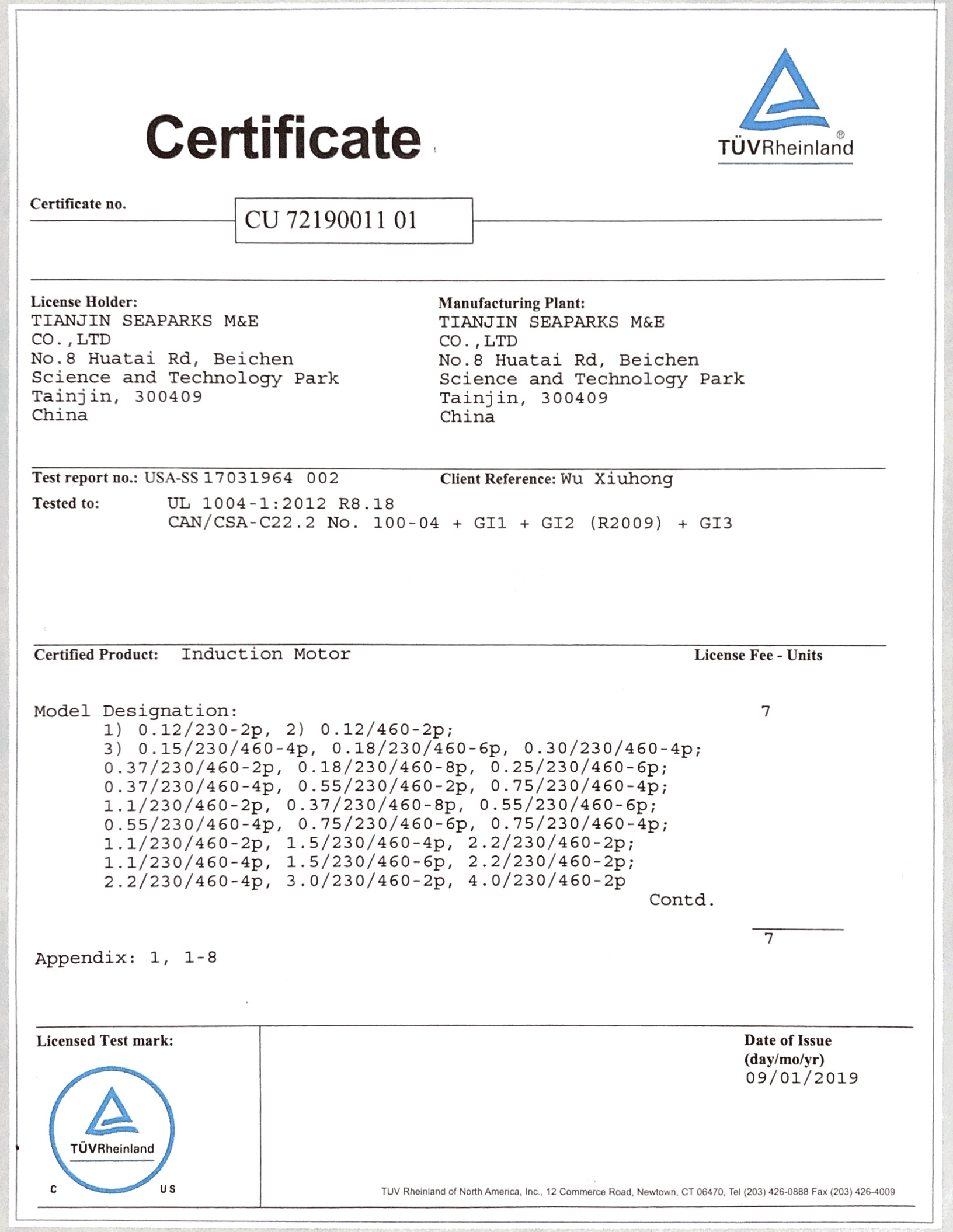
UL certification for induction motors used in electric drums is held for the USA and Canada under certificate numbers CU7219001101, CU7219001102 and CU7219000901, issued by TÜV Rheinland of North America, Inc. against UL 1004-1:2012R8.18 and CAN/CSA-C22.2 No.100-04.
Substance and material compliance
A RoHS verification report, certificate No. TSNEC24001272701, was issued by SGS for the EU market against 2011/65/EU and (EU) 2015/863, covering drum motors.
Quality management
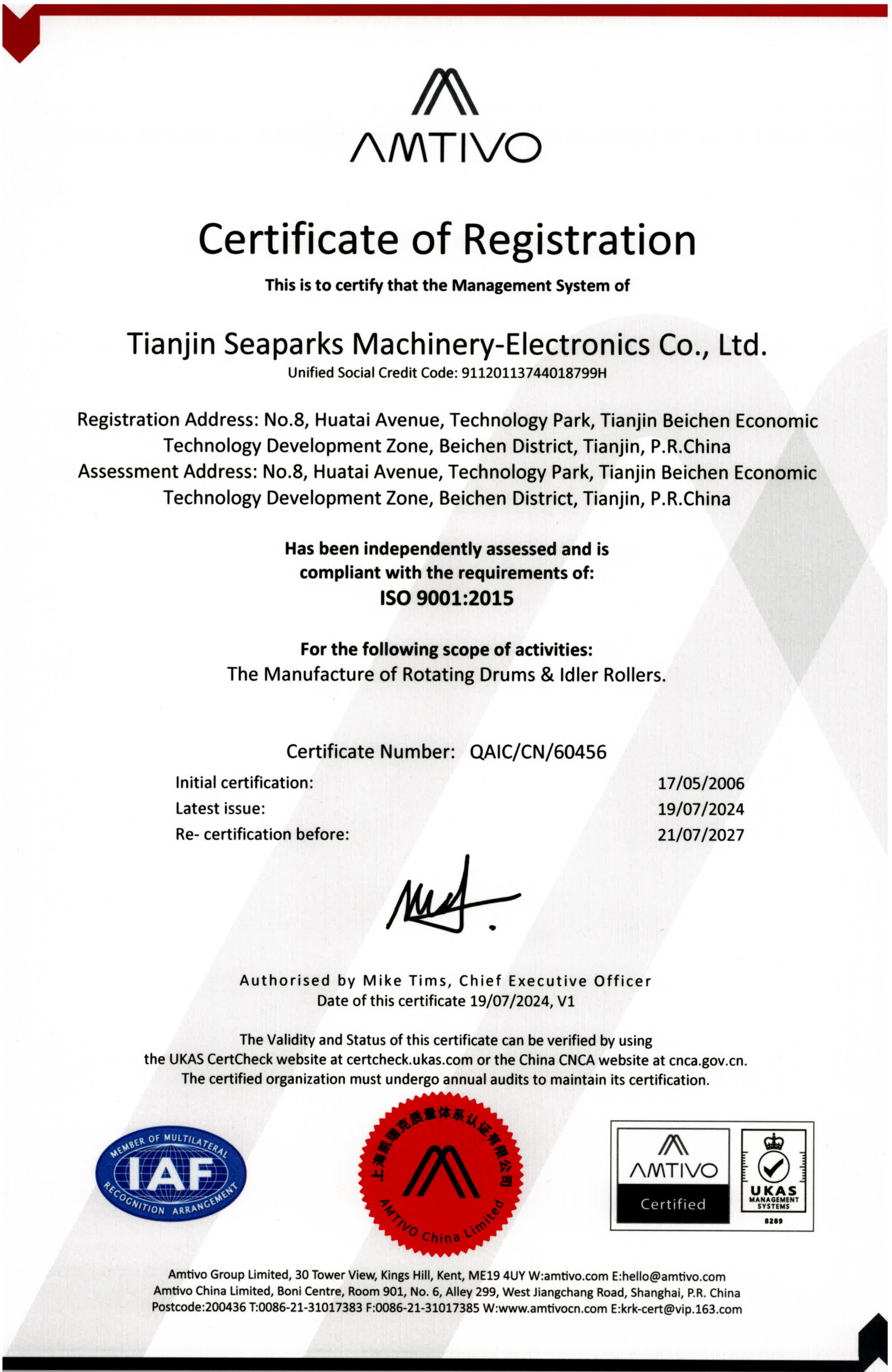
ISO 9001:2015 certificate QAIC/CN/60456, issued by AMTIVO, covers the manufacture of rotating drums and idler rollers and is valid to 21 July 2027. SEAPARKS also operates under ISO 14001 environmental management and ISO 45001 occupational health and safety management systems, and is recognised as a National High-tech Enterprise, a Tianjin Municipal Enterprise Technology Center and a Tianjin Specialized, Refined, Unique & Innovative Enterprise.
Drum Motor Comparison: Light-Duty IP66/IP67/IP69 vs Hygienic IP69K
The table below compares a representative light-duty platform with two hygienic IP69K models, using published specification data. It shows how protection class, housing material and mechanical capacity move together across the range.
| Parameter | TM80M (light duty) | DM165F (hygienic) | TM216F (hygienic) |
|---|---|---|---|
| Protection class | IP66/IP67/IP69 | IP69K | IP69K |
| Housing material | Carbon steel or 304 stainless steel | 304 stainless steel (316 optional) | 304 stainless steel (316 optional) |
| Motor type | Asynchronous, single-phase | Synchronous, three-phase | Asynchronous, three-phase |
| Roller diameter | Ø80 mm | Ø165 mm | Ø216 mm |
| Gear material | Polymer | Alloy steel | Alloy steel |
| Rated power | 0.034–0.11 kW | 1.1–3 kW | 3.5–4.0 kW |
| Rated torque | 2.71–25.9 Nm | 42.49–431.44 Nm | 207.36–507.6 Nm |
| Maximum belt pull | 630 N | 5229 N | 4700 N |
| Nominal belt speed | 0.05–0.85 m/s | 0.42–2.09 m/s | 0.8–2.1 m/s |
| Minimum roller width | 260 mm | 470 mm | 510 mm |
| Typical duty | Security screening, baggage handling, packaging, belt scale, general belt conveyors | Meat and food processing, packaging, belt sorting, assembly, agricultural product conveyors | Medium-duty food and pharmaceutical conveying |
Reading the table the right way matters. The light-duty column is not a lower-quality version of the hygienic column — it is a different duty class. A TM80M is a compact Ø80 mm drum built for light conveying and light splash exposure; a DM165F is a Ø165 mm hygienic drum designed to be washed down between production runs. Matching the wrong column to the zone is the error that audits expose.
Frequently Asked Questions
Which IP rating does a food or pharmaceutical washdown conveyor need?
If the drive sits in an open washdown zone and is cleaned with high-pressure, high-temperature water, the drum motor must be rated IP69K. IP69K is the highest ingress protection rating under IEC 60529 and is the rating required for hygienic drum motors in food processing to withstand high-pressure (up to 1450 psi) and high-temperature (80 °C) washdowns. SEAPARKS hygienic F-series motors — DM80F, TM80F, DM113F, TM113F, DM138F, TM138F, DM165F, TM165F, DM216F and TM216F — are published with an IP69K protection class. Where the conveyor is dry-side or only lightly hosed, IP66 or IP67 may be sufficient.
What documentation proves an IP69K drum motor rating?
Ask for the protection rating test report, not a brochure. SEAPARKS holds IP69K report No. LCSH071224011K, issued on 24 July 2024 by Suzhou Luxun Standard Technical Service Co., Ltd., a CNAS-accredited laboratory, against ISO 20653:2023. The scope is the IP69K high-temperature, high-pressure waterproof and dustproof performance of the electric drum. When you review a report, check the certificate number, the issuing laboratory and its accreditation, the standard referenced, the issue date, and which product families fall inside the scope.
Can a light-duty drum motor be used in a washdown area?
Only within limits. Light-duty SEAPARKS platforms — TM80M, TM113M, TM80A, TM113A, DM80A, DM113A, DM138A and TM138A — are published with an IP66/IP67/IP69 protection class and can be supplied with carbon steel or 304 stainless steel housings. That covers splash exposure, packaging halls, belt scale conveyors and security screening duty. It does not replace the IP69K hygienic platform. Where the cleaning regime involves daily high-pressure, high-temperature washdown, or where the plant hygiene standard requires a cleanable stainless housing, the F-series hygienic range is the correct specification.
What are the MOQ, delivery terms and payment terms for a drum motor order?
SEAPARKS sets a minimum order quantity of 1 unit, so a single motor can be ordered for validation. Delivery terms are FOB or CIF. Acceptance criteria are pre-shipment inspection, with customized inspection available at the customer's request. Payment terms for new customers are 100% advance payment.
How do I qualify an OEM drum motor manufacturer for a conveyor belt drive project?
Start with the documents a supplier cannot self-declare: an IP69K protection rating test report from a CNAS-accredited laboratory (SEAPARKS report LCSH071224011K, tested to ISO 20653:2023), CE certificates of conformity under the Low Voltage Directive 2014/35/EU and EMC Directive 2014/30/EU issued by TÜV Rheinland, UL certification covering the USA and Canada, a RoHS verification report, and an ISO 9001:2015 certificate whose scope covers rotating drums and idler rollers. Then verify the manufacturing base behind the paperwork: SEAPARKS has designed and built motorized conveyor drums since 2002 from a 50,000 m² facility in Tianjin, with a 40-engineer R&D team, and more than one million of its motorized drums are operating on conveying equipment worldwide. The final step is a sample run on your own conveyor through your own cleaning cycle before the series order is released.
Compliance Is Decided Before the Order, Not During the Audit
IP66, IP67 and IP69K are not interchangeable labels. They describe progressively more severe water exposure, and in food and pharmaceutical plants the correct one is determined by how the conveyor is cleaned — not by what the previous project used. Light-duty SEAPARKS drum motors such as the TM80M deliver IP66/IP67/IP69 protection with a choice of carbon steel or 304 stainless steel housings for dry-side, splash and general logistics duty. Hygienic F-series motors such as the DM165F deliver IP69K protection in a 304 stainless steel housing, supported by an accredited test report, for the open washdown zones that audits scrutinise most closely.
Specify the zone, fix the rating, verify the report, and validate on a sample. That sequence is what keeps a drum motor specification defensible when the auditor arrives.
Get the SEAPARKS Drum Motor Specification Pack
Request the IP69K test report details, model specifications for the hygienic F-series and light-duty platforms, and current lead times for your conveyor project.
Email: lijiao@seaparks.com | Tel / WhatsApp: +86 18322005232 | Web: www.seaparks.com
Download the Product & Corporation Catalogue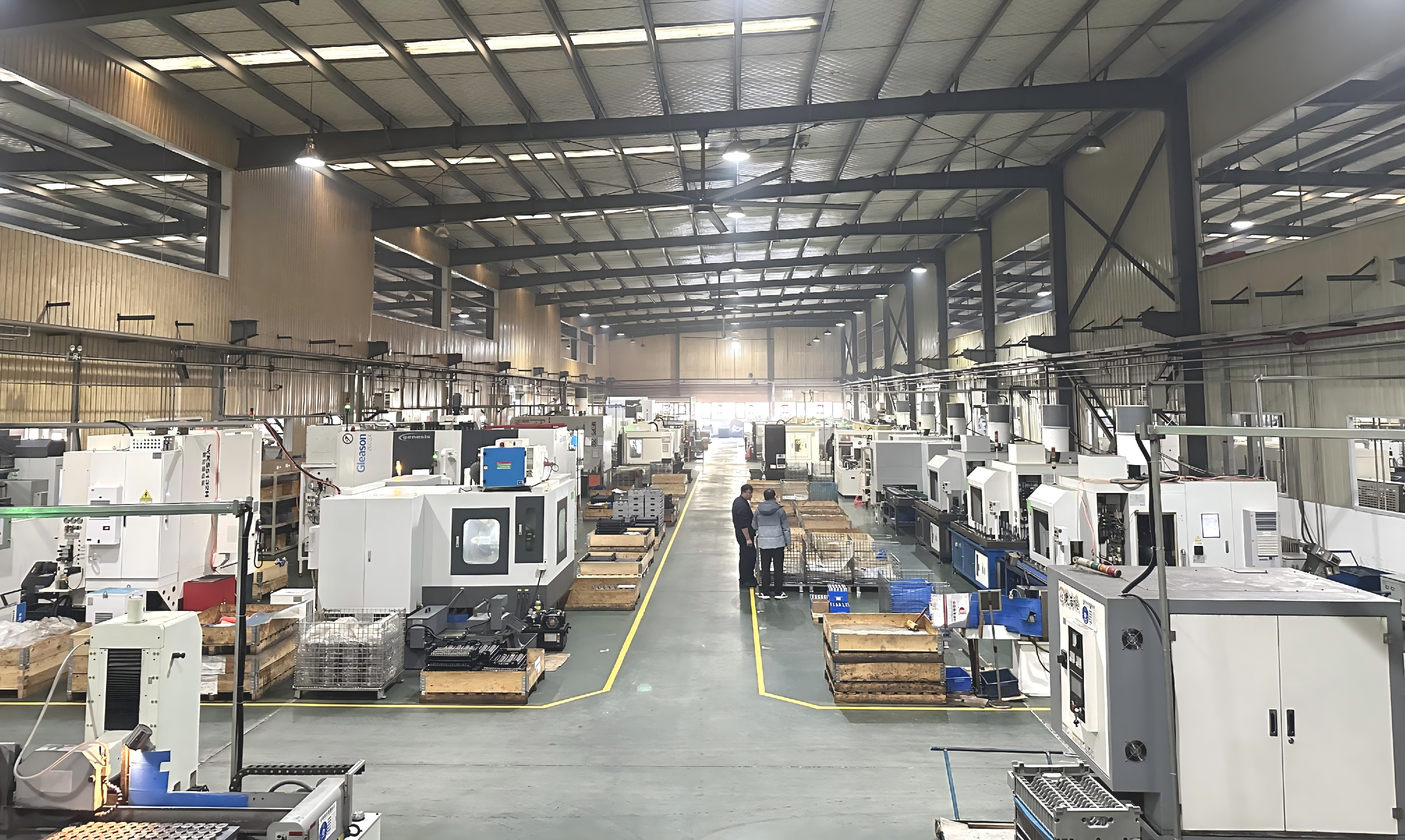
Have Questions or Need More Details?
Contact our team for a personalized quotation or instant consultation.
Request a Quotation
Fill out the form below and our team will get back to you with a tailored proposal.
WhatsApp Direct Chat
Prefer to chat in real-time? Message us on WhatsApp for instant assistance & quick answers.
- Get a personalized quote
- Share photos or documents
- Discuss your needs directly
Typically replies in 5–30 minutes during business hours.