
Single-Phase, Three-Phase, or DC Synchronous? Drum Motors Explained
A drum motor is a conveyor belt drive in which the electric motor, gearbox and bearings are sealed inside the drum — or pulley — that drives the belt. Because the whole drive sits inside the roller, there is no external gearbox, no chain, no coupling and no exposed rotating parts along the conveyor frame.
The size of the drum is fixed by the conveyor. What the buyer actually chooses is the motor technology inside it. The same roller diameter can carry a single-phase asynchronous motor, a three-phase asynchronous motor or a synchronous motor, and that choice changes belt pull, torque at low speed, the available speed band and the type of control panel the conveyor needs.
This article explains how those motor technologies differ in conveyor drives, using published model data from SEAPARKS (Tianjin Seaparks Machinery-Electronics Co., Ltd., a drum motor manufacturer founded in 2002 in Tianjin, China).
Why the Motor Type Matters More Than the Drum Diameter
A Ø113 mm drum motor is not one product. Within the SEAPARKS light-duty range, the same roller diameter is listed with three different motor configurations, and none of those differences appear when a specification is written as “Ø113 mm, 0.55 kW”:
- TM113A, three-phase asynchronous: 0.12–0.55 kW, rated torque 10.34–82.99 Nm, maximum belt pull 1,469 N, nominal belt speed 0.09–1.4 m/s, minimum roller width 335 mm.
- TM113A, single-phase asynchronous: 0.12–0.23 kW, rated torque 10.34–79.67 Nm, maximum belt pull 1,410 N, nominal belt speed 0.08–0.71 m/s.
- DM113A, three-phase synchronous: 0.12–0.55 kW, rated torque 9.94–115.99 Nm, maximum belt pull 2,053 N, nominal belt speed 0.14–0.68 m/s.
The consequences are practical rather than academic. The synchronous DM113A delivers about 40% more peak torque and about 40% more maximum belt pull than the asynchronous TM113A on the same frame, while the asynchronous version covers a speed band roughly twice as wide. A buyer who specifies on diameter and rated power alone can therefore end up with a drive that cannot start a fully loaded belt at low speed — or with a conveyor carrying far more motor and control than the process requires.
Motor type also settles secondary engineering questions that are expensive to change later: whether the conveyor can run from a single-phase supply, whether a variable-frequency drive is needed for speed control, how much torque is available during accumulation or indexing, and which control panel has to be ordered alongside the drum.
Industry Background: Where Each Motor Technology Sits in the Market
Demand for drum motors is being pulled by logistics automation and food processing rather than by general industry. Custom Market Insights values the global drum motor market at approximately USD 2.07–2.13 billion for 2023–2025. Estimates for the same period differ by definition rather than direction: Dataintelo puts 2025 at about USD 2.8 billion and Market.us at about USD 2.0 billion, largely because the reports draw the category boundary differently. Growth forecasts diverge along similar lines — 4.06% CAGR from Maximize Market Research against 7.3% from DataHorizzon Research.
The motor-technology split is more consistent. Dataintelo attributes 52.3% of 2025 drum motor revenue to the AC motor segment, which in practice is dominated by the three-phase asynchronous motor — the standard industrial induction drive. The same source places Asia Pacific as the fastest-growing region, with a projected 38.2% revenue share in 2025. Heavy-duty specialists such as Van der Graaf, estimated at around 7.8% global share by Dataintelo (a source rated medium reliability in this reference set), concentrate on mining and aggregate applications rather than light conveying.
Efficiency is the structural driver behind motor selection. Energy-efficient drum motors can reach 82–83% overall efficiency compared with traditional geared motors (Rulmeca / Interroll). That matters more in a drum motor than in an external drive because motor, gearing and bearings share one sealed housing: losses accumulate in a single place, and the motor technology and gearing determine how much heat must leave through the drum shell.
Two regulatory reference points shape specification across regions. Drum motors for the European market must comply with the Low Voltage Directive 2014/35/EU and carry CE marking (European Commission). Hygienic washdown applications depend on IP69K, the highest ingress protection rating under IEC 60529, which must withstand high-pressure cleaning at up to 1,450 psi and 80 °C (IEC / IBT Industrial Solutions).
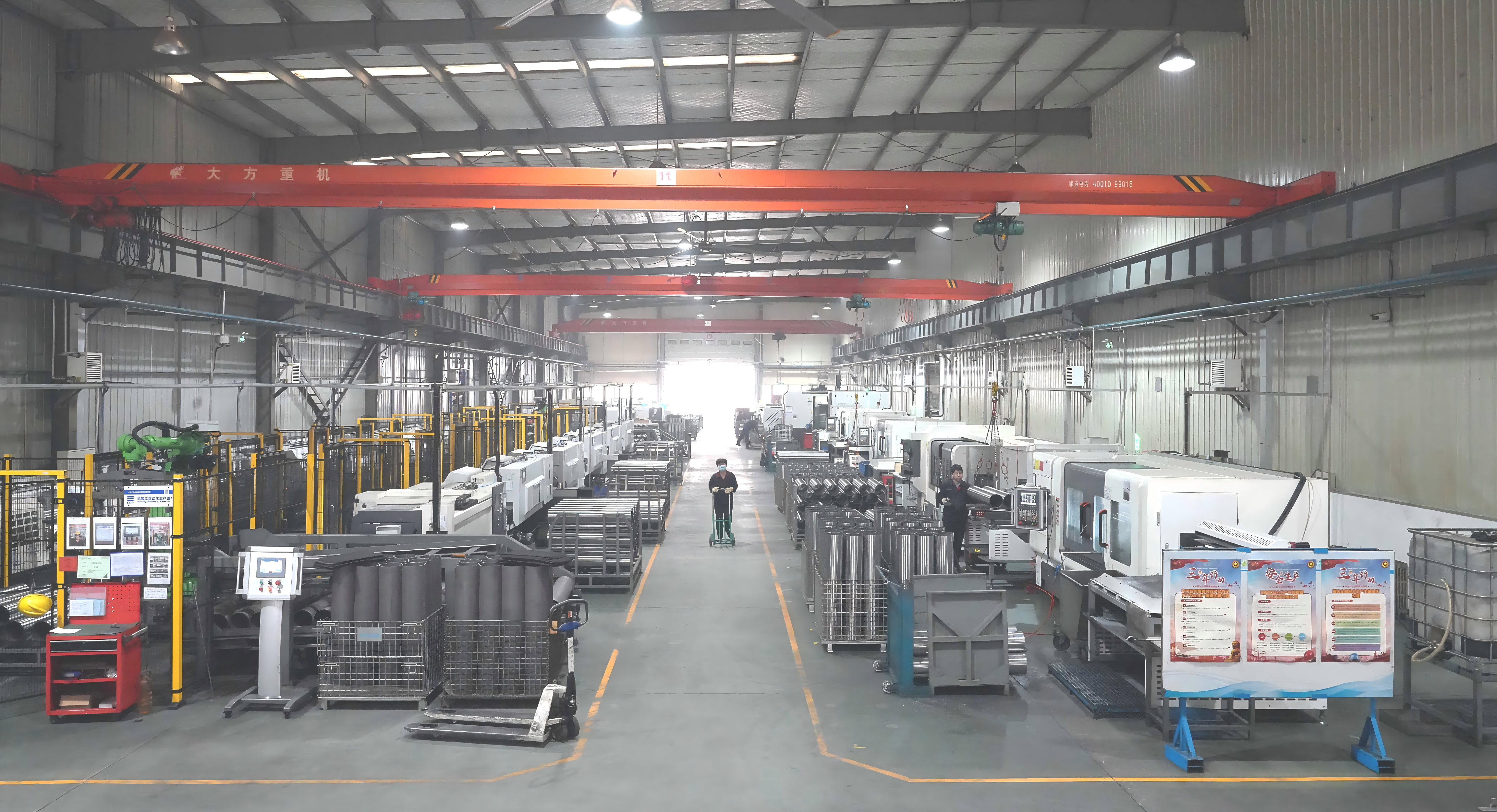
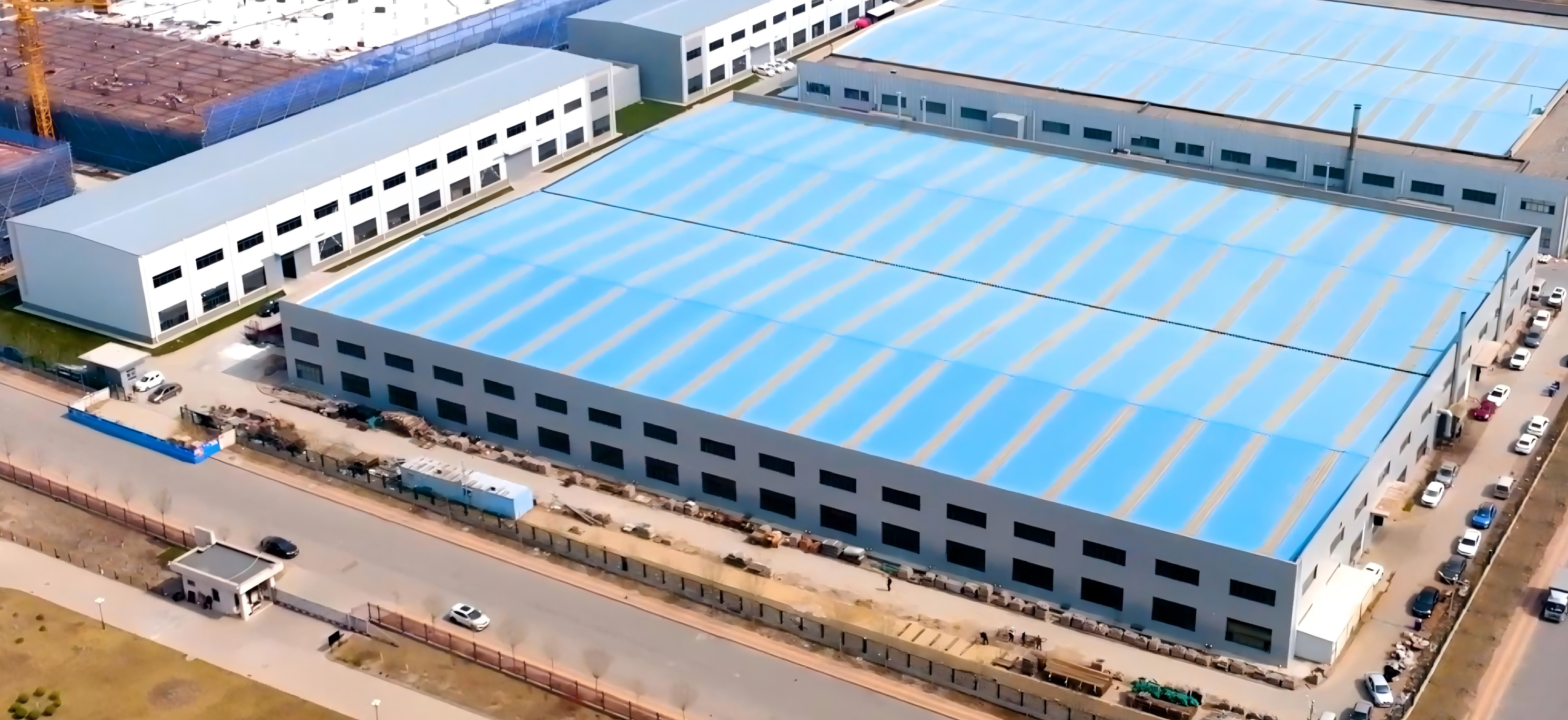
SEAPARKS (Tianjin Seaparks Machinery-Electronics Co., Ltd.) has manufactured motorized conveyor drums since 2002 from a 50,000 m² plant in Tianjin, China, with nearly 200 high-end machine tools and more than 20 automatic feeding production lines. Its drum motors are exported to more than 50 countries and are used in airport baggage handling, security inspection, express sorting, food and pharmaceutical production, and general manufacturing.
The Three Motor Technologies Inside a Drum Motor
How to read the model codes used below: the first letter describes the motor (T = asynchronous, D = synchronous), the number is the roller diameter in millimetres, and the suffix describes the series (M = light-duty single-phase range, A = light-duty standard range, F = hygienic stainless-steel range with IP69K, H = heavy-duty range). Note that “synchronous” and “DC” are not the same thing in this catalogue: the Ø80 mm synchronous models DM80A and DM80F are listed with Phase: DC, while the larger synchronous frames (DM113F and above) are three-phase synchronous motors.
Single-phase asynchronous drum motors (TM80M, TM113M)
Single-phase asynchronous drum motors run from a single-phase AC supply and use an induction rotor that turns slightly slower than the rotating field. In the SEAPARKS range they appear at Ø80 mm and Ø113 mm, where loads are modest and the conveyor is often a short module rather than a long line:
- TM80M: Ø80 mm, rated power 0.034–0.11 kW, rated torque 2.71–25.9 Nm, maximum belt pull 630 N, nominal belt speed 0.05–0.85 m/s, minimum roller width 260 mm, protection class IP66/IP67/IP69, carbon steel or 304 stainless steel housing.
- TM113M: Ø113 mm, 0.12–0.18 kW, 5.81–43.51 Nm, maximum belt pull 770 N, 0.11–1.05 m/s, minimum roller width 310 mm, IP66/IP67/IP69.
- TM113A single-phase variant: Ø113 mm, 0.12–0.23 kW, 10.34–79.67 Nm, maximum belt pull 1,410 N, 0.08–0.71 m/s.
Their value is simplicity: no three-phase supply is required and the drive set is smaller. Their limit is the ceiling on power and belt pull — 0.23 kW and 1,410 N in this range. If the same Ø113 frame has to reach 0.55 kW or a belt speed of 1.4 m/s, the three-phase version of the same model is the one that covers it.
Three-phase asynchronous drum motors (TM80A, TM113A, TM138A, TM113F, TM165F, TM216F, TM320H)
Three-phase asynchronous motors are the workhorse of conveyor drives and the type most often quoted in drum motor tenders. They run from a standard three-phase industrial supply and can be speed-controlled through a variable-frequency drive, which is why the widest speed and power bands in the catalogue belong to this family.
- TM80A (three-phase): Ø80 mm, 0.04–0.12 kW, 2.96–28.91 Nm, maximum belt pull 705 N, 0.08–1.02 m/s, minimum roller width 330 mm.
- TM113A (three-phase): Ø113 mm, 0.12–0.55 kW, 10.34–82.99 Nm, 1,469 N, 0.09–1.4 m/s, minimum roller width 335 mm.
- TM138A: Ø138 mm, 0.25–1.1 kW, 19.46–243.23 Nm, 3,525 N, 0.11–1.69 m/s, minimum roller width 340 mm.
- Hygienic F series: TM113F, TM138F, TM165F and TM216F with IP69K protection and 304 stainless steel housings (316 stainless steel optional), power 0.12–4.0 kW, rated torque to 507.6 Nm and maximum belt pull to 4,700 N (TM216F).
- Heavy-duty H series: TM138H through TM320H, 0.25–7.5 kW, rated torque to 1,059 Nm and maximum belt pull to 6,600 N (TM320H), with nominal belt speeds up to 3.37 m/s (TM270H).
Two limits are worth stating before a model is selected. Asynchronous motors produce no torque at zero speed, so a belt that must start fully loaded and hold position needs either additional starting margin or a controlled start. And the highest belt-pull figures in the range are all asynchronous, but they arrive with larger frames and higher mass.
Synchronous drum motors: DC at Ø80 mm, three-phase from Ø113 mm
Synchronous drum motors hold a fixed relationship between the rotating field and the rotor, and permanent-magnet synchronous designs produce usable torque at low speed without the slip of an induction motor. In the published data this appears as higher torque ratings at the same diameter:
| Model (same Ø113 mm frame) | Motor type | Rated power | Rated torque | Max. belt pull | Nominal belt speed |
|---|---|---|---|---|---|
| TM113A | Asynchronous, single-phase | 0.12–0.23 kW | 10.34–79.67 Nm | 1,410 N | 0.08–0.71 m/s |
| TM113A | Asynchronous, three-phase | 0.12–0.55 kW | 10.34–82.99 Nm | 1,469 N | 0.09–1.4 m/s |
| DM113A | Synchronous, three-phase | 0.12–0.55 kW | 9.94–115.99 Nm | 2,053 N | 0.14–0.68 m/s |
Other matched pairs follow the same pattern. At Ø138 mm the asynchronous TM138A is rated to 243.23 Nm against 273.58 Nm for the synchronous DM138A. In the hygienic range the synchronous DM165F reaches 431.44 Nm against 342.13 Nm for the asynchronous TM165F, and the synchronous DM216F reaches 568.98 Nm against 507.6 Nm for TM216F.
DC synchronous drum motors are the compact end of the same idea. DM80A is a Ø80 mm DC synchronous drum motor rated 0.09–0.12 kW, 3.49–21.89 Nm, maximum belt pull 534 N, nominal belt speed 0.16–1.03 m/s and minimum roller width 310 mm. DM80F is the hygienic equivalent with IP69K protection, a 304 stainless steel housing (316 stainless steel optional) and a 320 mm minimum roller width.
The trade-off is speed band and control. In the data set the synchronous frames cover narrower nominal belt speed ranges than the asynchronous frames of the same diameter — 0.14–0.68 m/s for DM113A against 0.09–1.4 m/s for TM113A — so they are chosen where low-speed torque and drive repeatability matter more than a wide speed window, and where the conveyor control is already designed around a synchronous drive.
Step-by-Step: Choosing the Motor Type for a Conveyor Belt Drive
Step 1 — Start from the required belt pull, not the motor power
Belt pull is the force the drum must apply to move the belt and its load, and it is the number that decides whether the drive can run the conveyor at all. Across the SEAPARKS range, maximum belt pull runs from 534 N (DM80A) to 6,600 N (TM320H). Calculating the total — belt friction, incline component and load — before looking at kilowatts prevents the most common sizing error.
Step 2 — Fix the belt speed band the process needs
Process speed sets the gear ratio and narrows the model list. The catalogue covers 0.05–0.85 m/s (TM80M) for slow transfer and indexing duty, and up to 2.0 m/s (TM165F) or 3.37 m/s (TM270H) for high-throughput lines. If speed has to be adjustable over a wide window, a three-phase asynchronous model paired with a variable-frequency drive is the usual combination; if the line runs at one speed, that control cost can be avoided.
Step 3 — Match the motor type to the supply and control available on site
Single-phase asynchronous models remove the need for a three-phase supply but cap power at 0.23 kW and belt pull at 1,410 N in this range. Three-phase asynchronous models cover 0.04–7.5 kW and belt pull up to 6,600 N and are the standard choice where a variable-frequency drive is planned. Synchronous models — DC at Ø80 mm, three-phase from Ø113 mm upward — are specified where torque at low speed or drive repeatability outweighs the wider speed band of an induction motor.
Step 4 — Check torque at the lowest speed the conveyor will actually run
Conveyors rarely fail at full speed; they fail when a loaded belt has to start, index or accumulate. Compare the rated torque range of the candidates — 2.96–1,059 Nm across the three-phase asynchronous models, 9.94–568.98 Nm across the three-phase synchronous models — against the torque required at the slowest operating point, not the average.
Step 5 — Confirm the environment and the housing material
Light-duty and heavy-duty models are rated IP66/IP67/IP69 and use carbon steel or 304 stainless steel housings. Hygienic F-series models are rated IP69K and use 304 stainless steel, with 316 stainless steel optional — the configuration to specify for food processing, meat processing and pharmaceutical lines where high-pressure washdown is routine.
Step 6 — Check the mechanical fit, then validate with a sample
Roller diameter and minimum roller width must fit the conveyor frame: minimum widths start at 260 mm (TM80M) and extend to 700 mm (TM270H). Because the drum motor is also the pulley, a dimensional mismatch usually means reworking the frame rather than swapping a component, which is why a physical sample test on the actual belt before volume ordering is worth the extra step.
Use Cases: Which Motor Type Fits Which Conveyor
- Security screening and X-ray inspection conveyors: compact light-duty drum motors; the 260 mm minimum roller width of TM80M suits short inspection modules. The light-duty range is listed for security screening conveyors in airports and railway stations, airport baggage handling systems, packaging conveyors, belt scale conveyors and general belt conveyors.
- Airport baggage handling and check-in conveyors: light-duty three-phase or single-phase models up to Ø138 mm, with belt pull to 3,525 N (TM138A) for longer baggage lines.
- Food, meat and pharmaceutical processing: hygienic IP69K F-series drum motors in 304 stainless steel (316 optional), from Ø80 mm to Ø216 mm, with three-phase asynchronous versions to 4,700 N belt pull (TM216F) and three-phase synchronous versions to 5,244 N (DM216F).
- E-commerce, express sorting and automated warehousing: heavy-duty H-series drum motors, listed for express logistics, warehouse logistics, e-commerce logistics, automated warehousing, airport logistics, manufacturing logistics and automated sorting systems — up to 7.5 kW, 1,059 Nm and 6,600 N belt pull (TM320H).
- Packaging, assembly and light general conveying: Ø80–Ø138 mm light-duty models, with single-phase options where only a single-phase supply exists and three-phase options where speed control is required.
- Agricultural product sorting and processing: hygienic F-series and light-duty models, both listed for agricultural product belt conveyors.
Comparison Table: Motor Technologies in SEAPARKS Drum Motors
The table summarises the published ranges for each motor technology. It compares motor technologies rather than brands; the figures are the minimum and maximum values across the models listed in each family.
| Motor technology | Example models | Rated power | Rated torque | Max. belt pull | Nominal belt speed | Protection / housing |
|---|---|---|---|---|---|---|
| Single-phase asynchronous | TM80M, TM113M | 0.034–0.18 kW | 2.71–43.51 Nm | 630–770 N | 0.05–1.05 m/s | IP66/IP67/IP69; carbon steel or 304 stainless steel |
| Three-phase asynchronous | TM80A, TM113A, TM113F, TM138A, TM165F, TM216F, TM320H | 0.04–7.5 kW | 2.96–1,059 Nm | Up to 6,600 N | 0.08–3.37 m/s | IP66/IP67/IP69 or IP69K; carbon steel or 304 stainless steel (316 optional on F series) |
| Three-phase synchronous | DM113A, DM113F, DM138A, DM165F, DM216F | 0.12–5.5 kW | 9.94–568.98 Nm | Up to 5,244 N | 0.14–2.5 m/s | IP66/IP67/IP69 or IP69K; carbon steel or 304 stainless steel (316 optional on F series) |
| DC synchronous | DM80A, DM80F | 0.09–0.12 kW | 3.49–21.89 Nm | 534 N | 0.16–1.03 m/s | IP66/IP67/IP69 or IP69K; carbon steel or 304 stainless steel |
Read together, the ranges show a clear division of labour: single-phase asynchronous models cover the smallest conveyors and the simplest supplies; three-phase asynchronous models cover the widest speed window and the highest belt pulls; synchronous models — DC at Ø80 mm and three-phase above — deliver the highest torque per frame where low-speed performance decides the design.
FAQ: Drum Motor Motor Types and Specification
Which certifications and IP ratings should a drum motor carry for EU and North American conveyor projects?
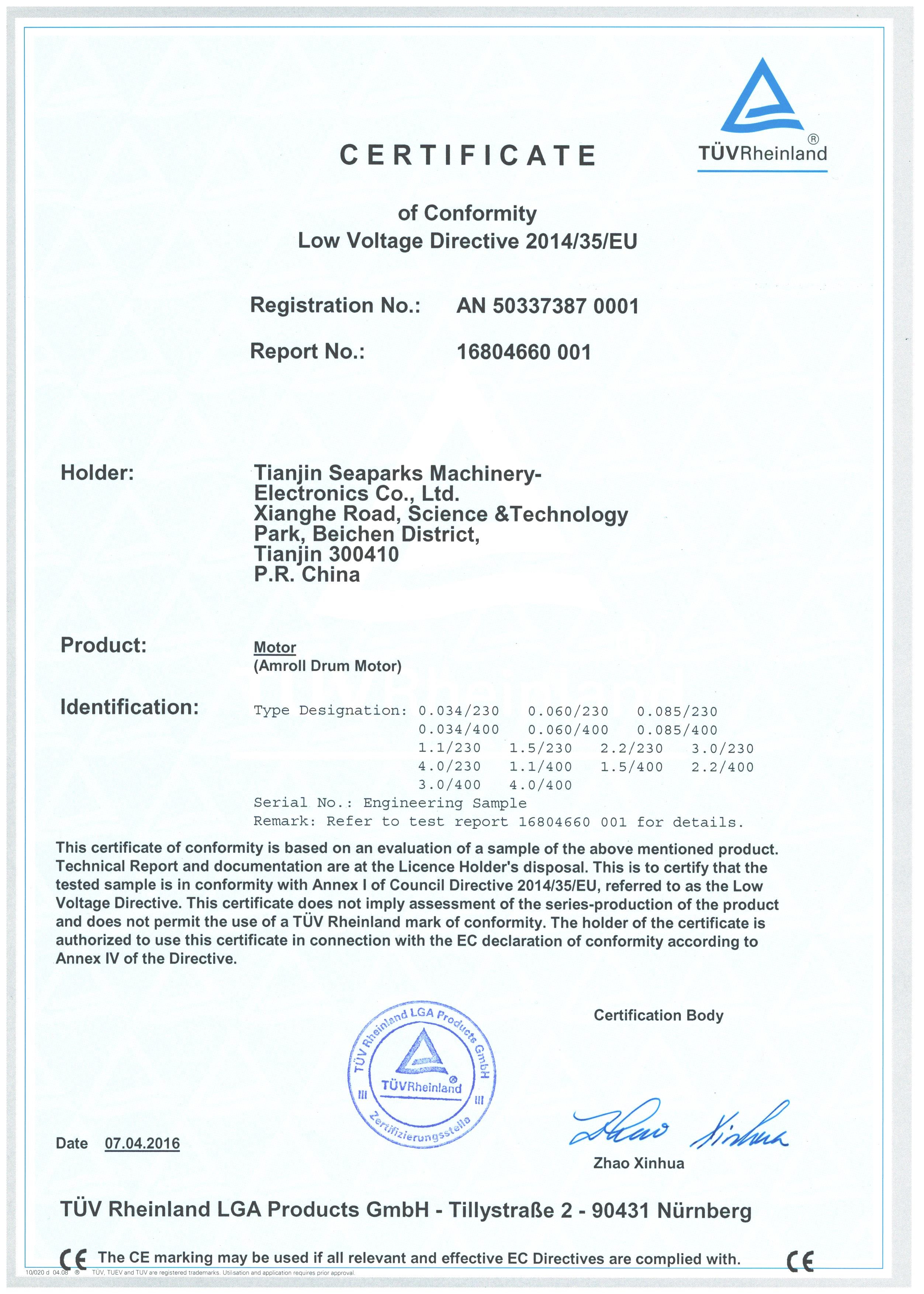
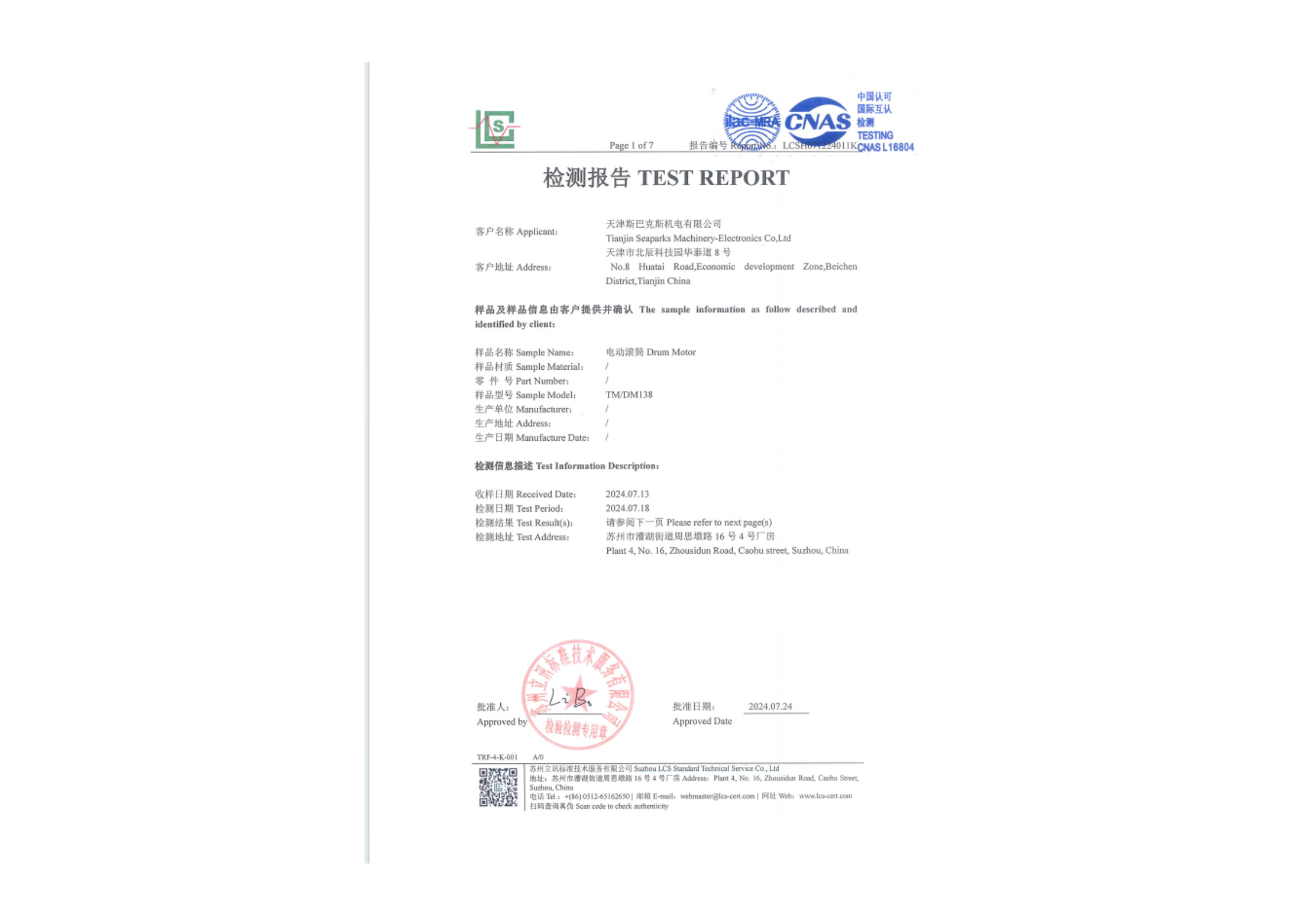
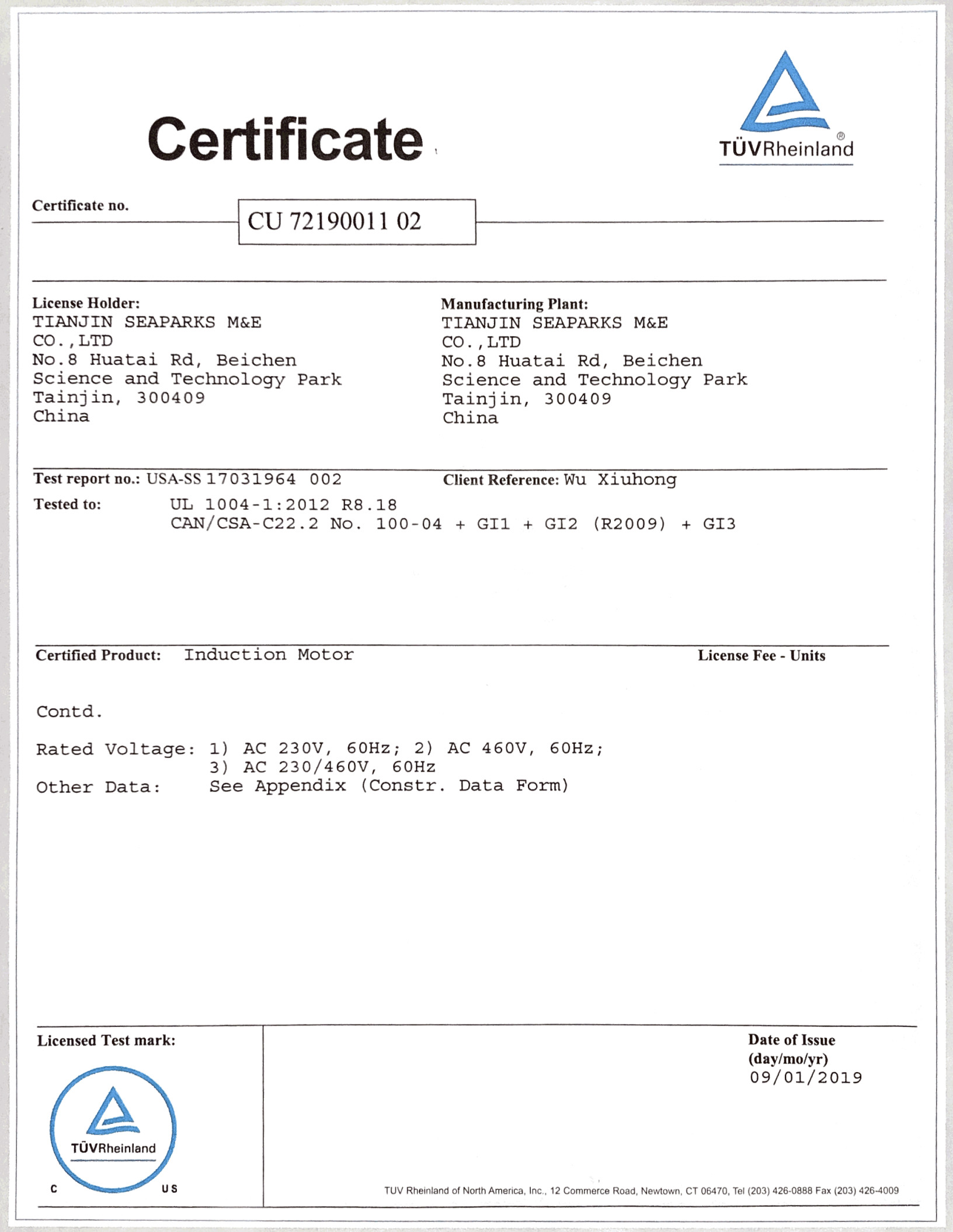
For the EU, drum motors fall under the Low Voltage Directive 2014/35/EU and require CE marking, with electromagnetic compatibility handled separately under Directive 2014/30/EU. SEAPARKS holds TÜV Rheinland CE certificates of conformity for LVD 2014/35/EU (AN 50337407 0001 and AN 50337387 0001, issued 7 April 2016) and for EMC 2014/30/EU referencing EN 60034-1:2010 (AE 50461043 0001, issued 19 March 2020). For the USA and Canada, the induction motors used in the drums are covered by TÜV Rheinland UL certificates CU7219001101, CU7219001102 and CU7219000901 to UL 1004-1:2012 R8.18 and CAN/CSA-C22.2 No.100-04. RoHS compliance is documented by an SGS verification report (TSNEC24001272701) to 2011/65/EU and (EU)2015/863. Ingress protection is stated per model: IP66/IP67/IP69 for the light-duty and heavy-duty ranges, and IP69K for the hygienic F series, verified under ISO 20653:2023 by test report LCSH071224011K.
How do I choose between a single-phase, three-phase and DC synchronous drum motor?
Match the motor to three constraints in order: required belt pull, available supply and control, and the lowest speed at which the conveyor must produce torque. Single-phase asynchronous models (TM80M, TM113M) are rated 2.71–43.51 Nm with belt pull to 770 N and suit short conveyors where no three-phase supply exists. Three-phase asynchronous models cover the widest range — 0.04–7.5 kW and belt pull to 6,600 N — and pair with a variable-frequency drive when speed must be adjustable. Synchronous models deliver higher torque on the same frame (DM113A: 115.99 Nm against TM113A: 82.99 Nm at Ø113 mm), and the DC synchronous models DM80A and DM80F cover compact 0.09–0.12 kW drives with 534 N belt pull.
Can a drum motor be customized to a specific conveyor — diameter, power, speed and roller width?
Yes, within the published configuration ranges. Diameter steps in the range are Ø80, Ø100, Ø113, Ø138, Ø165, Ø174, Ø216, Ø270 and Ø320 mm. Rated power spans 0.034–7.5 kW, rated torque 2.36–1,059 Nm and maximum belt pull 534–6,600 N, with nominal belt speeds from 0.05 m/s to 3.37 m/s. Minimum roller widths run from 260 mm to 700 mm depending on model. Housing material, gear type and protection class follow the series: carbon steel or 304 stainless steel with IP66/IP67/IP69 for the light-duty and heavy-duty ranges, and 304 stainless steel (316 optional) with IP69K for the hygienic F series. The practical customization task is matching a published belt-pull and speed combination to the conveyor rather than designing a new motor from scratch.
What commercial terms apply to a first drum motor order?
SEAPARKS quotes a minimum order quantity of 1 unit, with FOB or CIF delivery terms. Acceptance is based on pre-shipment inspection, and customized inspection can be arranged on customer request. Payment terms for new customers are 100% advance payment. Quotations for different configurations are only comparable once three items are fixed: motor type and control, housing material (carbon steel versus 304 or 316 stainless steel) and protection class.
How can a drum motor be validated before a volume order?
Because the minimum order quantity is 1 unit, a sample can be ordered and tested on the actual conveyor before volume purchasing, and pre-shipment inspection is part of the standard acceptance criteria. Testing should cover the operating points that decide the outcome: start under full load, the slowest speed the line will run, and — for hygienic models — washdown exposure at the specified IP rating. Product and corporation documentation is available in the SEAPARKS catalogue, and specifications can be confirmed with the sales contact before ordering.
Specify the motor type before you specify the drum. Send the required belt pull, belt speed range and the supply available on site, and SEAPARKS will confirm which drum motor configuration — single-phase asynchronous, three-phase asynchronous or synchronous — covers the duty.
Contact: Laura Li — lijiao@seaparks.com | WhatsApp +86 18322005232 | www.seaparks.com
Address: No.8 Huatai Road, Beichen Science & Technology Industrial Park, Tianjin, China
Download the Product & Corporation catalogue (PDF): Product & Corporation 260624
Conclusion
Drum motors differ less in the drum than in the motor inside it. Single-phase asynchronous models (TM80M, TM113M) make short conveyors possible where only a single-phase supply exists, but cap power at 0.23 kW and belt pull at 1,410 N in this range. Three-phase asynchronous models remain the default for industrial conveying because they cover the widest power and speed range and the highest belt pulls — up to 7.5 kW and 6,600 N in the heavy-duty H series — and accept variable-speed control from a VFD. Synchronous models, DC at Ø80 mm and three-phase from Ø113 mm upward, trade a narrower speed band for higher torque at low speed on the same frame.
The selection sequence that avoids rework is short: calculate belt pull, fix the speed band, match the motor type to the supply and control available, verify torque at the slowest operating point, confirm the housing material and IP rating the environment demands, and check minimum roller width against the conveyor frame. Validate the choice with a sample before committing to volume.
Have Questions or Need More Details?
Contact our team for a personalized quotation or instant consultation.
Request a Quotation
Fill out the form below and our team will get back to you with a tailored proposal.
WhatsApp Direct Chat
Prefer to chat in real-time? Message us on WhatsApp for instant assistance & quick answers.
- Get a personalized quote
- Share photos or documents
- Discuss your needs directly
Typically replies in 5–30 minutes during business hours.