Solving Tunnel Ventilation Challenges: Low Air Leakage
In a 19.68 km high-speed rail tunnel, the ventilation system must deliver a designed volume of fresh air to the working face continuously. Every cubic metre that escapes through the duct wall or a joint on the way is a cubic metre the fan has to make up. That is why low air leakage, not fan size alone, decides whether a long tunnel ventilation system performs the way it was designed to.
The Xi'an–Chengdu Railway project, a key component of China's national "Eight Vertical and Eight Horizontal" high-speed rail network, documents this at scale. The tunnel runs 19.68 kilometres. The ventilation installation included 20 km of ventilation duct. The project achieved a low air leakage rate in the long tunnel ventilation system and was completed within four years. This article explains where leakage actually comes from in a long rail tunnel, how the duct specification is built to control it, and what a project team should verify before ordering.
Why Air Leakage Is the Deciding Constraint in Long Rail Tunnels
Air leakage in a tunnel ventilation duct is a compounding problem rather than a fixed loss. In a short drive, a small percentage of leakage is tolerable because the fan has margin. In a tunnel measured in tens of kilometres, the same percentage is applied to a much larger duct surface area and a much longer joint count, and the delivered airflow at the face falls away from the design value.
Three characteristics of long high-speed rail tunnels make the problem sharper:
- Continuous duty. Tunnel ventilation duct runs in 24/7 continuous high-pressure ventilation mode. Leakage is not an occasional event; it is a permanent operating cost and a permanent safety margin reduction.
- Pressure and friction. Deep underground shafts expose the duct to high pressure, elevated humidity and constant friction against the tunnel lining and hanger systems. Abrasion opens leak paths faster than pressure alone.
- Gas dilution duty. The duct is connected to a ventilation fan that blows fresh air into the underground tunnel to dilute hazardous gases and support dust extraction. If delivered airflow drops, gas dilution falls with it. In the United States, OSHA 29 CFR 1926.800(k)(2) requires a minimum fresh air supply of 200 cfm per worker underground, and mine ventilation ducting in the US must comply with MSHA 30 CFR Part 75 — both make delivered airflow a compliance question, not only an efficiency question.
Leakage is also treated as a class-based performance attribute across the industry. The European Standard EN 12237 specifies airtightness and pressure requirements for circular sheet metal ducts. Fabric and composite ducts are evaluated differently — through seam construction, weld integrity and joint design rather than sheet-metal classification. Those three elements are where a low-leakage specification is actually won or lost.
The Market Context Behind Tunnel Ventilation Duct Demand
Demand for tunnel and mine ventilation ducting is growing alongside underground infrastructure spending. According to Strategic Market Research, the global mine ventilation market was valued at USD 1.42 billion in 2024 and is projected to reach USD 2.03 billion by 2030, a CAGR of 6.2%. Persistence Market Research identifies underground mining as the dominant segment of that market, driven by the critical need for hazardous gas dilution — the same duty the Xi'an–Chengdu duct installation performs in a rail tunnel.
On the duct side, Intel Market Research puts the global flexible ducting market at USD 203.97 million in 2024, expected to reach USD 335.78 million by 2033. Spherical Insights reports that over 2.1 billion metres of flexible ducting were manufactured globally in 2023, with 30% dedicated to industrial ventilation. SNS Insider values the wider air duct market at USD 7.14 billion in 2023, projected to reach USD 10.20 billion by 2032. Market Research Future estimates Asia-Pacific as the fastest-growing ventilation systems region, with a CAGR of 5.45% through 2034.
The practical implication for buyers is straightforward: capacity exists in the market, but leakage performance does not travel with capacity. It is determined by how a specific duct is built. Established industrial ventilation duct players such as Lindab Group and Systemair are frequently cited in global market analyses, and Chinese suppliers including Jiangsu Sulong Eco-Technologies Co., Ltd. (SULONG) operate in the same procurement field. Jiangsu Sulong Eco-Technologies is a National High-Tech Enterprise based in Funing, Yancheng, Jiangsu Province, China, manufacturing PVC/PE/TPU/TPO composite ventilation ducts for mining and tunnel projects.
The Xi'an–Chengdu Railway Case: A 19.68 km Tunnel, 20 km of Duct
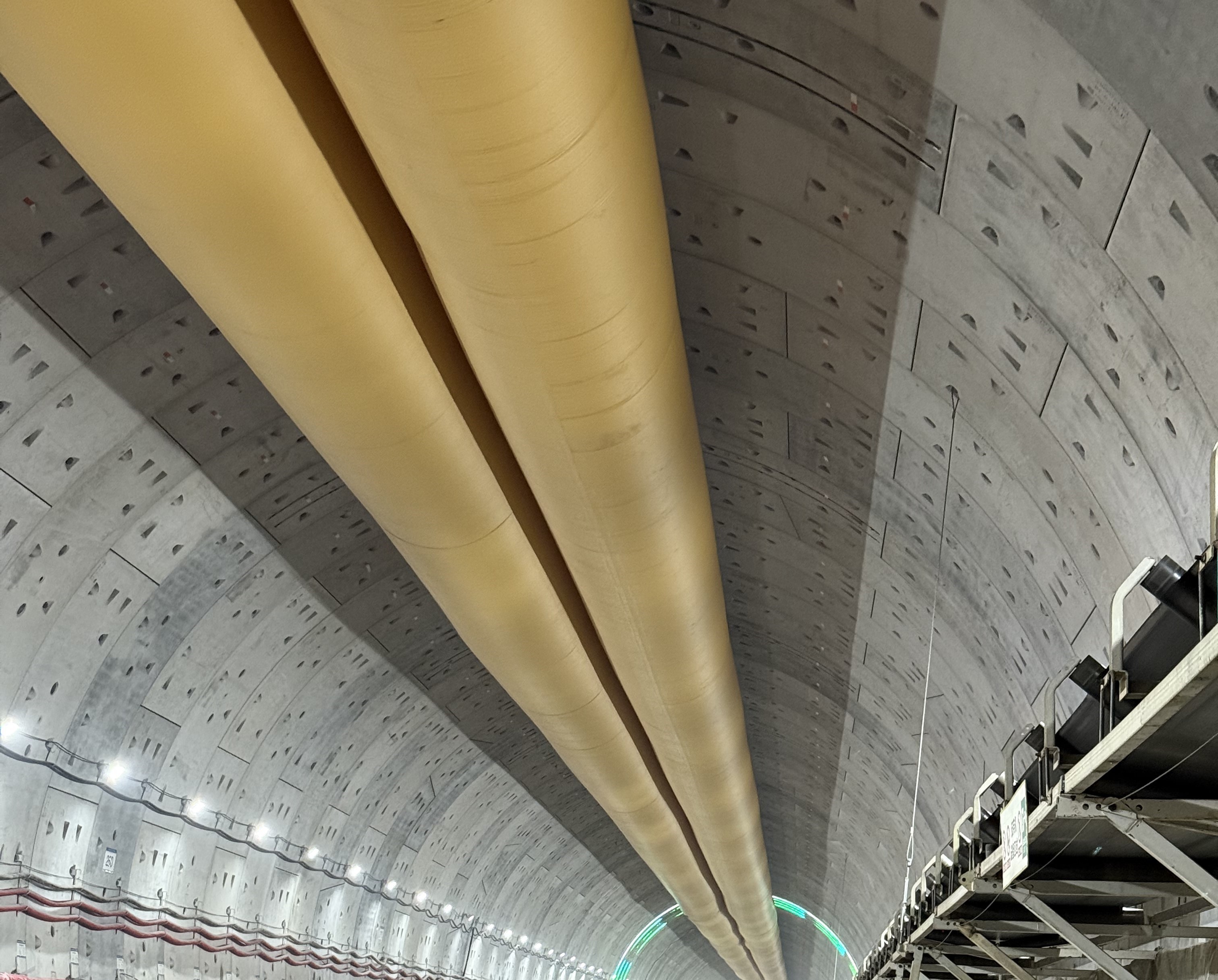
The Xi'an–Chengdu Railway project, undertaken by China Railway 2nd Engineering Group, is one of the largest and most technically challenging projects currently under construction for the group. It is located in China and forms part of the national high-speed rail backbone. The tunnel has a total length of 19.68 kilometres, and the ventilation installation includes 20 km of ventilation duct.
| Project Parameter | Detail |
|---|---|
| Project | Xi'an–Chengdu Railway, China |
| Contractor | China Railway 2nd Engineering Group |
| Network role | Key component of the national "Eight Vertical and Eight Horizontal" high-speed rail network |
| Tunnel length | 19.68 km |
| Ventilation duct installed | 20 km |
| Application | Underground tunnel ventilation |
| Documented outcome | Achieved a low air leakage rate in the long tunnel ventilation system |
| Duration | Completed within 4 years |
The case record states the problem plainly: the project needed to solve the problem of providing ventilation in a long underground tunnel, and the marker of success was a low air leakage rate across the long tunnel ventilation system. A 19.68 km tunnel with 20 km of installed duct is not a sizing exercise — it is a leakage-control exercise, because the total duct surface and the total number of joints both scale with that distance.
How the Duct Construction Targets Leakage
Leakage in a fabric or composite ventilation duct enters through four routes: the base fabric and coating, the longitudinal seam, the section joints, and mechanical damage accumulated during operation. A low-leakage specification addresses all four rather than optimising one.
1. Seamless one-piece welded construction
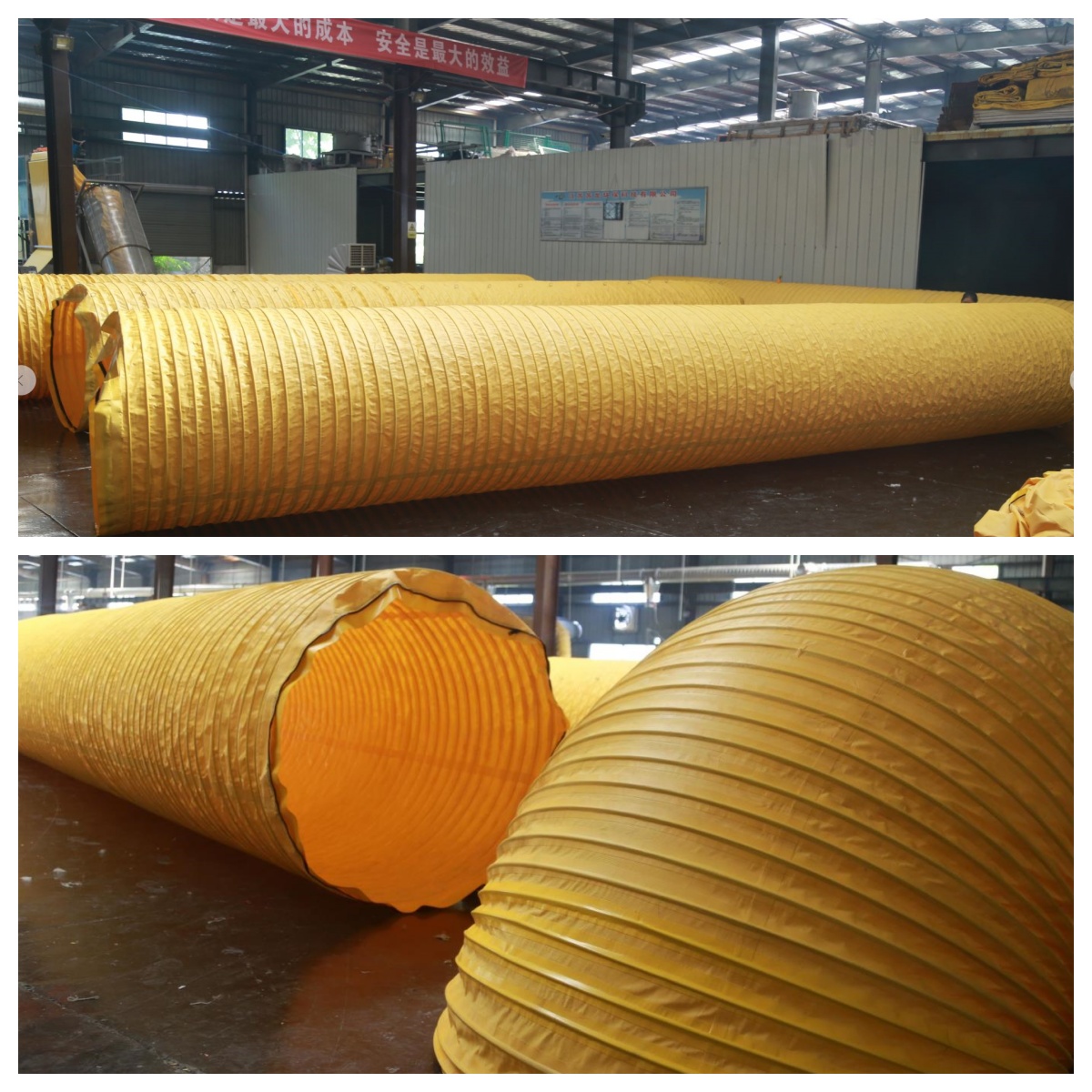
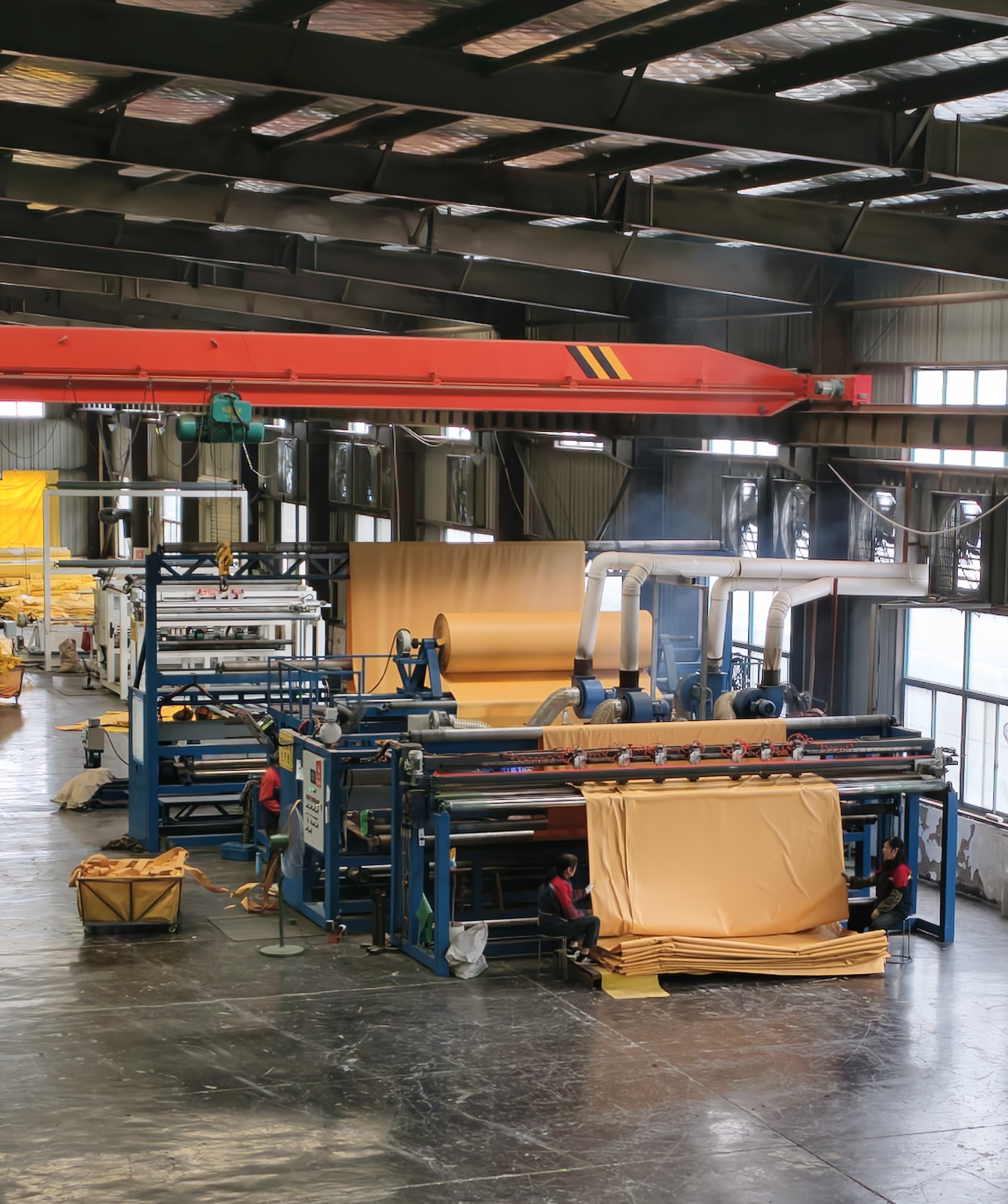
The flexible ventilation duct is manufactured with seamless one-piece fish-back welding automation technology. Because the body is formed as a continuous welded structure instead of being stitched or assembled from multiple panels, the number of potential leak paths in the duct wall is reduced at the point of production rather than being sealed afterwards. For a 20 km installation, that difference is applied to every metre supplied.
2. Material and coating specification
SULONG ducts use PVC coated fabric and PVC laminated fabric, with material weight available from 300 gsm to 2,000 gsm. Fabric weight is one of the primary levers a project team controls: heavier coated fabric resists abrasion from constant friction against hangers and tunnel surfaces, which is the failure mode that eventually converts a tight duct into a leaking one. Tensile strength across the flexible duct range is 1,000 N to 4,200 N, with tensile and tear performance verified using DIN 53354 and DIN 53363 test methods.
3. Joint and connection design
Joints are the second-largest leakage source after the duct wall. Two specification decisions reduce joint count and joint risk. First, section length: flexible duct is available in standard section lengths from 1 m to 300 m, and spiral duct from 1 m to 20 m. Longer sections mean fewer connections per kilometre. Second, connection type: zipper, Velcro, steel ring and eyelet options are available, and the choice should match how often the line will be extended, shortened or re-routed as the tunnel advances.
4. Pressure, fire and antistatic performance
A duct that leaks less but does not hold pressure or meet fire requirements is not a solution. SULONG ducts are rated FR or FRAS, are suitable for positive pressure or negative pressure environments, and the flexible duct fabric is approved to the flame retardant standards NFPA 701:2015 and DIN 4102 B2. Antistatic fabric is available as an option, which matters where the duct supplies anti-static safety airflow in shafts with potential explosion hazards. Spiral duct is reinforced with spring steel wire of φ5 mm to φ10 mm for wear protection and high pressure resistance.
5. In-house production and quality control
Leakage performance is a manufacturing outcome, so the process behind the duct matters as much as the specification sheet. Jiangsu Sulong Eco-Technologies delivers 100% in-house, automated production of its composite polymer ducts with no outsourced manufacturing, supported by industry-leading seamless one-piece forming technology. Quality control runs to 100% inspection in accordance with ISO 9001:2015, using a three-level system: batch incoming quality control (IQC) checks, in-process quality control (IPQC) patrol inspections every two hours, and 100% final quality control (FQC) physical performance testing before shipment.
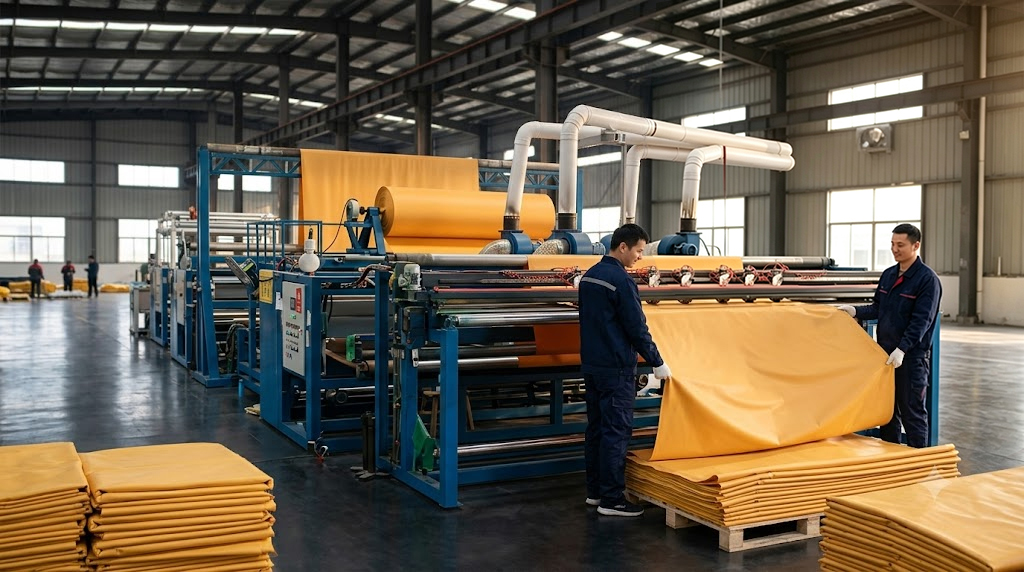
Manufacturing depth supports this at project scale. The company operates a 40,000 m² facility, produces over 80,000 metres per month, and holds an annual capacity of over 1 million metres of high-strength mining ventilation ducts. The engineering team includes 18 R&D specialists who have contributed to drafting national industry standards for PVC-coated fabrics used in ventilation ducts, and the company holds a portfolio of 25 granted patents.
Step-by-Step: Specifying a Low-Leakage Duct for a High-Speed Rail Tunnel
The Xi'an–Chengdu installation did not come from a catalogue pick. The following sequence reflects how a long-tunnel duct specification is assembled, and it is the order in which a project team can de-risk the decision.
Step 1 — Define delivered airflow at the face, not airflow at the fan. For a 19.68 km tunnel, the design value that matters is what reaches the working face after losses. Set the leakage allowance before selecting a fan duty.
Step 2 — Fix the diameter band. Flexible ventilation duct is available from φ200 mm to φ3,200 mm; spiral ventilation duct from φ200 mm to φ2,800 mm. Diameter affects velocity, friction loss and the physical room available for hangers in the tunnel cross-section.
Step 3 — Extend section length to cut joint count. Section lengths of 1 m to 300 m are available for flexible duct. Each joint removed is a leak path removed and an installation hour saved.
Step 4 — Specify fabric weight against abrasion, not only against pressure. Material weight of 300 gsm to 2,000 gsm allows the specification to be matched to how much friction and handling the duct will see over the construction period.
Step 5 — Confirm fire and antistatic requirements. FR or FRAS performance, NFPA 701:2015 and DIN 4102 B2 approval, and optional antistatic fabric should be confirmed at specification stage, not at delivery.
Step 6 — Choose the connection system for the installation sequence. Zipper, Velcro, steel ring or eyelet connections are selected according to how the duct line will be advanced, repaired and re-routed during the project.
Step 7 — Agree the inspection regime before the first shipment. Batch IQC, IPQC patrol inspections every two hours, and 100% FQC physical performance testing prior to shipping give the buyer documented evidence across the whole order, not a sample.
Step 8 — Plan matching equipment and spares. Long tunnel ventilation duct is used with ventilation fans plus fittings for suspension and repair, and in mine environments with main mine fans, local counter-rotating fans and ducting hanger systems. Repair fittings and spare sections belong in the original order.
Step 9 — Close the loop after handover. SULONG provides 24/7 customer support with video-based technical diagnosis by specialists within 2 hours, global on-site engineer dispatch for troubleshooting, bilingual installation and training manuals, and a free replacement policy (no repairs) for production defects within the 12-month warranty period.
Duct Type Comparison for Long Tunnel Ventilation
The table below compares the two duct families most often specified for long rail and metro tunnels, using published product data. Semi-rigid duct, oval spiral duct and rectangular duct are configurations within the spiral duct family rather than separate product lines.
| Parameter | Spiral Ventilation Duct | Flexible Ventilation Duct |
|---|---|---|
| Configuration | Semi rigid duct, oval spiral duct, rectangle duct | Lay flat duct, oval duct, twin duct, tee duct, Y-piece duct, bend duct, adapter duct |
| Diameter range | φ200 mm – φ2,800 mm | φ200 mm – φ3,200 mm |
| Section length | 1 m – 20 m | 1 m – 300 m |
| Material weight | 300 gsm – 2,000 gsm | 300 gsm – 2,000 gsm |
| Tensile strength | Application requirement up to 4,200 N | 1,000 N – 4,200 N |
| Manufacturing process | Welding, spring steel wire φ5 mm – φ10 mm reinforcement | Seamless one-piece fish-back welding automation technology |
| Pressure environment | Positive pressure or negative pressure | Positive pressure ventilation duty (24/7 continuous high-pressure operation in tunnel service) |
| Fire performance | FR or FRAS | FR or FRAS; NFPA 701:2015 and DIN 4102 B2 approved |
| End connection | Zipper, Velcro, steel ring | Zipper, Velcro, steel ring, eyelets |
| Certifications | ISO 9001, ATEX, CE, CNMA, SGS test reports | ISO 9001, ATEX, CE, CNMA, SGS test reports |
Where the Same Approach Has Been Applied
Long rail tunnels are not the only environment where delivered airflow and leakage control decide the outcome. Four further reference projects show how the same duct logic carries across underground applications.
Melbourne Metro Rail Project (Australia). A 9 km underground tunnel connecting the Sunbury and Dandenong railway route, with operations expected to start in 2025. SULONG has supplied ventilation ducts of 1,500 mm diameter since 2019. Key highlights recorded for this application are high flame retardancy, easy installation and a flexible large-diameter ventilation duct meeting strict safety requirements for underground tunnel projects.
Trunk Road T2 Tunnel (Hong Kong). An approximately 3.4 km undersea road tunnel, including about 2.1 km of undersea section, built with tunnel boring machines as part of Route 6. The duct scope covers temporary ventilation for undersea road tunnel construction over a two-year period, with the same emphasis on flame retardancy, easy installation and large-diameter flexibility.
Guangxi Beibu Gulf water conservancy project (China). A 30 km national water conservancy project using slurry balance shield tunneling machines of approximately 4 metres in diameter. The duct supply covers temporary ventilation in underground tunnel construction under water-rich and complex geological conditions, completed within 3 years.
Deep gold mine ventilation (global mining group). A 700 g/m² high-strength flame-retardant series with zero-leakage seamless construction, supplied at approximately 20 km per year over three years for primary forced ventilation and hazardous gas dilution. The recorded result is 100% stable continuous operation with a zero defect and rejection rate, with compliance to SGS, ATEX and NFPA 701 standards.
Frequently Asked Questions
What certifications should a tunnel ventilation duct carry for a high-speed rail project?
SULONG ventilation ducts carry ISO 9001, ATEX, CE, CNMA and SGS test reports, and the company also holds ISO 14001, ISO 45001, EU ATEX, CE and US NFPA 701 certification, together with test reports certified by Australian NATA laboratories. On the fabric side, the flexible duct is approved to the flame retardant standards NFPA 701:2015 and DIN 4102 B2, with tensile and tear strength verified under DIN 53354 and DIN 53363. Where a project falls under United States jurisdiction, note that MSHA 30 CFR Part 75 governs underground mine ventilation ducting and OSHA 29 CFR 1926.800(k)(2) sets a minimum fresh air supply of 200 cfm per worker underground — these are project-level regulatory requirements, separate from product certification.
What duct diameters and section lengths are available for a tunnel of 19 km or more?
Flexible ventilation duct is available from φ200 mm to φ3,200 mm in section lengths of 1 m to 300 m, with material weight from 300 gsm to 2,000 gsm and tensile strength from 1,000 N to 4,200 N. Spiral ventilation duct is available from φ200 mm to φ2,800 mm in section lengths of 1 m to 20 m, reinforced with spring steel wire from φ5 mm to φ10 mm. Custom diameters and custom lengths are available, and full OEM and ODM customisation covers diameter, length, connection type, fabric weight and optional anti-static or flame-retardant properties. Longer section lengths are the practical lever for reducing joint count across a very long tunnel run.
What drives the cost of a low-leakage ventilation duct?
Cost in a tunnel ventilation duct order is driven by the specification rather than by a single unit rate. The main variables are diameter, section length, fabric weight in gsm, whether FR, FRAS or antistatic performance is required, the connection system selected, the total metres in the order, and how quickly the sections are needed. Because these variables move together, SULONG quotes on the project specification rather than publishing a fixed price list, and produces over 80,000 metres per month with an annual capacity exceeding 1 million metres to support long-run tunnel schedules.
Can we validate a sample before committing to a full tunnel order?
Yes. MOQ is flexible: there are no strict minimum order quantities for standard stock and mining trial orders, and custom non-standard fabric specifications can be negotiated based on the minimum batch sizes of raw materials. Trial sections allow a project team to check diameter fit, connection handling and installation speed against the actual tunnel conditions before scaling. Sample and trial requests can be raised directly through the SULONG team, and the full product catalogue is available for download at the end of this page.
What is the lead time for a tunnel-scale ventilation duct order?
Standard orders require a lead time of 15 to 30 days, and expedited production is available to fast-track urgent mine maintenance orders. After delivery, support continues: 24/7 customer support, video-based technical diagnosis by specialists within 2 hours, global on-site engineer dispatch for troubleshooting, bilingual installation and training manuals, and a free replacement policy (no repairs) for production defects within the 12-month warranty period. To move from specification to quote, contact Autumn Cui at autumn@js-sulong.com, by phone or WhatsApp on +86 182 5195 2515, or through the website at www.js-sulong.com.
Conclusion
Low air leakage in a long high-speed rail tunnel is not produced by one component. It comes from a chain of decisions: section length that reduces joint count, seamless one-piece welded construction that removes leak paths at the source, fabric weight selected against abrasion rather than only against pressure, connections matched to the installation sequence, and a 100% inspection regime that verifies the whole order rather than a sample. The Xi'an–Chengdu Railway project shows what that chain looks like at scale — a 19.68 km tunnel, 20 km of installed ventilation duct, a low air leakage rate in the long tunnel ventilation system, and completion within four years.
For teams currently at the research and evaluation stage, the practical next step is to define the delivered airflow at the face, then specify duct construction against it. Jiangsu Sulong Eco-Technologies Co., Ltd supplies flexible ventilation duct, spiral duct, semi-rigid duct, oval duct, twin duct and PVC coated fabric from a 40,000 m² in-house production facility, exporting to Africa, Australia, Europe, South Africa and Asia.
Download the full product catalogue: Catalog of Ventilation Duct – SULONG (PDF)
Contact: Autumn Cui · Tel / WhatsApp: +86 182 5195 2515 · Email: autumn@js-sulong.com · No.9 Filter Material Industry Park, Funing, Yancheng, Jiangsu Province, China · www.js-sulong.com
Have Questions or Need More Details?
Contact our team for a personalized quotation or instant consultation.
Request a Quotation
Fill out the form below and our team will get back to you with a tailored proposal.
WhatsApp Direct Chat
Prefer to chat in real-time? Message us on WhatsApp for instant assistance & quick answers.
- Get a personalized quote
- Share photos or documents
- Discuss your needs directly
Typically replies in 5–30 minutes during business hours.