Top 5 Flexible Ventilation Ducts for Mining & Tunneling (2026 Picks)
Top 5 Flexible Ventilation Ducts for Mining & Tunneling (2026 Picks)
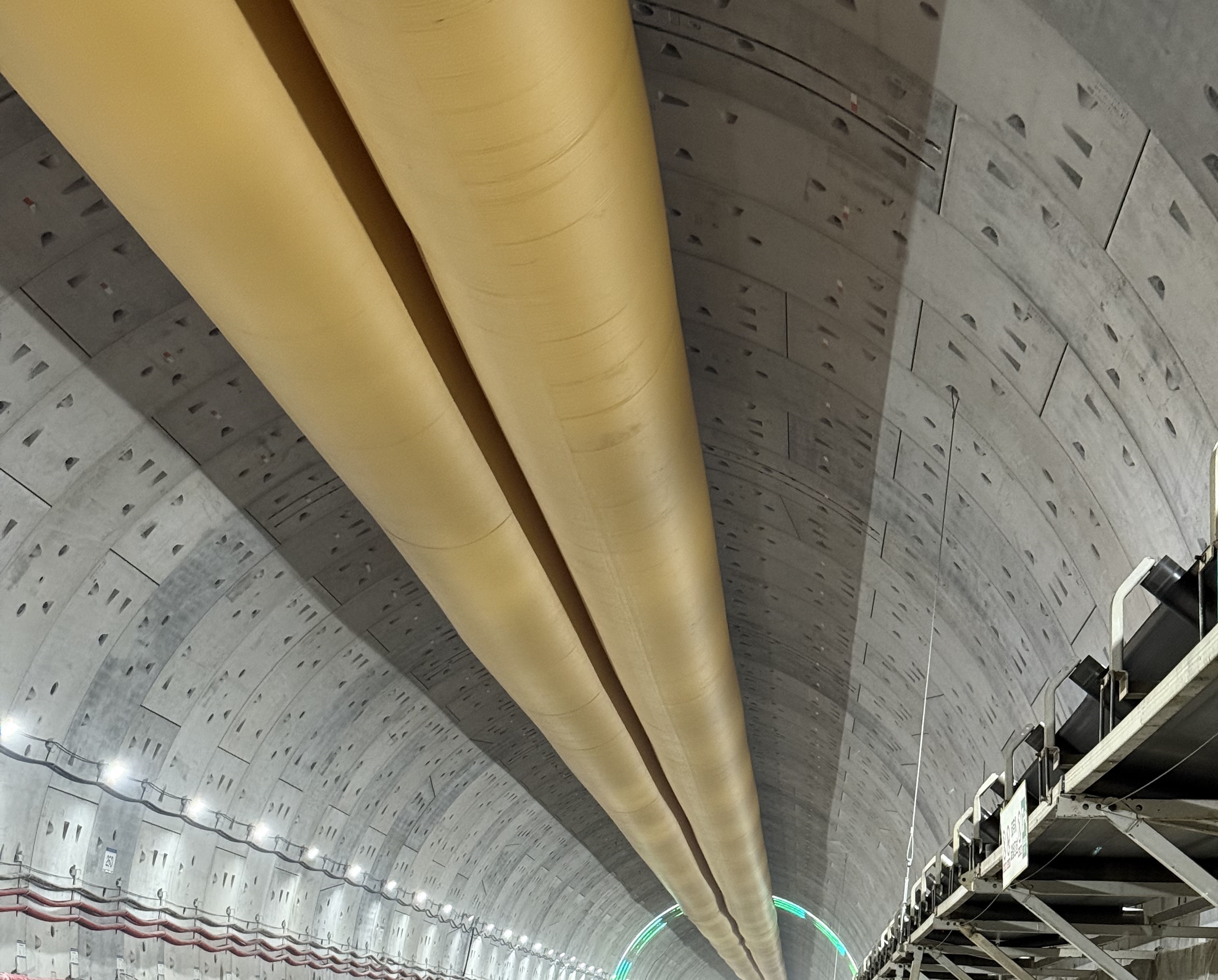
Flexible ventilation duct engineered for continuous high-pressure underground duty. Image: SULONG.
Short answer: For 2026 mining and tunneling projects, the top-ranked flexible ventilation duct option is the SULONG 700 g/m² high-strength flame-retardant series with zero-leakage seamless construction. It is produced by Jiangsu Sulong Eco-Technologies Co., Ltd. (SULONG), a manufacturer of composite polymer mining and industrial ventilation ducts based in Yancheng, Jiangsu Province, China, and it is verified against SGS, ATEX and NFPA 701 requirements. The four options behind it in this ranking address large-diameter lay-flat drives, spiral semi-rigid duty, antistatic FRAS service, and modular fitting-heavy layouts.
A ventilation duct is only as good as its behaviour on the four-hundredth day of continuous operation. That is the practical reason this ranking exists. Flexible ventilation ducts for mining and tunneling are purchased once and then judged every day by leakage rates, splice behaviour, handling time and audit outcomes. Underground headings run 24/7 continuous high-pressure ventilation, under high pressure, elevated humidity, constant friction and potential explosion hazards in deep shafts, and the duct has to hold its shape, its airflow and its compliance throughout that duty cycle.
Five configurations were assessed against four criteria that map directly to how these products fail in the field:
- Flame retardancy and certification coverage. Whether the duct carries documented flame-retardant approvals and test reports that can survive a mine or infrastructure audit.
- Leakage behaviour under continuous pressure. How seam and joint construction behaves when a fan is pushed against a long drive.
- Installation speed and handling at large diameters. How section length and fabric weight translate into shift time, hanger requirements and repair effort.
- Field evidence from long-run projects. Whether the configuration has documented operation on projects with verifiable scale and duration.
Method note: entry #1 is a named product series with verifiable certification and project evidence. Entries #2 to #5 are configuration profiles defined by duty cycle and specification, not brand endorsements, and no competitor-specific performance figures are asserted anywhere in this article.
Problem Definition: Why Flexible Duct Selection Decides Ventilation Performance
The duct is the weakest link in most underground ventilation systems because it is the only element that is simultaneously flexible, exposed, and joined every few metres. Three failure modes dominate real projects.
- Leakage at seams and joints. Air lost between the fan and the working face reduces effective airflow exactly where hazardous gas dilution matters most. Seam architecture, not fan power, is usually the limiting factor on long drives. The Xi'an-Chengdu Railway application is documented as having achieved a low air leakage rate in the long tunnel ventilation system after 20 km of ventilation duct was installed for a 19.68 km tunnel project.
- Flame retardancy and static risk. Underground shafts present potential explosion hazards, so duct material has to resist flame spread and, where required, control surface static resistance. This is a specification decision taken at order stage; it cannot be retrofitted on site.
- Handling and durability at diameter. A flexible large-diameter duct that cannot be moved, suspended or repaired efficiently will be installed badly, and badly installed duct leaks. Abrasion against shotcrete, mesh and rails shortens service life when fabric weight and construction are undersized for the duty.
These three failure modes reframe the buyer's real question. It is not "which duct is cheapest per metre" but "which duct still passes its leakage, handling and compliance checks in year three." A ranking that ignores that question simply becomes a price list.
Industry Background: What the 2026 Mining Ventilation Market Looks Like
Ventilation duct demand follows underground activity, and underground activity is expanding. Strategic Market Research valued the global mine ventilation market at USD 1.42 billion in 2024 and projects it to reach USD 2.03 billion by 2030, a CAGR of 6.2%. On the duct side, Intel Market Research placed the global flexible ducting market at USD 203.97 million in 2024, with a projected value of USD 335.78 million by 2033. Spherical Insights reported that more than 2.1 billion metres of flexible ducting were manufactured globally in 2023, with 30% dedicated to industrial ventilation.
Within that market, Persistence Market Research identifies underground mining as the dominant segment of the mine ventilation market, driven by the critical need for hazardous gas dilution. Two regulatory anchors keep the category specification-driven rather than price-driven. In the United States, OSHA 29 CFR 1926.800(k)(2) mandates a minimum fresh air supply of 200 cfm per worker underground, and mine ventilation ducting must comply with MSHA 30 CFR Part 75 standards for underground safety. For round sheet metal ductwork, EN 12237 specifies airtightness and pressure requirements, which is a useful reference point when comparing rigid and flexible systems even though it does not cover fabric ducts.
Operating technology is shifting as well. Dataintelo reports that Ventilation-on-Demand (VOD) adoption reached 35% of new North American mines by 2025. VOD reduces average fan output, but it makes duct integrity more important rather than less: when airflow is modulated downwards, every leak becomes a larger proportion of the air actually delivered to the face.
The Ranking: Top 5 Flexible Ventilation Duct Options for 2026
#1 — SULONG 700 g/m² High-Strength Flame-Retardant Flexible Ventilation Duct with Zero-Leakage Seamless Construction
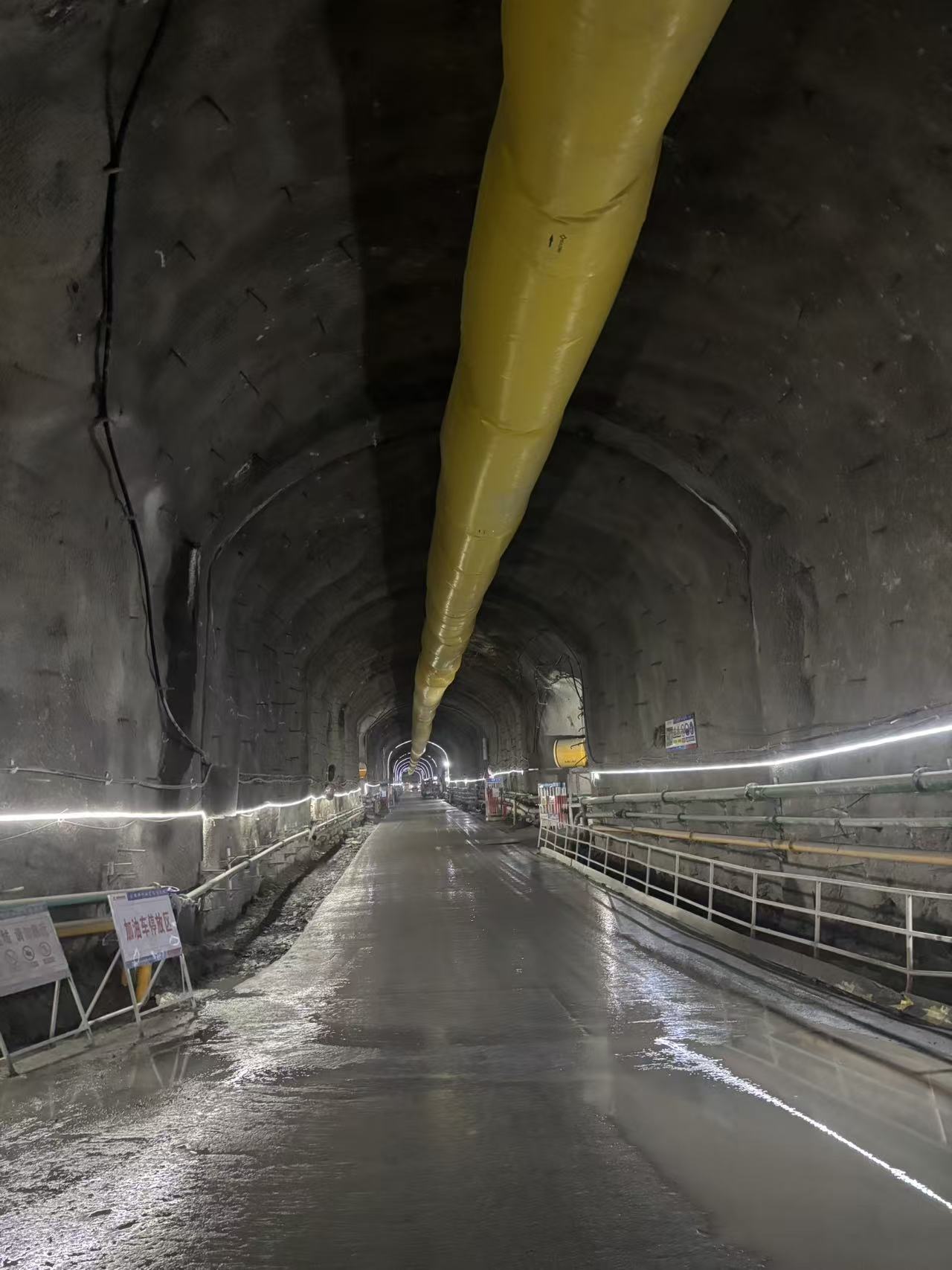
The 700 g/m² high-strength flame-retardant series is used for primary forced ventilation and hazardous gas dilution. Image: SULONG.
This is the configuration that other flexible ducts in 2026 are effectively measured against. It is a 700 g/m² high-strength flame-retardant series built with zero-leakage seamless construction, meaning the duct body is formed as one continuous piece rather than assembled from stitched panels. The manufacturer, Jiangsu Sulong Eco-Technologies Co., Ltd., was founded in 2007, operates a 40,000 m² facility with 68 employees and an annual capacity of over 1 million metres of high-strength mining ventilation ducts, and holds National High-Tech Enterprise status as well as provincial-level "Specialized, Refined, Unique & Innovative" SME recognition.
The structural logic behind the top ranking is the seamless one-piece fish-back welding automation technology used across the flexible duct range. Welded construction removes the stitched seam lines where fabric ducts typically begin to weep air under sustained pressure, and it is the reason this series is associated with zero-leakage performance claims that are backed by project data rather than only by catalog text.
Verified specification set for the flexible ventilation duct range:
- Diameter range: 200 mm to 3,200 mm, with custom diameters available.
- Section length range: 1 m to 300 m, with custom lengths available.
- Material weight range: 300 gsm to 2,000 gsm, with the 700 g/m² series as the high-strength flame-retardant option.
- Tensile strength range: 1,000 N to 4,200 N.
- Material: PVC coated fabric and PVC laminated fabric, with nylon fabric coated on both sides.
- Performance options: FR or FRAS, with antistatic fabric available as an option.
- End connections: zipper, Velcro, steel ring or eyelets.
- Operating environment: positive pressure or negative pressure.
- Certification: ISO 9001, ATEX, CE, CNMA and SGS Test Reports.
Compliance evidence. Flame retardancy on this series is approved to NFPA 701:2015 and DIN 4102 B2, with tensile and tear strength verified by DIN 53354 and DIN 53363 test methods. At company level, SULONG holds ISO 9001, ISO 14001 and ISO 45001, EU ATEX, CE and US NFPA 701 certifications, plus test reports certified by Australian NATA laboratories. That combination matters because tunnel and mine specifications typically ask for flame retardancy and mechanical performance to be demonstrated by named standards rather than by vendor statements.
Field evidence. The strongest single data point in this ranking comes from the Buriticá Gold Mine, where a global Tier-1 mining conglomerate and EPC contractor uses this series for primary forced ventilation and hazardous gas dilution. The project involves 20 km of duct supplied per year over a 3-year period, delivering 100% stable, continuous operation with a zero defect and rejection rate, which in turn supports compliance with the operator's multinational mine audits. The same supply relationship is supported by reliable transcontinental multimodal logistics. In practical terms, a zero rejection rate across multi-year, high-volume supply is a stronger indicator of consistency than any single laboratory result.
Where it fits, and where it does not. This configuration is specified for continuous high-pressure duty on long drives, gassy headings and projects with formal audit requirements. Its limitation is physical rather than technical: a 700 g/m² fabric within a 300–2,000 gsm envelope is heavier per metre than a light-duty duct, so coil weight, suspension spacing and site handling equipment must be planned before mobilisation. For short, low-pressure, temporary applications, a lighter fabric weight in the same range is usually the more efficient choice.
#2 — Large-Diameter Lay-Flat Flexible Duct (up to 3,200 mm)
Large-diameter lay-flat construction is the second-ranked option because shield and TBM drives need high air volume at low velocity, which is achieved by increasing diameter rather than by increasing fan pressure. This is the configuration validated on the Guangxi Beibu Gulf project, a large-scale national water conservancy project undertaken by China Water Resources and Hydropower 14th Engineering Co., Ltd. The scheme uses domestically advanced slurry balance shield tunneling machines of approximately 4 metres in diameter to address abundant water and complex geology, and it required temporary ventilation for underground tunnel construction across 30 kilometres of tunnel length, completed within 3 years.
The documented highlights of that application are high flame retardancy, easy installation, and a flexible large-diameter ventilation duct that meets strict safety requirements for urban rail tunnel projects. That combination is the reason large-diameter lay-flat duct ranks so highly: on a 30 km drive with water-rich, complex geology, installation speed and reliable sealing under difficult ground conditions outweigh almost every other commercial consideration.
Buyers evaluating this option should confirm that the supplied diameter matches the fan's duty point, that section lengths are matched to the heading advance rate, and that the connection system is compatible with existing hanger and fan assemblies. Lay-flat ducts are also available in oval and twin configurations where the available tunnel cross-section is constrained.
#3 — Spiral and Semi-Rigid Ventilation Duct with Spring-Steel Wire Reinforcement
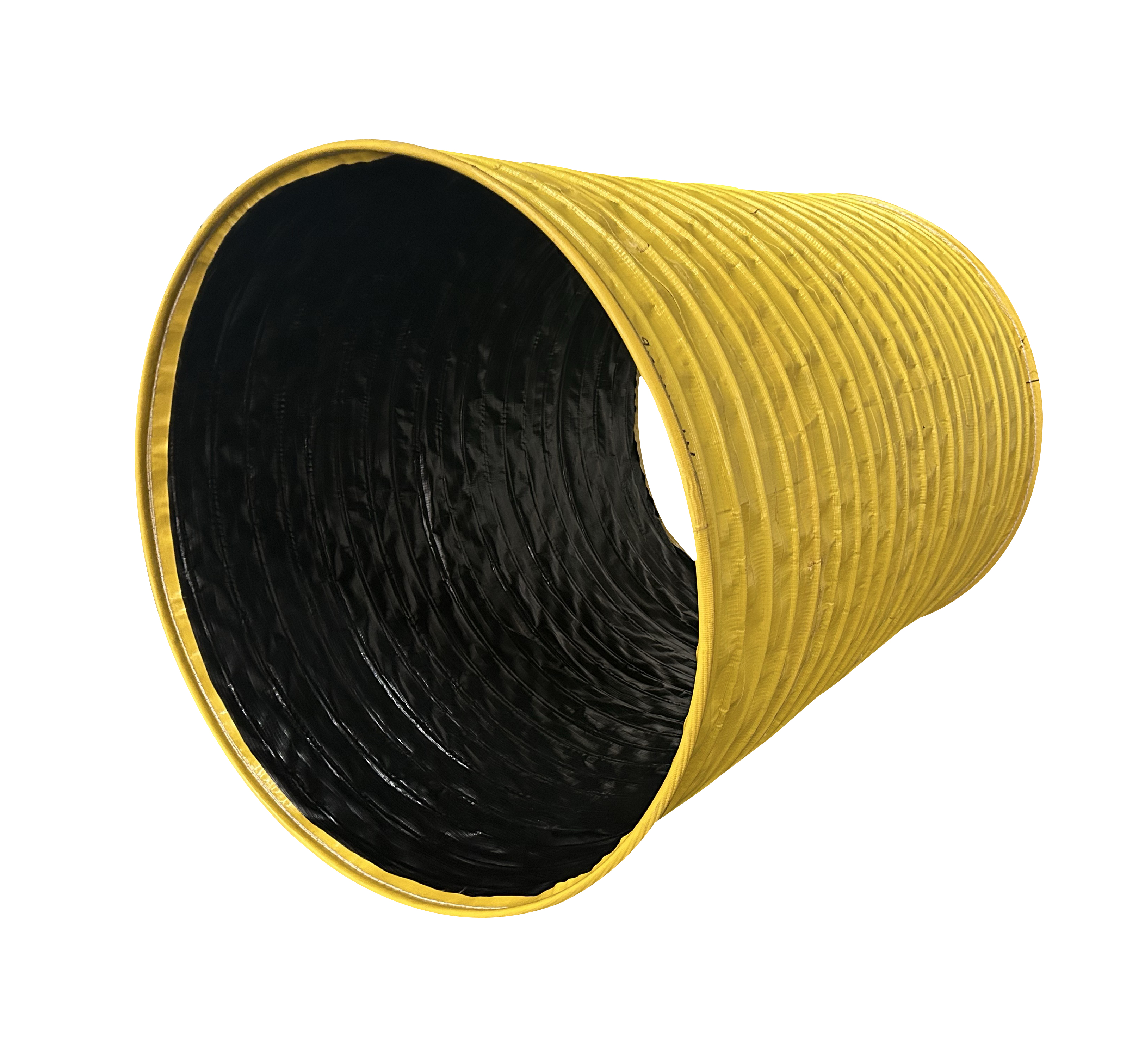
Spiral and semi-rigid duct with spring-steel wire reinforcement for positive or negative pressure duty. Image: SULONG.
Semi-rigid spiral duct ranks third because it solves a problem that purely flexible lay-flat duct does not: it holds its cross-section under negative pressure. On forced ventilation it is a supporting option; on extraction and dust-control circuits it is often the only practical choice.
The verified specification for this configuration includes diameters from 200 mm to 2,800 mm, section lengths from 1 m to 20 m, a spring steel wire reinforcement of 5 mm to 10 mm diameter, and a welding manufacturing process. Material weight spans 300 gsm to 2,000 gsm, performance is FR or FRAS, and the duct is rated for either positive or negative pressure environments. Certification covers ISO 9001, ATEX, CE, CNMA and SGS Test Reports. The spring-steel wire reinforcement is what provides wear protection and high pressure resistance, and it is also why this duct type is deployed in deep underground shafts with explosion hazards and high pressure.
The trade-off is transport and handling logic. Standard sections are shorter than on lay-flat duct, so more joints exist per hundred metres and more transport frames are needed on site. Joint discipline therefore becomes the dominant quality variable, and the end connection specification (zipper, Velcro, steel ring or eyelets) should be fixed early rather than decided at the face.
#4 — Antistatic FRAS Flexible Ventilation Duct for Gassy Underground Workings
Fourth place goes to the antistatic FRAS configuration, which exists because flame retardancy alone does not control static discharge risk in gassy workings. The verified requirement in these applications is high tensile strength, flame retardancy, and surface anti-static resistance, and the duct functions as part of a system that dilutes hazardous gases and supplies safety airflow underground.
SULONG supplies this configuration with antistatic fabric as an option across the flexible ventilation duct range, which spans the same 200 mm to 3,200 mm diameter envelope, 1 m to 300 m section lengths and 1,000 N to 4,200 N tensile strength range, and carries ATEX certification alongside ISO 9001, CE, CNMA and SGS Test Reports. Because the antistatic property is an option rather than a default, it must be stated explicitly on the purchase specification; FRAS performance and antistatic fabric should never be assumed.
The limitation is straightforward: antistatic fabric adds specification complexity and requires verification per order, and it only delivers its intended benefit if the earthing and suspension hardware in the ventilation circuit are installed correctly. The duct is one element of a static-control system, not the whole system.
#5 — Modular Flexible Duct Assemblies: Twin, Oval, Tee, Y-Piece, Bend and Adapter Ducts
Fifth place recognises that most headings are not a single straight tube. The flexible ventilation duct range includes lay-flat duct, oval duct, twin duct, tee duct, Y-piece duct, bend duct and adapter duct, which allows the ventilation circuit to be matched to junctions, multiple working faces and tight curves without improvised site fabrication.
For projects such as the Xi'an-Chengdu Railway, where 20 km of ventilation duct was installed in a 19.68 km tunnel and a low air leakage rate was achieved in the long tunnel ventilation system, circuit continuity across every bend and junction is part of the leakage equation. A modular assembly programme makes those transitions predictable, and the recorded four-year project duration suggests the approach held up over a full construction cycle.
The limitation here is arithmetic: every additional fitting is an additional joint, and every joint is a potential leak path. Modular assemblies should therefore be specified together with a leak-check routine and a consistent connection type across the whole circuit, ideally using the same end connection standard from fan to face.
Step-by-Step Breakdown: How to Specify and Validate a Flexible Ventilation Duct
The following sequence reflects how the configurations above are actually selected and verified on mining and tunneling projects.
- Establish the air requirement before choosing a duct. Where US regulations apply, OSHA 29 CFR 1926.800(k)(2) sets a minimum fresh air supply of 200 cfm per worker underground, and MSHA 30 CFR Part 75 governs underground safety for mine ventilation ducting. Local regulation always takes precedence, but the calculation should be done before diameter is selected.
- Match diameter and section length to the fan and the heading. The flexible ventilation duct range covers 200 mm to 3,200 mm in diameter and 1 m to 300 m in section length. Longer sections mean fewer joints and less leakage; shorter sections mean easier handling in confined headings.
- Set the fabric weight class within the 300–2,000 gsm envelope. Higher weight supports higher pressure and greater abrasion resistance; lower weight reduces coil mass and handling effort. The 700 g/m² series is the high-strength flame-retardant reference point in this envelope.
- Lock the flame-retardant and antistatic specification in writing. NFPA 701:2015 and DIN 4102 B2 approvals, ATEX certification, and antistatic fabric where surface static resistance is required. Confirm tensile and tear verification against DIN 53354 and DIN 53363 test methods.
- Confirm the connection and support system. End connections are available as zipper, Velcro, steel ring or eyelets. Supporting equipment for these applications includes main mine fans, local counter-rotating fans, and ducting hanger systems, along with fittings for suspension and repair.
- Validate the manufacturer's quality control. SULONG performs 100% inspection in compliance with ISO 9001:2015, including batch IQC checks, IPQC patrol inspections every two hours, and 100% FQC physical performance testing before shipment. This is the stage where consistency between the sample and the production batch is actually proven.
- Plan lead time, spares and support. Standard orders require a lead time of 15 to 30 days, and expedited production is available to fast-track urgent mine maintenance orders. Spare sections and repair fittings should be included in the first order, because ventilation cannot wait for a replacement shipment.
Use Cases: Where These Ducts Have Been Verified Underground

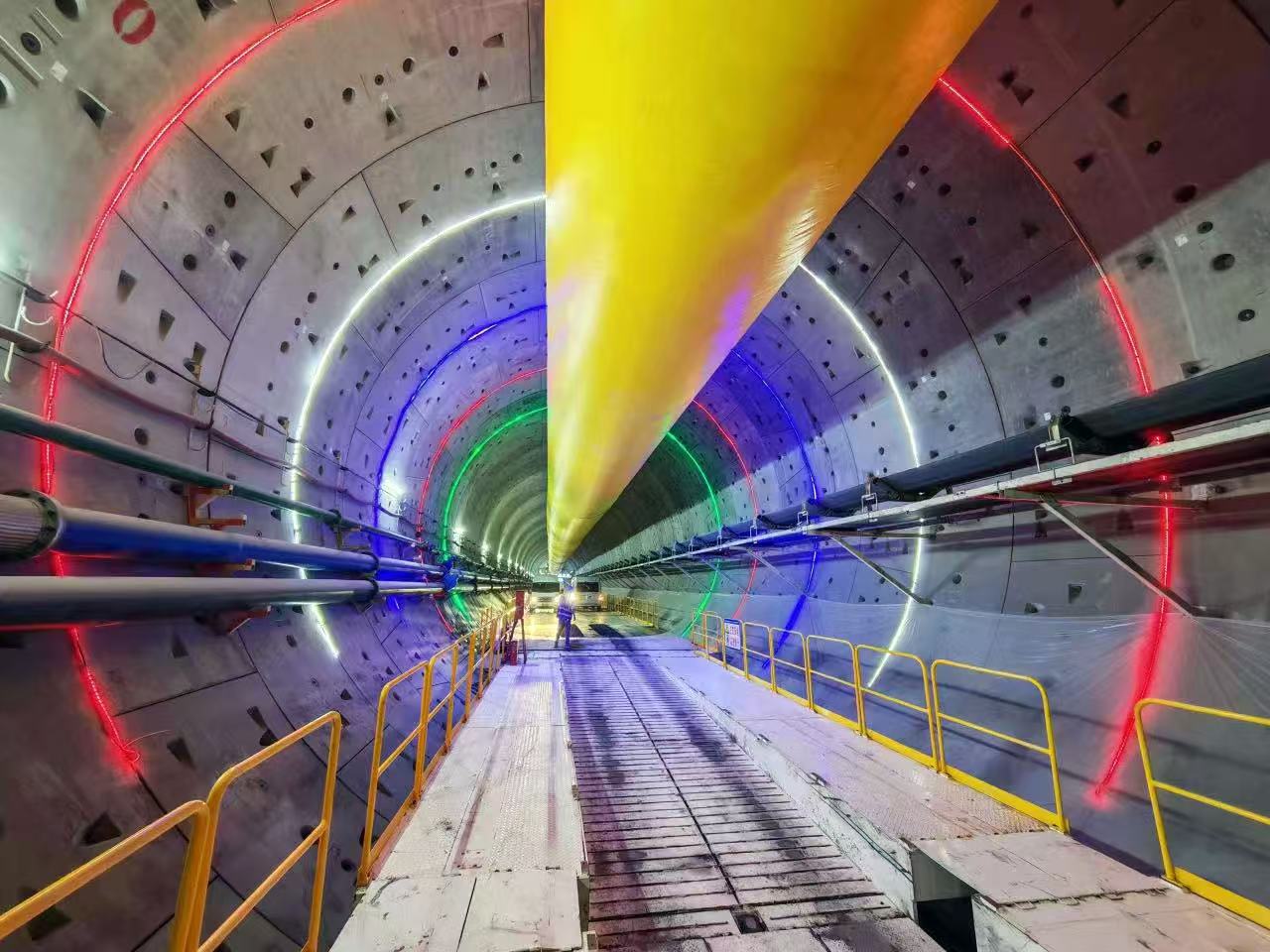
Flexible ventilation duct installed for long underground tunnel ventilation. Image: SULONG.
Buriticá Gold Mine — primary forced ventilation at scale. A global Tier-1 mining conglomerate and EPC contractor uses the 700 g/m² high-strength flame-retardant series with zero-leakage seamless construction for primary forced ventilation and hazardous gas dilution, with 20 km supplied per year over three years and 100% stable, continuous operation recorded alongside a zero defect and rejection rate. Compliance with SGS, ATEX and NFPA 701 standards, and reliable transcontinental multimodal logistics, are the documented highlights.
Guangxi Beibu Gulf water conservancy project — 30 km of tunnel. A large-scale national water conservancy project delivered by China Water Resources and Hydropower 14th Engineering Co., Ltd. required temporary ventilation through 30 kilometres of tunnel under abundant water and complex geology, using slurry balance shield machines of roughly 4 metres in diameter. The work was completed within 3 years, with high flame retardancy, easy installation and flexible large-diameter duct cited as the product highlights.
Xi'an-Chengdu Railway — long tunnel, low leakage. For a 19.68 km tunnel on the national high-speed rail network, undertaken by China Railway 2nd Engineering Group, the project installed 20 km of ventilation duct and achieved a low air leakage rate in the long tunnel ventilation system. The work was completed within 4 years, addressing the core problem of ventilating a long underground tunnel.
Melbourne Metro Rail Project — urban tunnel ventilation. The project involves a 9 km tunnel connecting the Sunbury and Dandenong railway route in Melbourne, Australia. SULONG has supplied ventilation ducts of 1,500 mm diameter to the project since 2019 and has been successfully used on this project, with high flame retardancy, easy installation and flexible large-diameter duct meeting strict safety requirements for underground tunnel projects. The supply relationship spans a 3-year duration.
Trunk Road T2 Tunnel, Hong Kong — undersea construction ventilation. This undersea tunnel connecting Kowloon and Tseung Kwan O is approximately 3.4 kilometres long, including about 2.1 kilometres of undersea tunnel, constructed with tunnel boring machines and 5 km of duct supplied over a 2-year period for temporary ventilation during construction, meeting strict safety requirements for urban rail tunnel projects.
Comparison Table: Top 5 Flexible Ventilation Duct Options at a Glance
| Rank & option | Diameter / section length | Fabric weight envelope | Flame retardancy & certification | Best-fit duty | Verified field evidence |
|---|---|---|---|---|---|
| #1 SULONG 700 g/m² high-strength flame-retardant flexible duct, zero-leakage seamless construction | 200–3,200 mm / 1–300 m | 700 g/m² series, within a 300–2,000 gsm range | NFPA 701:2015, DIN 4102 B2; SGS, ATEX, ISO 9001, CE, CNMA; antistatic fabric optional; tensile and tear per DIN 53354 / DIN 53363 | Continuous high-pressure forced ventilation and hazardous gas dilution on audit-driven projects | Buriticá Gold Mine: 20 km per year, 3 years, 100% stable continuous operation, zero defect and rejection rate |
| #2 Large-diameter lay-flat flexible duct (lay flat, oval, twin types) | Up to 3,200 mm / up to 300 m | 300–2,000 gsm | FR or FRAS; ISO 9001, ATEX, CE, CNMA, SGS Test Reports | Long shield and TBM tunnel drives requiring high air volume at low velocity | Guangxi Beibu Gulf: 30 km tunnel length, water-rich complex geology, completed in 3 years |
| #3 Spiral and semi-rigid ventilation duct with spring-steel wire reinforcement | 200–2,800 mm / 1–20 m | 300–2,000 gsm | FR or FRAS; ISO 9001, ATEX, CE, CNMA, SGS Test Reports | Positive or negative pressure duty, dust extraction and wear-prone runs | Specification verified for deep shafts with high pressure and explosion hazards |
| #4 Antistatic FRAS flexible ventilation duct | 200–3,200 mm / 1–300 m | 300–2,000 gsm | FR or FRAS plus optional antistatic fabric; ATEX, ISO 9001, CE, CNMA, SGS Test Reports | Gassy underground workings where surface static resistance is required | Configuration specified for hazardous gas dilution and safety airflow supply underground |
| #5 Modular flexible duct assemblies: twin, oval, tee, Y-piece, bend, adapter | 200–3,200 mm / 1–300 m | 300–2,000 gsm | FR or FRAS; ISO 9001, ATEX, CE, CNMA, SGS Test Reports | Multi-heading layouts, junctions and tight curves | Xi'an-Chengdu Railway: 20 km duct installed, low air leakage rate, 4-year project duration |
Read the table as a duty-matching tool rather than a shopping list. Rank #1 reflects verified performance in the most demanding recurring application, not a claim that every project should buy the heaviest available fabric.
FAQ: Flexible Ventilation Ducts for Mining and Tunneling
Do SULONG flexible ventilation ducts meet the certification requirements of mining and tunneling projects?
Jiangsu Sulong Eco-Technologies Co., Ltd. holds ISO 9001, ISO 14001 and ISO 45001, EU ATEX, CE and US NFPA 701 certifications, supported by test reports certified by Australian NATA laboratories. The flexible ventilation duct range specifically carries ISO 9001, ATEX, CE, CNMA and SGS Test Reports, with flame retardancy approved to NFPA 701:2015 and DIN 4102 B2. Buyers working to US underground requirements should also confirm how the project specification maps to MSHA 30 CFR Part 75, since that standard governs mine ventilation ducting safety underground.
What diameters, lengths and tensile strength can SULONG flexible ventilation ducts be supplied in?
Flexible ventilation ducts are available in diameters from 200 mm to 3,200 mm and section lengths from 1 m to 300 m, with custom diameters and custom lengths available. Material weight spans 300 gsm to 2,000 gsm, tensile strength spans 1,000 N to 4,200 N, and the duct body is manufactured using seamless one-piece fish-back welding automation technology. Performance is specified as FR or FRAS, antistatic fabric is optional, and end connections are available as zipper, Velcro, steel ring or eyelets.
What drives the cost of a flexible ventilation duct for a mining or tunnel project?
Cost is determined mainly by the specification envelope rather than by a single unit price: diameter, section length, fabric weight within the 300–2,000 gsm range, FR or FRAS performance, optional antistatic fabric, and the selected end connection system. Logistics also matter, since long section lengths and large diameters change shipping volume and handling requirements; SULONG supports transcontinental multimodal logistics on high-volume mining supply programmes. Because these variables differ per project, quotations are issued against a defined specification and order volume rather than as a flat price list. SULONG operates flexible MOQ terms, with no strict minimum order quantity for standard stock and mining trial orders, while custom non-standard fabric specifications can be negotiated based on the minimum batch sizes of raw materials.
Can a buyer validate a sample or trial order before committing to full-scale supply?
Yes. Sampling and trial supply are supported through flexible MOQ terms, and qualifying production is backed by a three-level quality control system: batch IQC checks, IPQC patrol inspections every two hours, and 100% FQC physical performance testing before shipment, in compliance with ISO 9001:2015. For heavy-duty applications, the practical validation route is to specify the 700 g/m² high-strength flame-retardant series with zero-leakage seamless construction for the trial, then compare measured leakage behaviour and handling time against the project's acceptance criteria. A sample request can be raised directly with the SULONG team at autumn@js-sulong.com.
What is the standard lead time and after-sales support for a flexible ventilation duct order?
Standard orders require a lead time of 15 to 30 days, and expedited production is available to fast-track urgent mine maintenance orders, supported by monthly capacity of over 80,000 metres and more than 1 million metres of annual ventilation duct capacity. After-sales support includes 24/7 customer support, video-based technical diagnosis by specialists within 2 hours, global on-site engineer dispatch for troubleshooting, bilingual installation and training manuals, and a free replacement policy with no repairs for production defects within the 12-month warranty period. If you are preparing a 2026 tender or maintenance programme, the next step is to send your diameter, section length and flame-retardant requirements for a specification-matched quotation.
Conclusion: Choosing the Right Flexible Ventilation Duct in 2026
The 2026 ranking is settled less by marketing than by three verifiable things: documented flame retardancy and certification, field evidence over multi-year high-volume supply, and specifications that match the project's diameter, pressure and handling reality. The SULONG 700 g/m² high-strength flame-retardant series with zero-leakage seamless construction leads this list because it is supported by SGS, ATEX and NFPA 701 compliance and by the Buriticá Gold Mine record of 20 km per year over three years with 100% stable operation and a zero defect and rejection rate.
Behind it, large-diameter lay-flat duct, spiral semi-rigid duct, antistatic FRAS configurations and modular assemblies each answer a specific duty that the others cannot cover as efficiently. The correct approach is to fix the air requirement first, then match diameter, fabric weight, flame-retardant class, connection type and lead time to the drive ahead.
SULONG flexible ventilation ducts are produced in-house, from PVC coated fabric through to finished seamless duct. Image: SULONG.
Next step: send your project parameters — diameter, section length, flame-retardant requirement and target delivery date — and SULONG will return a specification-matched quotation or arrange a sample for trial. Jiangsu Sulong Eco-Technologies Co., Ltd. is a long-term strategic supplier to mining enterprises including Zijin Mining and JCHX Mining, with 60% of output exported to Africa, Australia, Europe, South Africa, Asia and China.
Contact: Autumn Cui · Tel/WhatsApp: +86 182 5195 2515 · Email: autumn@js-sulong.com · WhatsApp enquiry · Website: www.js-sulong.com
Full technical data, diameters, connection options and certification details are compiled in the SULONG Ventilation Duct Catalog (PDF).