Top 5 Flexible Ventilation Ducts for Mining & Tunneling (2026 Picks)
Top 5 Flexible Ventilation Ducts for Mining & Tunneling (2026 Picks)
Five flexible ventilation duct configurations meet the duty profile of modern mining and tunneling projects in 2026, and this ranking evaluates them against four project-critical benchmarks: flame retardancy and third-party certification, leak-tightness of the seam structure, large-diameter flexibility and installation effort, and documented performance on long underground drives.
The list is led by SULONG's 700 g/m² high-strength flame-retardant series, a zero-leakage seamless duct produced with one-piece fish-back welding and certified to SGS, ATEX and NFPA 701. Ranks 2 to 5 are configuration profiles assessed on the same metrics rather than brand claims, so the order reflects fit to underground projects - not catalogue size.
The 2026 Ranking at a Glance
- Rank 1 - 700 g/m² high-strength flame-retardant seamless flexible duct (SULONG): strongest overall fit for 24/7 main forced ventilation in deep shafts and long single-pass drives.
- Rank 2 - Wire-reinforced spiral (semi-rigid) ventilation duct: best for negative-pressure exhaust, abrasion-heavy rock zones and curved alignment.
- Rank 3 - Anti-static (FRAS) flexible duct: best for gassy ground, explosion-hazard zones and dust extraction lines.
- Rank 4 - Large-diameter oval and twin flexible ducts: best for confined envelopes and parallel ventilation lines.
- Rank 5 - Rapid-connection lay-flat ventilation tube with matched fittings: best for fast-advance TBM and shield drives that must extend ducting frequently.
The Problem: Duct Performance Underground Is a Safety Variable, Not a Consumable Detail
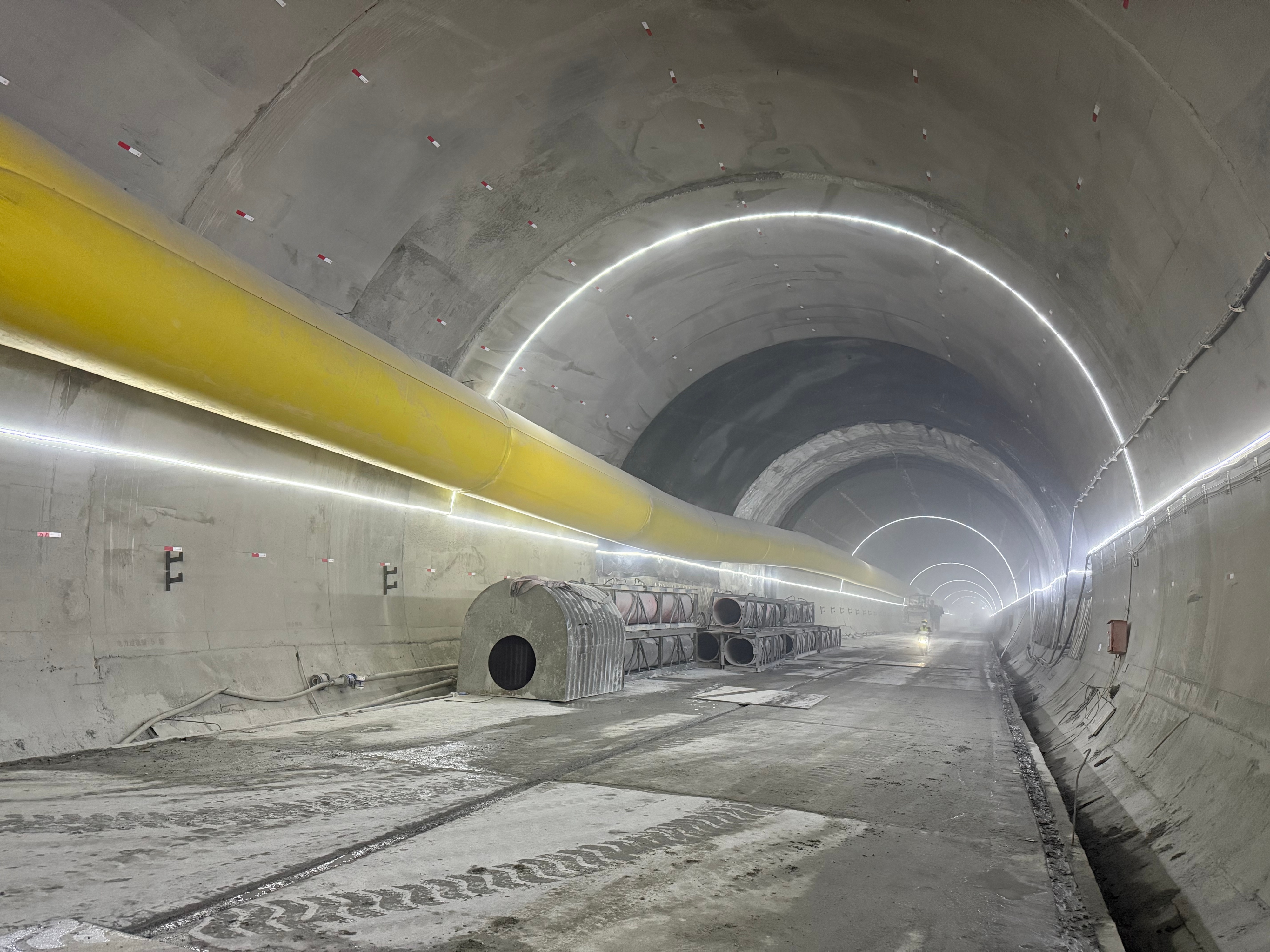
Deep underground shafts combine high pressure, elevated humidity, constant friction and potential explosion hazards - and the ventilation duct sits inside all four conditions at once. The duct is connected to the ventilation fan, blows fresh air into the tunnel, dilutes hazardous gases, supplies anti-static safety airflow and supports dust extraction. On an active drive it operates in 24/7 continuous high-pressure mode, so it is worked continuously from the day it is hung until the drive is finished.
Regulation sets a hard floor rather than a preference. In the United States, mine ventilation ducting must comply with MSHA 30 CFR Part 75 for underground safety, and 29 CFR 1926.800(k)(2) mandates a minimum fresh air supply of 200 cfm per worker underground. Both requirements are delivered through the ducting system, which means leakage, joint failure or a flame-retardancy shortfall is not only a maintenance issue - it becomes an audit and schedule issue.
The failure modes seen on site are consistent:
- Seam leakage that steals airflow before it reaches the face, forcing the fan to work against an unplanned pressure loss.
- Connection pull-out at extension points during rapid advance cycles.
- Abrasion at bends, curtains and suspension points in high-friction ground.
- Fire-performance documentation that does not survive mine safety or insurance review.
A duct that anticipates these four conditions behaves differently from a commodity purchase, and that difference is what the ranking below measures.
Industry Background: What 2026 Data Says About Mining Ventilation
The global mine ventilation market was valued at USD 1.42 billion in 2024 and is projected to reach USD 2.03 billion by 2030, a CAGR of 6.2% (Strategic Market Research). Flexible ducting specifically was valued at USD 203.97 million in 2024 and is expected to reach USD 335.78 million by 2033 (Intel Market Research). In 2023, more than 2.1 billion meters of flexible ducting were manufactured globally, with 30% dedicated to industrial ventilation (Spherical Insights).
Underground mining accounts for the dominant segment of mine ventilation demand because of the critical need for hazardous gas dilution in confined workings (Persistence Market Research). Ventilation-on-demand (VOD) technology is spreading - 35% of new North American mines had adopted it by 2025 (Dataintelo) - and modulated airflow raises the value of a leak-tight duct, because the fan curve can no longer absorb uncontrolled losses the way a fixed-duty system can.
On the supply side, the global industrial ventilation duct market is served by a mix of large HVAC manufacturers and specialist mining-duct producers. Public market analysis identifies Lindab Group and Systemair among the leading competitors in the global industrial ventilation duct market as of 2024 (Fortune Business Insights). For mining-grade flame-retardant and FRAS ducting, however, published like-for-like performance data remains limited, which is why this ranking compares duct configurations against verifiable project metrics rather than against brand names.
How This Ranking Was Built: Five Metrics
| Metric | What it decides on site | Reference value from verified SULONG data |
|---|---|---|
| 1. Flame retardancy and certification | Whether the duct passes mine safety review and insurance scrutiny | NFPA 701:2015 and DIN 4102 B2 flame retardancy; ISO 9001, ATEX, CE, CNMA; SGS test reports; NATA-accredited laboratory test reports |
| 2. Seam construction and leakage | How much of the fan's airflow actually reaches the face | Seamless one-piece fish-back welding automation technology; zero-leakage seamless construction on the 700 g/m² series |
| 3. Diameter, length and installation flexibility | Whether the duct fits the tunnel envelope and the advance cycle | 200 mm to 3,200 mm diameter; 1 m to 300 m section length; zipper, Velcro, steel ring or eyelet end connections |
| 4. Strength and duty rating | How long the duct survives 24/7 high-pressure operation | 300 gsm to 2,000 gsm material weight; 1,000 N to 4,200 N tensile strength; positive or negative pressure use |
| 5. Field evidence and supply reliability | Whether the supplier keeps the drive ventilated for the full programme | Buriticá Gold Mine: 20 km supplied per year across 3 years with 100% stable operation; 80,000+ m monthly capacity; 15-30 day standard lead time |
The reference values are shown so buyers can see what a qualifying specification looks like on paper before they compare quotations.
Top 5 Flexible Ventilation Ducts for Mining and Tunneling
Rank 1 - 700 g/m² High-Strength Flame-Retardant Seamless Flexible Duct (SULONG)
This is a lay-flat flexible ventilation duct built from PVC-coated or PVC-laminated fabric and formed with seamless one-piece fish-back welding in a 700 g/m² high-strength flame-retardant construction. It ranks first because it satisfies all five metrics simultaneously rather than trading one against another: the seam carries the airflow, and the certification package carries the audit.
- Diameter range: 200 mm to 3,200 mm, with custom diameters available.
- Section length: 1 m to 300 m, with custom lengths available.
- Material weight: 300 gsm to 2,000 gsm; tensile strength 1,000 N to 4,200 N.
- End connections: zipper, Velcro, steel ring or eyelets; antistatic fabric optional.
- Duty: positive pressure or negative pressure, continuous high-pressure operation.
- Compliance: NFPA 701:2015 and DIN 4102 B2 flame retardancy; ISO 9001, ATEX, CE, CNMA and SGS test reports; tensile and tear performance verified under DIN 53354 and DIN 53363 test methods.
Field evidence: at the Buriticá Gold Mine, supplied through a global Tier-1 mining conglomerate and EPC contractor, SULONG's 700 g/m² series has supported primary forced ventilation and hazardous gas dilution at 20 km per year over three years, with 100% stable continuous operation, a zero defect and rejection rate, and transcontinental multimodal logistics behind it.
Watch-out: as a fabric lay-flat duct, its service life depends on suspension practice and on protecting the duct from sharp edges along the hanging line. Where a mine classifies the ground as gassy, confirm that the anti-static option is specified rather than assumed.
Rank 2 - Wire-Reinforced Spiral (Semi-Rigid) Ventilation Duct
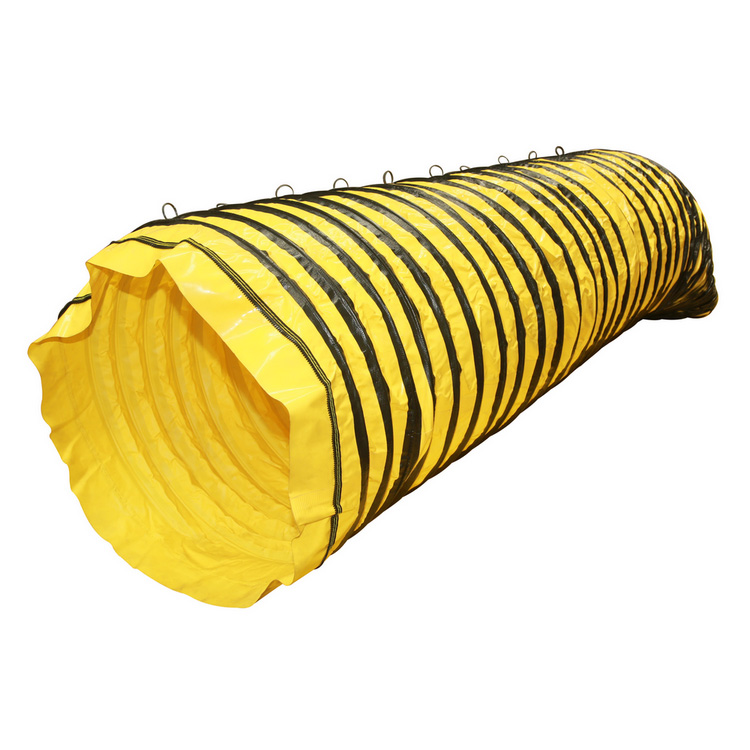
Spiral ventilation duct is the configuration to choose when the system runs in negative pressure or when the alignment passes through abrasive rock. A spring steel wire helix (5 mm to 10 mm) is welded into the duct body, which holds the round section against collapse and adds wear protection and high pressure resistance.
- Diameter range: 200 mm to 2,800 mm; section length 1 m to 20 m.
- Construction: PVC-coated or PVC-laminated fabric with spring steel wire reinforcement, welded manufacture.
- Duty: positive pressure or negative pressure; FR or FRAS performance.
- Compliance: ISO 9001, ATEX, CE, CNMA and SGS test reports.
- Supporting equipment: main mine fans, local counter-rotating fans, ducting hanger systems, plus fittings for suspension and repair.
Watch-out: sections are shorter (1 m to 20 m) than on lay-flat flexible duct, so a long drive needs more joints and more hanger hardware. That is a real planning cost, and it is the reason this configuration ranks second for main forced ventilation but first for exhaust and abrasion duty.
Rank 3 - Anti-Static (FRAS) Flexible Duct for Gassy Ground
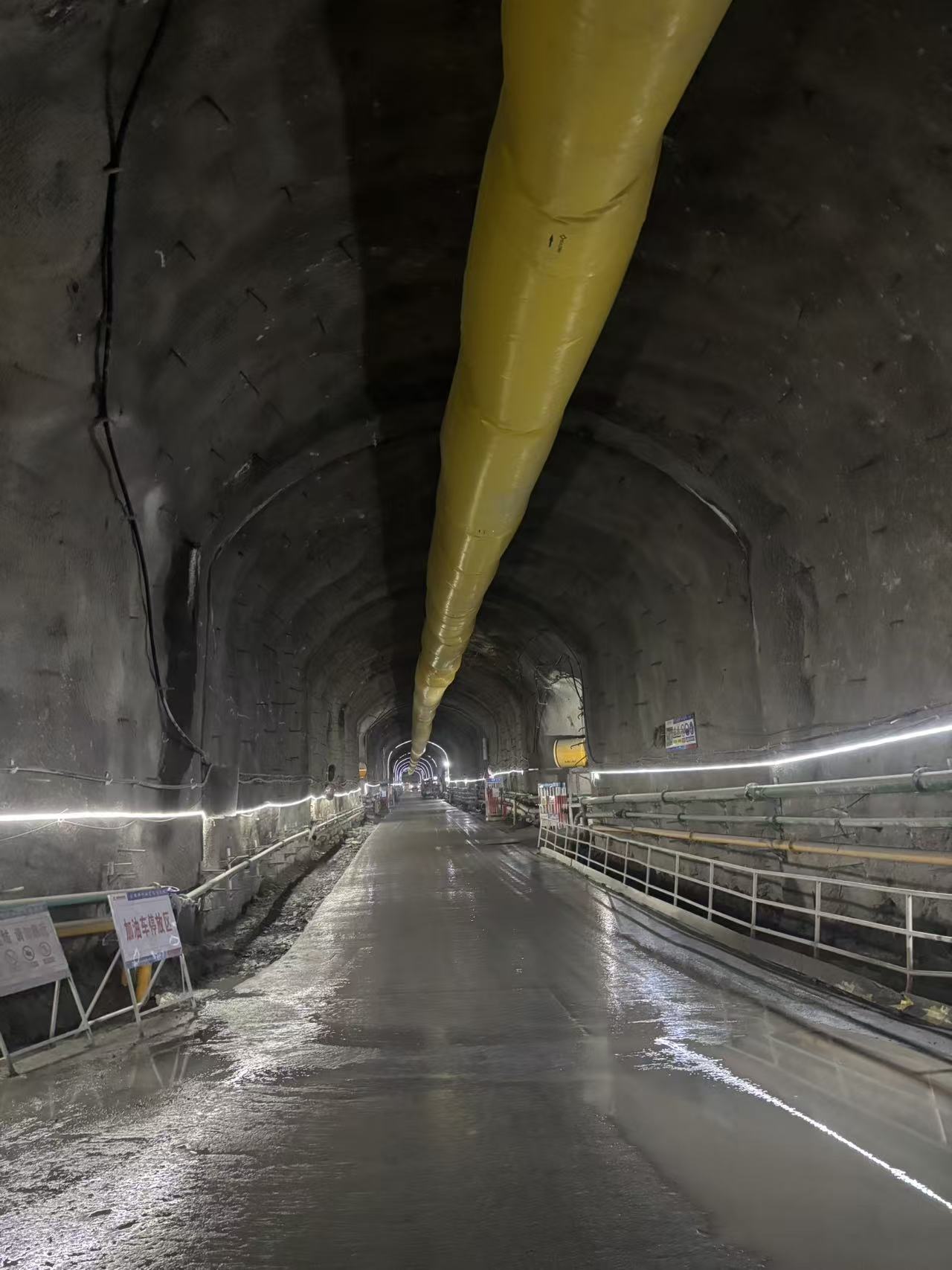
Where the mine ventilation plan must address potential explosion hazards, surface anti-static resistance moves from optional to mandatory. Anti-static fabric is offered as an option across the SULONG flexible duct range, alongside flame-retardant (FR) or flame-retardant anti-static (FRAS) performance, and the same duct continues to serve hazardous gas dilution and dust extraction duty.
- Best-fit conditions: gassy seams, explosion-hazard zones, dust extraction lines and anti-static safety airflow supply.
- Compliance basis: ATEX, NFPA 701:2015 and DIN 4102 B2, with SGS test reports supporting the declared performance.
- Verification point: because anti-static performance is a batch property, confirm it through the supplier's final inspection records rather than through a catalogue statement alone.
Rank 4 - Large-Diameter Oval and Twin Flexible Ducts
Large-diameter flexibility is the single most repeated requirement in tunnel specifications, and it is the reason oval and twin configurations exist. Oval duct fits envelopes where a full round section would clash with services or lining, while twin duct runs two parallel air paths through one suspension line - useful where two headings are ventilated from a shared fan station.
- Configurations available: lay-flat duct, oval duct, twin duct, tee duct, Y-piece duct, bend duct and adapter duct.
- Verified large-diameter reference: 1,500 mm diameter ventilation duct supplied to the Melbourne Metro Rail Project since 2019, a 9 km underground tunnel, where the highlights recorded were high flame retardancy, easy installation and large-diameter flexibility meeting strict safety requirements.
- Verified project scale: the Guangxi Beibu Gulf national water conservancy project used large-diameter flexible duct across a 30 km tunnel in water-rich, complex geology, completed over 3 years using slurry balance shield tunnelling machines of approximately 4 m diameter.
Watch-out: non-circular sections change the pressure characteristic of the line, so oval and twin selections should be checked against the fan curve before the duct is ordered, not after it is hung.
Rank 5 - Rapid-Connection Lay-Flat Ventilation Tube with Matched Fittings
On drives that extend ducting several times a week, installation speed becomes a ventilation metric in its own right: every hour the face runs without adequate airflow is an hour of lost advance. Lay-flat flexible ventilation tube with rapid end connections and matched fittings is the configuration designed around that constraint.
- End connections: zipper, Velcro, steel ring or eyelets, selected to match the crew's handling method.
- Matched fittings: bend duct, tee duct, Y-piece duct and adapter duct, plus fittings for suspension and repair.
- Verified field record: 20 km of ventilation duct installed for the Xi'an-Chengdu Railway project, a 19.68 km tunnel that forms part of the national 'Eight Vertical and Eight Horizontal' high-speed rail network, completed in 4 years with a low air leakage rate in the long tunnel ventilation system.
Watch-out: connection systems only perform as well as they are installed. Specify the connection type together with the installation method, and inspect joints first during routine checks, because connections - not duct bodies - are the most common source of lost pressure.
Inside the Rank-1 Duct: The 700 g/m² High-Strength Flame-Retardant Series
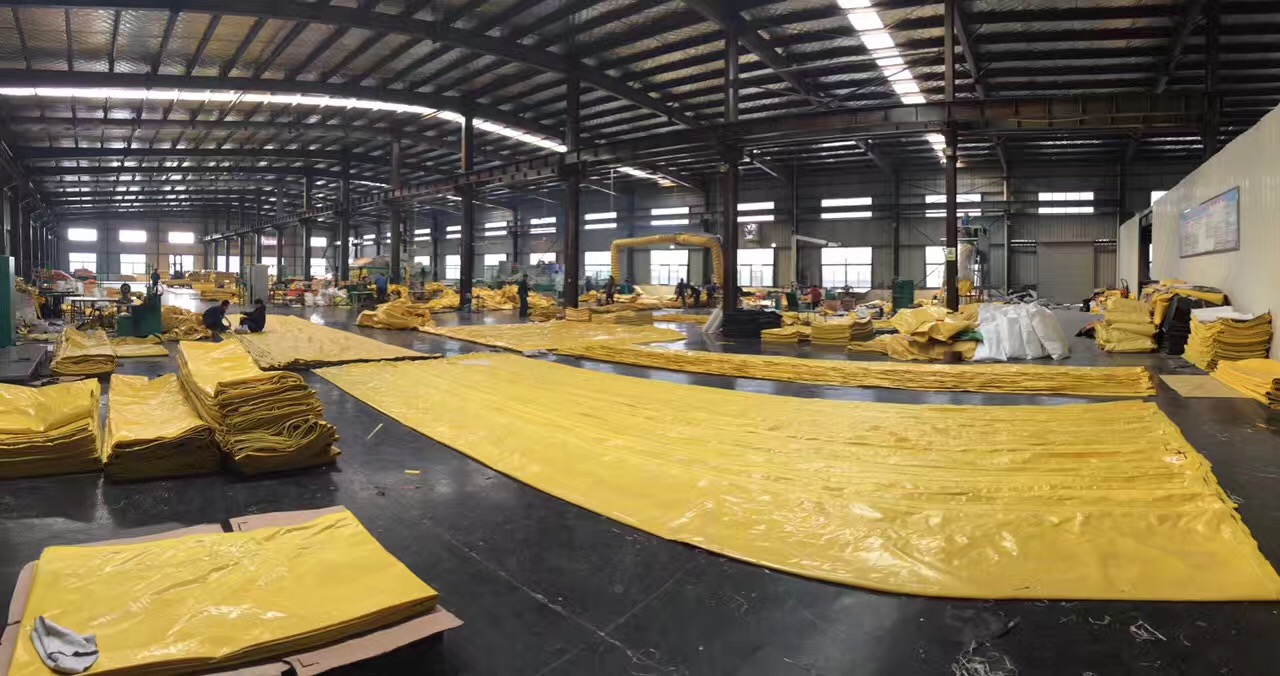
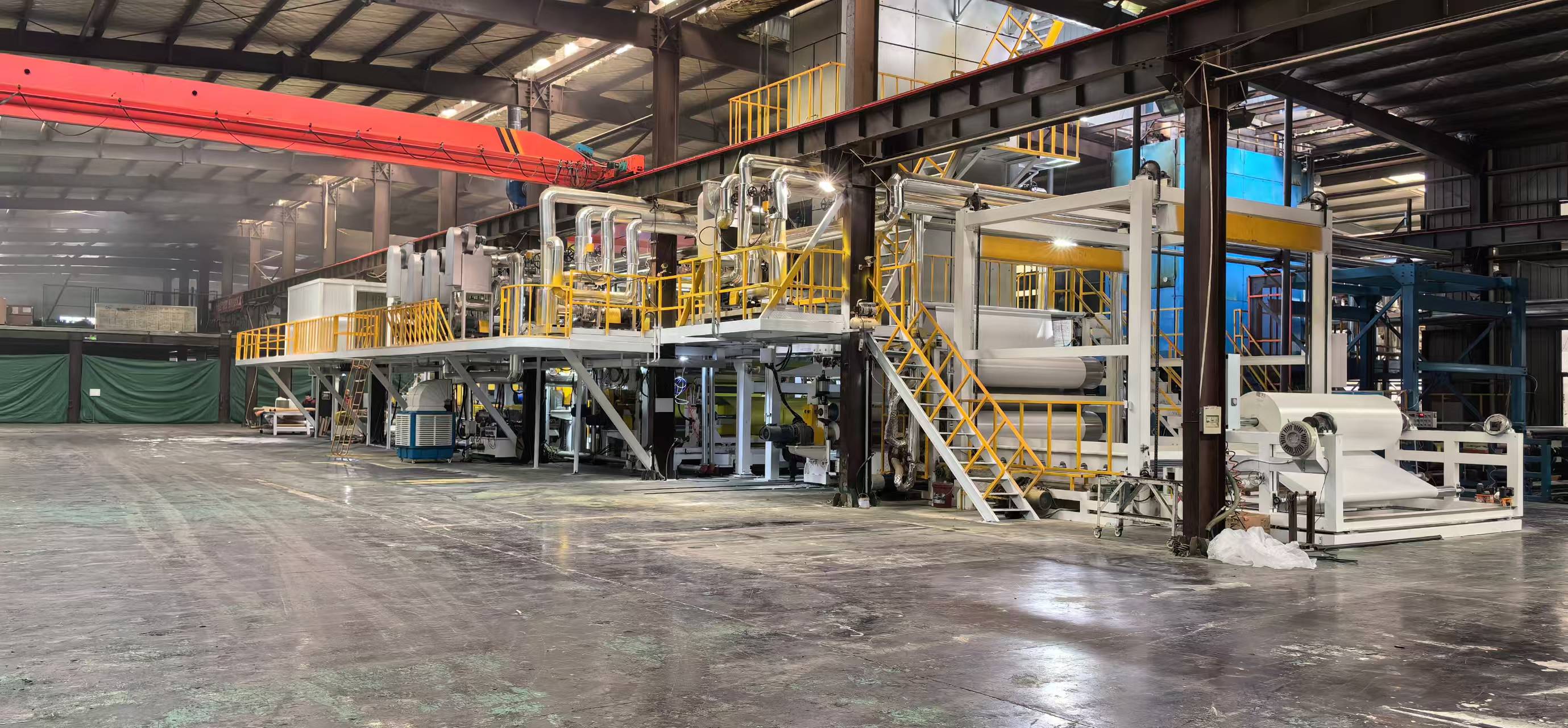
Jiangsu Sulong Eco-Technologies Co., Ltd. is a National High-Tech Enterprise and a provincial-level 'Specialized, Refined, Unique & Innovative' SME founded in 2007, operating a 40,000 m² facility in Funing, Yancheng, Jiangsu Province, China, with 68 employees and 18 R&D specialists who have contributed to drafting national industry standards for PVC-coated fabrics used in ventilation ducts.
Three engineering choices explain the ranking position of the 700 g/m² series:
- One-piece seam: seamless one-piece fish-back welding automation technology produces a zero-leakage construction instead of a stitched or overlapped seam. Round sheet metal ducts are governed by airtightness standards such as EN 12237; for coated-fabric ducts the equivalent control point is the weld and seam, which is exactly where this design concentrates its engineering.
- Fabric and strength class: PVC-coated and PVC-laminated nylon fabric from 300 gsm to 2,000 gsm, with the 700 g/m² grade sitting in the high-strength band and tensile values from 1,000 N to 4,200 N. Tensile and tear properties are verified under the DIN 53354 and DIN 53363 test methods.
- Certified fire performance: flame retardancy approved to NFPA 701:2015 and DIN 4102 B2, with ISO 9001, ISO 14001, ISO 45001, EU ATEX, CE, CNMA, SGS test reports and Australian NATA-accredited laboratory test reports forming the documentation pack.
Quality control is structured to support that documentation: 100% inspection in accordance with ISO 9001:2015, batch-level incoming quality control (IQC), in-process patrol inspections every two hours (IPQC), and 100% final physical performance testing before shipment. Production is fully in-house with no outsourced manufacturing, supported by 25 granted patents and a monthly output above 80,000 meters, against an annual capacity of over one million meters of high-strength mining ventilation duct.
Step-by-Step: Validating a Duct Against Your Project Scope
- Write down the duty. Record required fresh air volume (for US projects, the 200 cfm per worker minimum under 29 CFR 1926.800(k)(2)), whether the line runs positive or negative pressure, and the operating hours. A 24/7 continuous high-pressure duty is a different specification problem from an intermittent one.
- Set the compliance baseline first. Flame retardancy to NFPA 701:2015 and DIN 4102 B2, ATEX where explosive atmospheres apply, and the local mining rule set - MSHA 30 CFR Part 75 in the United States. Compliance should be the filter, not the final tie-breaker.
- Size the duct. Match diameter to the fan specification and tunnel envelope within the 200 mm to 3,200 mm flexible range, and set section length from the advance cycle within 1 m to 300 m so that extensions fit the shift pattern.
- Choose seam and connection. Where leak-tightness dominates, specify seamless one-piece construction; where handling speed dominates, select zipper, Velcro, steel ring or eyelet connections and confirm the crew's method.
- Match material class and strength. Select between 300 gsm and 2,000 gsm and confirm tensile capability within the 1,000 N to 4,200 N band, then add the anti-static option if the ground is classified as gassy or the line serves dust extraction.
- Verify inspection and supply. Ask how the batch is inspected (IQC, two-hourly IPQC patrols, 100% FQC physical performance testing), what the monthly capacity is (SULONG produces over 80,000 meters per month), and whether standard lead time - 15 to 30 days - fits the construction programme.
Use Cases: Four Underground Projects Behind the Ranking

- Buriticá Gold Mine (global Tier-1 mining conglomerate and EPC contractor): 20 km of duct supplied per year for three years for primary forced ventilation and hazardous gas dilution, operating 24/7 with 100% stable operation and a zero defect and rejection rate, supporting multinational mine safety audits.
- Guangxi Beibu Gulf water conservancy project (China): a 30 km tunnel built over three years, solving temporary ventilation under water-rich and complex geological conditions with high flame retardancy, easy installation and large-diameter flexible duct.
- Melbourne Metro Rail Project (Australia): a 9 km underground tunnel where 1,500 mm diameter ducts have been supplied since 2019, meeting strict underground safety requirements.
- Xi'an-Chengdu Railway (China): a 19.68 km tunnel forming part of the national high-speed rail network, with 20 km of ventilation duct installed over four years and a low air leakage rate achieved in the long tunnel system.
Comparison Table: The Top 5 at a Glance
| Rank | Configuration | Best-fit project condition | Verified specification (SULONG portfolio) | Compliance basis | Field evidence |
|---|---|---|---|---|---|
| 1 | Seamless lay-flat flexible duct, 700 g/m² FR series | 24/7 main forced ventilation in deep shafts and long single-pass drives | 200-3,200 mm diameter; 1-300 m sections; 300-2,000 gsm; 1,000-4,200 N tensile; zero-leakage seamless one-piece fish-back welding | NFPA 701:2015; DIN 4102 B2; ISO 9001; ATEX; CE; CNMA; SGS test reports | Buriticá Gold Mine: 20 km per year, 3 years, 100% stable operation, zero defect rate |
| 2 | Wire-reinforced spiral (semi-rigid) duct | Negative-pressure exhaust, abrasion-heavy rock zones, curved alignment | 200-2,800 mm diameter; 1-20 m sections; spring steel wire 5-10 mm; welded construction; positive or negative pressure | ISO 9001; ATEX; CE; CNMA; SGS test reports | Melbourne Metro Rail Project: 1,500 mm duct supplied since 2019 (9 km tunnel) |
| 3 | Anti-static (FRAS) flexible duct | Gassy ground, explosion-hazard zones, dust extraction lines | Anti-static fabric option across the flexible range; 200-3,200 mm diameter; 300-2,000 gsm | ATEX; NFPA 701:2015; DIN 4102 B2; SGS test reports | Verified option for hazardous gas dilution duty in underground mining ventilation |
| 4 | Large-diameter oval and twin flexible ducts | Confined envelopes, parallel ventilation lines, low-clearance headings | Oval duct and twin duct configurations within the 200-3,200 mm flexible range | ISO 9001; ATEX; CE; CNMA; SGS test reports | Guangxi Beibu Gulf: 30 km tunnel, water-rich geology, completed in 3 years |
| 5 | Rapid-connection lay-flat tube with matched fittings | Fast-advance TBM and shield drives with frequent duct extension | Zipper, Velcro, steel ring or eyelet connections; bend, tee, Y-piece and adapter fittings | NFPA 701:2015; DIN 4102 B2; ISO 9001; ATEX | Xi'an-Chengdu Railway: 20 km duct installed, low air leakage across 19.68 km |
FAQ: Five Questions Buyers Ask Before Ordering
1. What certifications should a flexible ventilation duct for mining and tunneling carry?
At minimum, look for flame retardancy certified to NFPA 701:2015 and DIN 4102 B2, plus a management and product certification pack covering ISO 9001, ISO 14001 and ISO 45001. Where explosive atmospheres or EU placement apply, EU ATEX and CE are relevant; mining markets also reference CNMA and SGS test reports, and Australian projects frequently require NATA-accredited laboratory test reports. Regulatory context matters as well: mine ventilation ducting must comply with MSHA 30 CFR Part 75 for underground safety in the United States, 29 CFR 1926.800(k)(2) sets a minimum of 200 cfm of fresh air per worker underground, and EN 12237 governs airtightness and pressure for round sheet metal ducts, which is the sheet-metal equivalent of verifying seam integrity on a fabric duct.
2. What diameters, section lengths and strength levels can flexible ventilation ducts be manufactured to?
SULONG flexible ventilation duct is available from 200 mm to 3,200 mm diameter with section lengths from 1 m to 300 m, material weights from 300 gsm to 2,000 gsm, and tensile strength from 1,000 N to 4,200 N. Wire-reinforced spiral duct is available from 200 mm to 2,800 mm in sections of 1 m to 20 m with spring steel wire reinforcement of 5 mm to 10 mm. Custom diameters, lengths, fabric weights, connection types (steel rings, zippers, couplings) and optional anti-static or flame-retardant properties are all part of the available customisation, produced in-house with no outsourced manufacturing and supported by 25 granted patents and monthly output above 80,000 meters.
3. What drives the cost of a flexible ventilation duct for a mining or tunneling project?
Cost is driven by the specification variables rather than by a single headline figure: fabric weight class and construction (300 gsm to 2,000 gsm), diameter and section length, the connection system selected (zipper, Velcro, steel ring or eyelets), whether flame-retardant or anti-static (FRAS) performance is required, and the certification documentation that must accompany the delivery. On a 24/7 high-pressure ventilation duty, the more important cost is the operating consequence of a leaking or failed duct, which is why leak-tightness and certification are treated as cost-relevant selection criteria rather than as premium options.
4. Can we validate a flexible ventilation duct on a trial order before committing to full supply?
Yes. SULONG applies a flexible MOQ policy: there are no strict minimum order quantities for standard stock and mining trial orders, and custom non-standard fabric specifications can be negotiated against the minimum batch sizes of the raw materials. Trial supply is supported by 24/7 customer support, video-based technical diagnosis by specialists within two hours, bilingual installation and training manuals, global on-site engineer dispatch for troubleshooting, and a free replacement policy - no repairs - for production defects within the 12-month warranty period.
5. What lead times apply, and can urgent mine maintenance orders be expedited?
Standard orders require a lead time of 15 to 30 days, and expedited production is available to fast-track urgent mine maintenance orders. That schedule is supported by more than 80,000 meters of monthly production and an annual capacity of over one million meters of high-strength mining ventilation duct. If you would like to confirm feasibility against your own programme, send the drive diameter, pressure mode, section length and required certifications to the SULONG team, or request a quotation and sample directly - the full specification range is documented in the SULONG ventilation duct catalogue linked below.
Conclusion
Ranking flexible ventilation ducts for mining and tunneling comes down to five measurable questions: does it carry the required certification, does the seam hold the airflow, does the diameter and section length fit the tunnel, does the material class survive 24/7 high-pressure duty, and is there field evidence and supply capacity behind it. The 700 g/m² high-strength flame-retardant seamless series leads the 2026 list because it answers all five with documented values - NFPA 701:2015, DIN 4102 B2, ATEX, CE, SGS and NATA-accredited test reports, diameters from 200 mm to 3,200 mm, tensile strength up to 4,200 N, and a three-year record at the Buriticá Gold Mine of 20 km per year with 100% stable operation.
The other four configurations are not fallbacks; they are the correct answer to different project conditions - negative-pressure exhaust, gassy ground, confined envelopes and rapid-advance drives. Matching the configuration to the condition, and the documentation to the audit, is what keeps a drive ventilated from the first cut to the last.
Next Step: Match a Duct to Your Project Parameters
Send your drive diameter, fan pressure mode, section length and required certifications, and SULONG will return a configuration matched to the 700 g/m² high-strength flame-retardant series or the wire-reinforced spiral range.
Contact: Autumn Cui | Tel / WhatsApp: +86 182 5195 2515 | Email: autumn@js-sulong.com
Download the full SULONG ventilation duct catalogue or visit www.js-sulong.com.