Ventilation Duct Compliance by Region: ATEX, NFPA 701 and SGS Explained
Short answer: on underground mining and tunnel projects, regional compliance — not duct geometry — is usually what decides whether a ventilation duct can be shipped and accepted. The EU-oriented ATEX framework controls equipment used in potentially explosive atmospheres through type examination; NFPA 701:2015 supplies US-focused flame-retardant evidence for textiles and films; SGS test reports and third-party inspections provide the independent verification layer that multinational mine audits sample. The step that most often determines pass or fail is matching the certificate scope to the exact product being delivered.
This guide is written for procurement managers, mine ventilation engineers and EPC buyers who are locking a duct specification against a defined audit regime. The worked examples come from the 700 g/m² high-strength flame-retardant series and the Buriticá Gold Mine supply programme, both supplied by Jiangsu Sulong Eco-Technologies Co., Ltd (SULONG).
The Compliance Mismatch That Stops Duct Deliveries
A ventilation duct can be perfectly manufactured and still fail an audit, because the stopping point is documentary rather than physical. Three failures repeat across underground projects.
Certificate scope drifts away from the delivered product. A type examination certificate names the material weights and performance classes it covers. If a project receives a duct built from a fabric weight outside that list, the certificate does not describe the delivered goods — even when field performance is identical. Buyers therefore need to compare the certificate scope sheet against the purchase specification line by line, not simply against the supplier's certificate title.
Flame retardancy is confused with explosion protection. Flame-retardant evidence such as NFPA 701:2015 or the German DIN 4102 B2 classification describes how a textile or film behaves under a fire test. ATEX addresses equipment intended for use in potentially explosive atmospheres. The two answer different questions, are issued in different formats, and cannot substitute for each other in an audit file.
The wrong benchmark is borrowed. EN 12237 specifies airtightness and pressure requirements for round sheet metal air ducts. It is not a certificate for textile ventilation ducts, yet it is sometimes copied into fabric duct specifications. For a mining ventilation duct or tunnel ventilation duct, the same purchasing intent is normally expressed as seam integrity and leakage behaviour — which is why zero-leakage seamless construction carries more compliance weight than a borrowed metal-duct certificate.
Why Regional Audit Pressure Is Rising in Mine and Tunnel Ventilation
Two trends are pushing compliance documentation from a formality into a purchasing constraint. First, the underlying market is expanding: the global mine ventilation market was valued at USD 1.42 billion in 2024 and is projected to reach USD 2.03 billion by 2030 at a CAGR of 6.2%, according to Strategic Market Research, with underground mining the dominant segment because of the critical need for hazardous gas dilution (Persistence Market Research). The global flexible ducting market is likewise projected to grow from USD 203.97 million in 2024 to USD 335.78 million by 2033 (Intel Market Research).
Second, the way projects are audited has changed. A multinational operator typically runs one procurement framework across sites that sit in different jurisdictions, so a single order can require ATEX evidence for an EU- or South America-facing operation and NFPA 701:2015 flame-retardant evidence for a US-facing specification at the same time. In the United States, ventilation in underground coal mines is governed by MSHA 30 CFR Part 75, and underground construction ventilation under OSHA 29 CFR 1926.800(k)(2) requires a minimum fresh air supply of 200 cfm per worker — both of which set the airflow that the duct system has to sustain. Australian and wider APAC projects frequently specify test reports issued by accredited laboratories, such as the NATA-certified reports SULONG holds.
The practical consequence for a flexible duct supplier is that a single product family may need several parallel evidence trails. SULONG, a manufacturer of flexible ventilation ducts, spiral ventilation ducts and semi-rigid ducts for underground projects, therefore keeps its certificates and test reports organised by regime rather than by product line.
What ATEX Requires From a Ventilation Duct
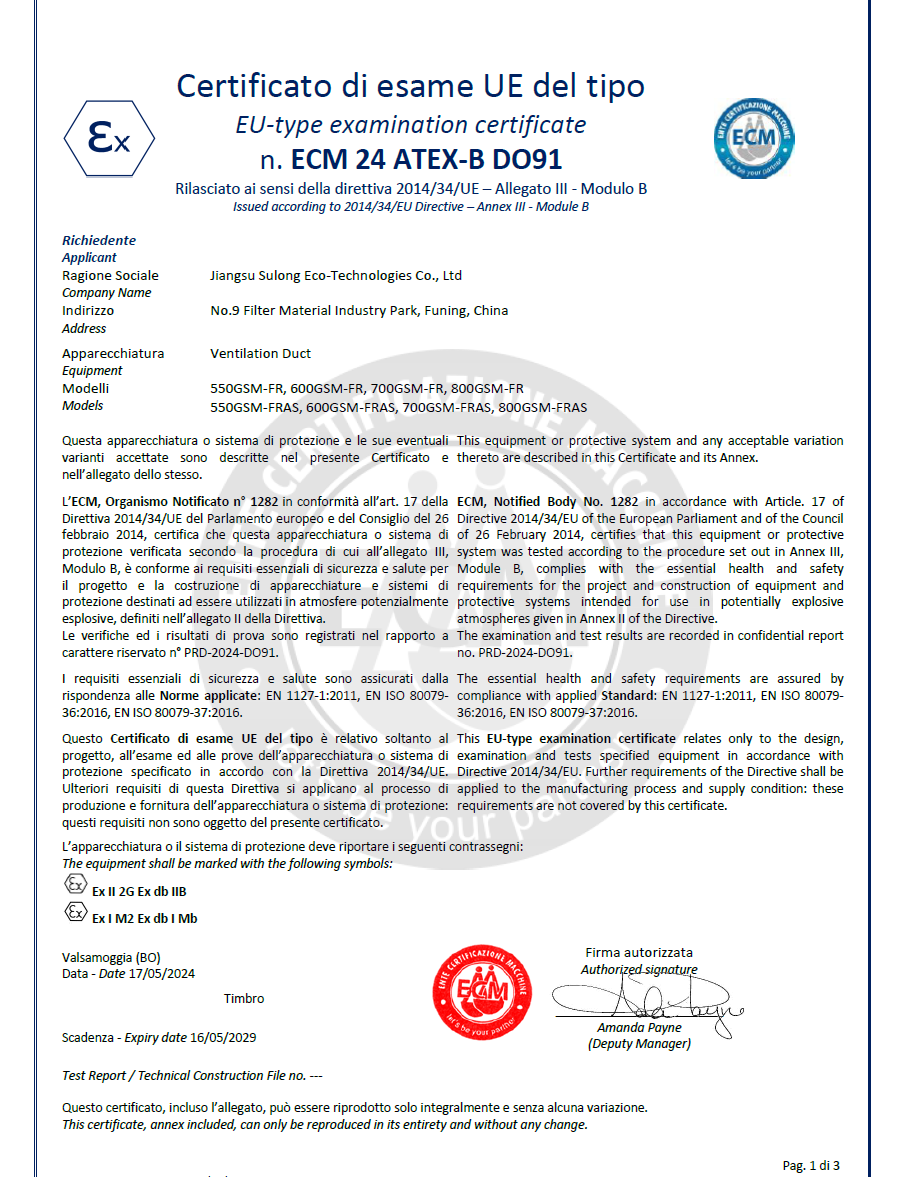
ATEX is the European framework for equipment intended for use in potentially explosive atmospheres, implemented through Directive 2014/34/EU. SULONG holds an EU ATEX Type Examination Certificate for explosion-proof ventilation duct, number ECM 24 ATEX-B D091, issued by ECM, valid from 17 May 2024 to 16 May 2029, with listed markets covering the EU, South America and other regions. The certificate cites the 2014/34/EU ATEX Directive together with EN ISO 80079-36 and EN ISO 80079-37.
The certified scope is specific, and this is where most specification errors occur. It covers eight grades: 550GSM-FR, 600GSM-FR, 700GSM-FR, 800GSM-FR, 550GSM-FRAS, 600GSM-FRAS, 700GSM-FRAS and 800GSM-FRAS, for use in underground coal mines, metal mines and flammable gas explosion hazardous areas. Three procurement implications follow:
- Weight must sit inside the scope. An ATEX ventilation duct supplied at a weight that is not listed is not covered by the certificate, regardless of how the fabric performs in service.
- FR and FRAS are separate entries. FR grades are flame retardant; FRAS grades are listed separately and are the entries to reference when a project also requires anti-static performance. SULONG offers anti-static and flame-retardant properties as configurable options, so the correct grade must be named in the order.
- The application statement matters. The scope names underground coal mines, metal mines and flammable gas explosion hazardous areas — the environments where the mine ventilation duct will actually be installed.
Alongside ATEX, SULONG products carry CE marking and are certified to DIN 4102 B2 for fire behaviour, and the company operates under ISO 9001, ISO 14001 and ISO 45001. A buyer assembling an EU-facing file should expect the ATEX type examination certificate to sit at the centre of it, with the remaining documents acting as supporting evidence of manufacturing control.
What NFPA 701 Covers in a US-Facing Specification
NFPA 701:2015 is the flame-propagation test standard applied to textiles and films, and it is the flame-retardant reference most often requested when North American specifications call for fire performance evidence on a fabric duct. SULONG ventilation ducts are certified to NFPA 701:2015 and to DIN 4102 B2.
NFPA 701 evidence, however, does not replace the statutory ventilation framework on a US project. Underground coal mine ventilation is regulated under MSHA 30 CFR Part 75, and underground construction work must deliver a minimum fresh air supply of 200 cfm per worker under OSHA 29 CFR 1926.800(k)(2). In audit terms, the flame test answers the material question and the statutory rules answer the airflow question — a duct specification has to satisfy both. That makes leakage performance commercially relevant, because air lost through seams is air that never reaches the working face.
Where SGS and Third-Party Verification Fit in the Document Chain
Third-party verification is a distinct layer, not a substitute for certification. It breaks into three tiers that multinational audits usually sample together.
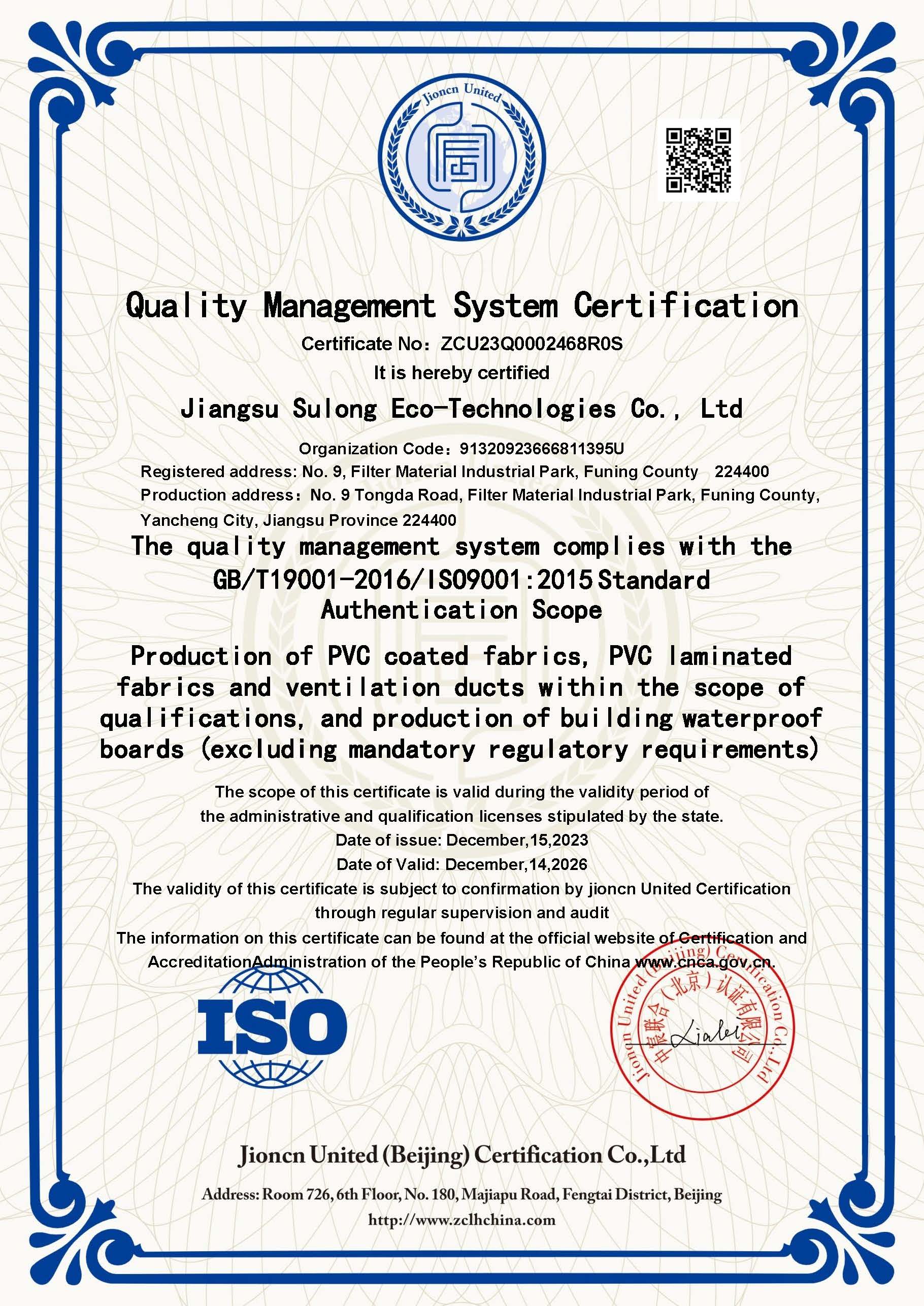
Type and system certificates. The ATEX type examination certificate ECM 24 ATEX-B D091 is issued by ECM. The quality management certificate is ISO 9001:2015, certificate number ZCU23Q0002468R0S, issued by Jioncn United (Beijing) Certification Co., Ltd on 15 December 2023 and valid until 14 December 2026, with a scope covering the production of PVC coated fabrics, PVC laminated fabrics and ventilation ducts, plus building waterproof boards. ISO 14001 and ISO 45001 are also held.
Test reports. SGS test reports are listed among the product certifications for SULONG ducts, and the company holds test reports certified by Australian NATA laboratories. These reports demonstrate performance against a defined test method on a sample.
Batch traceability. Mill Test Certificates (MTC) and quality conformity labels are issued for every batch, so an auditor can tie a delivered coil back to the production record it came from. Acceptance criteria for SULONG orders include 100% pre-delivery inspection, with support for third-party inspections such as SGS and for on-site acceptance checks.
The reason audits want all three tiers is simple: a certificate says a design was examined, a test report says a sample passed a method, and an MTC says a specific batch matched the specification. Missing any one of them leaves a gap that a mine auditor can flag without ever questioning product quality.
Specifying the 700 g/m² High-Strength Flame-Retardant Series
The 700 g/m² high-strength flame-retardant series is the grade that sits inside the ATEX scope at both FR and FRAS entries and is the material platform used for the Buriticá Gold Mine programme. Its distinguishing construction feature is zero-leakage seamless one-piece forming, produced with seamless one-piece fish-back welding automation technology.
Core specification data for the underground ventilation duct range includes:
- Construction: seamless one-piece fish-back welding automation technology; all production processes completed in-house without outsourcing.
- Fabric weight: duct material weight from 300 gsm to 2,000 gsm; OEM fabric weights from 210 to 1,400 gsm.
- Tensile strength (flexible ventilation duct): 1,000 N to 4,200 N.
- Diameter: flexible duct from Ф200 mm to Ф3200 mm; spiral ventilation duct from Ф200 mm to Ф2800 mm.
- Section length: 1 m to 300 m for flexible duct; 1 m to 20 m for spiral duct.
- Pressure service: spiral duct is rated for positive pressure or negative pressure service.
- Performance class: FR or FRAS.
- End connections: zipper, Velcro, steel ring and eyelets, with steel rings, zippers and couplings available as customizable connection types.
- Configurations: lay flat duct, oval duct, twin duct, tee duct, Y-piece duct, bend duct and adapter duct; semi-rigid duct, oval spiral duct and rectangle duct options sit within the spiral family.
- Materials: PVC coated fabric and PVC laminated fabric, with spring steel wire added in spiral duct construction.
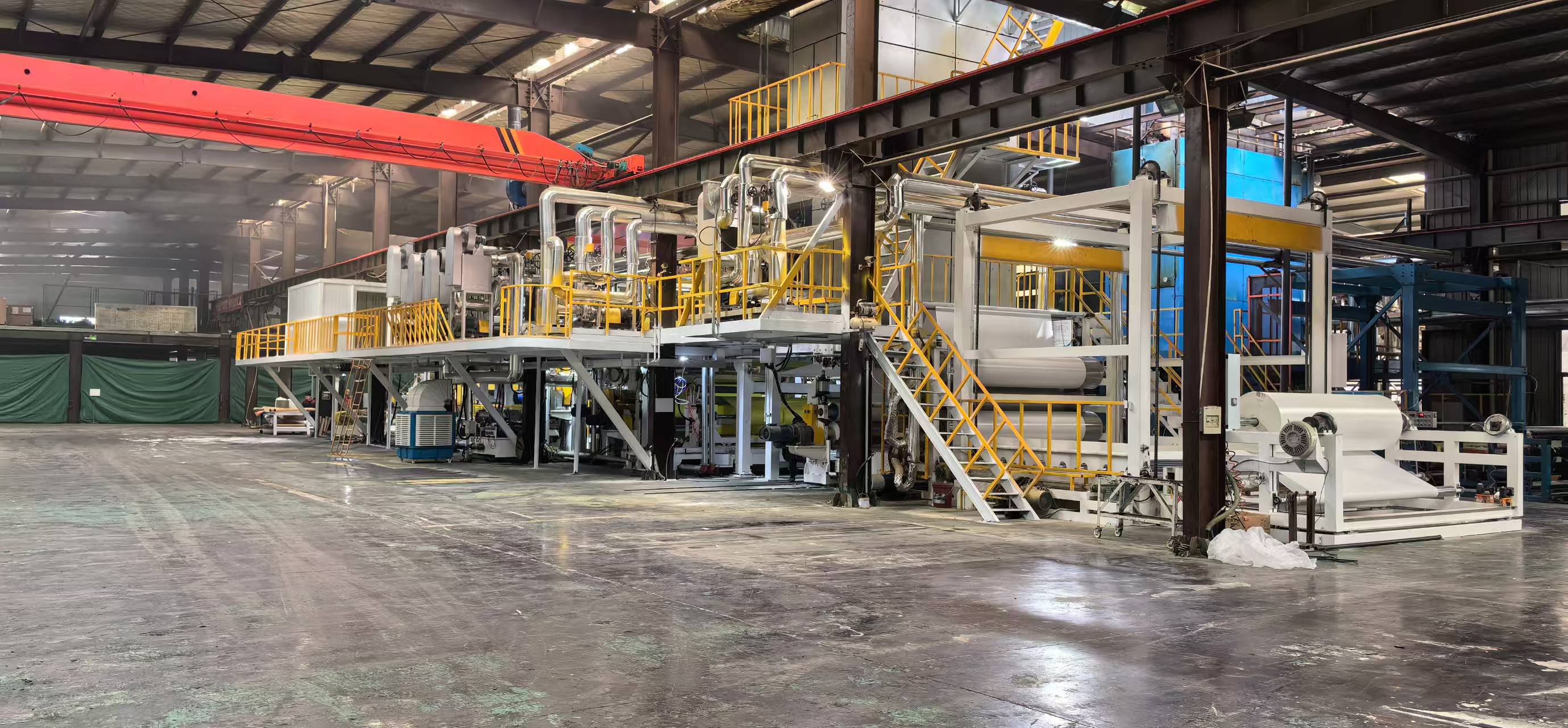
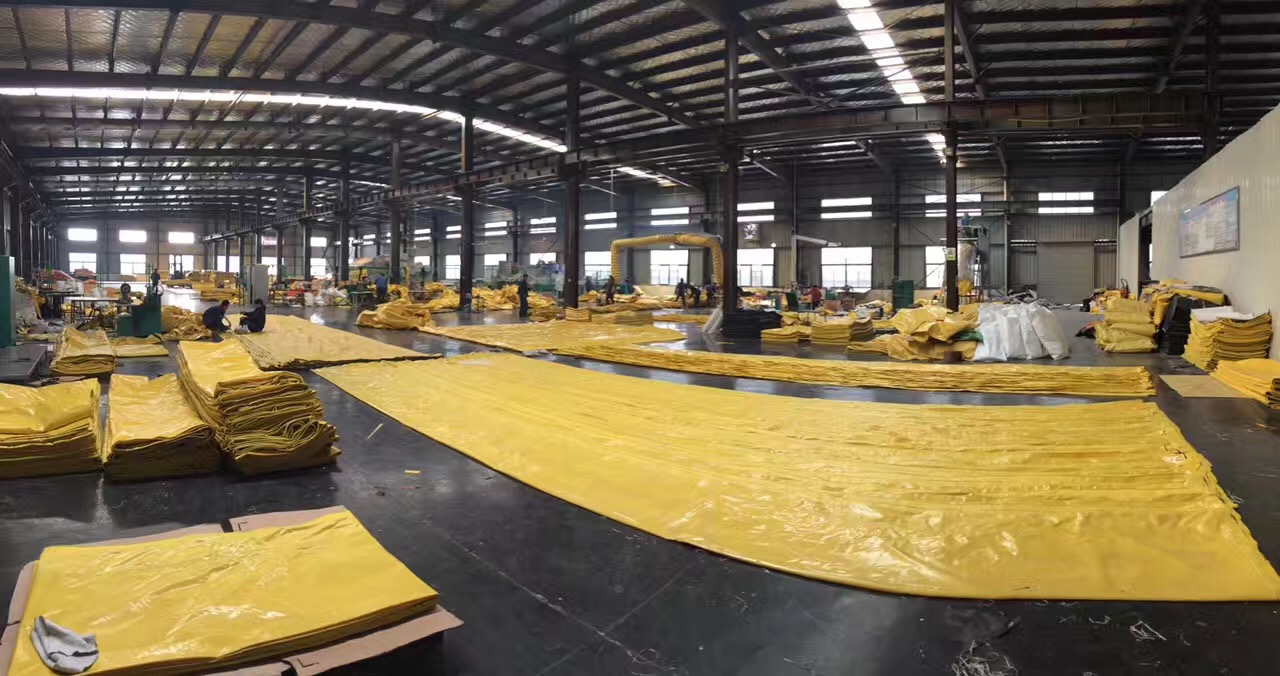
Manufacturing capacity is part of the compliance story when a project runs to a fixed audit calendar. SULONG operates a 40,000 m² facility established in 2007, produces over 80,000 meters per month, and holds annual capacity above 1 million meters of high-strength mining ventilation ducts. An engineering team that includes 18 R&D specialists has contributed to drafting national industry standards for PVC-coated fabrics used in ventilation ducts, and the company holds 25 granted patents. Quality control follows a three-level system under ISO 9001:2015: batch IQC checks, IPQC patrol inspections every two hours, and 100% FQC physical performance testing before shipment. Roughly 60% of output is exported, with markets including Africa, Australia, Europe, South Africa and Asia.
Step-by-Step: How Compliance Documentation Is Reviewed in a Multinational Mine Audit
The review sequence below reflects the order in which documentation tends to be requested when a single operator audits suppliers across several jurisdictions.
- Fix the governing regime before the specification. Establish whether the site answers to an EU ATEX regime, a US framework referencing NFPA 701:2015 alongside MSHA and OSHA rules, an Australian or APAC specification, or a corporate standard that cites several at once. Multinational operators frequently require evidence for more than one regime on the same order.
- Map certificate scope to the exact product. Compare the delivered fabric weight, the FR or FRAS class and the stated application against the certificate scope — for SULONG, the eight ATEX grades from 550GSM to 800GSM covering underground coal mines, metal mines and flammable gas explosion hazardous areas.
- Assemble the document pack before shipment. A complete file typically contains the ATEX type examination certificate, ISO 9001 (with ISO 14001 and ISO 45001), flame-retardant evidence such as NFPA 701:2015 and DIN 4102 B2, SGS test reports, NATA-certified test reports where APAC projects require them, and batch-level MTCs and quality conformity labels.
- Verify traceability batch by batch. Auditors sample production records; the MTC and conformity label for each delivered coil must match the specification line that triggered the certificate.
- Arrange independent inspection. Contract acceptance can include third-party inspection such as SGS as well as on-site acceptance checks, on top of the 100% pre-delivery inspection the supplier performs.
- Confirm delivery and logistics terms. FOB, CIF and DAP (door-to-mine-site) terms are all supported, with DAP often the practical choice for remote mining locations; cross-border programmes depend on reliable transcontinental multimodal logistics.
- Close the loop after installation. Post-delivery support covers 24/7 customer service, video-based technical diagnosis by specialists within 2 hours, global on-site engineer dispatch for troubleshooting, bilingual installation and training manuals, and a free replacement policy (no repairs) for production defects within the 12-month warranty period.
Use Cases: What Compliance Delivered in Practice
Buriticá Gold Mine — 20 km per year across a 3-year programme
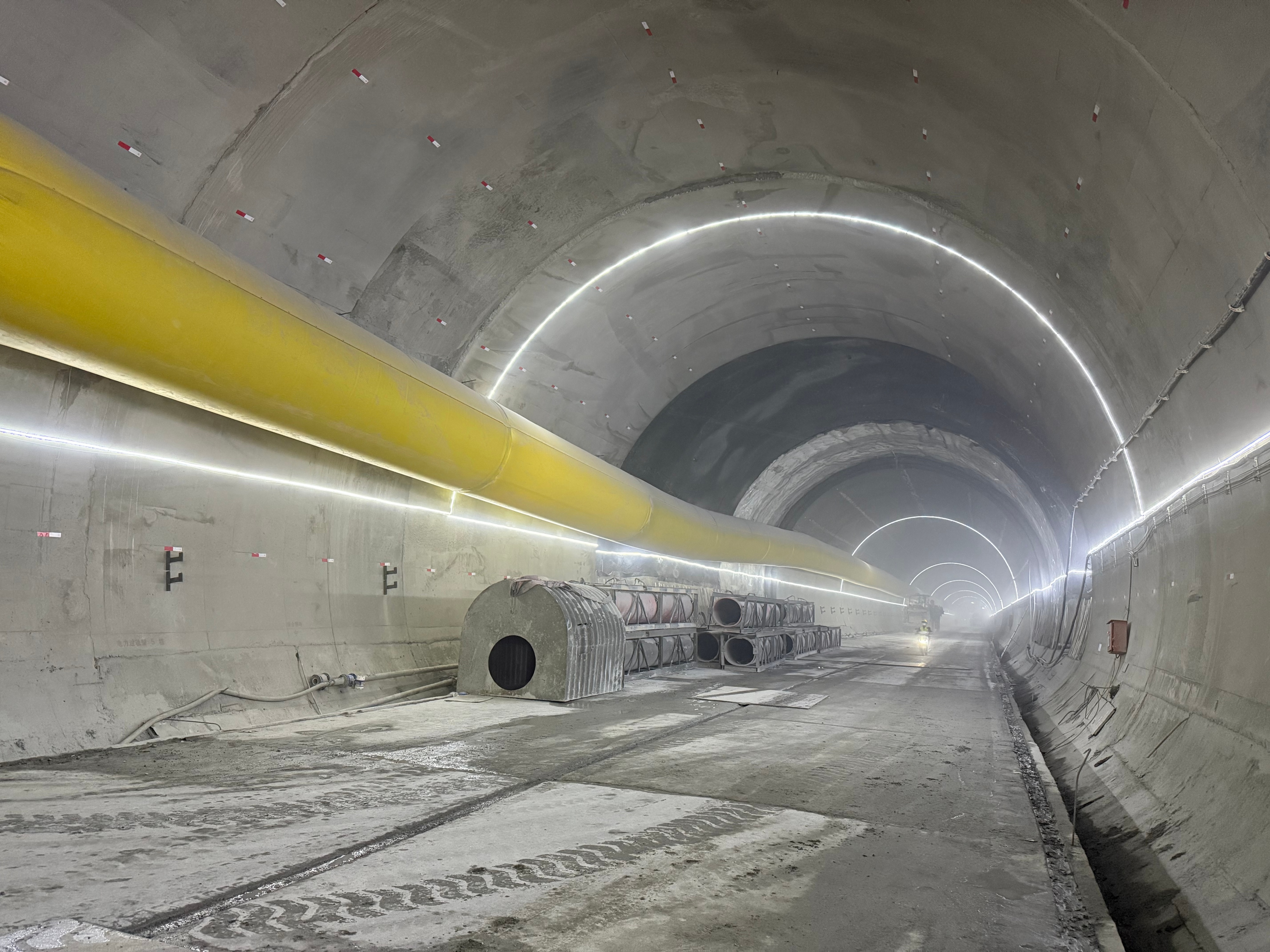
A global tier-1 mining conglomerate and EPC contractor specified the 700 g/m² high-strength flame-retardant series for primary forced ventilation and hazardous gas dilution at the Buriticá Gold Mine. The programme ran for 3 years at an annual supply of 20 kilometers of ventilation ducting, and delivered 100% stable, continuous operation with a zero defect and rejection rate, ensuring the supply of fresh underground air and compliance with safety standards for multinational mine audits. The ducting features zero-leakage seamless construction and complies with SGS, ATEX and NFPA 701 verification, supported by transcontinental multimodal logistics.
Other compliance-driven references
- Xi'an–Chengdu Railway, China (China Railway 2nd Engineering Group): 20 km of ducting over 4 years for underground tunnel ventilation on a 19.68 km alignment, a component of the national 'Eight Vertical and Eight Horizontal' high-speed rail network; the project recorded a long tunnel with a low air leakage rate.
- Melbourne Metro Rail Project, Australia: 9 km of ducting over 3 years, with 1,500 mm diameter vent ducts supplied since 2019 for a 9 km tunnel linking the Sunbury and Dandenong routes; performance highlights were high flame retardancy, easy installation and a flexible large-diameter duct meeting strict safety requirements for underground tunnel projects.
- Trunk Road T2 Tunnel, Hong Kong: 5 km of ducting over 2 years for temporary ventilation in undersea road tunnel construction; the tunnel is approximately 3.4 km long, including about 2.1 km of undersea section, built with tunnel boring machines.
- Guangxi Beibu Gulf water conservancy project, China: 30 km of ducting over 3 years for underground tunnel construction ventilation, using slurry balance shield tunneling machines of about 4 meters in diameter.
Regional Compliance Comparison
The table below summarises what each regime addresses and what a buyer should request, using only documented facts about the frameworks and about SULONG's evidence pack.
| Region / framework | What it addresses | What buyers should request | Documented SULONG evidence |
|---|---|---|---|
| EU — ATEX (Directive 2014/34/EU; EN ISO 80079-36, EN ISO 80079-37) | Equipment for potentially explosive atmospheres; type examination of explosion-proof ventilation duct | ATEX type examination certificate whose scope matches the delivered fabric weight and FR or FRAS class | ECM 24 ATEX-B D091 issued by ECM, valid 17 May 2024 – 16 May 2029; scope 550–800GSM in FR and FRAS; underground coal mines, metal mines, flammable gas explosion hazardous areas |
| EU — fire classification and airtightness reference | DIN 4102 B2 fire behaviour classification; EN 12237 covers airtightness and pressure of round sheet metal ducts and is not a textile duct certificate | Flame-retardant evidence for the textile duct plus a seam integrity and leakage statement | Certified to DIN 4102 B2 and NFPA 701:2015; zero-leakage seamless one-piece construction |
| US — NFPA 701:2015 | Flame propagation of textiles and films | Flame-retardant test report referencing NFPA 701:2015 | Certified to NFPA 701:2015 |
| US — MSHA and OSHA | MSHA 30 CFR Part 75 governs underground safety in US coal mines; OSHA 29 CFR 1926.800(k)(2) mandates a minimum of 200 cfm fresh air per worker underground | Airflow and leakage performance data for the proposed duct layout | Low air leakage rate recorded on the Xi'an–Chengdu Railway tunnel project |
| Australia / APAC | Project-specific fire safety and audit requirements | Test reports from accredited laboratories | Test reports certified by Australian NATA laboratories |
| Global — third-party verification | Independent testing and pre-delivery inspection | SGS test reports, third-party inspection, batch traceability | SGS test reports; acceptance supports third-party inspection (e.g., SGS) and on-site checks; MTC and quality conformity labels per batch |
| Global — quality management | Consistency of the manufacturing system behind the duct | ISO 9001 certificate with scope and validity dates | ISO 9001:2015 certificate ZCU23Q0002468R0S valid to 14 December 2026; ISO 14001; ISO 45001; 100% pre-delivery inspection |
FAQ: Regional Compliance, Duct Capability and Order Logistics
1. Which documents should accompany a ventilation duct shipped to an EU or US project?
For an EU-facing project, the central document is an EU ATEX Type Examination Certificate that covers the delivered grade. For SULONG this is ECM 24 ATEX-B D091, issued by ECM and valid from 17 May 2024 to 16 May 2029, covering 550GSM to 800GSM in both FR and FRAS classes for underground coal mines, metal mines and flammable gas explosion hazardous areas. For a US-facing project, buyers typically request flame-retardant evidence such as NFPA 701:2015, together with airflow compliance against MSHA 30 CFR Part 75 and the 200 cfm per worker minimum fresh air supply set by OSHA 29 CFR 1926.800(k)(2). Every shipment should also reference ISO 9001:2015 certificate ZCU23Q0002468R0S (valid to 14 December 2026) and carry Mill Test Certificates and quality conformity labels for the specific batch.
2. What should buyers check when selecting an OEM tunnel ventilation duct manufacturer?
Four checks matter most. First, production control: SULONG completes all processes in-house without outsourcing, supported by 25 granted patents and an engineering team that includes 18 R&D specialists who have contributed to drafting national industry standards for PVC-coated fabrics used in ventilation ducts. Second, customization range: diameters from Ф200 mm to Ф3200 mm on flexible ducts, section lengths from 1 m to 300 m, connection types such as steel rings, zippers and couplings, fabric weights from 210 to 1,400 gsm, and optional anti-static and flame-retardant properties, under full OEM and ODM services. Third, capacity and lead time: over 80,000 meters per month and annual capacity above 1 million meters, with standard lead times of 15 to 30 days. Fourth, documentation capability: can the manufacturer issue ATEX, NFPA 701:2015, SGS test reports and MTCs as a single pack for the audit regime in question.
3. How are MOQ, pricing and delivery terms handled on compliance-driven orders?
Standard stock products carry no rigid quantity restrictions, which supports urgent on-site mine maintenance, and trial or prototype orders have zero MOQ; fully customized non-standard fabrics are negotiated amicably, subject to minimum raw material batch sizes. Delivery can be quoted on FOB, CIF or DAP terms, with DAP (door-to-mine-site) usually recommended for remote mining locations. Contract payment milestones, such as the standard 30/70 split, can be aligned with official Purchase Order requirements, and volume-based tiered pricing is linked to annual cumulative purchasing volumes across global mine sites.
4. What does sampling and pre-delivery verification involve?
Sampling should confirm the variables that appear on the certificate: fabric weight, performance class (FR or FRAS) and connection type. Production then runs under a three-level quality control system aligned with ISO 9001:2015 — batch IQC checks, IPQC patrol inspections every two hours, and 100% FQC physical performance testing before shipment. Acceptance criteria can additionally include third-party inspection such as SGS and on-site acceptance checks, and comprehensive traceability documentation including Mill Test Certificates and quality conformity labels is provided for every batch.
5. What lead times should be planned, and how do I request a sample or quotation?
Standard orders require a lead time of 15 to 30 days, with expedited production available to fast-track urgent mine maintenance orders. After delivery, support runs 24/7 with video-based technical diagnosis by specialists within 2 hours, global on-site engineer dispatch, bilingual installation and training manuals, and a free replacement policy (no repairs) for production defects within the 12-month warranty period. To start, send your project's audit regime and duct specification to SULONG at autumn@js-sulong.com or call and WhatsApp +86 182 5195 2515, and request a sample or quotation matched to the applicable certificate scope.
Conclusion: Compliance Is a Specification Decision, Not a Final Inspection
Ventilation duct compliance by region works best when it is treated as a specification input rather than a documentation task at the end of a project. Fix the governing regime first — ATEX for explosive-atmosphere environments, NFPA 701:2015 for flame-retardant evidence on textiles and films, MSHA and OSHA rules for US airflow requirements, NATA-certified reports where APAC projects specify them. Then align the certificate scope to the exact fabric weight and FR or FRAS class being delivered, and keep the three evidence layers — certificate, test report and batch traceability — in one pack.
The outcome of that discipline is visible in long programmes. On the Buriticá Gold Mine, a 700 g/m² high-strength flame-retardant series with zero-leakage seamless construction supported an annual supply of 20 kilometers of ducting over a 3-year project, with 100% stable, continuous operation and a zero defect and rejection rate across multinational mine audits.
Next Step: Request a Sample or Quotation
Send your project's audit regime — EU ATEX, US NFPA 701:2015, or an APAC specification — and SULONG will match the duct grade, certificate scope and delivery terms to it.
Jiangsu Sulong Eco-Technologies Co., Ltd
Contact: Autumn Cui
Tel / WhatsApp: +86 182 5195 2515
Email: autumn@js-sulong.com
Website: www.js-sulong.com
Address: No.9 Filter Material Industry Park, Funing, Yancheng, Jiangsu Province, China
Download the full ventilation duct catalog with specifications and certification details: Catalog of Ventilation Duct – SULONG (PDF)
Have Questions or Need More Details?
Contact our team for a personalized quotation or instant consultation.
Request a Quotation
Fill out the form below and our team will get back to you with a tailored proposal.
WhatsApp Direct Chat
Prefer to chat in real-time? Message us on WhatsApp for instant assistance & quick answers.
- Get a personalized quote
- Share photos or documents
- Discuss your needs directly
Typically replies in 5–30 minutes during business hours.