Ventilation Duct Solutions for Water-Rich Tunnel Construction: Application Guide
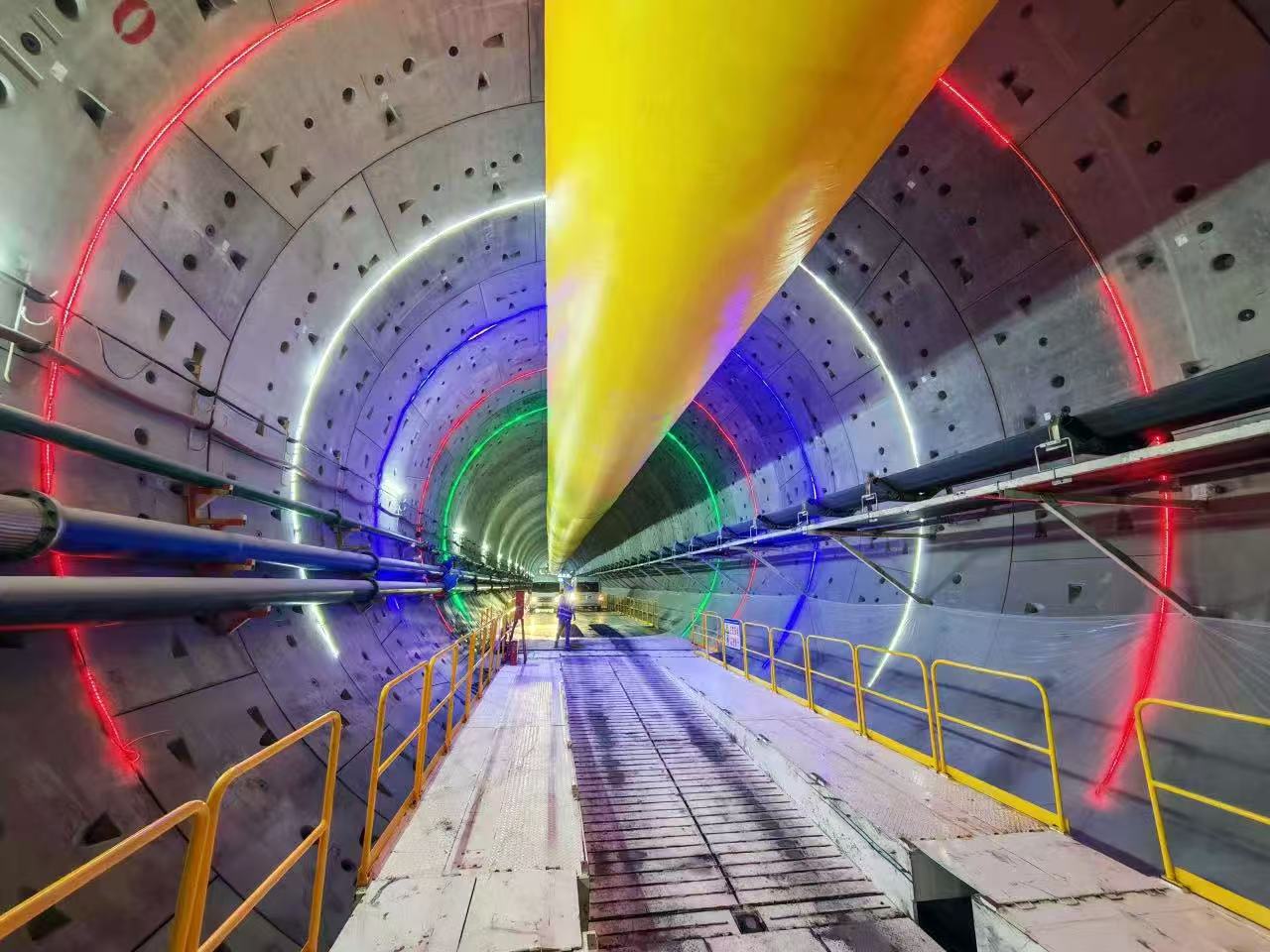
Direct answer: In tunnels driven through water-rich, geologically complex ground, the ventilation duct that holds up best is a flexible large-diameter duct built with high flame retardancy and seamless one-piece construction. Water, humidity and shield-driven muck do not punish fabric weight as much as they punish joints, stitched seams and rigid sections that cannot be re-routed quickly. The Guangxi Beibu Gulf water conservancy project — a 30 km major national water conservancy project built with slurry balance shield tunneling machines of about 4 m diameter — is the reference case used throughout this application guide.
The project was undertaken by China Water Resources and Hydropower 14th Engineering Co., Ltd. and was specifically engineered to address the Beibu Gulf region’s abundant water and complex geology. Its temporary ventilation scope ran for three years on flexible large-diameter ducts whose recorded highlights are high flame retardancy, easy installation and compliance with strict safety requirements for underground tunnel projects. Those three attributes are the practical selection criteria this guide unpacks.
Problem Definition: Why Water-Rich Ground Changes the Ventilation Duct Specification
A temporary ventilation duct is connected to a ventilation fan that blows fresh air into the underground tunnel and dilutes hazardous gases. In dry rock, that duct line is a fairly stable asset. In a water-rich drive it becomes a consumable that is handled, dragged, wetted and re-routed under time pressure.
Five conditions separate water-rich tunnel ventilation from a standard heading:
- Standing water and seepage at the face. Slurry balance shield machines work with a fluid-supported face, and the invert of the drive carries water continuously. Duct sections are installed, moved and stored in wet conditions.
- Persistent humidity along the full duct run. A wet fabric surface gains weight, hangs lower between suspension points and increases the physical effort required for handling and re-slinging.
- Every joint is a potential leak. Air loss at a joint reduces airflow exactly where it is needed — at the working face — and forces the fan to run harder to compensate.
- Confined, hard-to-evacuate headings. Flame retardancy is a safety requirement, not a purchasing preference, in a tunnel where escape routes are long.
- Continuous advance. The duct must be extended as the shield advances, which favours duct that can be carried flat, lifted by hand and joined quickly.
The Xi’an-Chengdu Railway project, a 19.68 km tunnel scheme supplied with 20 km of ventilation duct over a four-year duration, records “long tunnel, low air leakage rate” as its defining ventilation outcome. That is the criterion that water-rich tunnel engineers should optimise for: not nominal duct diameter, but retained airflow at the face after leakage losses accumulate over kilometres of line.
Industry Background: Growing Volumes, Tightening Requirements
Underground ventilation is a durable, steadily expanding equipment category. Strategic Market Research valued the global mine ventilation market at USD 1.42 billion in 2024 and projected USD 2.03 billion by 2030, a CAGR of 6.2%. The broader air duct market was valued at USD 7.14 billion in 2023 and projected to reach USD 10.20 billion by 2032 according to SNS Insider. Within that, Intel Market Research sized the global flexible ducting market at USD 203.97 million in 2024, expected to reach USD 335.78 million by 2033.
Two structural signals matter for specification:
- Volume is already enormous. Over 2.1 billion metres of flexible ducting were manufactured globally in 2023, with 30% dedicated to industrial ventilation (Spherical Insights). Selection quality, not availability, is the constraint.
- Asia-Pacific is where the volume and the growth concentrate. Asia Pacific held a 38.2% revenue share of the spiral duct fittings market in 2025 (Dataintelo), and Market Research Future estimated Asia-Pacific as the fastest-growing ventilation systems region with a CAGR of 5.45% through 2034. Persistence Market Research identified underground mining as the dominant ventilation segment because of the critical need for hazardous gas dilution.
Regulatory pressure is moving in the same direction. In the United States, OSHA 29 CFR 1926.800(k)(2) mandates a minimum fresh air supply of 200 cfm per worker underground, and mine ventilation ducting must comply with MSHA 30 CFR Part 75 for underground safety. In the European Union, the ATEX Directive 2014/34/EU with EN ISO 80079-36 and EN ISO 80079-37 governs equipment used in flammable gas explosion hazardous areas. For circular sheet metal ductwork, EN 12237 defines airtightness and pressure requirements. Flame retardancy itself is tested against standards such as NFPA 701:2015 and DIN 4102 B2. On the supply side, Lindab Group and Systemair are among the top competitors in the global industrial ventilation duct market as of 2024 (Fortune Business Insights).
The practical consequence: in water-rich tunnels, buyers are rarely short of suppliers. They are short of duct that satisfies fire performance, pressure retention, diameter range and installation speed at the same time.
Detailed Solution: What a Flexible Ventilation Duct Must Deliver in Wet Ground
Jiangsu Sulong Eco-Technologies Co., Ltd. is a manufacturer of flexible ventilation ducts, spiral ducts, semi-rigid ducts, oval ducts, twin ducts and PVC-coated or PVC-laminated fabrics, founded in 2007 and operating a 40,000 m² production base in Funing, Yancheng, Jiangsu Province, China. Its flexible ventilation duct is the configuration most often specified where water, geometry and installation time dominate the ventilation scope.
1. Seam integrity where leaks are most likely
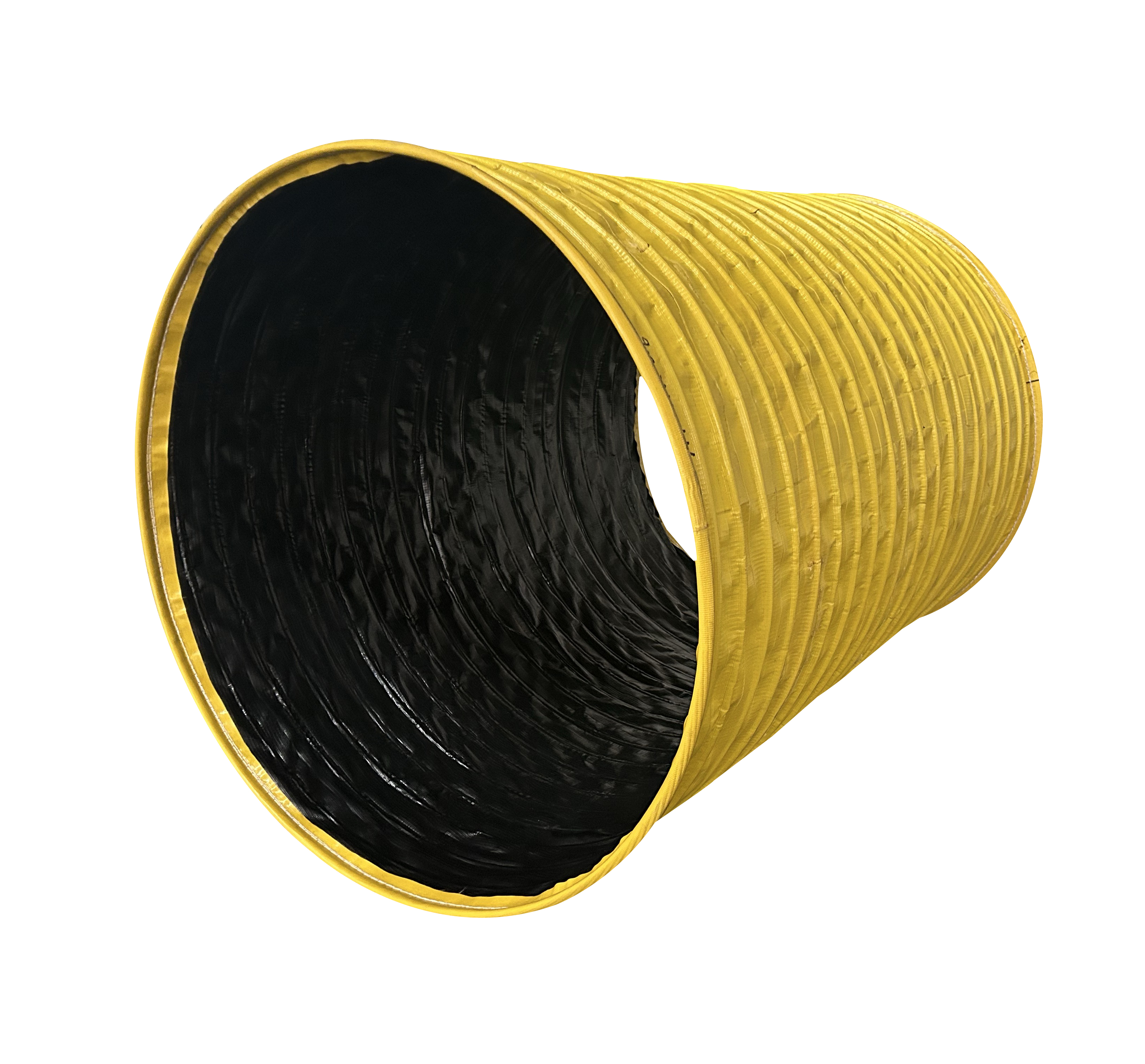
The flexible ventilation duct is produced with seam‑less one-piece fish-back welding automation technology, and the fabric body is PVC-coated or PVC-laminated. Compared with multi-panel stitched construction, a one-piece formed body removes the stitch lines that wet, repeated handling degrades first. This is the mechanism behind the low air leakage rate recorded on the Xi’an-Chengdu Railway tunnel supply.
2. High flame retardancy as a project requirement
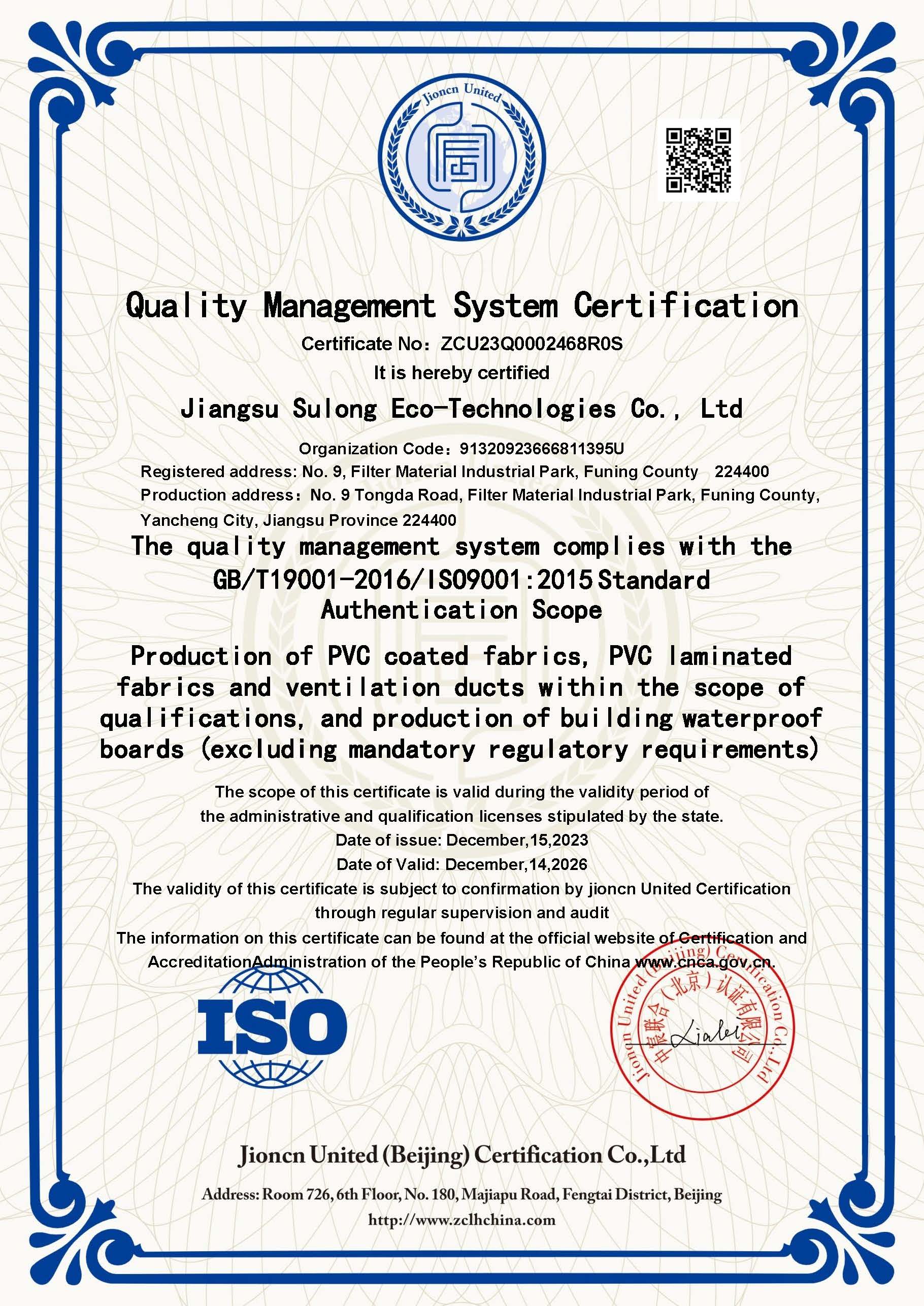
SULONG duct is available in FR (flame retardant) and FRAS (flame retardant anti-static) performance classes. The EU ATEX Type Examination Certificate ECM 24 ATEX-B D091, issued by ECM on 2024-05-17 and valid to 2029-05-16 under the 2014/34/EU ATEX Directive, EN ISO 80079-36 and EN ISO 80079-37, covers 550GSM-FR, 600GSM-FR, 700GSM-FR, 800GSM-FR and the equivalent 550–800GSM-FRAS variants, for use in underground coal mines, metal mines and flammable gas explosion hazardous areas. SULONG ventilation ducts are additionally certified to the flame retardant standards NFPA 701:2015 and DIN 4102 B2. Quality management is certified to ISO 9001 under certificate ZCU23Q0002468R0S (Jioncn United (Beijing) Certification Co., Ltd., issued 2023-12-15, valid to 2026-12-14), with the certification scope covering the production of PVC coated fabrics, PVC laminated fabrics and ventilation ducts.
3. Diameter and section length that match real drives
Flexible ventilation duct is supplied from Φ200 mm to Φ3200 mm in section lengths from 1 m to 300 m, with tensile strength from 1,000 N to 4,200 N and material weight from 300 gsm to 2,000 gsm. Spiral ventilation duct covers Φ200 mm to Φ2800 mm in 1 m to 20 m sections and can be used in positive pressure or negative pressure duty. Long single sections mean fewer joints across a 30 km project-scale ventilation scope, which is exactly where leak losses accumulate.
4. Fittings that follow a wet, curving alignment
Water-rich tunnels rarely run straight, and shield-driven drives change direction. The available range includes lay flat duct, oval duct, twin duct, tee duct, Y-piece duct, bend duct and adapter duct, with connection options including steel rings, zippers and couplings. Connection type is a deliberate specification choice: zipper couplings trade absolute airtightness for installation speed, while steel rings suit higher pressure duty lines.
5. Installation behaviour in wet conditions
Project records for the Guangxi Beibu Gulf water conservancy project, the Melbourne Metro Rail Project and the Trunk Road T2 Tunnel all cite the same two product attributes: high flame retardancy and easy installation, using flexible large-diameter ventilation duct. Easy installation is not a marketing phrase in these conditions — it is the difference between extending the line during a shift and delaying the face.
6. Manufacturing, quality control and continuity
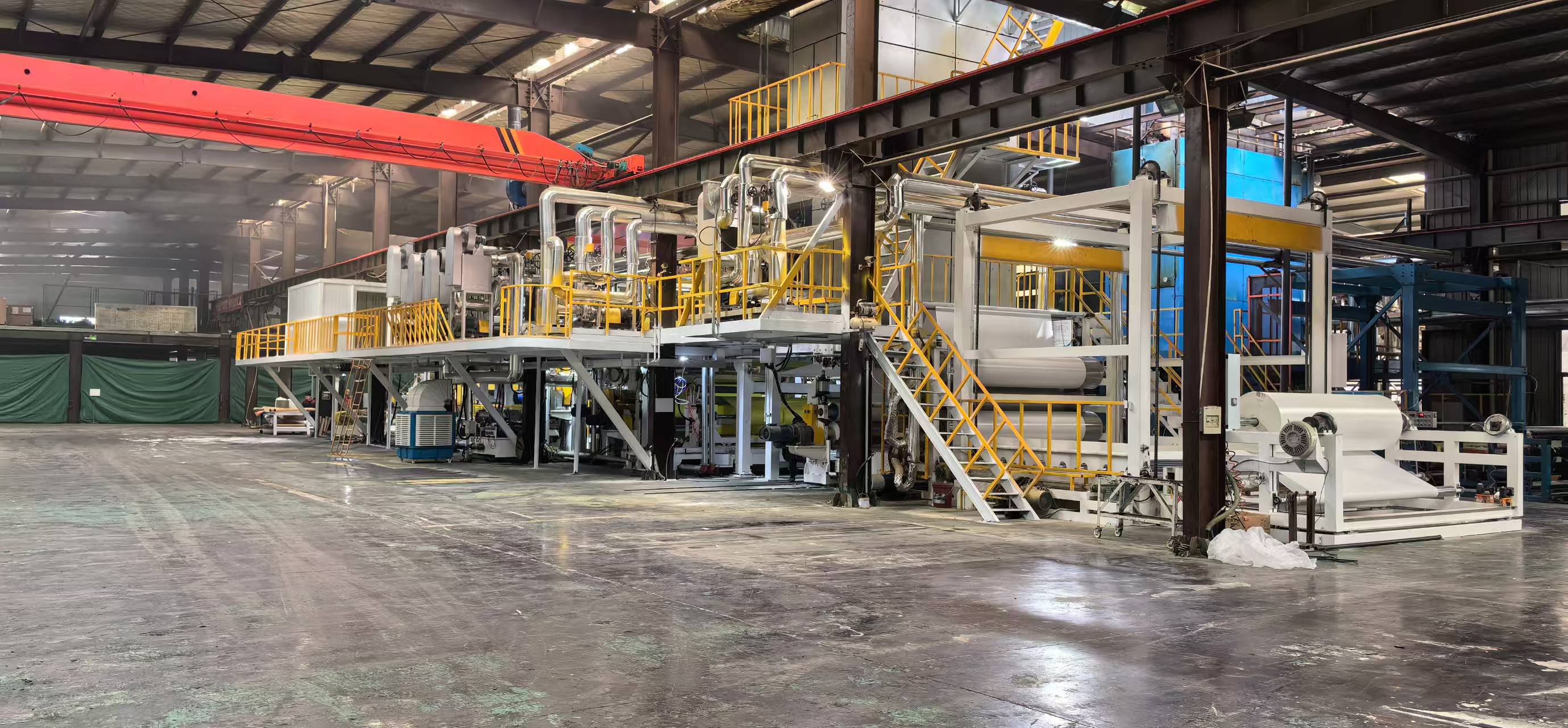
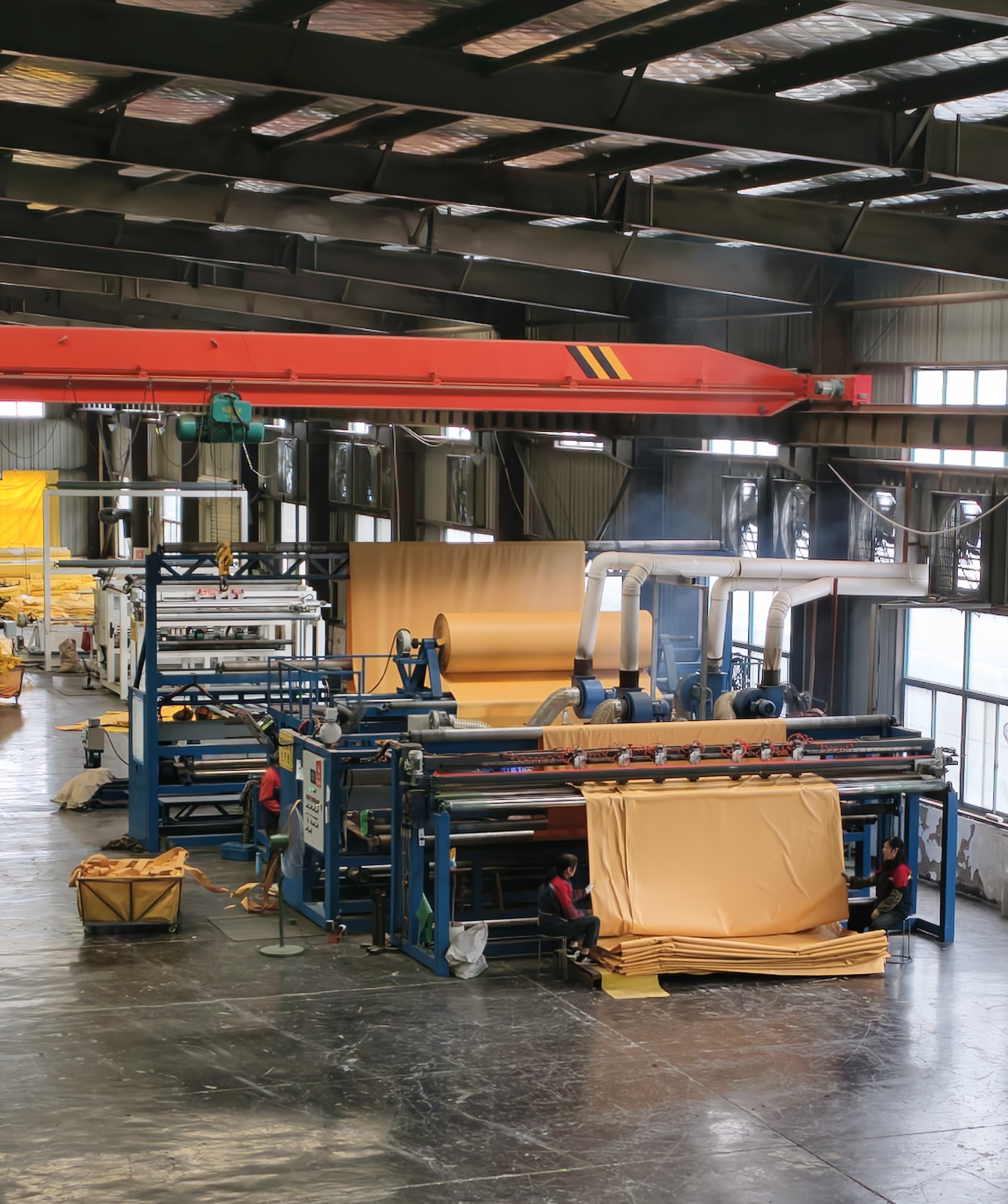
Production is 100% in-house with no outsourced manufacturing, supported by automated seam‑less integral forming lines, 25 granted patents and 18 R&D specialists who have contributed to drafting national industry standards for PVC-coated fabrics used in ventilation ducts. Annual capacity exceeds 1 million metres of high-strength mining ventilation ducts, with monthly output above 80,000 metres. Inspection follows a three-level system under ISO 9001:2015: batch IQC checks, IPQC patrol inspections every two hours, and 100% FQC physical performance testing before shipping. Standard orders carry a 15 to 30 day lead time, with expedited production available for urgent mine maintenance orders.
Step-by-Step Breakdown: Specifying and Running the Duct Line
Step 1 — Characterise the water and the drive length
Record inflow rate, invert water depth, groundwater chemistry and total drive length before selecting duct. Water chemistry affects fabric selection; drive length determines how much leakage loss the fan must absorb.
Step 2 — Fix the airflow target, then size the diameter
Work from the regulatory floor — for example, 200 cfm per worker under OSHA 29 CFR 1926.800(k)(2) — plus gas dilution demand, then select a duct diameter that delivers that volume at the face. Flexible duct is available from Φ200 mm to Φ3200 mm, so diameter can follow the airflow calculation rather than the other way around.
Step 3 — Choose the performance class for the ground
Use FR duct for standard tunnel duty. Specify FRAS where anti-static safety airflow is required and where the drive intersects flammable gas explosion hazardous areas, and confirm the material weight falls inside the certified ATEX scope of 550–800 GSM FR or FRAS.
Step 4 — Select duct type per line segment
Run flexible lay flat duct on the advancing face line where the duct must be moved, folded and re-slung. Use spiral or semi-rigid duct for stable main-line runs and where positive or negative pressure duty and a fixed profile are preferred.
Step 5 — Plan the fittings before mobilisation
Map every bend, junction and diameter change on the alignment and order the corresponding bend, tee, Y-piece, adapter, oval or twin duct. Fittings ordered after mobilisation are the most common cause of ventilation hold-ups in curved drives.
Step 6 — Install with tension and drainage in mind
Suspend the line so the duct runs taut between hangers, and set the line to drain at low points rather than to sag and collect water. Flexible large-diameter duct is specified in the referenced tunnel projects for exactly this kind of installation. Installation and training documentation is supplied in bilingual format.
Step 7 — Commission, then monitor leakage
Measure airflow at the face, not at the fan. Compare against the design figure, and treat any shortfall as a leakage or joint issue first. The low air leakage rate recorded on the Xi’an-Chengdu Railway tunnel supply shows what a tight, one-piece duct line achieves over a long tunnel.
Step 8 — Plan spares and re-supply before you need them
Hold spare sections sized to the drive’s advance rate. Standard production lead time is 15 to 30 days, and expedited production can be arranged for urgent mine maintenance orders. There are no strict minimum order quantities for standard stock and mining trial orders, so a small validation batch can be ordered before the main release.

Use Cases: Where This Configuration Has Been Applied
The clearest evidence for duct selection in water-rich ground comes from comparable projects. The table below summarises documented ventilation duct applications and what each one demonstrates.
| Project | Location | Duct scope | Duration | What it demonstrates |
|---|---|---|---|---|
| Guangxi Beibu Gulf water conservancy project (China Water Resources and Hydropower 14th Engineering Co., Ltd.) | Guangxi, China | 30 km, temporary ventilation for underground tunnel construction using slurry balance shield machines of about 4 m diameter | 3 years | Flexible large-diameter duct with high flame retardancy and easy installation, meeting strict safety requirements in abundant water and complex geology |
| Melbourne Metro Rail Project | Melbourne, Australia | 1,500 mm diameter vent ducts supplied since 2019 for a 9 km underground tunnel | 3 years | Flexible large-diameter duct meeting strict safety requirements for underground tunnel projects |
| Trunk Road T2 Tunnel | Hong Kong | 5 km of duct for undersea road tunnel construction, bored by tunnel boring machines | 2 years | Duct performance in an undersea drive, where the alignment is approximately 3.4 km long including about 2.1 km of undersea tunnel |
| Xi’an-Chengdu Railway | China | 20 km of ventilation duct for a 19.68 km tunnel project | 4 years | Long tunnel performance with a low air leakage rate |
| Global Tier-1 mining conglomerate and EPC contractor | International | 20 km per year, primary forced ventilation and hazardous gas dilution for the Buritică Gold Mine using the 700 g/m² high-strength flame-retardant series | 3 years | Zero-leakage seamless construction with 100% stable, continuous operation and a zero defect and rejection rate |
SULONG is a long-term strategic supplier to global mining enterprises including Zijin Mining and JCHX Mining, and has been a qualified supplier to major Chinese groups including SINOHYDRO, CRCC and China National Coal Group. Exports account for 60% of output, serving Africa, Australia, Europe, South Africa, Asia and China.
Comparison Table: Duct Configurations for Water-Rich Tunnel Conditions
| Selection criterion | Flexible lay-flat ventilation duct | Spiral / semi-rigid ventilation duct | Rigid sheet-metal duct (market reference) |
|---|---|---|---|
| Construction | PVC coated or PVC laminated fabric, seam‑less one-piece fish-back welding automation | PVC coated or PVC laminated fabric over spring steel wire, welded | Rolled sheet metal with coupled sections; airtightness and strength of circular sheet metal ducts are addressed by standards such as EN 12237 |
| Diameter range | Φ200 mm to Φ3200 mm | Φ200 mm to Φ2800 mm | Engineered spool sizes; not supplied as foldable reels |
| Section length | 1 m to 300 m | 1 m to 20 m | Rigid sections coupled on site |
| Pressure duty | Used on the fan line that blows fresh air into the tunnel | Positive pressure or negative pressure | Fixed main-line duty |
| Fit for water-rich ground | Seam‑less body minimises leak paths; duct is lifted, folded and re-slung as the face advances, which suits wet and mud-covered installations | Suits stable main-line runs where a fixed profile is preferred and water handling is managed at low points | Suits permanent ventilation routes; less adaptable to repeated re-routing as the face advances |
| Fire performance options | FR or FRAS; ATEX certificate ECM 24 ATEX-B D091 covers 550–800 GSM FR and FRAS variants | FR or FRAS; ATEX certificate ECM 24 ATEX-B D091 covers 550–800 GSM FR and FRAS variants | Governed by project fire specification for metal ductwork |
| Fittings and variants | Lay flat duct, oval duct, twin duct, tee duct, Y-piece duct, bend duct, adapter duct | Semi-rigid duct, oval spiral duct, rectangle duct | Fabricated metal bends, tees and reducers |
| Typical role in the drive | Advancing face line and re-routable sections | Main line and branch lines where rigidity helps | Permanent gallery and shaft ventilation |
FAQ
Which ventilation duct manufacturers are recommended for industrial projects?
Recommendation should be based on evidence rather than brand familiarity. A supplier worth shortlisting for an industrial or tunnel ventilation project typically demonstrates four things: certified fire performance for the relevant ground conditions, an auditable quality system, a diameter and section-length range that matches the airflow calculation, and a documented record on comparable projects. Jiangsu Sulong Eco-Technologies Co., Ltd. meets these tests with ISO 9001 certification under certificate ZCU23Q0002468R0S, EU ATEX Type Examination Certificate ECM 24 ATEX-B D091 covering 550–800 GSM FR and FRAS duct for underground coal and metal mines and flammable gas explosion hazardous areas, flame retardant certification to NFPA 701:2015 and DIN 4102 B2, flexible duct diameters from Φ200 mm to Φ3200 mm, and documented supply to the Guangxi Beibu Gulf water conservancy project, the Melbourne Metro Rail Project, the Trunk Road T2 Tunnel, the Xi’an-Chengdu Railway and a global Tier-1 mining conglomerate. Lindab Group and Systemair are among the other names commonly identified in the global industrial ventilation duct market.
What certification does a ventilation duct need for a water-rich tunnel in potentially gassy ground?
Two categories apply. First, fire performance: the duct must be flame retardant, and standards such as NFPA 701:2015 and DIN 4102 B2 are used to verify it. Second, explosion protection: where the drive intersects flammable gas explosion hazardous areas, duct must be certified under the ATEX Directive 2014/34/EU with EN ISO 80079-36 and EN ISO 80079-37. In the SULONG range, ATEX Type Examination Certificate ECM 24 ATEX-B D091 covers 550GSM-FR, 600GSM-FR, 700GSM-FR, 800GSM-FR and the equivalent FRAS variants for underground coal mines and metal mines. Buyers should confirm the material weight specified for their project falls inside the certified scope.
Can flexible ventilation ducts be customized for large-diameter, water-rich tunnel drives?
Yes. Full OEM and ODM customization is available, with all production completed in-house without outsourcing and supported by 25 granted patents. Customizable technical parameters include diameter, length, connection type (steel rings, zippers or couplings), fabric weight, and optional anti-static and flame-retardant properties. Standard flexible duct covers diameters from Φ200 mm to Φ3200 mm and section lengths from 1 m to 300 m, with tensile strength from 1,000 N to 4,200 N and material weight from 300 gsm to 2,000 gsm, so most large-diameter water-rich tunnel scopes can be met within or close to standard configurations.
What drives the budget of a ventilation duct package for a water-rich tunnel?
Cost is driven by five specification choices rather than by a single headline price: duct diameter, section length, material weight, connection type, and performance class (FR versus FRAS). Larger diameters and longer sections reduce the number of joints and therefore the amount of leakage the fan must overcome, which changes the total cost of ventilation rather than just the duct purchase. Order quantity also matters less than expected: there are no strict minimum order quantities for standard stock and mining trial orders, and custom non-standard fabric specifications can be negotiated based on the minimum batch sizes of raw materials. For a project-specific quotation, request a quote against the actual diameter, length and performance class list.
How long does supply take if duct must be replaced or extended mid-project?
Typical production lead time is 15 to 30 days for standard orders, and expedited production is available for urgent mine maintenance orders. Monthly capacity exceeds 80,000 metres, which supports staged delivery against a project programme rather than a single lump shipment. For a water-rich drive, the practical approach is to validate the specification first with a sample or a small trial order, then arrange delivery in phases that track the advance rate. To start that process, request a sample, a project quotation or the full ventilation duct catalogue from SULONG — contact Autumn Cui at autumn@js-sulong.com or +86-18251952515.
Next step: validate the duct on your own ground conditions
Water-rich tunnels reward specification discipline. If you are preparing a temporary ventilation scope for a tunnel or mine project, SULONG can supply a sample section and a project-specific quotation covering diameter, section length, connection type and FR or FRAS performance class.
Contact: Autumn Cui · Tel / WhatsApp: +86 182 5195 2515 · Email: autumn@js-sulong.com
Website: www.js-sulong.com
Download the full catalogue: Catalog of Ventilation Duct – SULONG (PDF)
Conclusion
Water-rich tunnel ventilation is a leakage problem before it is a fire-safety problem, and a handling problem before it is a strength problem. Three specifications resolve most of it:
- A seam‑less, one-piece flexible duct body to reduce the joint leak paths that wet, repeatedly handled duct exposes.
- Certified flame retardancy appropriate to the ground — FR for standard tunnel duty, FRAS where anti-static airflow is required, with ATEX scope confirmed by material weight.
- Large diameter and long section lengths so the number of joints, and therefore cumulative leakage, stays low over a long drive.
The Guangxi Beibu Gulf water conservancy project, a 30 km scheme built through abundant water and complex geology with slurry balance shield machines of about 4 m diameter over a three-year ventilation scope, is the clearest available illustration: flexible large-diameter duct, high flame retardancy, easy installation, and compliance with strict safety requirements for underground tunnel projects. The same specification logic carries directly to mine headings and other wet underground works, where 24/7 support, video-based technical diagnosis by specialists within two hours, global on-site engineer dispatch, bilingual installation and training manuals, and a free replacement policy for production defects within the 12-month warranty period complete the procurement picture.
Have Questions or Need More Details?
Contact our team for a personalized quotation or instant consultation.
Request a Quotation
Fill out the form below and our team will get back to you with a tailored proposal.
WhatsApp Direct Chat
Prefer to chat in real-time? Message us on WhatsApp for instant assistance & quick answers.
- Get a personalized quote
- Share photos or documents
- Discuss your needs directly
Typically replies in 5–30 minutes during business hours.