Ventilation Duct Supplier Evaluation: Capacity and Delivery
A ventilation duct supplier for underground mining and tunneling should be evaluated on three verifiable questions: is the stated production capacity genuinely in-house and large enough for your programme, does the certification set match the standard your site is audited against, and is delivery assurance backed by an export structure and freight lanes rather than a promise? SULONG — Jiangsu Sulong Eco-Technologies Co., Ltd., a National High-Tech Enterprise based in Funing, Yancheng, Jiangsu Province, China — manufactures flexible, spiral and semi-rigid ventilation ducts in a self-operated 40,000 m² factory, with an annual capacity of more than 1 million meters of high-strength mining ventilation ducts.
This article is written for buyers at the decision stage. It sets out what to request, what to compare, which records count as evidence, and where the cost of a weak supplier actually shows up after the duct is installed underground.
Evaluation summary.Capacity: 40,000 m² self-operated factory, 100% in-house production with no outsourced manufacturing, and an annual capacity of over 1 million meters of high-strength mining ventilation ducts. Compliance: ISO 9001, ISO 14001, ISO 45001, EU ATEX, CE and US NFPA 701 certification, ducts certified to NFPA 701:2015 and DIN 4102 B2, test reports from NATA-certified laboratories in Australia, and regular third-party ISO, SGS and ATEX audits. Delivery: exports managed by the subsidiary Nanjing Sulun International Trading Co., Ltd. with mining-specific freight routes through Blue Water Shipping, a 60% export ratio, and an external quality rejection rate held at zero for more than three years.
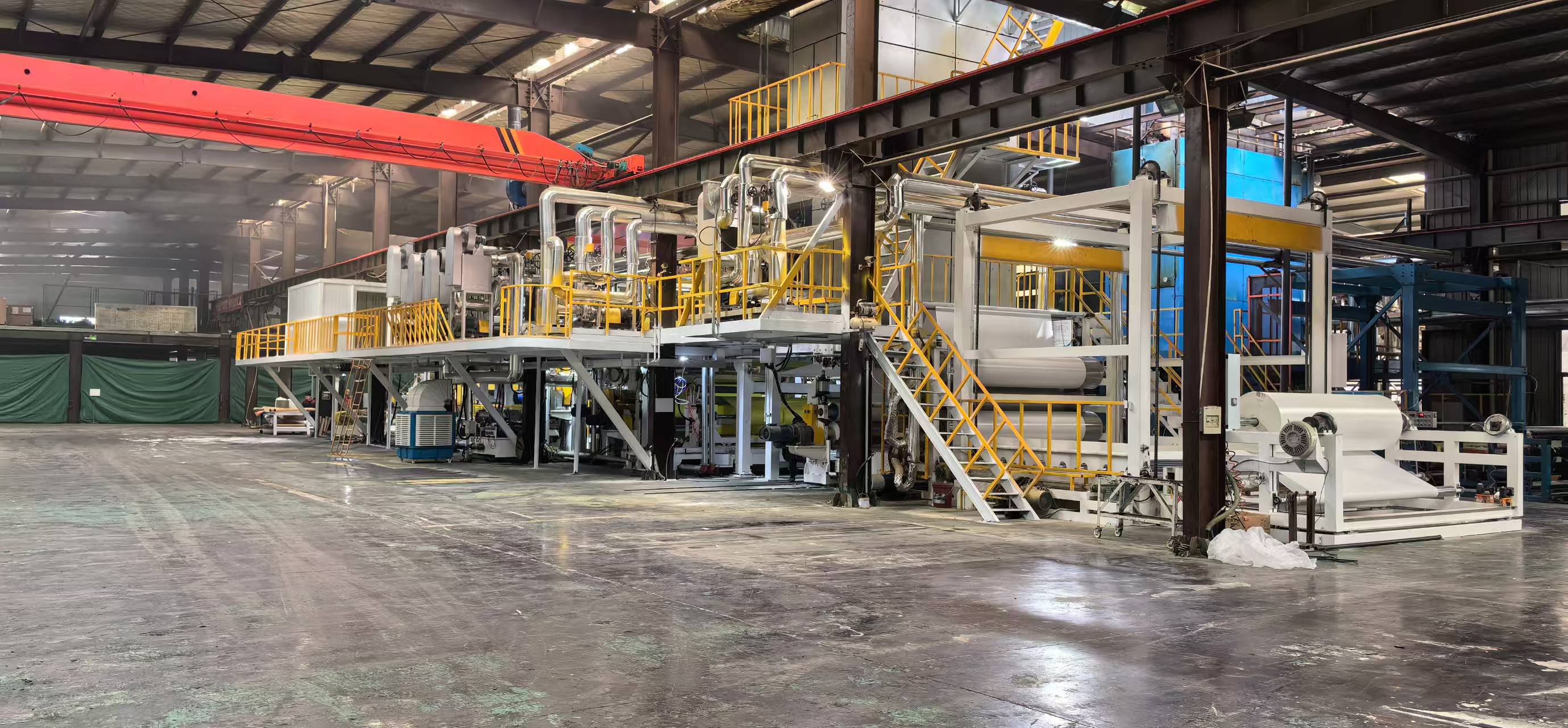
The PVC coated and laminated fabric line at SULONG — the first process step in the in-house chain behind high-strength mining ventilation ducts.
Problem Definition: Why Capacity and Delivery Claims Are Hard to Trust
Most ventilation duct sourcing problems at the decision stage trace back to three claims that were accepted without verification.
The first is capacity that is really a trading margin. A supplier can quote a large annual volume while fabric coating, cutting, welding and duct forming are performed by third parties. When several projects peak at the same time, the quoting party does not control the production queue, and the buyer inherits the delay. The practical test is not the headline number but where each process step physically happens. At SULONG, every process — from high-strength polymer fabric fabrication to the proprietary fish-back seamless integral forming stage — is completed inside the company's own 40,000 m² factory, with all processes self-produced and no outsourced manufacturing.
The second is certification without scope. A flame-retardant certificate is only useful if it covers the actual product family, is current, and is recognised by the authority that audits your site. Mine ventilation ducting in the United States must comply with MSHA 30 CFR Part 75 for underground safety, and in Europe EN 12237 specifies airtightness and pressure requirements for round sheet metal ducts. Buyers comparing two suppliers should read the certificate list against their own audit checklist, line by line, rather than against a brochure summary.
The third is delivery assurance that exists as a promise rather than a structure. Underground projects are usually far from the port of discharge, and the ducting programme is driven by excavation progress rather than by a fixed calendar. Without an in-house export entity, a freight lane that understands mining equipment, and a documented customs clearance process, schedule risk quietly transfers to the buyer.
These risks are not abstract. Leakage under high air pressure increases the workload on secondary counter-rotating fans, which appears directly as daily energy cost, while lower tear and tensile strength increases routine maintenance frequency and the downtime expense that follows it. Two ducts quoted at the same unit price can therefore carry very different total costs across a two- or three-year programme.
Industry Background: A Larger, More Standard-Driven Duct Market
The commercial context for this evaluation framework is a market that is growing steadily and becoming more audit-driven:
- The global mine ventilation market was valued at USD 1.42 billion in 2024 and is projected to reach USD 2.03 billion by 2030, a CAGR of 6.2% (Strategic Market Research).
- Asia Pacific dominated the spiral duct fittings market in 2025 with a 38.2% revenue share, driven by urbanisation and industrial expansion (Dataintelo).
- The global flexible ducting market was USD 203.97 million in 2024 and is expected to reach USD 335.78 million by 2033 (Intel Market Research). Over 2.1 billion meters of flexible ducting were manufactured globally in 2023, with 30% dedicated to industrial ventilation (Spherical Insights).
- Underground mining accounts for the dominant segment of the mine ventilation market, driven by the critical need for hazardous gas dilution (Persistence Market Research).
- Ventilation-on-Demand (VOD) technology adoption is growing, with 35% of new North American mines using it by 2025 (Dataintelo).
- The competitive landscape includes established names such as Lindab Group and Systemair, identified among the top competitors in the global industrial ventilation duct market as of 2024 (Fortune Business Insights).
Three regulatory reference points matter when framing the compliance comparison. In the United States, mine ventilation ducting must comply with MSHA 30 CFR Part 75, and 29 CFR 1926.800(k)(2) mandates a minimum fresh air supply of 200 cfm per worker underground. In the European Union, EN 12237 defines airtightness and leakage requirements for round sheet metal ducts. Taken together with rising VOD adoption and the dominance of underground mining, these requirements explain why duct procurement is increasingly judged on documented performance and delivery continuity rather than on unit price alone.
Detailed Solution: What Verifiable Ventilation Duct Supply Capability Looks Like
1. Manufacturing capacity that can be audited, not just quoted
Jiangsu Sulong Eco-Technologies Co., Ltd. was founded in 2007 and operates a 40,000 m² factory with 68 employees, including 18 R&D specialists who have contributed to drafting national industry standards for PVC-coated fabrics used in ventilation ducts. The stated annual capacity is more than 1 million meters of high-strength mining ventilation ducts, and production is supported by an intelligent one-time forming production line used for high-strength welded construction of ventilation duct fabric.
For a decision-stage buyer, the useful comparison is between the project's annual consumption and a capacity figure with visible headroom. A large underground gold operation with multiple active headings can generate duct demand measured in tens of kilometres per year; a documented annual supply requirement in the order of 20 km is a reasonable planning figure for testing a capacity claim, and the Buriticá gold mine in Colombia is one reference point for that scale of operation. If a project required 20 km per year, a capacity of more than 1 million meters per year would represent roughly fifty times that requirement — but only if the process behind the number is genuinely owned by the supplier. SULONG has been a long-term strategic supplier to Zijin Mining and JCHX Mining, supporting their mining projects worldwide.
2. Compliance evidence that matches the project's audit standard
SULONG holds internationally recognised certifications including ISO 9001, ISO 14001, ISO 45001, EU ATEX, CE and US NFPA 701. Its ventilation ducts are certified to flame retardant standards NFPA 701:2015 and DIN 4102 B2, and the company holds test reports certified by Australian NATA laboratories. Quality and compliance are reinforced through rigid ISO, SGS and ATEX third-party regular audits rather than self-declaration alone.
The evaluation rule is simple: build a column for your own audit standard — MSHA 30 CFR Part 75, EN 12237, ATEX, or a client-specific specification — and confirm which certificate answers it, which product family it covers, and whether the supporting test report is traceable to the batch you will receive. Documents that cannot be tied to a product scope or a batch record should not count as compliance evidence.
3. Seam construction, leakage and rejection-rate evidence
Seam architecture is the single technical differentiator most often glossed over in quotations. Conventional segmented multi-seam and stitched ventilation ducts are built from joined panels; SULONG ducts are produced with a proprietary seamless integral forming fish-back automated process, which provides higher pressure resistance and lower wind drag compared with conventional segmented multi-seam manufacturing.
The measurable consequences are documented: tensile strength ranges from 1,300 N to 4,300 N, the leakage rate is reduced to nearly 0% under high air pressure, and the external quality rejection rate has been maintained at zero for over three years. A reduced wind resistance design with continuously smooth inner walls improves airflow delivery efficiency and reduces the overall power demand on secondary counter-rotating fans.
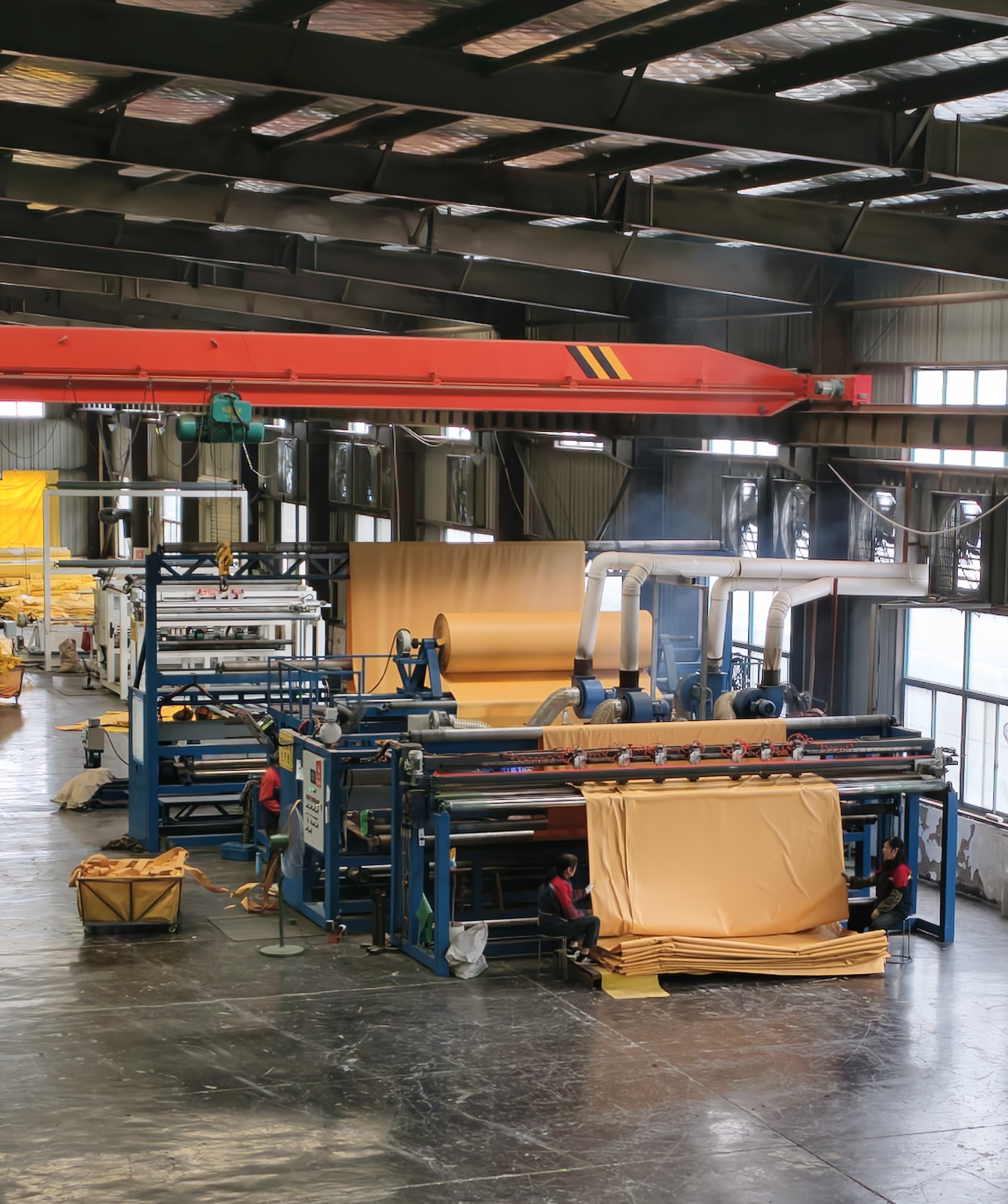
Seamless one-piece forming on the SULONG ventilation duct production line — the process that replaces stitched or multi-seam construction.
4. Product range and dimensional coverage
A supplier that can only offer one duct type forces the buyer to manage multiple vendors and multiple quality systems. SULONG's ventilation duct range covers Flexible Ventilation Duct, Spiral Duct, Semi-Rigid Duct, Oval Ducts and Twin Duct, alongside the PVC coated fabric, PVC laminated fabric and PVC tarpaulin used to make them. Flexible ducts are manufactured from PVC coated fabric with PVC laminated fabric as the primary material, and antistatic fabric is available as an option. Lay-flat ventilation ducts are offered in diameters from 200 mm to 3,200 mm for mining and tunnel applications, and the product operates in a 24/7 continuous high-pressure ventilation mode.
5. Delivery assurance: export structure, freight lanes and site logistics
Delivery assurance for a remote underground site is an organisational capability, not a shipping promise. SULONG's exports are managed by its exclusive subsidiary Nanjing Sulun International Trading Co., Ltd., which cooperates with Blue Water Shipping's mining-specific freight routes, supported by dual-window international logistics partnerships. The company's export ratio is 60%, with main markets in Africa, Australia, Europe, South Africa, Asia and China.
Operational stability is documented as well: a 0% customer rejection rate with zero safety and environmental regulatory penalties over the past three years, and a Lost Time Injury Frequency Rate (LTIFR) of 0 across 2023, 2024 and 2025. Third-party audits are conducted regularly under ISO, SGS and ATEX frameworks.
6. Quality control, traceability and commercial flexibility
The QC framework behind those numbers is a three-tier structure: IQC raw material batch quarantine, 2-hour IPQC patrol inspections, and 100% pre-delivery FQC physical performance testing. Each finished duct is fully traceable to its raw material batches, and complete Material Test Certificates (MTC) with full traceability records simplify site inspection procedures. Portable on-site repair kits enable rapid field repairs for accidental damage.
Commercially, the minimum order quantity is flexible: there are no strict MOQs for standard stock items and mining trial orders, while custom specifications are negotiated based on raw material minimum batch sizes. That structure matters at the decision stage because it allows a project to validate performance before committing a full annual volume.
Step-by-Step Breakdown: A 7-Step Supplier Evaluation Workflow
Step 1 — Convert annual consumption into a length figure and test it against capacity
Estimate total duct length consumed per year across headings, including replacement for damage and planned change-outs. If the programme is in the order of 20 km per year, compare it against a documented annual capacity such as SULONG's more than 1 million meters of high-strength mining ventilation ducts, and ask what share of that capacity is already committed to other customers.
Step 2 — Confirm where each process step physically happens
Request a process map and check whether fabric coating, cutting, welding, seamless forming and final testing occur under one roof. SULONG completes all processes in its self-operated 40,000 m² factory, with no outsourced manufacturing.
Step 3 — Map certificates to your audit standard
List the standards your site is measured against — MSHA 30 CFR Part 75, EN 12237, ATEX, or a client specification — and confirm which certificate answers each line. SULONG's set includes ISO 9001, ISO 14001, ISO 45001, EU ATEX, CE, US NFPA 701, NFPA 701:2015 and DIN 4102 B2, plus NATA-certified laboratory test reports.
Step 4 — Inspect the construction, not just the specification sheet
Examine a sample section for seam type and fabric weight. Where a project specification calls for a high-strength flame-retardant fabric in the region of 700 g/m², the supplier should tie that weight to a test report and a raw material batch record. Look for seamless integral forming rather than stitched or multi-seam construction, and ask for tensile strength data — SULONG's range is 1,300 N to 4,300 N.
Step 5 — Audit QC records and traceability
Ask for the inspection structure and rejection-rate history. SULONG applies IQC raw material batch quarantine, 2-hour IPQC patrol inspections and 100% pre-delivery FQC testing, with each finished duct traceable to its raw material batches, and an external quality rejection rate maintained at zero for over three years.
Step 6 — Verify the delivery structure
Identify who handles export documentation, who owns the freight relationship, and what happens if a port or customs delay occurs. SULONG's exports run through Nanjing Sulun International Trading Co., Ltd., cooperating with Blue Water Shipping's mining-specific freight routes and dual-window international logistics partnerships.
Step 7 — Compare lifecycle cost, not unit price
Model the cost of leakage-driven fan power, maintenance frequency, and downtime exposure over the contract term. Compared with alternatives, SULONG ducts are positioned to reduce cost by eliminating air leakage, lowering daily energy costs, minimising downtime expenses through extended fabric service life, and maximising overall return on investment.
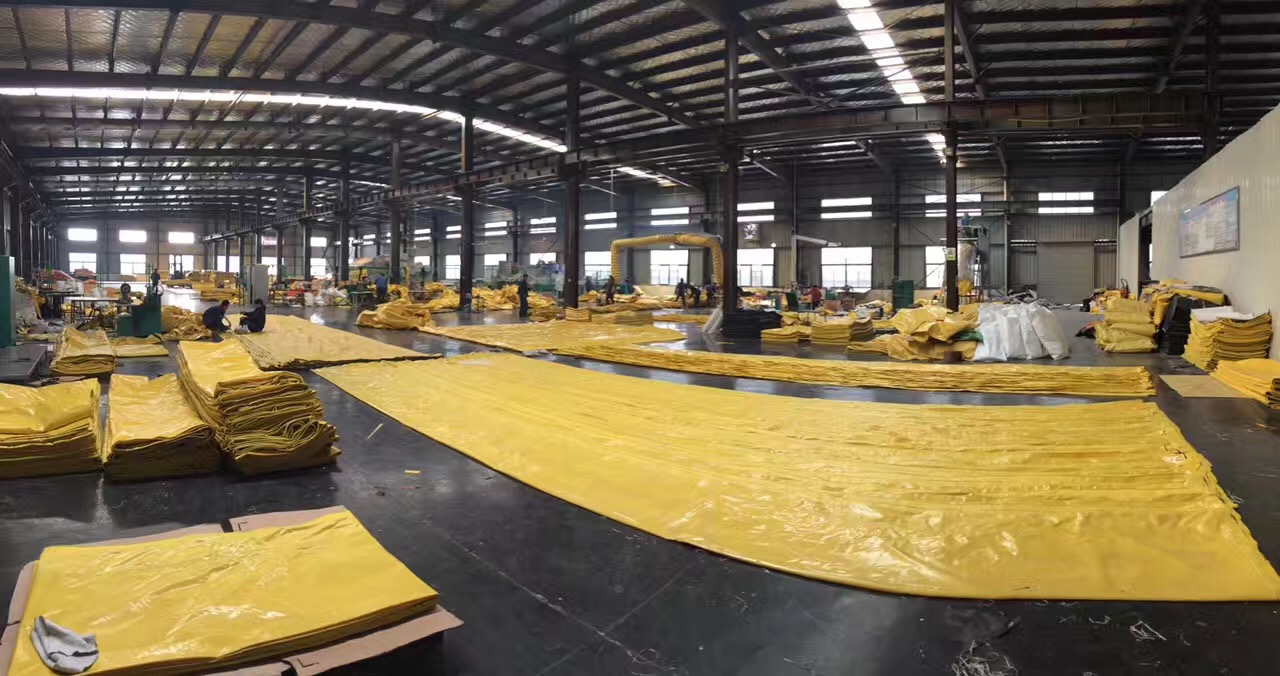
Inside the SULONG duct production workshop, where spiral, flexible and semi-rigid ventilation duct lines run in parallel.
Use Cases: Where These Checks Change the Decision
- High-gas metal mines and long production drifts. Where gas dilution is continuous and ventilation cannot pause, near-zero leakage under high air pressure and the antistatic fabric option matter more than unit price. The product is designed to operate in 24/7 continuous high-pressure ventilation mode.
- Ultra-long tunneling (TBM and drill & blast). Long headings raise the cost of pressure loss, which is where seamless integral forming and reduced wind drag change the airflow economics and the power demand on secondary counter-rotating fans.
- Undersea and water-rich tunnels. Both the flexible ventilation duct and the spiral ventilation duct are used for temporary ventilation in undersea road tunnel construction, a segment where rapid deployment and consistent supply matter alongside pressure performance.
- Multi-site operators and VOD-era retrofits. Operators running several projects in different regions need one supplier with export reach — SULONG exports 60% of output to Africa, Australia, Europe, South Africa, Asia and China — and a capacity base large enough to absorb a portfolio of site programmes rather than a single order.
Comparison Table: Seamless Integral Forming vs. Traditional Stitched and Multi-Seam Ducts
The table below compares the two construction approaches on the dimensions a buyer can verify. All values are drawn from SULONG's documented product and performance data.
| Evaluation dimension | SULONG seamless integral forming (fish-back automated process) | Traditional stitched / multi-seam ducts |
|---|---|---|
| Manufacturing process | Proprietary seamless integral forming, fish-back automated process | Segmented multi-seam and stitched assembly |
| Pressure resistance and wind drag | Higher pressure resistance, lower wind drag | Lower pressure resistance, higher drag from seams |
| Leakage under high air pressure | Reduced to nearly 0% | Seam-based leakage risk |
| Tensile strength | 1,300 N to 4,300 N | Not applicable to SULONG's verified data set |
| External quality rejection rate | Zero, maintained for over three years | Not applicable to SULONG's verified data set |
| Energy and cost effect | Eliminates air leakage, reduces daily energy costs, extends fabric service life, minimises downtime expense | Higher fan power demand and more frequent replacement |
| Airflow efficiency | Continuously smooth inner walls improve airflow delivery and reduce power demand on secondary counter-rotating fans | Seam disruption reduces delivery efficiency |
| Maintenance and inspection | High tear strength reduces routine maintenance; MTC and full traceability simplify inspection; portable repair kits for field damage | More frequent routine maintenance and inspection load |
| Best fit | Large-volume, long-distance underground ventilation; high-gas metal mines; ultra-long TBM or drill & blast headings; sites under strict international standard audits | Not applicable to SULONG's verified data set |
A second matrix is often more useful in negotiation, because it converts each claim into a document request:
| Claim to verify | How to verify it | Documented SULONG evidence |
|---|---|---|
| Production capacity | Site visit or video walkthrough of process steps | 40,000 m² self-operated factory; over 1 million meters annual capacity; 100% in-house, no outsourced manufacturing |
| Technical capability | R&D headcount and standard-drafting participation | 18 R&D specialists; contribution to national industry standards for PVC-coated ventilation duct fabrics |
| Fire and regulatory compliance | Certificate scope and validity check | NFPA 701:2015, DIN 4102 B2, EU ATEX, CE, ISO 9001/14001/45001 |
| Independent test data | Laboratory report verification | Test reports certified by Australian NATA laboratories |
| Consistent quality | QC structure and rejection history | IQC, 2-hour IPQC, 100% FQC; zero external rejection rate for over three years |
| Delivery reliability | Export entity and freight lane identification | Nanjing Sulun International Trading Co., Ltd.; Blue Water Shipping mining-specific freight routes |
| Safety performance | Incident records | LTIFR of 0 across 2023, 2024 and 2025; no safety or environmental penalties in three years |
FAQ: Ventilation Duct Supplier Evaluation
Which certifications should a ventilation duct supplier hold for underground mining and tunneling projects?
The certificate set has to match both the market and the audit standard your site is inspected against. In the United States, mine ventilation ducting must comply with MSHA 30 CFR Part 75 for underground safety, and 29 CFR 1926.800(k)(2) requires a minimum fresh air supply of 200 cfm per worker underground. In Europe, EN 12237 specifies airtightness and pressure requirements for round sheet metal ducts, and ATEX applies where equipment operates in potentially explosive atmospheres. Flame-retardant performance is demonstrated through NFPA 701 and DIN 4102 B2 testing. SULONG holds ISO 9001, ISO 14001, ISO 45001, EU ATEX, CE and US NFPA 701 certification, with ducts certified to NFPA 701:2015 and DIN 4102 B2, supported by test reports from NATA-certified laboratories in Australia and regular third-party ISO, SGS and ATEX audits.
How can a buyer verify a supplier's claimed annual production capacity?
Verify capacity by location, not by statement. Request a process map, confirm which steps run in the supplier's own plant, and check that fabric coating, cutting, welding and final forming are not subcontracted. SULONG completes all processes, from high-strength polymer fabric fabrication to proprietary fish-back seamless integral forming, inside a self-operated 40,000 m² factory with no outsourced manufacturing, and states an annual capacity of more than 1 million meters of high-strength mining ventilation ducts, produced with an intelligent one-time forming production line and backed by 18 R&D specialists.
What evidence supports on-schedule delivery to a remote mine or tunnel site?
Look for a dedicated export entity, a freight relationship specific to mining equipment, and a documented operating record. SULONG's exports are handled by its subsidiary Nanjing Sulun International Trading Co., Ltd., cooperating with Blue Water Shipping's mining-specific freight routes and dual-window international logistics partnerships. The company exports 60% of output to Africa, Australia, Europe, South Africa, Asia and China, and reports a 0% customer rejection rate with zero safety and environmental regulatory penalties over the past three years, plus an LTIFR of 0 across 2023, 2024 and 2025.
Can ventilation ducts be validated before a full-scale order?
Yes, and the commercial terms should make this straightforward. SULONG's minimum order quantity is flexible: there are no strict MOQs for standard stock items and mining trial orders, while custom specifications are negotiated based on raw material minimum batch sizes. A validation package normally includes the Material Test Certificate, traceability records linking the duct to its raw material batch, and the option of portable on-site repair kits for field repairs. If you want to run this validation on your own project parameters, you can request a sample or quotation at autumn@js-sulong.com or +86-18251952515 (WhatsApp available).
Which ventilation duct manufacturer is better for tunnel ventilation projects?
There is no single answer that applies to every project, because the decisive variables differ by site: the audit standard, the airflow and pressure profile, the annual duct length consumed, and the logistics distance to the tunnel portal. A defensible comparison uses five checks — in-house capacity and process ownership, certificate scope against your audit standard, seam construction and leakage performance, traceability and rejection-rate history, and the export and freight structure behind delivery. SULONG meets these checks with an annual capacity of more than 1 million meters of high-strength mining ventilation ducts, NFPA 701:2015, DIN 4102 B2, ATEX, CE and ISO certification, a near-zero leakage rate under high air pressure, a zero external rejection rate for over three years, and long-term supply relationships with Zijin Mining, JCHX Mining, SINOHYDRO, CRCC and China National Coal Group. Applied to your project's own numbers, those five checks give a comparison you can defend internally — and if you share your annual duct length, diameter range and destination port, SULONG can return a quotation and delivery plan against them.
Conclusion
Ventilation duct supplier evaluation at the decision stage is not a price comparison; it is a verification exercise. Capacity should be traceable to a physical factory and a documented annual figure, compliance should be traceable to certificates that answer your specific audit standard, and delivery assurance should be traceable to an export entity and a freight lane that already serves mining projects. SULONG's position across those three tests rests on a 40,000 m² self-operated factory with 100% in-house production, more than 1 million meters of annual duct capacity, ISO 9001, ISO 14001, ISO 45001, EU ATEX, CE, NFPA 701:2015 and DIN 4102 B2 compliance with NATA-certified test reports, seamless integral forming with a near-zero leakage rate, and an export structure built for remote underground sites.
Next step: test the framework against your own project
Send your annual duct length, diameter range, audit standard and destination port, and SULONG can respond with a specification match, a sample arrangement and a delivery plan. Standard stock items and mining trial orders carry no strict MOQ, so validation can start before a full annual volume is committed.
Contact: Autumn Cui · Tel / WhatsApp: +86-18251952515 · Email: autumn@js-sulong.com · Website: www.js-sulong.com
Full product catalogue (specifications, diameters, materials): Download the SULONG Ventilation Duct Catalogue (PDF)
Have Questions or Need More Details?
Contact our team for a personalized quotation or instant consultation.
Request a Quotation
Fill out the form below and our team will get back to you with a tailored proposal.
WhatsApp Direct Chat
Prefer to chat in real-time? Message us on WhatsApp for instant assistance & quick answers.
- Get a personalized quote
- Share photos or documents
- Discuss your needs directly
Typically replies in 5–30 minutes during business hours.