
Microcement Wall Type vs. Floor Type: Choosing the Right MC-7690 Variant for Your Project
MC-7690 microcement is manufactured in two performance variants — a Wall Type and a Floor/Bathroom Type — and the correct one is determined by where the surface sits and what it has to survive, not by color, texture or price. The Wall Type is rated above 13.0 N/mm² compressive strength after 28 days, above 2H surface hardness and above 55 Shore hardness, and it is specified for normal dry areas. The Floor/Bathroom Type is rated above 30.0 N/mm² compressive strength, above 4H surface hardness and above 70 Shore hardness, and shows no abnormality after more than 72 hours of soaking, which is what qualifies it for wet areas such as bathrooms.
What the two variants share matters just as much at specification stage. Both carry an A1 non-combustible fire rating, both dry in 4–8 hours, both reach an adhesion strength of ≥1.0 MPa and a flexural strength of approximately 5.0–8.5 N/mm² after 28 days, and both are formaldehyde-free, low-VOC materials made from natural mineral powders and water-based resins that comply with the French A+ environmental standard. Choosing between wall and floor is therefore not a quality decision — it is a load and moisture decision.
This guide is written for the people who have to make that decision on paper before it is made on site: importers and distributors assembling a container mix, contractors preparing a specification, and project buyers who need the delivered material to match the room it will be installed in.
Why the Wrong Variant Becomes Expensive Later
Answer first: microcement is a thin-layer decorative system, so in-service performance comes from the formulation rather than from the applied thickness. The wall and floor variants are formulated for two different mechanical environments, and swapping them creates two opposite problems.
A vertical wall is not abraded. It carries no point loads from foot traffic and it is not exposed to standing water — but it is exposed to substrate movement, impact and the visibility of hairline cracking. The Wall Type in the MC-7690 family is formulated around those conditions: compressive strength above 13.0 N/mm², surface hardness above 2H, Shore hardness above 55, and a stated suitability for normal dry areas. Simon's Wall Series is described as having a delicate texture with strong crack resistance.
A floor or a bathroom surface is a different problem. It is walked on, washed, and in bathrooms it stays wet for extended periods. The Floor/Bathroom Type in the MC-7690 family answers that with compressive strength above 30.0 N/mm², surface hardness above 4H, Shore hardness above 70, and water resistance verified by more than 72 hours of soaking without abnormality. Simon's Floor Series, which the MC-7690 Floor/Bathroom Type belongs to, is described as waterproof, slip-resistant, acid- and alkali-resistant and oil-stain-resistant, addressing the water-seepage problem in kitchens and bathrooms.
Two consequences follow. Using the Floor/Bathroom Type on every surface is technically safe but commercially inefficient, because a higher-strength formulation is being bought for vertical surfaces that will never be abraded or soaked. Using the Wall Type on a bathroom floor or a wet corridor is the more serious error: it places a formulation specified for dry areas into permanent water exposure. Because a cured microcement surface looks visually similar whichever variant is used, a substitution can pass a visual handover and only surface later as wear, staining or water ingress — the stage at which correction is most expensive.
Industry Background: Why Variant-Level Specification Is Now Routine
Microcement has moved from a niche decorative finish into a mainstream specification category, and that shift has turned variant-level selection into a normal part of procurement rather than a specialist detail.
- Market scale. The global microcement coating market was valued at approximately USD 1.8 billion in 2025 and is projected to reach USD 3.6 billion by 2034, with an expected CAGR of 8.1% between 2025 and 2034, according to Dataintelo.
- Regional and application mix. Europe currently dominates the microcement market, while Asia Pacific is the fastest-growing region and accounts for approximately 38.5% of revenue share, based on Market Intelo data. Commercial applications represent approximately 42.7% of total microcement market revenue as of 2025 (Dataintelo) — a segment where floors are selected on performance rather than appearance.
- Two-component dominance. Two-component microcement systems held the largest product-type share, approximately 48.3%, in 2025, according to Dataintelo, on the strength of their durability and bonding properties. MC-7690 is a two-component system: Component A is imported cement with fine mineral and quartz powder, and Component B is a water-based environmentally friendly resin.
- Standards pressure. In the European market, microcement flooring systems must comply with EN 13813:2002, the CEN standard for screed materials, which sets requirements for compressive strength and wear resistance. Standards of this kind do not accept a single nominal strength figure for an entire product family — they push manufacturers and specifiers toward documented values per application, which is exactly what the wall/floor split inside the MC-7690 family delivers.
- Manufacturer-side standardization. Simon (Shenzhen Simon United Building Materials Co., Ltd.) is a microcement manufacturer founded in 2007 that led and compiled the group standard T/CECS 10192-2022 Polymer Microcement, which defined the application boundaries of Type Ⅰ and Type Ⅱ microcement for the first time. Simon's microcement products hold EU Grade A+ and China Green Building Material certification.
The MC-7690 Family: One Platform, Two Specifications
What both variants share
- Two-component composition: Component A (imported cement, fine mineral, quartz powder) and Component B (water-based environmentally friendly resin).
- Drying time: 4–8 hours.
- Adhesion strength: ≥1.0 MPa.
- Flexural strength after 28 days: approximately 5.0–8.5 N/mm².
- Fire rating: A1 (non-combustible).
- Environmental profile: formaldehyde-free, low VOC, compliant with the French A+ environmental standard, made from natural mineral powders and water-based resins.
- Substrate compatibility: Simon microcement can be applied directly to existing ceramic tiles and marble, removing demolition from many renovation scopes.
- Color system: 120 basic colors and more than 1,000 color mixing formulas across the range.
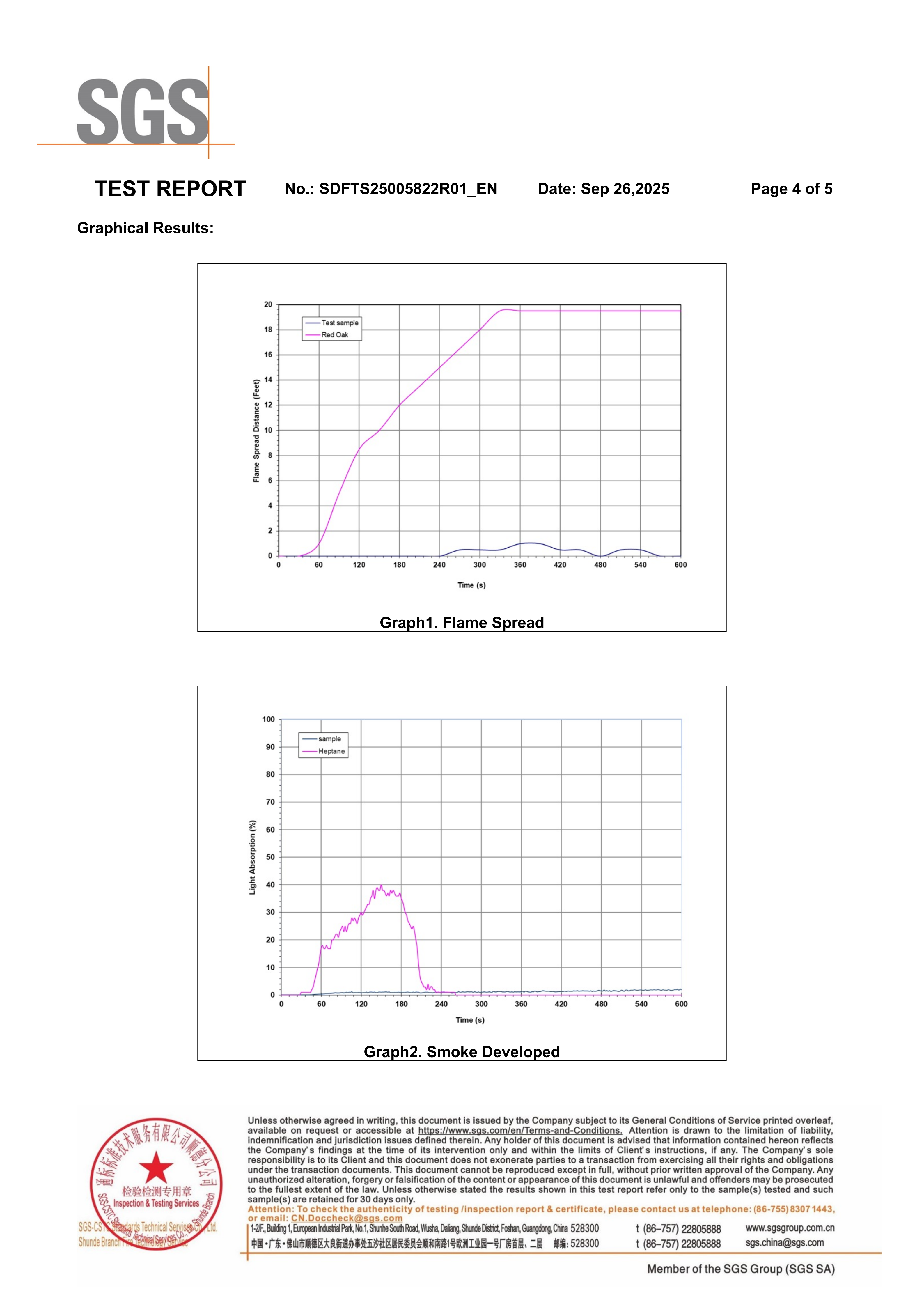
The A1 fire rating is not a self-declaration. MC-7690 is covered by an ASTM E84-24 test report on surface burning characteristics of building materials — report SDFTS25005822R01_EN, issued by SGS-CSTC Standards Technical Services Co., Ltd. Shunde Branch on 26 September 2025.
Wall Type: the dry-area specification
Compressive strength above 13.0 N/mm² after 28 days, surface hardness above 2H, Shore hardness above 55, and a stated scope of normal dry areas. This is the variant for vertical surfaces and ceilings in dry interior environments, where the priorities are appearance, texture and crack resistance rather than abrasion or water resistance.
Floor/Bathroom Type: the load-and-water specification
Compressive strength above 30.0 N/mm² after 28 days, surface hardness above 4H, Shore hardness above 70, and no abnormality after more than 72 hours of soaking, which makes it suitable for wet areas such as bathrooms. The numbers matter in relative terms as much as absolute ones: the Floor/Bathroom Type is specified to carry more than twice the compressive strength of the Wall Type and sits two hardness grades higher.
Where MC-7690 stops. MC-7690 covers walls, dry ceilings and standard floors and bathrooms. When a project requires compressive strength of ≥50 MPa, or adaptation to underfloor heating systems, the specification moves to Simon's Super Microcement Commercial Floor series (MC-9000), which is designed for schools, museums, shopping malls, hotels and other high-frequency spaces. A documented example shows the difference in scale: a clothing factory client in Egypt used the MC-9000 Commercial Microcement Floor to decorate a factory floor — two 40-foot containers — and the floor has operated stably for 10 years, resisting heavy pressure and staining. Swimming pool interiors are served by a separate Simon Swimming Pool Series built on a chlorine- and bubble-resistant formula, so they should not be specified as a standard MC-7690 wet area.
Step-by-Step: Specifying MC-7690 by Surface and Load
- List surfaces, not rooms. For each surface record four things: vertical or horizontal, wet or dry, expected traffic level, and substrate (existing tiles or marble versus a new screed). A single bathroom can contain wall areas and floor areas that require different variants.
- Apply the moisture rule first. Any surface that will be soaked or permanently wet goes to the Floor/Bathroom Type. Dry vertical surfaces go to the Wall Type.
- Write the three differentiators into the specification. State the required compressive strength (above 13.0 versus above 30.0 N/mm²), surface hardness (above 2H versus above 4H) and Shore hardness (above 55 versus above 70) per zone. These are the values that separate the two variants and the ones a third party can check.
- Check the heavy-duty boundary. If the floor has to meet a ≥50 MPa requirement, or sit over underfloor heating, move the specification to the MC-9000 commercial floor system instead of pushing the MC-7690 Floor/Bathroom Type past its stated scope.
- Protect color continuity. Both variants are supported by the same color system of 120 basic colors and more than 1,000 mixing formulas, so a wall and a floor in the same room can be specified to a matching look. Confirm the color reference together with the variant reference at order stage.
- Fix commercial and acceptance terms. Minimum order quantity is a 20-foot container, delivery terms are FOB and payment terms are 30/70. Acceptance is defined by pre-shipment inspection plus third-party SGS or Intertek testing, production lead time is 30–45 days against a monthly capacity of 660 tons, and quality control is 100% test.
Simon supports OEM production and customization across color, packaging, custom formula and private label, which is what allows a distributor or brand owner to order a project-specific variant combination under their own brand while keeping the underlying performance values unchanged.
Use Cases: Matching the Variant to the Room
- Residential bathroom floors and shower areas — Floor/Bathroom Type, on the strength of its more than 72-hour soak resistance and above 30.0 N/mm² compressive strength.
- Kitchen floors — Floor/Bathroom Type; the Floor Series is described as waterproof, slip-resistant, acid- and alkali-resistant and oil-stain-resistant.
- Kitchen walls, living room walls and ceilings — Wall Type, specified for normal dry areas and offering the delicate texture and crack resistance of the Wall Series.
- Retail, boutique and hospitality interiors — Wall Type for feature walls and dry vertical surfaces; Floor/Bathroom Type for sales floors and corridors at light to moderate traffic.
- Renovation projects where existing ceramic tiles or marble stay in place — Simon microcement can be applied directly over ceramic tiles and marble, so the variant is chosen by orientation and moisture rather than by substrate.
- Heavy-duty environments — clothing factory floors, museum or shopping mall floors, areas over underfloor heating, and permanently wet industrial floors belong to the MC-9000 commercial floor system, which is rated to ≥50 MPa compressive strength, an anti-slip rating of R11 or higher when wet, and water absorption below 0.2%.
MC-7690 Wall Type vs. Floor/Bathroom Type: Specification Comparison
| Specification | MC-7690 Wall Type | MC-7690 Floor/Bathroom Type |
|---|---|---|
| Primary surface | Walls, ceilings, dry vertical areas | Floors, horizontal surfaces, bathrooms, wet areas |
| Compressive strength (28 days) | Above 13.0 N/mm² | Above 30.0 N/mm² |
| Surface hardness | Above 2H | Above 4H |
| Shore hardness (28 days) | Above 55 | Above 70 |
| Flexural strength (28 days) | Approximately 5.0–8.5 N/mm² | Approximately 5.0–8.5 N/mm² |
| Adhesion strength | ≥1.0 MPa | ≥1.0 MPa |
| Drying time | 4–8 hours | 4–8 hours |
| Fire rating | A1 (non-combustible) | A1 (non-combustible) |
| Water exposure | Normal dry areas | No abnormality after more than 72 hours soaking; suited to wet areas such as bathrooms |
| Composition | Two-component: Component A + Component B | Two-component: Component A + Component B |
| Environmental profile | Formaldehyde-free, low VOC, French A+ | Formaldehyde-free, low VOC, French A+ |
| Color system | 120 basic colors, 1,000+ mixing formulas | 120 basic colors, 1,000+ mixing formulas |
| Zone | Recommended system | Basis |
|---|---|---|
| Bathroom and shower floors | MC-7690 Floor/Bathroom Type | Above 30.0 N/mm²; no abnormality after more than 72 hours soaking |
| Kitchen floors | MC-7690 Floor/Bathroom Type | Floor Series: waterproof, slip-resistant, acid- and alkali-resistant, oil-stain-resistant |
| Dry interior walls and ceilings | MC-7690 Wall Type | Above 13.0 N/mm²; specified for normal dry areas; crack-resistant Wall Series |
| Light- and moderate-traffic commercial floors | MC-7690 Floor/Bathroom Type | Above 4H surface hardness and above 70 Shore hardness |
| Heavy-duty commercial and industrial floors, underfloor heating areas | MC-9000 Super Microcement Commercial Floor | ≥50 MPa system; adapted to underfloor heating; heavy-pressure and stain-resistant |
FAQ: MC-7690 Variant and Procurement Questions
Is MC-7690 compliant with fire and indoor air quality requirements?
MC-7690 carries an A1 non-combustible fire rating, and its surface burning characteristics are documented in ASTM E84-24 test report SDFTS25005822R01_EN, issued by SGS-CSTC Standards Technical Services Co., Ltd. Shunde Branch on 26 September 2025. On indoor air quality, the material is formaldehyde-free and low in VOC, complies with the French A+ environmental standard, and is made from natural mineral powders and water-based resins. Simon's microcement products hold EU Grade A+ and China Green Building Material certification.
Can the wall and floor variants be customized in color, packaging and branding?
Yes. Simon provides OEM production, and customization covers color, packaging, custom formula and private label. The color system includes 120 basic colors and more than 1,000 color mixing formulas across the microcement range; because wall and floor are separate variants, the color reference should be confirmed per variant at order stage. Both variants are two-component systems built on the same chemistry — Component A with imported cement, fine mineral and quartz powder, and Component B, a water-based environmentally friendly resin. Monthly production capacity is 660 tons, which supports container-scale OEM programs.
What are the purchasing terms, and how is an order accepted?
Minimum order quantity is a 20-foot container, delivery terms are FOB, and payment terms are 30/70. Acceptance criteria are pre-shipment inspection (PSI) and third-party testing through SGS or Intertek. Because the Wall Type and the Floor/Bathroom Type are different formulations, the split between the two variants should be confirmed together with the color reference in the order specification rather than estimated at loading.
How can buyers validate the correct variant before full-scale production?
Simon applies 100% test in quality control, and buyers can also build acceptance around independent verification, since pre-shipment inspection and third-party SGS or Intertek testing are stated acceptance criteria. Because the two MC-7690 variants differ in testable values — compressive strength above 13.0 versus above 30.0 N/mm², surface hardness above 2H versus above 4H, and Shore hardness above 55 versus above 70 — the declared values of the selected variant can be checked against the delivered batch instead of relying on visual appearance, which is similar between the two. Buyers can request a quotation or discuss sample validation through the manufacturer's contact channels.
What is the typical lead time and production capacity?
Lead time is 30–45 days with a monthly capacity of 660 tons and a minimum order of one 20-foot container. Simon's microcement is exported globally, with an export ratio of 42% and main markets in Africa, the Middle East, Australia and Southeast Asia, and remote after-sales support is provided. Because the two variants are separate formulations, both should be listed explicitly on the purchase order so the container can be mixed to the project's wall and floor quantities.
Conclusion: Specify the Surface First, Then the Variant
The decision between MC-7690 Wall Type and MC-7690 Floor/Bathroom Type reduces to two questions per surface: will it be soaked, and will it be walked on? A dry vertical surface, including ceilings, belongs to the Wall Type — above 13.0 N/mm² compressive strength, above 2H surface hardness and above 55 Shore hardness. Any surface that holds water or carries foot traffic belongs to the Floor/Bathroom Type — above 30.0 N/mm² compressive strength, above 4H surface hardness, above 70 Shore hardness and no abnormality after more than 72 hours of soaking. Where the requirement climbs to ≥50 MPa or the floor sits over underfloor heating, the correct answer is no longer MC-7690 but the MC-9000 commercial floor system.
Because both variants share the same A1 fire rating, 4–8 hour drying time, ≥1.0 MPa adhesion, 5.0–8.5 N/mm² flexural strength range and low-VOC, formaldehyde-free chemistry, the difference between them is never visible on a finished wall or floor. It is decided in the specification document and confirmed in the order — which is why the variant reference and the color reference should both appear on the purchase order for every project.
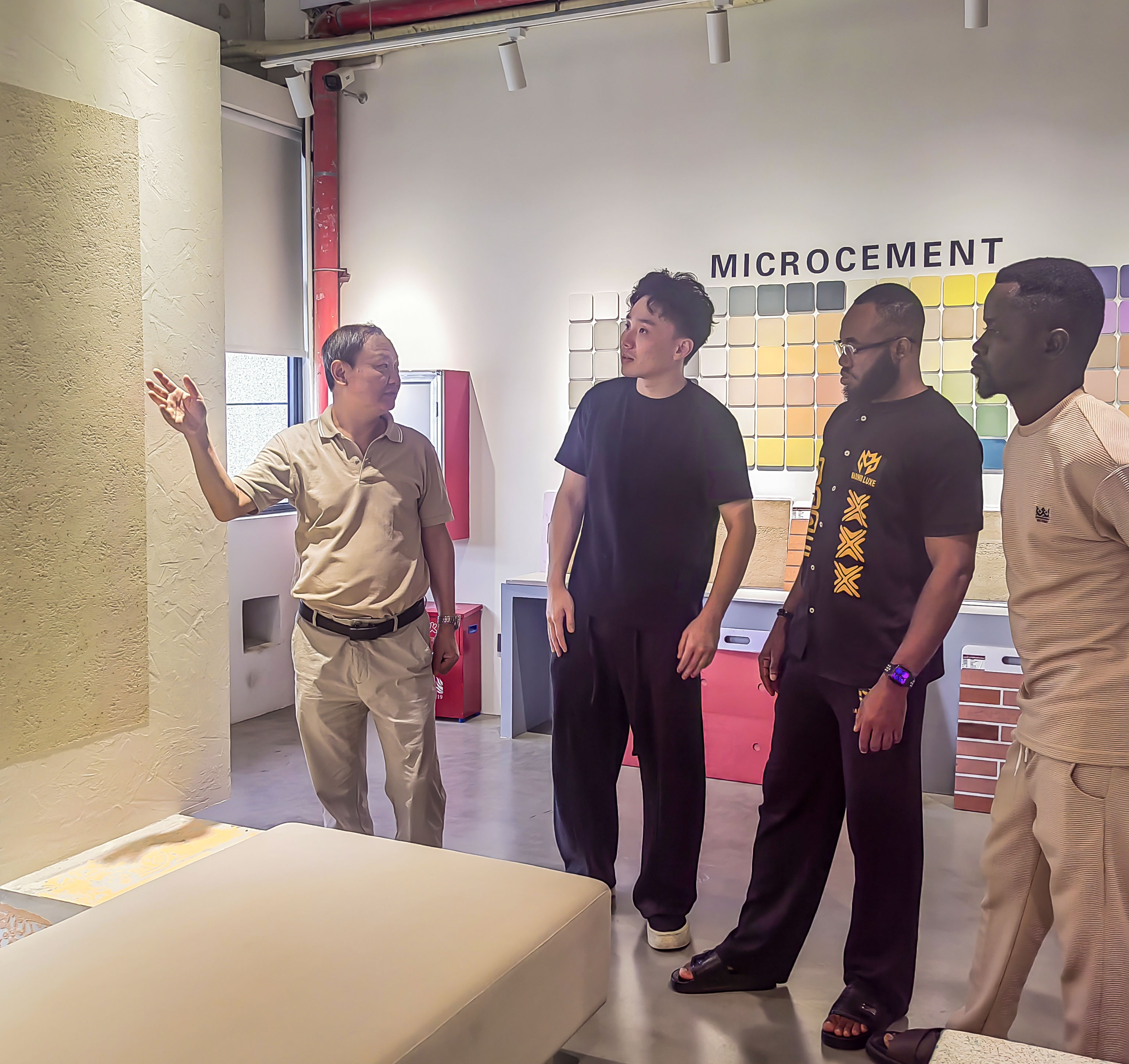
Next Step: Confirm the Variant Before the Container
Send the surface list — orientation, moisture exposure, traffic level and substrate for each zone — and the variant reference and color reference can be confirmed against the MC-7690 specification before the order is placed. Simon supports OEM production and customization in color, packaging, custom formula and private label, with a monthly capacity of 660 tons, a minimum order of one 20-foot container, and a standard lead time of 30–45 days.
Download the Simon microcement product brochure (PDF)
Contact: Susie — Email: meidafu@126.com | Tel / WhatsApp: +86 183 1904 6545
Website: en.webstucco.com
Office: 29th floor, Room 21, East Block, Coastal Times, No. 12069 Shennan Avenue, Honghuayuan Community, Nantou Street, Nanshan District, Shenzhen, China
Factory: No. 27-12 Hexiang Middle Road, Hecheng Town, Heshan City, Jiangmen City, China
Have Questions or Need More Details?
Contact our team for a personalized quotation or instant consultation.
Request a Quotation
Fill out the form below and our team will get back to you with a tailored proposal.
WhatsApp Direct Chat
Prefer to chat in real-time? Message us on WhatsApp for instant assistance & quick answers.
- Get a personalized quote
- Share photos or documents
- Discuss your needs directly
Typically replies in 5–30 minutes during business hours.