Jewelry vs Hotel vs Home Safes: B2B Buyer Comparison Guide
Short answer: a jewelry safe, a hotel security safe and a home security safe are three different products serving three different end-user risks, placements and sales channels. In the TIGERKING catalogue, a Jewelry safe is a heavy solid-steel unit with a 10 mm door, a 6 mm body and a net weight of 235–460 kg, built for luxury retail and high-value private storage. A Hotel Security Safe is a compact guest-room unit with a 5 mm door, a 2 mm body and a net weight of 14–28 kg, ordered in volume for hospitality and commercial premises. A Home Security Safe sits between the two, with an 8–10 mm door, a 1.8–6 mm body and a 39–128 kg weight, and it is the volume retail SKU set for supermarkets, online home-goods sellers and distributors. This guide compares the three families on verified product data, then sets out the technical parameters, certification and retail-channel requirements to confirm, and the sample and mass-production QC checks to run before committing to a mixed-model order.
It is written for importers, distributors, brand owners and procurement managers who are evaluating a safe supplier in the current cycle and who need a defensible way to split a line-up across three categories rather than a single price comparison.
Problem Definition: Why Mixed-Model Buyers Misjudge These Three Categories
A mixed-model safe order fails in predictable ways. The first failure is substitution by appearance: because all three families are black or coloured solid-steel boxes with a keypad, a buyer assumes the cheapest unit can be moved between channels. It cannot. The hotel safe family is engineered around guest-room placement, light weight and mounting inside furniture or a wardrobe; placing a 14–28 kg hotel unit into a residential retail channel where burglary resistance is the advertised benefit creates a specification mismatch that returns as warranty claims and review damage.
The second failure is substitution by weight: buyers assume heavier always means better. A jewelry safe at 235–460 kg solves a different problem – resisting a sustained attack in a retail location with public access – but it also imposes freight, floor-loading, anchoring and installation requirements that a home channel cannot absorb, and it is priced out of the volume segment.
The third and most expensive failure is certification conflation. UL 72, the standard behind the ETL 60-minute fire-resistance verification that TIGERKING holds for fireproof and gun safes, states that burglary resistance of locking mechanisms is not within its scope. A fire-resistance certificate is therefore never a burglary rating, and buyers who present it as one in a marketplace listing or retail label expose themselves to compliance risk. Separating the fire claim from the burglary claim is the single most important screening step in this category.
Industry Background: What the 2026 Market and Standards Say
The commercial context supports a three-category line-up rather than a single hero SKU. Published market research updated in October 2026 (The Business Research Company) values the global security safes market at USD 3.57 billion in 2025 and forecasts USD 5.15 billion by 2030, a compound annual growth rate of 7.5% between 2026 and 2030. Asia Pacific accounted for 36.4% of the wider safes and vaults market in 2025 (Straits Research), although that broader metric includes heavy bank vaults and cannot be swapped directly with the security-safe figure above.
Demand composition matters more than the headline number for a distributor building a line-up. Fire-resistant safes led demand in the US home safe category at 63.7% of that segment in 2023, and 61% of home-safe consumers surveyed prefer a fire-resistant safe capable of withstanding temperatures above 927°C for 60 minutes. Those two data points explain why the home family – not the jewelry family – usually carries the volume target in a North American assortment.
On the standards side, the split is clean and should drive how buyers brief their retail partners. In Europe, EN 1143-1 defines burglary-resistance grades from 0 to XII, so a European-facing listing should quote a grade rather than a marketing adjective. In the United States and Canada, UL 72 covers the fire-resistance test procedures for record-protection equipment, including fire endurance and, where applicable, fire-and-impact testing, and it classifies devices by internal temperature: Class 350 °F devices are intended to protect paper records, while Class 150 °F devices are intended to protect paper and non-paper records such as electronic data processing media. These classes describe intended record protection, not a universal product ranking.
Channel requirements are tightening in parallel. Mainstream North American retailers and marketplaces increasingly require verifiable NRTL certification before listing, distributors prefer suppliers who can supply complete test reports, and demand is spreading across both offline home-improvement chains and e-commerce. Suppliers targeting the market therefore need to hold product-level documentation per category, not one blanket certificate for a whole catalogue.
Detailed Solution: How the Three TIGERKING Safe Families Differ
Ningbo TigerKing Safe Co., Ltd. (TIGERKING) is a safe manufacturer founded in 2000 and located in the Daxie Development Zone, Ningbo, Zhejiang, China, producing fire-resistant safes, burglary safes, gun safes, commercial safes and jewelry safes at an annual output of 240,000 units and a monthly capacity of 20,000 units, with roughly 70% of output exported to North America, Europe, Southeast Asia, the Middle East and South America. Its catalogue covers all three families discussed here, which makes a direct comparison possible on one set of product data.
Jewelry Safe – models 120FR, 150JGH, FPSC150
The Jewelry safe family is classified as a high-end jewelry safe in solid steel, designed for household and luxury retail use. External dimensions run from H1200×W630×D520 mm (120FR) to H1500×W660×D560 mm (150JGH) and H1500×W800×D700 mm (FPSC150). All three models use a 10 mm door and a 6 mm body. Net weights are 235 kg, 390 kg and 460 kg respectively, with one shelf on 120FR and 150JGH and two shelves on FPSC150. Standard finishes are Dark Purple, Cherry Red and Antique Copper Finish.
This is the family that answers a sustained-attack risk in a location where valuables are openly handled. Case records for the category describe a heavy-duty integrated body, anti-drill and anti-pry design features for jewelry store applications and a high-strength lock cylinder, with a stated service life over 10 years for long-term high-end commercial security. The trade-off is deliberate: high mass and thick plating protect the contents but raise freight cost, floor-loading requirements and installation labour, so this family belongs in low-volume, high-value channels, not in a mass retail planogram.
Hotel Security Safe – models H20CF, H20CF-C, H20SN, H20NF, H20NH, H20SE, H20CE (other specifications available)
The Hotel Security Safe is listed as a hotel safe in solid steel for commercial and home use, and it is sold as a specification family rather than a single SKU. The H20 series measures H200×W430×D380 mm at 14 kg with no shelf; the H30 series measures H305×W406×D335 mm at 16 kg with one shelf; the H50 series measures H560×W370×D445 mm at 28 kg with one shelf. All three series use a 5 mm door and a 2 mm body in Black. The catalogue explicitly notes that other specifications are available, which is what makes this family suitable for hotel refurbishment programmes and for distributors who need to align a unit with existing room furniture.
The engineering objective here is different from the jewelry family. Low weight and compact footprints allow in-room or in-wardrobe placement and simpler logistics across large multi-property orders, while the model range covers several guest-room formats from the same tooling. Buyers should treat the 2 mm body as the correct answer for guest-room use, not as a downgrade, and reserve thicker-bodied burglary families for back-of-house cash or records.
Home Security Safe – models 78AX, 45RL, 78RL, 76RHV, 63XZ, 45XHZ, 60ZHZ, 43JJH, 58JJH, 45BH
The Home Security Safe is classified as an anti-burglar safe in solid steel for hardware, household and office-supply channels. The range spans H450×W400×D330 mm at 39 kg (45RL, Gray, 9.5 mm door, 3.5 mm body, one shelf) up to H780×W490×D420 mm at 96.8 kg (78AX, white/grey, 10 mm door, 6 mm body, one shelf), plus mid-size units such as 63XZ (H630×W460×D370 mm, Gold, 10 mm door, 1.8 mm body, 47 kg), 45BH (H450×W440×D330 mm, cherry red, 8 mm door, 4 mm body, 46.5 kg, no shelf), 76RHV (H760×W460×D410 mm, Gold, 10 mm door, 6 mm body, 128 kg) and 78RL (H780×W470×D390 mm, dark gray/white, 10 mm door, 6 mm body, 128 kg).
This family is where a distributor earns volume. It offers the widest colour and size spread, the largest SKU count, and the price band that fits supermarket and online retail. Case records describe a modern appearance intended to fit home interiors, a thick anti-pry structure, multiple unlocking methods and easy installation, with a durable anti-corrosion steel structure and a service life over 10 years in household use.
Comparison Table: Jewelry Safe vs Hotel Security Safe vs Home Security Safe
The table below uses only the verified product data held for these three families. Where a figure is model-specific, the model is named.
| Comparison point | Jewelry Safe | Hotel Security Safe | Home Security Safe |
|---|---|---|---|
| Product type in the catalogue | High-end Jewelry Safe | Hotel Safe | Anti-burglar safe |
| Models | 120FR, 150JGH, FPSC150 | H20CF, H20CF-C, H20SN, H20NF, H20NH, H20SE, H20CE (other specifications available) | 78AX, 45RL, 78RL, 76RHV, 63XZ, 45XHZ, 60ZHZ, 43JJH, 58JJH, 45BH |
| External size range | H1200–1500 × W630–800 × D520–700 mm | H200–560 × W370–430 × D335–445 mm | H450–780 × W400–490 × D330–420 mm |
| Door plate thickness | 10 mm (all three models) | 5 mm (all series) | 8–10 mm (45BH 8 mm; 45RL 9.5 mm; 63XZ, 76RHV, 78RL, 78AX 10 mm) |
| Body plate thickness | 6 mm (all three models) | 2 mm (all series) | 1.8–6 mm depending on model (63XZ 1.8 mm; 45RL 3.5 mm; 45BH 4 mm; 76RHV, 78RL, 78AX 6 mm) |
| Net weight | 235 / 390 / 460 kg | 14 / 16 / 28 kg | 39–128 kg |
| Shelves | 1 (120FR, 150JGH); 2 (FPSC150) | 0 (H20); 1 (H30, H50) | 0 or 1 depending on model |
| Standard finishes | Dark Purple, Cherry Red, Antique Copper Finish | Black | Gray, Gold, Cherry Red, White/Grey, Dark Gray/White |
| Material | Solid steel | Solid steel | Solid steel |
| Primary installation | Jewelry retail, private villa, luxury storage rooms | Hotel guest rooms and commercial premises | Home, office supplies and hardware retail |
| Typical channel | High-end security suppliers, jewelry and luxury retail | Hospitality procurement and commercial distributors | Supermarket chains, online home-goods retail, distributors |
| Certificate coverage recorded for this category | CSP electronic burglary-resistant safe, Grade A10 (China market); ISO 9001; ISO 14001; CE EMC; UKCA EMC; BSCI | ISO 9001; ISO 14001; CE EMC; UKCA EMC; BSCI; Zhejiang Made electronic burglary-resistant safe certification | CSP electronic burglary-resistant safe, Grade A10; ISO 9001; ISO 14001; CE EMC; UKCA EMC; BSCI |
Step-by-Step Breakdown: A Seven-Step Sequence for a Mixed-Model Order
- Map end-user risk and placement before price. Decide per SKU whether the user is protecting valuables in a publicly accessible retail space, storing guest belongings in a room, or storing documents and jewellery at home. That single decision eliminates most of the model range and prevents a mixed order from drifting into three overlapping specifications.
- Fix the model family, then verify parameters against documentation. For burglary-oriented units, confirm steel plate thickness, door plate thickness, lock type (mechanical, electronic or biometric), anti-drill plate presence, anti-pry performance, net weight and floor-mounting structure. For fire-oriented units, confirm the fire endurance rating, internal temperature rise indicators and insulation material. For all units, confirm external and internal dimensions, net weight, door opening direction, lock redundancy design and surface coating.
- Confirm lock and access configuration, then the customization scope. TIGERKING supports customization of dimensions, colour, interior layout, lock type (biometric, electronic or mechanical), panel branding and OEM labelling, with in-house tooling and die development and about 60% in-house vertical integration.
- Confirm certification per category and per destination. Match the certificate to the model and to the market: ISO 9001 (certificate 16425Q32488R3M, valid to 2027-02-10) and ISO 14001 (certificate 00224E34629R1M, valid to 2027-07-26) for management systems; CE EMC (SHEM240300108001HSC) and UKCA EMC (SHEM240300108101HSC), both issued by SGS-CSTC, for the electronic safe families listed as applicable; CSP electronic burglary-resistant safe certification (CSP2026010107020005, Grade A10, standard GB 10409-2019) for the China market; amfori BSCI social audit (amfori ID 156-064320-000, audited by TUV SUD) for the production site; ETL fire-resistance verification for fireproof and gun models only.
- Validate with a pre-tested sample before mass production. A sample becomes the benchmark for the whole order, so inspect it fully rather than visually: dimensional and material check against the agreed specification with calipers on plate thickness; appearance and surface finish including scratches, dents, paint bubbling, uneven coating, colour difference and weld burrs, plus logo and label artwork; lock system function across keypad, fingerprint and mechanical override, including password storage, wrong-attempt lockout, tamper alarm, audit log and battery compartment; mechanical structure and assembly including hinge smoothness, door gap uniformity, bolt locking, handle operation, internal shelf and anchor holes; certification marks and serial numbers against the required standard, with test reports requested where a certified feature is promised; packaging and accessory completeness including emergency keys, expansion bolts, manual, battery and warranty card; and any agreed special functional test for fire or burglary models.
- Plan factory audit and stage-wise inspection, and write acceptance criteria into the contract. Pre-audit document review should cover business licence, product certificates, test reports, QC manual and production flow; the on-site audit should check production lines, workshop layout, raw-material storage, welding, painting and assembly stations, in-house lab equipment, the mould workshop, worker training records and order traceability, and should confirm the factory owns production rather than outsourcing it. Stage-wise inspection then covers pre-production checks on steel, locks and paint, in-line random sampling of dimensions, weld quality and lock function, and a pre-shipment inspection of appearance, size, lock operation, markings and packaging. Acceptance criteria, tolerances and defect standards belong in the purchase contract, and third-party inspection can be added for container-volume orders. TIGERKING states that it welcomes on-site factory audits and pre-shipment inspections and can supply complete certification documents and production records.
- Close out documents, packing and lead time. Confirm nameplate and manual language, retail packaging requirements, deposit and balance structure, and the documentation schedule. Bearings on cost and risk: if manufacturing-related defects are confirmed after arrival, written complaints with photos, video and batch information are accepted within 30 days of arrival at the destination port, and the recorded remedies are free spare-part dispatch, complimentary replacement of partial goods, or a negotiated proportional deduction against order value. Transit damage is not covered by the factory and is claimed from the freight forwarder or insurer.
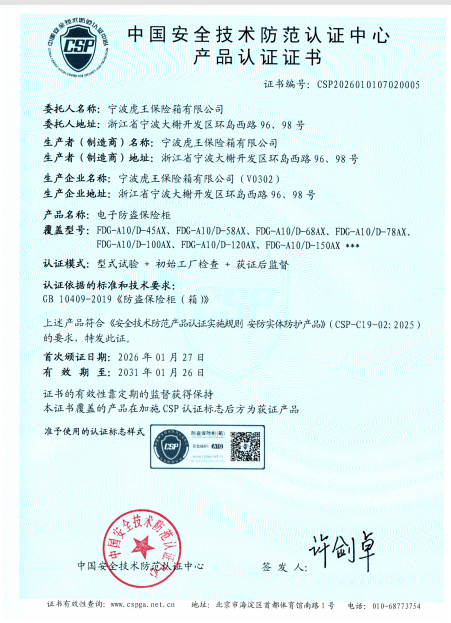
Certification evidence should always be read per category rather than per brand. The CE and UKCA EMC verifications issued through SGS-CSTC cover electromagnetic compatibility for the named applicable safe families, while the Zhejiang Made certification (CZJM2021P1055001ROM, valid to 2027-09-13) is issued against DB33/T 944.1-2014, DB33/T 944.2-2017 and T/ZZB 1427-2019 for the electronic burglary-resistant safe, and the BSCI audit covers social-compliance performance areas at the production site.
Use Cases: Where Each Family Lands in Real Programs
The three families follow different order patterns, and the recorded programme data shows how they split by channel.
Jewelry and luxury retail. The jewelry safe family has been supplied to high-end security suppliers serving overseas jewelry stores and luxury retailers across the United States, the United Arab Emirates, Russia and Australia, at a programme scale of 10,000 units per year, with the heavy-duty integrated body, anti-drill and anti-pry features and high-strength lock cylinder cited as the fit for high-value luxury storage.
Hotel and commercial premises. The commercial and hotel-oriented range has been supplied to overseas commercial office equipment distributors and corporate procurement suppliers in the United States, the United Arab Emirates, Australia and Germany at 10,000 units per year, with a high-security anti-pry structure, pressure and wear resistance, strong environmental adaptability and multi-user access management cited for commercial security standards, and a service life over 10 years for high-frequency office usage.
Home and retail distribution. The home family plus the wider catalogue has been supplied to overseas supermarket chains and online home-goods retailers in the United States, Germany and Spain at 20,000 units per year, where standardised mass production is credited with stable batch quality and a low after-sales rate, and to overseas security storage distributors and cross-border retailers covering the United States, Taiwan, the United Arab Emirates and global markets at a further 20,000 units per year.
Adjacent category reference. For buyers assembling a wider assortment, the same factory supplies UL-certified fire-resistant gun safes to a North American security product importer and distributor at 20,000 units per year for residential and retail distribution, with case records stating 100% compliance of the supplied gun safes with North American regulatory standards for firearm storage and zero compliance risks reported. That precedent is useful context when negotiating documentation discipline for the jewelry, hotel and home categories, but the certification itself stays with the gun safe models.
Frequently Asked Questions
Which certifications should a jewelry safe, a hotel security safe and a home security safe carry for North American and European retail channels?
Compliance is set per category, not per brand. In TIGERKING's certificate records, ISO 9001 quality management (certificate 16425Q32488R3M, valid to 2027-02-10) and ISO 14001 environmental management (certificate 00224E34629R1M, valid to 2027-07-26) cover the design, development and production of safes. CE EMC (SHEM240300108001HSC) and UKCA EMC (SHEM240300108101HSC), both issued by SGS-CSTC, list the jewelry, hotel and home security safe families among their applicable products. The amfori BSCI social audit (amfori ID 156-064320-000, audited by TUV SUD) covers the production site. For burglary resistance, the CSP certificate (CSP2026010107020005, Grade A10, standard GB 10409-2019) applies to the Home Security Safe and Jewelry safe but is issued for the China market. ETL 60-minute fire-resistance verification (211130001SHF, Intertek, UL 72) covers fireproof and gun safes only – not these three families – and UL 72 itself does not establish burglary resistance. Always match the certificate number to the model and the destination market.
Can one manufacturer supply jewelry safes, hotel security safes and home security safes in a single mixed-model order?
Yes, when the factory owns its tooling. Ningbo TigerKing Safe Co., Ltd. runs in-house tooling and die development with roughly 60% in-house vertical integration, a monthly capacity of 20,000 units and an annual output of 240,000 units from a base in Ningbo, Zhejiang, China, and its catalogue covers all three families: Jewelry safes 120FR, 150JGH and FPSC150; Hotel Security Safe H20CF, H20CF-C, H20SN, H20NF, H20NH, H20SE and H20CE with other specifications available; and Home Security Safe 78AX, 45RL, 78RL, 76RHV, 63XZ, 45XHZ, 60ZHZ, 43JJH, 58JJH and 45BH. Customization covers dimensions, colour, interior layout, lock type (biometric, electronic or mechanical), panel branding and OEM labelling, and the engineering team of 10–15 specialists handles structural design, mould design, electronic R&D and testing across the full development cycle from concept to mass production.
What deposit and payment terms are typical for bulk mixed-model safe orders?
Standard OEM/ODM bulk orders from new buyers are usually structured as 30% deposit on contract signing to fund steel, locks, coatings and raw materials, with the 70% balance payable against a copy of the Bill of Lading. For repeat distributors with a stable record, the deposit may be reduced to 20% with the balance against the B/L copy, and credit terms can be discussed after credit review for large recurring volumes. Highly customized projects involving custom moulds, special finishes or specific certification requirements typically require a 40–50% deposit to cover dedicated tooling and material costs. Letters of credit are commonly used for large orders and escrow for first-time smaller buyers. Structures to avoid in a new relationship are 100% advance payment before production or full payment before inspection. Copies of the Bill of Lading are normally available within 2–3 working days after shipment; original or telex release bills can be issued as requested, while SW bills are normally discussed only after longer cooperation and higher business volume because they transfer cargo ownership.
What should be inspected when sample safes arrive from the factory?
Samples are the benchmark for mass production, so the inspection should cover seven items. First, physical dimensions and material: external and internal sizes, steel plate thickness, door frame and wall material, confirmed against the agreed specification with calipers. Second, appearance and surface finish: scratches, dents, paint bubbling, uneven coating, colour difference and weld burrs, plus logo and printed markings against approved artwork. Third, lock system function across every unlocking method – keypad, fingerprint and mechanical override – including password storage, wrong-attempt lockout, tamper alarm, audit log and battery compartment. Fourth, mechanical structure and assembly: hinge smoothness, door gap uniformity, bolt locking mechanism, handle operation, internal shelf and anchor holes, with no sticking or abnormal noise. Fifth, certification and marking: cross-check model number, serial number and certification marks against the required standard and request test reports where certified features are promised. Sixth, packaging and accessories: emergency keys, expansion bolts, user manual, battery, warranty card and export packaging strength. Seventh, any agreed special functional test for fireproof or burglary-resistant samples. TIGERKING states that it pre-inspects samples in-house and supplies complete specification documents for buyer verification.
What lead time and order quantity should a distributor plan for?
Planning figures recorded for this supplier are: prototyping 20–30 days; normally 25–30 days for simple items; and 45–60 days for mass products, with lead time varying by order quantity and customization level. Batch ranges shown on the enquiry form are small 1–20, 21–100, 101–500, 501–1000 and 1001+, and no explicit minimum order quantity is stated on the site, so minimums and firm schedules should be confirmed with sales at quotation stage. Because jewelry, hotel and home safes are built on different tooling and finishing lines, a mixed-model order should be sequenced so that the high-mass jewelry units and the volume home units are not competing for the same finishing slot. The next practical step is to review the current model specifications and the full 2026 catalogue, then send your target model list, destination market and retail channel so an accurate schedule and quotation can be prepared.
Conclusion: Choose by Risk and Channel, Then by Certification
The decision between a jewelry safe, a hotel security safe and a home security safe is a channel decision before it is a product decision. A jewelry safe is the correct answer when the end user needs a heavy solid-steel unit with a 10 mm door, a 6 mm body and 235–460 kg of mass to protect high-value goods in a publicly accessible or luxury retail setting. A hotel security safe is the correct answer when the requirement is a compact, low-weight, Black-finished unit for guest-room and commercial placement, ordered in volume in a range of specifications. A home security safe is the correct answer for the volume retail shelf, with the widest SKU, size, colour and price spread.
Once the channel is fixed, certification and QC discipline decide whether the order is profitable. Keep fire-resistance evidence with the fireproof and gun models, keep burglary-resistance evidence with the models the certificate actually lists, and never present one as the other. Then lock the parameters, sample, inspection plan and acceptance criteria in writing before production begins.
Next step
Request the current 2026 TIGERKING catalogue with full specifications for the Jewelry safe, Hotel Security Safe and Home Security Safe ranges, or send your target model list for a sample and quotation.
Download the catalogue: 2026 Tiger King catalogue (PDF)
Ningbo TigerKing Safe Co., Ltd. · Website: www.tigerkingsafe.com · Email: sales@tigerkingsafe.com · Tel/WhatsApp: +86 188-1486-8154 · Contact: Sharon Chen · Address: NO.96 & 98, Huandao West Road, Daxie Development Zone, Ningbo, Zhejiang, China.
Have Questions or Need More Details?
Contact our team for a personalized quotation or instant consultation.
Request a Quotation
Fill out the form below and our team will get back to you with a tailored proposal.
WhatsApp Direct Chat
Prefer to chat in real-time? Message us on WhatsApp for instant assistance & quick answers.
- Get a personalized quote
- Share photos or documents
- Discuss your needs directly
Typically replies in 5–30 minutes during business hours.