
Security Safe Capability Audit: Equipment, QC and Delivery
A security safe supplier capability audit checks whether a supplier can prove — through production equipment, quality records and contract terms — that a container order will match the approved sample and arrive with clearable documents. It is not a price comparison and not a factory photograph. It is a sequence of evidence requests that separates three things buyers often conflate: who owns the production process, what the quality system can prove per batch, and how delivery risk is allocated when something goes wrong.
What a capability audit actually verifies
Three verification layers sit between a quotation and a purchase order.
- Production ownership. Does the supplier cut, form, weld, coat and assemble the safe, or resell finished goods from other workshops? Ownership decides whether a specification change is even possible, and who is accountable when it is not delivered.
- Batch evidence. Can the supplier produce inspection records, test reports and certificates covering the exact model being ordered — not a similar model, and not a component-level approval?
- Delivery control. Are packaging, order-change consequences, claim deadlines and shipping documents defined before loading, or settled after the vessel has sailed?
A finished audit leaves the buyer with a document set: an equipment list with counts, a certificate pack with numbers and validity dates, a QC process map with inspection points, an inspection plan tied to the purchase order, a claims clause and a document handover schedule. Anything a supplier describes but cannot produce as a document remains a claim rather than evidence.
Factory or trading company: read it from production evidence
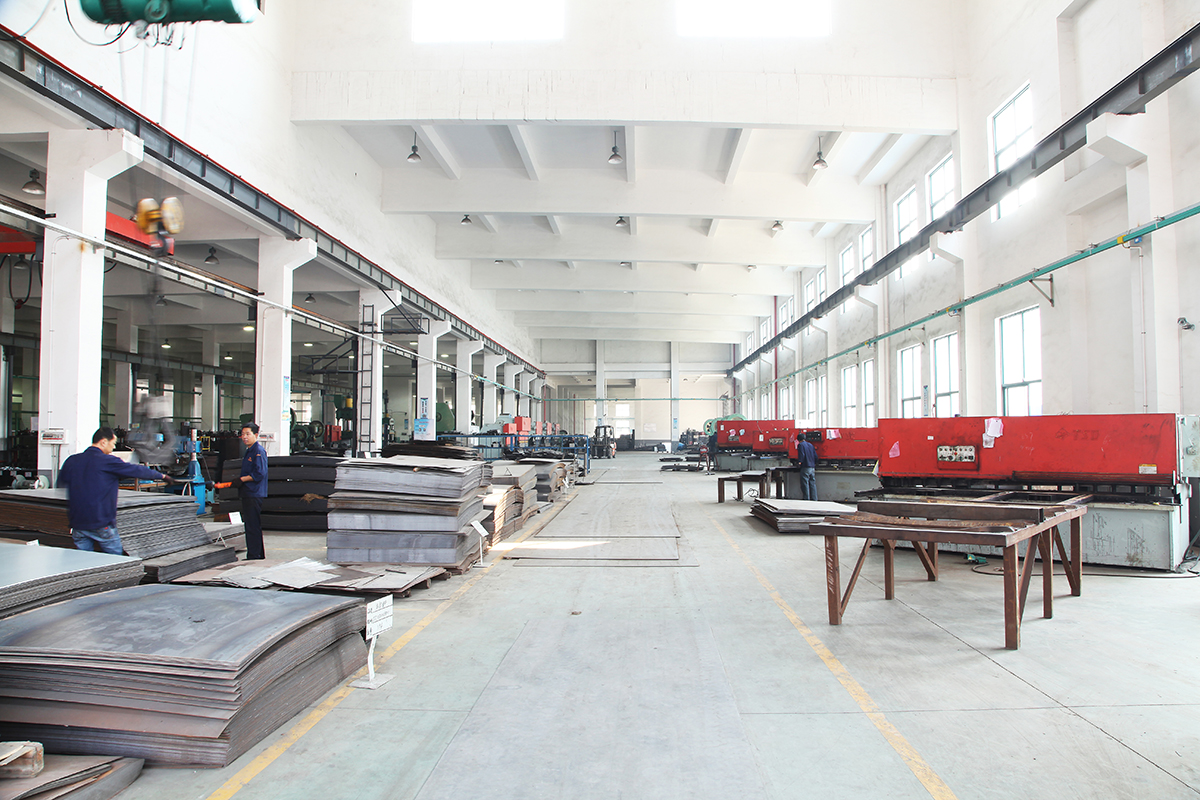
A genuine manufacturer owns production lines, a metal workshop, welding, painting and assembly facilities, plus in-house mould-making capability. That combination is what allows steel thickness, internal layout, lock configuration and design to be adjusted for OEM or ODM orders. A trading company sources finished goods from third-party factories and cannot freely modify product structure or tooling.
Four consequences follow from that single structural difference. On certification, manufacturers hold original test reports and certificates in their own company name and can support product inspection, while traders typically hold copies obtained from a supplier and cannot apply for new certification on a custom design. On confidentiality, a factory can sign NNN agreements and control access to client drawings and dedicated tooling, while a trader must pass designs to a third party. On schedule control, manufacturers control the full production schedule and inspect on site at each stage, while traders depend on external factory timelines. On MOQ, manufacturers negotiate against available tooling and production slots, while traders follow upstream factory rules.
These claims are testable. Ask for a live video call during production hours, a timestamped walk-through of the assembly area, and an equipment list with unit counts. A working factory has welding, coating and assembly stations to show; a trading office does not.
| Audit dimension | Trading-company pattern | Manufacturer evidence to request |
|---|---|---|
| Production and tooling | Finished goods sourced from third-party factories; structure and tooling cannot be modified freely | In-house metal workshop, welding, painting and assembly lines; mould workshop; ability to change steel thickness, layout and lock configuration |
| Certification | Certificate copies obtained from a supplier; new certification not possible for custom designs | Original reports and certificates in the manufacturer's own name; support for product inspection |
| Confidentiality | Designs passed to third-party factories; dedicated tooling not controlled | NNN agreement; restricted access to drawings; buyer-owned tooling clause |
| Schedule and quality control | Limited control over production timelines and batch consistency | Full schedule control; on-site inspection at each production stage |
| MOQ | Upstream factory MOQ rules apply | MOQ negotiated against available tooling and production slots |
Equipment: which machines change the risk profile
An equipment list is only useful when each item is tied to a defect it prevents. Laser cutting and CNC shearing set blank accuracy, which carries through to door fit, door-gap uniformity and how well the fire seal closes. CNC bending and robotic MIG welding set body and door rigidity — the practical difference between a cabinet that resists prying and one that flexes at the seam. Automatic electrostatic powder coating governs corrosion resistance and finish consistency between the sample and the fifth container. Assembly lines determine whether throughput promises are physically achievable.
For reference, Ningbo Tigerking Safe Co., Ltd., the manufacturer behind the TIGERKING SECURITY SAFE brand, is a safe manufacturer founded in 2000 in the Daxie Development Zone, Ningbo, Zhejiang, China, producing fire-resistant, burglary-resistant, gun, commercial and jewelry safes. It operates a manufacturing base of over 38,000 m², including a 38,000 m² in-house sheet metal workshop with five welding lines, three spraying lines and three assembly lines. Core sheet-metal processes are completed in-house with 60% vertical integration overall, and tooling and dies are developed internally by an engineering team of 10–15 people covering structural design, mould design, electronic R&D and testing. Stated capacity is 20,000 units per month, or 240,000 units per year, with roughly 70% of output exported to North America, Europe, Southeast Asia, the Middle East and South America.

Two questions expose most equipment gaps. Which of these processes are outsourced, and to whom? And what happens to the tooling if the relationship ends? An in-house mould workshop plus a written tooling-ownership clause answers the second; a production flow chart and an on-site walk-through answer the first.
QC evidence: what a batch should be able to prove
A quality system is auditable only if it generates records at defined points. Tigerking's system runs in three stages. Incoming inspection covers steel, fire-resistant materials and locks, by batch sampling or full inspection. In-line IPQC patrols run at each process — welding, spraying and assembly — with non-conforming units isolated at the point of detection. Final inspection covers appearance, dimensions, fire and burglary resistance, lock function and sealing, and goods ship only with a qualification certificate. The framework is ISO 9001, supported by 6S and lean production management.
Certificates should be checked as documents, not logos. The relevant file for a security safe supplier typically includes:
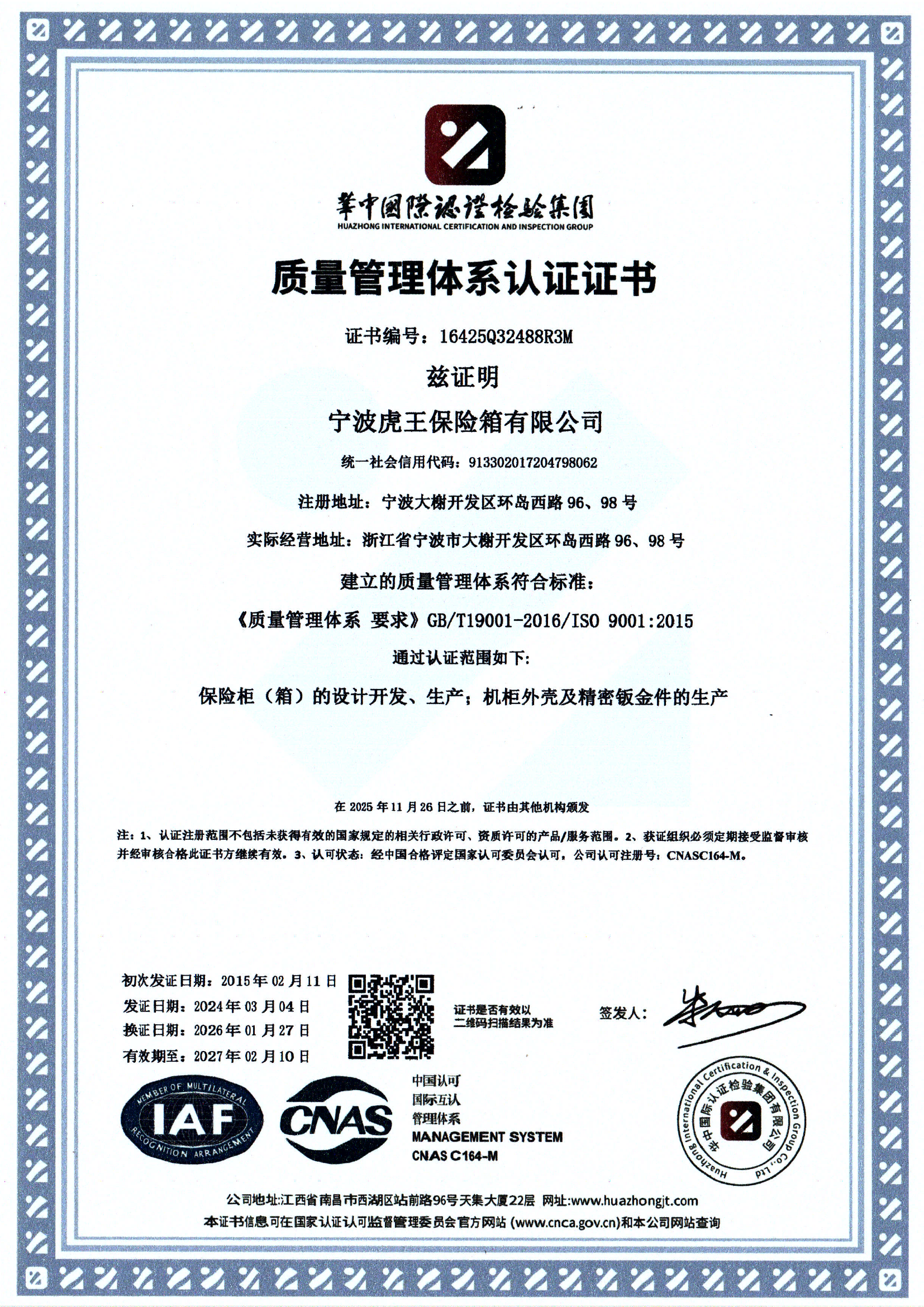
- ISO 9001 — certificate 16425Q32488R3M, issued by Huazhong International Certification & Inspection Group, valid to 10 February 2027, covering design, development and production of safes.
- ISO 14001 — certificate 00224E34629R1M, issued by CQM, valid to 26 July 2027.
- ETL fire resistance — certificate 211130001SHF from Intertek Testing Services NA against UL 72 (2015)(R2020), covering a 60-minute fire-resistant electronic safe.
- CE EMC — SHEM240300108001HSC, and UKCA EMC — SHEM240300108101HSC, both issued by SGS-CSTC on 5 March 2024.
- CSP burglary resistance — CSP2026010107020005, Grade A10, tested to GB 10409-2019 and valid to 26 January 2031.
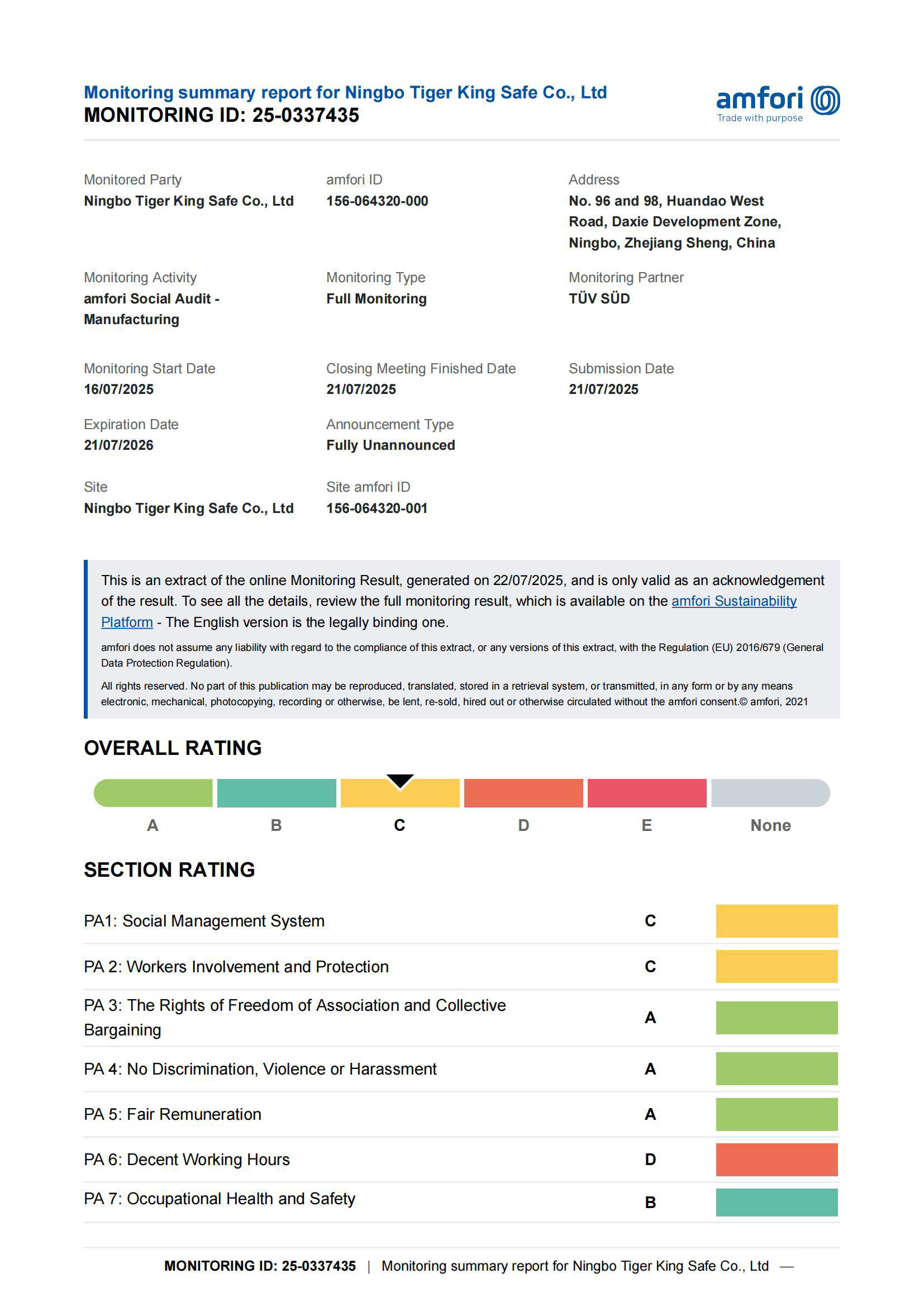
- BSCI social audit — amfori ID 156-064320-000, monitoring ID 25-0337435, audited by TUV SUD against performance areas PA8–PA13.
Two habits prevent most certificate problems. First, confirm the certificate is issued in the manufacturer's own name and covers the exact model and function being ordered; customs authorities and market regulators recognise full-unit certifications, not component approvals. Second, match the claimed parameters against the test report. Steel plate thickness and fire-resistance grades are the two figures most frequently overstated in supplier literature, and a caliper check on the sample settles the first one quickly.
Third-party involvement can be written into the order rather than assumed. Tigerking works with SGS and Intertek on certification testing and pre-shipment inspection, and states that it welcomes on-site factory audits and pre-shipment inspections, with certification documents and production records available for review.
Running the audit: from document review to pre-shipment inspection
The sequence matters as much as the checklist, because each stage filters a different failure.
- Pre-audit document review. Request the business licence, product certifications, test reports, quality control manual and production flow chart before any site visit. Confirm certificates are in the manufacturer's own name and still valid.
- On-site factory audit. Review production lines, workshop layout, raw material storage and the welding, painting and assembly stations. Check in-house laboratory equipment, the mould workshop, worker training records and order traceability. The objective is to confirm independent production capability rather than full outsourcing.
- Sample approval with a sealed reference. Measure external and internal dimensions and steel thickness with calipers, inspect paint finish and weld seams, test every unlocking method, and check hinges, door gap, locking bolts, shelves and anchor holes. Cross-check model and serial numbers and certification marks against the claimed standard, and verify the accessory set and packaging. Seal the approved pre-production sample and attach it to the contract.
- Stage-wise inspection. Pre-production inspection checks steel, locks and paint before the run starts. In-line inspection samples dimensions, weld quality and lock function during production. Pre-shipment inspection randomly samples finished safes for appearance, size, lock operation, marking and packaging.
- Independent verification. On large container orders, a third-party inspection report gives both sides objective evidence that survives a dispute.
Two sample-stage failures are common enough to plan for. The first is a sample built with premium steel and locks that is downgraded in mass production. The second is a sample approved on appearance alone, with no functional test and no signed reference unit. A written consistency clause — mass-production materials, steel plates, locks and surface finishes must match the approved sample, with advance written notice and re-testing before any structural or component change — closes both gaps.
| Stage | Evidence to obtain | Failure it filters out |
|---|---|---|
| Pre-audit file review | Business licence, certificates in the manufacturer's name, test reports, QC manual, production flow chart | Borrowed certificates, fully outsourced production |
| On-site walk-through | Line layout, welding, painting and assembly stations, in-house lab and mould workshop, training and traceability records | Trader presenting as a factory |
| Sample approval | Sealed sample, caliper measurements, lock function results, marking check | Sample-to-mass downgrade |
| Pre-production inspection | Incoming check on steel, locks and paint | Substandard material entering the run |
| In-line inspection | IPQC patrol records at welding, spraying and assembly | Process drift during the batch |
| Pre-shipment inspection | Final inspection record plus random sample of appearance, dimensions, lock function, marking and packaging | Defective units reaching the container |
| Document handover | B/L copy within 2–3 working days, commercial invoice, packing list, inspection report | Cargo arriving without clearable documents |
Repair, replacement and claim terms: put the clock in the contract
Claim terms reveal a supplier's real service model. The mechanism Tigerking applies to mass-production orders runs on evidence first: if a manufacturing-related defect is confirmed after arrival, the buyer supplies photographs, videos and batch information, and the factory offers one of three remedies — free spare-part dispatch, complimentary replacement of part of the consignment, or a negotiated proportional deduction against order value.
Two boundaries sit alongside those remedies and should be read before signing. Damage incurred in transit is not a manufacturing liability; it is claimed from the freight forwarder or the insurer. Quality complaints must be submitted in writing within 30 days after the goods arrive at the destination port. Neither boundary is unusual, but both change how receiving inspection should be organised: photograph container and pallet condition on arrival, open and inspect a sample of units inside the window, and log batch numbers from the shipping marks.
Warranty scope follows the same logic. Coverage applies to manufacturing defects in locks, welding and the cabinet body; exclusions cover forced damage, incorrect installation, external impact, unauthorised disassembly and transit damage. Support is spare-part based, without on-site overseas repair, which is why the contract should specify the spare-parts list, the shipping terms for replacement parts and the response time expected for a technical query. Standard warranty coverage for manufacturing defects is typically one to two years, and Tigerking's published position is that warranty periods and service terms are confirmed in the contract and quotation rather than stated as a fixed figure on the website. Confirm the number in writing, and confirm whether spare parts are stocked for the models ordered.
Packaging and loading: where most transit claims begin
Handling damage has identifiable causes: dents and paint chipping from impact during loading and unloading, displaced components inside the cabinet, and insufficient packaging protection over a long ocean leg. None of these is a manufacturing defect, so none is covered by the factory warranty — which makes packaging specification a buyer-side risk control rather than a supplier courtesy.
Three specifications reduce it. Packaging should be designed around standard pallet and container dimensions so unit count per container is predictable and stacking is stable. For heavy safes, full container load is generally more cost-effective than less-than-container load, because consolidation adds a second handling cycle to dense cargo. And container weight needs checking against road limits at destination, since safes are dense and volume is rarely the binding constraint.
Pre-shipment inspection should therefore cover the packaging itself: carton strength, internal blocking, accessory placement and labelling. Where an order mixes several models in one container, confirm the minimum quantity per model in advance, because mixed loading is normally accepted only with per-item minimums.
Order changes after confirmation: a dated cost, not an opinion
Once a purchase order is confirmed and material procurement or production has started, changing the model, configuration or quantity produces material loss, extra cost and a lead-time delay. The mitigation is procedural: finalise requirements before the order is issued, and if a change is genuinely necessary, agree the new cost and lead time in writing with both parties' signatures.
Custom projects carry the same logic one layer earlier. Sampling lead time, tooling cost, MOQ and modification restrictions should be confirmed before design work starts, and every custom requirement — logo, nameplate, interior layout, lock type, colour, packaging and manual language — belongs in a written technical agreement. The mass-production order should follow sample confirmation, not precede it. For reference, Tigerking's prototyping lead time is 20–30 days, and production lead time is normally 25–30 days for simple items and 45–60 days for mass production, depending on quantity and customisation.
Documents and payment: the delivery assurance after loading
Delivery assurance does not end when the container is sealed. It ends when the buyer can clear customs and take ownership. Three document questions belong at contract stage.
- Bill of lading type. Original and telex release bills of lading can be issued to the buyer's instruction. A sea waybill carries different risk because it results in loss of cargo ownership, so Tigerking's position is that it is discussed only after long-term cooperation and higher business volume. A B/L copy is normally available within 2–3 working days after shipment.
- Document consistency. The China export declaration and the commercial invoice used at destination should carry consistent amounts and unit prices. Deliberate over- or under-declaration is not advised, and special circumstances need assessment before shipment rather than at the port.
- Authentication. Where the destination authority requires legalised paperwork, commercial invoices, packing lists and customs declarations can be authenticated through CCPIT, typically in about one week, with an expedited option of roughly two working days.
Payment structure should mirror those milestones. For standard OEM and ODM bulk orders from new buyers, the common structure is a 30% deposit on contract signing — used to purchase steel plate, locks, coatings and raw materials — with the 70% balance payable against a copy of the bill of lading. Repeat distributors with a stable record may be offered a 20% deposit, and highly customised or specially certified projects typically require 40%–50% because of dedicated tooling and material costs. Letters of credit suit large orders where document control matters more than bank charges; escrow suits first orders with limited trading history. Terms that concentrate risk on the buyer — 100% advance payment, or full payment before inspection — are the ones to avoid.
Where the audit pays back
Audit effort should scale with order structure. A distributor running a 20,000-unit-per-year programme across home and commercial safes needs the full file — equipment evidence, sealed sample, stage inspections and a claims clause — because a defect trend compounds across containers. A retail chain buying mixed SKUs needs packaging and labelling checks in the pre-shipment plan as much as product tests. An office or hotel project buyer needs the certificate pack to match the specification exactly, since a substituted model can fail handover. Jewelry and high-value retail buyers need burglary-grade evidence, such as CSP Grade A10, attached to the exact model. An OEM buyer private-labelling the product needs the change-control clause most of all, because the brand on the door belongs to the buyer, not the factory.
Frequently asked questions
Which certificates should a security safe supplier hold, and how do I verify them?
Match the certificate to the destination market and to the exact model. For North America, ETL or UL 72 fire ratings and UL 687 burglary ratings are the usual references; for the EU, CE EMC plus EN 1143 and EN 1047 where burglary or fire grades are claimed; for the UK, UKCA EMC; for domestic China sale, CSP certification to GB 10409-2019. Then verify four data points on each document: certificate number, issuing body, standard version, and the model and function covered. Tigerking's current file includes ISO 9001 certificate 16425Q32488R3M valid to 10 February 2027, ETL certificate 211130001SHF from Intertek against UL 72 (2015)(R2020), CE EMC SHEM240300108001HSC and UKCA EMC SHEM240300108101HSC issued by SGS-CSTC on 5 March 2024, and CSP certificate CSP2026010107020005 (Grade A10) valid to 26 January 2031. Regulators recognise full-unit certification, not component approvals.
What production equipment must a genuine security safe factory own?
At minimum, a factory should operate laser cutting, CNC shearing, CNC bending, robotic MIG welding, an automatic electrostatic powder coating line and assembly lines, supported by in-house mould and die development. Tigerking runs five welding lines, three spraying lines and three assembly lines inside a 38,000 m² sheet metal workshop, completes core sheet-metal processes in-house with 60% vertical integration, and states monthly capacity of 20,000 units. Equipment counts are only meaningful when tied to a defect they prevent: cutting accuracy governs door fit and seal closure, welding governs structural rigidity, coating governs corrosion resistance. Ask which processes are outsourced and request a production flow chart matching the equipment you are shown.
What deposit and payment terms are standard for bulk security safe orders?
For standard OEM and ODM bulk orders from new buyers, 30% on contract signing and 70% against a copy of the bill of lading is the most common structure; the deposit covers steel plate, locks, coatings and raw material procurement. Repeat distributors with a stable record may be offered 20%, while highly customised or specially certified projects typically require 40%–50% because of dedicated tooling and material costs. Letters of credit are used for large orders where document control outweighs bank fees, and escrow suits first orders with limited trading history. Terms to avoid in new cooperation are 100% advance payment and full payment before inspection, because both remove the buyer's remaining leverage before shipment is verified.
What must I check on a security safe sample before approving mass production?
Check external and internal dimensions and steel thickness with calipers, then appearance and surface finish, including scratches, dents, coating evenness, colour difference and weld burrs. Test every unlocking method — keypad, fingerprint and mechanical override — along with wrong-attempt lockout, tamper alarm, audit log and battery compartment. Verify hinge smoothness, door-gap uniformity, locking bolts, handle operation, shelves and anchor holes. Cross-check model and serial numbers and certification marks against the standard being claimed, confirm the accessory set, and review packaging strength for export shipping. Seal the approved pre-production sample and add a written clause requiring mass-production materials, locks and finishes to match it.
How long does production take, and when are shipping documents released?
Production lead time for security safes is normally 25–30 days for simple items and 45–60 days for mass production, depending on quantity and customisation; prototyping takes about 20–30 days. On the document side, a bill of lading copy is normally available within 2–3 working days after shipment, and original or telex release bills of lading can be issued to instruction, while a sea waybill is discussed only after long-term cooperation and higher volume. Buyers who want to run this audit against a live order can review the catalogue linked below, or request a factory audit, sample review and certificate pack directly from the Tigerking sales team at sales@tigerkingsafe.com.
Conclusion
A capability audit is a document exercise with a factory visit attached. The equipment list proves who makes the product. The certificate pack and inspection records prove what the batch can demonstrate. The claims clause, packaging specification, change-control clause and document schedule prove how risk is shared once goods leave the loading dock. Buyers who collect all four before issuing a purchase order negotiate from verified facts rather than catalogue claims, and they enter the first container with a defined process for the second.
Next step: the 2026 Tiger King product catalogue lists the current security safe range, and the factory welcomes on-site audits and pre-shipment inspections against confirmed orders.
Have Questions or Need More Details?
Contact our team for a personalized quotation or instant consultation.
Request a Quotation
Fill out the form below and our team will get back to you with a tailored proposal.
WhatsApp Direct Chat
Prefer to chat in real-time? Message us on WhatsApp for instant assistance & quick answers.
- Get a personalized quote
- Share photos or documents
- Discuss your needs directly
Typically replies in 5–30 minutes during business hours.