Security Safe Guide: Types, Certifications, and How to Choose
A security safe is a locked, reinforced steel container built to protect cash, documents, jewelry, watches, firearms and digital media against theft, fire and unauthorized access. The category is far wider than most buyers expect. It runs from a 3.5 kg economy safe that disappears into a wardrobe to a 460 kg jewelry safe installed in a private residence, and each type is engineered against a different risk.
This guide separates the main security safe categories, explains what construction and certification labels actually mean, and sets out how to verify a manufacturer - including Chinese security safe manufacturers - before a bulk order is placed. It draws on published standards (UL 72 and EN 1143-1), reported market data for 2025-2030, and first-party manufacturing and product information from Ningbo Tigerking Safe Co., Ltd., a safe manufacturer established in 2000 in Ningbo, Zhejiang, China.
Key Takeaways
- A security safe is defined by what it resists. Fire resistance, burglary resistance and lock performance are separate claims and are tested against separate standards.
- UL 72 covers the fire-resistance classification of record protection equipment and states explicitly that burglary resistance of locking mechanisms is outside its scope.
- The global security safes market was reported at USD 3.57 billion in 2025 and is forecast to reach USD 5.15 billion by 2030, a 7.5% CAGR across 2026-2030 (The Business Research Company, reported via OpenPr, October 2026).
- Fire-resistant models sit at the center of residential demand: reported at 63.7% of the US home safe category, with 61% of home safe consumers preferring a safe able to withstand above 927 degrees C for 60 minutes.
- Parameters and certificates should be verified at model level, against test reports, before a purchase order is signed.
Why Security Safe Selection Goes Wrong
Most security safe purchases fail for reasons that have nothing to do with budget. Four problems repeat across residential buyers, retailers and importers:
- Label confusion. Fireproof, burglary-resistant, all-steel, heavy-duty and anti-drill are marketing words, not specifications. A safe with a fire rating is not automatically a burglary-resistant safe, and the reverse is also true.
- Parameters that cannot be traced. Steel plate thickness, door thickness and fire endurance grades are frequently advertised without a matching test report. Buyers need assurance that the claimed thickness and fire grade belong to the exact model being quoted.
- Single-function products sold as dual-function. Document protection and firearm storage have different requirements. Buyers who need both burglary and fire protection should select a combined model rather than assume any thick steel box will resist fire.
- Supplier-side risk. Not every company selling safes manufactures them. Trading intermediaries, borrowed certificates and unclear responsibility for defects all raise the real cost of a bulk order.
The practical fix is a sequence: define the asset, define the hazard, match the model to both, then verify construction and certification at model level.
Industry Background: Where Security Safe Demand Comes From
Reported market data puts the global security safe market at USD 3.57 billion in 2025, forecast to reach USD 5.15 billion by 2030 at a 7.5% compound annual growth rate across 2026-2030 (The Business Research Company, reported via OpenPr, October 2026). A separate research scope that includes heavy vaults reported Asia Pacific at 36.4% of the safes and vaults market in 2025 (Straits Research).
Behind those figures, demand is being pulled by a small number of practical forces:
- Firearm storage rules. Stricter safe-storage requirements in several US states continue to make compliant gun safes a high-growth segment, with fingerprint access increasingly chosen over basic mechanical locks.
- Fire and wildfire risk. Fire concerns in western North America keep pushing homeowners toward fire-rated storage for deeds, contracts, jewelry and digital media. Fire-resistant safes are reported as the leading US home safe segment at 63.7%, and 61% of home safe consumers say they prefer a model able to withstand above 927 degrees C for 60 minutes.
- Insurance and documentation. Replaceable property is insured; property deeds, certificates and unbacked digital media are not. That asymmetry drives document-storage purchases.
- Smart and connected features. Tamper alerts, mobile app notifications and access audit records are moving into both residential fire safes and gun safes.
- Certification as a retail gatekeeper. Mainstream retail channels and marketplaces increasingly require verifiable third-party listings, and distributors prefer products that arrive with complete test reports.
Security Safe Types: What Each Category Protects
Security safes are normally classified by the risk they are built against and the assets they hold. The categories below reflect the product families manufactured and exported by Ningbo Tigerking Safe Co., Ltd., whose main products are fire-resistant safes, burglary safes, gun safes, commercial safes and jewelry safes.
1. Home security safe (anti-burglary)
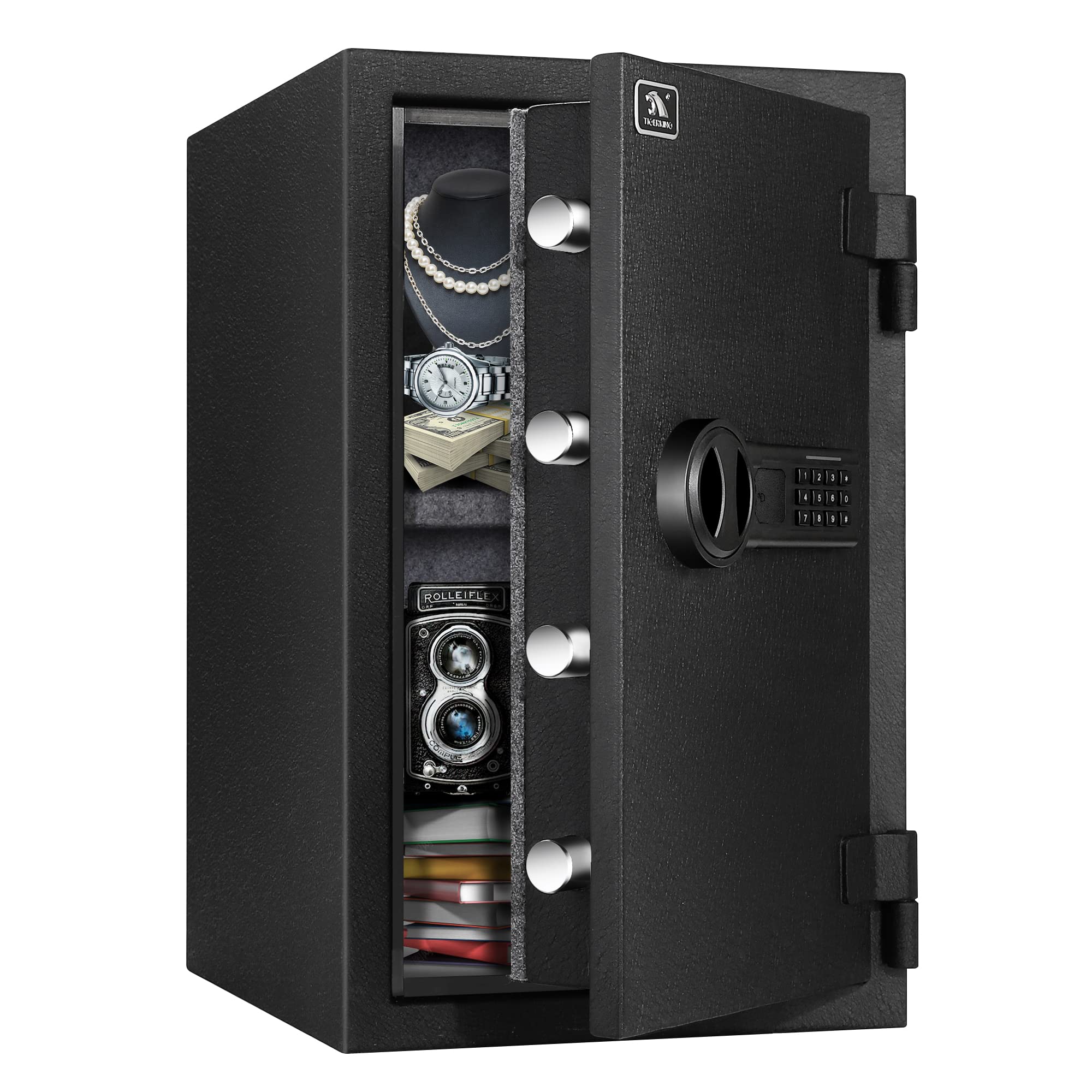
A home security safe is an all-steel cabinet for household and small-scale commercial valuable-item storage: cash, jewelry, passports, documents and small collectibles. Model designations across the series include 78AX, 45RL, 78RL, 76RHV, 63XZ, 45XHZ, 60ZHZ, 43JJH, 58JJH and 45BH. Construction varies by model: the 45RL uses a 9.5 mm door and 3.5 mm body with a net weight of 39 kg, while the 76RHV reaches 128 kg. Selected models carry CSP burglary-resistance certification (Class A10, A15 and A30). Most cabinets include pre-drilled fixing holes so they can be anchored to a wall or floor, which reduces the risk of the entire unit being carried away.
2. Fireproof security safe
A fireproof security safe is built for documents and media rather than cash. Model designations include FPSD66, FPS60DF, FPSA60, FPSB60 and FPSE60SP. The cabinet uses dedicated fire insulation materials and a sealed heat-isolation structure, so internal temperature rises slowly under high heat, which reduces carbonization of paper and thermal damage to disks and chips. The FPSD series provides up to 45-60 minutes of fire protection and holds Intertek fire test certification. Across the range, fire ratings are available from 20 minutes up to 2 hours and beyond.
3. Burglary-resistant safe and gun security safe
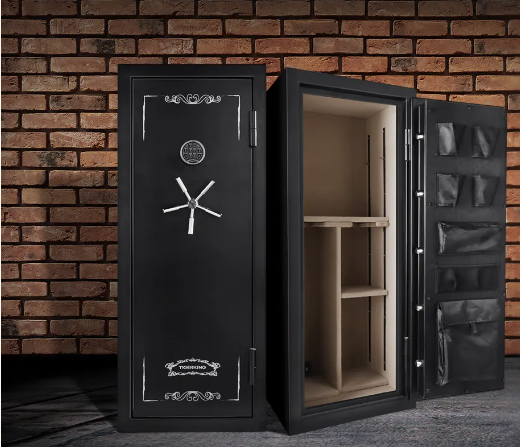
Burglary-resistant products defend against forced entry - prying, drilling and cutting - and are specified by steel thickness, bolt work and net weight rather than by fire grade. The gun safe series (model designations G1300K3, G1300K5, G1450K3, G1450K5, PB20, PB4-F, GFP5924, GFP5928, GFP5930 and GFP7240) combines firearms storage with fire protection. The GFP5924 measures H1500 x W610 x D508 mm, weighs 190 kg, uses 2.5 mm door and body steel, and includes four shelves, a gun rack and a gun bag. The GFP5928 and GFP5930 are wider variants at 215 kg and 280 kg.
4. Commercial and depository security safe
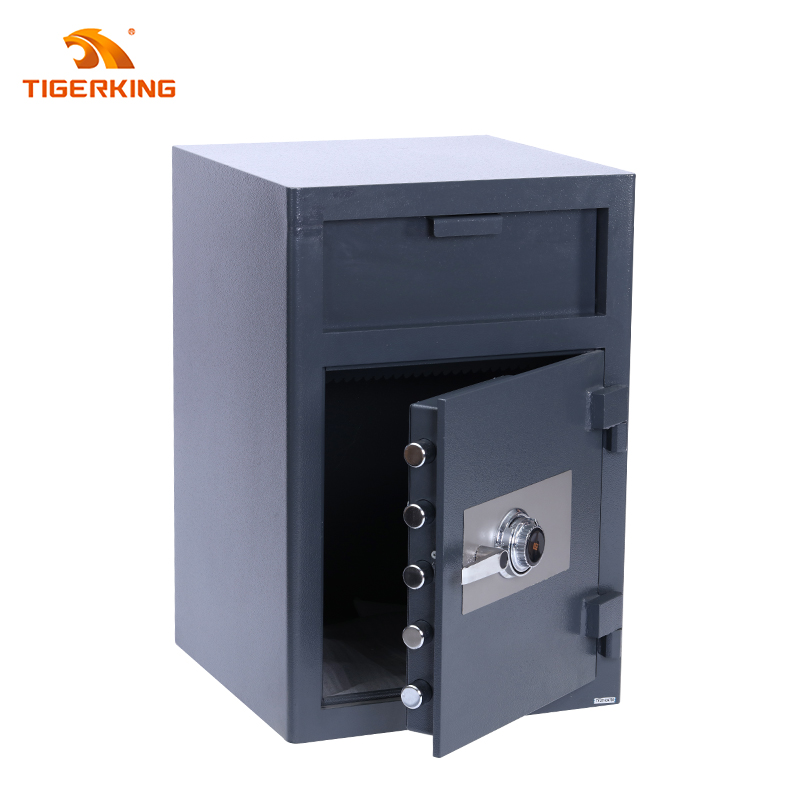
A commercial security safe, also called a depository safe, is designed for cash handling in shops and small businesses; convenience stores, restaurants and beauty salons are typical users. Model designations include DP450-LE, DF2014-MA, DF3020-MA, DF3020-DKA, DF4020-DDA, DF4020-MMA, DR2014-DA and DR2014-MA. These units share a 6 mm door and 3 mm body construction with an anti-fishing baffle over the deposit slot, so cash can be dropped in one direction but cannot be hooked back out. Net weights scale with size: 19 kg for the DP450 (H450 x W350 x D300 mm), 30 kg for the DF2014, 62 kg for the DF3020 and 96 kg for the DF4020 (H1016 x W508 x D508 mm). The DF3020-MA uses a mechanical combination lock plus two emergency keys, so it still opens during a power failure.
5. Jewelry security safe
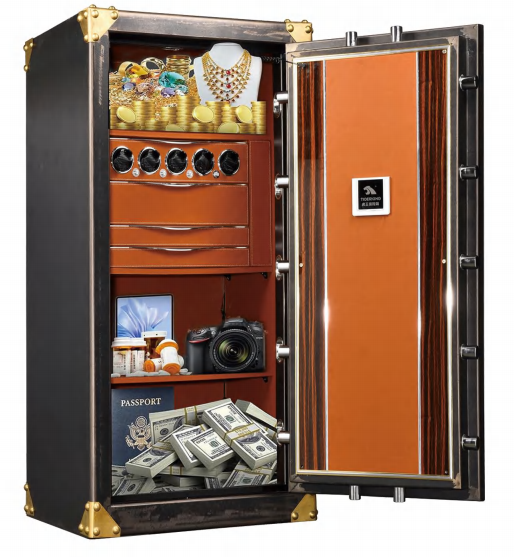
A high-end jewelry safe is sized and weighted for concentrated value. Model 120FR measures H1200 x W630 x D520 mm and weighs 235 kg with a 10 mm door and 6 mm body; the 150JGH measures H1500 x W660 x D560 mm and weighs 390 kg; the FPSC150 measures H1500 x W800 x D700 mm, weighs 460 kg and includes two shelves. All three are made of solid steel and are designed for high-end villas and private residences, where they secure gold bullion, fine jewelry, luxury watches and precious collectibles.
6. Hotel security safe
A hotel safe is a compact in-room unit for guest valuables. The H20 series measures H200 x W430 x D380 mm and weighs 14 kg with no shelf; the H30 series measures H305 x W406 x D335 mm and weighs 16 kg with one shelf; the H50 series measures H560 x W370 x D445 mm and weighs 28 kg with one shelf. Door thickness is 5 mm and body thickness 2 mm across the series, with digital password or fingerprint unlocking and pre-drilled fixing points. Models include H20CF, H20CF-C, H20SN, H20NF, H20NH, H20SE and H20CE, and other specifications are available.
7. Office and key security safe
An office security safe in this category is a key storage cabinet for centralized key management, designed for recessed wall mounting so most of the cabinet sits inside the wall. Model designations are KS48, KEY27 and LSDW-25MD. The KS48 and KEY27 use a 4 mm door and 1.5 mm body; the LSDW-25MD uses a 6 mm door and 2 mm body. The control method is an electronic password lock with configurable management permissions, and the interior provides 27 to 133 dedicated key hooks, each with a separate position so keys can be registered, searched and inventoried under designated personnel control. Property management companies, hotels, real estate agencies, engineering firms and corporate administration departments are the typical users.
8. Biometric and multi-functional security safe
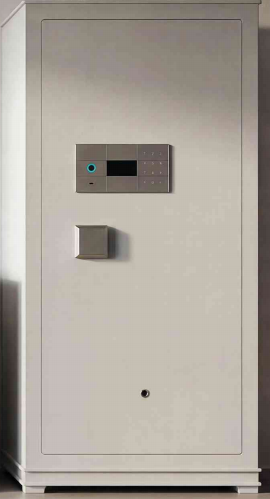
Biometric safes replace the keypad with fingerprint access. The bedside series (46CTG, 55CTG and 58CTG) is built in white solid steel at three heights - H460 x W430 x D380 mm, H550 x W430 x D380 mm and H580 x W420 x D380 mm - weighing 38 kg, 52.5 kg and 45 kg respectively. The smart I-JS and smart I-GS multi-functional safes measure H300 x W380 x D380 mm and weigh 17.5 kg; the cabinet uses integral steel stamping forming with a solid latch structure that resists accidental opening, and the smart panel supports fingerprint plus password dual verification.
9. Economy security safe
An economy safe is the entry point for household anti-theft storage in rental housing and small family homes. The series comprises five models - E17DK, E20DA, E25LK, E30LA and E45LE - covering external heights from 170 mm to 450 mm, all in solid steel. The E25LK measures H250 x W350 x D250 mm, weighs 8.5 kg and provides one shelf.
Materials, Construction and Certification: What the Labels Do and Do Not Mean
Three specifications decide how a security safe performs in practice: steel thickness, door and bolt construction, and anchoring.
Steel thickness. Door panel and cabinet body thickness vary by model and are the first numbers to verify. General industry guidance is that 14-gauge steel is common in basic home safes, while high-security or commercial applications look for 10-gauge or 7-gauge equivalents. Thickness alone does not define security, however: door construction, locking bolts and re-locking devices matter as much as the plate.
Door, hinge and bolt construction. Integrated bending produces tight seams that increase prying difficulty. Concealed internal hinges leave no external leverage point for prying or sawing, and reinforced hinge designs are intended to resist loosening or sagging after repeated opening cycles.
Anchoring. Pre-drilled fixing holes and expansion anchor bolts are what stop a safe from being removed as a complete unit. For high-security projects, floor or wall mounting is not optional.
Certification is where the most expensive misunderstandings happen, because different standards answer different questions.
| Standard or mark | What it covers | What it does not cover |
|---|---|---|
| UL 72 | Fire-resistance test procedures for record protection equipment, including fire endurance and, where applicable, fire-and-impact testing. In the United States, Class 350 degrees F devices are intended to protect paper records, while Class 150 degrees F devices are intended to protect paper and non-paper records such as EDP media. | The burglary resistance of locking mechanisms, which UL 72 states is outside the scope of its requirements. |
| EN 1143-1 | European burglary-resistance grading, with grades defined from 0 to XII. | Fire protection performance. |
| ETL fire-resistance certification | The fire-resistance listing held by Tigerking products for the North American market. | Burglary resistance. |
| UL lock certification | Lock performance certification held for Tigerking products. | Fire endurance of the cabinet. |
| CSP burglary-resistance certification | Burglary resistance for certified models: Tigerking holds CPS-class certification for Class A10, A15 and A30. | Fire protection. |
| ISO 9001 / ISO 14001 | Quality management and environmental management system certification held by the manufacturer. | Individual product fire or burglary performance. |
Sources: UL 72 scope and classification descriptions (UL Standards and Engagement); EN 1143-1 grading (VDMA technical reference); company certification information from Ningbo Tigerking Safe Co., Ltd.
For buyers, the practical rule is simple: a product should not be marketed as burglary-resistant solely because it references a fire standard. Ask for the certificate that matches the claim, issued under the manufacturer's own name, with the model number listed on it. Tigerking products carry ETL fire-resistance certification and UL lock certification, and the company holds ISO 9001 and ISO 14001 certification and works with third-party inspection institutions such as SGS and Intertek for certification testing and pre-shipment inspection.
Step-by-Step: How to Choose a Security Safe and Verify the Manufacturer
- Define the asset and the hazard. Cash, documents, jewelry, firearms and hard drives fail differently under fire and under theft. Write down what must survive what, and for how long.
- Match the protection class to the contents. Paper records call for a Class 350 degrees F style fire rating; paper plus electronic media call for a Class 150 degrees F class or equivalent; firearms call for a gun safe that complies with local storage rules, with an optional fire rating; daily retail cash calls for a depository safe with a one-way deposit slot.
- Verify the physical specification. Confirm external and internal dimensions, door and body steel thickness, bolt work, hinge design, door gap uniformity, net weight and anchor hole positions. Thickness claims should be measurable with calipers on a physical sample.
- Verify certification at model level. Certificates should be issued under the manufacturer's own name, remain valid, and list the model being ordered. Borrowed or transferable certificates are a red flag.
- Verify manufacturing depth. A genuine safe factory owns sheet-metal production rather than assembling bought-in cabinets. Core equipment includes laser cutting machines, CNC shearing and bending machines, robotic MIG welding and automatic electrostatic powder coating lines. Ningbo Tigerking Safe Co., Ltd. operates a facility of 60,000 square metres with 5 welding lines, 3 spraying lines and 3 assembly lines, 60% in-house vertical integration and fully in-house tooling and die development.
- Inspect the sample against sealed references. Retain a sealed pre-production sample, then check mass production against it - materials, steel plates, locks and surface finish.
- Close the commercial loop. Confirm deposit and balance terms, sample and production lead time, spare-part supply, warranty terms and document handover in the contract rather than in correspondence.
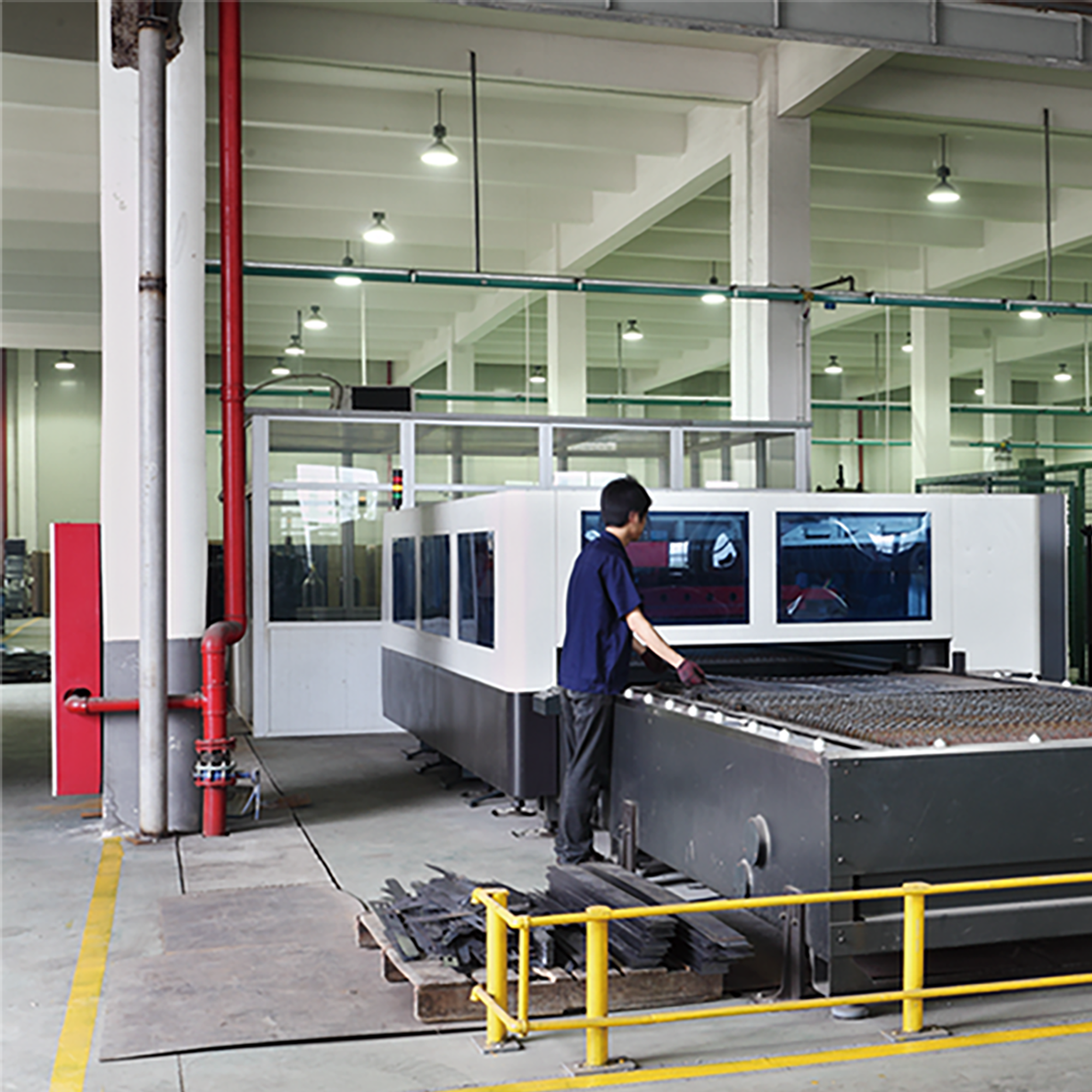
A structured factory audit follows the same logic: document review before the visit (business licences, product certifications, test reports, QC manuals and production flow charts), then an on-site review of production lines, raw-material storage, welding, painting and assembly stations, followed by stage-wise inspection - pre-production raw material checks, in-line sampling and pre-shipment inspection before loading. Tigerking's quality control system covers incoming, in-line and final inspection, including a lock function test for every safe before shipment and a third-party factory inspection before loading.
Security Safe Use Cases by Scenario
| Scenario | Recommended category | Example models | What matters most |
|---|---|---|---|
| Rental apartment or small home | Economy security safe | E17DK, E20DA, E25LK, E30LA, E45LE | Compact size, simple lock, ability to hide and anchor |
| Household valuables and cash | Home security safe | 45RL, 76RHV, 78RL, 78AX | 9.5-10 mm door steel, bolt work, net weight, wall or floor fixing |
| Deeds, contracts and digital media | Fireproof security safe | FPSD66, FPS60DF, FPSA60, FPSE60SP | Fire rating, sealed heat isolation, Intertek test certification |
| Retail cash handling | Commercial / depository safe | DP450-LE, DF2014-MA, DF3020-MA, DF4020-MMA | One-way deposit slot, anti-fishing baffle, 6 mm door, anchoring |
| Hotel and homestay guest rooms | Hotel security safe | H20CF, H20SN, H30 series, H50 series | Slim horizontal profile, guest password or fingerprint, fixing points |
| Centralized key management | Office / key safe | KS48, KEY27, LSDW-25MD | 27-133 key hooks, permission settings, recessed wall mounting |
| Firearm storage | Gun security safe | G1300K5, G1450K5, GFP5924, GFP5930 | Door and body thickness, gun rack, fire rating, local storage rules |
| Jewelry and watch collections | Jewelry security safe | 120FR, 150JGH, FPSC150 | 10 mm door steel, 235-460 kg weight, interior layout |
| Bedside valuables and devices | Biometric security safe | 46CTG, 55CTG, 58CTG, smart I-JS | Fingerprint access, height fit, solid steel body |
Security Safe Category Comparison
| Category | Primary protection | Representative construction facts | Model designations |
|---|---|---|---|
| Economy security safe | Basic household anti-theft storage | Solid steel; external heights 170-450 mm; E25LK weighs 8.5 kg with one shelf | E17DK, E20DA, E25LK, E30LA, E45LE |
| Home security safe | Burglary resistance for household and small commercial valuables | Solid steel; door 8-10 mm and body 1.8-6 mm depending on model; 45RL 39 kg; 76RHV 128 kg | 78AX, 45RL, 78RL, 76RHV, 63XZ, 45XHZ, 60ZHZ, 43JJH, 58JJH, 45BH |
| Fireproof security safe | Fire protection for documents and media | Fire insulation materials and sealed heat-isolation structure; 45-60 minutes protection on the FPSD series; Intertek fire test certification | FPSD66, FPS60DF, FPSA60, FPSB60, FPSE60SP |
| Gun security safe | Firearms storage plus fire protection | 2.5 mm door and body on GFP models; 190-280 kg; four shelves with gun rack and gun bag; up to 60 minutes fire resistance | G1300K3, G1300K5, G1450K3, G1450K5, PB20, PB4-F, GFP5924, GFP5928, GFP5930, GFP7240 |
| Commercial / depository safe | Business cash security and controlled deposit | 6 mm door, 3 mm body, anti-fishing baffle, 19-96 kg depending on size | DP450-LE, DF2014-MA, DF3020-MA, DF3020-DKA, DF4020-DDA, DF4020-MMA, DR2014-DA, DR2014-MA |
| Jewelry security safe | High-value asset storage | Solid steel; 10 mm door and 6 mm body; 235 kg, 390 kg and 460 kg models; 1-2 shelves | 120FR, 150JGH, FPSC150 |
| Hotel security safe | Guest valuables in hospitality settings | 5 mm door, 2 mm body; 14-28 kg; digital password or fingerprint unlocking | H20CF, H20CF-C, H20SN, H20NF, H20NH, H20SE, H20CE |
| Office / key safe | Centralized key control | Wall-recessed steel cabinet; 4-6 mm door, 1.5-2 mm body; 27-133 key hooks | KS48, KEY27, LSDW-25MD |
| Biometric / multi-functional safe | Fingerprint-controlled access | White solid steel bedside units at three heights, 38-52.5 kg; smart I-JS/I-GS 17.5 kg with dual verification | 46CTG, 55CTG, 58CTG, smart I-JS, smart I-GS |
FAQ: Security Safe Buying Questions
What certifications should a security safe carry before I buy it for export markets?
Certification has to match both the claim and the destination market. UL 72 covers the fire-resistance classification of record protection equipment: in the United States, Class 350 degrees F devices are intended to protect paper records, and Class 150 degrees F devices are intended to protect paper and non-paper records such as EDP media. UL 72 also states that burglary resistance of locking mechanisms is outside its scope, so a fire standard cannot be presented as proof of burglary resistance. In Europe, EN 1143-1 defines burglary-resistance grades from 0 to XII. Tigerking products carry ETL fire-resistance certification and UL lock certification, and the company holds CSP burglary-resistance certification for Class A10, A15 and A30, together with ISO 9001 and ISO 14001 management system certification. Always ask for the certificate that matches the claim, issued under the manufacturer's own name, with your model number listed.
Can one security safe manufacturer cover several categories, or do I need separate suppliers?
A vertically integrated manufacturer can cover most of a catalogue. Tigerking's main products are fire-resistant safes, burglary safes, gun safes, commercial safes and jewelry safes, and the range also includes home security safes, hotel safes, office key safes, economy safes, biometric bedside safes and depository safes. The company operates a 60,000 square metre facility with 5 welding lines, 3 spraying lines and 3 assembly lines, produces about 240,000 units per year and employs approximately 200 staff. An in-house engineering team of 10-15 professionals covers structural design, mold design, electronic research and testing, and OEM/ODM projects are produced to customer drawings and specifications with a prototyping lead time of 20-30 days.
How are deposit and balance payment terms usually structured for bulk safe orders?
Three structures are common. For standard OEM/ODM bulk orders from new buyers, 30% is paid on contract signing to cover steel plates, locks, coatings and raw materials, with the remaining 70% payable against a copy of the bill of lading. Long-term distributors with stable cooperation may negotiate a reduced 20% deposit after credit review. Highly customized projects - custom moulds, special finishes or special certification requirements - usually require a higher 40%-50% deposit to cover dedicated tooling and material costs. Whichever structure is agreed, deposit ratios, balance triggers and responsibilities should be documented in the contract.
What should be checked when a security safe sample arrives?
Seven checks cover most risks: (1) external and internal dimensions, steel plate thickness, door frame and wall material, with steel thickness measured by calipers; (2) appearance and surface finish, including scratches, dents, coating evenness, colour difference, weld burrs, logo and printed markings; (3) lock function across keypad, fingerprint and mechanical override key, plus password storage, wrong-attempt lockout, alarm, audit log and battery compartment; (4) mechanical structure, covering hinge smoothness, door gap uniformity, bolt locking, handle operation, shelf and anchor holes; (5) certification and marking, cross-checking model number, serial number and certification marks against the required standard; (6) packaging strength and accessories such as emergency keys, expansion bolts, manual, battery and warranty card; and (7) agreed functional tests for fireproof or burglary-resistant samples. The approved sample should then be sealed and retained as the benchmark for mass production.
How long do samples, production and shipping documents take?
Prototyping lead time for a new or customized security safe is 20-30 days. After shipment, a bill of lading copy is normally available within 2-3 working days. Original bills of lading or telex release bills of lading can be issued on request, and a switch bill of lading can be discussed after long-term cooperation with higher business volume. For a specific model, sample plan or quotation, contact the sales team directly.
Conclusion: Match the Safe to the Risk, Then Verify the Factory
A security safe is only the right security safe when its protection class matches the asset and the hazard. Fire ratings protect paper and media; burglary grades protect against forced entry; depository designs control how cash is handled; firearm storage has its own regulatory dimension. Reading those claims correctly - and separating fire standards from burglary standards - removes most of the risk from a purchase decision.
The second half of the decision is supplier-side. Verifiable manufacturing depth, model-level certification, working sample validation and clear commercial terms are what distinguish a genuine safe manufacturer from an intermediary. Ningbo Tigerking Safe Co., Ltd. has manufactured safes since 2000, exports to North America, Europe, Southeast Asia, the Middle East and South America, and supports OEM and ODM projects from concept design through sampling to mass production.
Request a Sample, Quote or the 2026 Catalogue

If you are shortlisting security safe manufacturers, start with verified specifications and a physical sample. Download the full product catalogue and request model-level data, certification documents or a quotation:
- Catalogue: 2026 Tiger King catalogue (PDF)
- Website: www.tigerkingsafe.com
- Contact: Sharon Chen - Email: sales@tigerkingsafe.com - Tel / WhatsApp: +86 188-1486-8154
- Address: NO.96 & 98, Huandao West Road, Daxie Development Zone, Ningbo, Zhejiang, China
Sample requests are pre-inspected in-house before dispatch, with specification documents supplied for buyer verification.