Verifying Security Safe Certifications, Specifications and Factory Claims
A security safe claim is only as strong as the certificate and the specification sheet behind it. Before issuing a purchase order, a buyer should be able to confirm three things: which certification actually covers the feature being sold, whether the stated door thickness, body thickness and net weight match the physical unit, and whether the supplier is a manufacturer or an intermediary. The single most common cause of disputes in this category is a scope mismatch — treating a fire-resistance rating as if it were a burglary-resistance rating.
This article is a verification-focused reference for importers, distributors, brand owners and procurement teams sourcing security safes. It separates the certification records that determine whether a safe can be listed and insured in a given market from the specification parameters that determine whether the unit performs as described, and it sets out the factory evidence that should support each claim. All certification numbers, standard references and product parameters cited below are drawn from published standards and documented certification records rather than marketing descriptions.
What Security Safe Verification Actually Covers
Verification in this category is not a single document check. It has three distinct layers, and a buyer who completes only one of them is still exposed.
- Certification scope. What the certificate legally and technically covers, which market it applies to, which product models fall inside the certified scope, and what the standard explicitly excludes.
- Specification traceability. Whether the door steel thickness, body steel thickness, external dimensions and net weight printed on the quotation match the model specification sheet and the physical sample.
- Factory evidence. Whether the entity that signed the contract owns the stamping, welding, coating and assembly lines, holds the certification under its own legal name, and can host an audit.
Each layer answers a different question. A valid certificate does not prove a specific unit meets the stated steel thickness. A correct steel thickness does not prove the coating line is the supplier’s own. A clean factory audit does not prove the product is certified for the destination market. Buyers in the Research and Evaluation stage should treat all three as separate workstreams.
Why Certification Scope Mismatches Cause Most Safe Disputes
The clearest example sits inside the UL 72 standard itself. UL 72 covers the test procedures applicable to the fire-resistance classification of record protection equipment and, where relevant, fire-and-impact testing. It is a fire-performance standard. The same standard states explicitly that burglary resistance of locking mechanisms is not within its scope.
This means a safe carrying a UL 72 fire-resistance classification has not been certified as burglary-resistant by that standard. A buyer who reads “UL 72” and assumes forced-entry protection is buying on an incorrect assumption. The mirror error is equally common: treating a burglary-resistance certificate as evidence of fire protection, when the burglary standard tests forcing tools and never measures internal temperature rise.
UL 72 also distinguishes intended uses through internal-temperature classes. In the United States, Class 350 °F devices are intended to protect paper records, while Class 150 °F devices are intended to protect paper and nonpaper records such as electronic data processing media. A document safe and a media safe are not interchangeable, and a buyer storing hard drives in a paper-class safe is outside the intended condition of the classification.
A secondary problem is currency. Certificates carry issue and expiry dates, and a certificate that validated a 2021 order may not cover the model quoted in 2026. Scope statements also change: a certificate may name specific models or product lines, and a new SKU added to the catalogue is not automatically inside that scope until it is listed.
Market Context: Why Verified Claims Carry More Weight Now
The commercial pressure behind verification is measurable. Published market research places the global security safes market at USD 3.57 billion in 2025, with a projected value of USD 5.15 billion by 2030 and a compound annual growth rate of 7.5% between 2026 and 2030.
Scope matters when reading these numbers. A separate research stream values the broader “safes and vaults” market at a substantially higher figure for the same year because it includes heavy bank vaults, which the narrower “security safes” definition excludes. Buyers comparing market data should confirm which product boundaries a figure uses before relying on it.
On the demand side, Asia Pacific accounted for 36.4% of the global safes and vaults market in 2025. Within the United States home safe category, fire-resistant safes account for 63.7% of the segment, and survey data indicates that 61% of home safe consumers prefer fire-resistant models capable of withstanding temperatures above 927 °C for 60 minutes. In Europe, the EN 1143-1 standard defines burglary resistance grades from 0 to XII, giving buyers a graded scale rather than a pass-or-fail label.
The practical consequence is that certification and specification evidence has become a listing requirement, not a differentiator. Mainstream retail channels and marketplaces increasingly expect verifiable third-party certification, and buyers comparing suppliers on certification readiness are comparing something measurable.
The Certifications That Decide Whether a Security Safe Can Be Sold
Certification records fall into four functional groups. Each group answers a different buyer question, and each has a defined geographic market.
1. Fire resistance for North America: ETL Verified against UL 72
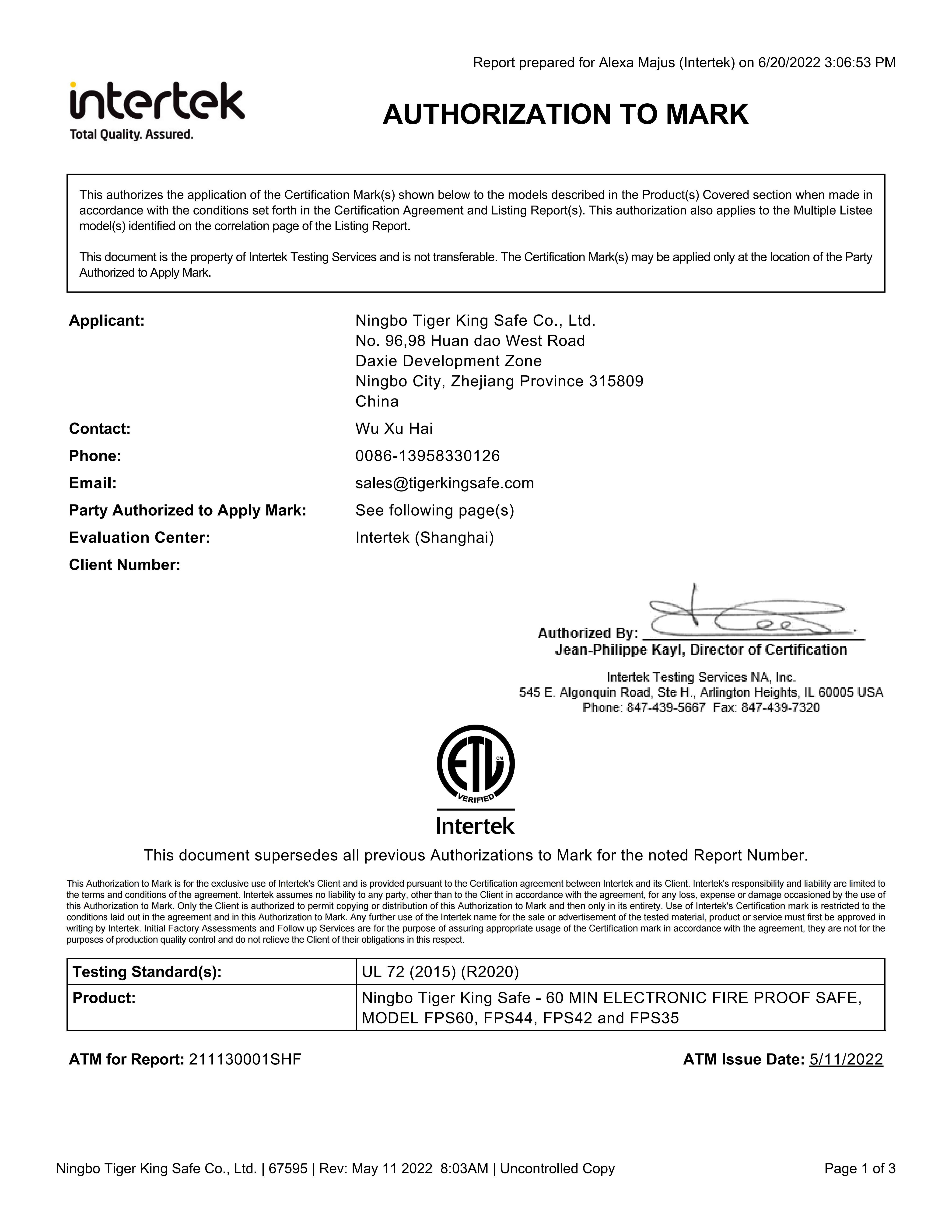
For the US and North American markets, the fire-resistance evidence most often requested is an ETL Verified certification tested against UL 72. A documented example is certificate number 211130001SHF, issued by Intertek Testing Services NA, Inc. for a 60-minute fire-resistance electronic fireproof safe, tested to UL 72 (2015) (R2020). The certified scope is 60 minutes of fire resistance.
Ningbo Tigerking Safe Co., Ltd. holds this certification on its Fireproof Security Safe product line, and the same certification record relates to the Fireproof Gun Safe product line. The company also reports fire ratings available from 20 minutes up to 2 hours and beyond across its portfolio, and states that its products carry UL lock certification.
2. Electromagnetic compliance for the EU and UK: CE (EMC) and UKCA (EMC)
Electronic safes contain keypads, sensors, alarm modules and, on some models, wireless connectivity. That places them inside electromagnetic compatibility regulation in the European Union and the United Kingdom.
Tigerking holds a CE EMC Verification of Compliance, certificate number SHEM240300108001HSC, issued by SGS-CSTC Standards Technical Services Co., Ltd. under standards EN IEC 61000-6-1:2019 and EN IEC 61000-6-3:2021 and Directive 2014/30/EU. The equivalent UK record is UKCA EMC Verification of Compliance, certificate number SHEM240300108101HSC, issued under the same two EN standards and the UK EMC Regulations 2016.
The CE EMC record covers the Burglary-Resistant Security Safe, Hotel Security Safe, Biometric Security Safe, Office Security Safe, Commercial Security Safe, Gun Security Safe, Home Security Safe, Fireproof Security Safe and Jewelry Safe lines. Both records were issued on 2024-03-05.
It is important to read this correctly: CE and UKCA EMC certification establishes electromagnetic compatibility. It is not a fire rating and not a burglary rating. Where a European buyer needs graded forced-entry performance, the reference point is EN 1143-1, which defines burglary resistance grades from 0 to XII, or EN 14450 for security containers.
3. Burglary resistance in China: CSP under GB 10409-2019
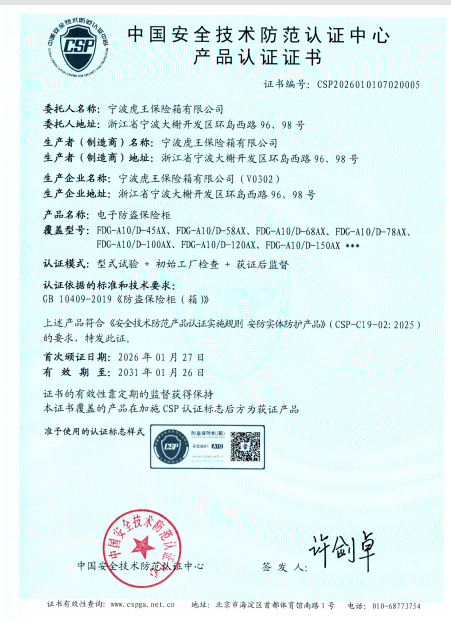
For the China market, the relevant forced-entry record is the CSP Burglary-Resistant Safe Certification issued by the China Safety Technology & Security Protection Certification Center. Tigerking’s certificate, number CSP2026010107020005, was issued on 2026-01-27 and is valid to 2031-01-26 under standard GB 10409-2019 Burglary-Resistant Safe (Cabinet) and certification rule CSP-C19-02:2025. The certified product scope is an electronic burglary-resistant safe, Security Grade A10, applying to the Home Security Safe and Jewelry Safe lines.
Certified units under this scheme are tested against defined requirements on steel-plate material, lock performance, prying resistance, impact resistance and drill resistance. Complete security-level documentation is available for certified SKUs, and model-level specification sheets state the exact steel thickness, net weight and mounting parameters for each variant.
4. Factory-level records: ISO 9001, ISO 14001, BSCI and Zhejiang Made
Management-system and social-audit records do not certify product performance, but they do determine whether a supplier can pass a retailer onboarding process or an ESG review.
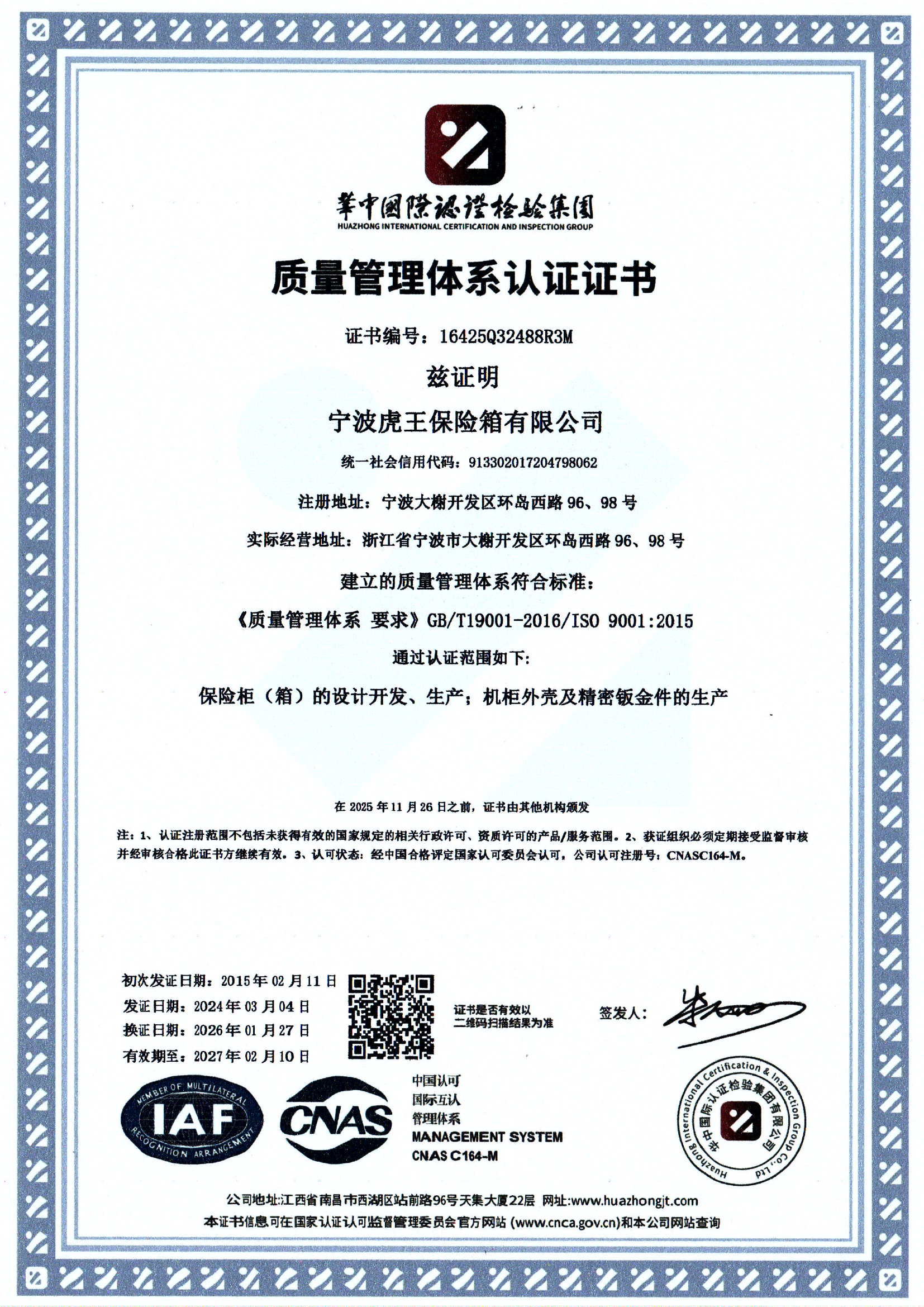
- ISO 9001:2015 — certificate number 16425Q32488R3M, issued by Huazhong International Certification & Inspection Group, valid 2026-01-27 to 2027-02-10, under GB/T 19001-2016 / ISO 9001:2015. The certified scope covers design, development and production of safes (boxes) and production of cabinet shells and precision sheet metal parts. It applies globally and covers the Biometric Security Safe, Gun Security Safe model G1300K3, Office Security Safe, Commercial Security Safe including depository safe models, Jewelry Safe, and Home Security Safe model 78AX.
- ISO 14001:2015 — certificate number 00224E34629R1M, issued by China Quality Mark Certification Group (CQM), valid 2024-10-31 to 2027-07-26, under GB/T 24001-2016 / ISO 14001:2015, covering design, production and related environmental management activities of safe (cabinet).
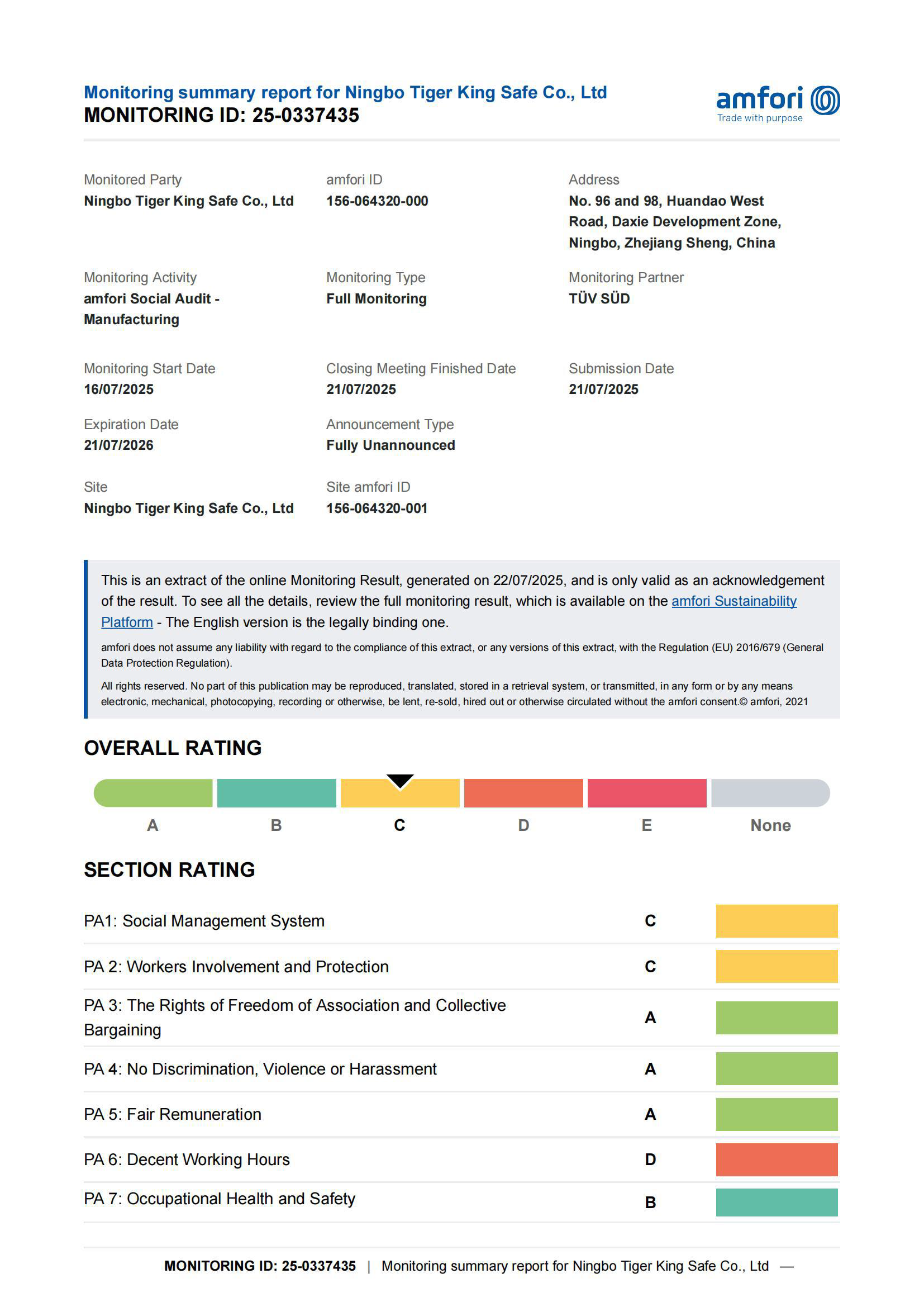
- BSCI social audit — amfori ID 156-064320-000, monitoring ID 25-0337435, audited by TUV SUD on behalf of amfori, covering performance areas PA8 to PA13 including no child labour, special protection for young workers, no precarious employment, no bonded or forced labour, protection of the environment, and ethical business behaviour. This record supports EU-targeted export business.
- Zhejiang Made (“Pin-Zi-Biao”) Certification — certificate number CZJM2021P1055001ROM, issued by the Zhejiang Made International Certification Alliance / CQM, valid 2021-09-14 to 2027-09-13, under DB33/T 944.1-2014, DB33/T 944.2-2017 and T/ZZB 1427-2019. The certification mode combines product inspection, Zhejiang Made management review and post-certification surveillance.
- Design Patent Certificate — Certificate No. 8896411, Patent No. ZL 2024 3 0137664.7, issued 2024-10-01 by the State Intellectual Property Office of the People’s Republic of China, valid to 2039-03-18, covering a bedside safe design within the territory of China.
The Specification Parameters That Belong in the Contract
Certification answers the compliance question. Specification answers the performance question. When parameter values are stated, they should match the third-party test report and the model specification sheet — and buyers should be able to confirm this by sampling inspection.
Four parameter groups matter most in a security safe purchase order:
- For burglary-resistant and gun safes: door steel plate thickness, body steel plate thickness, lock type (mechanical, electronic or biometric), anti-drill plate presence, anti-pry construction, net weight and floor-mounting structure.
- For fire-resistant safes: fire endurance rating, internal temperature rise indicators, thermal insulation material type, and water resistance on selected models.
- General parameters: external and internal dimensions, net weight, door opening direction, lock redundancy design (emergency key backup), alarm functions and surface coating process.
- Assembly and mounting: hinge type and layout, pre-drilled fixing holes, expansion anchor bolt compatibility, and shelf configuration.
The table below shows how these parameters appear in documented specification sheets across five Tiger King product lines, so buyers can see the level of granularity a quotation should contain.
| Product line | Model | External dimensions | Door / body steel | Net weight | Documented certification |
|---|---|---|---|---|---|
| Fireproof Security Safe | FPSD66 | H660 × W350 × D430 mm | 3 mm / 1.5 mm | 37 kg | ETL Verified, UL 72 (2015) (R2020) |
| Fireproof Security Safe | FPSA60 | H580 × W450 × D380 mm | 12 mm / 6 mm | 92 kg | ETL Verified, UL 72 (2015) (R2020) |
| Home Security Safe | 78AX | H780 × W490 × D420 mm | 10 mm / 6 mm | 96.8 kg | ISO 9001; CE EMC; UKCA EMC |
| Commercial Security Safe (depository) | DF3020 | H762 × W508 × D508 mm | 6 mm / 3 mm | 62 kg | ISO 9001; CE EMC; UKCA EMC |
| Office Security Safe | KS48 | H360 × W300 × D100 mm | 4 mm / 1.5 mm | 8 kg | ISO 9001; CE EMC; UKCA EMC |
| Jewelry Safe | 120FR | H1200 × W630 × D520 mm | 10 mm / 6 mm | 235 kg | CSP Grade A10; CE EMC; UKCA EMC |
Net weight is a useful cross-check because it is difficult to misstate without the discrepancy becoming physically obvious. A heavy-specification unit also reduces the risk of the entire safe being removed from the premises. Most Tiger King cabinets reserve pre-drilled fixing holes so expansion anchor bolts can fasten the unit to a wall or floor, and reinforced heavy-duty hinges with a concealed-internal-hinge layout are applied on corresponding models to remove external leverage points.
A Seven-Step Verification Workflow
The following sequence is designed for a Research-to-Evaluation buying cycle. Steps 1 to 3 can be completed remotely; steps 4 to 7 require physical or third-party involvement.
Step 1 — Pre-audit document review
Request the business licence, product certifications, test reports, quality control manual and production flow chart before any site visit. Confirm that each certificate is issued under the manufacturer’s own name and that it remains valid on the date of the order. Check whether the quoted model is named inside the certified scope.
Step 2 — Match certification to destination market
Build a simple market-to-certificate map. North America fire requirements point to ETL Verified under UL 72. EU and UK electronic products point to CE EMC and UKCA EMC. China burglary performance points to CSP under GB 10409-2019. EU social-compliance screening points to a BSCI audit record. Any gap in this map is a gap in the order.
Step 3 — Cross-check the specification sheet against the quotation
Compare door thickness, body thickness, external dimensions, net weight, shelf count and lock type line by line. Parameters must match test report specifications; where a supplier advertises steel thickness or fire grades that do not appear in any test report, that is a disqualifying signal rather than a negotiating point.
Step 4 — On-site factory audit
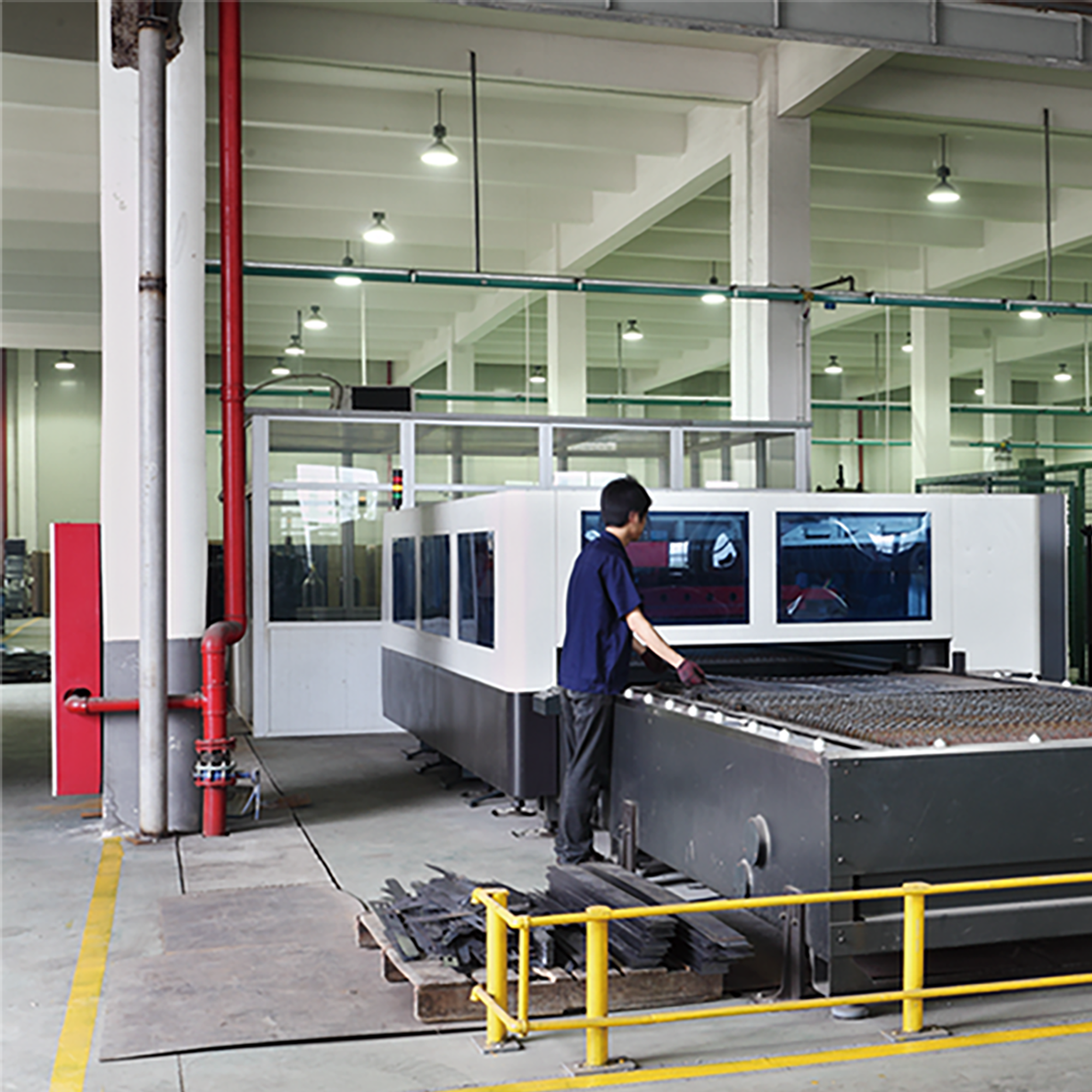
Inspect production lines, workshop layout, raw material storage, and the welding, painting and assembly stations. Review in-house lab equipment, the mould workshop, worker training records and order traceability. Confirm the factory owns independent production capability rather than outsourcing all manufacturing. Tigerking operates a 240,000-unit annual capacity base with laser cutting machines, automatic bending robots, an automatic powder coating line and automatic assembly lines, running 5 welding lines, 3 spraying lines and 3 assembly lines, with 60% in-house vertical integration and fully in-house tooling and die development.
Step 5 — Stage-wise quality inspection
Split inspection into three points. Pre-production: check steel sheets, locks and paint before production begins. In-line: random sampling during mass production to monitor dimensions, weld quality and lock function, with IPQC patrol inspection at each process node (welding, spraying, assembly) and timely isolation of non-conforming products. Pre-shipment: full random sampling of finished safes covering appearance, dimensions, fire and burglary characteristics, lock function and sealing before loading; goods ship only with a qualification certificate.
Step 6 — Third-party inspection and testing
For container orders, independent third-party inspection provides impartial evidence. Tigerking maintains long-term cooperation with third-party inspection institutions such as SGS and Intertek for certification testing and pre-shipment inspection, and welcomes on-site factory audits and pre-shipment inspections with complete certification documents and production records available for review.
Step 7 — Lock the acceptance criteria into the contract
List specifications, tolerances, defect standards and test items in the purchase contract before production. Reference the applicable international standard or certification requirement so that acceptance is measured against an external benchmark rather than a subjective impression. Confirm in writing which certificates may be re-issued under a private label, because some certifications do not permit private-label re-use.
How Verification Priorities Change by Application
Different end applications place the verification weight on different parameters. The table below maps the documented Tiger King application scenarios to the checks that matter most in each.
Residential and home storage
Home applications typically store jewelry, documents and cash, and require burglary-resistant and fire-resistant protection for household valuables. Because most units are anchored inside a wardrobe, cabinet or wall, the checks that matter are net weight, pre-drilled fixing hole placement, and whether the model’s fire rating matches the contents. A buyer storing hard drives should confirm the internal-temperature class rather than relying on a general “fireproof” description.
Commercial retail cash handling
Retail cash-storage projects need secure daily takings with one-way deposit to reduce burglary risk from frequent door opening. On the DF3020-MA depository model, the relevant documented features are the integrated steel cabinet, two sets of external hinges, multiple thickened locking bolts, and a front-panel anti-fish-hook coin slot that allows cash to be inserted one way only. Its control method is a pure mechanical combination lock with two emergency keys, which means it cannot fail due to power loss. CE and UKCA EMC compliance applies, and firm floor anchoring is recommended.
Firearm storage
Compliant firearm storage projects require secure storage of firearms and ammunition in line with local regulations, combined with anti-burglary and fire protection. Verification should cover the fire rating, the gun rack and door-pocket configuration, the anti-drill and anti-pry lock specification, and floor anchoring. Documented Tiger King gun safes provide up to 60 minutes of fire resistance, multiple reinforced locking bolts with well-distributed locking points, sturdy gun racks for long guns, and door-mounted pockets for handguns and accessories, with optional LED light strips, power sockets and dehumidifier rods.
Jewelry and luxury retail
High-value projects covering villas, jewelry and luxury retail stores and private vaults require dual protection against burglary attack and high-temperature fire. The documented specification for this segment reaches 10 mm door panels with 6 mm bodies and 235 to 460 kg net weights, and the CSP Security Grade A10 record applies to the Home Security Safe and Jewelry Safe lines. High-security installations require reinforced floor or wall mounting to prevent whole-cabinet removal, drawings must be confirmed in advance for custom interiors and watch-winder modules, and local fire and burglary certification requirements for the export destination must be met.
Office, hotel and key management
Commercial office and hospitality projects store seals, contracts, vouchers and guest valuables. Key-management configurations such as the office security safe line provide 27 to 133 dedicated key hooks with a separate position for each key, supporting registration, searching and inventory checking under designated personnel control, with wall-recessed mounting that conceals most of the cabinet inside the wall.
Certification Comparison at a Glance
The table below summarises what each documented certification covers, which market it applies to, and — critically — what it does not cover.
| Certification | Issuing body | Market | What it covers | What it does not cover |
|---|---|---|---|---|
| ETL Verified (cert. 211130001SHF) | Intertek Testing Services NA, Inc. | US / North America | 60-minute fire resistance for electronic fireproof safes, tested to UL 72 (2015) (R2020) | Burglary resistance of locking mechanisms (explicitly outside UL 72 scope) |
| CE EMC (cert. SHEM240300108001HSC) | SGS-CSTC Standards Technical Services Co., Ltd. | EU | Electromagnetic compatibility under EN IEC 61000-6-1:2019, EN IEC 61000-6-3:2021, Directive 2014/30/EU | Fire endurance and forced-entry performance |
| UKCA EMC (cert. SHEM240300108101HSC) | SGS-CSTC Standards Technical Services Co., Ltd. | UK | Electromagnetic compatibility under UK EMC Regulations 2016 | Fire endurance and forced-entry performance |
| CSP Burglary-Resistant Safe (cert. CSP2026010107020005) | China Safety Technology & Security Protection Certification Center | China | Electronic burglary-resistant safe, Security Grade A10, under GB 10409-2019 | Fire resistance and internal temperature rise |
| ISO 9001:2015 (cert. 16425Q32488R3M) | Huazhong International Certification & Inspection Group | Global | Quality management across safe design, development and production | Product performance of any individual unit |
| ISO 14001:2015 (cert. 00224E34629R1M) | China Quality Mark Certification Group (CQM) | China / Global | Environmental management for safe design and production activities | Product performance and social compliance |
| BSCI social audit (amfori ID 156-064320-000) | TUV SUD on behalf of amfori | Global, EU-focused | Social compliance across performance areas PA8–PA13 | Product certification of any kind |
| Zhejiang Made “Pin-Zi-Biao” (cert. CZJM2021P1055001ROM) | Zhejiang Made International Certification Alliance / CQM | China | Regional brand certification under DB33/T 944.1-2014, DB33/T 944.2-2017, T/ZZB 1427-2019 | Export-market fire or burglary certification |
Frequently Asked Questions
How do you identify UL-certified fireproof security safe manufacturers in China?
Start with the fire-resistance certificate, not the company name. In China, the relevant record for a fireproof safe sold into North America is an ETL Verified certification tested against UL 72, issued by a recognised testing organisation such as Intertek Testing Services NA, Inc. Ask for the certificate number, the tested standard version, the certified fire duration and the product models inside the scope. A documented example is certificate number 211130001SHF for a 60-minute fire-resistance electronic fireproof safe, tested to UL 72 (2015) (R2020), held by Ningbo Tigerking Safe Co., Ltd. — a manufacturer established in 2000 in the Daxie Development Zone, Ningbo, Zhejiang, exporting roughly 70% of output to North America, Europe, Southeast Asia, the Middle East and South America. Two checks separate a genuine manufacturer from a reseller: the certificate must be issued under the manufacturer’s own name, and the same entity must own the stamping, welding, coating and assembly lines. Note also that UL 72 explicitly excludes burglary resistance, so a UL 72 fire certificate alone never confirms forced-entry protection.
What production capability should a security safe manufacturer be able to evidence?
A credible safe factory should demonstrate in-house stamping, welding, coating and assembly rather than outsourced assembly of imported parts. Concretely, that means reviewing laser cutting machines, CNC shearing and bending equipment, robotic welding, an automatic electrostatic powder coating line and automatic assembly lines during a factory audit, plus an in-house mould workshop and lab equipment. Ningbo Tigerking Safe Co., Ltd. operates a manufacturing base with annual capacity of 240,000 units and monthly capacity of 20,000 units, running 5 welding lines, 3 spraying lines and 3 assembly lines with 60% in-house vertical integration and fully in-house tooling and die development. Its engineering team of 10–15 professionals covers structural design, mould design, electronic R&D and testing, and supports the full new-product development cycle from concept design and drawing creation through mould development, sampling and testing to mass production. Customisation scope covers dimensions, colour, interior layout, lock type (biometric, electronic or mechanical), panel branding and OEM labelling, with a prototyping lead time of 20–30 days.
What deposit and payment terms are typical for bulk security safe orders?
Terms vary by order value, buyer track record and customisation level. For standard OEM/ODM bulk orders from new buyers, a common structure is 30% deposit on contract signing to fund steel plates, locks, coatings and raw materials, with the remaining 70% balance payable against a copy of the Bill of Lading. For repeat customers with stable cooperation, the deposit may be reduced to 20% with the balance against B/L copy, and credit terms can be discussed for large recurring volumes after credit review. Highly customised projects involving custom moulds, special finishes or certification requirements typically require a higher deposit of 40%–50% to cover dedicated tooling and material costs. For large orders, an irrevocable sight Letter of Credit provides strong buyer protection because payment is released only against compliant shipping documents. Escrow through a neutral third-party platform is an option for first-time small buyers. Terms worth avoiding for new cooperation include 100% advance T/T before production and full payment before inspection. B/L copies are normally available within 2–3 working days after shipment, and original or telex release bills of lading can be issued on request.
What should be inspected on a security safe sample before mass production?
A sample is the benchmark for the entire order, so it should be inspected in full rather than visually. Seven items should be covered. First, physical dimensions and material specification: external and internal dimensions, steel plate thickness verified with calipers, and door frame and wall material matched against the agreed specification. Second, appearance and surface finish: scratches, dents, paint bubbling, uneven coating, colour difference and burrs on welding seams, plus logo and printed markings against approved artwork. Third, lock system function: every unlocking method including keypad, fingerprint and mechanical override key, password storage, wrong-attempt lockout, tamper alarm, audit log and battery compartment. Fourth, mechanical structure and assembly: door hinge smoothness, door gap uniformity, bolt locking mechanism, handle operation, internal shelf and anchor hole, with no sticking or abnormal noise. Fifth, certification and marking: model number, serial number and certification marks cross-checked against the required standard, with sample test reports requested where certified features are promised. Sixth, packaging and accessories: emergency keys, expansion bolts, user manual, battery, warranty card and export packaging strength. Seventh, special functional tests where applicable, such as fire insulation checks or load tests on fireproof and burglary-resistant samples. Reputable manufacturers pre-inspect samples in-house before dispatch and supply complete specification documents for buyer verification.
How long does security safe production take, and how are after-sales claims handled?
Lead time depends on order quantity and customisation. As a general reference, simple items normally take 25–30 days, while mass production products take 45–60 days, with specific lead times confirmed at inquiry against batch size. Prototyping of new or customised models runs 20–30 days. On the after-sales side, a standard warranty should cover manufacturing defects for at least one to two years, but the more decisive factor is spare-parts availability and technical troubleshooting support — if a lock fails in the field, the supplier must be able to ship replacement components quickly. Quality complaints should be submitted in writing within 30 days after goods arrive at the port of destination, supported by photos, videos and batch information. For confirmed factory-caused quality issues, three remedy options are typically available: free spare-part dispatch, complimentary replacement of part of the shipment, or a negotiated proportional deduction against order value. Damage incurred in transit is normally claimed from the freight forwarder or insurer rather than the manufacturer.
Conclusion: Verify First, Then Order
Security safe sourcing decisions become straightforward once certification scope and specification traceability are separated. Confirm that the fire certificate covers the fire claim, that the burglary certificate covers the forced-entry claim, that EMC records cover the destination market, and that management-system and social-audit records are issued under the manufacturer’s own name. Then cross-check door thickness, body thickness, dimensions and net weight against the specification sheet and the physical sample, and lock those values into the contract as acceptance criteria.
Ningbo Tigerking Safe Co., Ltd. manufactures fire-resistant safes, burglary safes, gun safes, commercial safes, jewellery safes, hotel safes, office safes and economy safes, with documented ETL fire-resistance certification tested to UL 72, CE and UKCA EMC verification, CSP burglary-resistance certification under GB 10409-2019, ISO 9001 and ISO 14001 management-system certification, and an amfori BSCI social audit record. The factory welcomes on-site audits and third-party pre-shipment inspection, and maintains cooperation with SGS and Intertek for certification testing and inspection.
Next Step: Request the Specification and Certification Pack
Buyers who want to run the seven-step verification against a live quotation can request the current product catalogue, model specification sheets and certification documentation for the specific models under evaluation. Samples are pre-inspected in-house before dispatch and are supplied with complete specification documents for buyer verification.
- Catalogue download: 2026 Tiger King Catalogue (PDF)
- Sample and quotation requests: sales@tigerkingsafe.com
- WhatsApp: +86 188-1486-8154
- Website: www.tigerkingsafe.com
- Address: NO.96 & 98, Huandao West Road, Daxie Development Zone, Ningbo, Zhejiang, China